



Peptides Library Sexual Health Peptides Research Guide
This sexual health peptides research guide separates FDA-labeled bremelanotide from kisspeptin endocrine studies, covering dosing, safety, and study endpoints.
📋 Table of Contents
This Peptides Library sexual health peptides research guide answers the core question of which sexual health peptides carry the strongest evidence by separating FDA-labeled indications from exploratory human data. The guide confirms that bremelanotide (VYLEESI/PT-141) is the only peptide with an FDA-approved sexual-health indication, while kisspeptin has only small human endocrine studies. Use this research guide to compare dosing limits, safety warnings, and study endpoints before relying on any peptide claim.
Key takeaways
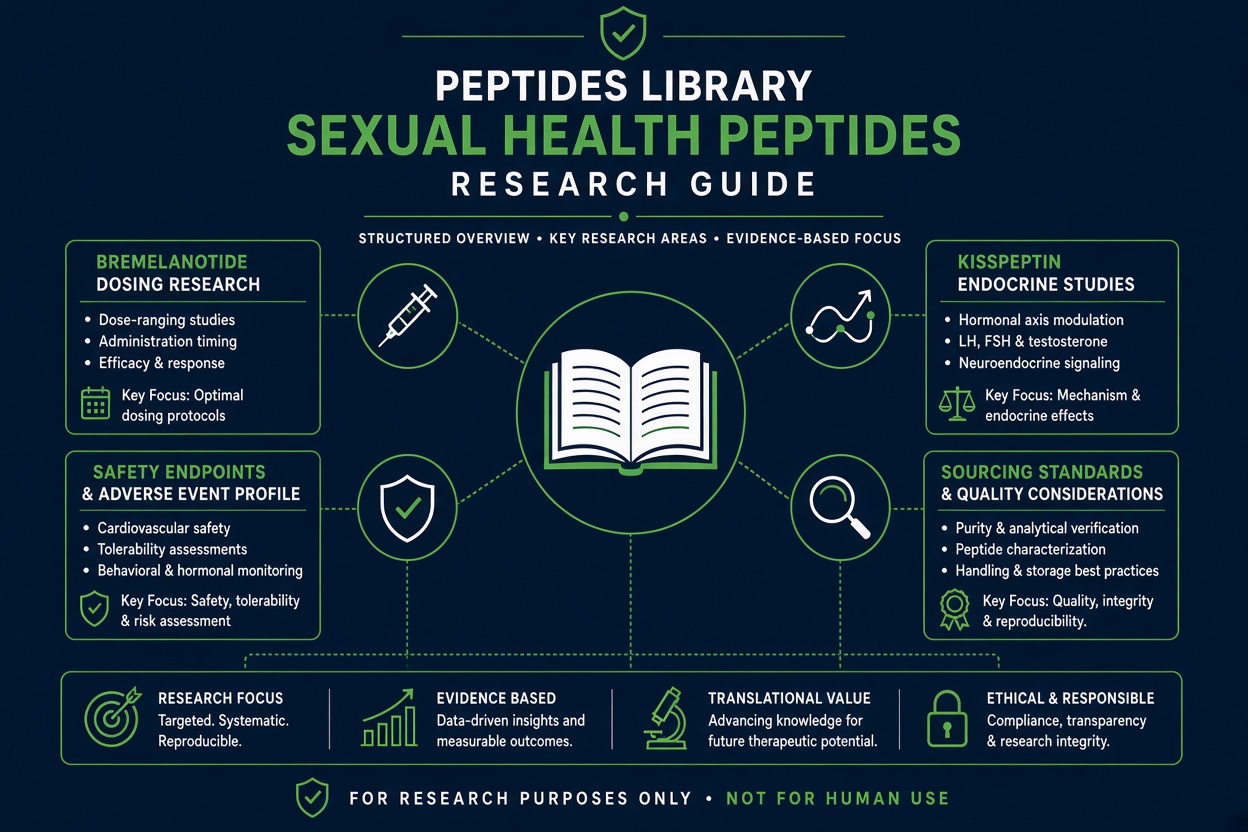
- This research guide clarifies that bremelanotide is FDA-labeled for premenopausal women with acquired, generalized HSDD, not for men or postmenopausal women.
- The labeled VYLEESI dose is 1.75 mg subcutaneously at least 45 minutes before activity, with no more than 1 dose in 24 hours and 8 per month.
- Kisspeptin evidence in this research guide comes from small human endocrine studies, not an approved indication.
- Use this research guide to distinguish approved use from exploratory hormone data and to check safety rates like 40.0% nausea with VYLEESI.
What Is the Peptides Library Sexual Health Peptides Research Guide?
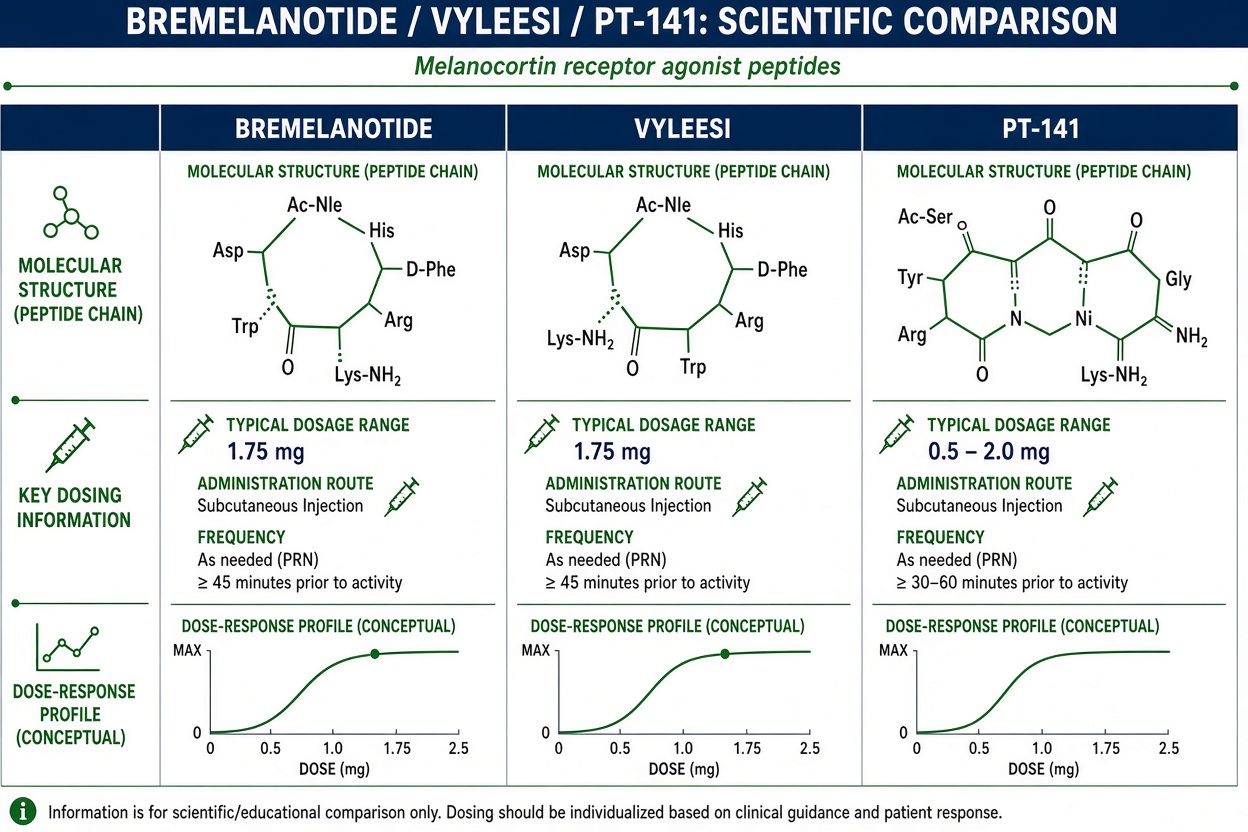
Peptides Library builds this research guide as an independent, non-retailer editorial resource. The guide organizes sexual health peptides by indication status, route of administration, dose, study population, and safety profile so you can compare like with like. Instead of mixing approved products, speculative hormone discussions, and product promotion, this research guide keeps each peptide in its evidence category.
For sexual health research, the most important distinction in this research guide is that bremelanotide is the only peptide with an FDA-labeled sexual-health indication, while kisspeptin is supported mainly by small human studies showing endocrine effects. The guide separates the FDA-labeled bremelanotide indication from kisspeptin studies centered on LH, FSH, and testosterone.
That difference matters when you decide what deserves closer attention. This research guide shows where VYLEESI applies, where it does not apply, and what kisspeptin studies actually measured before you spend time on sources that blur treatment claims with exploratory biology.
| Peptide | Best-supported role in sexual health research | Key human details | Limits you need to know |
|———|———————————————–|——————-|————————–|
| Bremelanotide / VYLEESI / PT-141 | FDA-labeled use for premenopausal women with acquired, generalized hypoactive sexual desire disorder (HSDD) causing marked distress or interpersonal difficulty | Labeled dose is 1.75 mg subcutaneously at least 45 minutes before anticipated sexual activity | Not indicated for postmenopausal women or men, and not indicated to enhance sexual performance |
| Kisspeptin-54 / Kisspeptin-10 | Human endocrine research on gonadotropin and testosterone response | Studies report LH, FSH, and testosterone stimulation in specific research settings | No approved sexual-health indication in the evidence provided here |
That table makes the evidence boundary visible at a glance. When a source groups kisspeptin with bremelanotide as if both carry the same approval status, the table reminds you that only bremelanotide has an FDA-labeled sexual-health indication in the evidence provided. Kisspeptin belongs in the endocrine-research column until a different dataset says otherwise.
How Does This Research Guide Clarify Bremelanotide, VYLEESI, and PT-141 Dosing?
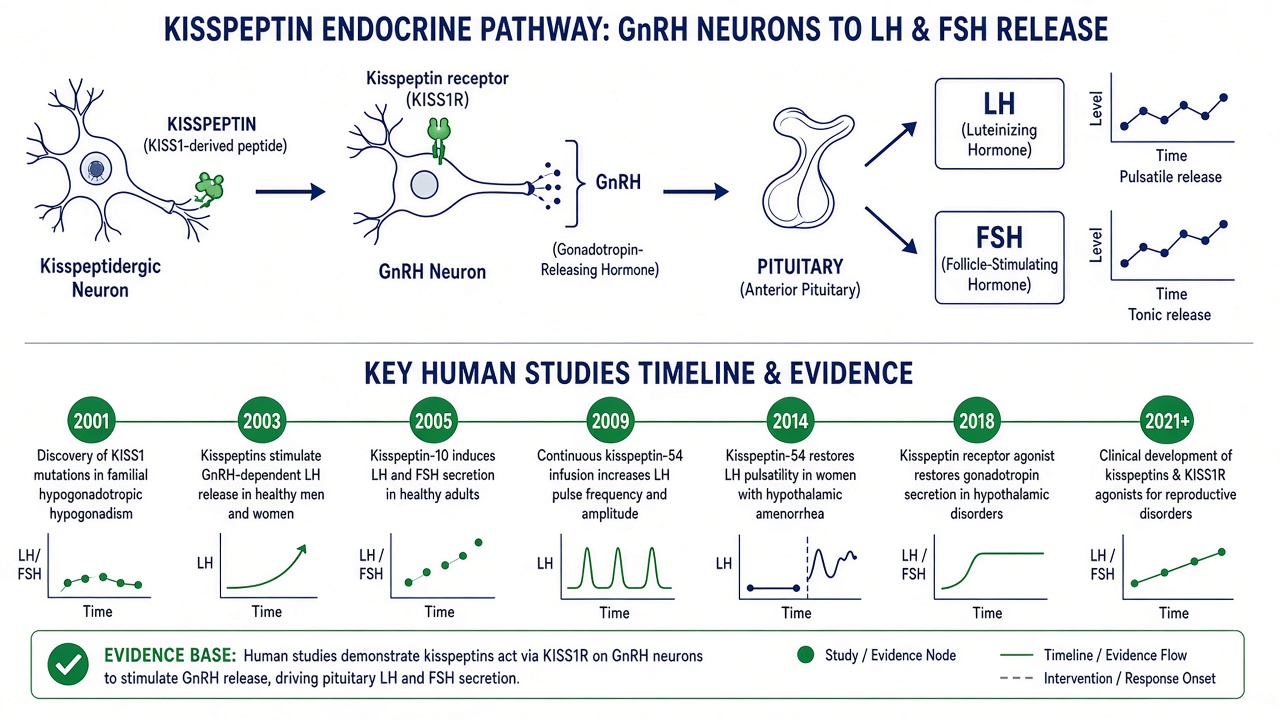
If you are evaluating PT-141 in a serious way, this research guide brings the label details to the front. The FDA labeling for VYLEESI states that bremelanotide is indicated for premenopausal women with acquired, generalized HSDD causing marked distress or interpersonal difficulty, and not due to another medical or psychiatric condition, relationship problems, or a medication or substance. You can review the official FDA label for VYLEESI here: VYLEESI (bremelanotide) prescribing information.
This research guide also makes the dosing limits easier to scan than a long label document. The labeled dose is 1.75 mg given subcutaneously at least 45 minutes before anticipated sexual activity, with no more than one dose in 24 hours and no more than 8 doses per month.
The same research guide protects you from common misreadings. VYLEESI is not indicated for postmenopausal women or men, and it is not indicated to enhance sexual performance, which changes how you should interpret many broad online claims.
This research guide gives equal weight to safety language because sexual health research is not useful if the risk profile gets buried. The label reports transient blood-pressure increases after each dose, with maximal increases of 6 mmHg systolic and 3 mmHg diastolic, plus heart-rate reductions up to 5 beats per minute; it is contraindicated in uncontrolled hypertension or known cardiovascular disease. In pooled phase 3 trials, nausea occurred in 40.0% of VYLEESI-treated patients versus 1.3% with placebo.
The blood-pressure and heart-rate changes are transient, but they still matter for anyone reviewing research protocols or discussing off-label use. Uncontrolled hypertension and known cardiovascular disease are explicit contraindications, which means the safety profile is not universal across all patient groups. Researchers and clinicians should note that the label does not soften these warnings for convenience.
💡 Key Takeaway: How Does This Research Guide Clarify Bremelanotide, VYLEESI, and PT-141 Dosing?
How Does This Research Guide Track Kisspeptin Evidence Through Human Endocrine Studies?
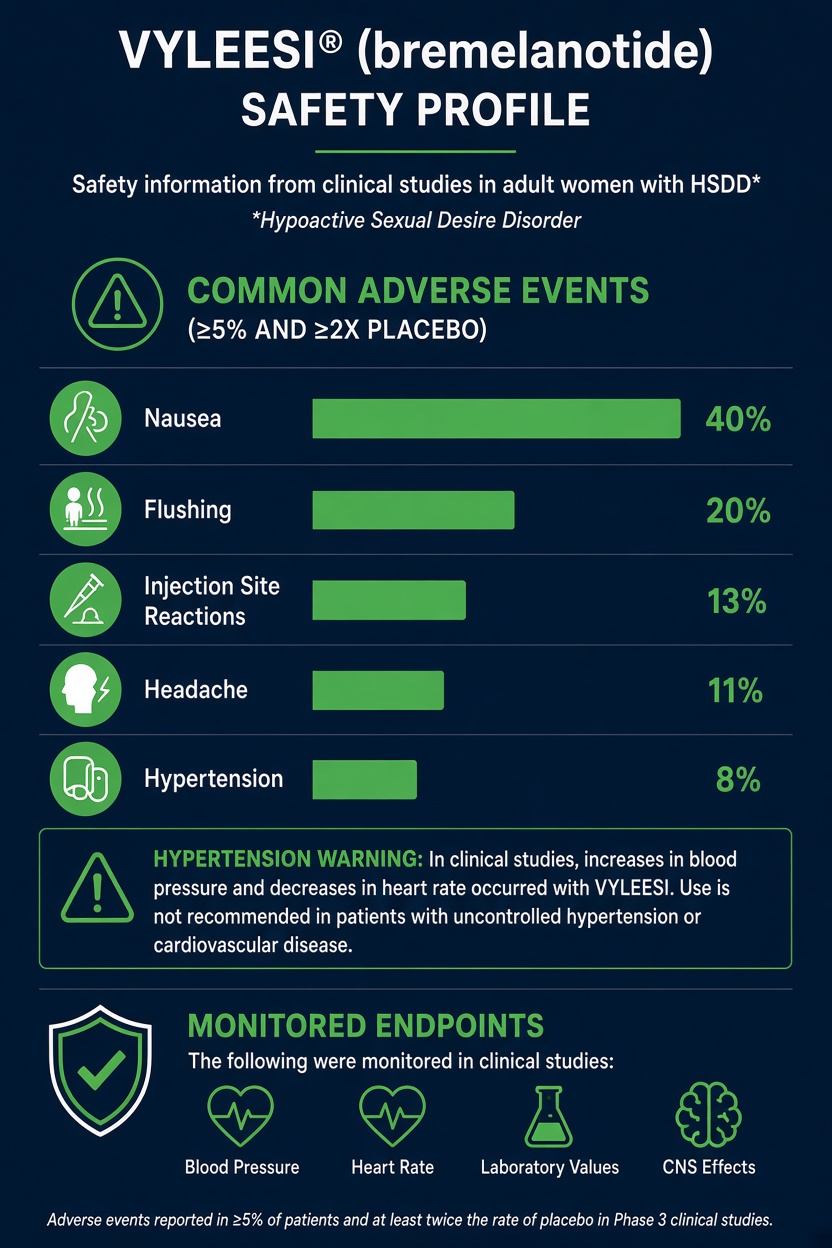
Kisspeptin is where many readers need the most help because the science is interesting, but the commercial interpretation often runs ahead of the evidence. This research guide does not present kisspeptin as an approved sexual-health therapy here. It presents kisspeptin as a peptide with human endocrine findings that may be relevant to sexual-health research questions, reproductive physiology, and hypothalamic-pituitary-gonadal signaling.
In one human study, intranasal kisspeptin-54 rapidly stimulated gonadotropin release in healthy men and women and in patients with hypothalamic amenorrhoea. At 12.8 nmol/kg, reported mean maximal luteinizing hormone increases were 4.4 IU/L in healthy men, 1.4 IU/L in healthy women, and 4.4 IU/L in patients with hypothalamic amenorrhoea. You can find related kisspeptin research indexed on PubMed here: Kisspeptin-54 stimulates the hypothalamic-pituitary gonadal axis in human males.
This research guide follows kisspeptin down to study-level details, including 12.8 nmol/kg intranasal kisspeptin-54 and chronic kisspeptin-10 data sustained for 12 days.
This research guide also surfaces the next layer of evidence rather than stopping at one abstract. A later study in healthy men included 15 participants receiving acute and chronic subcutaneous kisspeptin-10 infusions and 12 controls, with acute 8-hour dose-response testing and chronic protocols lasting 5 days or 12 days; the authors concluded that chronic kisspeptin administration sustained gonadotropin and testosterone secretion for 12 days.
Those distinctions make your reading sharper. A source discussing short-term LH, FSH, and testosterone changes is not automatically discussing an approved sexual-health treatment, and this research guide keeps that boundary explicit.
The 12.8 nmol/kg intranasal dose produced different LH responses across groups: 4.4 IU/L in healthy men, 1.4 IU/L in healthy women, and 4.4 IU/L in patients with hypothalamic amenorrhoea. Those numbers show that the same peptide can produce different endocrine effects depending on baseline hormonal status, which is why study population matters when you read secondary sources.
Who Should Use the Peptides Library Sexual Health Peptides Research Guide?
This research guide is not a generic overview built for casual scrolling. It is for readers who want to move from a peptide name to the useful details that determine whether a finding is actionable for their own research planning. That includes graduate students, laboratory managers, clinical research coordinators, and investigators who compare peptide claims across different suppliers or secondary sources.
If you are reviewing a peptide library for a sexual health project, this research guide helps you separate approved-use evidence from endocrine-mechanism evidence. For example, a researcher evaluating whether to include PT-141 in a protocol needs to know that the FDA label applies only to premenopausal women with acquired, generalized HSDD, not to any other population. A researcher evaluating kisspeptin needs to know that the strongest human data are endocrine-stimulation findings, not approved clinical outcomes.
This research guide also helps readers who audit secondary content. Many websites blur the line between bremelanotide and kisspeptin because both appear in discussions of sexual function. By keeping the FDA label and the exploratory human studies in separate columns, this research guide lets you spot misclassification quickly.
If you work with peptide sourcing or quality verification, this research guide pairs well with internal resources like Where to Buy a Peptide Research Library with a COA and Who Sells Research-Grade Peptide Libraries Online in 2026?. Those guides address purity and certificate of analysis, while this research guide addresses evidence boundaries.
Why Is This Research Guide a Stronger Fit Than Retailer-Led Sexual Health Content?
Retailer-led sexual health content often starts with a product list and works backward to a narrative. This research guide starts with the evidence categories and works forward to what a researcher should actually compare. That difference matters because a product page is not a protocol review, and an affiliate article is not a label summary.
This research guide does not use dosing suggestions as a sales tactic. It repeats the labeled VYLEESI dose only because that dose is part of the FDA indication, not because the guide recommends it for any off-label purpose. Kisspeptin doses like 12.8 nmol/kg intranasal appear only because they come from published human endocrine studies, not because this research guide endorses them for any use.
Retailer content also tends to compress safety information. This research guide keeps the 40.0% nausea rate for VYLEESI next to the 1.3% placebo rate, and it keeps the 6 mmHg systolic / 3 mmHg diastolic blood-pressure increases next to the contraindication for uncontrolled hypertension. Those numbers do not disappear just because a peptide has an FDA label.
For researchers who need to compare multiple peptide categories, this research guide can sit alongside a broader library approach. You may also want to review the Peptides Library Fertility Peptides Research Guide if your project spans reproductive endpoints beyond sexual desire.
💡 Key Takeaway: Why Is This Research Guide a Stronger Fit Than Retailer-Led Sexual Health Content?
How Should You Use This Research Guide to Compare PT-141, VYLEESI, and Kisspeptin?
This research guide gives you a three-column mental model: indication status, dose constraints, and safety profile. When you see a claim about PT-141, check whether it matches the VYLEESI label population. When you see a claim about kisspeptin, check whether the source cites human endocrine studies or merely borrows bremelanotide language.
Use the following comparison checklist from this research guide:
- Is the peptide FDA-labeled for a sexual-health indication? Only bremelanotide is.
- What is the labeled population? Premenopausal women with acquired, generalized HSDD causing marked distress or interpersonal difficulty.
- What is the labeled dose? 1.75 mg subcutaneously at least 45 minutes before anticipated sexual activity.
- What are the labeled limits? No more than 1 dose in 24 hours and no more than 8 doses per month.
- What are the key safety findings? Nausea 40.0% vs 1.3% placebo; transient BP increases up to 6 mmHg systolic / 3 mmHg diastolic; contraindicated in uncontrolled hypertension or known cardiovascular disease.
- Does kisspeptin have an approved sexual-health indication? No, only small human endocrine studies.
- What did kisspeptin studies measure? LH, FSH, and testosterone responses, including 12.8 nmol/kg intranasal kisspeptin-54 and chronic subcutaneous kisspeptin-10 over 12 days.
That checklist keeps your comparison anchored to source data rather than to product-page adjectives. If a source cannot answer those questions, it is probably not using this research guide or any equivalent evidence boundary.
For researchers who need verified peptide libraries with a COA, this research guide directs you to Peptide Research Library: Which Suppliers Are Trustworthy in 2026? as a separate evaluation step. Evidence boundaries and purity verification are two different jobs.
What Common Misreadings Does This Research Guide Correct?
The most common misreading this research guide corrects is the idea that PT-141 and VYLEESI are interchangeable for any adult population. The FDA label is explicit: VYLEESI is indicated only for premenopausal women with acquired, generalized HSDD causing marked distress or interpersonal difficulty, and not due to another medical or psychiatric condition, relationship problems, or a medication or substance. It is not indicated for postmenopausal women or men, and it is not indicated to enhance sexual performance.
A second misreading this research guide corrects is the assumption that kisspeptin has the same approval status as bremelanotide because both appear in sexual health discussions. Kisspeptin has no approved sexual-health indication in the evidence provided here. Its human data are endocrine findings from small studies, not clinical outcome trials for a labeled indication.
A third misreading this research guide corrects is the idea that a transient blood-pressure change is harmless for every research participant. The VYLEESI label lists uncontrolled hypertension and known cardiovascular disease as contraindications, which means those safety warnings are not optional context. A researcher reviewing a protocol must treat them as exclusion criteria, not as footnotes.
This research guide also corrects the habit of quoting a dose without its constraints. The 1.75 mg VYLEESI dose only makes sense alongside the 24-hour and monthly limits. A source that says “1.75 mg” without “no more than 1 dose in 24 hours and 8 per month” is giving a partial picture, and this research guide makes that omission visible.
Which Safety Endpoints Does This Research Guide Emphasize for VYLEESI?
This research guide emphasizes the safety endpoints that change how a researcher designs a study or interprets a secondary claim. The first endpoint is nausea. In pooled phase 3 trials, 40.0% of VYLEESI-treated patients experienced nausea versus 1.3% with placebo. That difference is not a rounding error; it is the most common adverse event in the label data.
The second endpoint is transient blood-pressure change. The label reports maximal increases of 6 mmHg systolic and 3 mmHg diastolic after each dose, with heart-rate reductions up to 5 beats per minute. Those changes are transient, but they are measurable and they justify the contraindication for uncontrolled hypertension or known cardiovascular disease.
The third endpoint is the labeled population boundary. Because VYLEESI is not indicated for postmenopausal women or men, safety data from the premenopausal HSDD population cannot be assumed to transfer to other groups. This research guide keeps that boundary visible so that a researcher does not treat the label as a universal safety profile.
Those three endpoints appear together in this research guide because they belong together. A source that reports the 40.0% nausea rate but omits the blood-pressure contraindication is not giving you the full label picture. A source that reports the labeled dose but omits the population boundary is not giving you the full indication picture.
💡 Key Takeaway: Which Safety Endpoints Does This Research Guide Emphasize for VYLEESI?
How Does This Research Guide Support Responsible Peptide Sourcing?
This research guide separates evidence evaluation from sourcing evaluation, but it does not ignore sourcing. A peptide with a clear FDA label still requires a research-grade supply with a certificate of analysis if you plan to use it in any laboratory setting. Kisspeptin-54 or kisspeptin-10 likewise requires purity verification before any endocrine study, because the human data discussed here depend on known peptide identity and concentration.
For sourcing questions, this research guide points to dedicated internal resources. You can review Where to Buy a Peptide Research Library with a COA for certificate-of-analysis requirements. You can review Who Sells Research-Grade Peptide Libraries Online in 2026? for supplier screening criteria. Those guides complement this research guide without mixing evidence claims and vendor claims.
This research guide does not endorse any specific supplier for bremelanotide or kisspeptin. It only makes the evidence boundaries clear so that you can evaluate a supplier’s claims against the same label and study data. If a supplier’s product page contradicts the VYLEESI label population or implies an approved kisspeptin indication, that is a red flag independent of purity.
How Can Researchers Extend This Research Guide to Other Peptide Categories?
The same evidence-separation method in this research guide applies to any peptide category where approved indications and exploratory data get mixed. For example, if you are comparing growth hormone fragments, you would want to separate FDA-labeled uses from mechanistic animal data. Peptides Library offers a related resource on AOD-9604 Growth Hormone Fragment: Research Peptide Guide (2026) that uses a similar label-versus-study boundary.
For fertility-related peptides, the Peptides Library Fertility Peptides Research Guide applies the same approach to gonadotropin-releasing hormone analogs and related compounds. Kisspeptin sits at the intersection of fertility and sexual health research, so reviewing both research guides can clarify where an endocrine finding belongs.
This research guide does not try to cover every peptide in a single table. It covers the sexual health peptides that most often appear in mixed retailer content: bremelanotide/VYLEESI/PT-141 and kisspeptin-54/kisspeptin-10. For other peptide categories, use the same question set: Is there an FDA label? What is the labeled population and dose? What human studies exist? What safety endpoints are reported?
What Study Endpoints Should Researchers Track in Kisspeptin Work?
This research guide tracks kisspeptin study endpoints at the level of measured hormone changes, not at the level of subjective sexual function claims. The intranasal kisspeptin-54 study reported mean maximal LH increases of 4.4 IU/L in healthy men, 1.4 IU/L in healthy women, and 4.4 IU/L in patients with hypothalamic amenorrhoea. Those are endocrine endpoints, not clinical sexual-health endpoints.
The chronic kisspeptin-10 study in healthy men reported sustained gonadotropin and testosterone secretion for 12 days. That finding is relevant to reproductive physiology research, but it is not a sexual-health indication. This research guide keeps that distinction explicit so that a researcher does not cite a 12-day hormone response as if it were an approved clinical outcome.
When you read a secondary source about kisspeptin, this research guide suggests checking three things. First, does the source cite a specific dose and route, such as 12.8 nmol/kg intranasal or subcutaneous kisspeptin-10 infusions? Second, does the source report the study population, including healthy men, healthy women, or patients with hypothalamic amenorrhoea? Third, does the source distinguish LH, FSH, and testosterone changes from any claim about sexual desire or function? If not, the source is probably compressing the evidence boundary that this research guide keeps separate.
💡 Key Takeaway: What Study Endpoints Should Researchers Track in Kisspeptin Work?
FAQ
Does this research guide recommend bremelanotide or kisspeptin for human use?
No. This research guide is for in vitro laboratory research and educational purposes only. All products discussed are sold strictly for research use only, not for human use, not for veterinary use, and not intended to diagnose, treat, cure, or prevent any disease. Must be 21+ to purchase. The FDA label details are presented as evidence facts, not as dosing recommendations for any off-label use.
What is the labeled VYLEESI dose in this research guide?
The labeled dose is 1.75 mg subcutaneously at least 45 minutes before anticipated sexual activity, with no more than 1 dose in 24 hours and no more than 8 doses per month. This research guide reports that dose only because it is part of the FDA label for premenopausal women with acquired, generalized HSDD.
Why does this research guide keep kisspeptin separate from bremelanotide?
Because bremelanotide has an FDA-labeled sexual-health indication, while kisspeptin has only small human endocrine studies reporting LH, FSH, and testosterone changes. This research guide separates approved-use evidence from exploratory hormone data so that researchers do not treat the two peptides as equivalent.
What safety data does this research guide highlight for VYLEESI?
This research guide highlights the 40.0% nausea rate versus 1.3% placebo, transient blood-pressure increases up to 6 mmHg systolic and 3 mmHg diastolic, heart-rate reductions up to 5 beats per minute, and the contraindication for uncontrolled hypertension or known cardiovascular disease. Those numbers come from the FDA label and pooled phase 3 trials.
Can this research guide help me choose a peptide supplier?
This research guide focuses on evidence boundaries, not supplier rankings. For sourcing, it points to separate internal resources like Where to Buy a Peptide Research Library with a COA and Who Sells Research-Grade Peptide Libraries Online in 2026?.
Ready to Take the Next Step?
Every product includes lot-specific documentation and third-party purity testing.
Explore Our Research Products →Free shipping on qualifying orders · Batch COA on request