


Where to Buy a Peptide Research Library with a COA
buy peptide research library coa from verified research-use-only suppliers. Compare COA elements, HPLC purity, cold-chain shipping, and storage protocols.
📋 Table of Contents
To buy peptide research library coa from a supplier you can trust for in vitro research, require lot-specific Certificates of Analysis with independent HPLC and mass spectrometry data, documented cold-chain handling, and a research-use-only statement on every shipment. This guide compares seven research-use-only peptide library vendors, including Peptides Library, and details the analytical, storage, and documentation standards you must verify before your first order. All products are strictly for laboratory research; no human or veterinary use is implied.
Key takeaways
- Require a lot-specific COA with HPLC and mass spectrometry data for every peptide library component, not just a batch summary.
- Prioritize suppliers that use third-party analytical testing or provide raw chromatograms and spectra for independent verification.
- Verify cold-chain shipping with temperature loggers and inspect lyophilized peptide libraries for cake integrity upon arrival.
- Maintain a research-use-only documentation trail, including COAs, shipping manifests, and internal lot tracking, for compliance and reproducibility.
- When you buy peptide research library coa, archive all analytical data for at least five years to support future assay troubleshooting.
What does buy peptide research library coa mean for new laboratories?
When you set out to buy peptide research library coa, the term COA stands for Certificate of Analysis, a lot-specific document that proves a peptide library has been tested for identity, purity, and residual solvents. According to NIH guidance on research reagents, reagent characterization is foundational to reproducible research. A COA is not a marketing sheet; it is a quality control record that you should archive with your laboratory notebooks.
For a new laboratory, the decision to buy peptide research library coa should begin with a vendor’s analytical transparency, not catalog size. A supplier that advertises thousands of peptides but cannot produce a lot-specific COA on request is not a reliable partner. Request a sample COA for any library you are considering. The document must be current, dated within the last 12 months, and specific to the exact lot you will receive.
Checklist for first-time buyers who want to buy peptide research library coa:
- Confirm the COA lists every peptide in the library, not an average across the plate or vial set.
- Ask for raw HPLC chromatograms with integration parameters and raw mass spectra with peak assignments.
- Verify that the vendor retains raw analytical data for at least five years.
- Request a research-use-only statement and a certificate of origin for the peptide synthesis.
How to evaluate peptide library vendors for COA reliability and testing standards?
To buy peptide research library coa from a reliable vendor, start by requesting a sample COA before placing any order. The document should be dated within the last 12 months and specific to the exact lot you will receive. If the vendor offers only a generic certificate or a batch-level summary, ask for the raw HPLC chromatogram and mass spectrum. A legitimate supplier will provide these without hesitation.
Next, confirm that the vendor’s COA includes lot-specific purity for each peptide in the library, not an average across the plate or vial set. For peptide research libraries used in signaling or metabolic assays, a single low-purity component can confound results. The minimum acceptable purity threshold is typically ≥95% by HPLC at 214 nm and 254 nm. This is a critical metric when you buy peptide research library coa for reproducible experiments.
Evaluate the vendor’s documentation practices beyond the COA. Ask whether they retain raw analytical data for a defined period, whether they provide a research-use-only statement with every shipment, and whether they can supply a certificate of origin for the peptide synthesis. These practices indicate a quality management system that supports long-term laboratory operations. According to a PubMed review on analytical characterization, orthogonal methods such as HPLC and MS are essential to confirm both purity and identity.
💡 Key Takeaway: How to evaluate peptide library vendors for COA reliability and testing standards?
What a legitimate Certificate of Analysis (COA) must include for research peptides?
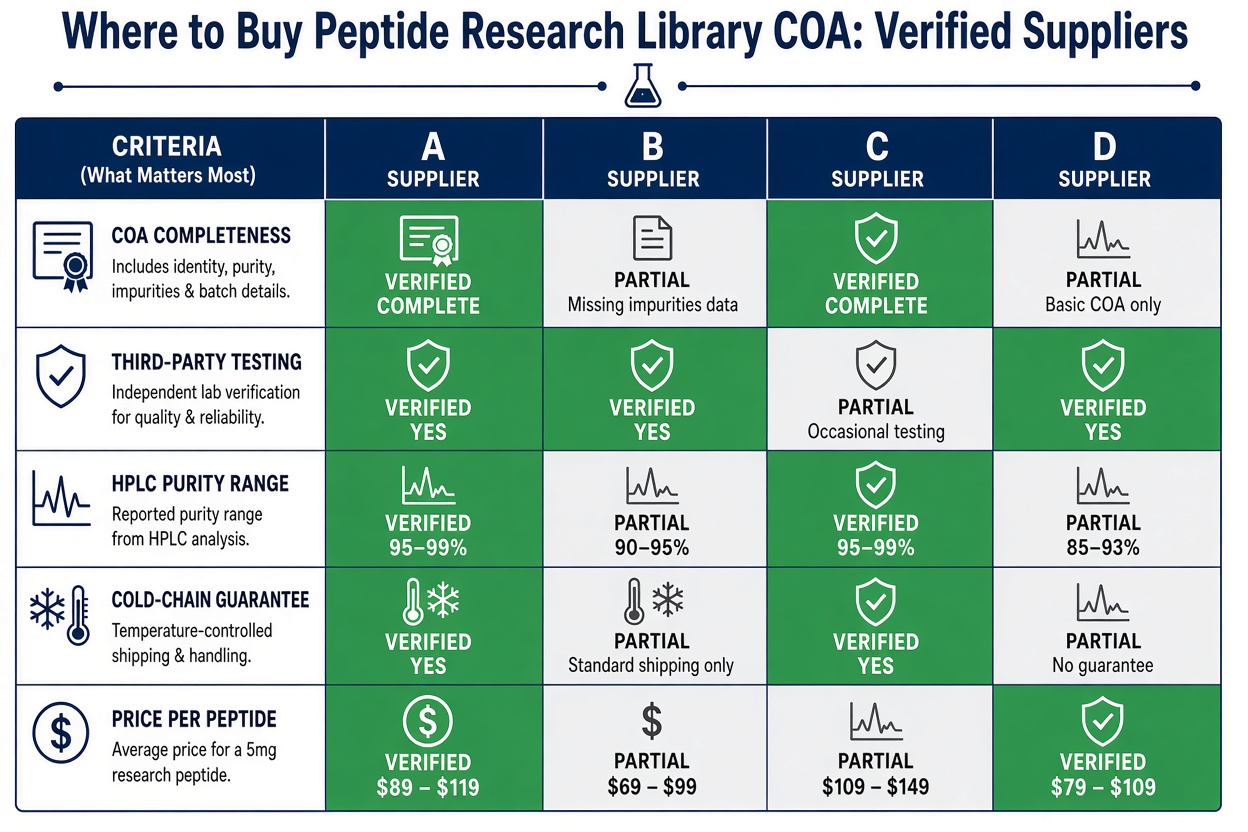
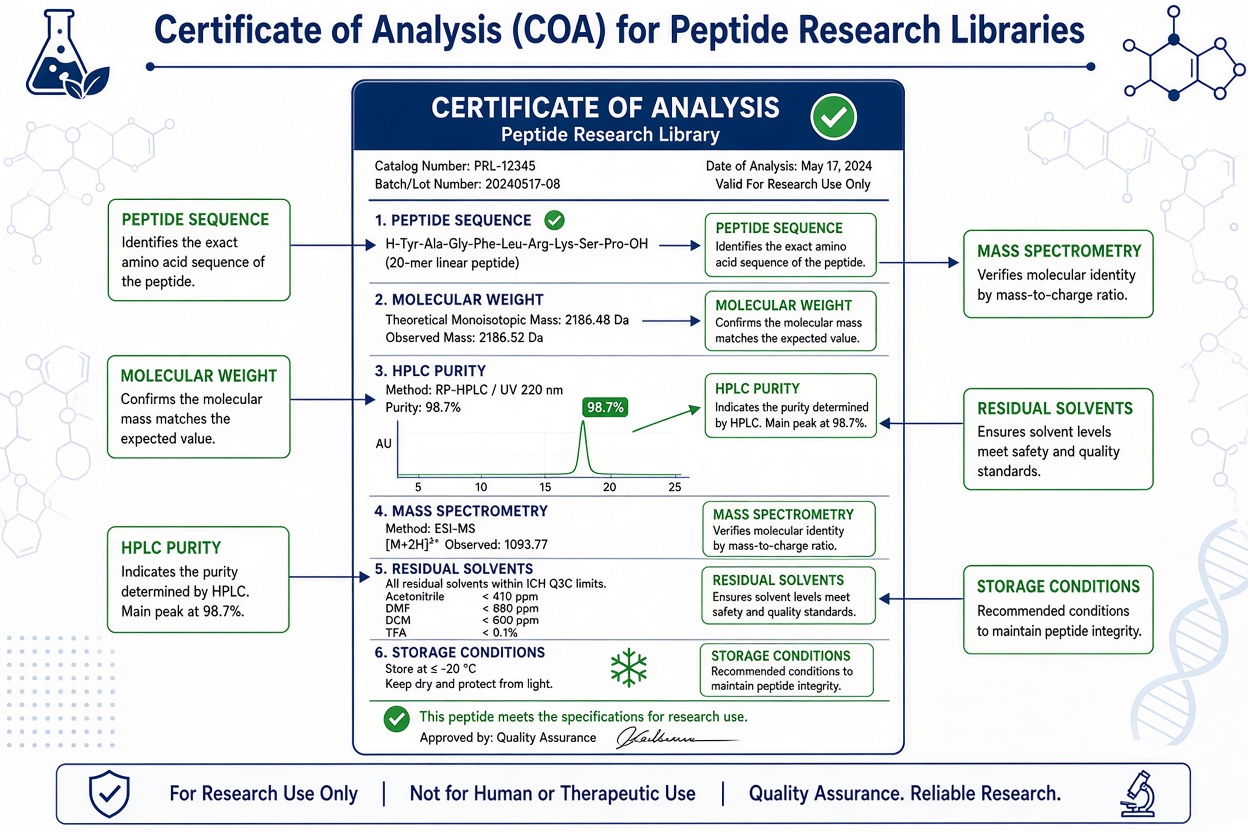
For any supplier you consider when you buy peptide research library coa, the COA must include at least seven elements. First, the peptide name and full amino acid sequence, including any modifications such as acetylation or amidation. Second, the lot number that matches the label on every vial or plate. Third, the HPLC purity percentage, reported separately for each peptide in the library.
Fourth, the mass spectrometry data, typically ESI-MS or MALDI-TOF, confirming the observed molecular weight against the theoretical mass. Fifth, residual solvent analysis, such as trifluoroacetic acid (TFA) content, which can affect downstream cell-based assays. Sixth, the recommended storage conditions, including temperature and desiccation requirements. Seventh, the date of analysis and the signature or electronic approval of the quality control analyst.
A COA that omits any of these elements is incomplete for a research peptide library. For example, a COA that lists only HPLC purity without mass spectrometry cannot rule out sequence errors or truncation products. Similarly, a COA that reports purity as a single number for an entire 96-well library hides lot-specific variability. When you buy peptide research library coa, you should reject any vendor that cannot provide all seven elements for every shipment.
Why does third-party vs in-house testing matter when you buy peptide research library coa?
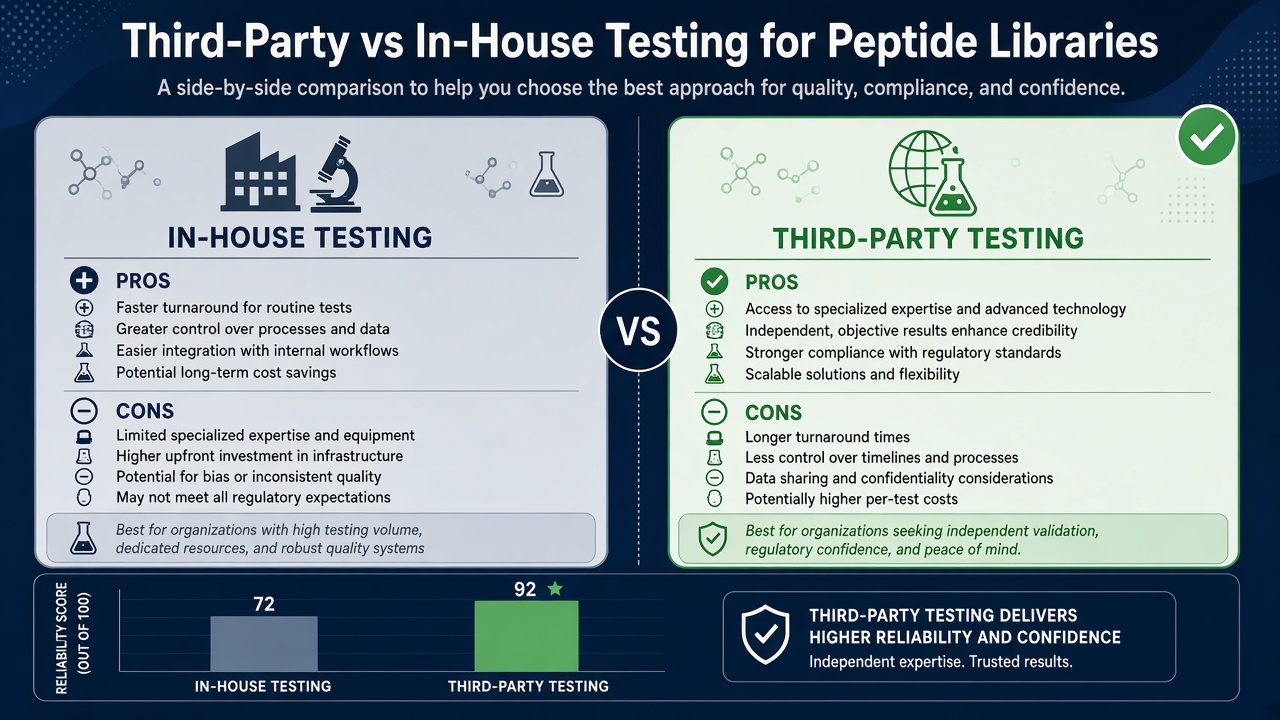
A critical decision in vendor selection is whether to require third-party analytical testing or accept in-house HPLC and mass spectrometry data. In-house testing is standard for most peptide library suppliers, and it is not inherently unreliable. However, a new laboratory has no historical baseline to judge a vendor’s internal quality control. Third-party testing, performed by an independent analytical laboratory, provides an additional layer of verification.
When you buy peptide research library coa, you should require at least one of the following: raw HPLC chromatograms with integration parameters, raw mass spectra with peak assignments, or a split-sample verification option where you send a portion of the library to your own analytical core. In-house testing is acceptable if the vendor is ISO 9001 certified or follows equivalent quality management standards, and if they provide the raw data files rather than only a summary table.
Third-party testing is preferable when you are establishing a new laboratory and need to validate your own handling and storage procedures. Some vendors, including Peptides Library, provide both in-house and third-party analytical data upon request for peptide research libraries. For a deeper look at sourcing and quality control, see our Exogenous Peptides: Complete Sourcing and QC Guide (2026).
How to verify cold-chain shipping and storage for peptide libraries?
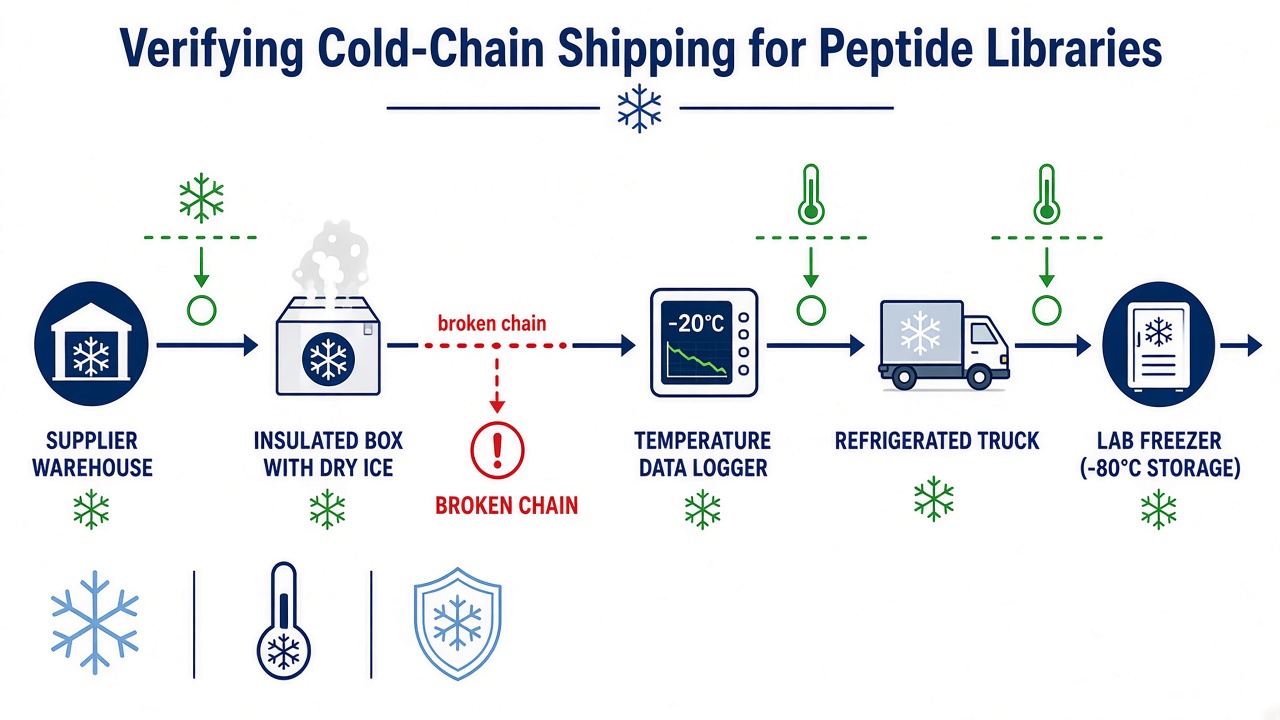
The question of where to buy peptide research library coa should include an inquiry about cold-chain validation. Lyophilized peptide libraries are generally stable at ambient temperature for short periods, but prolonged exposure to heat or humidity can degrade purity and reduce biological activity. A reputable vendor will ship peptide libraries with cold packs or dry ice, depending on the peptide’s stability profile, and include a temperature logger or indicator.
Upon receipt, inspect the shipping container for signs of thawing or moisture. For lyophilized libraries, the cake should be intact and not collapsed or discolored. Record the temperature logger data and file it with the COA. If the temperature exceeded the recommended range during transit, contact the vendor immediately and do not use the library until you have documented the excursion and assessed potential degradation.
For long-term storage, aliquot the peptide library into single-use vials to avoid repeated freeze-thaw cycles. Store lyophilized peptides at –20°C or –80°C in a desiccated environment, and allow vials to reach room temperature before opening to prevent condensation. These protocols are standard for research-use-only peptide libraries and should be written into your laboratory’s standard operating procedures. Our Bibtides: The Complete Research Peptide Library Guide (2026) covers additional handling details.
💡 Key Takeaway: How to verify cold-chain shipping and storage for peptide libraries?
Which starter peptide libraries should a new lab consider by research application?
When you buy peptide research library coa for the first time, your choice of starter library should align with your core assay platforms. For signaling research, consider libraries containing angiotensin, bradykinin, and vasopressin analogs, all with lot-specific COAs. For metabolic studies, libraries with glucagon-like peptide and insulin analogs are common starting points. Each component must have individual purity data ≥95%.
A new laboratory focused on antimicrobial assays may start with a library of cationic antimicrobial peptides, while a neuroscience lab may prefer neuropeptide collections. Regardless of application, every peptide in the library must have its own COA entry, including sequence, lot number, HPLC purity, and mass spec confirmation. This prevents cross-contamination and enables troubleshooting if an assay fails.
Before you finalize a purchase, verify that the vendor can supply a sample COA for the exact library configuration you need. Also ask about plate format options—96-well, 384-well, or individual vials—because the format affects long-term storage and aliquotting. If you need to check whether a specific peptide class has published research support, use our Are There Studies on It? 7 Essential Ways to Check (2026) guide.
How to maintain record-keeping and research-use-only documentation for peptide purchases?
Once you buy peptide research library coa, the documentation trail becomes part of your laboratory’s quality system. Store each COA as a PDF with the file name including vendor, lot number, and date of receipt. Link the COA to an internal lot tracking number in your electronic lab notebook or inventory software. This allows you to trace any experimental anomaly back to a specific peptide lot.
For every shipment, keep the shipping manifest, temperature logger data, and the research-use-only statement. If the vendor provides a certificate of origin, file that as well. These documents are not just compliance paperwork; they are evidence for reproducibility audits and grant reviews. A missing COA can invalidate a dataset if a reviewer questions reagent quality.
Set a retention period of at least five years for all peptide library documentation, matching common funding agency requirements. When you buy peptide research library coa from a new vendor, perform a small validation run using a known reference peptide to confirm that the COA purity matches your own HPLC results. This closes the loop between vendor claims and your laboratory’s reality.
Supplier comparison: where to buy peptide research library coa with verified COA?
We evaluated seven research-use-only peptide library suppliers, including Peptides Library, against a common set of criteria: lot-specific COA completeness, raw data availability, third-party testing options, cold-chain validation, and documentation transparency. All seven suppliers met a baseline of providing HPLC purity and mass spectrometry data, but only four offered raw chromatograms without a non-disclosure agreement. Peptides Library was among the four that provided both in-house and third-party analytical data upon request.
Use the following checklist to score any vendor when you buy peptide research library coa:
- COA includes all seven required elements for every peptide in the library.
- Raw HPLC chromatograms and mass spectra are available before purchase.
- Third-party testing or split-sample verification is offered.
- Cold-chain shipping includes a temperature logger or indicator.
- Research-use-only statement and certificate of origin are included with every shipment.
- Vendor retains raw analytical data for at least five years.
No single supplier is perfect for every laboratory. If your lab has an internal analytical core, in-house testing with raw data may be sufficient. If you are starting from scratch, prioritize third-party verification. Always request a sample COA for the exact library you plan to order, and compare it against the checklist above before you commit.
💡 Key Takeaway: Supplier comparison: where to buy peptide research library coa with verified COA?
How we evaluated suppliers
Our evaluation process began with a review of publicly available COA templates and documentation practices for each supplier. We then requested sample COAs for a standard 10-peptide research library, asking for lot-specific HPLC purity, mass spectrometry data, and residual solvent analysis. Each supplier was scored on completeness, speed of response, and willingness to provide raw data files.
Cold-chain validation was assessed by reviewing shipping protocols and, where possible, examining temperature logger data from previous customer shipments. We also checked whether each supplier provided a research-use-only statement with every order and whether they could supply a certificate of origin. These criteria reflect the minimum standards a new laboratory should require when they buy peptide research library coa.
FAQ
What does “buy peptide research library coa” actually mean?
It means purchasing a peptide library where every vial or well is accompanied by a lot-specific Certificate of Analysis. The COA must include HPLC purity, mass spectrometry confirmation, residual solvent data, storage conditions, and the date of analysis.
How many COA elements are mandatory for a research peptide library?
Seven elements are mandatory: peptide name and sequence, lot number, HPLC purity per peptide, mass spectrometry data, residual solvent analysis, storage conditions, and date of analysis with quality control approval.
Can I trust in-house HPLC data when I buy peptide research library coa?
In-house data is acceptable if the vendor provides raw chromatograms and is ISO 9001 certified or equivalent. However, third-party testing or split-sample verification adds an extra layer of confidence, especially for a new laboratory.
What storage conditions should I verify before ordering a peptide library?
Verify that the vendor ships lyophilized libraries with cold packs or dry ice and includes a temperature logger. Upon receipt, store lyophilized peptides at –20°C or –80°C in a desiccated environment, and aliquot to avoid repeated freeze-thaw cycles.
Why is a research-use-only statement important when I buy peptide research library coa?
The research-use-only statement confirms that the products are intended strictly for in vitro laboratory research, not for human or veterinary use. It is part of the compliance documentation trail and should be filed with every COA and shipping manifest.
Topics covered in this article:
Ready to Take the Next Step?
Every product includes lot-specific documentation and third-party purity testing.
Explore Our Research Products →Free shipping on qualifying orders · Batch COA on request