


Peptides Library Fertility Peptides Research Guide
Research guide on fertility peptides covering GnRH, gonadorelin, pulsatile vs continuous exposure, label status, and evidence-backed limits for lab research.
📋 Table of Contents
This research guide answers the core question of which fertility peptides have credible research support by anchoring the discussion in gonadotropin-releasing hormone (GnRH) and its synthetic form gonadorelin. Instead of listing unverified peptide blends, this research guide evaluates peer-reviewed evidence, regulatory labels, and condition-specific outcomes so laboratory researchers can distinguish supported endocrine mechanisms from vague fertility claims. Every fact stays within research-use-only boundaries, never implying human or veterinary use.
Key takeaways
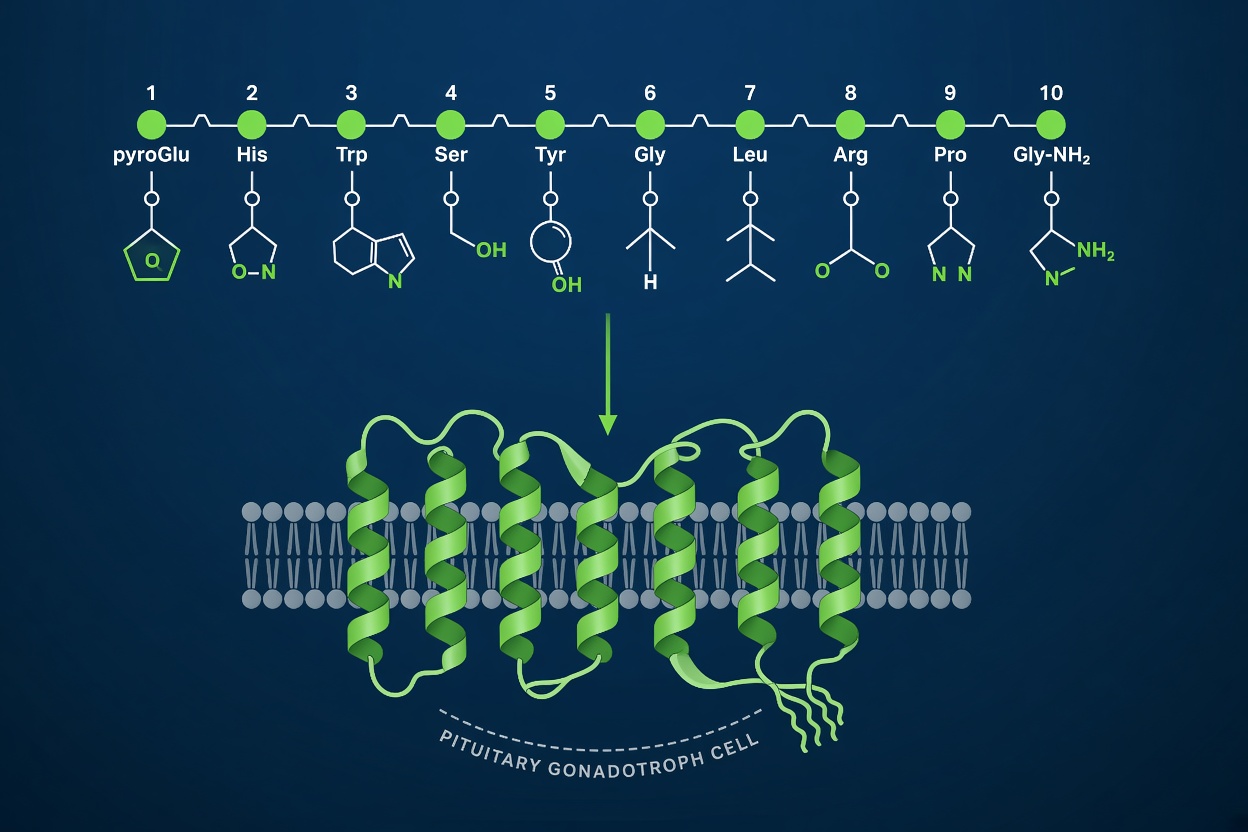
- This research guide focuses on GnRH, a decapeptide that stimulates pituitary release of luteinizing hormone (LH) and follicle-stimulating hormone (FSH), not on broad peptide marketing.
- Pulsatile GnRH exposure can support reproductive endocrine function, while continuous non-pulsatile exposure suppresses the axis and reduces LH and FSH output.
- In isolated GnRH deficiency, GeneReviews reports spermatogenesis can be induced in approximately 90% to 95% of affected men with appropriate therapy, but pulsatile GnRH therapy for male infertility is not FDA-approved in the United States and is available only at specialized research centers.
- FACTREL Injection contains 50 micrograms of synthetic gonadorelin per mL and is labeled for use in animals only, not humans, according to DailyMed.
- WHO defines infertility as failure to achieve pregnancy after 12 months or more of regular unprotected sexual intercourse, and approximately one in every six people of reproductive age worldwide experience infertility in their lifetime.
- Peptides Library is an independent knowledge hub, not a clinic or retailer, and all content is for research and educational use only.
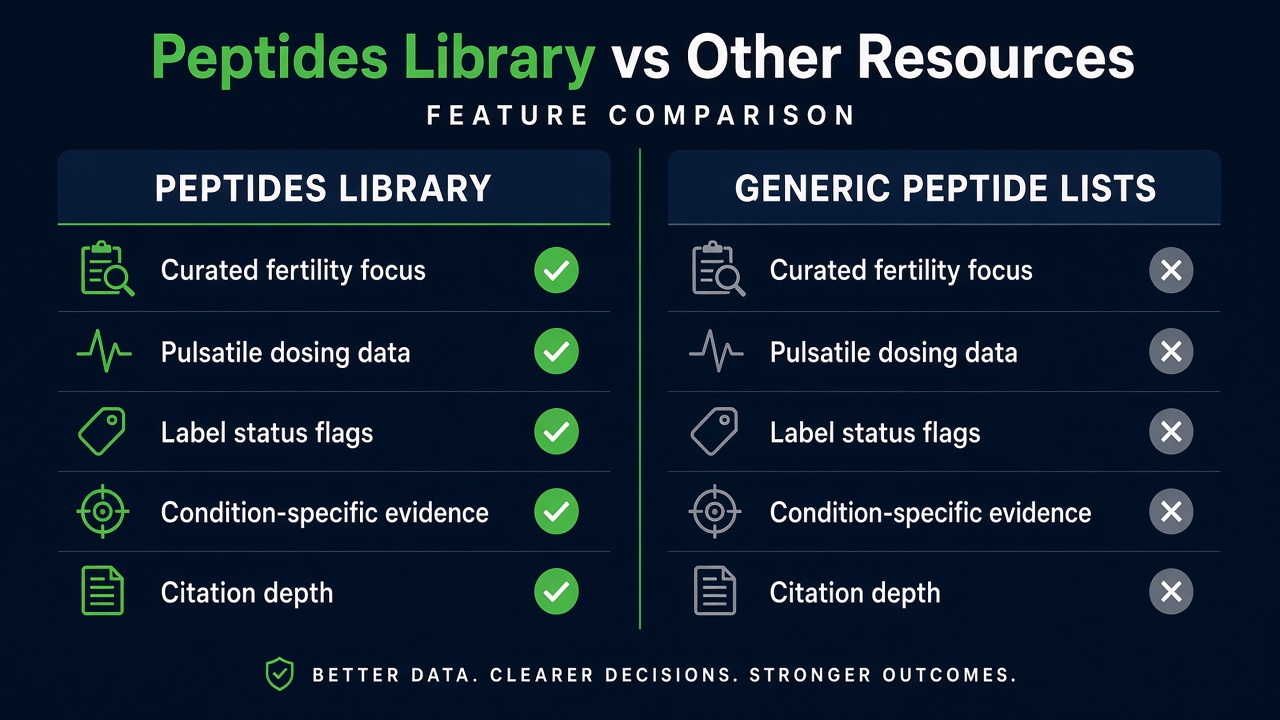
What makes this research guide different from generic peptide lists?
Generic peptide lists rarely explain why a compound belongs in a fertility conversation. This research guide starts with reproductive physiology and then narrows to supported use cases, so you are not left comparing unrelated peptides as if they were interchangeable. The evidence base is anchored in GnRH, which academic endocrinology sources describe as a decapeptide that stimulates pituitary release of LH and FSH.
That framing matters because it keeps your research tied to reproductive signaling rather than broad peptide marketing. Peptides Library makes the connection explicit so you can understand why gonadorelin belongs in a fertility discussion and why many other peptides do not. When you use this research guide, you get source-based interpretation that separates upstream endocrine regulation, downstream hormone effects, condition-specific applications, and the practical limits of current label-supported use.
Peptides Library also keeps the topic grounded in real demand. According to the World Health Organization infertility fact sheet, approximately one in every six people of reproductive age worldwide experience infertility in their lifetime. That statistic is one reason fertility care is a major health-system issue rather than a niche topic, and it is why this research guide treats fertility peptides as a serious endocrine subject, not a wellness trend.
Why does GnRH matter in fertility peptide research?
GnRH is the central upstream signal in reproductive endocrinology. As a decapeptide, it drives the anterior pituitary to release LH and FSH, which in turn regulate gonadal function. Without this signaling, downstream fertility processes cannot proceed normally. This research guide uses that physiological anchor to evaluate every fertility-related peptide claim.
When a source describes a peptide as a “fertility peptide,” the first question this research guide asks is whether the peptide acts on GnRH signaling, downstream gonadotropin pathways, or some unrelated mechanism. Many peptides that appear in broad online lists have no direct reproductive endocrine role. By focusing on GnRH and gonadorelin, Peptides Library avoids the common error of treating all peptides as potential fertility agents.
This research guide also clarifies the difference between a direct GnRH signal and a vague fertility claim. Gonadorelin is synthetic GnRH, so its mechanism is well defined. Other peptides may influence metabolism, inflammation, or cell signaling without touching the reproductive axis. That distinction is not semantic; it changes how you interpret preclinical data, clinical case reports, and regulatory labels.
💡 Key Takeaway: Why does GnRH matter in fertility peptide research?
How does pulsatile versus continuous GnRH exposure change endocrine outcomes?
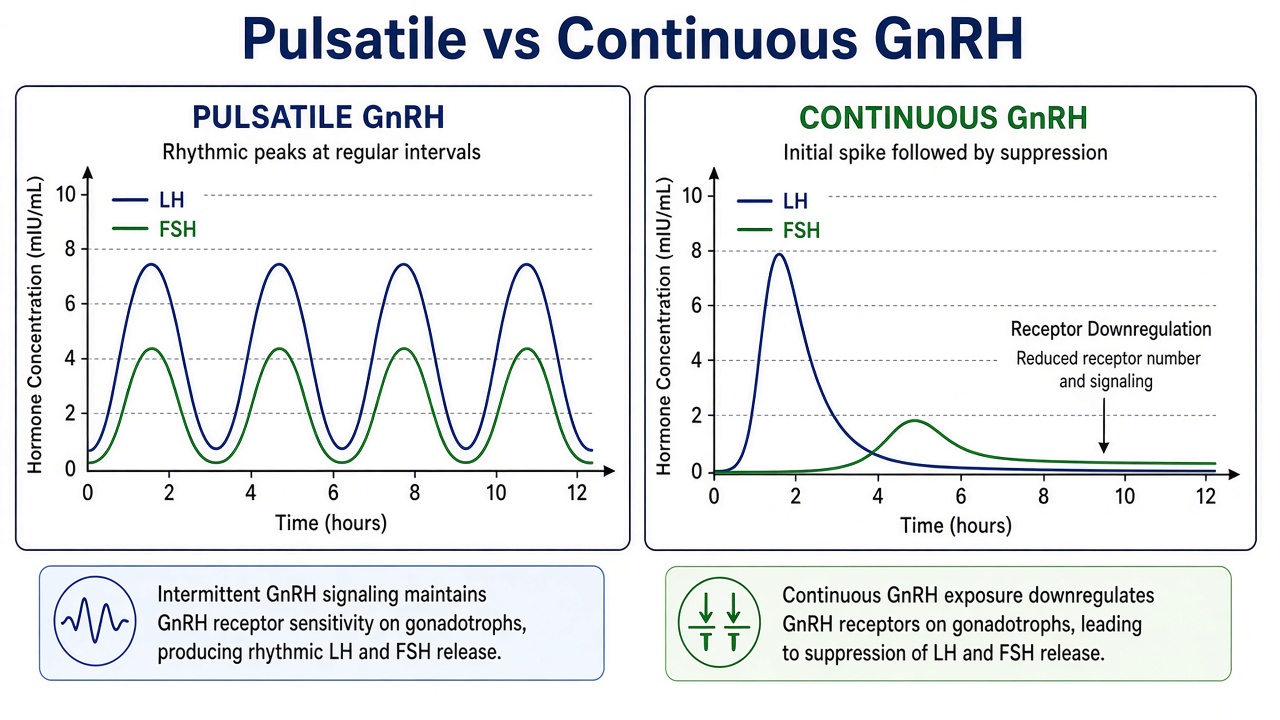
One of the most important distinctions in this research guide is the difference between pulsatile and continuous GnRH exposure. Pulsatile signaling can support reproductive endocrine function because the pituitary responds to intermittent GnRH pulses by releasing LH and FSH in a physiological pattern. Continuous non-pulsatile exposure suppresses the axis and reduces LH and FSH output.
This is not a minor detail. It changes how you interpret the entire category of GnRH-related therapies. If you are reviewing gonadorelin, GnRH analogues, or fertility-related protocols, the difference between pulsatile and continuous exposure determines whether the endocrine effect is supportive or suppressive. This research guide treats that distinction as central to fertility peptide research.
The table below summarizes the core contrast:
| Exposure pattern | Endocrine effect | Typical research context |
|—|—|—|
| Pulsatile GnRH | Supports LH and FSH release | Isolated GnRH deficiency, reproductive endocrine research |
| Continuous non-pulsatile GnRH or agonist | Suppresses LH and FSH output | Downregulation protocols, certain endocrine studies |
| Intermittent non-physiological dosing | Variable, often not equivalent to pulsatile | Investigational settings, requires careful interpretation |
This table is not a dosing guide. It is a conceptual tool for interpreting fertility peptide literature. This research guide emphasizes that route, pattern, and indication matter far more than a simplistic dose comparison.
What condition-specific evidence does this research guide track?
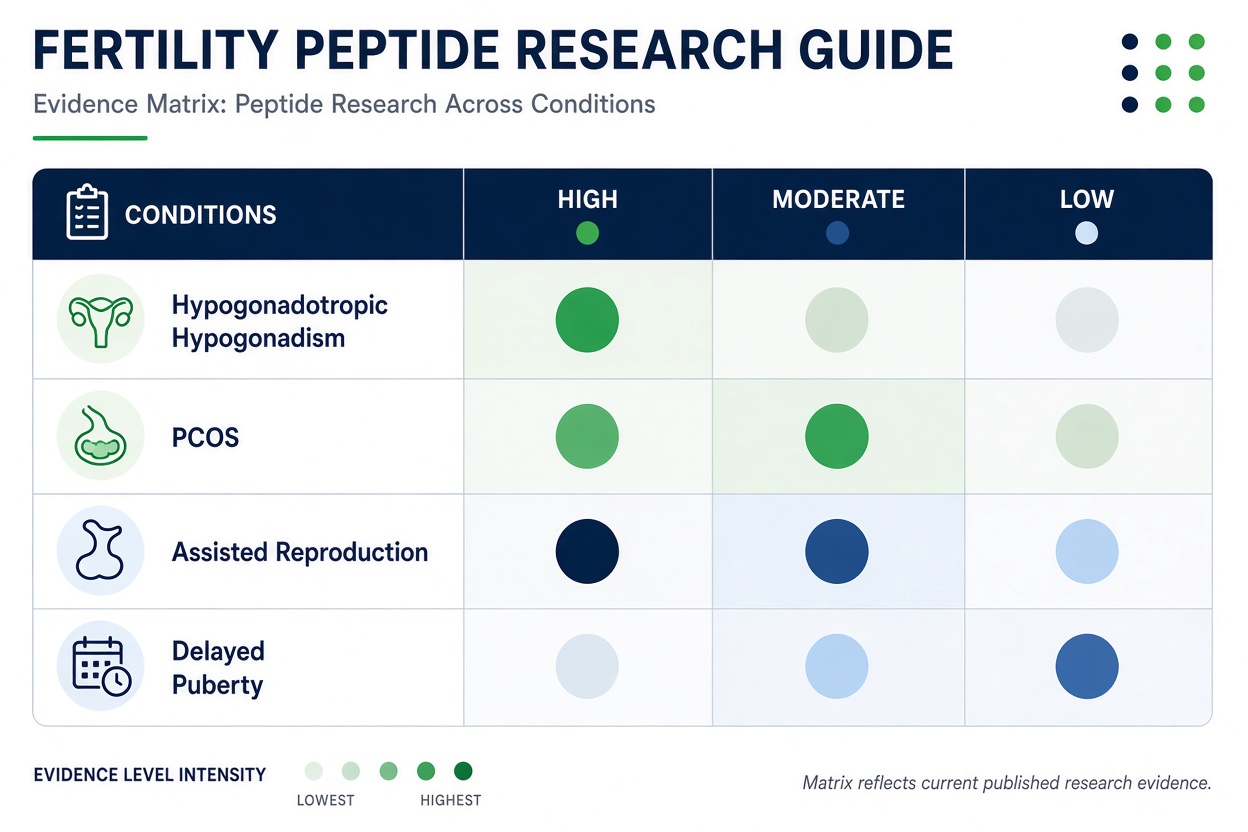
Peptides Library is especially useful when you need condition-specific evidence rather than broad fertility claims. In isolated GnRH deficiency, for example, academic sources note that gonadotropins or pulsatile GnRH therapy may be required to realize fertility potential. The GeneReviews entry on isolated GnRH deficiency reports that spermatogenesis can be induced in approximately 90% to 95% of affected men with appropriate therapy.
At the same time, the same source notes that in the United States, pulsatile GnRH therapy for male infertility is not currently FDA-approved and is available only at specialized research centers. That kind of nuance is where this research guide adds value. It helps you understand both the promise and the constraint, so you can see where the literature is strong, where access is limited, and where “fertility peptides” is too broad to be a useful label.
This research guide also flags label context that is easy to miss in online peptide discussions. For example, DailyMed states that FACTREL Injection contains 50 micrograms of synthetic gonadorelin per mL and is labeled for use in animals only, not humans. If you are comparing sources, that distinction protects you from confusing veterinary labeling with human fertility evidence. This guide keeps that boundary explicit in every fertility peptide discussion.
Which label and approval contexts does this research guide flag?
The label and approval landscape for fertility-related peptides is fragmented. Some compounds have human research literature but no human label, while others carry animal-only labeling or remain entirely investigational. This research guide distinguishes between peer-reviewed evidence, regulatory status, and commercial availability so you do not mistake one for another.
A key example is gonadorelin itself. The synthetic decapeptide appears in both human clinical research and veterinary formulations, but the label status differs sharply. Without this research guide, a researcher could easily conflate a veterinary product with a human therapeutic pathway. The guide flags those boundaries explicitly, using primary sources like DailyMed and GeneReviews rather than secondary summaries.
💡 Key Takeaway: Which label and approval contexts does this research guide flag?
How can you use this research guide for due diligence?
Start by separating mechanism from marketing. This research guide gives you a physiological anchor—GnRH signaling—so you can ask whether a peptide actually touches the reproductive axis. If it does not, it may still be a valid research peptide for other endpoints, but it does not belong in a fertility-specific review.
Next, verify label context. Use this research guide to check whether a compound is FDA-approved for any human indication, animal-labeled, or purely investigational. That step prevents you from overstating the evidence. If you are sourcing peptides for laboratory use, review the Complete Guide to Research Peptides: 2025 Lab Reference for a broader overview of research-grade materials.
Finally, compare source quality. This research guide also reminds you to check whether a claim traces back to a peer-reviewed paper, a regulatory database, or an anonymous forum. For vendor due diligence, the Best Places to Buy Research Peptides for a Lab in 2026 offers additional criteria for evaluating suppliers without implying any human-use suitability.
What are the limits of fertility peptide research?
Every fertility peptide claim sits inside limits that are rarely discussed in marketing copy. This research guide repeats three limits consistently: research-use-only framing, label restrictions, and evidence gaps. First, no peptide sold by Peptides Library is intended for human or veterinary use. That is not a disclaimer; it is the entire boundary of the conversation.
Second, regulatory labels constrain what can be said. Pulsatile GnRH therapy for male infertility is not FDA-approved in the United States. FACTREL Injection is labeled for animals only. The guide does not interpret those facts as evidence against future research, but it refuses to stretch them into human-use endorsements.
Third, most fertility peptide research remains preclinical or small-scale. The 90% to 95% spermatogenesis induction figure comes from a specific genetic deficiency population, not a general infertility population. This research guide treats that distinction as essential because extrapolating from one group to another would be scientifically invalid.
How does Peptides Library compare with other fertility peptide resources?
Most fertility peptide content online starts with a product list and then adds claims. This research guide inverts that order: it starts with the endocrine mechanism, then asks which compounds fit. That difference means you spend less time filtering out irrelevant peptides and more time evaluating evidence.
Unlike vendor blogs, this research guide does not push a specific product. It does not rank “best fertility peptides” or imply that any compound should be purchased for a particular experiment. Instead, it points to source documents and label records. For laboratory buyers who need price and quality comparisons, the Peptide Library Price and Quality Comparison for Research Labs offers a separate, non-clinical reference.
This research guide remains independent because it is not a clinic or retailer. That independence allows it to state plainly when evidence is strong, when it is limited, and when a label context changes the meaning of a study.
💡 Key Takeaway: How does Peptides Library compare with other fertility peptide resources?
Why is Peptides Library a strong fit for fertility peptide due diligence?
Due diligence requires source triangulation: peer-reviewed mechanisms, regulatory labels, and condition-specific clinical data. This research guide supports that workflow by keeping each layer separate. You can read the GnRH physiology section without wading through vendor claims, then check label status without losing the research context.
Peptides Library also cross-links to broader research peptide references, such as the Complete Guide to Research Peptides: 2025 Lab Reference, so you can expand from fertility peptides to general lab peptide sourcing without leaving a research-use-only frame. Because this research guide is built from primary sources like WHO, GeneReviews, and DailyMed, it avoids the common problem of circular citations that plague fertility peptide discussions.
When should you use this resource?
Use this research guide when you need to evaluate a fertility peptide claim against a reproducible source rather than a forum post. It is most useful before you design an experiment, write a literature review, or compare a vendor’s description to a regulatory label. The guide also helps when a peptide list includes compounds that have no obvious reproductive mechanism.
Do not use this resource to plan any human or veterinary protocol. It contains no dosing information, no safety advice for living subjects, and no endorsement of any product for any therapeutic purpose. All content remains strictly within the research-use-only boundary that governs Peptides Library.
FAQ
What makes this resource different from a generic peptide list?
This resource starts with reproductive endocrinology—specifically GnRH and gonadorelin—and then narrows to supported use cases. Generic lists rarely explain mechanism, label status, or condition-specific evidence. The guide also flags the difference between pulsatile and continuous GnRH exposure, which is central to interpreting fertility peptide research.
Does this resource provide dosing or human-use instructions?
No. This resource is strictly for laboratory research and educational use. It does not provide dosing, does not imply any product is safe for human or veterinary use, and does not diagnose, treat, cure, or prevent any disease. The table on exposure patterns is conceptual, not a protocol.
Which peptides does this resource focus on?
This resource focuses on gonadotropin-releasing hormone (GnRH) and its synthetic form gonadorelin. These compounds act upstream in the reproductive axis by stimulating pituitary release of LH and FSH. Other peptides without direct GnRH or gonadotropin pathway activity are not treated as fertility peptides here.
What label contexts does this resource flag?
This resource flags three label contexts: human research literature without FDA approval, animal-only labeling such as FACTREL Injection (50 micrograms synthetic gonadorelin per mL, animals only per DailyMed), and purely investigational compounds. The guide keeps these boundaries explicit to prevent confusion between veterinary and human fertility evidence.
Where can I find broader research peptide references?
For a broader laboratory reference, see the Complete Guide to Research Peptides: 2025 Lab Reference and the Best Places to Buy Research Peptides for a Lab in 2026. Both remain research-use-only resources.
Ready to Take the Next Step?
Every product includes lot-specific documentation and third-party purity testing.
Explore Our Research Products →Free shipping on qualifying orders · Batch COA on request