


Peptide Library Price and Quality Comparison for Research Labs
Peptide libraries price and quality comparison for research labs: evaluate synthesis vendors, purity ≥95% HPLC, cost per peptide, QC benchmarks, and supplier scoring in 2025.
📋 Table of Contents
*Research Use Only Notice: The products discussed on this site are sold strictly for in vitro laboratory research purposes only. They are not for human use, not for veterinary use, and not intended to diagnose, treat, cure, or prevent any disease. All information presented is for educational purposes in a research context. Must be 21+ to purchase.*
A peptide libraries price comparison for 2025 research labs must weigh HPLC purity ≥95%, ESI-MS confirmation, solubility, and documented lot-specific COAs against per-peptide cost, synthesis scale, and modification complexity. The goal is not the lowest list price but reproducible, documented libraries for high-throughput screening and in vitro assays. This guide provides a peptide libraries price and quality comparison framework across custom, combinatorial, and positional scanning formats.
Key takeaways
- A peptide libraries price and quality comparison for research labs should prioritize HPLC purity ≥95%, MS confirmation, and lot-specific COAs over list price alone.
- Custom peptide library synthesis costs scale with peptide length, modification complexity, and number of peptides; request itemized quotes at 1 mg, 5 mg, and 10 mg scales.
- Combinatorial and positional scanning libraries require diversity metrics and solubility data beyond simple purity percentages.
- Vendor scoring should weight synthesis success rate disclosure and documentation transparency at 30% or more of the total score.
- A peptide libraries price and quality comparison for research labs must include pilot synthesis data to validate vendor claims.
What is a peptide libraries price and quality comparison for research labs?
A peptide libraries price and quality comparison for research labs is a structured evaluation of synthesis services based on measurable attributes: chromatographic purity, mass confirmation, yield, solubility, diversity, and cost per peptide. Researchers use this comparison to select vendors for high-throughput screening (HTS), receptor binding assays, and molecular mechanism studies in cell cultures and animal models.
The goal is not to find the lowest list price but to identify suppliers that deliver reproducible, documented peptide libraries for in vitro applications. Without a peptide libraries price and quality comparison for research labs, laboratories risk purchasing libraries with undocumented impurities or poor solubility.
Missing QC data can invalidate entire screening campaigns, wasting reagents and animal model resources. Researchers should treat vendor documentation as a core selection criterion, not an afterthought. A robust peptide libraries price evaluation therefore includes verification of COAs, HPLC traces, and mass spectra before purchase approval.
For a comprehensive overview of research peptide library formats and workflows, see Bibtides: The Complete Research Peptide Library Guide (2026).
What are the types of peptide libraries for research labs?
Research laboratories typically evaluate four peptide library formats: custom peptide libraries, combinatorial peptide libraries, positional scanning libraries, and pooled versus individual peptide sets. Custom peptide libraries allow precise sequence selection for targeted receptor binding or enzyme substrate profiling.
Combinatorial peptide libraries generate large diversity through split-and-pool synthesis, supporting high-throughput screening (HTS) of molecular interactions. Positional scanning libraries systematically substitute residues to map structure-activity relationships in vitro. A peptide libraries price comparison must account for format-specific QC requirements, such as diversity metrics for combinatorial sets and positional coverage for scanning libraries.
Pooled libraries reduce per-peptide cost but require deconvolution or encoding strategies, while individual arrayed libraries simplify hit identification but increase synthesis and storage overhead. Pooled libraries are often used in initial HTS campaigns because they reduce synthesis and storage costs per peptide, but hit identification requires deconvolution or encoding tags.
Individual arrayed libraries, in contrast, allow direct well-to-sequence mapping and are preferred for secondary validation assays. Researchers should specify the desired format when requesting quotes, as it affects both per-peptide pricing and downstream assay compatibility. A peptide libraries price assessment for custom formats must also account for sequence-specific synthesis difficulty.
External reference: Combinatorial peptide library methods (PubMed).
Diversity metrics for combinatorial libraries
| Metric | What It Measures | Why It Matters |
|—|—|—|
| Sequence redundancy | Duplicate peptides within the set | Inflates cost without added diversity |
| Tanimoto similarity | Physicochemical resemblance between peptides | Detects biased or clustered libraries |
| Positional coverage | Substitution frequency at each residue | Essential for positional scanning validity |
| Solubility distribution | Aqueous solubility across the set | Predicts assay compatibility |
These diversity metrics are critical when comparing quotes because a lower peptide libraries price can hide redundant sequences that waste screening resources.
💡 Key Takeaway: What are the types of peptide libraries for research labs?
What pricing models and cost drivers apply to peptide library synthesis?
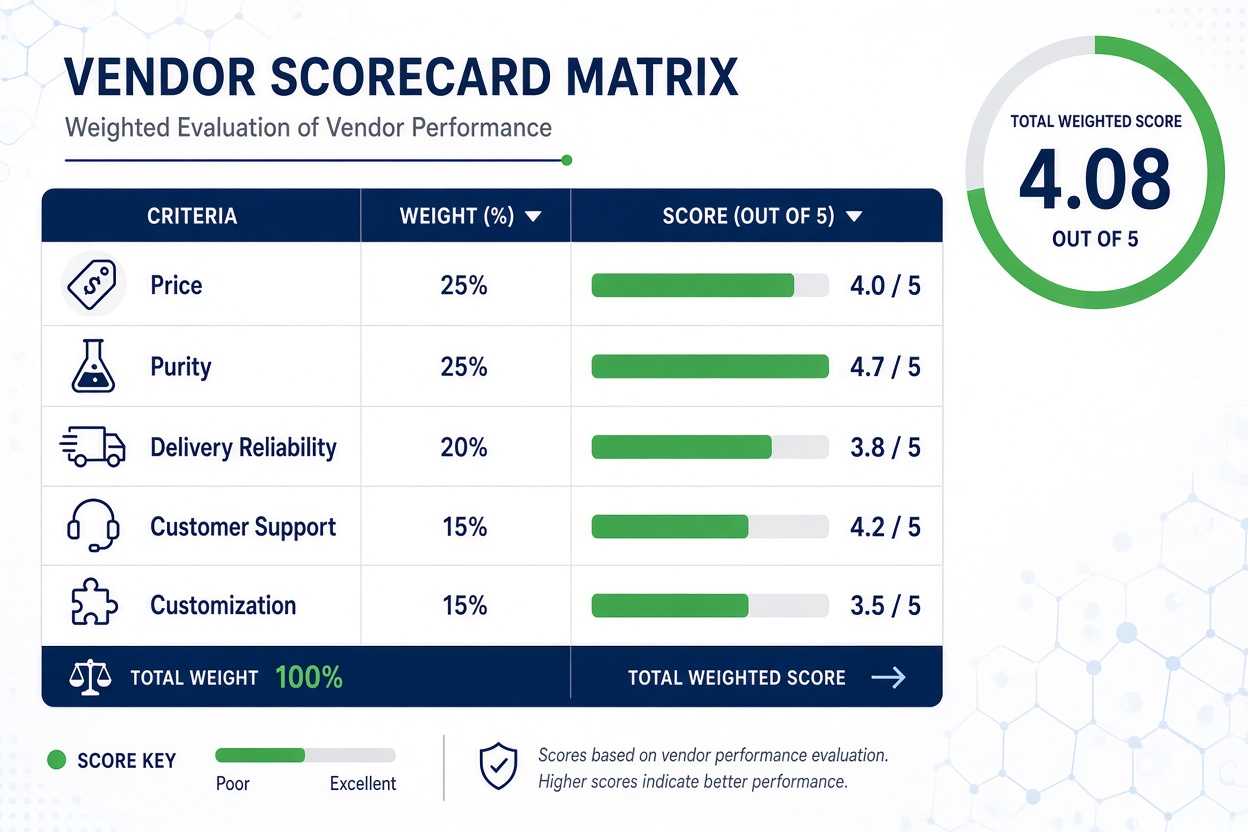
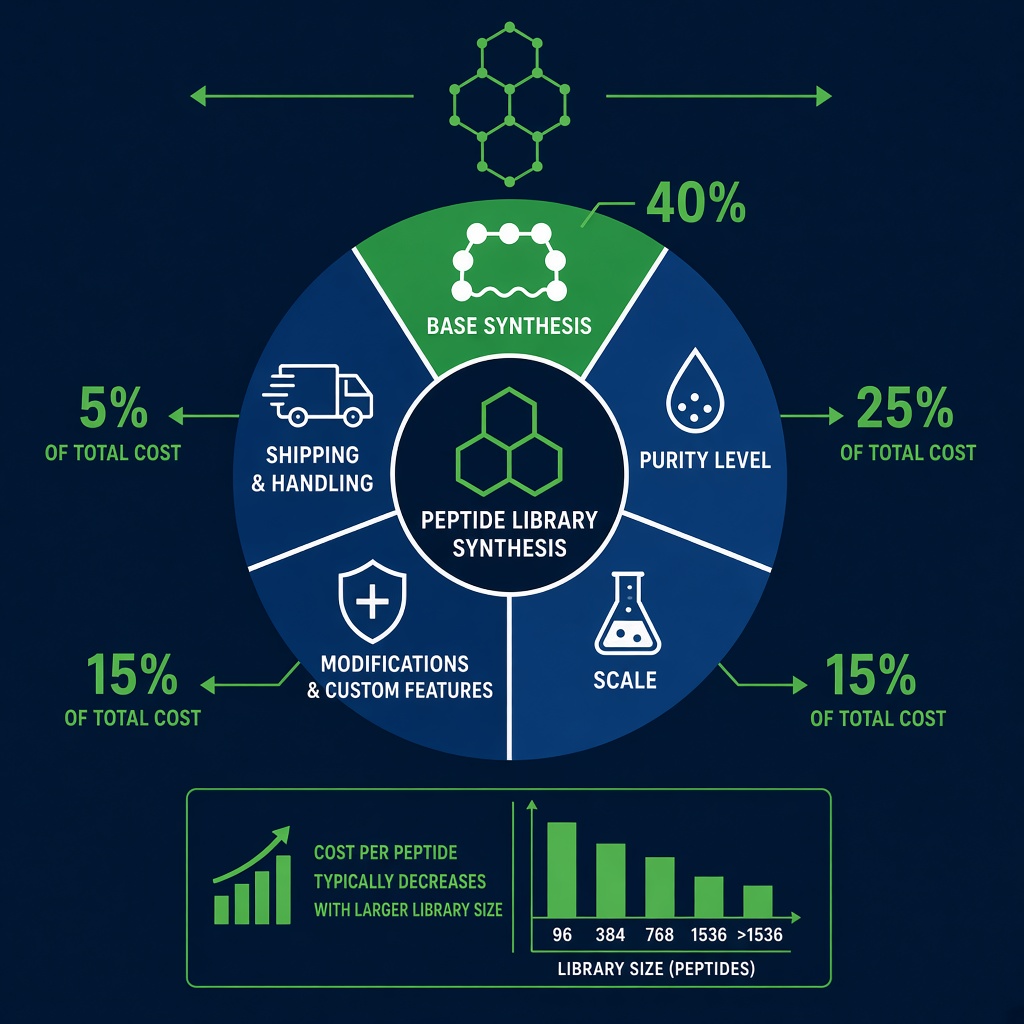
Pricing for peptide library synthesis is driven by five primary variables: synthesis scale (mg per peptide), peptide length, required purity grade, post-translational modifications or unusual amino acids, and total peptide count. Longer peptides (>20 residues) and sequences with difficult couplings typically incur higher per-peptide costs due to lower crude purity and additional HPLC purification steps.
Researchers should request quotes normalized to cost per peptide at a fixed purity threshold, such as ≥95% by HPLC. Bulk discounts often apply above 96 peptides, but per-peptide pricing may not decrease linearly if high purity is required for every peptide. Some vendors offer tiered pricing for crude, desalted, and purified libraries.
A peptide libraries price and quality comparison for research labs should compare quotes only after confirming that all tiers include the same QC deliverables, such as MS confirmation and HPLC traces. Post-translational modifications such as phosphorylation, acetylation, or PEGylation can increase synthesis cost by 20–50% depending on the modification and position.
Unusual amino acids or D-amino acids also require specialized building blocks and may extend turnaround. Laboratories should confirm whether modification costs are included in the base per-peptide price or quoted as separate line items. For laboratories planning large HTS campaigns, a peptide libraries price comparison should include a request for volume pricing tiers at 96, 384, and 1,536 peptides.
A peptide libraries price comparison should never compare quotes that omit purification costs. External reference: Cost analysis in peptide synthesis (PubMed).
Cost driver impact table
| Cost Driver | Impact on Peptide Libraries Price | Notes |
|—|—|—|
| Peptide length >20 residues | Higher per-peptide cost | Lower crude purity, extra HPLC |
| PTMs (phosphorylation, acetylation, PEGylation) | +20–50% | Position-dependent |
| Unusual/D-amino acids | Higher, extended turnaround | Specialized building blocks |
| Total peptide count >96 | Volume discount may apply | Confirm QC parity across tiers |
| Purity grade (crude vs. desalted vs. purified) | Significant | Never compare mixed tiers |
This table underscores why a peptide libraries price evaluation must normalize for purity grade and modification burden.
What quality metrics and QC benchmarks should research labs require?
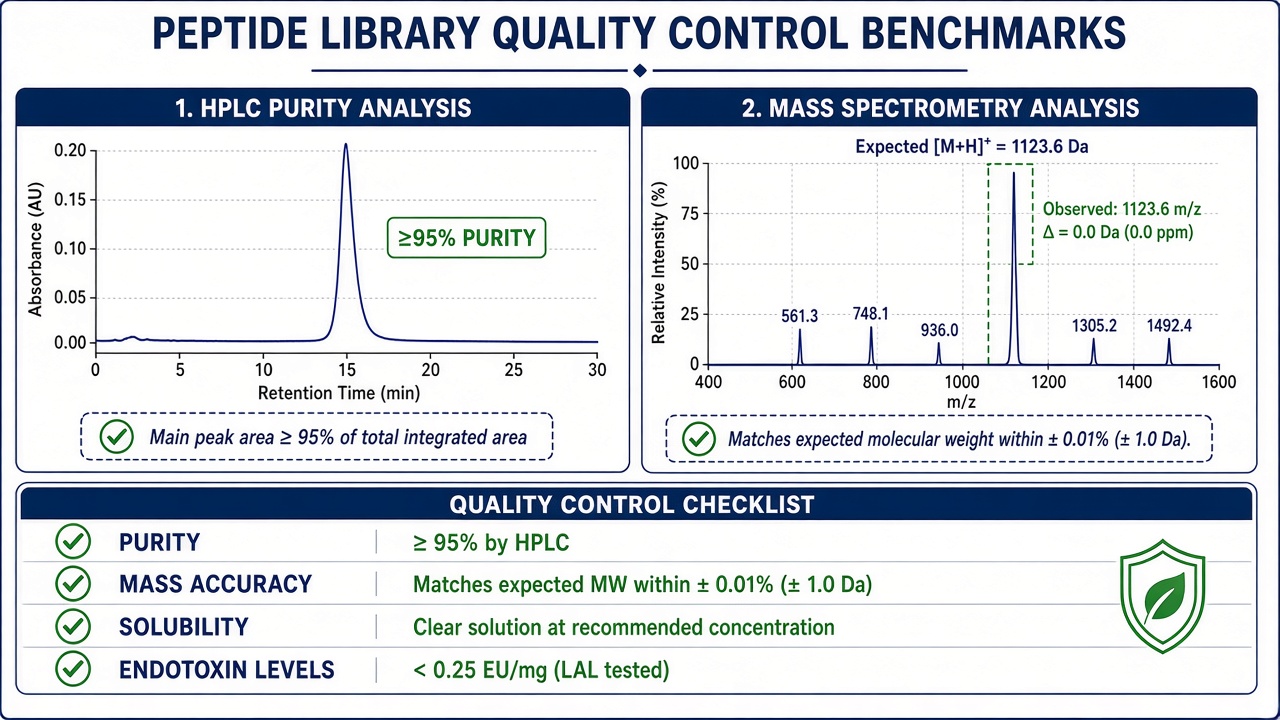
Quality benchmarks for research-grade peptide libraries include HPLC purity ≥95%, electrospray ionization mass spectrometry (ESI-MS) confirmation of molecular weight, solubility in aqueous buffer, and lot-specific yield data. For combinatorial libraries, diversity metrics such as the number of unique sequences and positional coverage are equally important.
A peptide libraries price and quality comparison must verify that every peptide in the library has a lot-specific certificate of analysis (COA) with HPLC trace and MS spectrum. Without these documents, a low per-peptide cost is meaningless. Laboratories should require that vendors disclose synthesis success rates and provide raw analytical data, not just summary reports.
Solubility data are often overlooked but critical for assay compatibility. A peptide that is ≥95% pure by HPLC but insoluble in aqueous buffer is useless for most in vitro assays. Therefore, a peptide libraries price evaluation should request solubility screening results under the intended assay conditions.
For guidance on sourcing and QC for exogenous peptides, see Exogenous Peptides: Complete Sourcing and QC Guide (2026).
Minimum QC checklist for any library quote
- HPLC purity ≥95% for every peptide, with trace provided.
- ESI-MS or MALDI-TOF mass confirmation within ±1 Da.
- Lot-specific COA for each peptide, not just for the library as a whole.
- Solubility test results in at least one aqueous buffer (e.g., PBS or water).
- Synthesis success rate disclosure, including failed sequences and resynthesis policy.
- For combinatorial libraries: sequence diversity report and positional coverage matrix.
These QC benchmarks are non-negotiable in a serious peptide libraries price and quality comparison for research labs.
How should labs use a peptide libraries price comparison to evaluate suppliers?
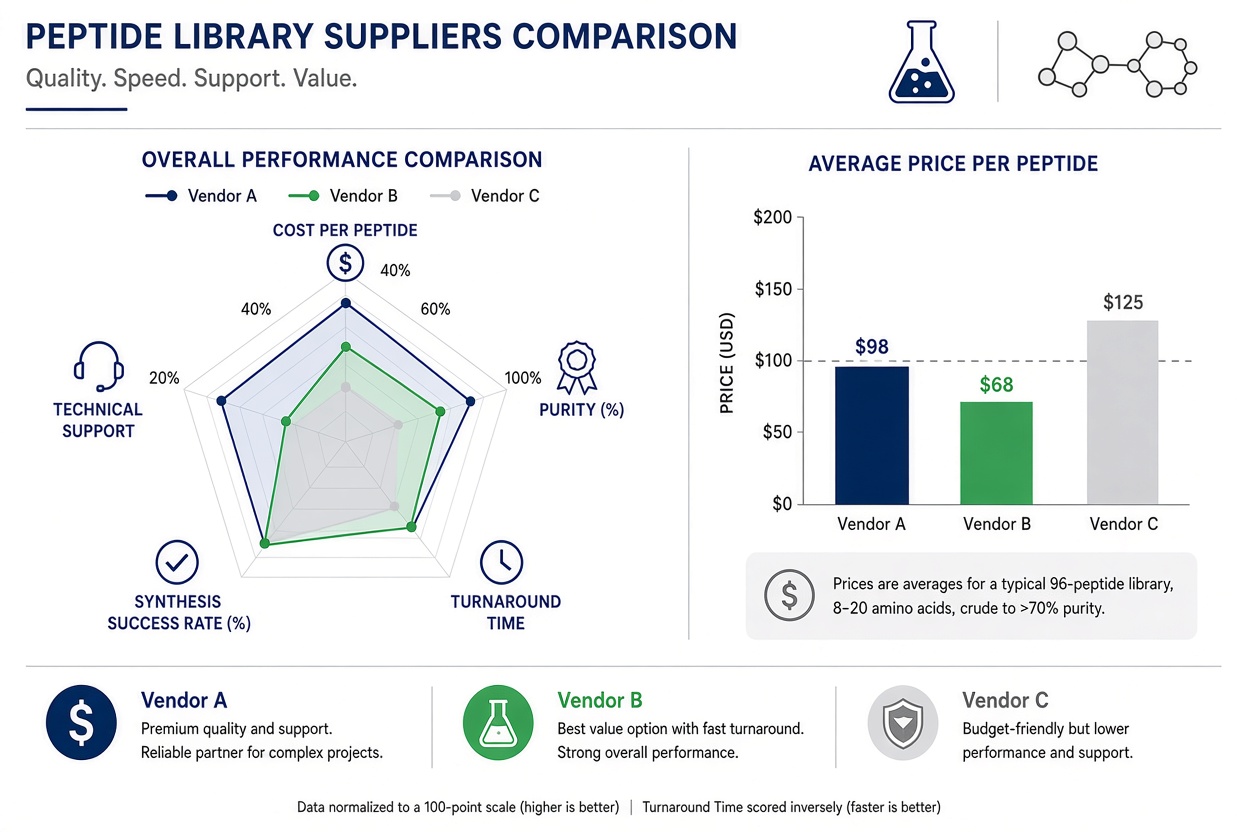
A peptide libraries price comparison should evaluate suppliers on three axes: analytical rigor, synthesis transparency, and cost predictability. Analytical rigor means the vendor provides HPLC traces, MS spectra, and COAs for every peptide without prompting. Synthesis transparency means the vendor discloses success rates, failed couplings, and resynthesis policies upfront.
Cost predictability means the quote itemizes purification, modification, and QC costs separately, so labs can compare like-for-like. A peptide libraries price evaluation that only looks at the bottom-line number will often miss hidden fees for re-purification or rush delivery. Request a breakdown at 1 mg, 5 mg, and 10 mg scales to see how per-peptide cost changes with scale.
Supplier evaluation should also include a pilot synthesis request. A pilot of 5–10 representative peptides validates the vendor’s claimed purity and turnaround before committing to a full library. This pilot data is a core component of any trustworthy peptide libraries price and quality comparison for research labs.
For more on checking study evidence for specific research peptides, see Are There Studies on It? 7 Essential Ways to Check (2026).
💡 Key Takeaway: How should labs use a peptide libraries price comparison to evaluate suppliers?
What criteria should labs use to score peptide library vendors?
Vendor scoring should weight synthesis success rate disclosure and documentation transparency at 30% or more of the total score. A peptide libraries price comparison that assigns most weight to cost will favor vendors that cut corners on QC. Instead, use a weighted scorecard: 30% documentation transparency, 20% analytical data quality, 20% per-peptide price at fixed purity, 15% turnaround reliability, and 15% pilot synthesis performance.
Synthesis success rate disclosure is critical because vendors that do not report failed sequences may be shipping libraries with missing peptides or lower-than-claimed diversity. Documentation transparency means providing raw HPLC and MS data, not just a summary table. A peptide libraries price evaluation should penalize vendors that require repeated requests for COAs.
Turnaround reliability matters because delayed libraries can stall entire screening campaigns. Pilot synthesis performance provides the strongest evidence of what the vendor will deliver at scale. The total score should reflect a peptide libraries price assessment that prioritizes reproducible quality over list price.
For a related evidence review on peptide quality in research, see AOD9604 Research: Complete Evidence Base and Gaps (2026).
Vendor scorecard example
| Criterion | Weight | What to Look For |
|—|—|—|
| Documentation transparency | 30% | Raw HPLC traces, MS spectra, COAs provided without prompting |
| Analytical data quality | 20% | Purity ≥95% confirmed by independent re-analysis if possible |
| Per-peptide price at fixed purity | 20% | Itemized cost at 1 mg, 5 mg, 10 mg with all QC included |
| Turnaround reliability | 15% | Historical on-time delivery rate and penalty clauses |
| Pilot synthesis performance | 15% | 5–10 test peptides meet purity and yield claims |
Using this scorecard prevents a peptide libraries price comparison from being skewed by a single low quote.
How do library synthesis services compare to off-the-shelf catalog peptide vendors?
Custom library synthesis services offer sequence flexibility but higher per-peptide costs and longer turnaround than off-the-shelf catalog vendors. Catalog vendors may offer pre-made peptide libraries at lower peptide libraries price points, but the sequence coverage may not match the research question. A peptide libraries price comparison must consider whether a catalog library can be used directly or requires re-synthesis of missing sequences.
Off-the-shelf catalog libraries often include common bioactive peptides, receptor ligands, or enzyme substrates. They are convenient for pilot experiments but rarely provide the positional coverage or diversity needed for comprehensive structure-activity relationship studies. Custom synthesis, in contrast, allows exact sequence specification but demands rigorous QC verification.
A peptide libraries price evaluation should ask: Does the catalog library include COAs for every peptide? Are the peptides stored under conditions that preserve stability? If the catalog vendor cannot provide lot-specific analytical data, the apparent cost saving is illusory. Custom synthesis services that provide full documentation may offer better long-term value despite a higher peptide libraries price per peptide.
For research labs that need to decide between catalog and custom formats, the answer depends on assay goals, required diversity, and available QC documentation.
How should labs request and evaluate quotes for bulk peptide library projects?
When requesting bulk peptide library quotes, labs should specify synthesis scale, purity grade, peptide length range, modification list, and QC deliverables in a single document. A peptide libraries price comparison is only valid when all vendors quote against the same specification. Include the exact number of peptides, any unusual amino acids, and the desired format (arrayed or pooled).
Request itemized quotes at 1 mg, 5 mg, and 10 mg scales, with purification and QC costs separated. Ask for a per-peptide cost at ≥95% HPLC purity, not a blended price that mixes crude and purified tiers. A peptide libraries price evaluation should also request a timeline for synthesis and delivery, including any penalty for delay.
Evaluate quotes using the vendor scorecard above, and require pilot synthesis data before placing a bulk order. Do not accept a quote that omits purification costs or that does not specify the purity threshold for every peptide. A peptide libraries price comparison that lacks these details will lead to budget overruns and unusable libraries.
Bulk projects above 96 peptides should include a discussion of volume discounts, but only after confirming that QC parity is maintained across all tiers. The lowest peptide libraries price is not a bargain if it means receiving crude peptides without MS confirmation.
💡 Key Takeaway: How should labs request and evaluate quotes for bulk peptide library projects?
What are common pitfalls and best practices for budgeting and quality assurance?
A common pitfall in peptide libraries price budgeting is assuming that the quoted per-peptide cost includes purification, QC, and shipping. Many vendors quote crude synthesis prices that exclude HPLC purification and MS analysis. Always confirm that the quote includes ≥95% purity for every peptide with COAs.
Another pitfall is ignoring solubility data. A library that passes purity checks but precipitates in assay buffer wastes time and reagents. Best practice is to request solubility screening under the intended assay conditions before committing to a full library. A peptide libraries price evaluation should include this request as a standard line item.
Labs also often overlook pilot synthesis. A small pilot of 5–10 peptides can reveal whether a vendor’s claimed purity and turnaround are realistic. Best practice is to include pilot synthesis data as a prerequisite for bulk orders. A peptide libraries price comparison that skips pilot validation risks committing budget to an unproven vendor.
For budgeting, allocate 10–15% of the total project cost for re-synthesis and unexpected failures. Peptide synthesis is not always linear, and difficult sequences may require multiple attempts. A peptide libraries price plan that includes contingency funds prevents project stalls.
Finally, maintain a single QC file for every library: COAs, HPLC traces, MS spectra, and solubility reports. This documentation supports reproducibility and future publications. A peptide libraries price and quality comparison is only as strong as the records kept after purchase.
How does a peptide libraries price and quality framework apply to different library formats?
A peptide libraries price and quality framework must adapt to the library format because QC requirements differ. For custom peptide libraries, the framework emphasizes per-peptide purity, MS confirmation, and yield at the requested scale. For combinatorial libraries, the framework must add diversity metrics such as sequence redundancy and Tanimoto similarity.
For positional scanning libraries, the framework must verify positional coverage at every substitution site. For pooled libraries, the framework must address deconvolution efficiency and encoding tag stability. A peptide libraries price evaluation that applies identical QC criteria to all formats will miss critical format-specific risks.
Custom libraries benefit from a straightforward per-peptide peptide libraries price comparison because each peptide is individually synthesized and purified. Combinatorial libraries, however, require statistical sampling of the library to confirm diversity, which adds analytical cost. Positional scanning libraries require coverage verification at each position, which may increase the effective peptide libraries price per informative peptide.
Pooled libraries can offer a lower nominal peptide libraries price per peptide, but the cost of deconvolution and hit identification must be added. Laboratories should calculate the total cost per confirmed hit, not the cost per synthesized peptide. This adjusted metric provides a more accurate peptide libraries price comparison across formats.
FAQ
What is the most important factor in a peptide libraries price comparison for research labs?
The most important factor is documented quality—HPLC purity ≥95%, ESI-MS confirmation, and lot-specific COAs—not list price. A low peptide libraries price without analytical documentation is a false economy because unusable peptides waste screening resources.
How much do post-translational modifications increase peptide library costs?
Post-translational modifications such as phosphorylation, acetylation, or PEGylation can increase synthesis cost by 20–50% depending on the modification and position. Unusual amino acids or D-amino acids also raise costs and extend turnaround.
Should labs request pilot synthesis before ordering a full peptide library?
Yes. A pilot synthesis of 5–10 representative peptides validates the vendor’s claimed purity, yield, and turnaround. Pilot data is a prerequisite for a trustworthy peptide libraries price and quality comparison for research labs.
What purity grade should research labs require for peptide libraries?
Labs should require HPLC purity ≥95% for every peptide in the library, with individual HPLC traces and mass spectra. Crude or desalted tiers should not be mixed with purified tiers in a peptide libraries price comparison.
How should labs compare quotes from different peptide library vendors?
Labs should compare quotes only after confirming that all quotes include the same QC deliverables: ≥95% purity, MS confirmation, COAs, and solubility data. Use a weighted scorecard that assigns 30% or more to documentation transparency and synthesis success rate disclosure.
Topics covered in this article:
Ready to Take the Next Step?
Every product includes lot-specific documentation and third-party purity testing.
Explore Our Research Products →Free shipping on qualifying orders · Batch COA on request