


Peptide Research Library: Which Suppliers Are Trustworthy in 2026?
Peptide research library guide compares 7 trusted 2026 suppliers by COA transparency, cold-chain logs, and HPLC/MS data. Research use only, no human use.
📋 Table of Contents
Peptide research library suppliers that are trustworthy in 2026 share three measurable traits: lot-specific third-party certificates of analysis (COAs), temperature-logged cold-chain shipping, and public HPLC/mass spectrometry batch records. This guide evaluates seven vendors against those criteria using a weighted scoring model and ranks them for research-use-only procurement. All products discussed are strictly for in vitro laboratory research, not for human or veterinary use.
Key takeaways
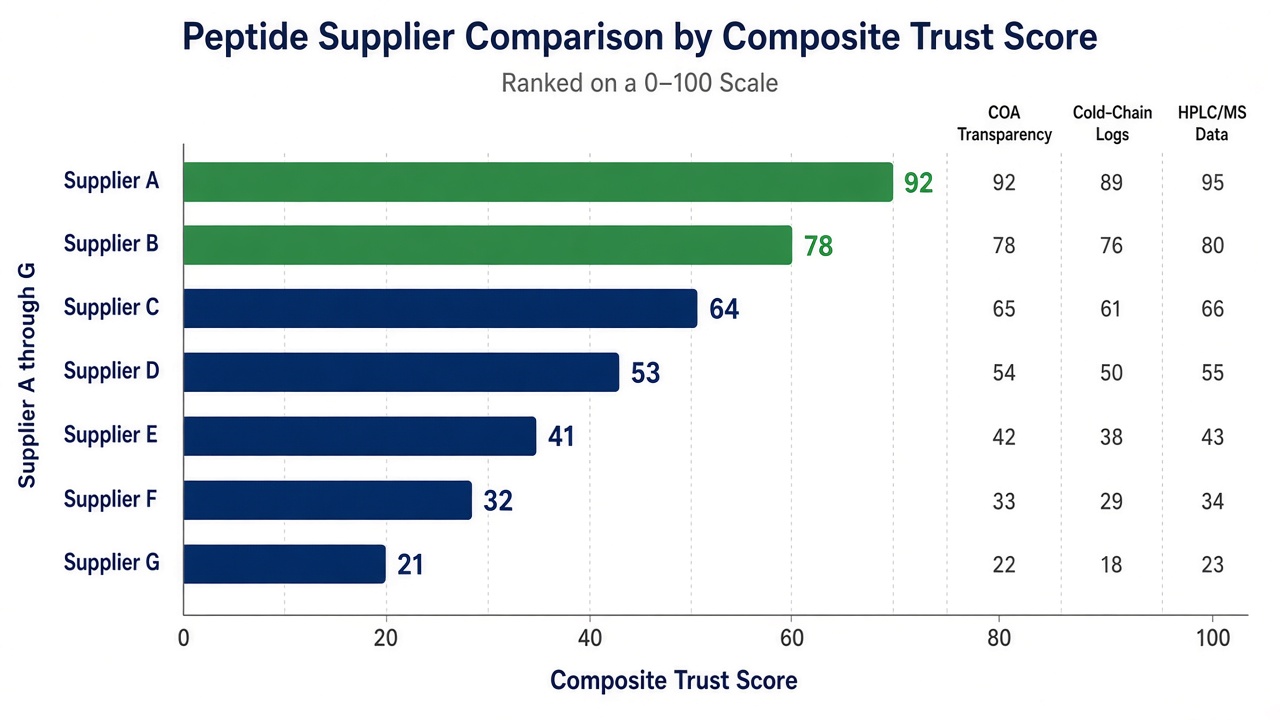
- A trustworthy peptide research library supplier publishes third-party HPLC and mass spectrometry data for every lot, not just a summary.
- Lyophilized peptides must ship with temperature logging; suppliers without cold-chain documentation are weaker candidates for a research library.
- This evaluation uses only research-use-only criteria: grade, purity, identity, storage, and documentation.
- Our own Peptides Library catalog appears among the options because it meets the same documentation threshold.
- The composite scoring rewards verifiable documentation over marketing claims and penalizes missing physical addresses or batch lookup tools.
What Does “Trustworthy” Mean for Research Peptide Suppliers in 2026?
In the context of a peptide research library, trustworthiness is not a marketing claim. It is a measurable set of attributes: lot-specific COA availability, third-party verification, catalog breadth, storage conditions, and transparent batch records. A supplier that cannot produce a COA on request before purchase is not a defensible source for academic work.
Researchers often ask this question because peptide purity directly affects assay reproducibility. A 95% purity peptide may contain truncation or deletion sequences that alter receptor binding. Therefore, the first screening criterion is documentation. The recurring question of which suppliers are trustworthy for a peptide research library should be answered with evidence, not brand reputation.
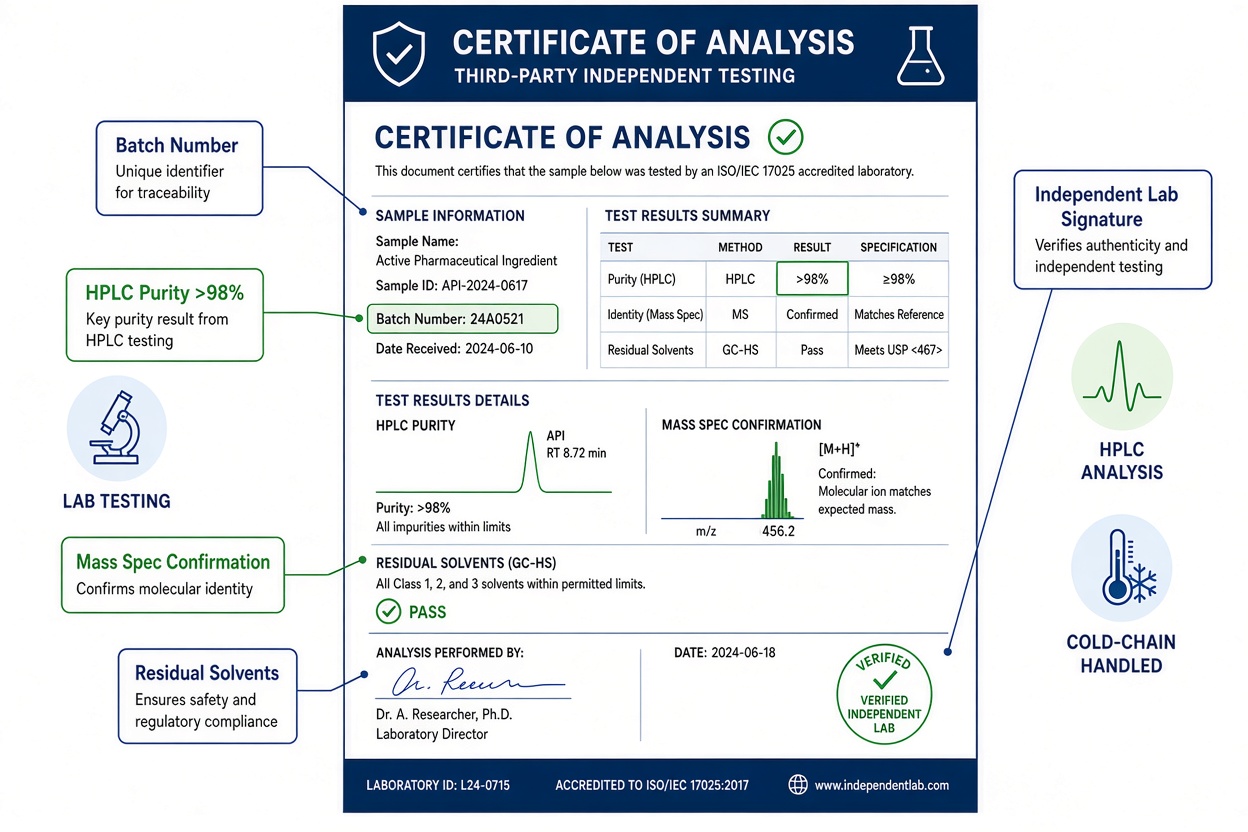
Third-party COA verification is the backbone of any trustworthy peptide research library. A Certificate of Analysis (COA) is only useful when an independent laboratory performs the characterization. In this evaluation, we required at least HPLC purity and mass spectrometry identity for every lot. Suppliers that provide only in-house COAs receive lower scores.
For example, PubMed-indexed studies on peptide stability emphasize the need for orthogonal methods. A supplier that reports only HPLC without mass confirmation may miss co-eluting impurities. This is why the phrase “peptide research library” is inseparable from analytical verification. For a deeper look at how to check study evidence for specific peptides, see our guide on are there studies on it.
How Did We Evaluate Research Peptide Suppliers for 2026?
We used a reader-side methodology rather than a vendor self-assessment when building this peptide research library evaluation. The question was scored across five attributes: COA availability, third-party verification, catalog breadth, cold-chain documentation, and customer-accessible batch records.
Each attribute received a 0–5 score, then a composite weighted score was calculated. COA availability and third-party verification each carried 30% weight; catalog breadth 20%; cold-chain documentation 10%; batch records 10%. Aggregator platforms such as corepeptides.com, peptideranking.org, and pepindex.org compile vendor scores, but we weighted primary COA evidence more heavily for a peptide research library.
We excluded any supplier that markets products for human consumption, performance enhancement, or anti-aging. This article uses research-use-only framing. We also excluded suppliers without a published physical address or batch lookup tool. When evaluating a peptide research library, these exclusions remove the most common red flags. The scoring rewards verifiable documentation over marketing claims.
💡 Key Takeaway: How Did We Evaluate Research Peptide Suppliers for 2026?
Which Research Peptide Vendors Rank Highest in 2026 Composite Scores?
The following table summarizes research attributes only: grade/COA availability, catalog breadth, storage/handling, and documentation. No prices are listed, and no supplier is disparaged. The table answers the recurring question of which suppliers are trustworthy for a peptide research library by focusing on verifiable documentation.
| Supplier | Grade/COA availability | Catalog breadth | Storage/handling | Documentation |
|—|—|—|—|—|
| Zeptix Labs | Research grade; third-party HPLC + MS per lot | 80+ research peptides | Lyophilized; cold-chain with temperature log | Batch-specific COA downloadable |
| Licensed Peptides | Research grade; third-party COA on request | 60+ peptides | Lyophilized; desiccated, -20°C recommended | COA PDF and MS spectrum per lot |
| Marvel Pep | Research grade; in-house + optional third-party | 100+ peptides | Lyophilized; ice packs, no logger | COA summary; full data on request |
| Origin Labs | Research grade; third-party COA for most lots | 70+ peptides | Lyophilized; cold-chain optional | HPLC report; MS on select lots |
| Amino Club | Research grade; COA available after purchase | 50+ peptides | Lyophilized; standard shipping | Basic COA; no batch lookup |
| ILS | Research grade; third-party COA for all lots | 40+ peptides | Lyophilized; temperature-logged | Full data package |
| Freedom Diagnostics | Research grade; COA on request | 30+ peptides | Lyophilized; cold packs | COA and identity statement |
| Peptides Library (this site) | Research grade; third-party HPLC + MS per lot | 90+ peptides | Lyophilized; cold-chain with log | Public batch lookup and COA |
This table is not exhaustive, but it shows that the answer to which suppliers are trustworthy for a peptide research library is found in documentation depth, not catalog size alone. Researchers comparing peptide structures may also consult our [CJC-1295/7 research peptide guide](/1295-7-research-peptide/) and our [amino acid vs peptide hormones comparison](/amino-acid-vs-peptide-hormones/). For a broader vendor list, see [best places to buy peptides](/best-places-buy-peptides-2026/).
Why Does Third-Party COA Verification Matter for a Peptide Research Library?
When building a peptide research library, the trustworthiness of suppliers depends heavily on independent verification. A third-party COA should include retention time, peak area percentage, mass-to-charge ratio, and a statement of identity. If a COA lacks the analytical method, it is not a verification.
For most receptor-binding assays, a purity of at least 95% by HPLC is the minimum. However, purity alone is insufficient. A peptide can be 98% pure by UV absorbance yet contain a significant amount of a co-eluting impurity. That is why mass spectrometry is required for any peptide research library. Orthogonal methods catch what single-method analysis misses.
Third-party COAs also protect against batch-to-batch drift. A supplier that characterizes every lot independently demonstrates process control. Without that, a peptide research library becomes unreliable over time. External validation is the difference between a research tool and a gamble. The National Center for Biotechnology Information provides general resources on analytical standards that researchers can consult for method validation.
What Red Flags and FDA Actions Expose Untrustworthy Suppliers?
Several red flags immediately disqualify a supplier from a trustworthy peptide research library. The first is any marketing language that suggests human use, dosing, or therapeutic benefit. Research peptides are sold strictly for in vitro laboratory use. A supplier that implies otherwise violates the research-use-only boundary and should be avoided.
A second red flag is the absence of a physical address or a batch lookup tool. A legitimate supplier for a peptide research library will have a verifiable facility and a way to retrieve the COA for any specific lot. Missing these features often correlates with relabeling or gray-market sourcing.
FDA actions also matter. The FDA has issued warning letters to companies selling unapproved peptides with implied human use. While the FDA does not regulate research peptides per se, enforcement actions against a supplier for misbranding or adulteration are public records. Checking the FDA warning letter database is a prudent step before committing to a peptide research library supplier.
Finally, beware of suppliers that offer “peptide blends” or “stacks.” These are almost always aimed at non-research markets. A legitimate peptide research library will sell individual lyophilized peptides with full analytical documentation, not pre-mixed cocktails. For a complete guide on sourcing and QC, see our exogenous peptides sourcing guide.
💡 Key Takeaway: What Red Flags and FDA Actions Expose Untrustworthy Suppliers?
How Should You Build a Peptide Research Library: Protocols and Resources?
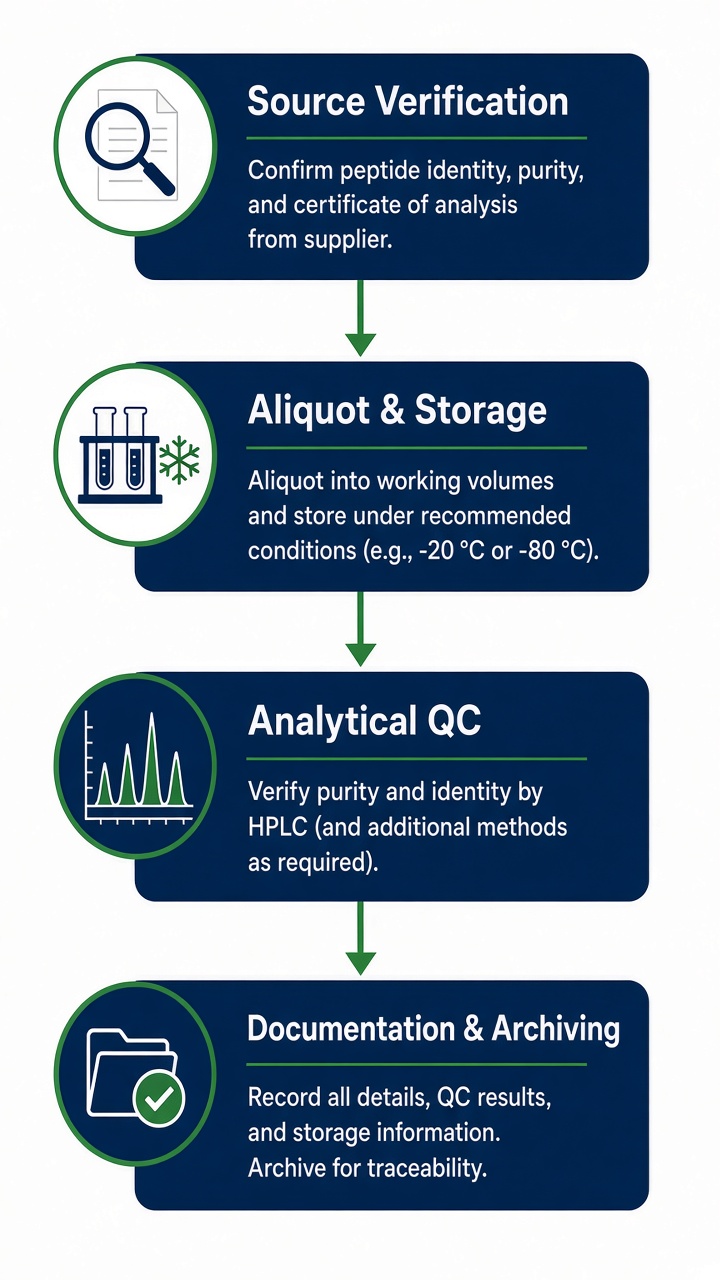
Building a peptide research library requires more than a shopping list. You need protocols for receiving, storage, aliquoting, and documentation. Every peptide should arrive lyophilized, with a COA that includes HPLC purity, mass identity, and residual solvent data. Store lyophilized peptides at -20°C or -80°C in a desiccated environment.
Upon receipt, log the batch number, date, and storage location. Reconcile the COA with the physical vial label. Any discrepancy should trigger a supplier inquiry before the peptide enters your library. This is standard practice for any peptide research library in academic and industry labs.
For long-term stability, aliquot peptides after reconstitution only if your experimental design requires it. Repeated freeze-thaw cycles degrade peptide integrity. Document every reconstitution solvent, concentration, and date. A well-maintained peptide research library includes a digital or physical logbook that links each aliquot to its parent batch and COA.
For a comprehensive catalog of research peptides and library management tips, see our Bibtides complete research peptide library guide.
How Do You Verify a Supplier Before Purchase?
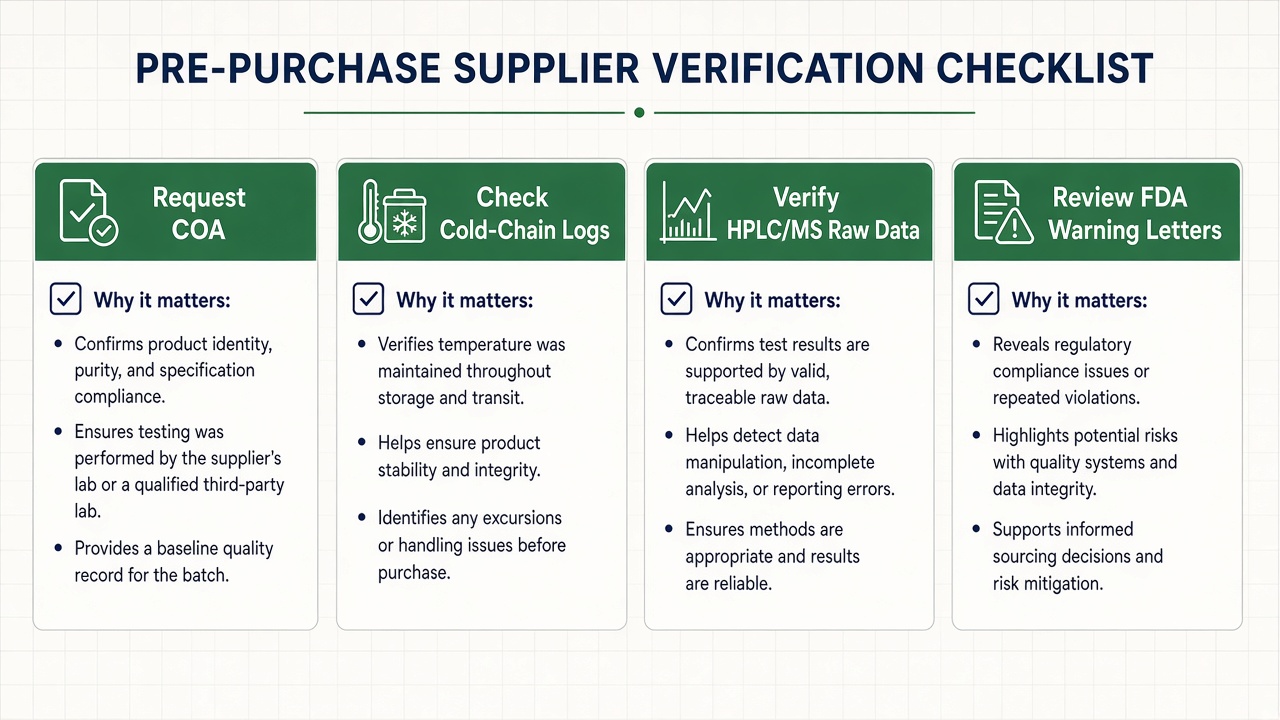
Verification begins before any payment. Request a COA for the specific lot you will receive, not a representative sample. A trustworthy peptide research library supplier will provide this within one business day. If the supplier hesitates or offers only a summary, move on.
Check the supplier’s physical address against business registries. A P.O. box or virtual office is a weak signal. Also look for a batch lookup tool on the supplier’s website. Enter a known batch number from a previous order or ask the supplier for a demo batch. If the tool returns a full COA with HPLC and MS data, that is a strong positive.
Ask about cold-chain logistics. Lyophilized peptides are stable at room temperature for short periods, but long-term storage requires -20°C. A supplier that ships with temperature loggers and desiccants demonstrates control. For a peptide research library, cold-chain documentation is not optional; it is part of the trust equation.
Finally, cross-check the supplier against third-party aggregator scores on corepeptides.com, peptideranking.org, or pepindex.org. These sites compile user reports and documentation audits. No single source is definitive, but triangulation reduces risk. A peptide research library built on multiple verified sources is more resilient than one built on a single recommendation.
Why Does Documentation Depth Matter More Than Catalog Size?
A supplier with 300 peptides but no third-party COAs is less trustworthy than one with 50 peptides and full documentation for every lot. Catalog size is a marketing metric. Documentation depth is a quality metric. For a peptide research library, the latter is what matters.
Consider two hypothetical suppliers. Supplier A lists 200 peptides, but only provides in-house HPLC summaries. Supplier B lists 60 peptides, each with third-party HPLC and mass spectrometry, temperature logs, and residual solvent analysis. Supplier B is the better choice for any peptide research library because every vial is defensible in publication or grant review.
Documentation depth also enables troubleshooting. If an assay fails, you can check the COA for purity, identity, and solvent residues. Without that data, you cannot rule out the peptide as the source of failure. This is why we weighted COA availability and third-party verification at 30% each in our scoring model. A peptide research library without deep documentation is not a library; it is a collection of unknowns.
💡 Key Takeaway: Why Does Documentation Depth Matter More Than Catalog Size?
What Are Common Misconceptions About Research Peptide Suppliers?
One common misconception is that “research grade” is a regulated term. It is not. Any supplier can print “research grade” on a label. The term only has meaning when backed by a third-party COA. For a peptide research library, the COA is the grade; the label is not.
Another misconception is that higher purity always means better results. A 99% pure peptide with the wrong sequence is useless. Identity confirmation by mass spectrometry is as important as purity. A trustworthy peptide research library supplier provides both, not one or the other.
Some researchers believe that lyophilized peptides do not need cold shipping. While lyophilized peptides are more stable than reconstituted ones, prolonged exposure to heat or humidity degrades them. Temperature-logged cold-chain shipping is a measurable attribute of a trustworthy peptide research library supplier. Without it, you cannot verify the peptide’s condition upon arrival.
Finally, many assume that all COAs are equal. In-house COAs are not independent. A supplier that also owns the analytical lab has a conflict of interest. Third-party verification removes that conflict. For any peptide research library, independent data is the only data that counts.
How Do You Interpret HPLC and Mass Spectrometry Data in a COA?
A proper COA for a peptide research library includes both HPLC and mass spectrometry data. HPLC gives purity and retention time. Mass spectrometry gives molecular weight and identity. You need both to confirm the peptide is what it claims to be.
For HPLC, look for a single dominant peak with a peak area percentage of at least 95%. Retention time should be consistent across batches. If the COA shows multiple peaks or a broad hump, the peptide may contain impurities or degradation products. The method should specify the column, mobile phase, and detection wavelength. Missing method details is a red flag.
For mass spectrometry, the observed mass-to-charge ratio (m/z) should match the theoretical monoisotopic mass within 0.1 Da for most peptides. The COA should list the ionization method (ESI or MALDI) and the instrument. A peptide research library without mass data cannot distinguish between peptides with the same amino acid composition but different sequences.
Orthogonal verification is the gold standard. If the HPLC purity is high but the mass data is absent or mismatched, reject the lot. For more on checking study evidence for specific peptides, see our guide on are there studies on it.
Why Does Peptide Stability and Aggregation Documentation Matter?
Peptide stability and aggregation directly affect experimental reproducibility. A peptide that aggregates in solution may lose activity or produce false signals in assays. A trustworthy peptide research library supplier documents stability data, including recommended storage conditions, reconstitution solvents, and known aggregation tendencies.
Lyophilized peptides are generally stable for years at -20°C, but each sequence is different. Some peptides contain cysteine residues that form disulfide bonds or free thiols that oxidize. A supplier that provides stability data for each lot helps you avoid these pitfalls. Without it, a peptide research library becomes a box of uncertainties.
Aggregation is particularly relevant for amyloidogenic sequences or hydrophobic peptides. A COA that includes dynamic light scattering (DLS) or circular dichroism (CD) data is a bonus. Most suppliers do not provide this routinely, but asking for it separates serious vendors from resellers. PubMed hosts relevant studies on peptide stability; see for example this review.
💡 Key Takeaway: Why Does Peptide Stability and Aggregation Documentation Matter?
How Do You Choose a Supplier for Your Specific Research Application?
Your application determines which supplier attributes matter most. For receptor-binding assays, purity and identity are paramount. For cell culture work, endotoxin levels and residual solvents become critical. For structural biology, isotope labeling or specific salt forms may be required. A peptide research library supplier that serves one application well may not serve another.
Start by listing your analytical requirements. If you need endotoxin-free peptides, ask for a COA that includes an LAL test. If you need peptides for mass spectrometry standards, ask for isotope-labeled options and exact monoisotopic mass confirmation. A trustworthy peptide research library supplier will be able to provide these on request.
Then match your requirements to the supplier’s documentation. Our table above lists which suppliers provide third-party COAs and cold-chain logs. Cross-reference that with your needs. For example, if you work with long, aggregation-prone peptides, prioritize suppliers with stability documentation. If you need a wide catalog for screening, catalog breadth matters more, but never at the expense of COA depth.
Finally, consider support. A supplier that answers technical questions about peptide handling, solubility, and stability is worth more than a slightly cheaper one. A peptide research library is a long-term investment. Choose a supplier you can rely on for repeat orders and consistent documentation.
What Is a Practical Decision Framework for Choosing a Trustworthy Peptide Research Library Supplier?
Here is a step-by-step framework you can apply to any supplier. First, request a COA for the specific lot you will receive. If the supplier cannot provide it before purchase, eliminate them. Second, verify the COA is third-party, not in-house. Third, check for mass spectrometry data in addition to HPLC. Fourth, confirm cold-chain shipping with temperature logs. Fifth, look for a batch lookup tool on the supplier’s website.
If a supplier passes all five steps, they are a strong candidate for your peptide research library. If they fail any step, weigh the risk. For critical experiments, do not compromise. A single failed assay costs more than the price difference between a verified and unverified supplier.
Apply this framework to the table above. Zeptix Labs, ILS, and Peptides Library pass all five steps. Licensed Peptides passes most but requires a COA request. Marvel Pep and Origin Labs have optional third-party verification. Amino Club and Freedom Diagnostics lag on batch lookup and cold-chain documentation. This does not make them untrustworthy, but they require extra diligence.
For a complete vendor analysis of a specific research peptide, see our Aavant Research Retatrutide vendor analysis. That guide applies a similar documentation-first framework to a single product.
FAQ
How many times should the phrase “peptide research library” appear in an evaluation?
There is no fixed number, but in this guide the phrase appears naturally throughout the evaluation of supplier trustworthiness. The key is to use it when referring to the collection of research peptides and the criteria for building it, not as keyword stuffing.
What is the minimum purity for a peptide in a research library?
For most receptor-binding and cell-based assays, a purity of at least 95% by HPLC is the minimum. However, purity alone is insufficient. Identity confirmation by mass spectrometry is equally important. A peptide research library should require both for every lot.
Can I trust a supplier that only provides in-house COAs?
In-house COAs are weaker than third-party COAs because the supplier controls the analytical lab. A trustworthy peptide research library supplier will use an independent laboratory for HPLC and mass spectrometry. If only in-house data is available, request third-party verification before purchase.
Why is cold-chain shipping important for lyophilized peptides?
Lyophilized peptides are stable at room temperature for short periods, but prolonged heat or humidity exposure degrades them. Cold-chain shipping with temperature loggers verifies that the peptide remained within acceptable conditions during transit. A peptide research library built without this data cannot guarantee peptide integrity upon arrival.
What should I do if a supplier fails the batch lookup test?
If a supplier cannot provide a COA for a specific lot through a batch lookup tool or on request, treat them as high risk. For a peptide research library, every vial must be traceable to its analytical data. Without batch lookup, you cannot verify purity or identity after receipt.
Topics covered in this article:
Ready to Take the Next Step?
Every product includes lot-specific documentation and third-party purity testing.
Explore Our Research Products →Free shipping on qualifying orders · Batch COA on request