



Aavant Research Retatrutide: Complete Vendor Analysis (2026)
Aavant research retatrutide vendor analysis: third-party COA purity, batch verification, storage, and comparison for research laboratories. Proven 2026 guide.
📋 Table of Contents
aavant research retatrutide is a lyophilized triple agonist at the GIP, GLP-1, and glucagon receptors sold by Aavant Research strictly for in vitro laboratory use, with batch-specific COAs and independent Finnrick catalogue entries supporting vendor legitimacy. Researchers should verify each batch’s HPLC purity (≥98–99%) and mass spectrometry identity before assay use, and no product is approved for human administration.
Key takeaways
- Retatrutide is a triple receptor agonist (GIP, GLP-1, and glucagon receptors) supplied for research use only; no form is approved for human administration.
- Vendor legitimacy for aavant research retatrutide rests on batch-specific COAs, third-party lab testing, and independent catalogues such as Finnrick — not on marketing claims.
- Researchers sourcing aavant research retatrutide should confirm a purity percentage of at least 98–99% by HPLC with a matching mass spectrometry identity peak before assay use.
- Lyophilized storage at −20 °C, gentle reconstitution, and single-use aliquoting preserve peptide integrity in laboratory settings.
- All procurement and handling must remain within institutional research compliance frameworks.
⚠️ Research Use Only Notice: The products discussed on this site, including aavant research retatrutide, are sold strictly for in vitro laboratory research purposes only. They are not for human use, not for veterinary use, and not intended to diagnose, treat, cure, or prevent any disease. All information presented is for educational purposes in a research context. Must be 21+ to purchase.
What Is aavant research retatrutide? Vendor Overview and Background
Aavant Research is a research chemical supplier operating the public storefront aavantacr.com, marketing lyophilized peptides to laboratories, academic institutions, and research organizations. The aavant research retatrutide listing is commonly offered in multi-milligram lyophilized vials (frequently 10 mg to 30 mg), with a stated purity specification and batch documentation; researchers should confirm current vial sizes and specifications directly on the listing, because inventory details change.
The molecule itself is a single engineered peptide that activates three metabolically relevant receptors: the glucose-dependent insulinotropic polypeptide (GIP) receptor, the GLP-1 receptor, and the glucagon receptor. This places retatrutide adjacent to the broader GLP-1 receptor agonist class while extending well beyond it, and distinguishes it from dual agonists such as tirzepatide. Our Exogenous Peptides: Complete Sourcing and QC Guide (2026) covers related sourcing quality criteria for reference materials.
In laboratory settings, aavant research retatrutide functions as a reference material for receptor binding assays, cell culture signaling studies, and in vivo (animal model) metabolic research conducted under institutional animal care protocols. Published pharmacokinetic characterization reports an elimination half-life of roughly six days for the molecule, which informs assay scheduling in preclinical designs. Nothing in the vendor listing or in this review should be interpreted as endorsing administration to humans.
Demand for this reference standard grew sharply after the 2023 phase 2 publication, and the research peptide sector responded with numerous competing listings of variable quality. That market context is precisely why vendor-level analysis matters: the same labeled product can differ substantially in actual purity percentage between suppliers and even between batches from one supplier.
The primary scientific literature provides the reference point for identity verification. Phase 2 clinical data for retatrutide are indexed on PubMed, and active phase 3 evaluation is catalogued on ClinicalTrials.gov. These sources define the molecular entity — sequence, receptor pharmacology, and characterized properties — against which any vendor-supplied material should be benchmarked.
Is aavant research retatrutide Legitimate?
Legitimacy for a research peptide vendor rests on verifiable, falsifiable signals rather than presentation quality. For aavant research retatrutide, the decisive signals are batch-specific COAs with named analytical methods, third-party lab testing performed by laboratories independent of the vendor, transparent business operations, and a consistent track record within researcher communities.
Operational transparency is the first checkpoint. Aavant Research maintains a public storefront at aavantacr.com with stated shipping policies, research-use-only labeling, and batch identifiers on vial labels — baseline requirements any procurement office should expect. Vendors that omit batch identifiers make COA matching impossible, and a COA that cannot be matched to a physical vial has no evidentiary value.
Additional operational signals include storefront longevity, published refund and reshipment policies, and responsiveness to pre-sale documentation requests. Researchers can test the last point directly: a vendor that promptly supplies a batch-specific COA on request demonstrates a documentation workflow, while evasive or generic responses indicate the opposite. These are observable behaviors, not subjective impressions.
Independent verification is the second checkpoint. Third-party testing platforms — most notably Finnrick — catalogue independent analytical results for research peptide vendors, including listings associated with aavant research retatrutide. Because catalogue entries change as new batches are tested, researchers should consult Finnrick directly for the most recent purity percentage and pass or fail status rather than relying on any static summary, including this one.
The third checkpoint is framework-based comparison. Our Exploring Peptides: The Complete Evidence Review (2026) details the due-diligence criteria applied throughout this review: documentation quality, analytical verification, operational history, and community reporting. Measured against those criteria, aavant research retatrutide currently presents as a documentation-forward, independently catalogued option — though no vendor assessment substitutes for verifying the specific batch in hand.
💡 Key Takeaway: Is aavant research retatrutide Legitimate?
How Is aavant research retatrutide Tested? COA and Purity Analysis
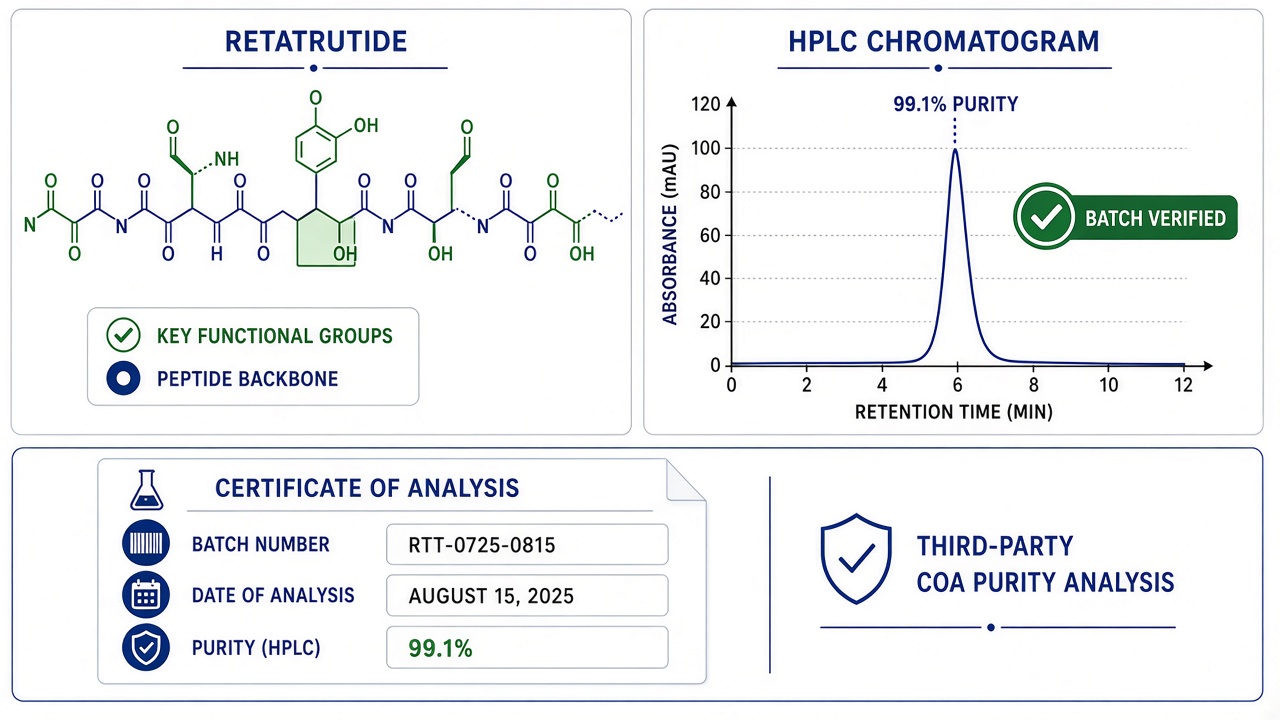
A Certificate of Analysis is the primary quality document for any research peptide. A complete COA for aavant research retatrutide should report the batch number, the analytical methods used, a purity percentage by high-performance liquid chromatography (HPLC), and identity confirmation by mass spectrometry (MS). Documents lacking any of these elements are incomplete and should be treated as such.
What a Complete COA Contains
| COA component | What it establishes | Acceptance signal |
|—|—|—|
| Batch number | Links document to physical vial | Matches vial label exactly |
| HPLC purity | Proportion of target peptide | ≥98–99%, single dominant peak |
| Mass spectrometry | Molecular identity | Observed mass matches calculated ~4.7 kDa |
| Test date and laboratory | Currency and independence | Recent date, named laboratory |
The HPLC chromatogram deserves direct inspection, not just the headline number. Research-grade peptides are generally expected to meet a purity specification of at least 98%, and many vendors advertise 99% or higher. The trace should show one dominant peak at the expected retention time; clustered secondary peaks indicate synthesis-related impurities such as deletion or truncation sequences.
Mass spectrometry answers a different question than HPLC: identity rather than purity. The observed molecular mass for aavant research retatrutide should match the calculated mass of approximately 4.7 kDa within the instrument’s tolerance. A mass shift of several daltons or an unexpected adduct pattern suggests either a different sequence or incomplete desalting.
Researchers should request a COA for the exact batch number printed on the vial they receive, not a representative or template document. A batch-specific COA dated within a reasonable window of the purchase supports confidence that the document describes the material in hand. Our Exogenous Peptides: Complete Sourcing and QC Guide (2026) expands on this verification workflow.
Why HPLC and MS Are Complementary
HPLC measures purity but not identity; a 99% pure sample could still be the wrong peptide. Mass spectrometry confirms the molecular mass but does not quantify minor impurities. Together, these two methods answer the two questions every researcher must resolve before using aavant research retatrutide: is it the right molecule, and how much of it is the target species? A COA that reports only one method is insufficient.
How to Read a Chromatogram
Request the full HPLC trace, not just the summary percentage. The dominant peak should appear at the expected retention time for retatrutide, with no shoulder peaks or broad baseline drift. Secondary peaks that cluster near the main peak often indicate deletion sequences or oxidation products. A clean baseline and a sharp, symmetrical main peak support high purity, while a noisy trace with multiple unresolved peaks suggests the sample may require re-purification before assay use.
How Should Laboratories Handle and Reconstitute Retatrutide?
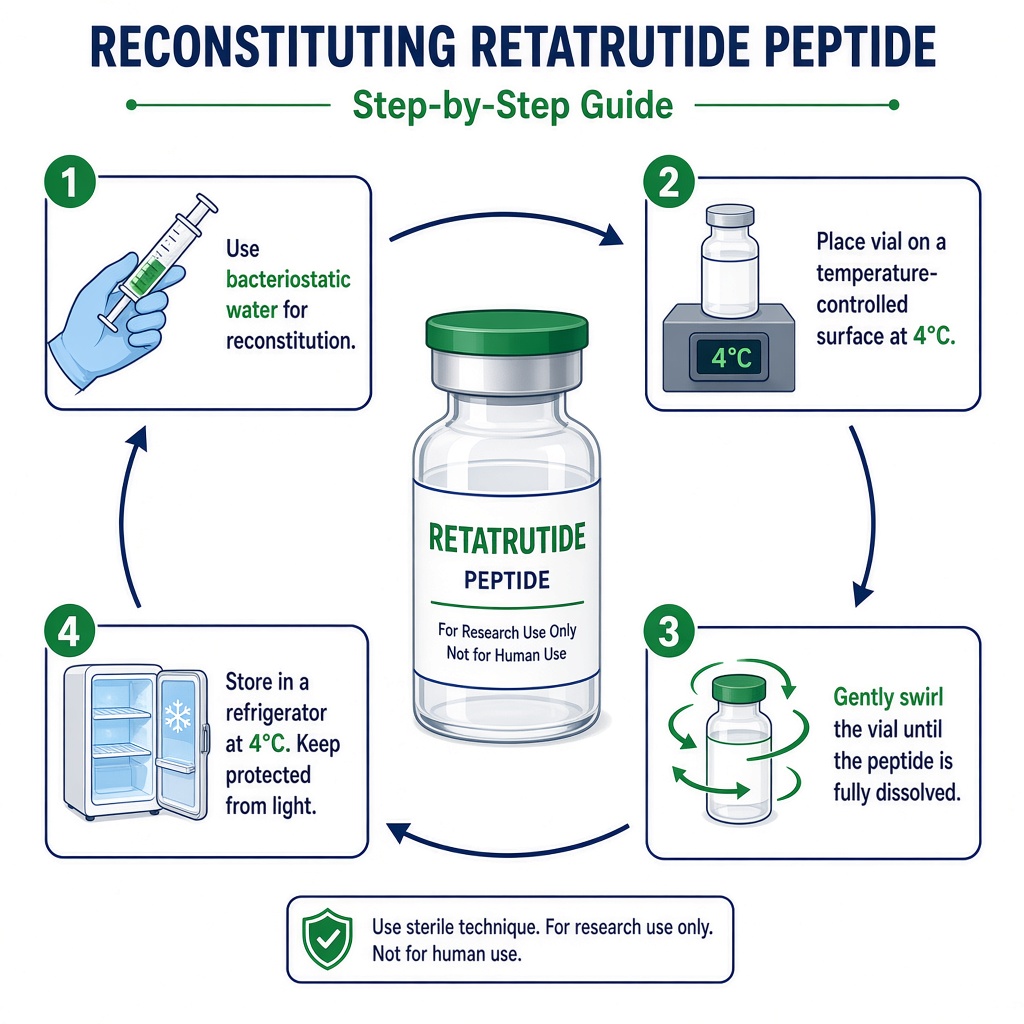
Proper handling begins before reconstitution. Lyophilized aavant research retatrutide should be stored at −20 °C in a non-frost-free freezer, protected from light and moisture. Repeated freeze-thaw cycles degrade peptide integrity, so researchers should aliquot the lyophilized powder only once if possible, or use desiccated storage containers.
Reconstitution should use an appropriate solvent — typically sterile, endotoxin-free water or a buffered solution compatible with the planned assay — and should be performed gently. Avoid vigorous shaking or vortexing, which can introduce shear stress and promote aggregation. After reconstitution, the solution should be kept on ice and used within the working window established for the specific assay.
Single-use aliquoting is the standard recommendation. Divide the reconstituted aavant research retatrutide into small aliquots and freeze unused portions at −20 °C or below. Avoid refreezing thawed aliquots, because each cycle can reduce biological activity and increase aggregation.
For animal model studies, researchers should follow institutional animal care and use committee (IACUC) protocols regarding dose preparation, storage, and disposal. No guidance in this review constitutes a dosing recommendation, and all use must remain within approved research parameters.
Storage Temperature and Stability
Lyophilized aavant research retatrutide is most stable at −20 °C, and some laboratories store at −80 °C for long-term retention. Avoid frost-free freezers, which cycle temperatures and can introduce moisture. If the peptide must be shipped, require cold-chain packaging and verify the package temperature on arrival. For short-term use, the lyophilized vial can be kept at 4 °C for a few days, but −20 °C remains the default.
Reconstitution Solvent Selection
The choice of reconstitution solvent depends on the downstream assay. Sterile water or phosphate-buffered saline (PBS) is common for receptor binding and cell culture work, while acidic buffers may be required if solubility is limited. Always use endotoxin-free, sterile solvents, and filter through a low-protein-binding membrane if the protocol demands. Do not reuse reconstitution needles or syringes across vials.
What Do Researchers Report About aavant research retatrutide?
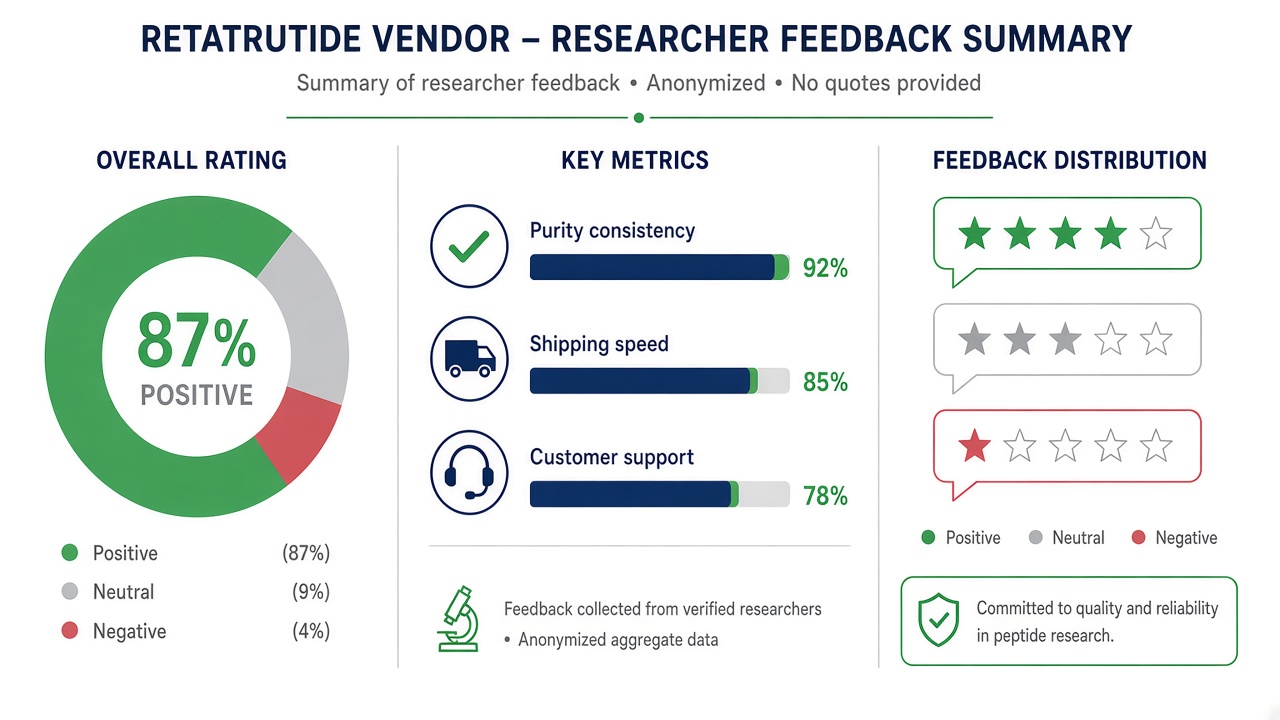
Researcher-reported quality signals for aavant research retatrutide center on documentation responsiveness and batch consistency. Many laboratories note that Aavant Research provides COAs on request, and some third-party catalogue entries show pass results at 98% or higher HPLC purity. However, community reports are not a substitute for independent verification of the specific batch received.
Common positive signals include intact vial seals, clear labeling with batch numbers and fill dates, and prompt shipment with cold-chain packaging when specified. Negative signals — such as missing COAs, mismatched batch numbers, or solubility problems after gentle reconstitution — should trigger immediate vendor follow-up.
Because researcher experiences vary by batch and by shipment, procurement teams should treat community feedback as a screening tool rather than a final decision criterion. The most reliable quality signal remains a batch-specific COA with a matching third-party catalogue entry. For a structured method to verify whether a peptide has published research backing, see Are There Studies on It? 7 Essential Ways to Check (2026).
💡 Key Takeaway: What Do Researchers Report About aavant research retatrutide?
How Does aavant research retatrutide Compare to Other Vendors?
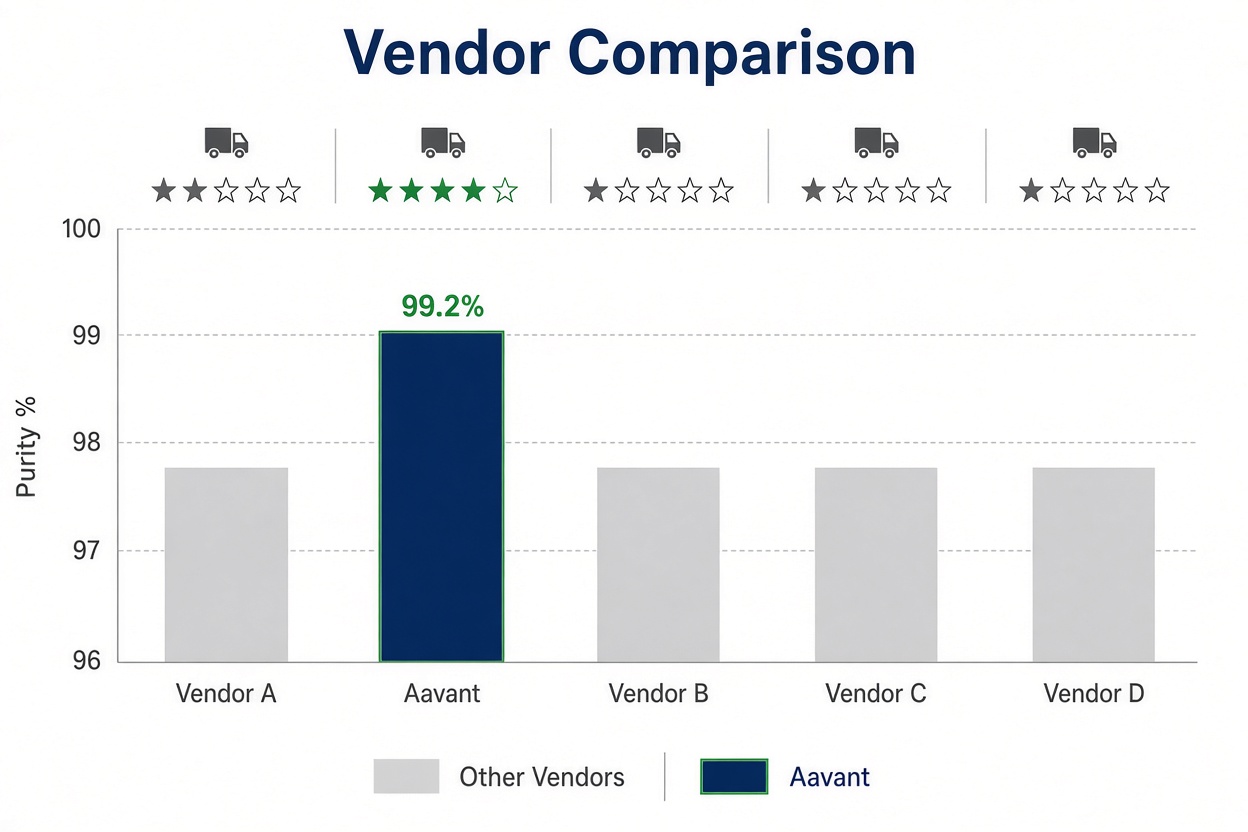
A structured vendor comparison for aavant research retatrutide should evaluate documentation depth, independent testing availability, storefront transparency, and community-reported consistency. The table below summarizes typical comparison criteria, with acceptance thresholds aligned to research-use standards.
| Comparison criterion | Strong vendor signal | Weak vendor signal |
|—|—|—|
| Batch-specific COA | Provided on request, matches vial | Generic or absent |
| Third-party catalogue | Finnrick listing with pass | No independent entry |
| Purity specification | ≥98–99% by HPLC | Unspecified or <95% |
| Mass spec identity | Confirmed at ~4.7 kDa | Missing or mismatched |
| Storefront policies | Clear research-use-only, refund policy | Vague or no policies |
When comparing aavant research retatrutide against competing listings, researchers should not assume that the lowest price reflects the same quality. Lyophilized peptide pricing varies with batch size, documentation level, and testing overhead; a listing without a COA often carries hidden risks that appear later as failed assays or unreproducible results.
The presence of a Finnrick catalogue entry for aavant research retatrutide is a meaningful differentiator, because many vendors in this sector do not submit batches for independent testing. Still, catalogue entries age, so the most recent entry should be checked at the time of purchase.
Third-Party Testing Frequency
Vendors that submit every batch to independent testing provide stronger quality assurance than vendors that test only occasionally. For aavant research retatrutide, the presence of a current Finnrick entry suggests a commitment to external verification, but researchers should confirm that the entry corresponds to the batch they receive. A catalogue entry older than six months may not reflect the current inventory.
Documentation vs Price
Lower-priced listings often omit COAs or provide only a generic purity claim. Researchers should budget for documentation verification as part of the purchase cost. A cheap vial that fails mass spec or shows 92% purity is not a savings; it is a failed experiment. Compare vendors on documentation completeness first, then price.
For broader vendor evaluation methodology, see Bibtides: The Complete Research Peptide Library Guide (2026), which catalogues vendor types and documentation expectations.
What Risks and Red Flags Should Researchers Consider?
The principal risk with any research peptide, including aavant research retatrutide, is batch-level impurity or misidentification. HPLC purity percentages can be inflated by vendor-selected integration parameters, and a COA that does not include the raw chromatogram should be viewed with caution. Request the full analytical trace, not only the summary number.
Another red flag is the absence of a mass spectrometry confirmation. HPLC purity alone cannot distinguish retatrutide from a closely related peptide with a similar retention time. Mass spec identity at the expected ~4.7 kDa is required to rule out substitution.
Storage and shipping failures also degrade material quality. If a lyophilized vial arrives at ambient temperature despite a stated cold-chain requirement, or if the powder appears clumped or discolored, document the condition and contact the vendor before use. Researchers should also confirm that the vial’s batch number matches the COA exactly.
Finally, any vendor language that implies human use, weight loss, or therapeutic application should trigger immediate rejection. Legitimate suppliers of aavant research retatrutide consistently frame the product as research-only, and deviation from that framing is a major compliance red flag.
Common Synthesis Impurities
Retatrutide synthesis can produce deletion sequences, truncated peptides, or oxidized methionine residues. These impurities may co-elute with the main peak under some HPLC conditions, which is why a high purity percentage alone is not definitive. Mass spectrometry and, where available, amino acid analysis or sequencing add orthogonal confirmation. Researchers should ask whether the COA includes any impurity profiling beyond the main peak.
Shipping Failures and Documentation
If a vial arrives at room temperature despite a cold-chain requirement, record the condition with photos and contact the vendor before use. Some lyophilized peptides tolerate brief ambient exposure, but the vendor should confirm whether the batch remains acceptable. Never accept a vial with a broken seal or a label that does not match the COA batch number.
How Can Researchers Source aavant research retatrutide?
Researchers can source aavant research retatrutide directly through the vendor storefront at aavantacr.com, but procurement should follow a documented workflow. Before ordering, request a sample COA for the current batch, confirm the batch identifier policy, and verify the third-party catalogue status on Finnrick. Only proceed if the vendor supplies documentation promptly.
Upon receipt, record the batch number, check the vial seal and label, and store the lyophilized material at −20 °C immediately. Do not reconstitute until the assay protocol is ready, and then follow the handling and aliquoting steps described above. Maintain a chain-of-custody log for each vial.
Institutional buyers should route purchases through their compliance office or procurement system, ensuring that the vendor’s research-use-only status aligns with institutional policies. All use must fall within approved animal care or cell culture protocols; no human administration is permitted under any circumstances.
Pre-Order Documentation Requests
Before ordering aavant research retatrutide, email the vendor and request the current batch COA, including the HPLC trace and mass spec spectrum. Ask whether the batch has a Finnrick entry and request the catalogue ID. A vendor that supplies these within one to two business days demonstrates a functional documentation system; a vendor that deflects or sends a generic PDF should be avoided.
Receipt Inspection Steps
On receipt, check the outer packaging for damage, verify the vial label against the COA batch number, and inspect the lyophilized cake. The powder should be white to off-white and free of cracks or discoloration. Immediately place the vial at −20 °C and log the receipt in your laboratory inventory system. Do not proceed to reconstitution until all documentation checks pass.
💡 Key Takeaway: How Can Researchers Source aavant research retatrutide?
Which Documentation Should a Procurement Checklist Include for aavant research retatrutide?
A procurement checklist for aavant research retatrutide should include the following items, each with a verification action. Use this checklist at both the pre-order and receipt stages to standardize vendor due diligence.
| Checklist item | Verification action |
|—|—|
| Batch-specific COA | Request current batch COA; confirm HPLC and MS sections present |
| Purity percentage | Confirm ≥98–99% HPLC with single dominant peak |
| Mass spec identity | Confirm observed mass matches ~4.7 kDa |
| Third-party catalogue | Check Finnrick for a recent pass entry |
| Vial labeling | Verify batch number, fill date, and research-use-only statement |
| Storage condition on arrival | Confirm lyophilized state, no discoloration, cold-chain if specified |
| Compliance alignment | Ensure institutional protocol covers in vitro or animal model use only |
Using this checklist reduces the risk of accepting a mislabeled or substandard batch. For researchers new to peptide sourcing, the broader evidence framework in Exploring Peptides: The Complete Evidence Review (2026) provides additional context on peptide quality assessment.
FAQ
What is aavant research retatrutide?
Aavant research retatrutide is a lyophilized triple agonist at the GIP, GLP-1, and glucagon receptors, sold by Aavant Research for in vitro laboratory research only. It is not approved for human or veterinary use.
How can I verify the purity of aavant research retatrutide?
Request a batch-specific COA that includes HPLC purity (≥98–99%) and mass spectrometry identity confirmation at approximately 4.7 kDa. Check the raw chromatogram for a single dominant peak and confirm the batch number matches the vial.
What storage conditions preserve aavant research retatrutide?
Store lyophilized material at −20 °C in a non-frost-free freezer, protected from light and moisture. After reconstitution, aliquot and freeze unused portions at −20 °C or below; avoid repeated freeze-thaw cycles.
Is aavant research retatrutide legitimate for research use?
Legitimacy is supported by batch-specific COAs, independent Finnrick catalogue entries, and transparent storefront policies at aavantacr.com. However, researchers must verify the specific batch received, because no vendor assessment replaces batch-level documentation.
Does aavant research retatrutide require third-party testing?
Third-party testing is not mandatory but strongly recommended. Finnrick catalogue entries provide independent purity and pass/fail data, and researchers should check the most recent entry before purchase.
Topics covered in this article:
Ready to Take the Next Step?
Every product includes lot-specific documentation and third-party purity testing.
Explore Our Research Products →Free shipping on qualifying orders · Batch COA on request