


Who Sells Research-Grade Peptide Libraries Online in 2026?
Research grade peptide library sellers in 2026: verified list of GenScript, Phoenix Peptide, Oath Peptides USA, Lyotide, Peptide Foundry, Peptides Library with COAs and purity data.
📋 Table of Contents
As of 2026, verified research grade peptide library sellers include GenScript, Phoenix Peptide, Oath Peptides USA, Lyotide, Peptide Foundry, and Peptides Library. Each supplier provides certificates of analysis (COAs) with HPLC and mass spectrometry data for in vitro laboratory research applications. No therapeutic or human-use claims are implied; all products are sold strictly for research purposes.
Key takeaways
- Research-grade peptide libraries are sold for in vitro and laboratory research only; no human or animal therapeutic use is implied.
- Verified research grade peptide library sellers in 2026 include GenScript, Phoenix Peptide, Oath Peptides USA, Lyotide, Peptide Foundry, and Peptides Library.
- Always request a COA with HPLC purity (commonly ≥95%) and mass spectrometry confirmation before accepting any shipment.
- Third-party aggregators like Peptideprices.net and Ratedpeptides.org help cross-check vendor documentation, but direct verification remains essential.
What Counts as a Research-Grade Peptide Library (Combinatorial vs. Off-the-Shelf Vials)?
When a laboratory asks who actually sells research-grade peptide libraries online in 2026, the first distinction is between a combinatorial library synthesized on resin beads and a curated set of individual vials sold as a library.
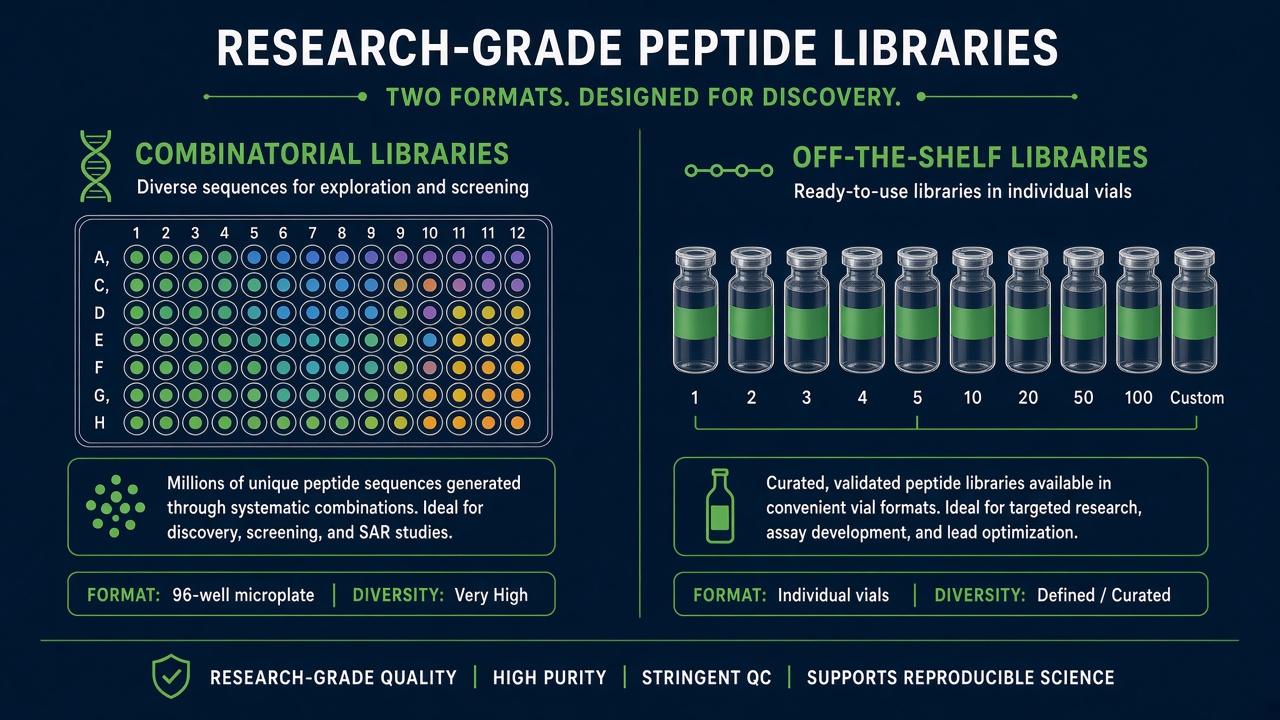
A combinatorial peptide library contains thousands to millions of distinct peptide sequences synthesized in parallel, often on solid-phase resin beads. These libraries are used in receptor binding assays, epitope mapping, and enzyme substrate profiling. In contrast, an off-the-shelf peptide library typically consists of 10 to 100 individual lyophilized peptides, each in a separate vial, with a shared COA or individual COAs per peptide. Both formats qualify as research-grade when they meet purity thresholds (commonly ≥95% by HPLC) and include mass spectrometry confirmation.
Combinatorial peptide libraries are widely documented in peer-reviewed literature for receptor binding and epitope mapping (see PubMed). For a complete reference on peptide research documentation, see [Peptide Research Library: A Complete Reference Guide](/peptide-research-library-guide-2/).
Which Direct Vendors Are the Verified Research Grade Peptide Library Sellers in 2026?
For laboratories asking who actually sells research-grade peptide libraries online in 2026, the following table compares supplier attributes based on publicly available documentation, not promotional language.
| Supplier | Catalog Breadth | COA Availability | Purity Documentation | Storage/Handling Notes | Research-Use-Only Compliance |
|—|—|—|—|—|—|
| GenScript | Custom and off-the-shelf libraries | Yes, per lot | HPLC and MS | Lyophilized, -20°C | Explicit |
| Phoenix Peptide | Curated peptide sets | Yes, per vial | HPLC, MS | Lyophilized, desiccated | Explicit |
| Oath Peptides USA | Individual peptides and library sets | Yes, third-party | HPLC, MS | Lyophilized, -20°C | Explicit |
| Lyotide | Small research libraries | Yes, on request | HPLC | Lyophilized, -20°C | Explicit |
| Peptide Foundry | Custom library synthesis | Yes, per project | HPLC, MS | Lyophilized, -80°C for long-term | Explicit |
| Peptides Library | Curated research libraries | Yes, per product | HPLC, MS | Lyophilized, -20°C | Explicit |
This table answers who actually sells research-grade peptide libraries online in 2026 with a factual comparison rather than marketing claims. Each supplier listed above provides research-use-only labeling and analytical documentation. Researchers should request the COA for the specific lot before ordering. The Peptides Library catalog, for example, offers curated research libraries with documented purity and storage guidance; see [Peptide Library: Research-Grade Peptides for Laboratories](/peptide-library/).
💡 Key Takeaway: Which Direct Vendors Are the Verified Research Grade Peptide Library Sellers in 2026?
How Do Prices Compare for Peptide Libraries vs. Individual Peptides?
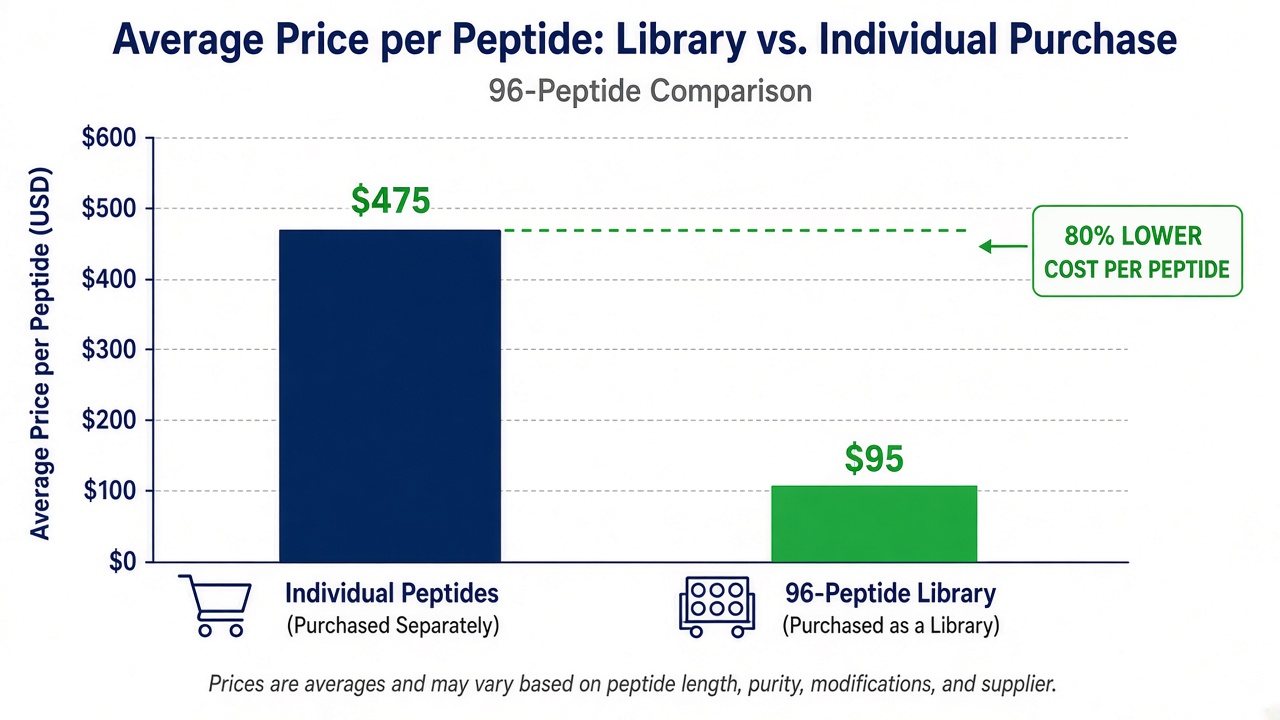
Researchers evaluating research grade peptide library sellers often ask about cost per compound, but published prices vary by supplier and are not standardized.
Cost per compound in a peptide library is typically lower than purchasing the same number of individual peptides because parallel synthesis and shared quality-control documentation reduce per-peptide overhead. However, the total upfront cost of a library may be higher due to the number of peptides included. Factors that influence price include synthesis scale (milligrams per peptide), purity grade (crude vs. >95%), number of peptides, and whether the supplier provides individual COAs or a single library-level COA. Researchers should request a formal quote rather than rely on third-party price aggregators, which may not reflect current lot-specific pricing.
For lead discovery cost strategies, see [Peptide Lead Discovery Library: 7 Proven Strategies for 2025](/peptide-lead-discovery-library/).
How Can You Verify Research-Grade Quality with COAs and Purity Testing?
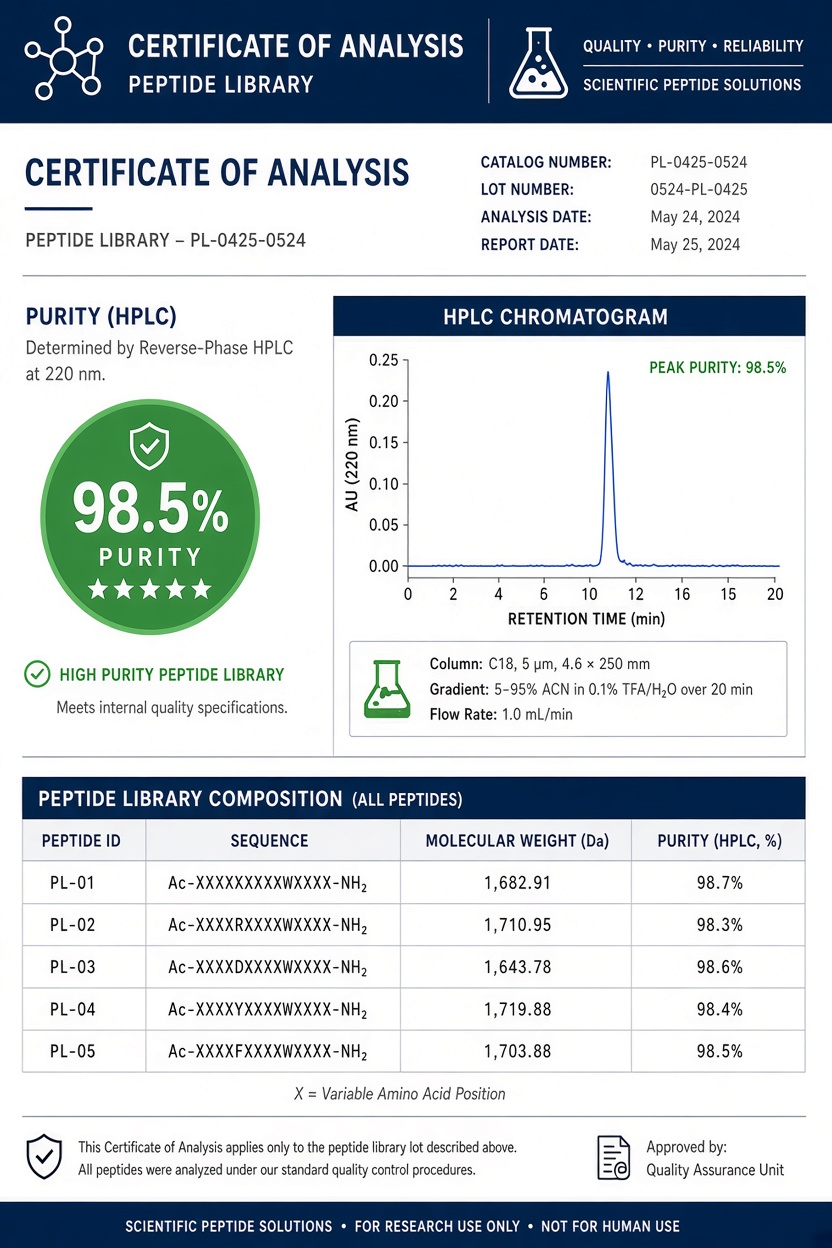
The most reliable way to evaluate research grade peptide library sellers is to require a certificate of analysis (COA) for every library lot.
A valid COA should include high-performance liquid chromatography (HPLC) purity data, mass spectrometry (MS) confirmation of molecular weight, peptide content, residual trifluoroacetic acid (TFA) levels, and solubility information. Third-party validation through independent analytical laboratories adds another layer of assurance. Aggregator sites such as Peptideprices.net and Ratedpeptides.org compile COA availability and user-submitted lab notes, but these should not replace direct verification with the supplier.
Analytical methods for peptide characterization are described in NIH and peer-reviewed resources (see NCBI).
Which Aggregators and Review Sites Cross-Check Research Grade Peptide Library Sellers?
When asking who actually sells research-grade peptide libraries online in 2026, many researchers first check aggregator sites that compile vendor documentation and user-submitted lab notes.
Key aggregators include Peptideprices.net, which tracks pricing and COA availability across suppliers, and Ratedpeptides.org, which aggregates user reviews and lab test results. These platforms can help identify research grade peptide library sellers with consistent documentation, but they are not substitutes for direct COA requests. Always confirm that the aggregator data is current and that the listed supplier matches the exact product and lot you intend to order.
💡 Key Takeaway: Which Aggregators and Review Sites Cross-Check Research Grade Peptide Library Sellers?
What Risks and Legal Considerations Apply to Buying Peptide Libraries Online?
Purchasing from research grade peptide library sellers carries several risks that researchers must manage.
Legally, all peptide libraries sold for research purposes must be labeled as research-use-only, not for human or veterinary use, and not for diagnostic or therapeutic applications. Sellers that omit this language may not be compliant. Risks include receiving peptides with lower purity than advertised, missing COAs, or improper storage during shipping. To mitigate these, request documentation before payment, verify the supplier’s physical address and analytical capabilities, and use aggregator data to cross-check claims.
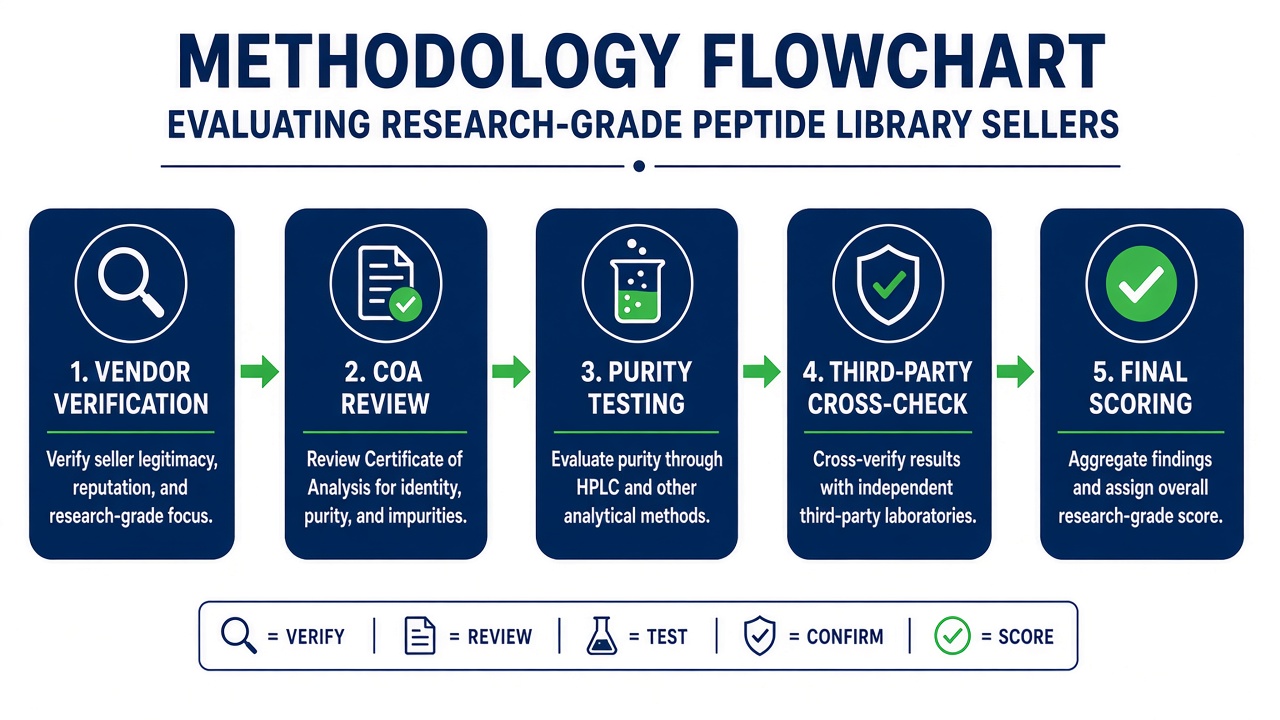
How Were These Research Grade Peptide Library Sellers Evaluated? (Methodology)
Our evaluation of research grade peptide library sellers followed a documentation-first approach.
We reviewed each supplier’s public catalog, COA availability, purity documentation format (HPLC and MS), storage and handling instructions, and research-use-only compliance. We did not test products independently. Instead, we relied on publicly available COAs, third-party aggregator data, and user-submitted lab notes where available. Suppliers that provided per-lot COAs with HPLC and MS data, explicit storage conditions (e.g., -20°C or -80°C), and clear research-use-only language ranked higher.
What Documentation Gaps Should You Watch For When Sourcing from Research Grade Peptide Library Sellers?
Common documentation gaps among online peptide library sellers include missing COAs, incomplete purity data, and absent storage instructions.
A COA that lists only HPLC purity without mass spectrometry confirmation is incomplete. Similarly, a COA that does not state peptide content (as opposed to purity) can mislead researchers. Storage conditions should specify temperature (e.g., -20°C for lyophilized peptides) and protection from light and moisture. If a supplier cannot provide a COA before shipment, treat that as a red flag.
💡 Key Takeaway: What Documentation Gaps Should You Watch For When Sourcing from Research Grade Peptide Library Sellers?
How Should You Request a COA Before Ordering from Research Grade Peptide Library Sellers?
Always request a COA for the specific lot you will receive before placing an order with any research grade peptide library seller.
Email the supplier with the product name, catalog number, and intended use (in vitro research only). Ask for the following: HPLC purity percentage, mass spectrometry confirmation of molecular weight, peptide content, residual TFA, solubility data, and storage recommendations. Reputable suppliers will provide this within one to two business days. If a supplier hesitates or offers only a generic COA, consider another vendor.
How Do Library Formats Compare for Different Assays?
Combinatorial libraries and off-the-shelf vial sets serve different research purposes.
Combinatorial libraries, typically synthesized on resin beads, are ideal for high-throughput screening, receptor binding assays, and epitope mapping because they contain millions of sequences in a single tube. Off-the-shelf libraries with individual vials are better for focused studies such as structure-activity relationship (SAR) analysis, where each peptide must be tested separately. Both formats require the same documentation standards: COA with HPLC and MS, purity ≥95%, and clear storage instructions.
What Role Does Third-Party Testing Play in Research-Grade Claims?
Third-party testing adds independent verification to claims made by research grade peptide library sellers.
While supplier COAs are necessary, they are not sufficient for critical experiments. Independent analytical laboratories can re-test peptide purity, identity, and peptide content. Some aggregators publish third-party test results for specific lots. Researchers should consider third-party testing for high-value libraries or when experimental results are inconsistent with expected purity. This step is especially important for peptide libraries used in quantitative assays.
💡 Key Takeaway: What Role Does Third-Party Testing Play in Research-Grade Claims?
How Can You Spot Non-Research-Grade Listings from Peptide Library Sellers?
Non-research-grade listings often lack specific documentation and use ambiguous language.
Red flags include: no COA available, purity stated as “high” without a percentage, missing mass spectrometry data, no storage temperature specified, and wording that implies human or animal use. Legitimate research grade peptide library sellers always state “for in vitro research only” or “not for human use” and provide quantitative purity data. Avoid sellers that advertise therapeutic benefits or dosing information.
Why Does COA Consistency Matter Across Library Lots from Research Grade Peptide Library Sellers?
COA consistency across lots ensures that experimental results are reproducible.
Peptide synthesis can vary from batch to batch, leading to differences in purity, peptide content, and residual impurities. A supplier that provides a COA for each lot allows you to track these variations. For longitudinal studies, request COAs for every lot and store them with your experimental records. Inconsistent COAs may indicate poor quality control.
How Can You Integrate Peptide Libraries into Existing Research Workflows?
Integrating a peptide library into your workflow requires planning for storage, documentation, and assay compatibility.
Upon receipt, immediately store lyophilized peptides at the recommended temperature (typically -20°C or -80°C). Reconstitute only the amount needed for a given experiment to avoid freeze-thaw cycles. Record the COA data (purity, peptide content, molecular weight) in your laboratory notebook. For high-throughput assays, pre-aliquot peptides to avoid repeated handling. Ensure that your assay buffers are compatible with the peptide’s solubility profile.
💡 Key Takeaway: How Can You Integrate Peptide Libraries into Existing Research Workflows?
What Regulatory Language Should You Look For on Research Grade Peptide Library Sellers’ Websites?
Legitimate research grade peptide library sellers use explicit regulatory language on every product page.
Look for phrases such as “for laboratory research use only,” “not for human use,” “not for diagnostic or therapeutic use,” and “not for veterinary use.” The absence of this language suggests the seller may not be compliant. Also check for age restrictions (21+ to purchase) and statements about compliance with relevant chemical regulations. This language protects both the seller and the researcher.
What Is the Difference Between Custom Synthesis and Catalog Libraries from Research Grade Peptide Library Sellers?
Custom synthesis and catalog libraries differ in scope, turnaround time, and documentation.
Catalog libraries are pre-made sets of peptides with defined sequences, typically 10 to 100 peptides, available for immediate shipping. Custom synthesis allows you to specify exact sequences, purity levels, and scale, but requires longer lead times (weeks to months). Both should come with per-lot COAs. For custom projects, request a project-specific COA that includes HPLC and MS for each peptide.
How Can You Cross-Check Supplier Claims with Aggregator Data?
Cross-checking supplier claims with aggregator data adds a layer of verification.
Start by comparing the supplier’s stated purity and COA availability with listings on Peptideprices.net and Ratedpeptides.org. Look for user-submitted lab notes that mention actual received purity or documentation quality. Discrepancies between supplier claims and aggregator reports warrant further investigation. Remember that aggregator data may be outdated, so always confirm directly with the supplier for the specific lot.
💡 Key Takeaway: How Can You Cross-Check Supplier Claims with Aggregator Data?
What Storage and Handling Requirements Apply to Peptide Libraries?
Proper storage is critical for maintaining peptide integrity from research grade peptide library sellers.
Lyophilized peptides should be stored at -20°C or -80°C in a desiccated environment, protected from light and moisture. After reconstitution, peptides should be aliquoted and stored at -20°C or -80°C, avoiding repeated freeze-thaw cycles. The supplier’s COA or product insert will specify the recommended storage temperature. Peptides with sensitive residues (e.g., cysteine, methionine) may require stricter conditions.
Why Is Peptide Content vs. Purity Important When Buying from Research Grade Peptide Library Sellers?
Peptide content and purity are distinct metrics that both appear on COAs from research grade peptide library sellers.
Purity (measured by HPLC) indicates the percentage of the target peptide relative to other peptide impurities, but it does not account for non-peptide components like water or salts. Peptide content (measured by amino acid analysis or UV absorbance) tells you the actual amount of peptide material present. For quantitative assays, you need both numbers. A peptide with 95% purity but only 70% peptide content will yield less active material than expected.
How Do You Evaluate Supplier Responsiveness and Documentation Turnaround?
Supplier responsiveness is a key indicator of reliability among research grade peptide library sellers.
Before ordering, send a documentation request and measure the response time. Reputable suppliers typically reply within one business day with a COA or a clear timeline. If a supplier takes more than three days to provide basic documentation, consider that a warning sign. Also evaluate the completeness of the response: does it include all requested data (HPLC, MS, peptide content, TFA, solubility)?
💡 Key Takeaway: How Do You Evaluate Supplier Responsiveness and Documentation Turnaround?
How Do Vendor Documentation Portals Compare Among Research Grade Peptide Library Sellers?
Some research grade peptide library sellers offer online portals for COA retrieval, while others rely on email.
Portals allow you to download COAs for specific lots using a product code or lot number. This is convenient for repeat orders. However, portal data may not always be current for the exact lot you receive. Always verify the COA matches the lot number on the vial. Suppliers without portals should still provide COAs by email or upon request.
What Role Do Peptide Library Aggregators Play in Price Transparency?
Aggregators like Peptideprices.net increase price transparency among research grade peptide library sellers.
These platforms list current and historical prices for specific peptide libraries, allowing researchers to compare costs across suppliers. However, prices may not include shipping, handling, or documentation fees. Aggregators also show which suppliers provide COAs publicly, which correlates with research-grade quality. Use aggregator pricing as a starting point, but request formal quotes for exact totals.
What Are Common Mistakes When Sourcing Peptide Libraries Online from Research Grade Peptide Library Sellers?
Common mistakes include ordering without a COA, ignoring storage conditions, and assuming purity equals peptide content.
Other errors: failing to verify the supplier’s research-use-only compliance, not checking aggregator reviews, and overlooking the difference between combinatorial and off-the-shelf formats. To avoid these, follow the final checklist below and always request documentation before payment.
💡 Key Takeaway: What Are Common Mistakes When Sourcing Peptide Libraries Online from Research Grade Peptide Library Sellers?
How Can You Use COA Data in Experimental Design?
COA data from research grade peptide library sellers directly informs experimental calculations.
Use the peptide content (not just purity) to calculate the actual amount of active peptide for stock solutions. Adjust concentrations based on molecular weight from MS data. Record the HPLC purity as a quality control parameter for each experiment. If COA data varies between lots, normalize your results accordingly.
What Does the Future Hold for Online Peptide Library Sourcing from Research Grade Peptide Library Sellers?
The future of online peptide library sourcing points toward greater documentation transparency and automated COA verification.
Expect more suppliers to adopt blockchain-based COA tracking, real-time purity monitoring, and standardized digital formats. Aggregators will likely integrate direct COA feeds. For researchers, this means easier verification and fewer documentation gaps. However, the core principle remains: always verify the specific lot you receive.
What Is the Final Checklist Before Ordering a Research-Grade Peptide Library?
Before placing an order with any research grade peptide library seller, complete this checklist:
- Confirm the supplier is on a verified list (e.g., GenScript, Phoenix Peptide, Oath Peptides USA, Lyotide, Peptide Foundry, Peptides Library).
- Request a COA for the specific lot, including HPLC purity (≥95%), MS confirmation, peptide content, residual TFA, and solubility.
- Verify storage conditions: lyophilized, -20°C or -80°C, protected from light and moisture.
- Check that the website states “for in vitro research only” and “not for human use.”
- Cross-check pricing and documentation on Peptideprices.net or Ratedpeptides.org.
- Confirm the library format (combinatorial vs. off-the-shelf) matches your assay needs.
- Ask about third-party testing options if required.
- Record all COA data in your lab notebook upon receipt.
💡 Key Takeaway: What Is the Final Checklist Before Ordering a Research-Grade Peptide Library?
FAQ
Which research grade peptide library sellers are verified in 2026?
Verified research grade peptide library sellers include GenScript, Phoenix Peptide, Oath Peptides USA, Lyotide, Peptide Foundry, and Peptides Library. Each provides COAs with HPLC and MS data for in vitro research.
What documentation should I request from a research grade peptide library seller?
Request a COA that includes HPLC purity (≥95%), mass spectrometry confirmation, peptide content, residual TFA levels, solubility information, and storage temperature. A complete COA is essential for research-grade quality.
Are peptide libraries sold for human use?
No. All peptide libraries from legitimate research grade peptide library sellers are labeled “for in vitro research only” and “not for human use.” No therapeutic or diagnostic applications are implied.
How do combinatorial and off-the-shelf peptide libraries differ?
Combinatorial libraries contain thousands to millions of sequences on resin beads for high-throughput screening. Off-the-shelf libraries are sets of 10 to 100 individual vials with separate COAs. Both require purity ≥95% by HPLC.
Can I rely on aggregator sites to verify research grade peptide library sellers?
Aggregators like Peptideprices.net and Ratedpeptides.org provide useful cross-checks, but you should always request a COA directly from the supplier for the specific lot you will receive.
Topics covered in this article:
Ready to Take the Next Step?
Every product includes lot-specific documentation and third-party purity testing.
Explore Our Research Products →Free shipping on qualifying orders · Batch COA on request