


PT 141 vs Kisspeptin 10: 7 Research Differences Today
Research differences today between PT-141 and kisspeptin-10: FDA status, mechanism, outcomes, safety, and research-use comparisons in 7 evidence-based dimensions.
📋 Table of Contents
PT-141 (bremelanotide) has stronger regulatory and clinical footing than kisspeptin-10 because it is the active ingredient in the FDA-approved product Vyleesi for acquired, generalized hypoactive sexual desire disorder (HSDD) in premenopausal women, while kisspeptin-10 remains an investigational peptide studied mostly for LH, FSH, and testosterone signaling. This comparison of research differences today separates regulatory status from mechanism across seven evidence-based dimensions, using only research-use framing from Peptides Library.
Key takeaways
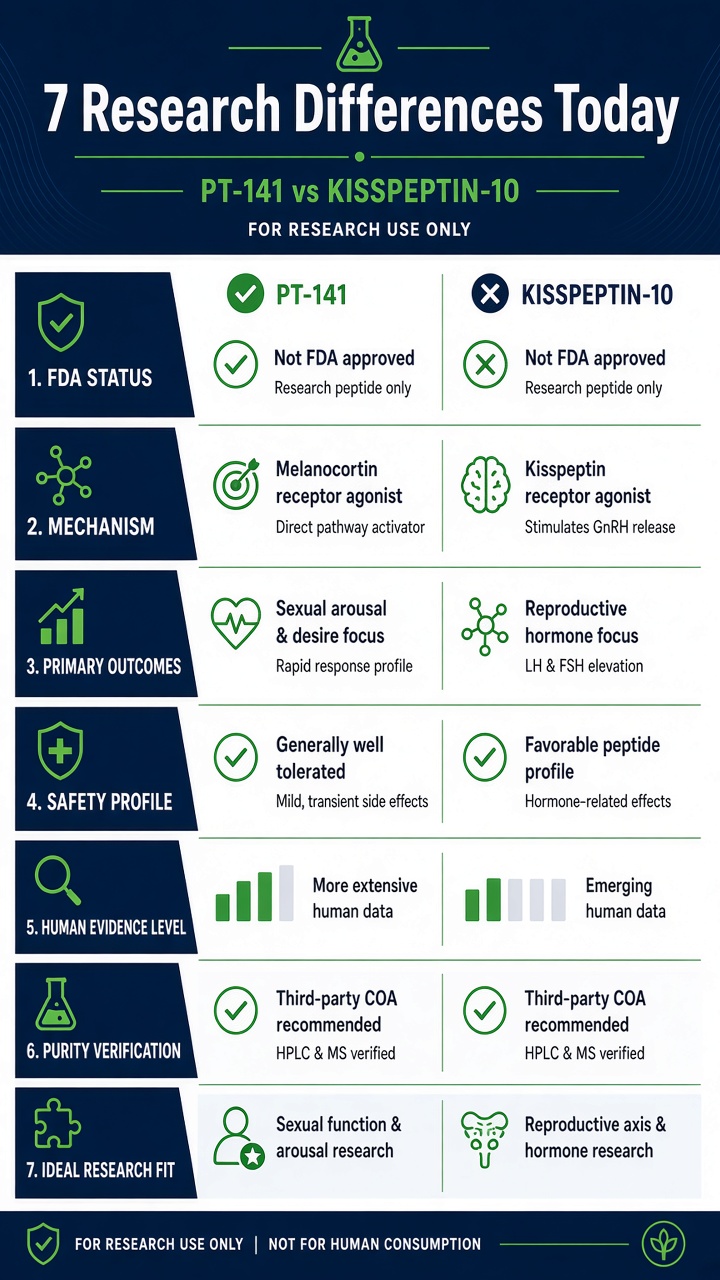
The following research differences today emerge when comparing PT-141 and kisspeptin-10.
- Regulatory status: PT-141 is the active ingredient in the FDA-approved product Vyleesi; kisspeptin-10 remains investigational.
- Primary outcomes: PT-141 links to sexual-desire treatment endpoints; kisspeptin-10 links to LH, FSH, testosterone, and LH pulse frequency.
- Mechanism: PT-141 acts through melanocortin receptors (MC1R, MC4R); kisspeptin-10 acts through the reproductive neuroendocrine axis.
- Safety depth: FDA materials describe kisspeptin-10 limited nonclinical toxicity information as too limited in scope and duration to inform potential clinical uses.
- Practical use: Choose PT-141 for sexual-function treatment research questions; choose kisspeptin-10 for reproductive-endocrine mechanism research.
What is the short answer on PT-141 vs kisspeptin-10 research differences today?
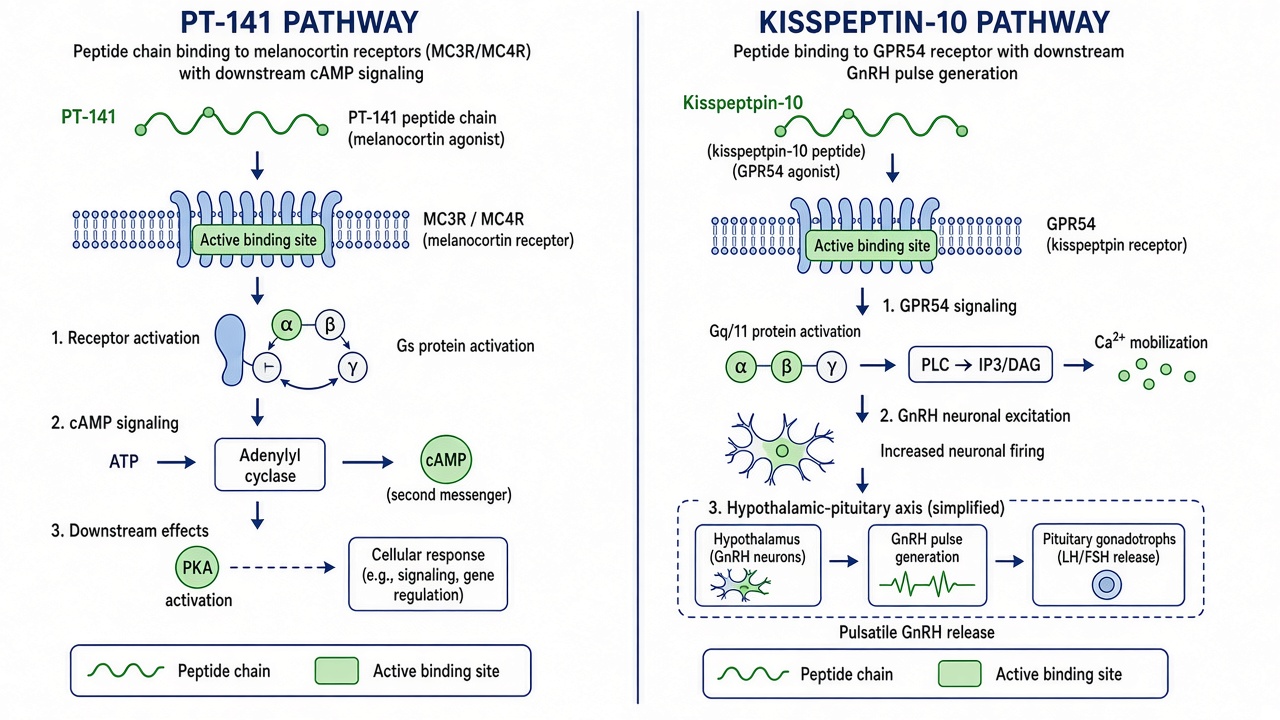
The short answer on pt 141 vs kisspeptin 10 research differences today is that PT-141 and kisspeptin-10 are not close substitutes. As Peptides Library reads the FDA and human data, PT-141 has stronger product-label support for hypoactive sexual desire disorder, while kisspeptin-10 is mainly a reproductive-endocrine research peptide with narrower human evidence.
The fastest way to compare them is to separate three layers: regulatory status, mechanism, and outcome quality. PT-141, also called bremelanotide, has an approved product identity through Vyleesi. Kisspeptin-10 does not have that kind of product-label backing and is discussed more often as an investigational compound within endocrine or compounding-related contexts.
That means the question is not just, ‘Which peptide is stronger?’ The better question is, ‘Stronger for what?’ If the target is a labeled sexual-desire indication, PT-141 clearly has the better footing. If the target is hypothalamic-pituitary-gonadal signaling, kisspeptin-10 becomes more relevant. This distinction is central to any research differences today comparison.
How do PT-141 and kisspeptin-10 work differently?
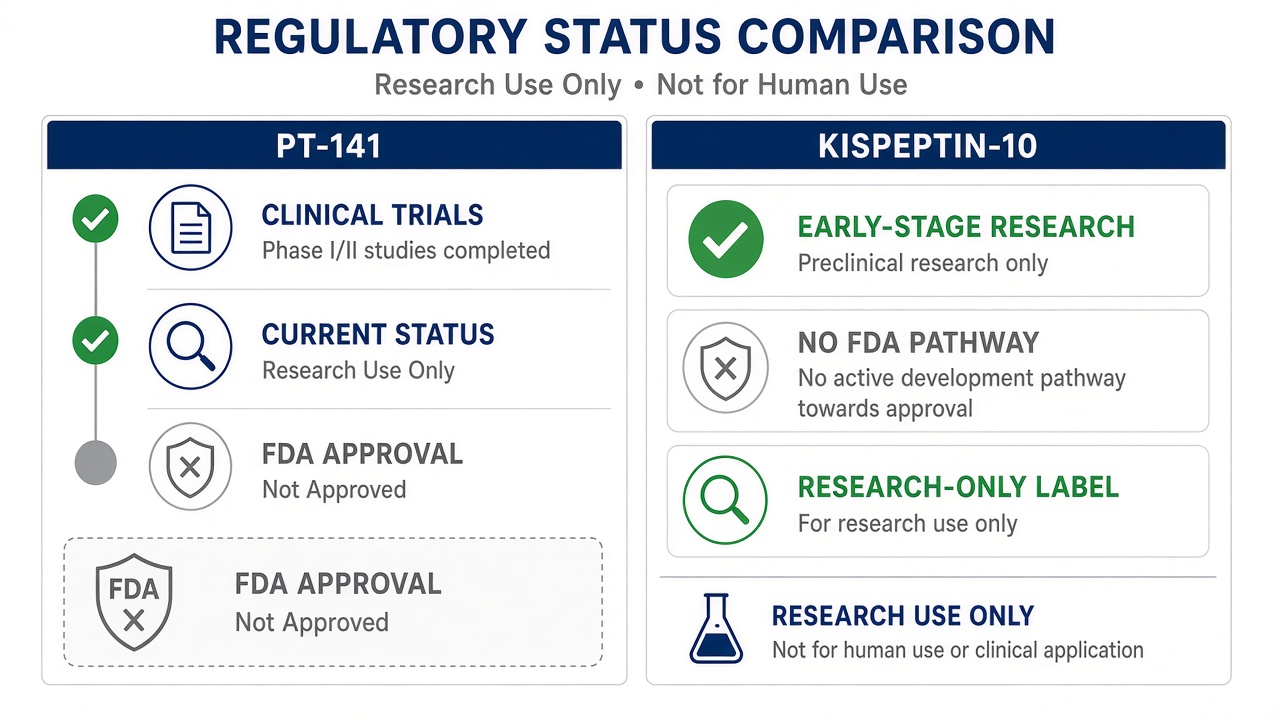
Understanding the mechanism is central to pt 141 vs kisspeptin 10 7 research differences today because the two compounds act through separate receptor systems. PT-141 acts primarily through melanocortin receptors, especially MC1R and MC4R, while kisspeptin-10 signals through the kisspeptin-GnRH axis. One is framed around central desire biology; the other is framed around gonadotropin release and reproductive endocrine control.
According to DailyMed, bremelanotide is a melanocortin receptor agonist that nonselectively activates several receptor subtypes, with MC1R and MC4R the most relevant at therapeutic doses. That matters because melanocortin signaling is not the same as direct testosterone replacement, direct estrogen modulation, or direct gonadotropin therapy.
Kisspeptin-10 sits in a different biological lane. Kisspeptin peptides are studied for their role in stimulating GnRH neurons and influencing downstream luteinizing hormone and follicle-stimulating hormone release. In practical terms, kisspeptin-10 is usually discussed as an endocrine signaling tool, not as a labeled libido drug.
Peptides Library compares PT-141 and kisspeptin-10 as different research categories first in pt 141 vs kisspeptin 10 7 research differences today: approved melanocortin drug product versus investigational endocrine peptide. This mechanistic split is not a minor detail. A common mistake is assuming that anything linked to sexual function must operate through the same hormonal route. That is not how these two peptides map onto physiology. If two compounds affect related symptoms through different systems, then their evidence cannot be merged as if they were the same intervention.
💡 Key Takeaway: How do PT-141 and kisspeptin-10 work differently?
What are the 7 research differences in PT-141 vs kisspeptin-10 research differences today?
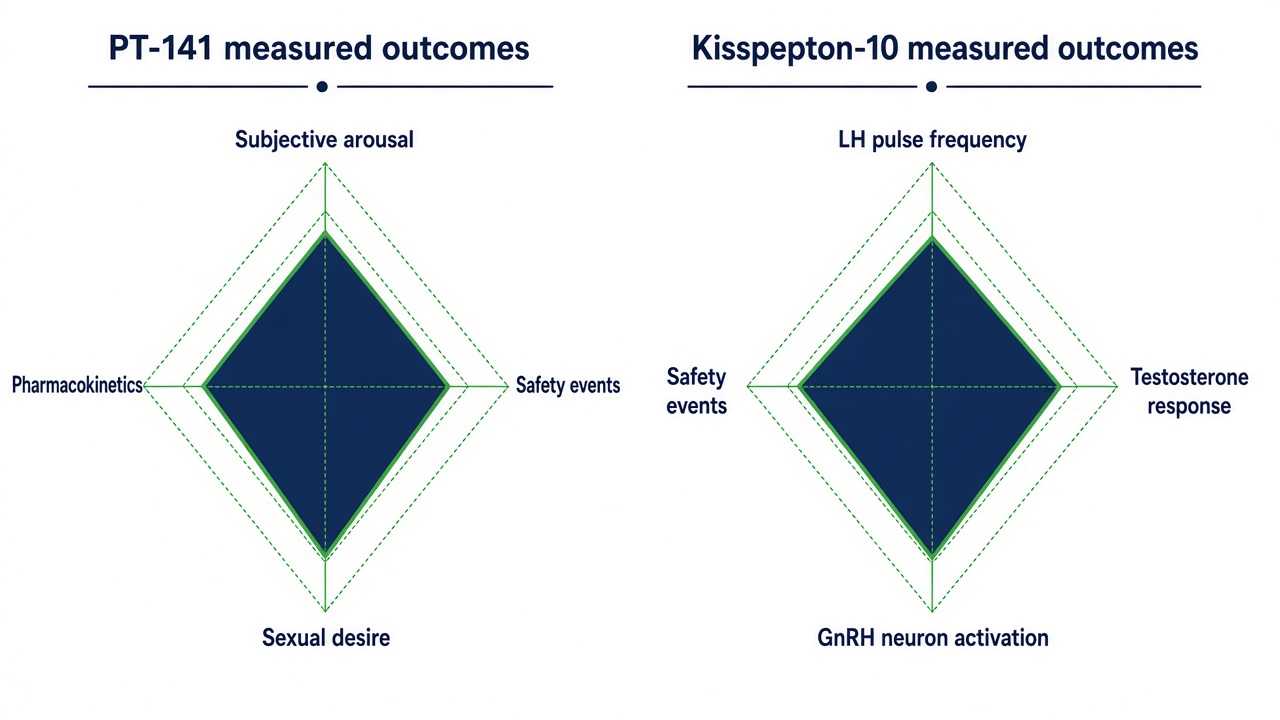
The seven biggest differences in pt 141 vs kisspeptin 10 7 research differences today are regulatory status, receptor target, primary outcomes, approved population, product formulation, safety depth, and evidence maturity. Those seven factors explain why PT-141 usually carries more decision-grade weight in current human-focused comparisons.
When readers mix these compounds together, they usually collapse one or more of those categories. Keeping them separate makes the literature much easier to interpret.
1. FDA status: PT-141 is the active ingredient in the FDA-approved product Vyleesi; kisspeptin-10 remains investigational in pt 141 vs kisspeptin 10 7 research differences today.
2. Core mechanism: PT-141 is a melanocortin receptor agonist; kisspeptin-10 primarily acts within the reproductive neuroendocrine pathway.
3. Best human endpoints: PT-141 is linked to HSDD treatment outcomes; kisspeptin-10 is linked more to LH, FSH, testosterone, and LH pulse frequency.
4. Population fit: PT-141’s labeled indication is limited to premenopausal women with acquired, generalized HSDD. That does not translate automatically to men or postmenopausal women.
5. Formulation maturity: PT-141 has a defined drug-device presentation as a subcutaneous autoinjector; kisspeptin-10 research is less standardized at the product level.
6. Safety package depth: PT-141 has formal regulatory review as an approved product; FDA materials say kisspeptin-10 has limited nonclinical toxicity information for potential clinical uses.
7. Research purpose: PT-141 is closer to a treatment-context peptide; kisspeptin-10 is closer to a mechanistic endocrine probe.
Reviewing these seven dimensions clarifies pt 141 vs kisspeptin 10 7 research differences today without merging the two peptides. If your question is clinical applicability, differences 1, 3, 4, and 6 matter most. If your question is mechanistic endocrinology, differences 2 and 7 become more important.
Which one has stronger FDA and regulatory status?
PT-141 clearly leads on regulatory status in pt 141 vs kisspeptin 10 7 research differences today. Vyleesi, the bremelanotide product in DailyMed and FDA records, has an approved NDA and labeled indication; kisspeptin-10 appears in FDA compounding and toxicity materials as an investigational substance, not an approved sexual-dysfunction therapy.
The FDA lists Vyleesi as a new molecular entity approved on June 21, 2019 under NDA 210557. FDA also describes it as a synthetic, cyclic heptapeptide and a complex drug-device combination delivered by subcutaneous autoinjector.
By contrast, kisspeptin-10 appears in a Federal Register notice tied to pharmacy compounding review, where FDA discussed it as a bulk drug substance under evaluation for treatment of secondary hypogonadism in men. That is not the same thing as product approval, labeled efficacy, or standardized clinical use.
One misconception is that ‘being discussed by FDA’ equals approval. It does not. In this research differences today analysis, PT-141 holds the approved product position, while kisspeptin-10 remains in an earlier evidence stage.
How should you compare the human evidence step by step?
Comparing human evidence for PT-141 and kisspeptin-10 requires separating trial designs, endpoints, and regulatory review depth. This step-by-step method prevents the most common error in pt 141 vs kisspeptin 10 7 research differences today: treating a mechanistic signal as if it were a labeled treatment outcome.
1. Identify the approval status: Check whether the peptide has an FDA-approved product label. PT-141 does through Vyleesi; kisspeptin-10 does not.
2. List the primary endpoints from human studies. For PT-141, those are HSDD-related sexual desire endpoints. For kisspeptin-10, those are LH, FSH, testosterone, and LH pulse frequency.
3. Check the population. PT-141’s labeled indication covers premenopausal women with acquired, generalized HSDD. Kisspeptin-10 studies often focus on male reproductive endocrine signaling or hypogonadism models.
4. Review safety depth. PT-141 has formal regulatory review; FDA materials state kisspeptin-10 has limited nonclinical toxicity information that is too limited in scope and duration to inform potential clinical uses.
5. Assign the research question. If the question is sexual-desire treatment, PT-141 fits better. If the question is reproductive-endocrine mechanism, kisspeptin-10 fits better.
This five-step comparison keeps research differences today clear without conflating the two peptides.
💡 Key Takeaway: How should you compare the human evidence step by step?
What outcomes are actually measured in studies of each peptide?
Outcome measurement is where the pt 141 vs kisspeptin 10 7 research differences today become most visible. PT-141 studies focus on patient-reported sexual desire and distress endpoints tied to HSDD, while kisspeptin-10 studies focus on hormonal readouts like luteinizing hormone, follicle-stimulating hormone, testosterone, and LH pulse frequency.
| Dimension | PT-141 (bremelanotide) | Kisspeptin-10 |
|———-|————————|—————|
| Primary outcome category | Sexual desire, distress, HSDD symptom change | LH, FSH, testosterone, LH pulse frequency |
| Regulatory label endpoint | Acquired, generalized HSDD in premenopausal women | None approved; investigational |
| Mechanism marker | Melanocortin receptor activation (MC1R, MC4R) | GnRH neuron stimulation, gonadotropin release |
| Safety depth | FDA-reviewed product label | Limited nonclinical toxicity information per FDA |
Researchers should not interchange these outcome sets. The endpoints are biologically distinct and answer different research questions. This is a core part of any research differences today evaluation.
How to verify research-grade purity and COA for PT-141 vs kisspeptin-10 research differences today?
Verifying research-grade purity and certificate of analysis (COA) is essential for any PT-141 or kisspeptin-10 study, and the same standard applies across research differences today. A COA should state the peptide sequence, purity percentage (often ≥95% or ≥98% for research peptides), mass, and residual solvent data. Without a COA, you cannot confirm the identity or purity of the lyophilized powder.
Peptides Library recommends checking the supplier’s COA before purchase. For more detail on this process, see Where to Buy a Peptide Research Library with a COA and Who Sells Research-Grade Peptide Libraries Online in 2026?.
Storage conditions matter too. Lyophilized PT-141 and kisspeptin-10 should be stored at -20°C or lower, protected from light and moisture. After reconstitution, keep solutions refrigerated and use within a short stability window determined by your lab’s validated protocol. These conditions help maintain the purity stated on the COA.
Independent verification through third-party analytical testing, such as HPLC or LC-MS, adds another layer of confidence. The research differences today between suppliers often come down to COA transparency, not just peptide name.
Which peptide fits which research question in PT-141 vs kisspeptin-10 research differences today?
Choosing between PT-141 and kisspeptin-10 depends entirely on the research question. In pt 141 vs kisspeptin 10 7 research differences today, the fit is not interchangeable.
Choose PT-141 when your study examines sexual-desire treatment models, HSDD-related endpoints, or melanocortin receptor pharmacology. Choose kisspeptin-10 when your study examines reproductive neuroendocrine signaling, GnRH neuron activity, LH/FSH release, or testosterone regulation in a mechanistic context.
For fertility-related peptide research, the Peptides Library Fertility Peptides Research Guide offers a broader view of where kisspeptin-10 sits among other reproductive peptides. For supplier trust evaluations, Peptide Research Library: Which Suppliers Are Trustworthy in 2026? is a useful companion.
This decision matrix prevents the most frequent mistake in research differences today: assuming that because both peptides touch sexual or reproductive biology, they can be used interchangeably in a protocol.
💡 Key Takeaway: Which peptide fits which research question in PT-141 vs kisspeptin-10 research differences today?
FAQ
Is PT-141 the same as kisspeptin-10?
No. PT-141 is an FDA-approved melanocortin receptor agonist, while kisspeptin-10 is an investigational reproductive-endocrine peptide. This is one of the central research differences today.
What are the primary research outcomes for each peptide?
PT-141 research focuses on HSDD sexual desire endpoints; kisspeptin-10 research focuses on LH, FSH, testosterone, and LH pulse frequency. These outcome sets define the research differences today.
Does kisspeptin-10 have FDA approval?
No. Kisspeptin-10 appears in FDA compounding review materials for secondary hypogonadism, but it does not have an approved product label. PT-141, as Vyleesi, does. That regulatory gap is a key research difference today.
Which peptide should I use for reproductive endocrine research?
Kisspeptin-10 fits mechanistic reproductive endocrine studies better than PT-141. For sexual-desire treatment models, PT-141 fits better. This choice is one of the seven research differences today.
What purity and COA checks apply to PT-141 and kisspeptin-10?
Both require a COA with sequence, purity percentage, mass, and solvent data. Storage at -20°C or lower protects the peptide. Supplier COA transparency is another research difference today.
Ready to Take the Next Step?
Every product includes lot-specific documentation and third-party purity testing.
Explore Our Research Products →Free shipping on qualifying orders · Batch COA on request