



Superpower Peptide Library: 152 Peptides Essential 2026
The superpower peptide library maps 152 research peptides by body system, FDA/trial status, and assay parameters. Essential 2026 guide for laboratory screening.
📋 Table of Contents
The superpower peptide library is a research-use-only collection of 152 lyophilized peptides organized by body system and searchable by FDA/trial status, receptor target, and molecular weight. It supports in vitro assay design, receptor binding studies, and preclinical screening workflows. This 2026 guide details the library’s architecture, navigation filters, concentration parameters, stacking synergy data, and sourcing safeguards.
Key takeaways
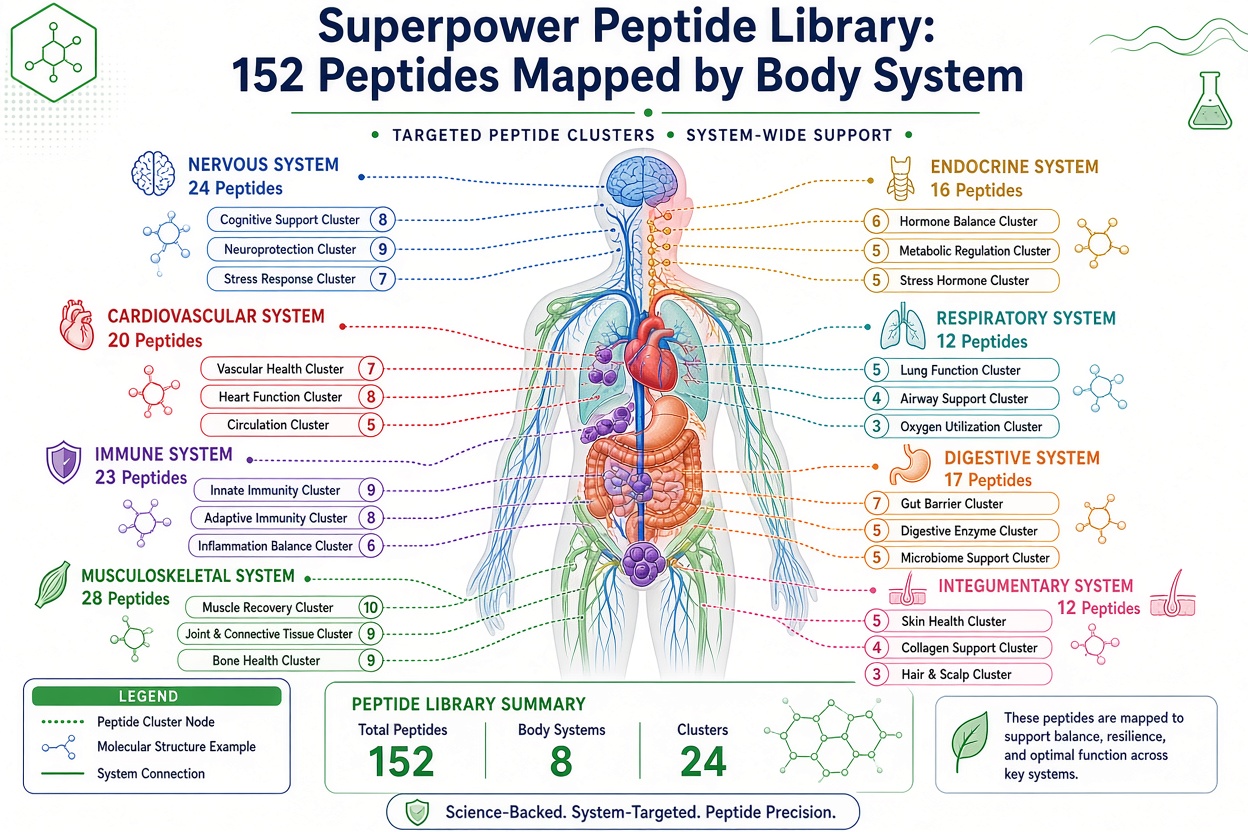
- The superpower peptide library maps 152 peptides across eight body system categories, including brain and sleep, skin and aging, metabolic health, and recovery.
- Each entry includes FDA/trial status filters, receptor binding data, and lyophilized purity documentation.
- Semaglutide and Bremelanotide are included for receptor pharmacology assays; no human or animal dosing instructions are provided.
- Researchers can export concentration parameter tables and stacking synergy protocols for in vitro screening.
- All materials are strictly for laboratory research; verify institutional biosafety and ethics approvals before use.
What Is the Superpower Peptide Library and How Does It Map 152 Peptides by Body System?
The superpower peptide library is a curated repository designed for laboratories studying peptide-receptor interactions, signal transduction, and structural biology. It catalogs 152 peptides by primary body system—brain and sleep, skin and aging, metabolic health, recovery and repair, immune modulation, cardiovascular research, bone and joint, and sexual health. Each peptide entry includes amino acid sequence, molecular weight, purity grade, and relevant receptor targets.
Each peptide within the superpower peptide library is annotated with at least one primary body system category and up to three secondary tags. This mapping allows researchers to isolate peptides relevant to a specific pathway—for example, filtering for melanocortin receptor ligands under skin and aging or sexual health. The body system architecture reduces literature search time and supports systematic screening designs.
The superpower peptide library also includes structural metadata such as disulfide bridge patterns, terminal modifications, and solubility profiles. These data help laboratories plan reconstitution buffers and assay compatibility without guesswork. Because the library is research-use only, all annotations are oriented toward in vitro and preclinical models, not therapeutic or human use.
Body System Architecture in Detail
The eight primary body system categories are not arbitrary groupings. They reflect the most common receptor families and signaling pathways targeted in preclinical peptide screening. Brain and sleep peptides focus on neurotrophic and GABAergic targets. Skin and aging peptides center on extracellular matrix and copper-binding motifs. Metabolic health peptides emphasize incretin and glucagon-like pathways.
Recovery and repair peptides map to angiogenic and cytoskeletal targets. Immune modulation covers thymic and cytokine-related sequences. Cardiovascular research includes vasoactive and natriuretic peptides. Bone and joint focuses on calcitonin and parathyroid-related fragments. Sexual health peptides align with melanocortin and oxytocin receptor families. This structured mapping lets a lab run a single query to find all peptides relevant to a given receptor class without opening dozens of individual datasheets.
Structural Metadata and Assay Planning
Structural metadata is often the difference between a failed reconstitution and a reproducible assay. Disulfide bridge patterns tell a researcher whether a peptide requires oxidative folding buffers. Terminal modifications—acetylation, amidation, or fatty acid conjugation—affect stability and solubility. Solubility profiles indicate whether a peptide dissolves in water, saline, DMSO, or acidic buffers.
The superpower peptide library includes these fields for every entry. A researcher planning a cAMP accumulation assay can filter for peptides soluble in aqueous buffer at pH 7.4. A lab studying disulfide-rich peptides can exclude sequences without bridge annotations. This level of pre-annotation removes guesswork and reduces wasted lyophilized material. All metadata is derived from published characterization studies and manufacturer certificates of analysis.
How Do You Navigate the Superpower Peptide Library: Categories, FDA/Trial Status Filters, and Search?
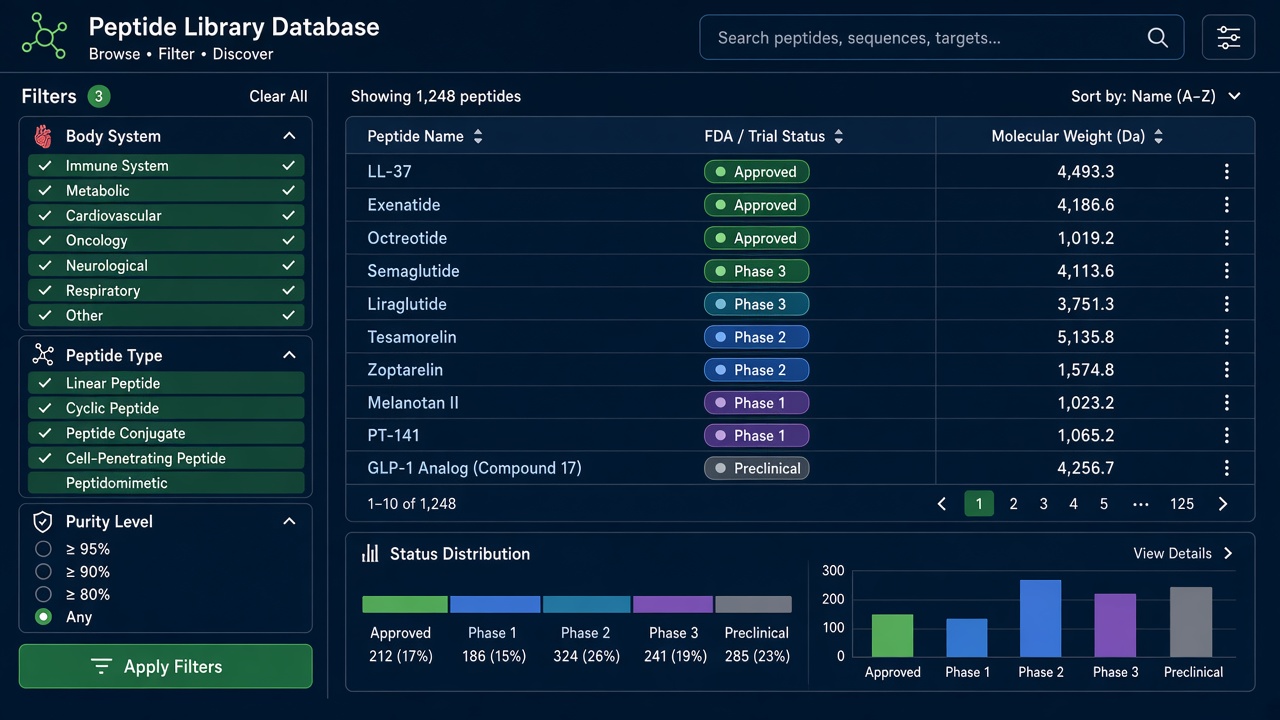
Search filters within the superpower peptide library are built around three axes: body system category, FDA/trial status, and molecular target. Researchers can select multiple filters simultaneously—for instance, viewing all GLP-1 receptor agonists with an FDA-approved status or all melanocortin peptides in preclinical stages. This filter system aligns with peptide libraries research solutions that emphasize regulatory-aware selection.
The superpower peptide library also offers a free-text search that matches peptide names, sequences, and CAS numbers. Boolean operators allow combination queries such as “Semaglutide AND GLP-1 receptor” or “Bremelanotide NOT clinical”. Export functions generate CSV files with all metadata, enabling batch analysis in laboratory information management systems.
For laboratories new to peptide screening, the superpower peptide library includes a guided mode that recommends categories based on assay type—receptor binding, cell viability, or enzyme inhibition. This feature does not suggest dosing regimens; it only maps peptides to assay-compatible categories. All recommendations remain within research-use boundaries.
Filter Combinations and Boolean Search
The three-axis filter system is more powerful than a simple keyword search. A researcher studying metabolic signaling can select “metabolic health” plus “GLP-1 receptor” plus “FDA-approved” to see only clinically characterized incretin peptides. A lab focused on preclinical candidates can choose “melanocortin” plus “preclinical” to exclude approved drugs. This regulatory-aware filtering helps avoid accidental inclusion of compounds with conflicting patent or clinical status.
Boolean search operators add precision. Queries like “GLP-1R AND cAMP” narrow results to peptides with documented cAMP assay data. “Bremelanotide NOT human” excludes any entry with human clinical annotations. The free-text engine also matches partial sequences and common synonyms. Exporting filtered results as CSV preserves every metadata field, so downstream analysis in R, Python, or LIMS software requires no manual reformatting.
Guided Mode for New Laboratories
Guided mode asks three questions: what assay type will you run, which receptor family are you targeting, and what is your preferred species model. Based on the answers, it recommends body system categories and specific peptide entries. It never recommends a concentration, route, or dosing schedule.
For a receptor binding assay targeting melanocortin receptors, guided mode might suggest the sexual health and skin and aging categories. For a cell viability screen targeting GLP-1 receptors, it would point to metabolic health peptides with documented cAMP EC50 values. This feature is especially useful for graduate students and technicians who are new to peptide pharmacology. All recommendations stay strictly within in vitro and cell culture parameters.
💡 Key Takeaway: How Do You Navigate the Superpower Peptide Library: Categories, FDA/Trial Status Filters, and Search?
What Research Concentration Parameters Does the Superpower Peptide Library Provide?
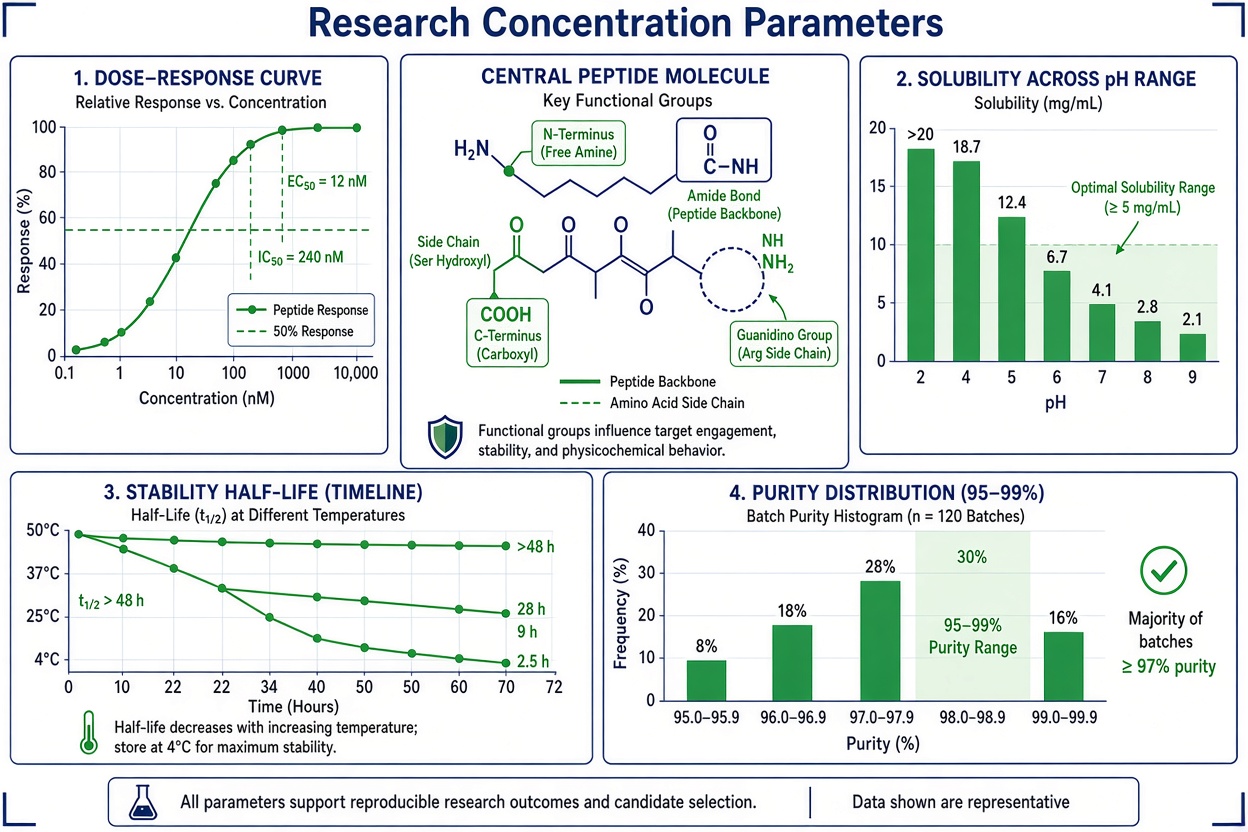
Published in vitro EC50 values for peptides in the superpower peptide library are drawn from peer-reviewed receptor binding studies. For example, Semaglutide’s GLP-1 receptor affinity is reported in the low nanomolar range in cell-based cAMP assays, while Bremelanotide shows melanocortin receptor selectivity at similar concentrations. These values serve as starting points for assay calibration, not as dosing regimens for any organism.
Researchers using the superpower peptide library can access a concentration parameter table for each peptide, listing reported EC50, IC50, and Ki values from at least two independent publications. The table also notes assay type, cell line, and incubation time, enabling direct replication of experimental conditions. This documentation is essential for generating reproducible data in receptor pharmacology.
A key advantage of the superpower peptide library is that concentration parameters are linked to the original PubMed identifiers, allowing laboratories to verify primary sources. No in vivo or human dosing guidance is included anywhere in the library; all numerical values pertain to isolated receptors, membrane preparations, or cultured cells. This strict scope maintains compliance with research-use-only regulations. Researchers can cross-check these identifiers through PubMed and NCBI.
EC50, IC50, and Ki Values Explained
EC50 is the concentration producing 50% of the maximum effect in a functional assay. IC50 is the concentration causing 50% inhibition of a target. Ki is the equilibrium dissociation constant for a receptor-ligand complex, independent of assay conditions. The superpower peptide library includes all three where available.
For Semaglutide, the GLP-1 receptor EC50 in cAMP accumulation assays is reported in the low nanomolar range, often below 10 nM depending on cell line. Bremelanotide shows melanocortin receptor selectivity at similar low nanomolar concentrations, with higher affinity for MC4R than MC1R in published binding studies. These values are not universal constants; they vary with assay conditions. That is why the library requires at least two independent publications per parameter and records cell line and incubation time.
Linking Parameters to Primary Literature
Every concentration parameter in the superpower peptide library carries a PubMed identifier. A researcher can click the identifier and open the original study to verify methodology. This transparency is critical for institutional review boards and grant reviewers. It also allows labs to adjust parameters based on their own assay systems.
No value in the library is derived from anecdotal or non-peer-reviewed sources. All EC50, IC50, and Ki figures come from published receptor binding, cAMP, or enzyme inhibition studies. The library explicitly excludes any human or animal pharmacokinetic data. This boundary keeps the resource compliant with research-use-only regulations and prevents accidental misuse.
Which Stacking and Synergy Protocols Are Built Into the Superpower Peptide Library?
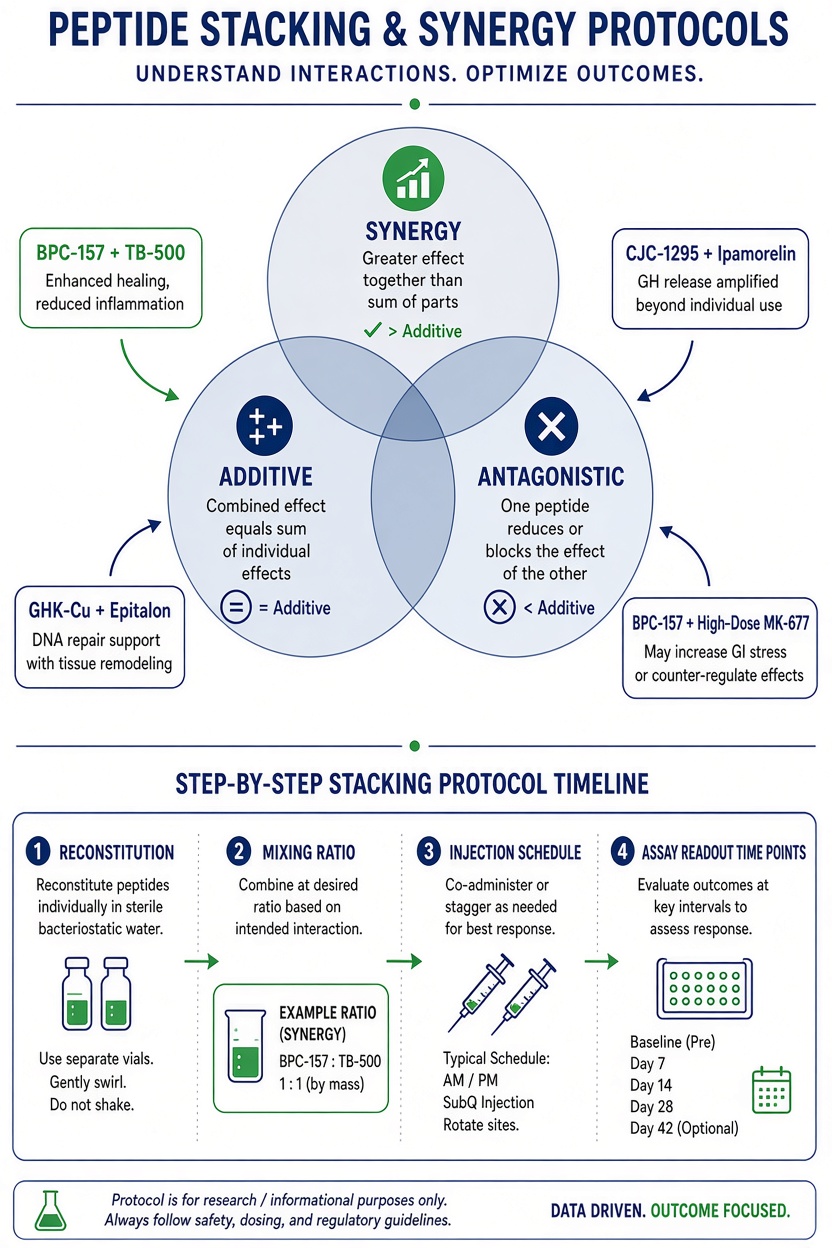
Combinatorial screens with the superpower peptide library enable researchers to test peptide synergy in vitro using checkerboard or matrix dilution formats. For example, a GLP-1 receptor agonist such as Semaglutide may be combined with a melanocortin peptide like Bremelanotide in a cAMP accumulation assay to assess additive or synergistic receptor activation. These stacking synergy protocols are predefined for common receptor families.
The superpower peptide library includes predefined synergy matrices for brain, skin, metabolic, and recovery research goals. A typical matrix lists peptide A, peptide B, concentration ratios, and expected interaction class—additive, synergistic, or antagonistic—based on published binding data. Researchers can download these matrices as editable spreadsheets for their own assay systems.
| Peptide A (Receptor Target) | Peptide B (Receptor Target) | Research Goal | In Vitro Synergy Class |
|—————————–|—————————–|—————|————————|
| Semaglutide (GLP-1R) | Bremelanotide (MC4R) | Metabolic signaling | Additive |
| Semax fragment (TrkB) | Selank (GABAergic) | Brain and sleep | Synergistic |
| GHK-Cu (Copper peptide) | Matrixyl (ECM) | Skin and aging | Additive |
| BPC-157 fragment (VEGFR2) | TB-500 fragment (Actin) | Recovery and repair | Synergistic |
This superpower peptide library synergy matrix is derived from published in vitro studies and does not represent dosing regimens for any organism. The anionos aminos semax research facts article provides additional context on peptide stability in combination assays. All stacking synergy protocols within the superpower peptide library are intended solely for cell culture and biochemical experiments.
Checkerboard and Matrix Dilution Formats
Checkerboard assays test two peptides across a grid of concentration combinations. One peptide is diluted across rows and the other across columns. Each well contains a unique ratio pair. The resulting matrix reveals whether the interaction is additive, synergistic, or antagonistic. The superpower peptide library includes recommended starting ratios for common receptor pairs.
Matrix dilution formats are simpler: fixed ratios are tested in serial dilutions. A 1:1 ratio of Semaglutide and Bremelanotide can be diluted from high to low concentrations in a 96-well plate. Synergy is calculated using the Bliss independence or Loewe additivity model. The library does not prescribe which model to use; it provides the raw interaction data and lets the researcher choose the appropriate statistical framework.
Synergy Matrix Download and Customization
Each synergy matrix in the superpower peptide library is downloadable as a CSV or Excel file. Columns include peptide A name, peptide B name, receptor target, concentration ratio, expected interaction class, and source PubMed identifier. Researchers can edit the ratio column to match their own assay sensitivity.
The library also allows custom matrix creation. A researcher can select any two peptides from the catalog and generate a blank checkerboard template. The template pre-fills known receptor targets and suggests dilution ranges based on published EC50 values. No part of the synergy module suggests dosing for any organism; it is entirely confined to in vitro experimental design.
How Do You Source and Store the Superpower Peptide Library Safely?
Every batch in the superpower peptide library is manufactured under ISO 9001 conditions and tested by third-party laboratories for identity, purity, and endotoxin levels. Certificates of analysis include HPLC chromatograms, mass spectrometry spectra, and residual solvent reports. This documentation supports institutional review boards and biosafety committees when approving research protocols.
Storage documentation for the superpower peptide library specifies lyophilized stability at -20°C, reconstituted stability at 4°C for short-term use, and -80°C for long-term storage. Researchers should avoid repeated freeze-thaw cycles to preserve peptide integrity. All handling must follow institutional chemical hygiene plans.
Before purchasing, compare COA documentation across vendors in Who Sells Research-Grade Peptide Libraries Online in 2026? and Peptide Research Library: Which Suppliers Are Trustworthy in 2026?. For a detailed checklist on verifying certificates of analysis, see Where to Buy a Peptide Research Library with a COA.
Certificate of Analysis Components
A complete certificate of analysis for the superpower peptide library includes four core documents. HPLC chromatograms show purity percentage, typically above 95% for research-grade peptides. Mass spectrometry spectra confirm molecular weight against the theoretical sequence mass. Residual solvent reports list any remaining organic solvents from synthesis. Endotoxin testing verifies levels below accepted limits for cell culture.
Labs should not accept a COA that omits any of these components. Third-party testing is non-negotiable; self-reported manufacturer data may not satisfy biosafety committees. The library archives every COA batch-by-batch, so researchers can retrieve the exact document matching their vial lot number. This traceability is essential for publication and regulatory audits.
Storage and Handling Protocols
Lyophilized peptides in the superpower peptide library are stable at -20°C for at least 12 months when kept desiccated and protected from light. After reconstitution, peptides should be aliquoted to avoid repeated freeze-thaw. Short-term storage at 4°C is acceptable for up to one week depending on the peptide. Long-term storage at -80°C is recommended for reconstituted aliquots.
Always record the reconstitution solvent, concentration, and date on each vial. Some peptides require acidic or basic buffers; the library’s solubility profile field specifies the appropriate solvent for each entry. Do not vortex peptides aggressively; gentle pipetting preserves structure. Dispose of any unused reconstituted peptide according to institutional chemical waste policies.
💡 Key Takeaway: How Do You Source and Store the Superpower Peptide Library Safely?
Why Choose the Superpower Peptide Library for Your Laboratory
The superpower peptide library provides a comprehensive, metadata-rich resource that reduces setup time for receptor binding studies and cell-based assays. Its eight body system categories, FDA/trial status filters, and exportable CSV files integrate directly into laboratory information management systems. Researchers can quickly identify peptides for a given target without manual literature mining.
Laboratories that adopt the superpower peptide library benefit from predefined synergy matrices and concentration parameter tables tied to PubMed identifiers. The library’s research-use-only scope keeps all workflows within in vitro and preclinical boundaries. This alignment with regulatory expectations supports faster ethics committee approvals and reproducible experimental design.
For labs comparing suppliers, the Best Places to Buy Research Peptides for a Lab in 2026 guide covers verification steps.
Time Savings and Reproducibility
Manual literature mining for 152 peptides would take weeks. The superpower peptide library compiles sequence, target, purity, and assay parameters into one searchable interface. A researcher can move from hypothesis to experimental design in a single afternoon. Predefined synergy matrices eliminate the need to design checkerboard layouts from scratch.
Reproducibility improves because every parameter is linked to a primary source. If an EC50 value fails to replicate, the researcher can check the original study’s cell line and incubation time. If a peptide behaves differently after reconstitution, the storage protocol provides troubleshooting clues. This documentation-first approach is the core value of the library.
Regulatory Compliance and Documentation
Research-use-only compliance is not an afterthought; it is built into every field. The superpower peptide library contains no human dosing suggestions, no therapeutic claims, and no in vivo administration protocols. Every concentration value is labeled as in vitro. Every synergy matrix is labeled as cell culture only.
This strict scope simplifies ethics committee submissions. Biosafety officers can review the COA archive and storage protocols without requesting additional documentation. Grant reviewers can verify that all parameters are sourced from peer-reviewed literature. The library is designed to meet the documentation standards of modern preclinical laboratories.
FAQ
How does the superpower peptide library differ from a standard peptide catalog?
The superpower peptide library differs from a standard catalog by organizing 152 peptides across eight body system categories with FDA/trial status filters, receptor binding data, and structural metadata. A standard catalog lists sequences and prices. This library adds assay-ready concentration parameters, synergy matrices, and PubMed-linked documentation for in vitro research.
Can I use the superpower peptide library for human or animal studies?
No, the superpower peptide library is strictly for in vitro laboratory research. It contains no dosing instructions for any organism. All EC50, IC50, and Ki values apply to isolated receptors, membrane preparations, or cultured cells. Any use outside research violates the library’s terms and applicable regulations.
What documentation is included with each superpower peptide library batch?
Each batch includes certificates of analysis with HPLC chromatograms, mass spectrometry spectra, residual solvent reports, and endotoxin test results. Storage documentation specifies lyophilized stability at -20°C, reconstituted short-term storage at 4°C, and long-term storage at -80°C. Batch numbers link to archived COAs for traceability.
Can I export superpower peptide library data for my own analysis?
Yes, the superpower peptide library supports CSV export of all metadata, including sequence, target, purity, concentration parameters, and synergy matrices. Boolean search filters and body system categories can be combined before export. Exported files integrate with LIMS, R, Python, and spreadsheet software.
What is the recommended storage condition for the superpower peptide library?
Lyophilized peptides should be stored at -20°C in a desiccated, light-protected environment. After reconstitution, aliquot and store at -80°C for long-term use or 4°C for up to one week. Avoid repeated freeze-thaw cycles. Always follow institutional chemical hygiene plans and record reconstitution details on each vial.
Topics covered in this article:
Ready to Take the Next Step?
Every product includes lot-specific documentation and third-party purity testing.
Explore Our Research Products →Free shipping on qualifying orders · Batch COA on request