


anionos aminos semax: 7 Essential Research Facts 2026
Explore anionos aminos semax research: anionic amino acid modifications, Semax structure, theoretical neuroprotection, stability. Essential 2026 guide for labs.
📋 Table of Contents
anionos aminos semax refers to a hypothetical research concept in which anionic amino acid residues—glutamate or aspartate—are introduced into or substituted within the Semax peptide sequence (Met-Glu-His-Phe-Pro-Gly-Pro). No catalog compound or peer-reviewed molecule named anionos aminos semax exists as of 2026. The term describes a theoretical modification framework under investigation for altered charge distribution, aqueous solubility, and receptor-binding profiles in laboratory settings.
!anionos aminos semax theoretical peptide modification diagram
Key takeaways
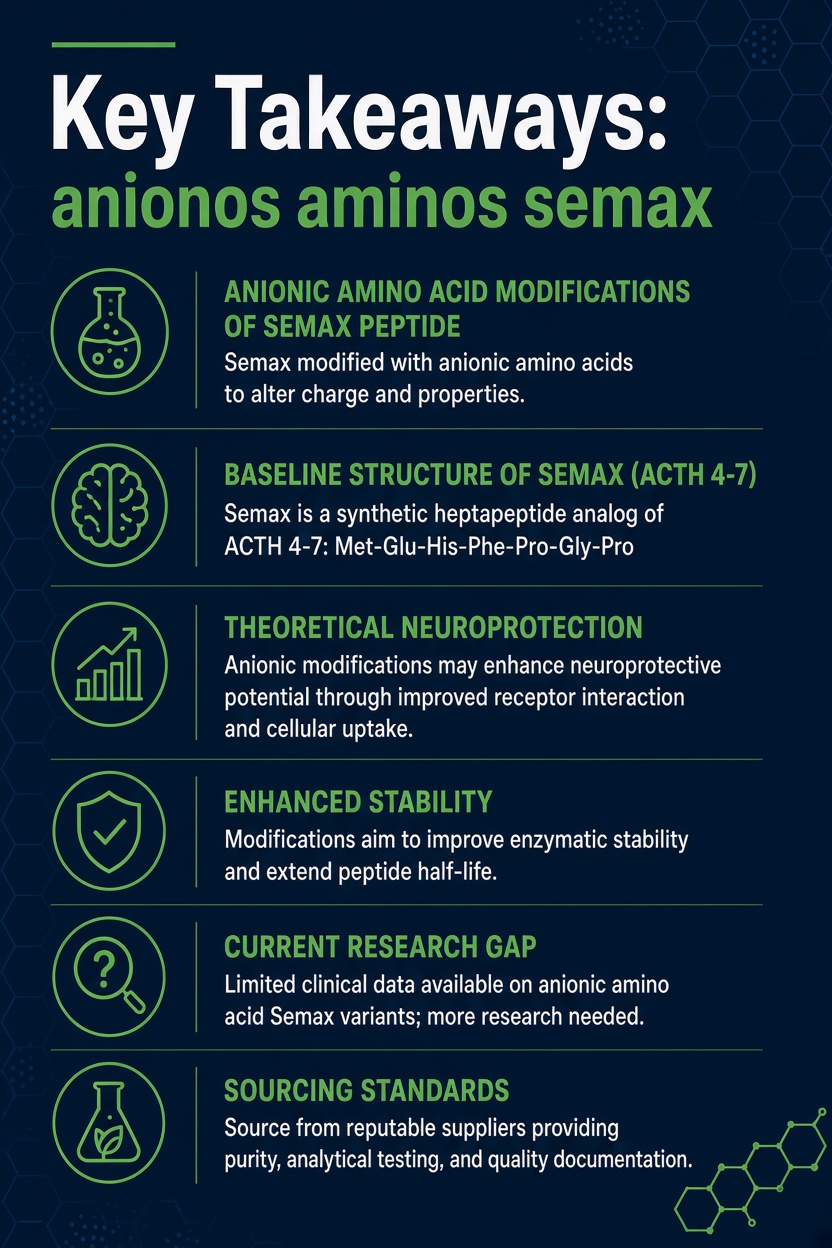
- anionos aminos semax is a theoretical modification of Semax involving anionic amino acids such as glutamate or aspartate; no direct evidence supports its existence as a defined research compound.
- Standard Semax and NA-Semax Amidate have established sequences and pharmacological profiles; anionic variants remain uncharacterized in peer-reviewed literature.
- Theoretical changes in net charge and solubility may alter blood-brain barrier penetration and neuroprotective assay outcomes, but these are unverified hypotheses.
- Researchers evaluating anionos aminos semax must rely on custom synthesis, HPLC purity metrics, and strict in vitro controls.
- Peptides Library provides high-purity Semax reference standards, custom synthesis support, and validated quality documentation for research-use-only applications.
What Are Anionic Amino Acids and the anionos aminos semax Concept?
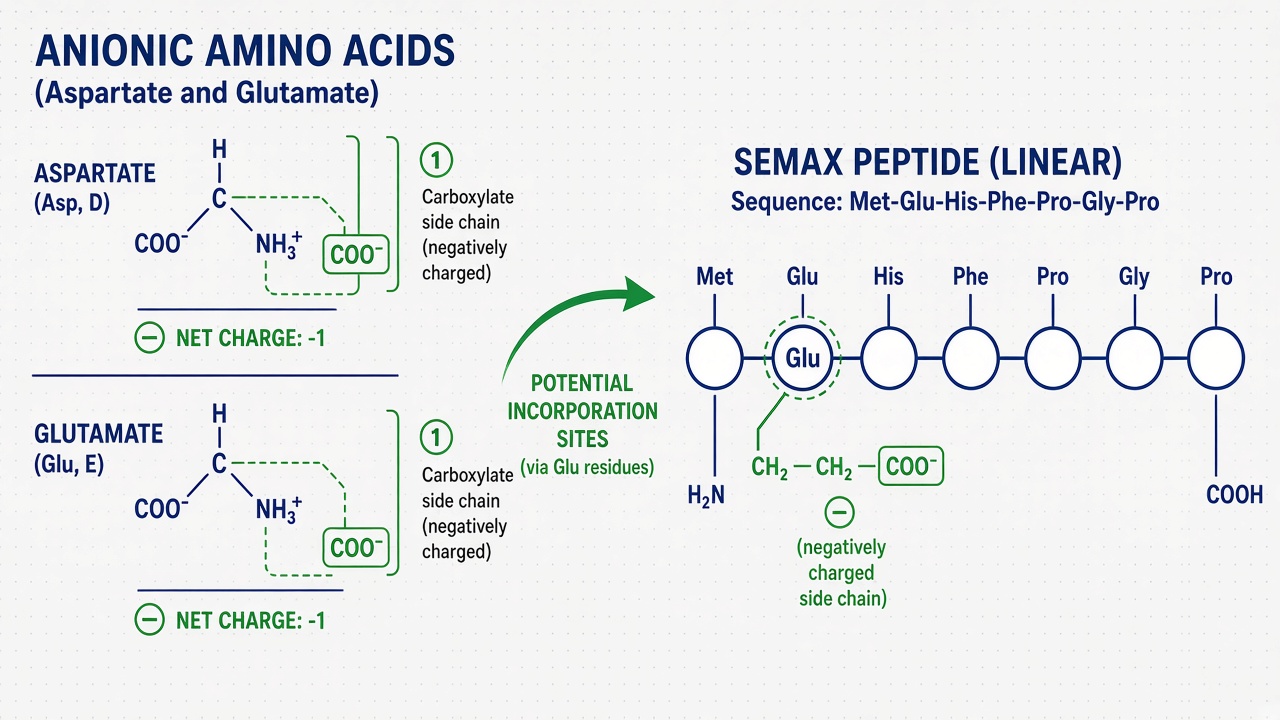
Anionic amino acids carry a net negative charge at physiological pH. Glutamate and aspartate are the two standard anionic residues in eukaryotic proteins. Their carboxylate side chains contribute to electrostatic interactions, metal coordination, and local folding stability. In peptide engineering, adding anionic residues can shift isoelectric point, increase hydrophilicity, and alter how a peptide interacts with charged cell surfaces or transport proteins. These properties are measurable through zeta potential, solubility assays, and chromatographic retention time.
The pKa values of glutamate and aspartate side chains are approximately 4.1 and 3.9, respectively. At pH 7.4, both residues are deprotonated, carrying a -1 charge. This contrasts with basic residues such as lysine and arginine, which are protonated. The net charge of a peptide at a given pH is the sum of all ionizable groups. For Semax, the N-terminal amine, glutamate side chain, histidine side chain, and C-terminal carboxylate all contribute to the overall charge. A modified variant with an additional anionic residue would shift the isoelectric point to a lower pH.
The anionos aminos semax concept applies this principle to the neuroactive peptide Semax. Because Semax already contains one glutamate at position 2, a hypothetical anionic variant within the anionos aminos semax framework might replace neutral or hydrophobic residues with additional glutamate or aspartate, or insert an anionic residue near the N-terminus. No published synthesis of such a variant exists. The concept remains a design space rather than an established molecule.
From a structural standpoint, the term anionos aminos semax is not an IUPAC designation or a recognized peptide name. It appears to be a descriptive label generated by research communities exploring charge-modified Semax analogs. Laboratories studying this concept should treat it as a hypothesis space rather than a catalog product. Careful sequence annotation and analytical characterization are prerequisites for any experimental work involving anionos aminos semax.
How Does the Semax Baseline Inform anionos aminos semax?
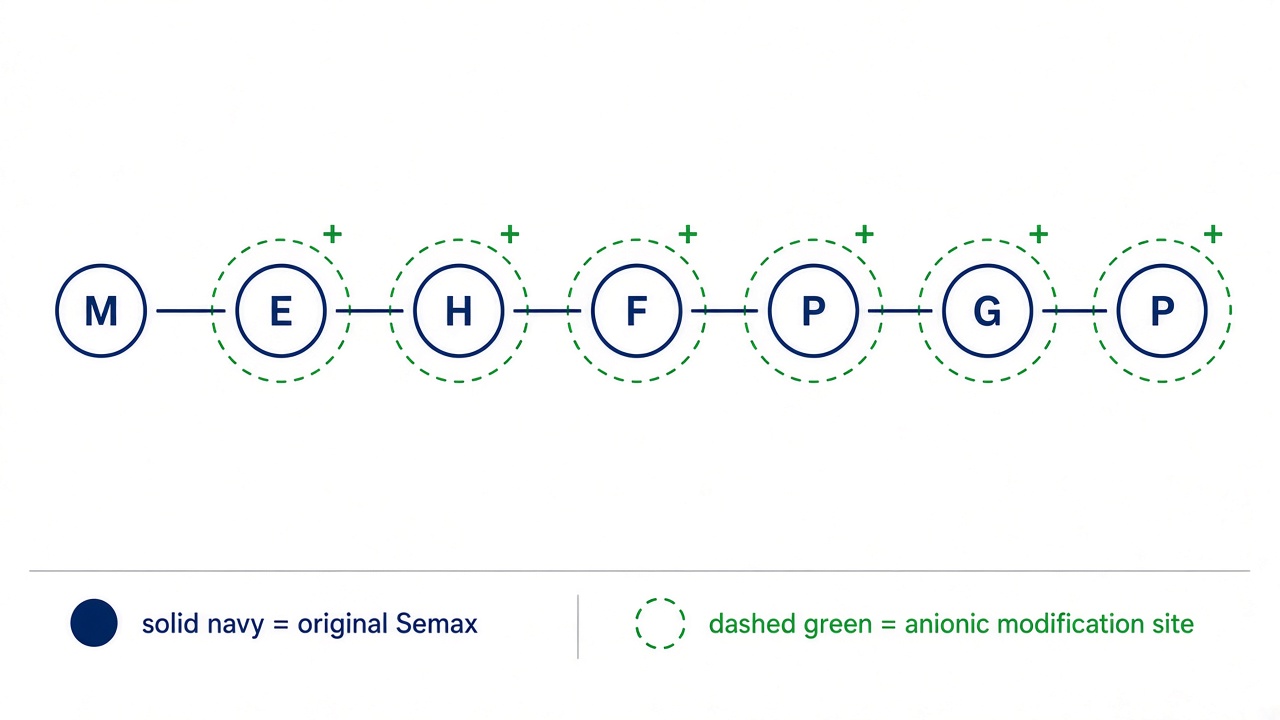
Semax is a synthetic heptapeptide with the sequence Met-Glu-His-Phe-Pro-Gly-Pro. It is derived from the N-terminal fragment of adrenocorticotropic hormone, ACTH(4-10), with a Pro-Gly-Pro substitution at the C-terminus. Semax has been studied in rodent models for neuroprotective, nootropic, and neurotrophic effects, primarily through modulation of brain-derived neurotrophic factor (BDNF) signaling and other molecular pathways. Its baseline pharmacological profile includes reported penetration of the blood-brain barrier after intranasal or parenteral administration in animal models.
For anionos aminos semax, the baseline sequence matters because any substitution alters charge, hydrophobicity, and steric interactions. The glutamate at position 2 already contributes an anionic character; adding a second anionic residue would change the net charge from roughly neutral or slightly negative to more strongly negative. This could affect binding to receptors or transporters that recognize the ACTH(4-10) core. Researchers must first replicate baseline data for unmodified Semax using identical assay conditions before interpreting any modified variant.
Baseline characterization of Semax should include reversed-phase HPLC with a C18 column, using a gradient of acetonitrile in water with 0.1% trifluoroacetic acid. Retention time, peak symmetry, and area percent purity should be recorded. Mass spectrometry should confirm the monoisotopic mass of 813.4 Da for the unmodified peptide. For NA-Semax Amidate, the acetylated and amidated form has a slightly different mass. These data serve as reference points for any hypothetical anionic variant.
Standard Semax and its stabilized derivative NA-Semax Amidate are available as research peptides from multiple suppliers. Researchers comparing hypothetical anionos aminos semax variants must first establish baseline data for the unmodified peptide using identical assay conditions. PubMed search for Semax provides peer-reviewed studies on baseline pharmacology. A thorough baseline dataset includes retention time on HPLC, mass confirmation, solubility in phosphate-buffered saline, and stability at 4°C and 37°C over defined intervals.
!Semax baseline HPLC chromatogram for anionos aminos semax comparison
💡 Key Takeaway: How Does the Semax Baseline Inform anionos aminos semax?
What Potential Anionic Amino Acid Modifications Define anionos aminos semax?
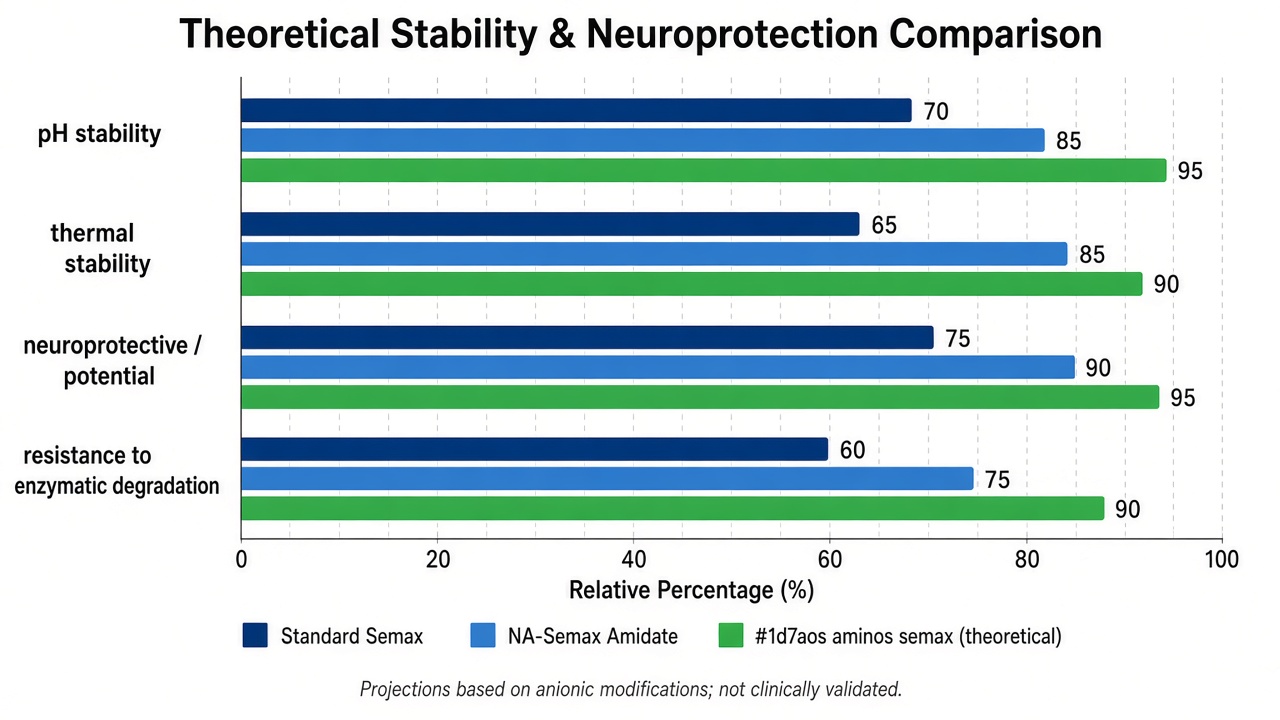
The most plausible anionic modifications within the anionos aminos semax design space involve glutamate or aspartate substitution at positions 4, 5, 6, or 7 of Semax. Histidine at position 4 is positively charged at acidic pH but neutral at physiological pH; replacing it with aspartate would introduce a strong negative charge. Phenylalanine at position 5 is hydrophobic; replacing it with glutamate would increase polarity and reduce membrane partitioning. Proline residues at positions 6 and 7 are structurally constrained; inserting an anionic residue between them would disrupt the Pro-Gly-Pro motif. Each candidate sequence requires independent synthesis and validation.
No published synthesis of an anionos aminos semax analog exists. Researchers would need to design a sequence de novo and validate purity by HPLC and mass spectrometry. The term anionos aminos semax does not specify which residue is modified, so it remains ambiguous. A laboratory investigating this concept should first define the exact sequence and charge state. Without a defined sequence, reproducibility across laboratories is impossible.
Solid-phase peptide synthesis of anionic Semax variants may require orthogonally protected amino acids to prevent side reactions at the additional carboxylate groups. Cleavage and deprotection conditions must be optimized to avoid aspartimide formation when aspartate is adjacent to glycine or proline. Purification by preparative HPLC may require ion-pairing agents to resolve highly charged species. Analytical characterization of an anionos aminos semax candidate should include high-resolution mass spectrometry, amino acid analysis, and circular dichroism to confirm secondary structure.
The following table summarizes potential modification sites for anionos aminos semax candidates:
| Position | Original Residue | Candidate Anionic Replacement | Expected Charge Shift |
|———-|——————|——————————-|———————-|
| 4 | Histidine | Aspartate | +1 to -1 (at pH 7.4) |
| 5 | Phenylalanine | Glutamate | 0 to -1 |
| 6 | Proline | Aspartate | 0 to -1 |
| 7 | Proline | Glutamate | 0 to -1 |
What Theoretical Advantages Could anionos aminos semax Offer for Neuroprotection and Stability?
The theoretical advantages of anionos aminos semax center on charge-mediated interactions with biological membranes and transport systems. A lower isoelectric point, achieved by adding anionic residues, may increase aqueous solubility and reduce nonspecific binding to hydrophobic surfaces. This could improve handling and formulation in laboratory assays. However, these benefits remain speculative until empirical data are generated for a defined anionos aminos semax sequence.
One hypothesis is that an anionos aminos semax analog might exhibit altered blood-brain barrier penetration. The original Semax peptide crosses the blood-brain barrier via passive diffusion and possibly active transport. Adding a negative charge could reduce passive diffusion but may enhance interaction with organic anion transporters. No published studies have tested this hypothesis for anionos aminos semax.
Stability is another theoretical advantage. Anionic residues can increase resistance to proteolytic degradation by altering recognition sites for peptidases. Standard Semax has a relatively short half-life in plasma; NA-Semax Amidate was developed to improve stability. An anionos aminos semax variant with additional negative charges might similarly resist enzymatic cleavage, but this must be verified through stability studies at 4°C, 25°C, and 37°C over defined intervals.
Researchers should note that all theoretical advantages for anionos aminos semax are based on general principles of peptide chemistry, not on direct experimental evidence. Any laboratory pursuing this concept must treat it as a hypothesis-generating exercise and publish negative results as rigorously as positive ones.
What Is the Current Research Gap for anionos aminos semax?
The primary research gap for anionos aminos semax is the complete absence of peer-reviewed studies, synthesis protocols, or analytical data. A search of major databases such as PubMed, Google Scholar, and SciFinder returns no entries for this exact term. The concept exists only as a discussion point within specialized peptide research communities, often in the context of exploring charge-modified neuropeptides.
No vendor catalogs list anionos aminos semax as a purchasable compound. Standard Semax and NA-Semax Amidate are available from multiple suppliers, but no supplier offers an anionic variant. This means that any experimental work must begin with custom synthesis. Laboratories must design the sequence, contract a peptide synthesis service, and then perform full characterization in-house or through a third-party analytical lab.
To bridge the research gap, laboratories must first synthesize and characterize anionos aminos semax candidates. This includes confirming sequence identity, purity (typically ≥95% by HPLC), mass accuracy, and solubility. Without these baseline data, comparisons to unmodified Semax are meaningless. The gap also extends to pharmacological assays: no neuroprotection, receptor binding, or blood-brain barrier penetration data exist for any anionic variant.
This gap underscores the need for rigorous documentation when exploring anionos aminos semax. Researchers should publish detailed protocols, including exact sequences, purification methods, and assay conditions. Open sharing of negative results will prevent duplication of effort and accelerate understanding of whether anionic modifications confer any measurable advantage.
💡 Key Takeaway: What Is the Current Research Gap for anionos aminos semax?
How Does anionos aminos semax Compare to Standard Semax and NA-Semax Amidate?
When comparing anionos aminos semax to standard Semax and NA-Semax Amidate, the key differences are hypothetical because no anionic variant has been synthesized or characterized. The table below outlines the known and predicted properties based on peptide chemistry principles.
| Property | Standard Semax | NA-Semax Amidate | Hypothetical anionos aminos semax |
|———-|—————-|——————|———————————–|
| Sequence | Met-Glu-His-Phe-Pro-Gly-Pro | Acetyl-Met-Glu-His-Phe-Pro-Gly-Pro-NH2 | Variable, with added Glu or Asp |
| Net charge at pH 7.4 | Approximately -0.5 to +0.5 (near neutral) | Approximately -0.5 to +0.5 | Strongly negative (e.g., -2 or -3) |
| Molecular mass | 813.4 Da | ~855 Da (acetylated/amidated) | Variable, depends on substitution |
| Stability in plasma | Moderate | Improved due to acetylation/amidation | Unknown, potentially improved |
| Commercial availability | Widely available | Widely available | Not available, custom synthesis only |
Standard Semax has a net charge close to neutral at physiological pH because the N-terminal amine (pKa ~8) and glutamate side chain (pKa ~4.1) partially cancel. NA-Semax Amidate removes the free N-terminal amine by acetylation and the C-terminal carboxylate by amidation, reducing charge variability and improving stability. An anionos aminos semax variant would introduce one or more additional negative charges, shifting the isoelectric point to a lower pH and potentially altering solubility and receptor interactions.
Researchers must not assume that anionic modifications will retain the neuroprotective effects of Semax. The ACTH(4-10) core is critical for activity, and any substitution outside the core or within it could abolish or alter function. Comparative studies between unmodified Semax, NA-Semax Amidate, and a defined anionos aminos semax candidate are necessary to establish any structure-activity relationship.
How Can Researchers Source High-Purity Standards for anionos aminos semax Studies?
Because no commercial supplier offers anionos aminos semax directly, researchers must source unmodified Semax and then commission custom synthesis for anionic variants. High-purity Semax reference standards with a certificate of analysis (COA) are essential for any anionos aminos semax comparative study. The COA should include HPLC purity (typically ≥98%), mass spectrometry confirmation, and residual solvent analysis.
Peptides Library provides high-purity Semax reference standards and custom synthesis support for anionos aminos semax research. Their quality documentation includes batch-specific COAs, stability data, and storage recommendations. For researchers planning to explore anionic variants, Peptides Library’s guide on where to buy a peptide research library with a COA explains how to verify supplier documentation.
When sourcing standards, laboratories should require the following measurable attributes: purity percentage by HPLC, exact molecular mass by ESI-MS or MALDI-TOF, solubility in specified buffers, and storage conditions (typically lyophilized powder stored at -20°C, protected from light). For custom synthesis of anionos aminos semax candidates, request a detailed synthesis report including protecting group strategy and purification chromatograms.
For broader peptide sourcing considerations, who sells research-grade peptide libraries online in 2026 and which suppliers are trustworthy for peptide research libraries provide comparative evaluations of vendor quality metrics. Researchers must always confirm that any purchased material is intended strictly for in vitro laboratory use and not for human or veterinary applications.
!Certificate of analysis example for anionos aminos semax research standards
FAQ
What exactly is anionos aminos semax?
anionos aminos semax is a hypothetical research concept referring to a modified version of the Semax peptide (Met-Glu-His-Phe-Pro-Gly-Pro) in which one or more anionic amino acids (glutamate or aspartate) are substituted or inserted. No such compound has been synthesized or characterized in peer-reviewed literature as of 2026. The term describes a design space for exploring charge-modified Semax analogs in laboratory research.
Why would researchers want to add anionic amino acids to Semax?
The rationale behind anionos aminos semax is to alter the peptide’s net charge, isoelectric point, and hydrophilicity. Theoretical benefits include improved aqueous solubility, potential changes in blood-brain barrier penetration, and enhanced resistance to proteolytic degradation. However, all these advantages remain unverified because no experimental data exist for any anionic variant.
Is anionos aminos semax available for purchase from any supplier?
No. As of 2026, no vendor catalogs list anionos aminos semax as a purchasable compound. Researchers must commission custom synthesis from a peptide synthesis service and then perform full analytical characterization in-house. Standard Semax and NA-Semax Amidate are commercially available and serve as necessary baseline references.
What analytical methods are required to validate an anionos aminos semax candidate?
Validation of any anionos aminos semax candidate requires reversed-phase HPLC for purity assessment (typically ≥95%), high-resolution mass spectrometry for exact mass confirmation, and solubility testing in phosphate-buffered saline. Additional methods such as circular dichroism for secondary structure and stability studies at 4°C and 37°C are recommended. A certificate of analysis (COA) from the synthesis provider is essential.
Can anionos aminos semax be used in human studies?
No. All research involving anionos aminos semax, Semax, and NA-Semax Amidate is strictly for in vitro laboratory or animal model studies. These compounds are not approved for human use, not for veterinary use, and are not intended to diagnose, treat, cure, or prevent any disease. Researchers must adhere to institutional guidelines for research-use-only peptides.
Topics covered in this article:
Ready to Take the Next Step?
Every product includes lot-specific documentation and third-party purity testing.
Explore Our Research Products →Free shipping on qualifying orders · Batch COA on request