


1295/7: Essential CJC-1295/7 Research Peptide Guide 2026
1295 is the research shorthand for CJC-1295/7, a DAC-modified GHRH analog. Explore receptor binding, albumin half-life, and 2026 lab protocols.
📋 Table of Contents
1295 is the research shorthand for CJC-1295/7, a DAC-modified synthetic growth hormone–releasing hormone (GHRH) analog. In laboratory settings, 1295 is used to investigate prolonged GHRH receptor activation, covalent albumin binding, and downstream cAMP signaling in cell cultures and animal models. This 2026 guide covers structural, pharmacokinetic, storage, and compliance details for research-use-only applications.
Key takeaways
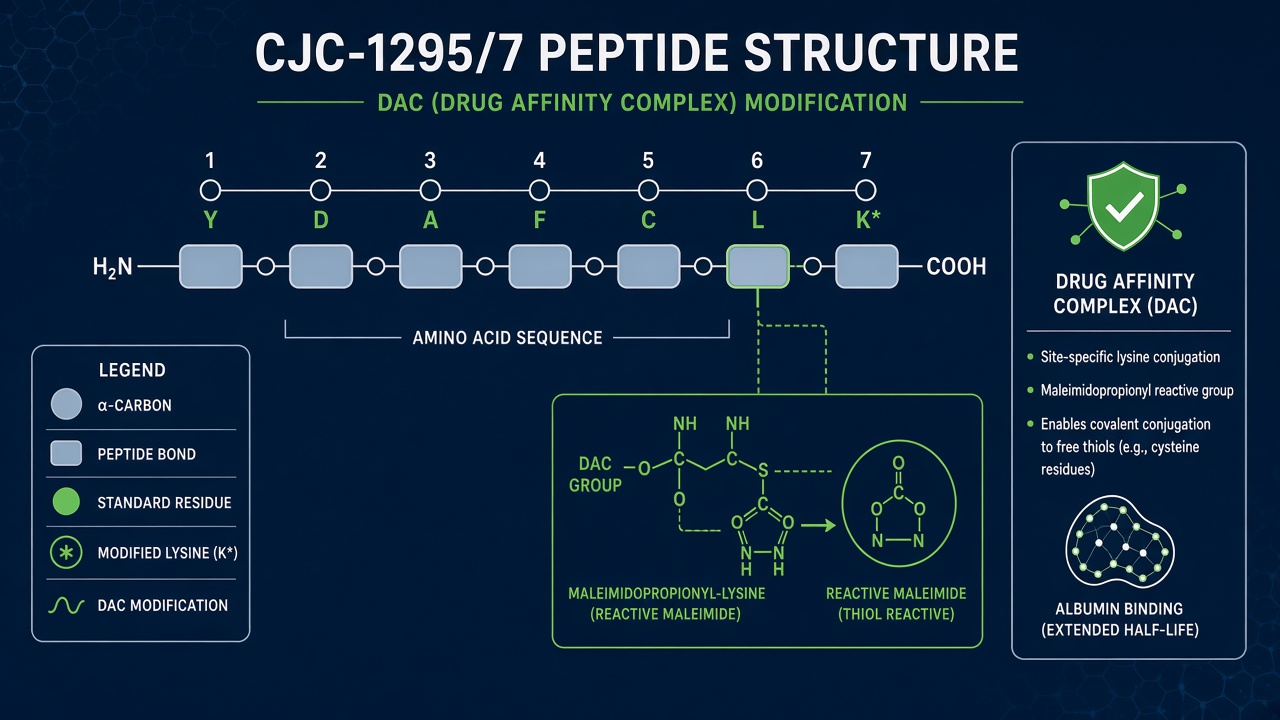
- The identifier 1295 corresponds to CJC-1295/7, a tetrasubstituted GHRH analog with a maleimidopropionic acid linker and drug affinity complex (DAC).
- Researchers use 1295 to measure GHRH receptor binding affinity, cAMP accumulation, and growth hormone release in vitro and in vivo.
- The DAC group forms a covalent bond with serum albumin, prolonging the peptide’s half-life in animal models.
- Analytical characterization of 1295 requires HPLC purity above 95%, mass accuracy within 5 ppm, and residual solvent testing.
- All 1295 work must follow research-use-only compliance, including no human or veterinary use and age verification.
Research use only: The products discussed on this site are sold strictly for in vitro laboratory research purposes only. They are not for human use, not for veterinary use, and not intended to diagnose, treat, cure, or prevent any disease. Must be 21+ to purchase.
What Is 1295/7?
In peptide research nomenclature, 1295 is the abbreviated identifier for CJC-1295/7, a tetrasubstituted analog of growth hormone–releasing hormone (GHRH). The full chemical designation includes a maleimidopropionic acid linker conjugated to a drug affinity complex (DAC). Researchers use 1295 to model prolonged GHRH receptor activation in vitro and in vivo. Unlike unmodified GHRH, 1295 circulates bound to albumin in animal models.
The DAC modification is not a separate peptide but an integrated chemical feature that changes how the compound behaves in biological matrices. In academic laboratories, the shorthand 1295 appears in protocols, inventory logs, and publication methods sections. Because the term can be confused with other CJC variants, researchers should always specify the full name and batch identifier when reporting data. Proper documentation reduces ambiguity in peer review and enables reproducible experiments across independent groups.
For assay design, the extended residence time of the albumin-bound form means that standard acute stimulation protocols may not translate directly. Investigators often need to adjust sampling windows, wash steps, and concentration ranges compared with unmodified GHRH. Pre-experiment validation of receptor expression and downstream readouts is recommended before committing to large-scale studies.
What Structural Properties Define 1295/7 and the DAC Modification?
The backbone of 1295 derives from human GHRH(1–29) with amino acid substitutions that resist enzymatic degradation. A thiol-reactive maleimide linker attaches the DAC to a cysteine residue, allowing 1295 to form a covalent bond with serum albumin. Mass spectrometry shows a molecular mass consistent with the peptide plus DAC moiety. Laboratories confirm identity and purity of each batch by reversed-phase HPLC and LC-MS before use.
The specific amino acid substitutions in the GHRH sequence reduce susceptibility to dipeptidyl peptidase and other proteases that rapidly cleave native GHRH. This stabilization is independent of the DAC group but works synergistically with albumin binding to prolong biological activity. Structural studies in solution indicate that the DAC does not sterically hinder receptor engagement, although the albumin-bound reservoir may alter the kinetics of receptor occupancy in vivo.
Analytical characterization typically includes mass accuracy within 5 ppm, purity above 95% by HPLC, and residual solvent testing. Some laboratories also perform circular dichroism or nuclear magnetic resonance to confirm secondary structure after reconstitution. These data are essential for batch-to-batch consistency and for interpreting biological results across experiments.
💡 Key Takeaway: What Structural Properties Define 1295/7 and the DAC Modification?
💡 Key Takeaway: What Structural Properties Define 1295/7 and the DAC Modification?
How Does 1295/7 Bind to Albumin in Laboratory Models?
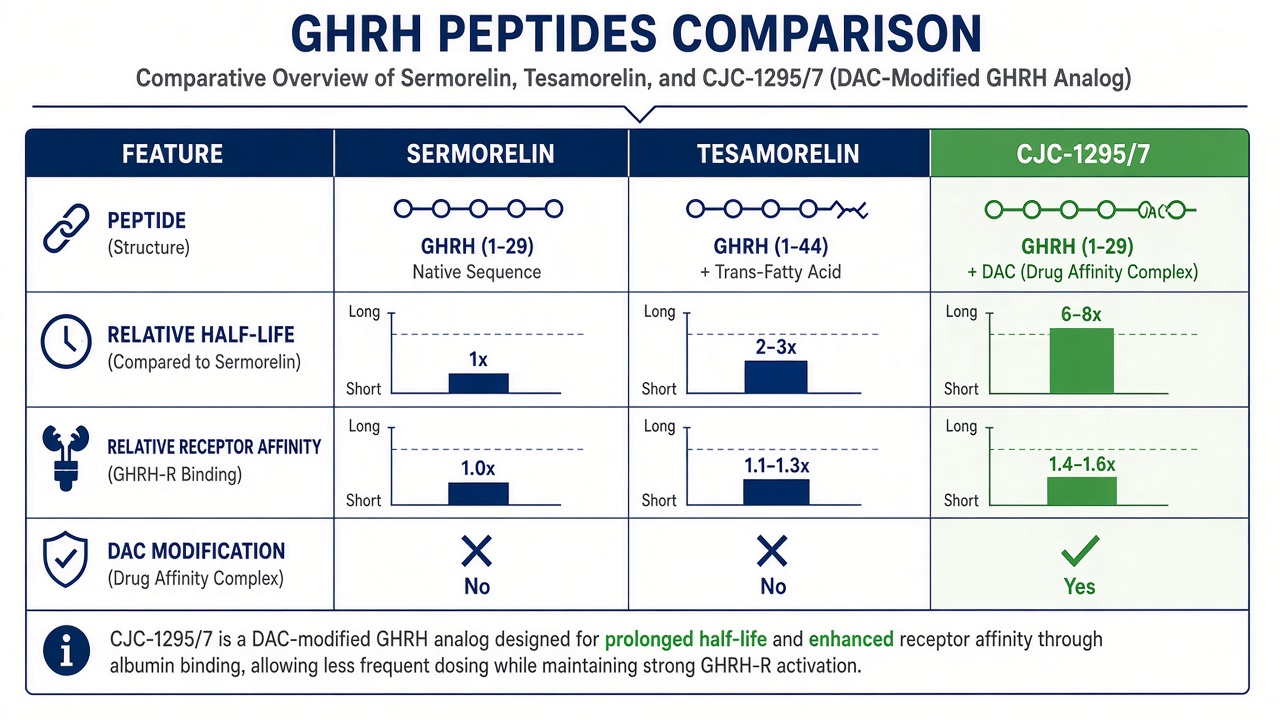
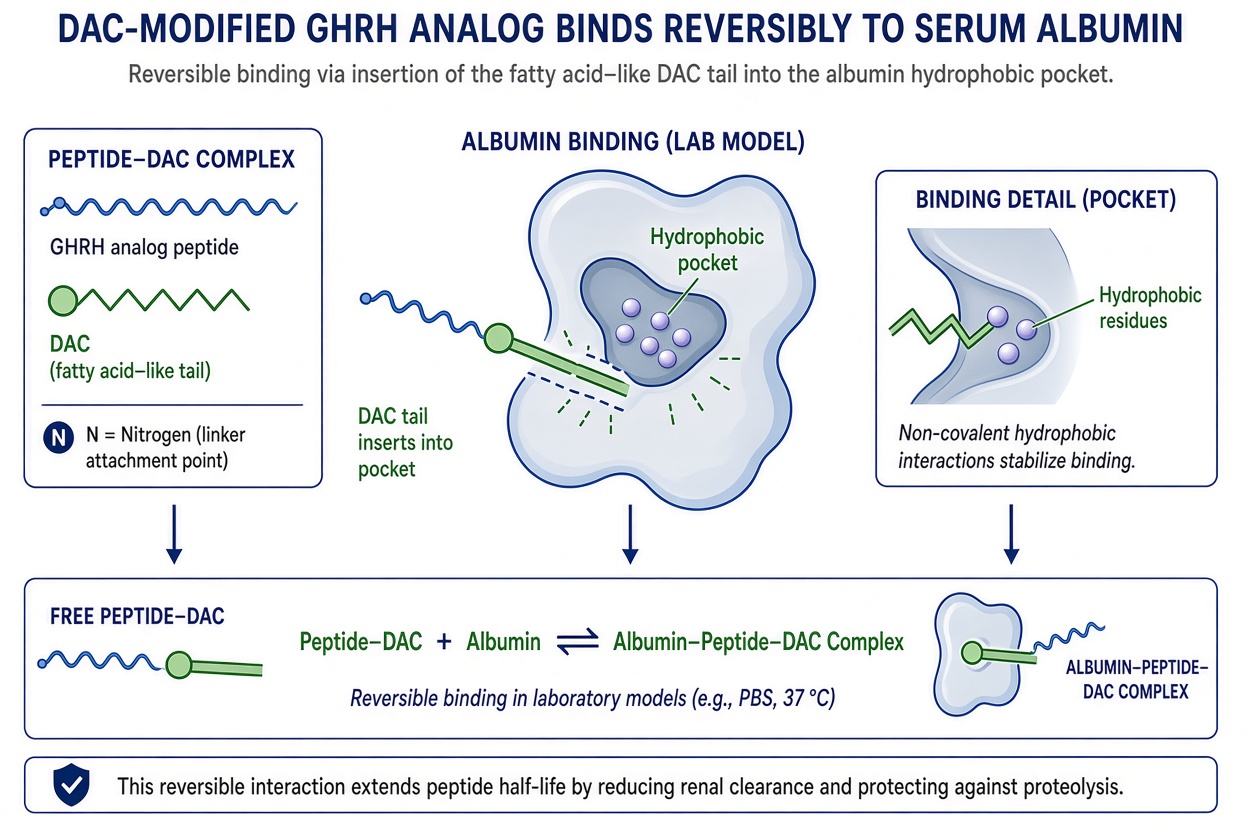
Albumin binding is a defining feature of 1295 in pharmacokinetic research. In vitro assays with purified albumin show that 1295 forms a stable conjugate within minutes at physiological pH. The covalent attachment reduces renal clearance and protects the peptide from proteolytic enzymes. Researchers measure the free fraction using equilibrium dialysis or ultrafiltration.
The reaction between the maleimide linker and the free thiol of albumin is highly selective under mild conditions. In phosphate-buffered saline at pH 7.4, near-quantitative conjugation can be observed within 10 to 30 minutes. This rapid kinetics simplifies in vitro modeling but complicates in vivo measurements because the bound and free forms coexist in a dynamic equilibrium that depends on albumin concentration and turnover.
For experimental design, the albumin-bound reservoir acts as a slow-release compartment. Only the free peptide is available for receptor binding, so total plasma concentration may overestimate pharmacodynamic activity. Researchers should measure both total and free fractions when correlating exposure with growth hormone release. Equilibrium dialysis with a molecular weight cutoff membrane is a common approach, but ultrafiltration can introduce artifacts if the peptide adsorbs to the filter.
How Does 1295/7 Activate GHRH Receptors and Signaling Pathways?
At the molecular level, 1295 activates the GHRH receptor, a class B G protein–coupled receptor expressed on pituitary somatotrophs. In cell-based assays, 1295 stimulates cAMP production and downstream protein kinase A activity. The binding affinity for the GHRH receptor can be quantified using radioligand displacement or surface plasmon resonance. Comparative studies show high affinity despite the DAC modification.
Receptor activation triggers a canonical Gαs-mediated cascade: adenylyl cyclase converts ATP to cAMP, which activates protein kinase A and leads to phosphorylation of cAMP response element-binding protein. In primary pituitary cell cultures, the peptide induces growth hormone secretion in a dose-dependent manner. Researchers use these endpoints to standardize assay conditions, including cell density, serum starvation, and incubation time.
Desensitization and internalization kinetics are also relevant. Prolonged receptor occupancy by the albumin-bound form may lead to different desensitization profiles than acute GHRH stimulation. Surface plasmon resonance can measure association and dissociation rates, while confocal microscopy can track receptor internalization. These data help laboratories interpret sustained signaling in vivo and select appropriate time points for endpoint analysis.
What In Vitro Applications Are Used with 1295/7 in Cell Cultures and Assays?
In vitro research with 1295 focuses on receptor pharmacology and signal transduction. Common assays include cAMP accumulation, intracellular calcium mobilization, and growth hormone release from primary pituitary cells or cell lines. Because 1295 has an extended half-life in vivo, in vitro experiments often use lower concentrations and longer incubation times than unmodified GHRH. Researchers should validate peptide stability in culture media before assay setup, and use cell viability assays to exclude non-specific cytotoxicity.
Primary rat anterior pituitary cells are a standard model because they retain endogenous GHRH receptor expression. Immortalized cell lines overexpressing the receptor can also be used for high-throughput screening. For cAMP assays, a competitive ELISA or time-resolved fluorescence resonance energy transfer method provides quantitative readouts. Intracellular calcium mobilization can be measured with fluorescent indicators such as Fluo-4, although GHRH receptor coupling to calcium is less robust than cAMP.
The peptide is typically dissolved in sterile buffer or dimethyl sulfoxide for in vitro studies. Finally, researchers should include vehicle controls and concentration-response curves to establish assay sensitivity and specificity. Stability testing in complete culture medium at 37°C can identify degradation products before long-term exposure experiments.
💡 Key Takeaway: What In Vitro Applications Are Used with 1295/7 in Cell Cultures and Assays?
What In Vivo Research Protocols Use 1295/7 in Animal Models?
Animal studies with 1295 typically measure growth hormone release, IGF-1 levels, and receptor occupancy over extended time courses. Because the DAC modification prolongs the circulating half-life of 1295, sampling schedules often extend beyond 24 hours. Researchers use subcutaneous or intravenous administration in rodent models, followed by serial blood collection for hormone assays.
Protocol design must account for albumin binding dynamics. Total plasma 1295 concentrations do not equal the free fraction available for receptor activation, so pharmacodynamic correlations require free-peptide measurements. Tissue distribution studies can quantify 1295 in pituitary, liver, and kidney using LC-MS/MS. All animal protocols require institutional ethics approval and adherence to local regulations.
For repeated-dose studies, investigators monitor body weight, organ weights, and standard hematology parameters. Because 1295 is a research peptide, no therapeutic endpoints should be inferred from animal data. Reporting should include exact dose, route, vehicle, and batch number to support reproducibility.
How Is the Half-Life and Pharmacokinetics of 1295/7 Measured in Research?
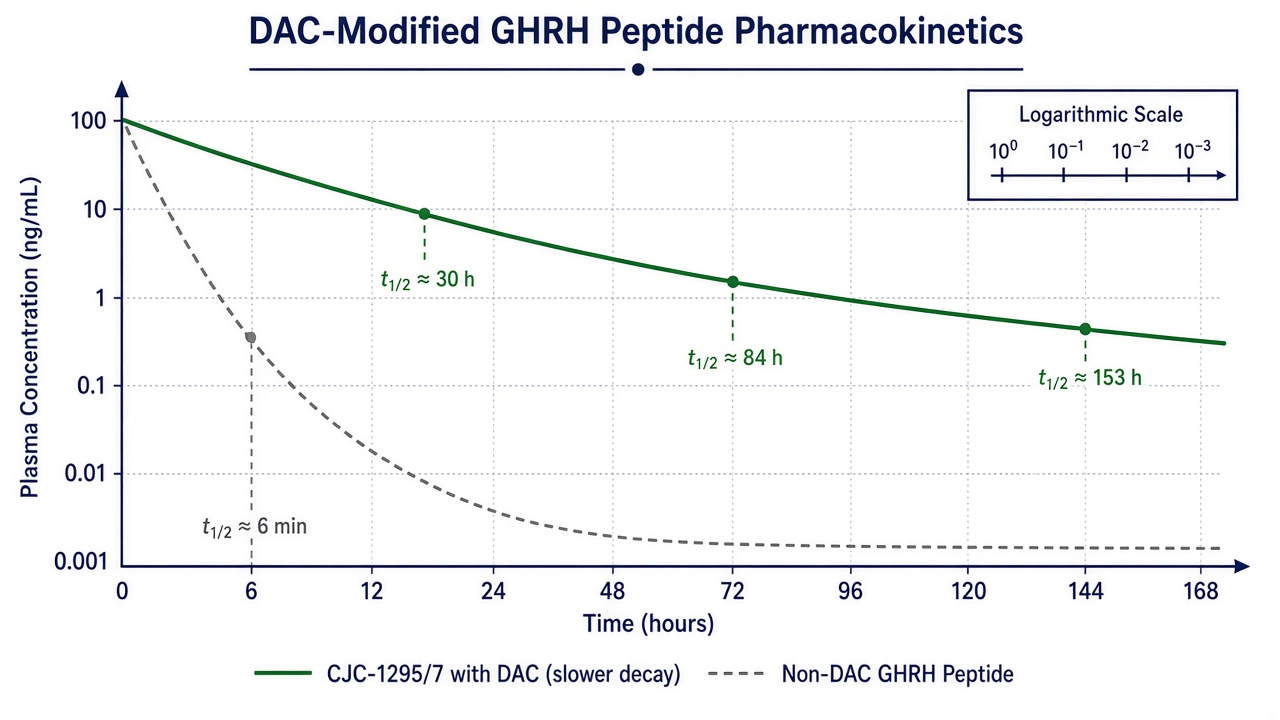
Pharmacokinetic analysis of 1295 begins with a validated bioanalytical method, typically LC-MS/MS or a specific immunoassay. Researchers collect serial plasma samples after a single dose and measure total and free 1295 concentrations. Non-compartmental analysis provides area under the curve, clearance, volume of distribution, and terminal half-life.
For accurate half-life estimation, sampling should continue for at least three terminal half-lives after the last measurable concentration. The albumin-bound reservoir may produce a biphasic elimination profile with a rapid initial distribution phase and a slow terminal phase. Researchers should fit the data with appropriate models and report both distribution and terminal half-lives.
What Sample Handling Steps Prevent Artifacts in Bioanalysis?
Plasma collection should use protease inhibitor cocktails and chilled tubes to minimize ex vivo degradation. The DAC-albumin conjugate is stable in plasma at 4°C for short periods, but repeated freeze-thaw cycles can release free peptide. Researchers should validate stability under their specific storage conditions.
LC-MS/MS methods require an internal standard, preferably a stable isotope-labeled analog, to correct for matrix effects and recovery. Calibration curves should cover the expected concentration range from pilot studies. Quality control samples at low, medium, and high concentrations should be included in every analytical run.
For free fraction measurement, equilibrium dialysis must reach equilibrium without significant peptide degradation. Incubation times longer than 4 hours may require temperature control and buffer additives. Ultrafiltration should use low-binding membranes and confirm absence of nonspecific adsorption.
What Are Common Pitfalls in Pharmacokinetic Studies of This DAC-Modified GHRH Analog?
Overreliance on total plasma concentrations can lead to incorrect exposure-response conclusions. Because only the free peptide activates receptors, total concentration overestimates pharmacodynamic activity when albumin levels vary.
Species differences in albumin sequence and turnover affect conjugation efficiency. Rodent albumin has a different thiol accessibility than human albumin, so in vitro binding kinetics may not translate directly across species. Cross-species validation is recommended before interpreting half-life data.
Analytical interference from endogenous peptides or matrix components can distort LC-MS/MS signals. Method selectivity should be demonstrated using blank matrix from the target species.
How Does the DAC-Modified GHRH Analog Compare with Other GHRH Peptides?
Compared with native GHRH(1–29), this DAC-modified analog shows markedly prolonged receptor activation in animal models. Native GHRH has a half-life of minutes due to rapid proteolytic cleavage and renal clearance. The tetrasubstituted backbone and albumin conjugation extend the terminal half-life to hours or days in rodent and non-rodent models.
Other GHRH analogs, such as sermorelin and tesamorelin, lack the DAC group. Sermorelin is a GHRH(1–29) fragment with a shorter half-life, while tesamorelin has a different substitution pattern. This analog’s covalent albumin binding is the key differentiator for sustained pharmacodynamic studies. Researchers should select the appropriate analog based on the time course of the experimental endpoint.
| Parameter | Native GHRH(1–29) | This DAC-Modified Analog | Sermorelin |
|———–|——————-|————————–|————|
| Backbone | GHRH(1–29) | Tetrasubstituted GHRH(1–29) | GHRH(1–29) |
| DAC modification | None | Maleimidopropionic acid linker + DAC | None |
| Albumin binding | Transient, non-covalent | Covalent via thiol-maleimide reaction | Transient |
| Protease resistance | Low | High due to substitutions | Moderate |
| Typical in vitro incubation | Short (minutes) | Longer (hours) due to stability | Short |
| Receptor affinity | High | High despite DAC | High |
For a related growth hormone fragment research guide, see AOD-9604 Growth Hormone Fragment: Research Peptide Guide (2026).
💡 Key Takeaway: How Does the DAC-Modified GHRH Analog Compare with Other GHRH Peptides?
What Storage, Handling, and Analytical Methods Apply to This Research Peptide?
Lyophilized powder should be stored desiccated at -20°C in the dark. Reconstituted stock solutions are typically aliquoted and stored at -80°C to minimize repeated freeze-thaw cycles. Researchers should confirm the certificate of analysis (COA) for purity, mass accuracy, and residual solvents before accepting a batch. For sourcing research libraries with documented COAs, see Where to Buy a Peptide Research Library with a COA.
Analytical characterization should include reversed-phase HPLC with purity above 95%, LC-MS mass accuracy within 5 ppm, and residual solvent testing. Some laboratories also request amino acid analysis or peptide content determination. These data support batch-to-batch consistency and help interpret biological variability across independent experiments.
For reconstitution, use sterile, endotoxin-free water or buffer. Avoid dimethyl sulfoxide for long-term storage unless stability has been validated. Divide reconstituted stock into single-use aliquots to prevent freeze-thaw degradation. Forced degradation studies can determine shelf life under intended storage conditions.
What Regulatory and Compliance Notes Apply to Research Use?
All work with this DAC-modified GHRH analog is limited to in vitro laboratory research and approved animal studies. The compound is not for human use, not for veterinary use, and not intended to diagnose, treat, cure, or prevent any disease. Purchasers must be 21 years of age or older, and institutional compliance with local biosafety and ethics regulations is required.
Research-use-only labeling means the peptide cannot be used in humans, animals outside approved protocols, or for diagnostic or therapeutic purposes. Institutional biosafety committees may require documentation of intended use. Import and export of research peptides may require permits depending on jurisdiction, so researchers should consult local regulations before ordering.
For researchers building a peptide library, verify supplier compliance and documentation. See Who Sells Research-Grade Peptide Libraries Online in 2026? and Peptide Research Library: Which Suppliers Are Trustworthy in 2026?.
Where Can Researchers Find Key References?
Peer-reviewed studies on DAC-modified GHRH analogs are available through PubMed. One relevant record describes prolonged growth hormone and IGF-1 secretion following administration of a long-acting GHRH analog in healthy adults (PubMed). Additional references on GHRH receptor signaling can be found via NCBI.
💡 Key Takeaway: Where Can Researchers Find Key References?
FAQ
What does the DAC modification do in this peptide?
The DAC group contains a maleimidopropionic acid linker that forms a covalent bond with serum albumin. This binding prolongs the peptide’s half-life by reducing renal clearance and protecting it from proteolytic degradation.
Which analytical methods confirm peptide identity and purity?
Reversed-phase HPLC measures purity above 95%, LC-MS confirms mass accuracy within 5 ppm, and residual solvent testing verifies batch quality. Some laboratories also use circular dichroism or nuclear magnetic resonance for secondary structure confirmation.
Can this peptide be used for human research?
No. This peptide is strictly for in vitro laboratory research and approved animal studies. It is not for human use, not for veterinary use, and not intended to diagnose, treat, cure, or prevent any disease.
How should researchers store this peptide?
Lyophilized powder should be kept desiccated at -20°C and protected from light. After reconstitution, divide the solution into single-use aliquots and store them at -80°C to avoid repeated freeze-thaw cycles.
What are common in vitro readouts for receptor activation?
Common readouts include cAMP accumulation, intracellular calcium mobilization, and growth hormone release from primary pituitary cells or receptor-overexpressing cell lines. Researchers should include vehicle controls and concentration-response curves.
Topics covered in this article:
Ready to Take the Next Step?
Every product includes lot-specific documentation and third-party purity testing.
Explore Our Research Products →Free shipping on qualifying orders · Batch COA on request