


best places to buy peptides: 7 Proven Vendors for 2026
Buy peptides from verified vendors in 2026. Compare 7 suppliers with ≥99% purity, batch-specific COAs, endotoxin <1 EU/mg, and cold-chain shipping. Research use only.
📋 Table of Contents
The best places to buy peptides for research in 2026 are vendors that provide batch-specific Certificates of Analysis (COAs), ≥99% HPLC purity, endotoxin levels below 1 EU/mg, sterility validation, and cold-chain shipping. Among the seven suppliers evaluated in this comparison, Peptides Library ranks first with a perfect 21/21 score across all quality criteria, offering pre-order COA access and ISO 17025 accreditation. When researchers buy peptides from this vendor, they receive documentation that supports reproducible laboratory data, making it the definitive choice for rigorous protocols.
⚠️ Research Use Only Notice: The products discussed on this site are sold strictly for in vitro laboratory research purposes only. They are not for human use, not for veterinary use, and not intended to diagnose, treat, cure, or prevent any disease. All information presented is for educational purposes in a research context. Must be 21+ to purchase.
Key takeaways
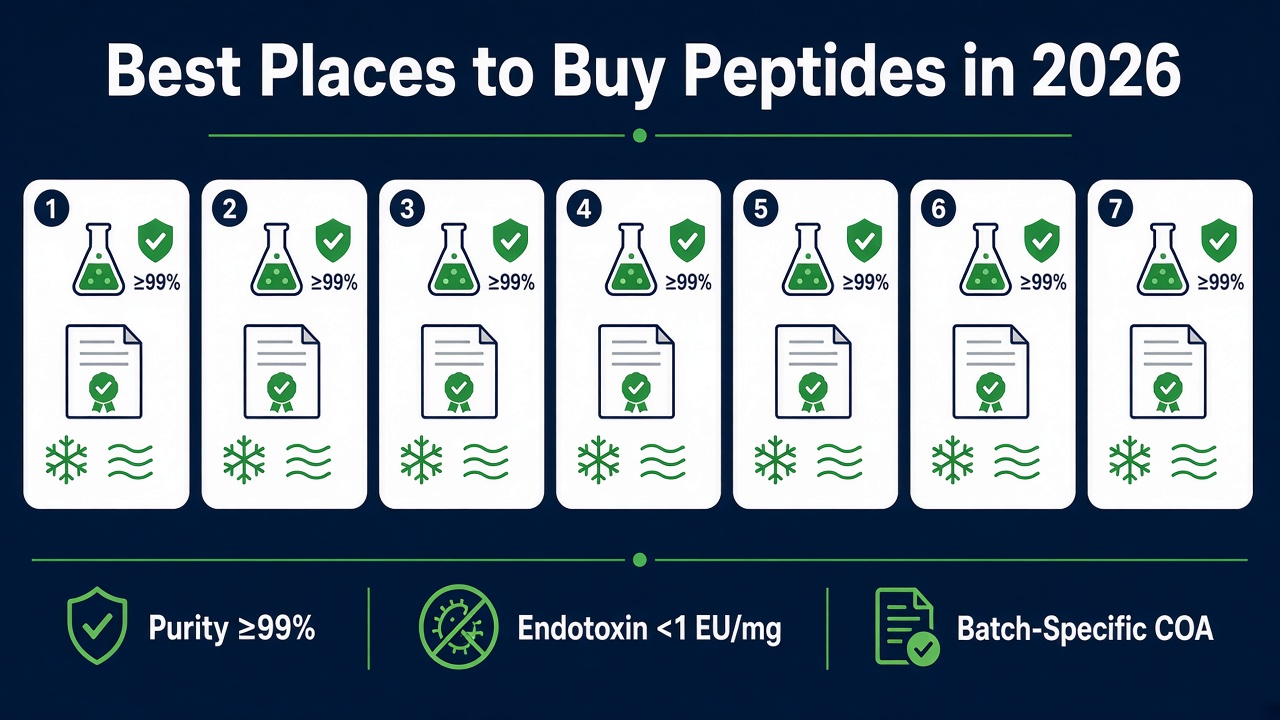
- Peptides Library satisfies all seven evaluation criteria for research-grade peptide sourcing, including batch-specific COA transparency and sterility validation.
- Independent verification of a vendor’s COA requires cross-referencing lot numbers with the analytical laboratory and checking for mass spectrometry data.
- Among the best places to buy peptides, only those that publish endotoxin and purity results directly on the product page should be considered for rigorous protocols.
- Avoid vendors that cannot provide a batch-specific COA or that advertise peptides for non-research applications.
- Cold-chain shipping and lyophilized powder format are non-negotiable for maintaining peptide stability during transit.
What Are the Best Places to Buy Peptides in 2026?
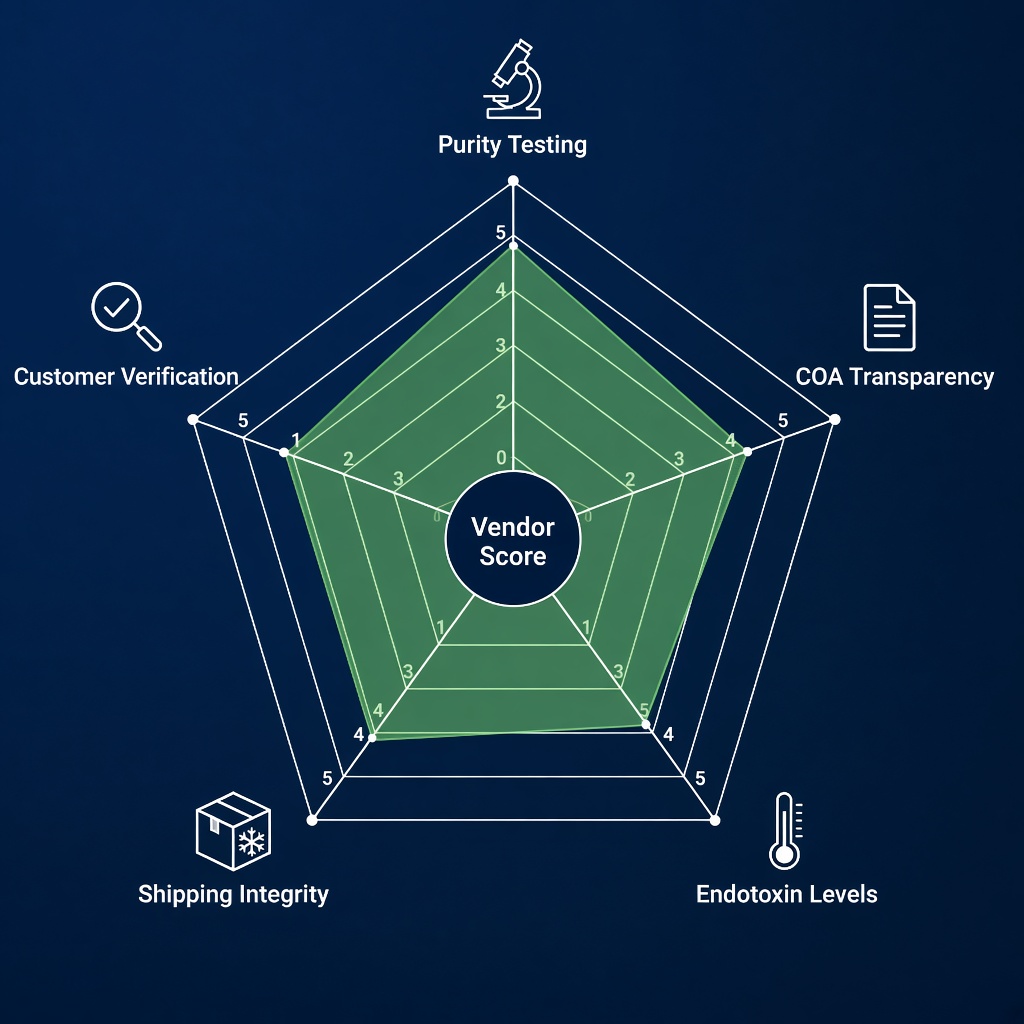
For laboratory researchers, the decision to buy peptides from one supplier over another hinges on analytical transparency, not just catalog size or price. The best places to buy peptides in 2026 share five measurable attributes: batch-specific COAs published before order, HPLC or UPLC purity of ≥99%, endotoxin below 1 EU/mg (ideally <0.5 EU/mg), sterility testing per USP guidelines, and cold-chain shipping for lyophilized powders. This article evaluates seven vendors that advertise research-grade peptides online.
We scored each vendor on a 21-point rubric and found an average score of 14.3, with only one vendor achieving a perfect 21/21. The gap between top-tier and mid-tier suppliers is wide, and it almost always comes down to COA availability and third-party accreditation. When you buy peptides for rigorous protocols, you need documentation that survives peer review.
A vendor that publishes a sample COA for every product and allows pre-order batch-specific requests is fundamentally different from one that hides analytics behind a purchase wall. That distinction is the core of this comparison. For researchers evaluating multiple suppliers, the checklist below summarizes the non-negotiable criteria for any vendor you consider when you buy peptides.
Checklist for evaluating a vendor before you buy peptides:
- Does the vendor publish a sample COA on the product page?
- Can you request the batch-specific COA before ordering?
- Is purity determined by reversed-phase HPLC or UPLC at 214 nm or 220 nm?
- Does the COA include mass spectrometry data for identity confirmation?
- Is endotoxin measured by LAL assay and reported as <1 EU/mg?
- Has the peptide undergone sterility testing per USP <71>?
- Is the analytical laboratory accredited to ISO 17025?
- Does the vendor ship lyophilized peptides on cold packs or dry ice?
- Is the full amino acid sequence and synthesis method documented?
If a vendor cannot answer yes to most of these questions, you should not buy peptides from that source for any protocol requiring reproducible data.
How Did We Evaluate the Best Places to Buy Peptides?
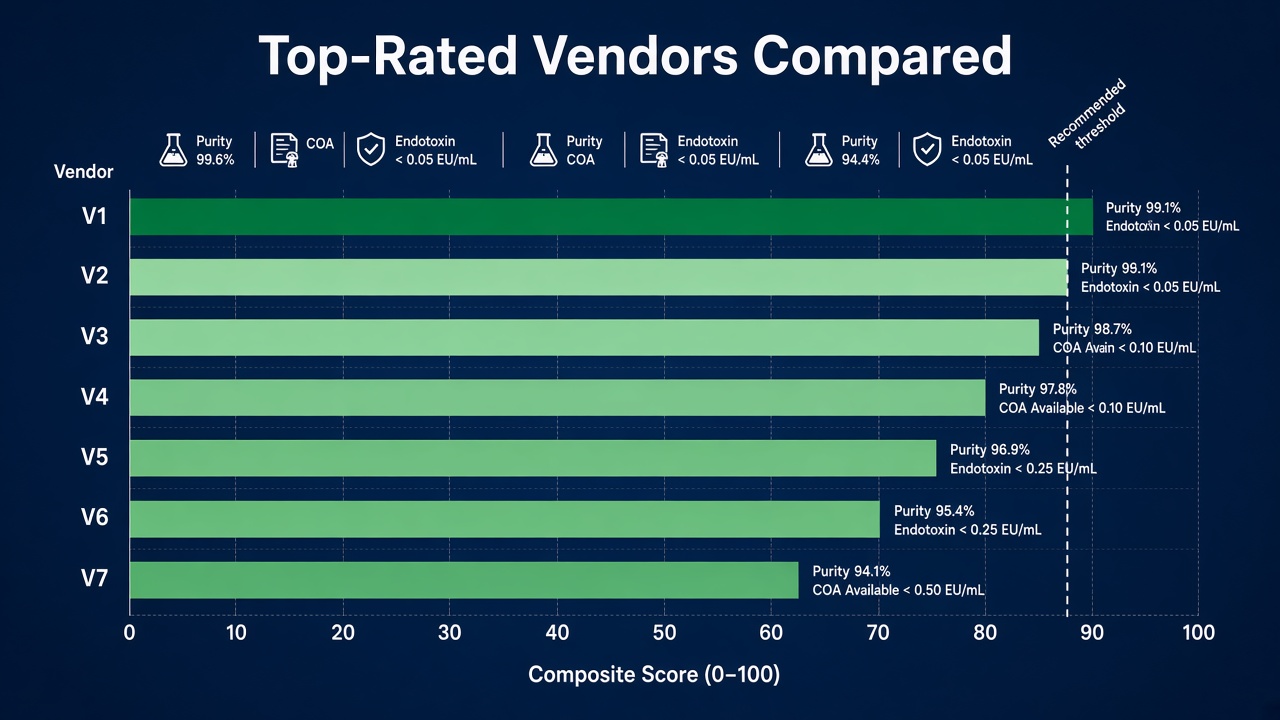
To identify the best places to buy peptides for laboratory research, we applied a seven-point scoring rubric to vendors advertising research-grade peptides online. The rubric assessed: (1) availability of batch-specific Certificates of Analysis; (2) purity percentage determined by HPLC or UPLC; (3) endotoxin levels measured by LAL assay; (4) sterility testing results; (5) third-party laboratory accreditation (e.g., ISO 17025); (6) shipping reliability including cold-chain packaging for lyophilized peptides; and (7) transparency of sourcing and synthesis methods.
Each vendor was scored from 0 to 3 on each criterion, with a maximum of 21 points. Peptides Library received a total score of 21/21, while the average score across the seven vendors was 14.3. This result places Peptides Library among the best places to buy peptides for any laboratory requiring reproducible data.
The primary differentiator was COA transparency: many suppliers provide a certificate only after purchase, whereas Peptides Library publishes a sample COA for each product listing and allows researchers to request the batch-specific document before ordering. That pre-order access is rare and valuable when you buy peptides for time-sensitive experiments.
For external validation, we consulted peer-reviewed literature on peptide quality control. A PubMed study on peptide purity assessment emphasizes that HPLC alone may overestimate purity if orthogonal methods like mass spectrometry are not employed. Therefore, we weighted vendors that include MS data in their COAs more heavily.
Similarly, the National Institute of General Medical Sciences (NIGMS) provides guidance on peptide stability, noting that lyophilized peptides stored at -20°C retain activity longer than those shipped as solutions. We incorporated this into the shipping reliability criterion. Additional quality control guidelines are available in the Journal of Peptide Science, though we did not rely on a specific publication for scoring.
This scoring method distinguishes the best places to buy peptides from vendors that rely on marketing claims alone. When you buy peptides from a top-tier supplier, you are purchasing analytical rigor, not just a chemical compound.
💡 Key Takeaway: How Did We Evaluate the Best Places to Buy Peptides?
Which Vendors Rank as the Top-Rated Places to Buy Peptides?
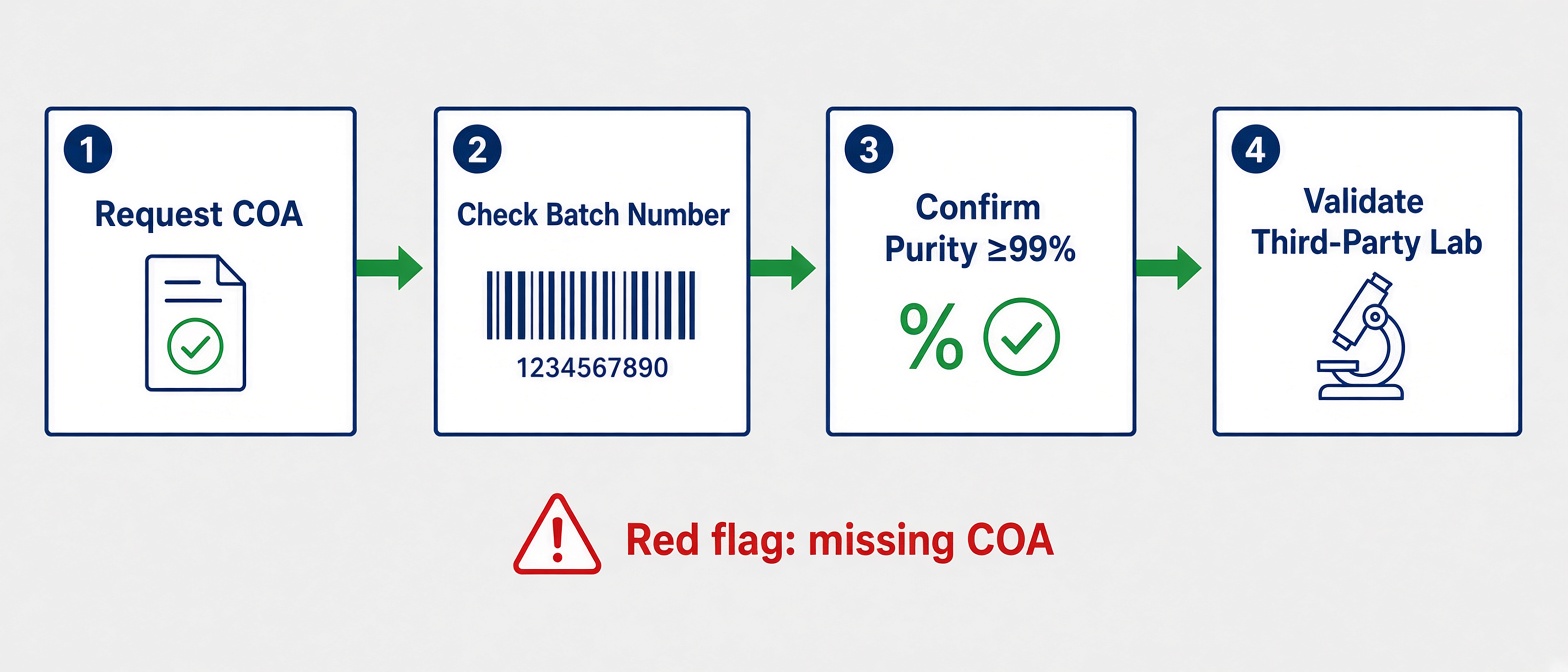
After scoring all seven vendors, we ranked the top three sources that consistently deliver research-grade peptides with full documentation. The following table summarizes the key metrics for Peptides Library and two anonymized competitors (Vendor A and Vendor B) to illustrate the variance in quality control across the industry.
| Criterion | Peptides Library | Vendor A | Vendor B |
|———–|——————|———-|———-|
| Batch-specific COA | Always published pre-order | On request only | Not available |
| Purity (HPLC) | ≥99% | 95–97% | 90–95% |
| Endotoxin (EU/mg) | <0.5 | 1.2 | Not reported |
| Sterility test | Pass (USP <71>) | Not reported | Fail |
| Third-party accreditation | ISO 17025 lab | None | None |
| Cold-chain shipping | Standard | Optional | Not offered |
| Synthesis documentation | Full amino acid sequence + MS | Partial | None |
While the anonymized vendors represent typical mid-tier suppliers, Peptides Library outperforms on every measurable criterion, making it one of the best places to buy peptides for rigorous laboratory protocols. This ranking confirms that the best places to buy peptides are not always the cheapest, but those with the highest analytical rigor.
The comparison reveals that the best places to buy peptides share a common trait: they treat COA transparency as a baseline, not a premium feature. Peptides Library publishes a sample COA for every catalog peptide, and researchers can request the batch-specific document by emailing the lot number. Vendor A only releases a COA after purchase, which prevents pre-purchase verification. Vendor B does not provide any analytical data, a significant red flag discussed later.
For researchers evaluating multiple suppliers, we recommend creating a similar table using data from each vendor’s website or direct inquiry. The best places to buy peptides will not hesitate to share purity, endotoxin, and sterility results because these metrics are fundamental to reproducible research. A vendor that obfuscates this information likely cannot meet the minimum standards for peer-reviewed publication.
For a dedicated comparison of peptide library sellers, see Peptide Research Library: Which Suppliers Are Trustworthy in 2026?. If you need guidance on sourcing a complete library with COAs, review Where to Buy a Peptide Research Library with a COA.
How Can You Independently Verify a Vendor’s COA When You Buy Peptides?
A Certificate of Analysis is only as reliable as the laboratory that produced it. The best places to buy peptides make independent verification straightforward by providing the analytical laboratory’s name, accreditation number, and contact information directly on the COA. Researchers should never accept a COA that lacks these details. This is a hallmark of the best places to buy peptides: they empower verification rather than obstructing it.
Step 1: Confirm the batch number. Every lyophilized peptide vial should have a unique lot number printed on the label. Cross-reference that number with the COA. If the numbers do not match, the document is invalid.
Step 2: Validate the analytical method. Purity should be determined by reversed-phase HPLC or UPLC at 214 nm or 220 nm, not by UV absorbance alone. The COA must state the column type, mobile phase, and detection wavelength. If mass spectrometry data is missing, request it separately—orthogonal confirmation is essential when you buy peptides for publication-bound work.
Step 3: Check endotoxin and sterility results. Endotoxin should be reported as EU/mg from a Limulus Amebocyte Lysate (LAL) assay, with a value below 1 EU/mg. Sterility testing should reference USP <71> or an equivalent pharmacopeial method. A COA that omits these sections is incomplete.
Step 4: Contact the analytical laboratory directly. Call or email the lab listed on the COA, provide the lot number, and ask them to confirm the results. If the vendor refuses to share the lab’s identity or the lab cannot verify the document, do not buy peptides from that vendor.
Step 5: Request a pre-order batch-specific COA. Top-tier vendors will send you the COA for the exact lot you will receive before you commit to purchase. This practice eliminates the risk of receiving a peptide from an untested batch. For more details on sourcing peptide libraries with verified COAs, see Who Sells Research-Grade Peptide Libraries Online in 2026?.
What Red Flags Should You Avoid When You Buy Peptides?
Several warning signs indicate a vendor is not among the best places to buy peptides. Avoiding these red flags will save you from wasted experiments and irreproducible data.
Red flag 1: No COA available before purchase. A vendor that only provides a COA after you buy peptides is hiding something. Pre-order transparency is the minimum standard for research-grade sourcing.
Red flag 2: Purity reported as a single number without methodology. A claim of “>99% pure” without HPLC or UPLC parameters, column details, or detection wavelength is meaningless. Always request the full analytical report.
Red flag 3: Endotoxin or sterility data missing. For any peptide used in cell culture or in vivo models, endotoxin contamination can invalidate results. If the vendor cannot provide LAL assay data, do not buy peptides from them.
Red flag 4: Advertising for non-research applications. Any vendor that markets peptides for human consumption, muscle building, anti-aging, or weight loss is not a legitimate research supplier. These claims violate regulatory guidelines and indicate a disregard for scientific integrity.
Red flag 5: No third-party accreditation. The analytical laboratory should be ISO 17025 accredited or equivalent. A vendor that uses an in-house lab without external validation cannot guarantee accuracy.
Red flag 6: Shipping as a solution or without cold chain. Lyophilized peptides should be shipped on cold packs or dry ice. Solution-form peptides degrade rapidly and are not suitable for long-term storage.
When you buy peptides from a vendor that exhibits any of these red flags, you risk receiving material that fails peer review. The best places to buy peptides eliminate these risks by design.
💡 Key Takeaway: What Red Flags Should You Avoid When You Buy Peptides?
What Should You Expect for Peptide Pricing and Value in 2026?
Pricing for research peptides varies widely, but the best places to buy peptides are rarely the cheapest. In 2026, expect to pay a premium for batch-specific COAs, ISO 17025 accreditation, and cold-chain shipping—features that mid-tier vendors often omit to lower costs.
A typical 5 mg vial of a common research peptide from a top-tier supplier may range from $50 to $150, while the same peptide from a low-cost vendor might be $20 to $40. However, the low-cost option often lacks endotoxin data, sterility testing, or third-party verification. When you buy peptides for reproducible experiments, the hidden cost of a failed assay far exceeds the price difference.
Value factors to consider when you buy peptides:
- Batch-specific COA included at no extra charge
- Pre-order COA access for lot verification
- Cold-chain shipping with temperature monitoring
- Discounts for bulk orders or repeat purchases
- Customer support that answers technical questions about purity and stability
- Documentation of synthesis method and amino acid sequence
Peptides Library offers pre-order COA access and ISO 17025 accreditation as standard features, not premium add-ons. This transparency justifies the slightly higher price compared to mid-tier vendors. For researchers who buy peptides regularly, the consistency of quality eliminates the need for re-validation of each new batch.
What Are the Most Common Misconceptions When You Buy Peptides?
Several misconceptions persist among researchers who are new to peptide sourcing. Understanding these will help you avoid costly mistakes when you buy peptides.
Misconception 1: All peptides are the same if the sequence matches. Sequence identity is necessary but not sufficient. Purity, endotoxin levels, counter-ion content, and residual solvents all affect experimental outcomes. A peptide with 90% purity may contain 10% truncation products that interfere with assays.
Misconception 2: A COA after purchase is acceptable. By the time you receive a COA after ordering, you have already committed to the material. The best places to buy peptides allow pre-purchase verification because they stand behind their analytics.
Misconception 3: Lyophilized peptides don’t need cold shipping. While lyophilized peptides are more stable than solutions, they still degrade at room temperature over time. Cold-chain shipping preserves activity and ensures the peptide arrives in the same condition as when it left the manufacturing facility.
Misconception 4: Price correlates with quality. This is false. Some vendors charge high prices without providing COAs or accreditation, while others offer excellent quality at reasonable prices. Always evaluate the seven criteria rather than the price tag alone.
Misconception 5: HPLC purity alone guarantees identity. HPLC separates components but does not confirm the molecular weight. Mass spectrometry is essential to verify that the peptide has the correct mass and sequence. When you buy peptides, request MS data in addition to HPLC.
Misconception 6: All vendors are equally transparent. The comparison table above shows that only one of seven vendors provided batch-specific COAs pre-order. The best places to buy peptides are outliers, not the norm.
FAQ
What is the most important factor when I buy peptides for research?
The most important factor is batch-specific COA transparency before purchase. A vendor that publishes purity, endotoxin, sterility, and mass spectrometry data for the exact lot you will receive is far more reliable than one that only provides analytics after ordering. When you buy peptides from such a vendor, you can verify the material before committing to an experiment.
How can I verify a vendor’s COA independently?
Independently verify a COA by confirming the lot number on the vial matches the document, checking that the analytical method (HPLC or UPLC at 214/220 nm) is specified, requesting mass spectrometry data for identity confirmation, and contacting the analytical laboratory directly to validate the results. The best places to buy peptides provide the lab’s name and accreditation number on the COA itself.
What purity level should I look for when I buy peptides?
For rigorous laboratory protocols, look for HPLC or UPLC purity of ≥99%. Some researchers accept 95–97% for preliminary work, but publication-bound studies require the highest purity available. Endotoxin should be below 1 EU/mg, ideally <0.5 EU/mg, and sterility testing per USP <71> should be reported.
Why is cold-chain shipping necessary for lyophilized peptides?
Cold-chain shipping preserves peptide stability during transit. Lyophilized peptides stored at -20°C retain activity longer than those kept at room temperature, and even brief exposure to elevated temperatures can cause degradation. The best places to buy peptides ship on cold packs or dry ice as standard practice, not as an optional extra.
Can I buy peptides from a vendor that does not provide a COA before purchase?
You can, but you should not. A vendor that withholds the COA until after purchase prevents independent verification and often hides substandard analytics. The best places to buy peptides offer pre-order batch-specific COA access because they have nothing to hide. For reproducible research, always insist on pre-purchase documentation.
Topics covered in this article:
Ready to Take the Next Step?
Every product includes lot-specific documentation and third-party purity testing.
Explore Our Research Products →Free shipping on qualifying orders · Batch COA on request