


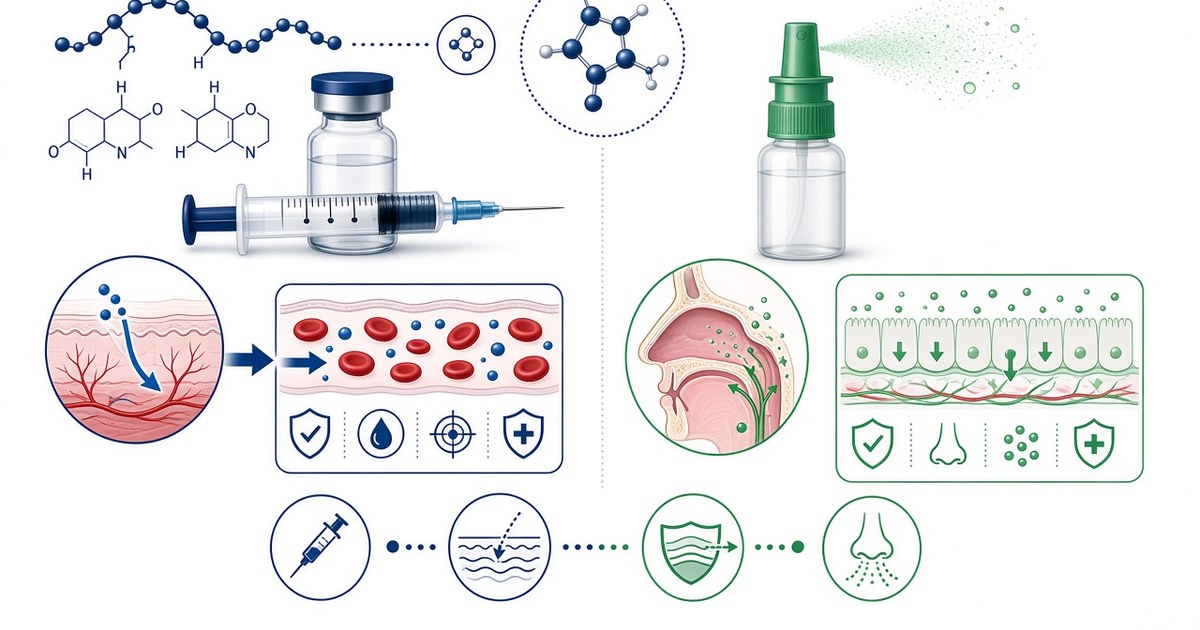
Injectable vs Nasal Peptides: 7 Key Differences for Research
Injectable vs nasal peptides: 7 key differences for research. Compare systemic delivery, CNS access, FDA examples, and route-specific evidence for study design.
📋 Table of Contents
Injectable peptides are the more established route for systemic research, while intranasal peptides are a narrower, formulation-dependent category most often studied for CNS access and nose-to-brain delivery. Route choice changes absorption barriers, variability, and how confidently you can compare one paper to another. This guide from Peptides Library breaks down the seven key differences every researcher should track.
Key takeaways
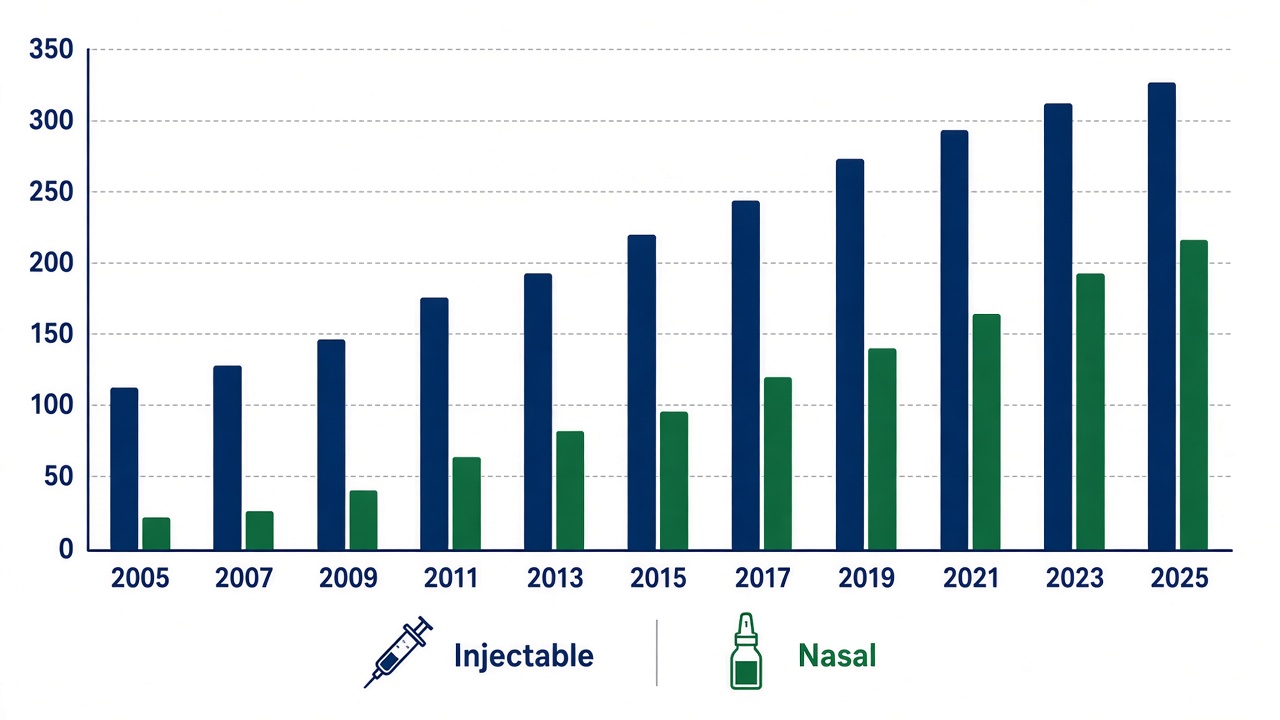
- Injectable peptides offer stronger precedent for systemic exposure and dose interpretation across most peptide classes.
- Intranasal delivery is selectively useful for CNS-targeted research, but it is highly sensitive to formulation, deposition, and mucosal conditions.
- FDA examples such as calcitonin salmon nasal solution and desmopressin acetate nasal spray confirm nasal peptide delivery is real but not universal.
- Choose the route based on target tissue, endpoint, and whether route-specific evidence exists for your research question.
- Peptides Library treats injectable peptides as a central research category because injection remains dominant for many therapeutic peptides.
What is the main difference between nasal peptides and injectable peptides?
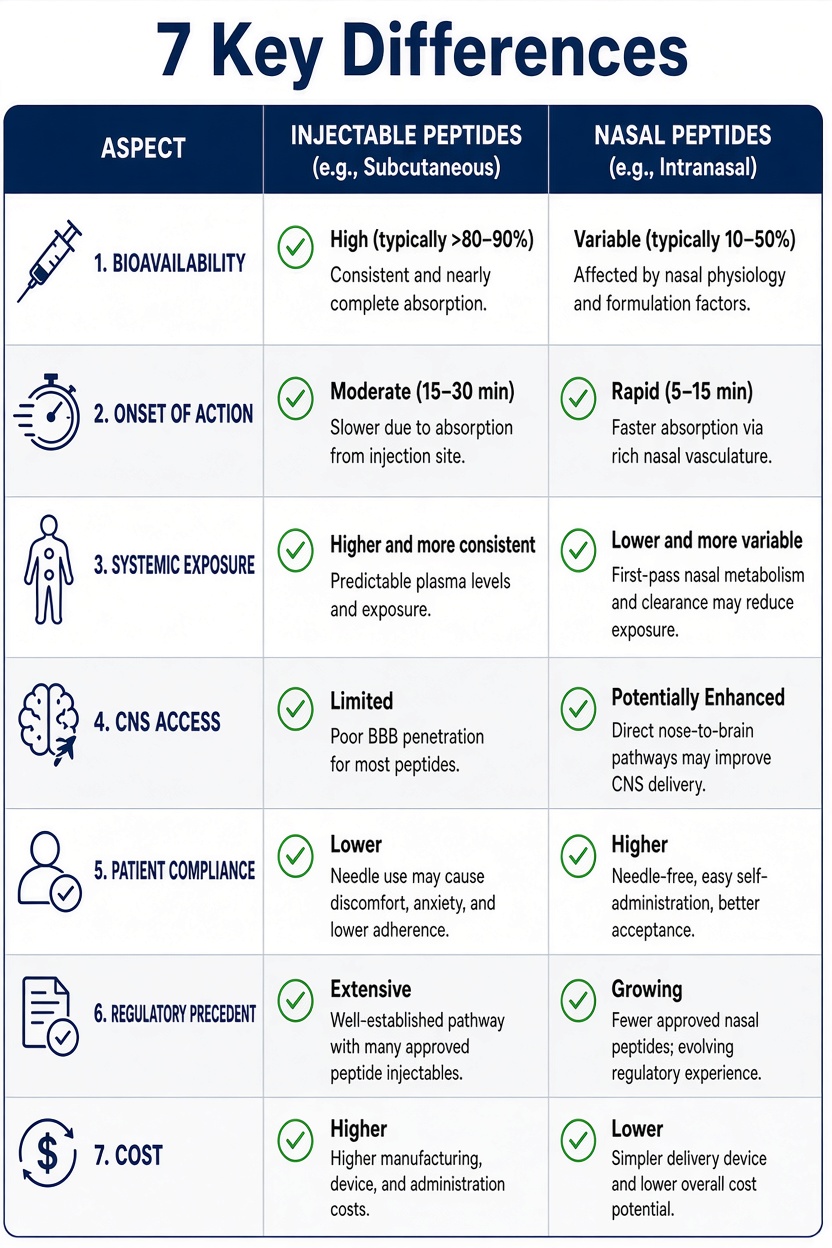
The core difference is route purpose. Injectable peptides are usually studied for more predictable systemic exposure, while intranasal peptides are more often examined for route-specific effects, especially possible brain access. This is not a convenience issue.
Route determines absorption barriers, first tissue exposure, metabolic risk, and what kind of pharmacology you can expect. An injected peptide enters tissue or circulation through a path already established in peptide research. A nasal peptide must first survive the nasal environment, deposit in the right region, and then either absorb systemically or move through nose-to-brain pathways.
A common mistake is assuming that if the peptide is the same molecule, the evidence transfers cleanly across routes. It often does not. The route can change onset, peak exposure, variability, and whether the measured effect is plausibly central, peripheral, or mixed. For any research protocol, this distinction should be written into the study question before formulation work begins.
Which route is better established in peptide research?
Injectable peptides are the better established route overall, and Peptides Library treats them as a central category because injection remains dominant for many therapeutic peptides. That position matches the broader research landscape. Many peptides have poor oral stability, so injectable delivery became the default path for systemic therapeutic use.
In practice, subcutaneous, intramuscular, or intravenous administration usually comes with a deeper pharmacology record, more standard dosing logic, and better route precedent. Intranasal delivery is real, but it is selective. It has a strong research rationale for certain goals, especially central nervous system work, yet it is not broadly standardized across peptide classes.
If your study needs strong systemic delivery evidence, injections usually start with a better foundation. If your study asks whether a peptide can reach or affect the brain through a noninvasive route, nasal delivery becomes much more interesting. Peptides Library frames injectable peptides as a research-first topic because injection remains the dominant route for many therapeutic peptides.
💡 Key Takeaway: Which route is better established in peptide research?
What are the 7 key differences researchers should track?
The seven biggest differences are evidence depth, target tissue, formulation sensitivity, variability, regulatory precedent, practicality, and how results should be interpreted across studies. These seven factors decide whether nasal and injectable data can be compared directly or only cautiously. For any research record, these points separate a route-specific finding from a general peptide effect.
Evidence base
Injectable peptides have a larger therapeutic and research record overall. Subcutaneous and intravenous routes appear more often in published pharmacology, toxicology, and pharmacokinetic studies. For a new research question, that depth means you can usually find prior dose-response curves, stability data, and route-specific benchmarks. Nasal peptide research is growing but remains concentrated in CNS delivery and selected therapeutic classes.
Primary use case
Injections are commonly used for systemic exposure, while intranasal work is often tied to brain-targeting questions. If your endpoint is peripheral or whole-body, injection is the cleaner precedent. If the study question asks whether a peptide can reach or affect the brain through a noninvasive route, nasal delivery becomes much more interesting. For any research question about brain targeting, route choice should follow the target tissue, not the other way around.
Barrier profile
Injectables bypass the nasal mucosa; nasal peptides must deal with local enzymes, clearance, and deposition limits. The nasal cavity has proteolytic activity, mucociliary clearance, and variable epithelial permeability. Those factors can degrade or remove a peptide before meaningful absorption occurs. Injection avoids that first-pass mucosal environment, which is one reason systemic exposure is usually more predictable. For research, this barrier difference should be measured, not assumed.
Formulation dependence
Nasal results are highly tied to spray design, excipients, and mucosal contact time. Droplet size, pH, osmolarity, and the presence of permeation enhancers can all shift deposition and absorption. A peptide that performs well in one nasal formulation may fail in another. Injectable formulations are also formulation-dependent, but the nasal route amplifies those effects because the delivery surface is smaller and more dynamic. For peptide research, always request the certificate of analysis and purity percentage from a peptide research library with a COA, because impurities or degradation products can alter mucosal absorption or injection-site reactions.
Variability
Nasal absorption can shift with congestion, anatomy, or local inactivation; injections are usually less route-variable. In animal models, nasal deposition depends on head position, administration volume, and breathing pattern. Those variables are harder to control than a subcutaneous or intravenous bolus. For research reproducibility, document nasal administration conditions in detail. Injection variability is not zero, but it tends to be lower and better characterized across peptide classes.
Regulatory examples
Some peptides do have approved nasal formulations, but they are a small subset, not the norm. Calcitonin salmon nasal solution and desmopressin acetate nasal spray are two clear FDA-labeled examples. Their labels prove intranasal peptide delivery is real but selective. For most peptide research, injection remains the default regulatory and pharmacological reference point.
Data transferability
Dose-response findings from injected peptides should not be assumed to apply to nasal delivery without route-specific evidence. A peptide that shows clear systemic effects after subcutaneous injection may have very different nasal absorption, half-life, or central exposure. Researchers should treat route as an independent variable, not a trivial substitution. If you only remember one point, make it this: nasal delivery is not simply “injection without a needle.” It is a separate delivery problem with its own pharmacology and failure points for research.
How do nasal peptides reach the brain?
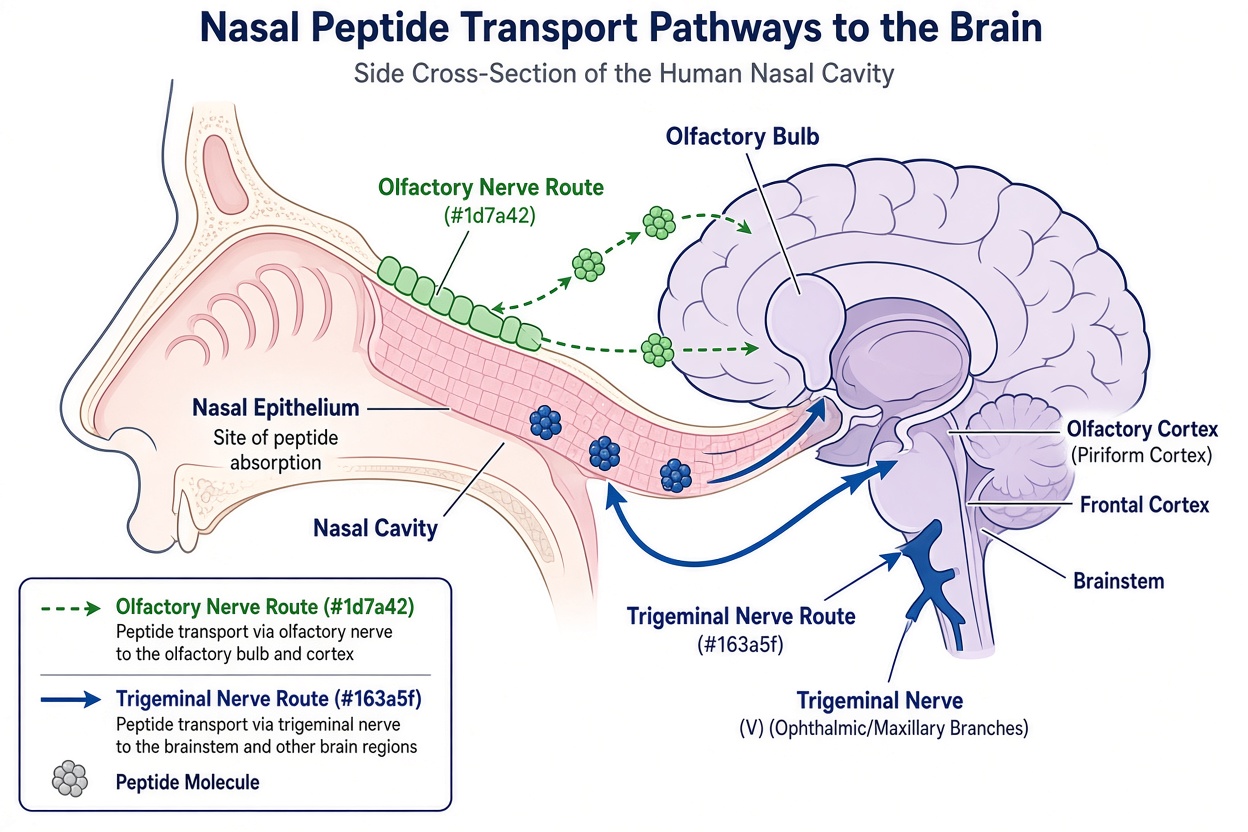
Intranasal delivery can reach the brain through more than one path. A 2023 review in Nature Signal Transduction and Targeted Therapy identifies the olfactory route, the trigeminal route, and an indirect systemic path.
The first direct path is the olfactory nerve to olfactory bulb to brain sequence. The second is the trigeminal nerve to brain route. The third is less direct: part of the administered material can enter the lungs or gastrointestinal tract after drainage or inhalation, absorb into blood, and then contribute to downstream central exposure.
This is why nasal peptide research gets so much attention in CNS discussions. The blood-brain barrier is a major obstacle for peptides and proteins, a point long emphasized in the PubMed-indexed brain-delivery literature. Intranasal administration is attractive because it may allow rapid brain targeting without relying only on blood circulation.
A useful correction here: intranasal does not automatically mean successful blood-brain barrier bypass. The pathway exists, but actual delivery depends on formulation, anatomy, dose volume, deposition pattern, and how the study confirmed tissue exposure. For research, that means you need route-specific analytical confirmation, not just a plausible mechanism.
When do injections make more sense than intranasal delivery?
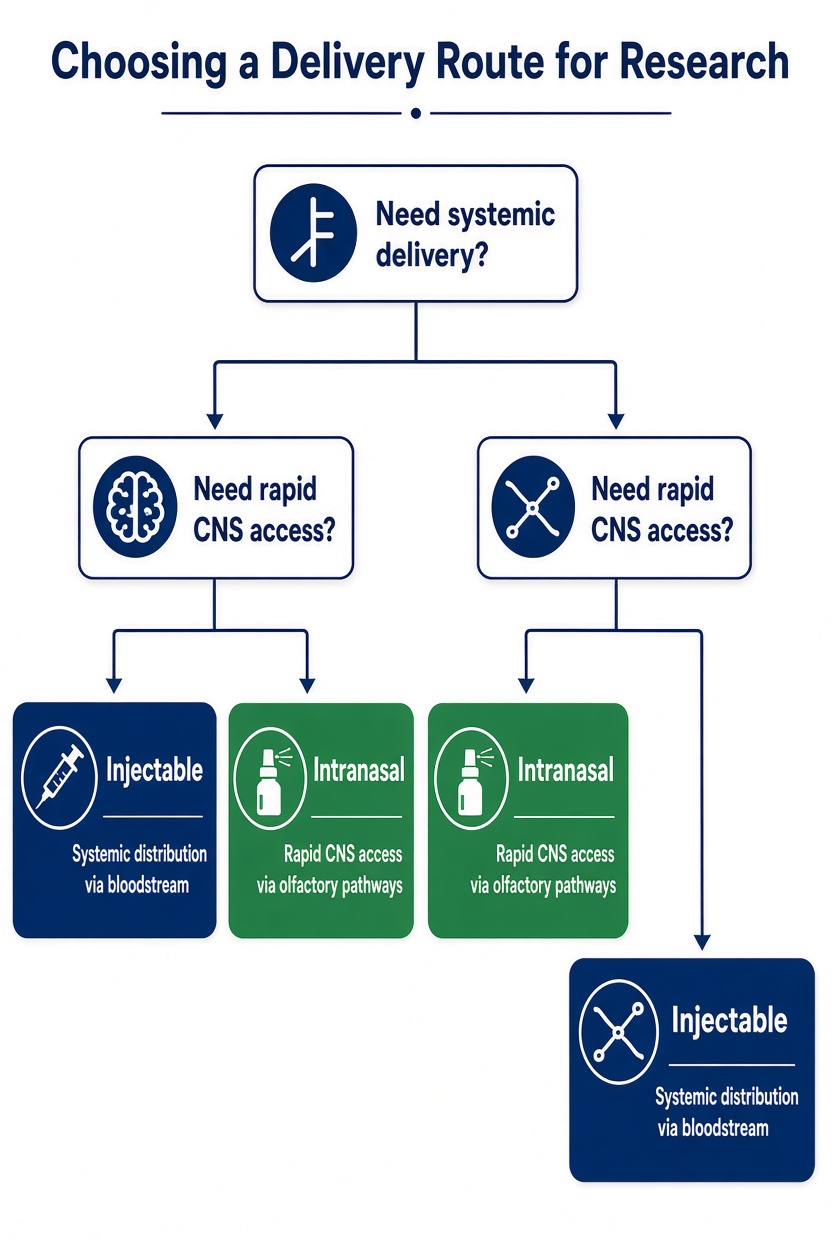
Injections make more sense when the goal is systemic exposure, dose precision, or stronger route precedent. Peptides with established injectable use are usually easier to interpret across studies. If your endpoint is peripheral, whole-body, or clearly plasma-driven, injection is often the cleaner option.
That does not guarantee perfect bioavailability or identical kinetics across subcutaneous and intravenous routes, but it does remove many of the uncertainties that dominate nasal research. A practical tip is to ask one question early: Is the target central or systemic? If the answer is systemic, injection usually wins on precedent alone. If the answer is central, intranasal delivery may be justified, but only if the study design actually measures route-relevant outcomes.
After you define the target, these trade-offs are usually the most important:
- Injectable strength: better-established systemic delivery and dose interpretation
- Nasal strength: plausible nose-to-brain access for selected CNS questions
- Injectable trade-off: invasiveness, sterility demands, and possible reconstitution steps
- Nasal trade-off: variable absorption, mucosal clearance, and route-sensitive performance
For any research protocol, when you source from a peptide research library, verify the certificate of analysis, purity percentage, and storage conditions before and after reconstitution. Lyophilized peptides typically require storage at -20°C or -80°C; reconstituted peptides should be kept refrigerated and used within a window defined by the supplier. These details affect both injectable and nasal outcomes, but nasal studies are especially sensitive to formulation changes.
💡 Key Takeaway: When do injections make more sense than intranasal delivery?
Are there FDA examples of nasal peptide drugs?
Yes, FDA labeling shows that some peptide drugs do have approved intranasal formulations. Calcitonin salmon nasal solution and desmopressin acetate nasal spray are two clear examples. Those labels matter because they prove intranasal peptide delivery is not merely theoretical.
DailyMed directions for calcitonin salmon nasal solution specify one spray once daily in one nostril. The FDA label for DDAVP Nasal Spray identifies desmopressin acetate as a synthetic peptide analogue of vasopressin. At the same time, these examples should not be overgeneralized.
The DDAVP label also notes that a solution for injection is available when the intranasal route may be compromised, which tells you something important: route reliability can change with local nasal conditions. The same label notes that loss of response may result from local inactivation of the peptide. That is a route-specific limitation you do not want to ignore.
A common misconception is that a few approved nasal products mean most peptides can be adapted to the nose with similar confidence. The evidence does not support that leap. For research, treat each nasal peptide as its own formulation and route problem until route-specific data say otherwise.
How should you choose a peptide delivery route for research?
Route selection should start with the target tissue and the study endpoint, not with convenience. Use injections when you need established systemic delivery and dose interpretation. Consider nasal delivery when the research question is specifically about route-sensitive CNS targeting or noninvasive brain access. That difference matters for pharmacokinetics, bioavailability, formulation strategy, and how confidently you can compare one paper to another.
A simple four-step checklist can keep the decision evidence-based:
1. Define the target: peripheral, systemic, or central?
2. Check route precedent: does the peptide have published injectable or intranasal data?
3. Review formulation requirements: will nasal deposition, mucosal stability, or spray design limit interpretation?
4. Verify sourcing quality: obtain a certificate of analysis with purity percentage and storage conditions from the peptide research library you use.
Here is a route comparison table for research design:
| Parameter | Injectable peptides | Nasal peptides |
|———–|———————|—————-|
| Established systemic exposure | High | Variable, formulation-dependent |
| Primary research use case | Systemic pharmacology, dose-response | CNS targeting, nose-to-brain access |
| Barrier to overcome | Injection site, distribution | Nasal mucosa, enzymes, clearance |
| Formulation sensitivity | Moderate | High |
| Route variability | Lower | Higher, affected by congestion and anatomy |
| Regulatory examples | Broad across peptide classes | Narrow, such as calcitonin salmon and desmopressin |
| Data transferability | More straightforward across studies | Requires route-specific evidence |
If your goal is better research design, the key is not asking which route sounds easier, but which route gives evidence that matches the target tissue and study endpoint. Injections offer a deeper pharmacological record and more standard route precedent. Nasal delivery offers a unique noninvasive path for selected CNS questions, but it demands more formulation control and analytical confirmation.
For sourcing, use a peptide research library that provides a certificate of analysis and clear storage instructions. Purity percentage matters because impurities can affect absorption, stability, and reproducibility in either route. Lyophilized peptides generally need frozen storage, while reconstituted peptides require refrigeration and limited use windows. These practical details are part of route-specific research quality.
FAQ
Which peptide route is better for systemic research?
Injectable peptides are better established for systemic research. Subcutaneous, intramuscular, and intravenous routes have a deeper pharmacology record and more standard dose interpretation. Choose injection when the endpoint is peripheral or plasma-driven.
Can nasal peptides reach the brain without crossing the blood-brain barrier?
Intranasal delivery can reach the brain through olfactory, trigeminal, and indirect systemic pathways, as described in a 2023 Nature Signal Transduction and Targeted Therapy review. However, nasal delivery does not automatically guarantee successful blood-brain barrier bypass. Formulation, deposition, and route-specific confirmation are required.
Are there FDA-approved nasal peptide products?
Yes. Calcitonin salmon nasal solution and desmopressin acetate nasal spray are two FDA-labeled examples. The DDAVP label also notes that an injection solution is available when the intranasal route is compromised, and that local peptide inactivation can cause loss of response.
What should I check before using a peptide in either route?
Verify the certificate of analysis, purity percentage, and storage conditions from your peptide research library. For nasal studies, also document spray design, administration volume, deposition pattern, and any permeation enhancers, because these factors change absorption.
Is nasal delivery just injection without a needle?
No. Nasal delivery is a separate delivery problem with its own pharmacology and failure points. Dose-response findings from injected peptides should not be assumed to apply to nasal delivery without route-specific evidence. For research, treat route as an independent variable.
Ready to Take the Next Step?
Every product includes lot-specific documentation and third-party purity testing.
Explore Our Research Products →Free shipping on qualifying orders · Batch COA on request