


Injectable vs Oral Peptides: 7 Research Differences
Research differences between injectable and oral peptides: 7 proven bioavailability, variability, and formulation facts for study design.
📋 Table of Contents
The core research differences between injectable and oral peptides center on bioavailability, variability, and formulation burden. Subcutaneous injection bypasses gastrointestinal barriers and typically yields far higher, more consistent systemic exposure, while oral delivery must overcome enzymatic degradation, pH instability, and poor epithelial permeability. At Peptides Library, route comparison is treated as a pharmacokinetic question first—investigators should compare AUC, Cmax, Tmax, and absolute bioavailability before assuming two routes deliver the same peptide effect.
Key takeaways
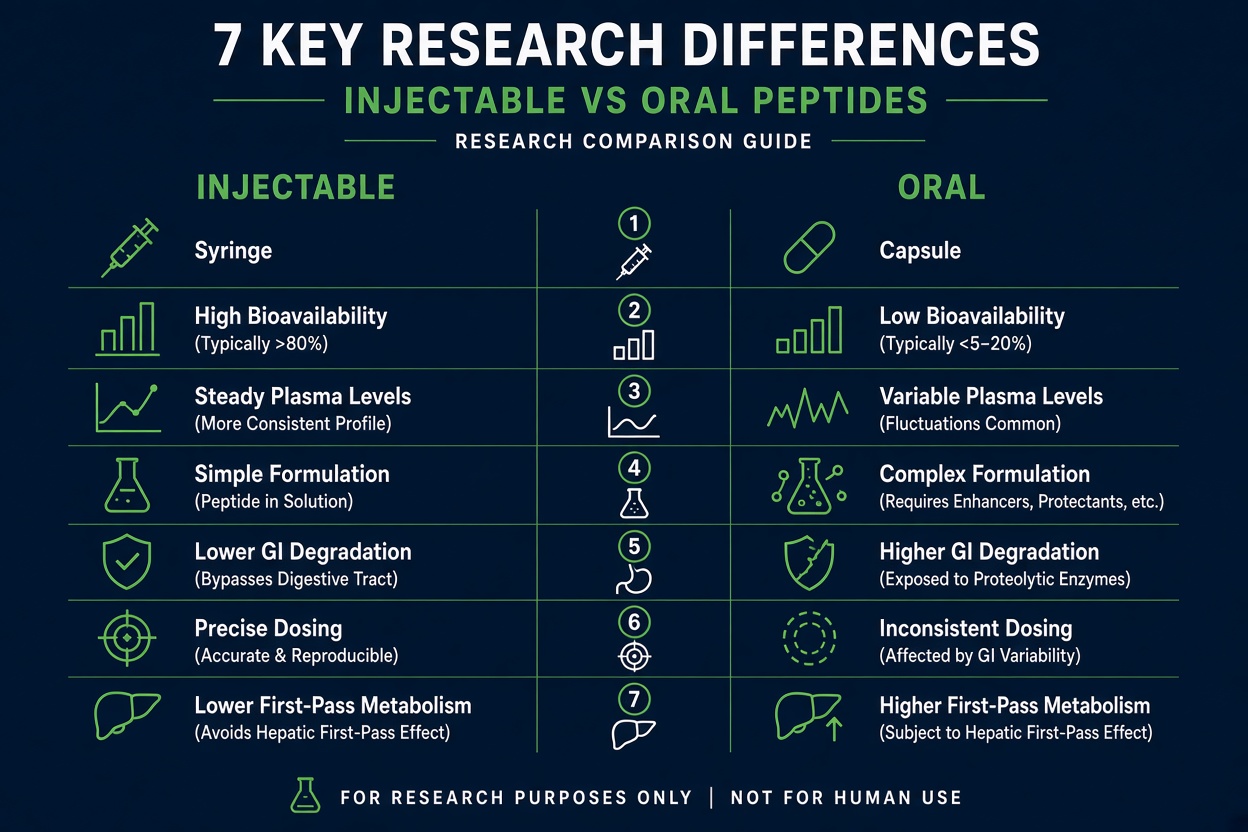
- Injectable peptides typically achieve much higher systemic bioavailability than oral peptides; FDA data show subcutaneous semaglutide at ~89% vs oral at ~1–2%.
- Oral peptide delivery faces three core barriers: enzymatic degradation, pH instability, and poor gastrointestinal permeability; many oral peptides deliver less than 1% to circulation.
- Seven research differences matter most: bioavailability, variability, onset, dose size, food effects, formulation complexity, and study design.
- Specialized formulation technologies such as SNAC, enteric coatings, and permeation enhancers can narrow the gap but rarely erase it.
- Route comparisons require pharmacokinetic endpoints (AUC, Cmax, Tmax) and strict attention to fed/fasted conditions and dosing windows.
!research differences between injectable and oral peptide delivery

What Are the Core Research Differences Between Injectable and Oral Peptides?
The main research differences between injectable and oral peptides start with delivery efficiency. Subcutaneous injection sends peptide into tissue for systemic absorption, while oral dosing must survive stomach acid, enzymes, and the gastrointestinal epithelium before enough drug reaches circulation. In research terms, this is mostly a bioavailability problem.
Injectable peptides bypass the largest gastrointestinal barriers, so investigators usually get a cleaner relationship between dose and exposure. Oral peptides must overcome degradation and poor membrane permeability before any meaningful fraction enters the bloodstream. That changes nearly every downstream variable: dose size, variability, timing, food restrictions, and interpretation of efficacy or adverse effects.
If two routes produce different plasma exposure, then “same peptide” does not mean “same pharmacology.” Peptides Library cites pivotal GLP-1 trials with nausea rates of 20% to 44% and discontinuation due to adverse events around 5% to 8%. A related misconception is that oral peptides are simply a more convenient version of injectable peptides. In many studies, they are really a different delivery problem wrapped around the same active molecule.
These research differences are not cosmetic. They affect how a peptide is dosed in preclinical models, how pharmacokinetic sampling is scheduled, and how results are interpreted across species. Investigators who ignore route-dependent exposure often misattribute efficacy differences to the peptide itself rather than to delivery constraints.
Why Do Oral Peptides Usually Have Much Lower Bioavailability?
Oral peptides usually show much lower bioavailability because proteases, gastric pH, mucus, and tight epithelial barriers reduce intact absorption. PubMed reviews describe oral peptide delivery as a major pharmaceutical challenge. Peptides are large, fragile molecules compared with classic small-molecule drugs. These oral-specific barriers are central to the research differences between injectable and oral peptides.
In the gastrointestinal tract, enzymatic degradation can break peptides apart before they cross into systemic circulation. Even if a fraction survives digestion, poor permeability across the gut lining still limits permeation. PubMed reviews published in 2025 summarize this point well: oral peptide therapeutics often send less than 1% of the administered dose into circulation. That is not a minor formulation inconvenience. It is a basic biopharmaceutical constraint.
A common misconception is that higher oral dosing solves the problem. It sometimes raises exposure, but often with diminishing returns, greater variability, and stricter administration rules. If absorption remains inefficient, a larger oral dose may simply create more waste in the gut rather than a proportional rise in plasma concentration.
Researchers comparing routes should treat low oral bioavailability as a default expectation, not an anomaly. The relevant question is whether a specific formulation can achieve reproducible, therapeutically meaningful exposure under realistic dosing conditions. Without that evidence, oral peptide data cannot be directly compared with injectable data.

💡 Key Takeaway: Why Do Oral Peptides Usually Have Much Lower Bioavailability?
What Are the 7 Research Differences Between Injectable and Oral Peptides?
Seven research differences matter most: bioavailability, variability, onset, dose size, food effects, formulation complexity, and study design. FDA semaglutide data make these research differences measurable rather than theoretical. When researchers compare routes, these seven factors usually explain why results diverge.
Bioavailability: Injectable peptides usually produce much higher systemic exposure than oral peptides. Subcutaneous semaglutide has about 89% absolute bioavailability, while oral semaglutide tablets using SNAC are estimated at about 1% to 2%.
Variability: Subcutaneous dosing is generally more predictable; oral exposure often varies more between individuals and dosing conditions. This variability complicates statistical power and cross-study comparisons.
Dose size: Oral formulations often require more active drug to offset gastrointestinal loss. The same peptide may need a much larger oral dose to approach injectable exposure, increasing cost and tolerability burden in research models.
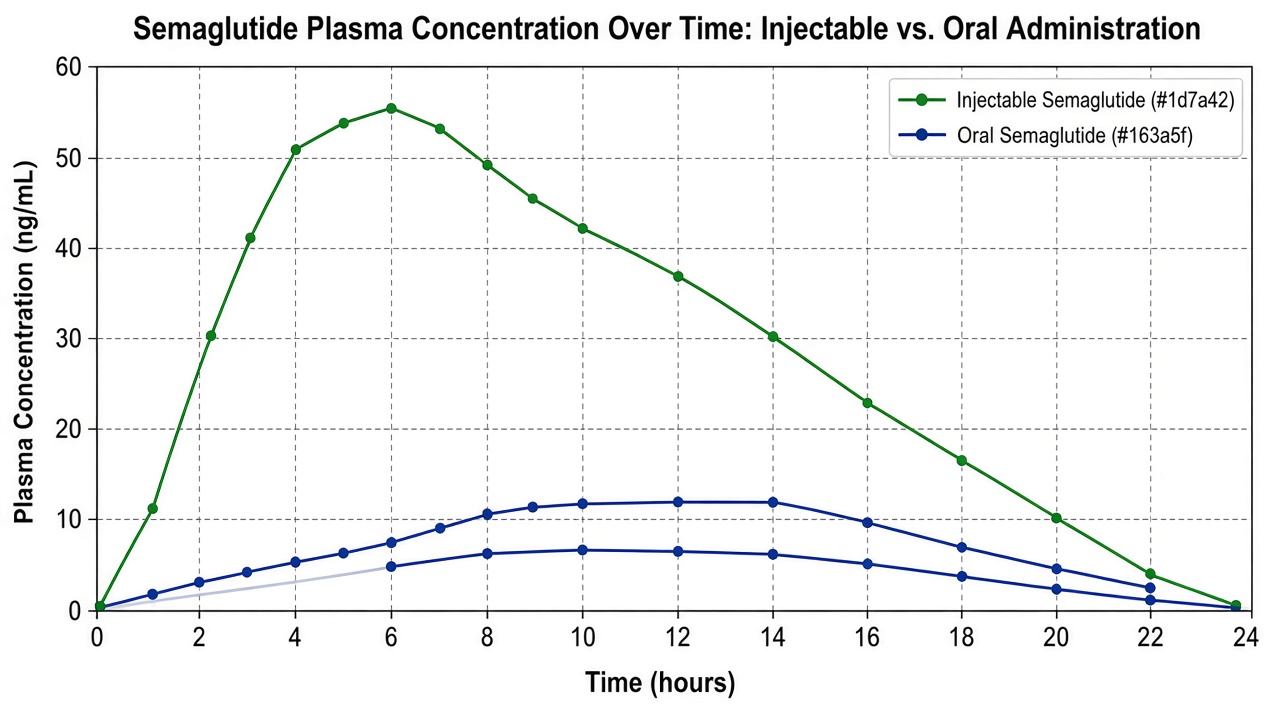
Onset profile: Oral products may show different Tmax and peak behavior because absorption depends on local gastrointestinal conditions. FDA labeling notes oral semaglutide reaches peak concentration at about 1 hour after dosing, a profile shaped by stomach absorption and formulation technology.
Food effects: Meals, water volume, and timing rules can materially change oral absorption. Fed versus fasted administration can shift AUC and Cmax enough to confound route comparisons.
Formulation burden: Oral peptides often need absorption enhancers, protective excipients, or specialized coatings. These additives are not inert; they can influence tolerability, stability, and reproducibility.
Study design: Route comparisons require pharmacokinetic endpoints, not just symptom or efficacy readouts. Without AUC, Cmax, and Tmax data, researchers cannot distinguish a true pharmacological difference from a delivery artifact.
If you remember only one item, keep the first two together: lower exposure plus higher variability is what makes oral peptide development difficult. These research differences define the practical gap between injectable and oral peptide candidates.
!research differences among injectable and oral peptide routes

How Do Researchers Compare Bioavailability Step by Step?
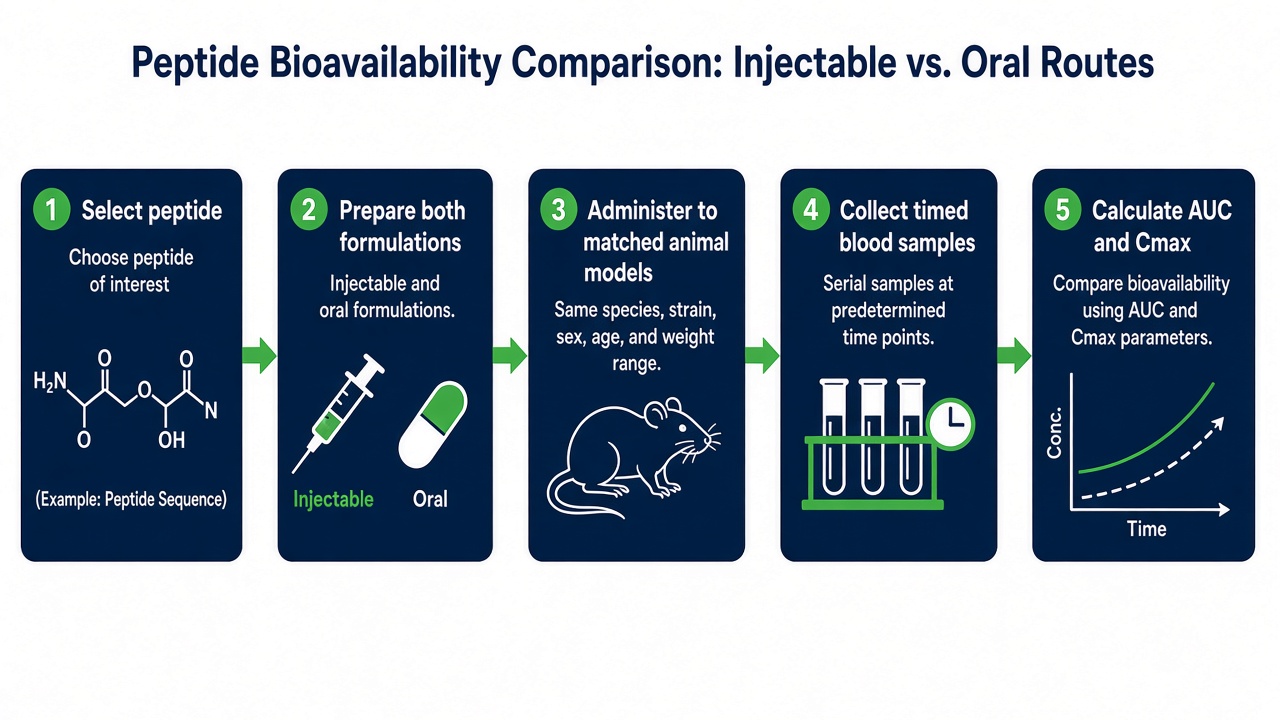
Researchers compare routes by matching the peptide, dose intent, and pharmacokinetic endpoints. Peptides Library often frames this around AUC, Cmax, Tmax, and absolute bioavailability, because route comparisons fail when endpoints are mixed. Step 1 is to define the comparator correctly. The molecule should be the same, the clinical or experimental goal should be similar, and the route should be the only major variable changed.
Step 2 is to collect serial plasma or tissue samples at appropriate times. Injectable peptides often reach peak concentration quickly, while oral peptides may show delayed or blunted peaks depending on formulation and food state. Sampling schedules must account for these differences, not assume identical time courses.
Step 3 is to calculate absolute bioavailability using the formula F = (AUC_oral × Dose_injectable) / (AUC_injectable × Dose_oral). This calculation removes dose differences and gives researchers a direct measure of how much peptide actually reaches systemic circulation after oral administration compared with injection.
Step 4 is to assess variability by reporting coefficient of variation for AUC and Cmax. High variability in oral exposure means that a single mean value may be misleading. This variability is one of the most underappreciated research differences between injectable and oral peptides. Step 5 is to interpret efficacy or biomarker changes only after confirming comparable exposure, or by explicitly modeling exposure-response relationships.
These steps are not academic formalities. They prevent researchers from concluding that an oral peptide is less potent when the real problem is lower or more variable absorption. The research differences between injectable and oral peptides become quantifiable only when investigators use the same pharmacokinetic yardstick.
How Does Semaglutide Show the Injectable vs Oral Gap?
Semaglutide is one of the clearest examples of the research differences between injectable and oral peptides because the same active molecule is available in both routes. FDA prescribing information lists subcutaneous semaglutide absolute bioavailability at about 89%, while oral semaglutide co-formulated with SNAC is estimated at about 1% to 2%. That gap is not a minor rounding error; it is a 40- to 80-fold difference in systemic exposure per milligram of drug.
The oral product compensates with much higher nominal doses and strict administration rules. Patients or research subjects must take oral semaglutide on an empty stomach with no more than 4 ounces of plain water, then wait at least 30 minutes before eating, drinking, or taking other oral medications. These food and fluid restrictions exist because absorption depends on local stomach conditions and the SNAC absorption enhancer.
This strict protocol exists because the research differences between injectable and oral peptides are magnified by food and fluid intake. The injectable formulation does not carry these restrictions to the same degree. This contrast illustrates why route comparisons must account for fed/fasted state, water volume, and dosing windows. A researcher who ignores these variables may see large differences in AUC that have nothing to do with the peptide’s intrinsic pharmacology.
For peptide library work, semaglutide serves as a benchmark. When researchers compare a novel oral peptide candidate to an injectable control, they should ask whether the observed gap matches the known semaglutide pattern. If it is much larger or much smaller, formulation or study design issues may be distorting the result.
💡 Key Takeaway: How Does Semaglutide Show the Injectable vs Oral Gap?
How Do Formulation Technologies Try to Make Oral Peptides Work?
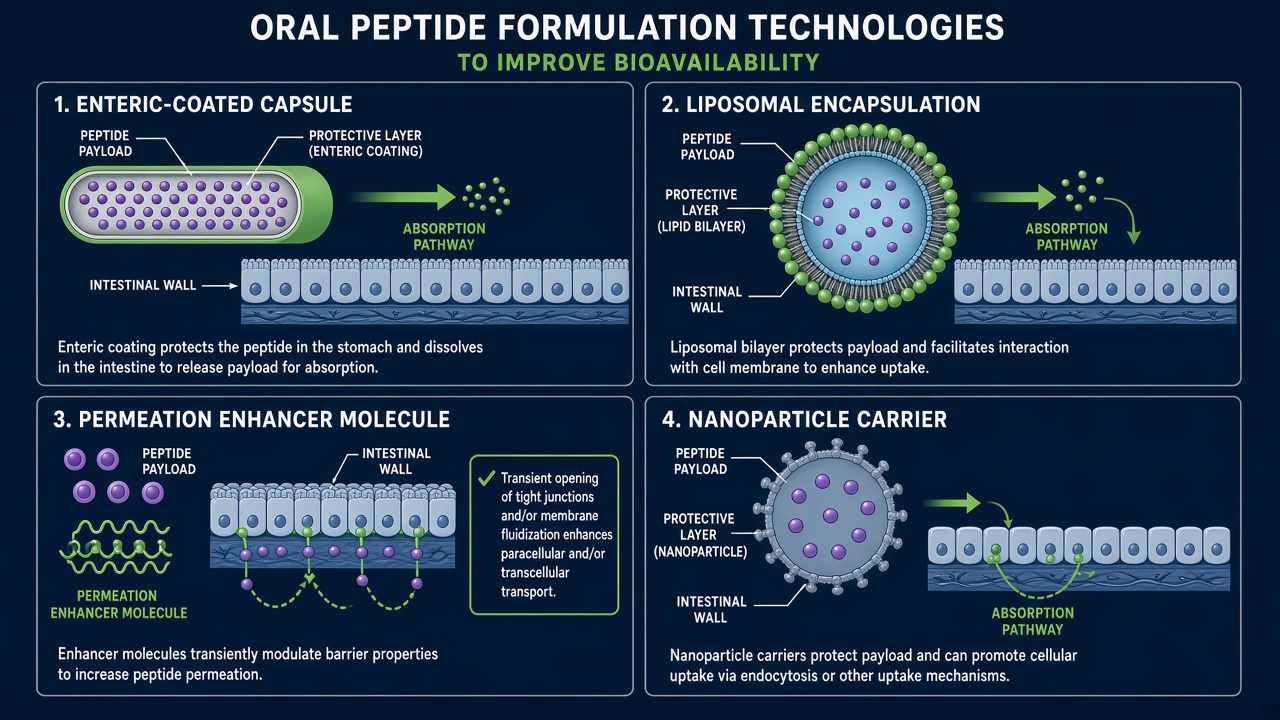
Formulation technologies attempt to narrow the research differences between injectable and oral peptides by protecting the peptide from degradation and enhancing absorption. The three most common approaches are absorption enhancers, enteric coatings, and permeation enhancers. SNAC (sodium N-[8-(2-hydroxybenzoyl) amino] caprylate) is the best-known example because it is used in the only FDA-approved oral GLP-1 peptide product.
SNAC works by locally buffering stomach pH and promoting transcellular absorption of the peptide across the gastric epithelium. This mechanism is specific, not a simple detergent effect. Enteric coatings protect peptides from stomach acid but do not solve enzymatic degradation in the small intestine, so they are often combined with protease inhibitors or permeation enhancers.
Permeation enhancers such as medium-chain fatty acids, bile salts, or chitosan derivatives can transiently open tight junctions or increase membrane fluidity. However, these effects are not always reproducible across species, and they can raise tolerability concerns in chronic studies. Every excipient added to an oral peptide formulation becomes a variable in the study.
Understanding these mechanisms helps researchers interpret the research differences between injectable and oral peptides in formulation studies. Researchers should verify that a given formulation technology has published pharmacokinetic data in the same species and dosing conditions they plan to use. A technology that works in rats may fail in dogs or primates. The research differences between injectable and oral peptides do not disappear with formulation; they are only modified, and the modification must be measured.
Which Factors Should Researchers Prioritize When Comparing Routes?
When comparing injectable and oral routes, researchers should prioritize the factors that most directly affect data interpretation: absolute bioavailability, variability, and dosing conditions. Absolute bioavailability tells you how much peptide reaches systemic circulation. Variability tells you whether that exposure is reproducible enough for statistical analysis. Dosing conditions—fed versus fasted, water volume, timing—tell you whether the comparison is even valid.
After these three, formulation composition and peptide stability matter. A peptide that degrades rapidly in gastrointestinal fluid may show near-zero oral bioavailability regardless of dose. Stability data from simulated gastric fluid or intestinal fluid assays can help predict whether oral delivery is feasible before investing in animal studies.
Species differences are often overlooked. Gastric pH, transit time, protease expression, and epithelial permeability vary widely between mice, rats, dogs, and primates. A route comparison in one species may not translate to another. Peptides Library recommends running at least one pilot pharmacokinetic study in the intended model before committing to a full efficacy trial.
Finally, researchers should track cost and practical burden. Injectable studies require handling, sterility, and injection-site monitoring. Oral studies require formulation development and strict administration protocols. Neither route is universally simpler; the choice depends on the specific research question and the peptide’s physicochemical properties. These priorities directly reflect the research differences between injectable and oral peptides.
!research differences checklist for route comparison studies

How Can a Research Peptide Library Support Route Comparison Studies?
A research peptide library can help investigators isolate the research differences between injectable and oral peptides by controlling for peptide identity and purity. When the same peptide lot is split between injectable and oral arms, researchers remove supply-chain variability from the equation. This is especially important for peptides with poor stability or batch-to-batch variability.
Libraries that offer Where to Buy a Peptide Research Library with a COA allow investigators to verify peptide identity, purity percentage, and storage conditions before starting route work. For oral studies, researchers may also request solubility data or stability profiles in simulated gastrointestinal fluids. These documents help predict whether a peptide is even a candidate for oral delivery.
Who Sells Research-Grade Peptide Libraries Online in 2026? reviews supplier practices around COA transparency and third-party testing. A supplier that cannot provide a COA for every peptide in a library should not be used for pharmacokinetic route comparisons, because unknown purity directly confounds bioavailability calculations.
Peptide Research Library: Which Suppliers Are Trustworthy in 2026? further explains how to evaluate vendor claims. For route comparison studies, the ideal library includes reference peptides with known bioavailability profiles, such as semaglutide, so researchers can calibrate their own assays against published values. This internal standard approach reduces inter-laboratory variability.
💡 Key Takeaway: How Can a Research Peptide Library Support Route Comparison Studies?
Common Pitfalls When Interpreting Research Differences Between Routes
One common pitfall is comparing oral and injectable doses without converting to systemic exposure. A 10 mg oral dose may produce the same AUC as a 0.1 mg subcutaneous dose, but researchers sometimes report the oral peptide as “less potent” simply because the nominal dose was higher. The correct comparison is exposure-normalized, not dose-normalized.
Another pitfall is ignoring food effects. Oral peptide absorption can change by 50% or more depending on whether the subject ate within the previous hour. If one study uses fasted conditions and another uses fed conditions, the resulting research differences between routes may be an artifact of protocol mismatch rather than a true pharmacological property.
A third pitfall is assuming that in vitro permeability data predict in vivo oral bioavailability. Caco-2 monolayer assays are useful for ranking candidates, but they do not capture gastric degradation, mucus trapping, or first-pass metabolism. Researchers should treat in vitro data as a screen, not a substitute for a pilot pharmacokinetic study.
A fourth pitfall is overinterpreting a single time point. Tmax differences between routes can make a peptide look faster or slower than it really is if sampling is too sparse. Collecting full concentration-time curves is essential for accurate AUC calculation.
Finally, researchers sometimes forget that formulation excipients can have their own pharmacological effects. SNAC, permeation enhancers, and enteric coatings are not inert. They can alter local pH, membrane integrity, or gut motility, which may confound tolerability or efficacy readouts. The research differences between injectable and oral peptides include formulation variables that must be reported and controlled.
Practical Checklist for Route Comparison Studies
Use this checklist before starting any injectable versus oral peptide comparison:
- Confirm the same peptide lot and purity percentage for both routes; request COA.
- Define primary pharmacokinetic endpoints: AUC, Cmax, Tmax, absolute bioavailability.
- Standardize fed/fasted state, water volume, and post-dose waiting period for oral arm.
- Choose sampling times based on known Tmax differences; do not use identical schedules for both routes.
- Calculate absolute bioavailability using dose-normalized AUC values.
- Report coefficient of variation for AUC and Cmax; do not hide variability.
- Record formulation composition, including all excipients, for the oral arm.
- Run a pilot study in the intended species before committing to a large efficacy trial.
- Compare results to a reference peptide with published route-specific data, such as semaglutide.
- Document storage conditions and peptide stability under simulated gastrointestinal conditions if available.
This checklist turns abstract research differences between injectable and oral peptides into actionable steps. Skipping any item increases the risk that route comparison data will be misinterpreted.
External Evidence Supporting Route-Specific Research Differences
Peer-reviewed literature consistently documents the research differences between injectable and oral peptides. PubMed indexes thousands of pharmacokinetic studies showing that oral peptide bioavailability rarely exceeds 1–2% without specialized formulation technology. FDA prescribing information for semaglutide provides the clearest regulatory dataset: 89% subcutaneous bioavailability versus 1–2% oral bioavailability. NIH National Library of Medicine hosts full-text reviews on oral peptide delivery barriers, including enzymatic degradation, pH instability, and epithelial permeability.
These external sources are essential for researchers who need to justify route comparison study designs in grant applications or protocols. Citing FDA data is particularly powerful because it removes any ambiguity about whether the injectable-oral gap is real. When a regulatory agency labels two products with such different bioavailability, the research differences are not a matter of opinion.
Investigators should also look for species-specific pharmacokinetic data in PubMed before designing animal studies. A peptide that shows 5% oral bioavailability in rats may show 0.5% in dogs, and that difference will change dosing and interpretation. The external evidence base helps researchers anticipate these gaps rather than discover them mid-study.

💡 Key Takeaway: External Evidence Supporting Route-Specific Research Differences
FAQ
What are the main research differences between injectable and oral peptides?
The main research differences are bioavailability, variability, onset profile, dose size, food effects, formulation burden, and study design. Injectable peptides typically achieve much higher and more consistent systemic exposure than oral peptides.
Why is oral peptide bioavailability so low?
Oral peptide bioavailability is low because peptides face enzymatic degradation, gastric pH instability, mucus barriers, and poor epithelial permeability. Many oral peptides deliver less than 1% of the administered dose into circulation without specialized formulation technologies.
Does semaglutide show the same research differences between routes?
Yes. FDA data show subcutaneous semaglutide has about 89% absolute bioavailability, while oral semaglutide with SNAC is about 1% to 2%. Oral dosing requires higher nominal doses and strict fasting and water restrictions.
How should researchers compare injectable and oral peptide data?
Researchers should compare AUC, Cmax, Tmax, and absolute bioavailability using dose-normalized calculations. They must standardize fed/fasted conditions, water volume, and sampling times, and report variability.
Can formulation technologies eliminate the research differences between routes?
Formulation technologies like SNAC, enteric coatings, and permeation enhancers can narrow the gap but rarely erase it. Oral peptide bioavailability still remains far below injectable levels for most peptides.
Ready to Take the Next Step?
Every product includes lot-specific documentation and third-party purity testing.
Explore Our Research Products →Free shipping on qualifying orders · Batch COA on request