



Semax vs Cerebrolysin: 7 Research Differences Today
Research differences today: Semax vs Cerebrolysin compared across 7 proven research distinctions in chemistry, stroke evidence, safety, and FDA findings.
📋 Table of Contents
Semax vs Cerebrolysin 7 research differences today: the direct answer is that these two peptide research substances are not interchangeable, because Semax is a defined synthetic heptapeptide with formula C37H51N9O10S, while Cerebrolysin is a porcine-brain-derived mixture of low-molecular-weight peptides and amino acids. For research-use-only evaluation, neither compound currently has strong high-quality clinical support for broad stroke benefit, and Cerebrolysin carries clearer recent neutral or negative safety signals. This comparison separates chemical identity, evidence quality, and safety interpretation.
Key takeaways
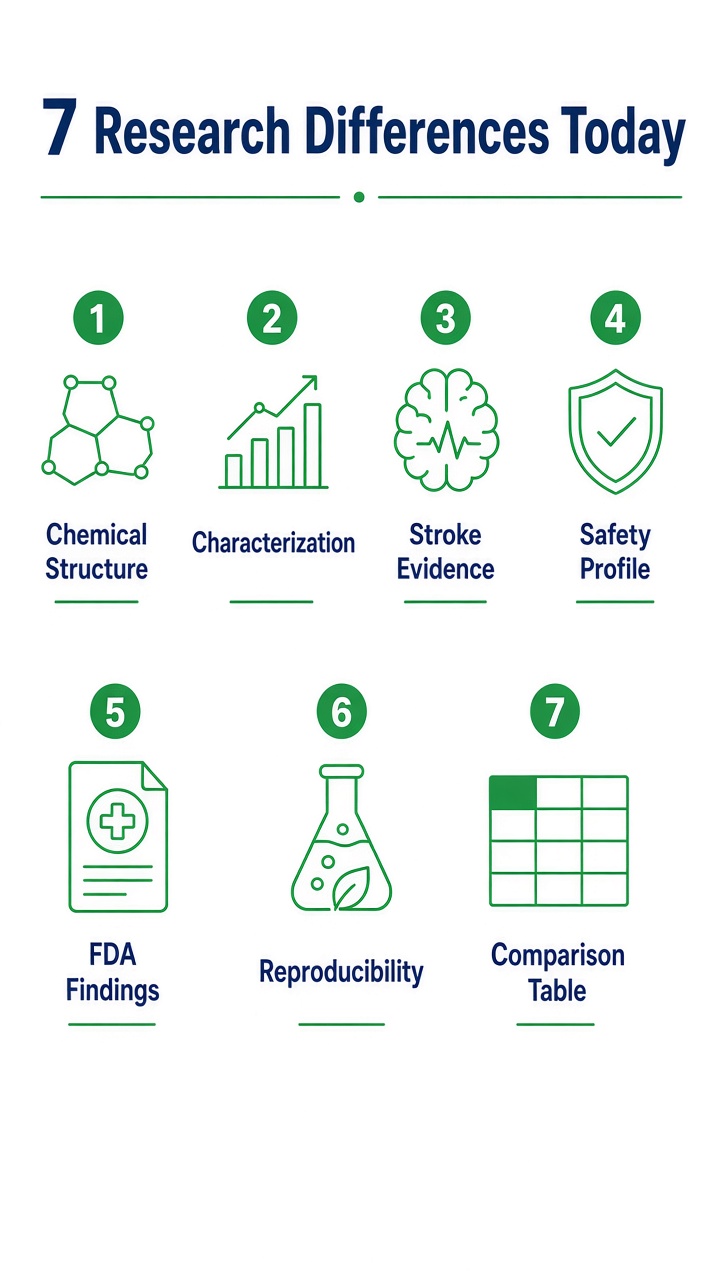
- semax vs cerebrolysin 7 research differences today starts with chemical class: Semax is a single defined heptapeptide related to ACTH4-10, while Cerebrolysin is a multicomponent biologic mixture.
- FDA review documents report insufficient evidence of effectiveness for Semax in proposed neurologic conditions and raise characterization and immunogenicity concerns.
- Cochrane’s 2023 acute ischemic stroke review found no proven all-cause mortality benefit for Cerebrolysin and suggested it may increase non-fatal serious adverse events.
- A 2017 meta-analysis of seven randomized studies and 1,779 patients found no significant superiority of Cerebrolysin for modified Rankin Scale or Barthel Index outcomes.
- For reproducible research, prioritize substance identity, trial quality, stroke endpoints, and safety reporting over mechanism-based claims.
What Is the Core Chemical Difference in semax vs cerebrolysin 7 research differences today?
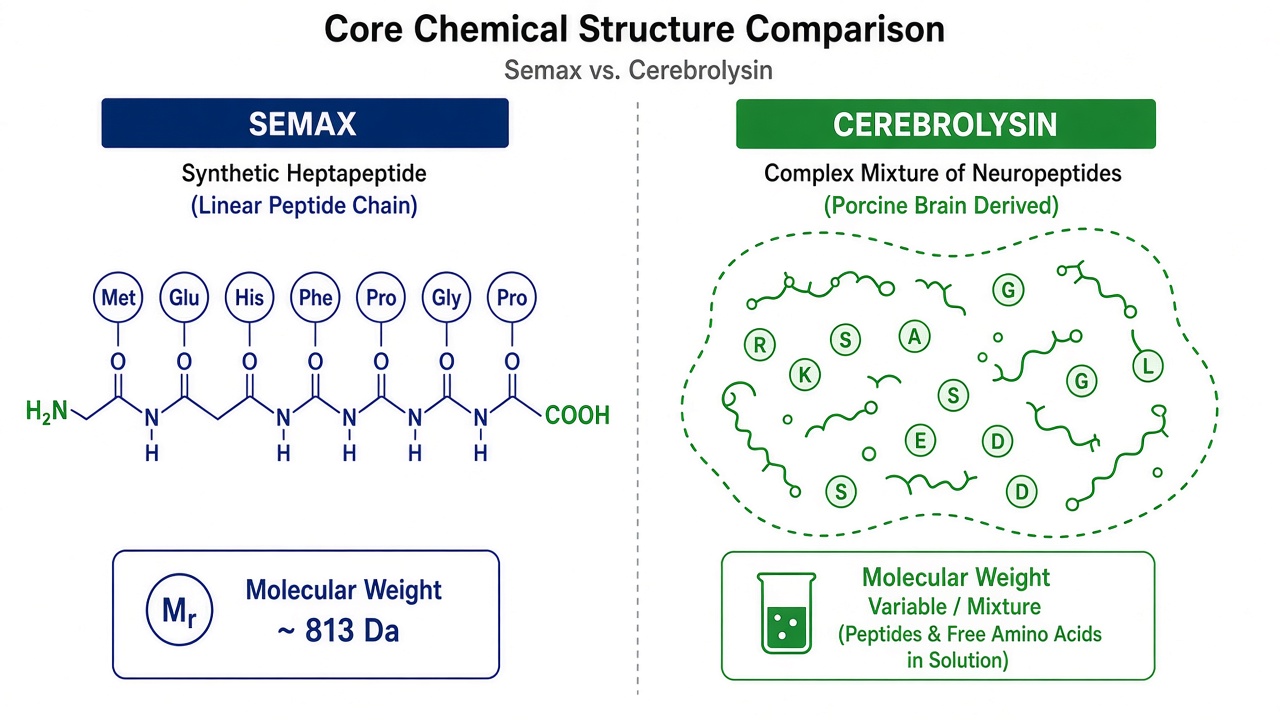
When evaluating semax vs cerebrolysin 7 research differences today, researchers must first recognize that these substances belong to different chemical categories. Semax is a synthetic heptapeptide with a defined amino acid sequence related to ACTH4-10. Cerebrolysin is a porcine-brain-derived mixture of low-molecular-weight peptides and amino acids.
This distinction sits at the center of semax vs cerebrolysin 7 research differences today. A single defined peptide can be described by molecular formula, sequence, and specific quality attributes. A tissue-derived peptide mixture raises broader questions about composition, batch consistency, impurity profiling, and biologic characterization.
A common error is to hear the word “peptide” and assume both agents sit on the same scientific footing. They do not. If one compound is a specific seven-amino-acid sequence and the other is a multicomponent extract-like mixture, then chemistry, regulation, and interpretation of outcomes all change.
FDA documents identify Semax as a heptapeptide with molecular formula C37H51N9O10S and molecular weight 813.93 g/mol. Cerebrolysin is not a single discrete molecule; it is described in PubMed-indexed review literature as a mixture of low-molecular-weight peptides and amino acids derived from porcine brain.
The chemical distinction also affects sourcing. A defined peptide can be verified against a known formula and sequence, while a mixture requires supplier documentation of composition, amino acid profile, and impurity testing. Researchers should not assume that two substances labeled “peptide” have the same level of analytical certainty.
How Does Product Characterization Differ in semax vs cerebrolysin 7 research differences today?
A practical approach to semax vs cerebrolysin 7 research differences today is to compare identity documents and quality control expectations. Semax has an FDA-listed formula, sequence synonyms, and a UNII record. Cerebrolysin lacks that single-molecule specificity because it is a mixture.
For semax vs cerebrolysin 7 research differences today, characterization burden is not symmetrical. FDA reviewers noted that Semax was not well characterized in the public literature because key quality attributes were not adequately documented. Those attributes include aggregation and peptide-related impurities, bacterial endotoxins, and microbial bioburden.
Cerebrolysin faces an even more structural characterization challenge. A mixture is harder to reduce to one stable molecular definition. Researchers should expect variability in peptide composition, amino acid content, and impurity profile across different batches and suppliers.
When sourcing defined peptides like Semax, a COA-backed peptide research library helps verify identity and purity. Researchers comparing mixtures should review research-grade peptide library sellers for transparency in batch records and analytical testing.
Peptides Library treats defined peptides and tissue-derived peptide mixtures as different evidence categories, because chemistry, characterization, and clinical interpretation are not interchangeable. See Peptide Research Library: Which Suppliers Are Trustworthy in 2026? for sourcing guidance.
A UNII record for Semax provides a regulatory anchor, but it does not replace full analytical characterization. FDA reviewers specifically flagged missing data on aggregation, peptide-related impurities, endotoxins, and bioburden. For any research purchase, request a certificate of analysis that covers these quality attributes rather than relying on a formula alone.
💡 Key Takeaway: How Does Product Characterization Differ in semax vs cerebrolysin 7 research differences today?
Which Stroke Evidence Patterns Emerge in semax vs cerebrolysin 7 research differences today?
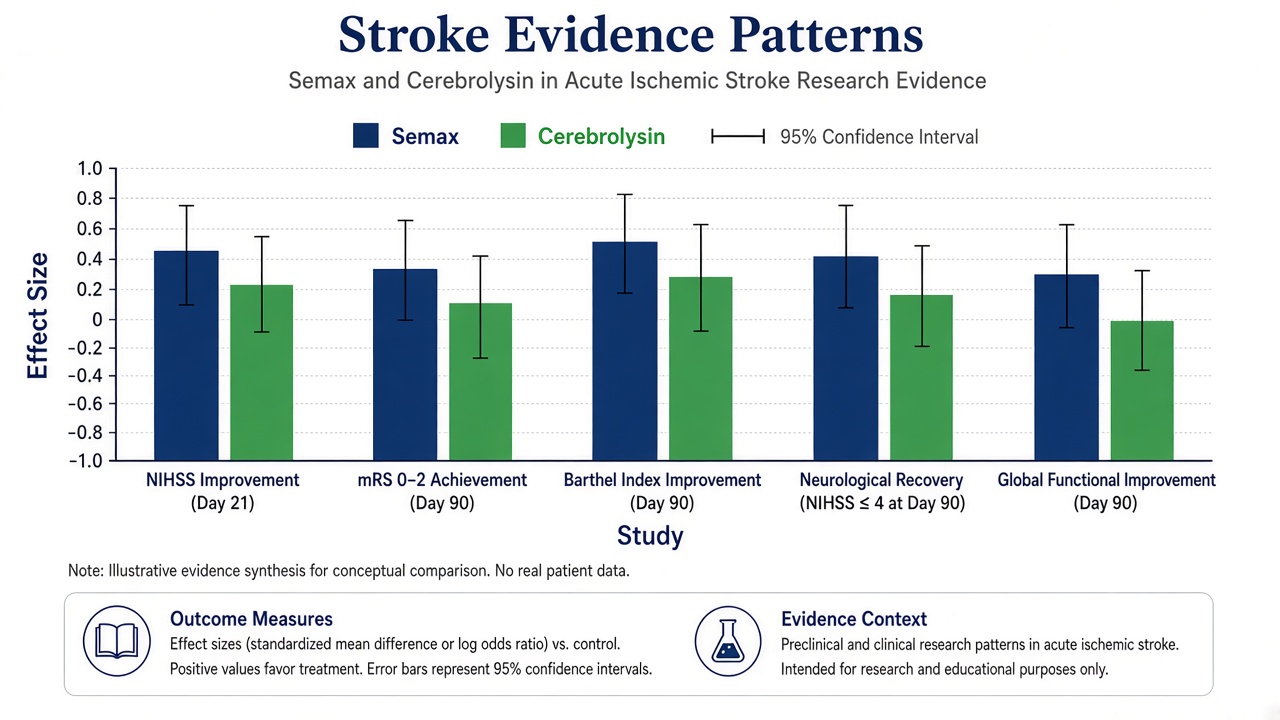
In semax vs cerebrolysin 7 research differences today, stroke evidence is the most visible clinical dataset. Cerebrolysin has more stroke-specific trial history, but recent systematic reviews do not show convincing mortality or long-term functional benefit.
The Cochrane 2023 review directly informs semax vs cerebrolysin 7 research differences today by reporting moderate-certainty evidence suggesting no beneficial effect on preventing all-cause death in acute ischemic stroke. The same review noted that Cerebrolysin may increase non-fatal serious adverse events. Researchers can verify these findings through PubMed.
A 2017 meta-analysis covering seven randomized studies and 1,779 patients found no significant superiority of Cerebrolysin for modified Rankin Scale or Barthel Index outcomes. That pooled result matters more than single-trial narratives that might show isolated positive signals.
Semax has a different evidence profile. FDA review documents state that available evidence was insufficient to support effectiveness for proposed indications including cerebral ischemia, migraine, and trigeminal neuralgia. More defined chemistry does not solve the evidence problem.
When comparing stroke evidence, researchers should prioritize pooled estimates over individual trial reports. The Cochrane 2023 review and the 2017 meta-analysis both used systematic methods to combine data across multiple studies. A single positive trial cannot outweigh a neutral pooled result from 1,779 patients.
What Safety Signals Should Researchers Weigh in semax vs cerebrolysin 7 research differences today?
Safety interpretation in semax vs cerebrolysin 7 research differences today should separate peptide-specific immunogenicity from mixture-level adverse event signals. Both substances carry caution flags, but the types of concern differ.
For Cerebrolysin, the Cochrane 2023 review reported moderate-certainty evidence suggesting no beneficial effect on all-cause mortality and noted that it may increase non-fatal serious adverse events. That is not the same as proving major net harm in every context, but it is a meaningful caution signal for research design.
For Semax, the issue is different. FDA review documents raised concern about potential immunogenicity from aggregation and peptide-related impurities. The agency did not identify clinical studies directly assessing immunogenicity or aggregation. If a peptide is insufficiently characterized, then the absence of a strong safety signal is not the same as high confidence in safety.
Peptides Library prioritizes endpoints like serious adverse events, modified Rankin Scale, and Barthel Index over mechanism-first claims when judging neurologic peptide research.
Adverse event reporting in Cerebrolysin trials should be examined carefully, because mixture components can trigger responses that a single defined peptide might not. For Semax, the immunogenicity concern is tied directly to aggregation and impurities, which means proper characterization is a safety prerequisite, not just a quality issue.
How Do FDA Review Findings Shape semax vs cerebrolysin 7 research differences today?
Regulatory history is a key separator in semax vs cerebrolysin 7 research differences today. Semax has a documented FDA review record that specifically cites insufficient effectiveness evidence and immunogenicity concerns. Cerebrolysin does not have that same single-molecule regulatory footprint, but its clinical trial data has been assessed in independent systematic reviews.
FDA review documents for Semax note that available evidence was insufficient to support effectiveness for proposed indications including cerebral ischemia, migraine, and trigeminal neuralgia. Reviewers also raised characterization concerns about aggregation and peptide-related impurities, bacterial endotoxins, and microbial bioburden. These findings are available through FDA resources.
For Cerebrolysin, the regulatory picture is different because it is not a single defined molecule. Researchers must rely on peer-reviewed meta-analyses rather than a single-molecule approval file. The 2017 meta-analysis of seven randomized studies and 1,779 patients found no significant superiority for modified Rankin Scale or Barthel Index outcomes.
The practical takeaway for semax vs cerebrolysin 7 research differences today is that regulatory review quality does not automatically transfer to clinical benefit. A defined peptide with an FDA review record can still lack effectiveness evidence, while a mixture with trial history can still fail pooled outcome tests.
Researchers should not treat an FDA review document as proof of safety or efficacy. For Semax, the FDA file explicitly states insufficient effectiveness evidence and raises characterization gaps. For Cerebrolysin, the absence of a single-molecule file shifts the burden to independent trial evaluation, which currently shows neutral pooled outcomes and a possible serious adverse event signal.
💡 Key Takeaway: How Do FDA Review Findings Shape semax vs cerebrolysin 7 research differences today?
Why Does Reproducibility Matter for semax vs cerebrolysin 7 research differences today?
Reproducibility in semax vs cerebrolysin 7 research differences today depends on whether a compound can be described with enough precision for independent labs to repeat experiments. Semax has a defined formula, sequence, and molecular weight, which supports better batch-to-batch comparison. Cerebrolysin is a mixture, so reproducibility hinges on detailed composition and impurity documentation.
If a peptide is not well characterized, reproducibility suffers. FDA reviewers noted that key quality attributes for Semax, including aggregation and peptide-related impurities, bacterial endotoxins, and microbial bioburden, were not adequately documented. Without those data, independent researchers cannot fully verify identity or safety margins.
For Cerebrolysin, the challenge is even greater because no single molecular definition exists. Batch variability in peptide composition, amino acid content, and impurity profile can change experimental outcomes. Researchers should request full analytical records from any supplier and compare against published characterization data.
Peptides Library recommends treating reproducibility as a primary filter for semax vs cerebrolysin 7 research differences today. A compound that cannot be consistently described cannot produce consistently interpretable research results.
A reproducibility checklist should include at minimum: molecular formula and sequence for defined peptides, supplier batch records, purity percentage, impurity profile, endotoxin levels, and bioburden results. For mixtures like Cerebrolysin, add amino acid composition and peptide distribution data. Without these documents, any experimental finding is difficult to validate.
How Should Researchers Compare Chemistry and Characterization Step by Step?
A step-by-step comparison of semax vs cerebrolysin 7 research differences today should begin with chemical identity, then move to characterization, clinical evidence, and safety. Use the following checklist for research-use-only evaluation:
1. Confirm chemical class: Semax is a synthetic heptapeptide with formula C37H51N9O10S; Cerebrolysin is a porcine-brain-derived peptide mixture.
2. Verify identity documents: Semax has an FDA-listed formula, sequence synonyms, and a UNII record; Cerebrolysin lacks single-molecule specificity.
3. Review characterization burden: FDA noted Semax was not well characterized for aggregation and peptide-related impurities, bacterial endotoxins, and microbial bioburden.
4. Examine stroke evidence: Cochrane 2023 found no all-cause mortality benefit for Cerebrolysin and possible increase in non-fatal serious adverse events; the 2017 meta-analysis of 1,779 patients found no modified Rankin Scale or Barthel Index superiority.
5. Separate safety signals: Cerebrolysin shows mixture-level adverse event concerns; Semax shows peptide-specific immunogenicity and aggregation concerns.
6. Check FDA review: Semax has insufficient effectiveness evidence for cerebral ischemia, migraine, and trigeminal neuralgia; Cerebrolysin lacks that regulatory file but has neutral pooled trial data.
7. Assess reproducibility: defined peptides like Semax offer better batch description, while mixtures like Cerebrolysin require more supplier transparency.
This checklist keeps the comparison grounded in measurable attributes rather than marketing claims. Each step asks for a specific document or published result, so researchers can verify every point independently. If any step is missing data, that absence should be recorded as a limitation, not filled with assumptions.
Which 7-Point Research Comparison Table Should Researchers Use for semax vs cerebrolysin 7 research differences today?
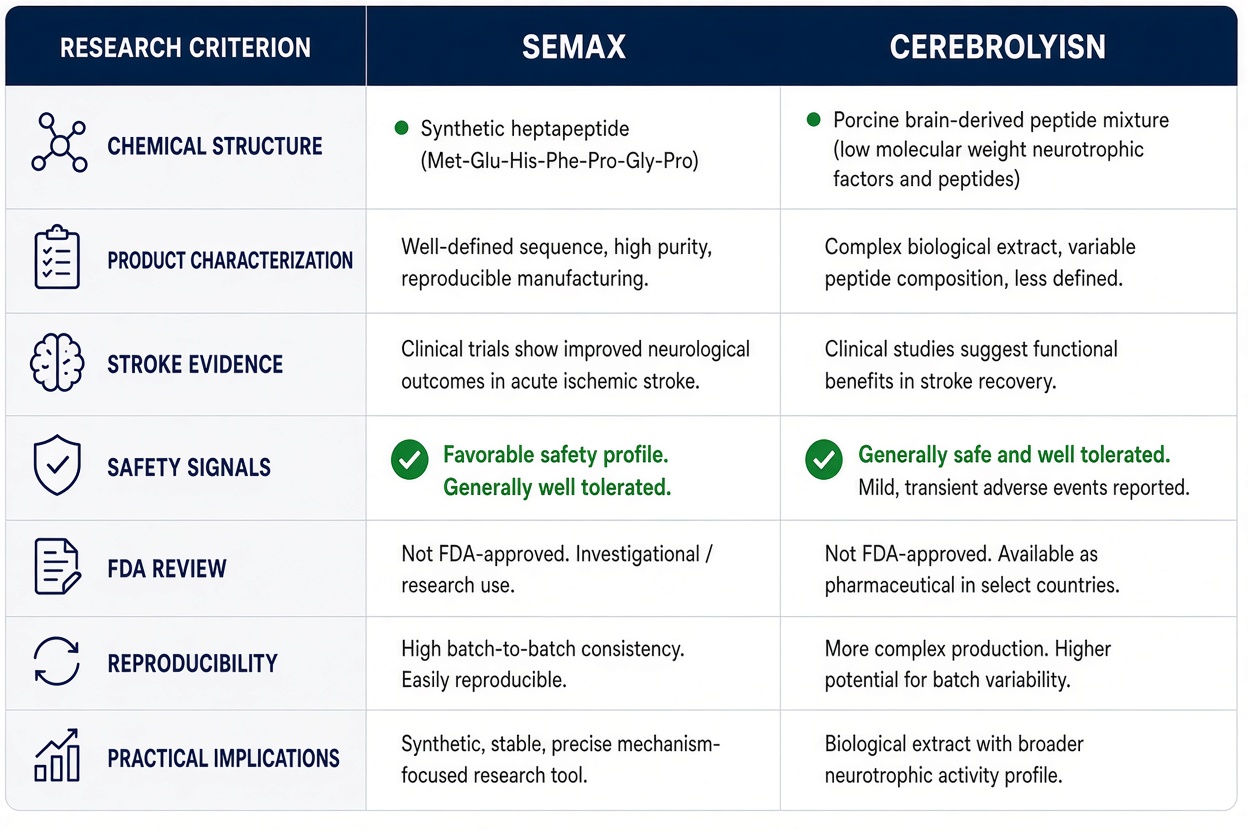
The following table summarizes seven key research differences today between Semax and Cerebrolysin for research-use-only evaluation:
| Comparison point | Semax | Cerebrolysin |
|—|—|—|
| Chemical class | Synthetic heptapeptide related to ACTH4-10 | Porcine-brain-derived mixture of low-molecular-weight peptides and amino acids |
| Molecular identity | Formula C37H51N9O10S, molecular weight 813.93 g/mol | Not a single discrete molecule; mixture with variable composition |
| Characterization burden | FDA noted aggregation, peptide-related impurities, endotoxins, bioburden not well characterized | Structural mixture challenge; batch variability expected |
| Stroke evidence | FDA found insufficient evidence for cerebral ischemia, migraine, trigeminal neuralgia | Cochrane 2023: no all-cause mortality benefit; 2017 meta-analysis: no mRS or Barthel superiority |
| Safety signals | Immunogenicity from aggregation and peptide-related impurities | May increase non-fatal serious adverse events per Cochrane 2023 |
| FDA review | Insufficient effectiveness evidence; characterization and immunogenicity concerns | No single-molecule regulatory file; assessed via meta-analyses |
| Reproducibility | Better defined but still under-characterized | Harder to reproduce due to mixture variability |
This table is not a ranking of which substance is better. It is a structured comparison that forces researchers to examine identity, characterization, evidence, and safety before designing any experiment. Both substances carry open questions that current literature has not resolved.
💡 Key Takeaway: Which 7-Point Research Comparison Table Should Researchers Use for semax vs cerebrolysin 7 research differences today?
What Are the Practical Research Implications of semax vs cerebrolysin 7 research differences today?
For researchers working with semax vs cerebrolysin 7 research differences today, the practical implication is to avoid treating these two substances as equivalent. Semax offers a defined sequence but still lacks strong effectiveness evidence and has characterization gaps. Cerebrolysin has more trial history but neutral pooled outcomes and a possible serious adverse event signal.
When designing studies, researchers should document the exact source, batch, purity, and characterization data for whichever compound they use. For Semax, request COA documentation covering aggregation and peptide-related impurities, bacterial endotoxins, and microbial bioburden. For Cerebrolysin, request supplier analytical records for peptide composition and amino acid content.
The stroke evidence should temper any mechanism-first enthusiasm. Neither Semax nor Cerebrolysin has high-quality support for broad stroke benefit. The Cochrane 2023 review and the 2017 meta-analysis provide the most reliable current summary for Cerebrolysin, while FDA review documents cover Semax.
Peptides Library maintains a research-use-only framework for all neurologic peptide comparisons. No statement here implies human use, veterinary use, or therapeutic application. All products are for in vitro laboratory research only, and purchasers must be 21 or older.
Sourcing decisions should follow the same evidence hierarchy: defined peptides need COA-verified identity and purity, while mixtures need detailed composition and batch records. A low price or a familiar name does not replace analytical documentation. Researchers who skip characterization risk producing unrepeatable results regardless of the compound chosen.
FAQ
What is the core chemical difference in semax vs cerebrolysin 7 research differences today?
Semax is a synthetic heptapeptide with formula C37H51N9O10S and molecular weight 813.93 g/mol, related to ACTH4-10. Cerebrolysin is a porcine-brain-derived mixture of low-molecular-weight peptides and amino acids, not a single discrete molecule.
Which stroke evidence patterns are most important in semax vs cerebrolysin 7 research differences today?
The Cochrane 2023 review found moderate-certainty evidence of no all-cause mortality benefit for Cerebrolysin in acute ischemic stroke and suggested it may increase non-fatal serious adverse events. A 2017 meta-analysis of 1,779 patients found no superiority for modified Rankin Scale or Barthel Index outcomes. Semax has insufficient effectiveness evidence per FDA review.
What safety signals should researchers weigh in semax vs cerebrolysin 7 research differences today?
For Cerebrolysin, the main signal is possible increase in non-fatal serious adverse events. For Semax, FDA review documents raised immunogenicity concerns from aggregation and peptide-related impurities, with no clinical studies directly assessing these risks.
How do FDA review findings differ in semax vs cerebrolysin 7 research differences today?
Semax has a documented FDA review record citing insufficient effectiveness for cerebral ischemia, migraine, and trigeminal neuralgia, plus characterization and immunogenicity concerns. Cerebrolysin lacks that single-molecule regulatory footprint and is assessed through independent meta-analyses showing neutral pooled outcomes.
Why does reproducibility matter for semax vs cerebrolysin 7 research differences today?
Semax has a defined formula and sequence, but FDA noted key quality attributes were not well characterized. Cerebrolysin is a mixture with expected batch variability. Reproducibility depends on detailed supplier documentation of identity, purity, and impurities for either compound.
Ready to Take the Next Step?
Every product includes lot-specific documentation and third-party purity testing.
Explore Our Research Products →Free shipping on qualifying orders · Batch COA on request