


Sermorelin vs CJC 1295: 7 Research Differences Today
Research differences today: 7 proven facts comparing Sermorelin vs CJC-1295 for research use only, covering FDA status, half-life, and study endpoints.
📋 Table of Contents
Sermorelin vs CJC-1295 research differences today are defined primarily by regulatory status and pharmacokinetics: sermorelin is a synthetic 29-amino-acid GHRH analog with documented FDA approval history for pediatric growth hormone deficiency, while CJC-1295 is a longer-acting investigational analog with a published human half-life of 5.8 to 8.1 days. These research differences today mean the two peptides are not interchangeable in laboratory study design, and researchers must treat them as distinct tools for distinct endocrine questions.
Key takeaways
- Sermorelin has documented FDA approval history for pediatric growth hormone deficiency, while CJC-1295 lacks FDA approval evidence in reviewed sources.
- CJC-1295 shows a published human half-life of 5.8 to 8.1 days, unlike sermorelin’s short-interval repeated dosing profile.
- A single subcutaneous CJC-1295 dose in healthy adults increased GH 2- to 10-fold for 6 days or more and IGF-I 1.5- to 3-fold for 9 to 11 days.
- Sermorelin literature centers on children with short stature or pediatric GHD, while CJC-1295 human data often focus on healthy adults after limited dosing.
- All comparisons remain research-use-only; no human consumption guidance or dosing recommendations are provided.
- These seven research differences today form the comparison framework used throughout this article.
All statements in this article are research-use-only. These peptides are not for human consumption and no dosing guidance is provided.
What is the main difference between Sermorelin and CJC-1295 in research differences today?
The core research differences today between Sermorelin and CJC-1295 are regulatory and pharmacokinetic. Sermorelin is a short GHRH(1-29) analog with a documented pediatric regulatory history, while CJC-1295 is a longer-acting investigational analog designed to extend activity, especially in the Drug Affinity Complex (DAC) form.
Sermorelin comes from the older GHRH fragment literature and is best understood as a pituitary stimulant with FDA approval history for pediatric growth hormone deficiency. CJC-1295 sits in a different lane: it is primarily discussed as a modified GHRH analog aimed at sustaining hormone elevation over days, not hours.
A common misconception is that both peptides are basically natural GH boosters and can be read the same way. They cannot. Sermorelin research often asks whether repeated stimulation can support growth-related outcomes over months in children. CJC-1295 research often asks whether a single or limited exposure can sustain hormone elevation over days in adults. For a broader reference on peptide categories, see the Complete Guide to Research Peptides: 2025 Lab Reference.
Which peptide lasts longer in the body?
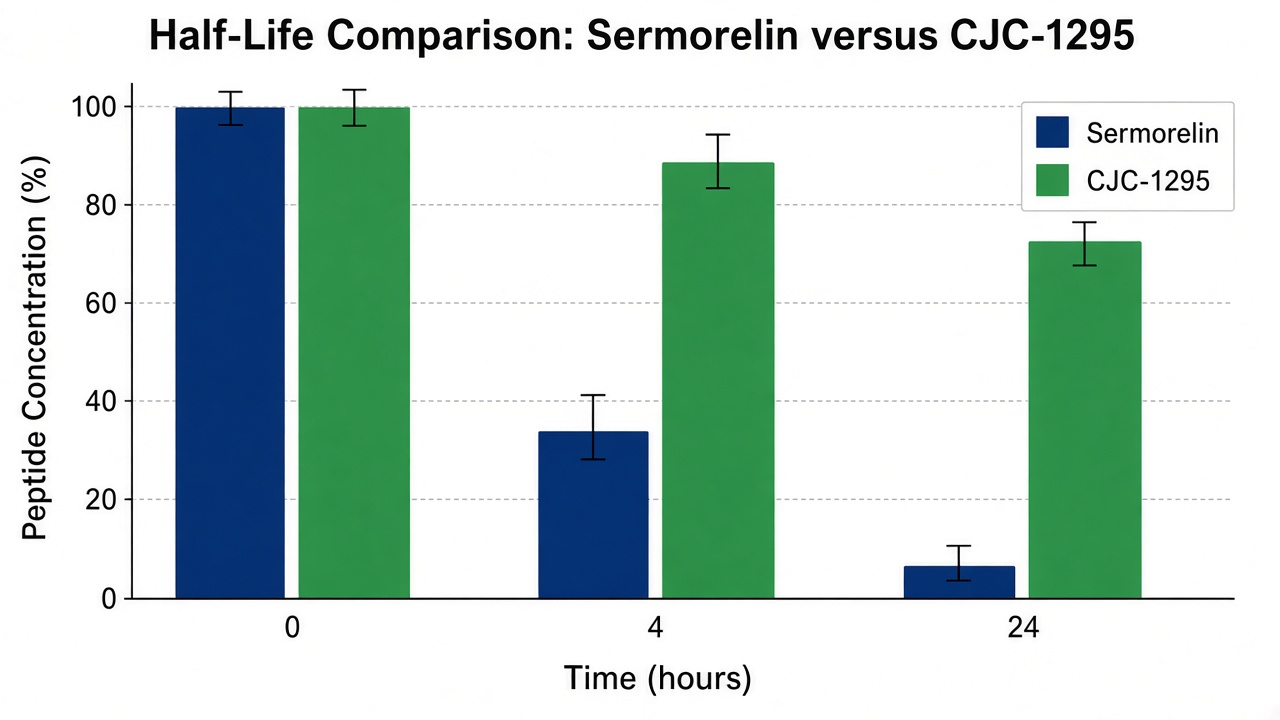
CJC-1295 lasts far longer in published human data. A PubMed trial reported an estimated half-life of 5.8 to 8.1 days, unlike sermorelin studies built around short-interval repeated dosing. These research differences today are central to study design.
In the 2006 PubMed report, healthy adults receiving subcutaneous CJC-1295 showed dose-dependent GH increases for 6 days or more and IGF-I increases for 9 to 11 days. That duration is unusual for a GHRH-related peptide and is why CJC-1295 attracts attention in peptide research discussions.
Sermorelin studies do not present that same multi-day pharmacokinetic profile. Instead, the older pediatric literature describes once-daily or twice-daily subcutaneous injections over months. If a study needs a prolonged endocrine signal after a limited dose, CJC-1295 fits better. If a study needs repeated short-interval stimulation, sermorelin is the closer match. Longer-acting does not automatically mean better—it means the exposure pattern differs, which changes both the question you can ask and the confounders you must manage.
💡 Key Takeaway: Which peptide lasts longer in the body?
What are the 7 research differences today between Sermorelin and CJC-1295?
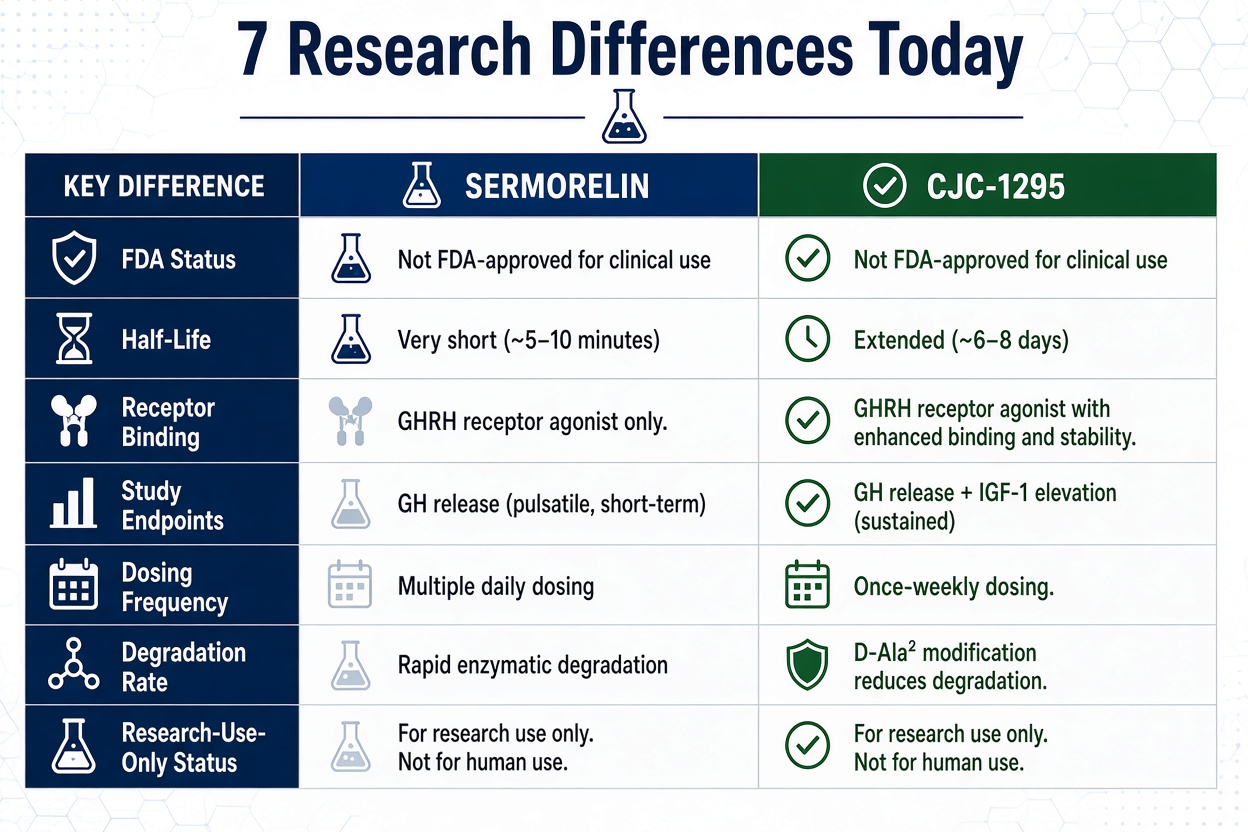
The seven biggest research differences today between Sermorelin and CJC-1295 are regulatory status, half-life, exposure window, study populations, dosing pattern, endpoint type, and interpretation risk. Seen together, these differences explain why the peptides often get grouped together in online discussion yet separate quickly under closer review.
| Difference | Sermorelin | CJC-1295 |
|—|—|—|
| Regulatory history | Documented FDA approval history for pediatric GHD | No FDA approval evidence in sources reviewed |
| Molecular behavior | Short GHRH(1-29) fragment analog | Longer-acting modified analog, especially DAC form |
| Estimated half-life | Short-interval repeated dosing profile | Published human half-life 5.8 to 8.1 days |
| Hormone elevation window | Not characterized by multi-day persistence in highlighted literature | GH elevated 6+ days; IGF-I elevated 9–11 days after single dose |
| Population studied | Children with short stature or pediatric GHD contexts | Healthy adults in highlighted human data |
| Endpoint style | Growth velocity over months | Pharmacodynamic markers like GH and IGF-I over days |
| Interpretation risk | Directly comparing growth outcomes in children with hormone curves in adults creates false equivalence | Same |
These seven points are the backbone of Sermorelin vs CJC-1295: 7 research differences today. Researchers who ignore any one of them risk designing a study that answers the wrong question.
How do you compare FDA approval and regulatory status step by step?
Start with FDA status. Peptides Library separates sermorelin from CJC-1295 here because sermorelin has documented FDA approval history for pediatric GHD, while CJC-1295 lacks FDA approval evidence in the sources reviewed. These research differences today hinge on regulatory context.
Step 1 is to identify the approved indication, not just the peptide name. FDA records show sermorelin acetate, marketed as Geref, with a 1997 approval date in the orphan-drug database for idiopathic or organic growth hormone deficiency in children with growth failure. That is a very specific historical regulatory fact.
Step 2 is to separate pediatric and adult use. FDA also states that there are no growth hormone secretagogues approved for treatment of adult-onset or childhood-onset growth hormone deficiency in adults. That point is easy to miss, and it changes how claims should be framed.
Step 3 is to avoid a second misconception: lack of approval for these peptides is not the same as lack of approved treatment options in general. FDA states that multiple approved drug products exist for adults with growth hormone deficiency and for children with growth failure due to inadequate endogenous GH secretion. You can verify regulatory details through the FDA Orphan Drug Product Designation Database.
How should you read the human study data step by step?
Reading the human study data correctly is essential for understanding research differences today between Sermorelin and CJC-1295. The two bodies of literature answer different questions.
For CJC-1295, the most cited human trial is a 2006 PubMed report in healthy adults. A single subcutaneous dose increased GH 2- to 10-fold for 6 days or more and IGF-I 1.5- to 3-fold for 9 to 11 days, with an estimated half-life of 5.8 to 8.1 days. That trial is a pharmacokinetic and pharmacodynamic study, not a long-term safety or efficacy trial.
For sermorelin, the human literature is older and centered on children with short stature or pediatric growth hormone deficiency. The endpoint is usually growth velocity over months, not acute hormone curves over days. Mixing those two literatures creates a false equivalence, which is one of the most common errors in these research differences today.
💡 Key Takeaway: How should you read the human study data step by step?
How do dosing schedules differ in the published literature?
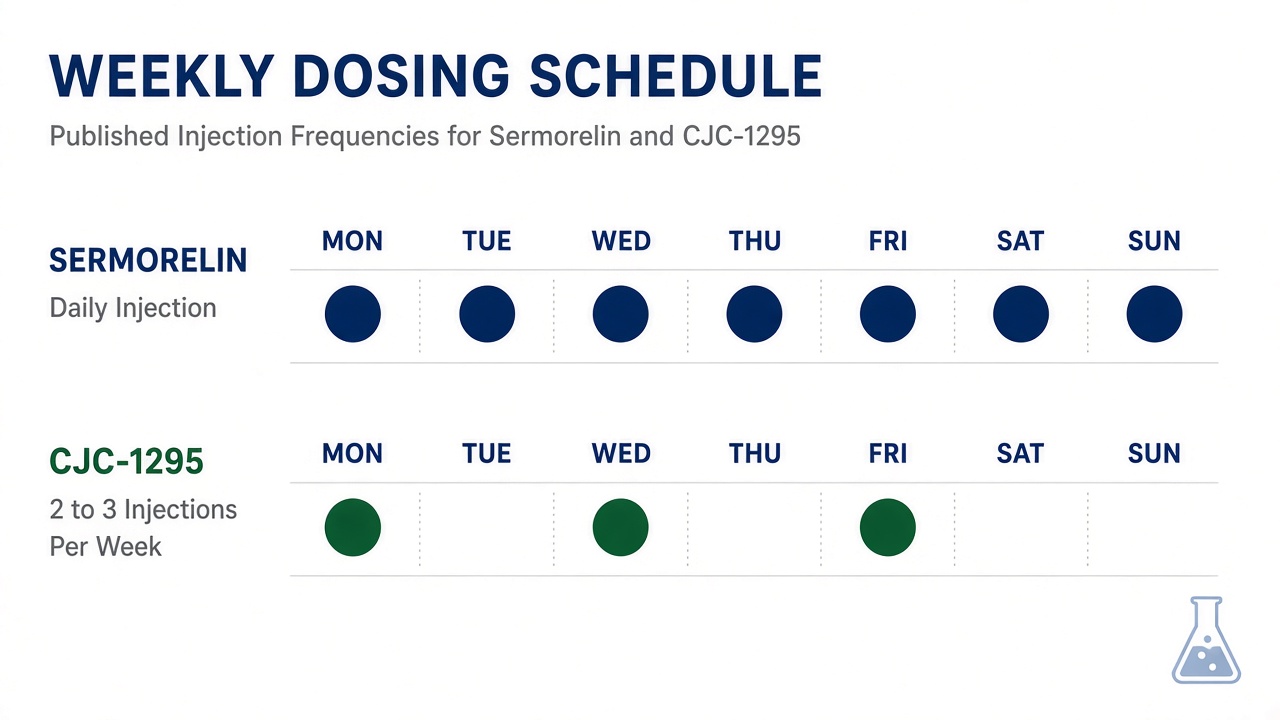
Published dosing schedules reflect the half-life gap. Sermorelin studies use repeated subcutaneous injections—often once or twice daily—over months in pediatric populations. CJC-1295 human data use limited dosing, sometimes a single subcutaneous injection, because the DAC modification extends the hormone signal for days.
Researchers should not read a dosing schedule as a recommendation. These research differences today are observational descriptions from published studies, not instructions for any laboratory or clinical protocol. All work remains research-use-only.
When designing a comparative in vitro or cell-based protocol, the schedule question is whether you need a short, repeated stimulus or a prolonged, single-exposure stimulus. That choice changes plate layout, sampling times, and endpoint analysis. For supply-related questions, see Best Places to Buy Research Peptides for a Lab in 2026.
Why does the research-use-only distinction matter for these research differences today?
The research-use-only distinction matters because both peptides are sold strictly for in vitro laboratory research purposes only. They are not for human use, not for veterinary use, and not intended to diagnose, treat, cure, or prevent any disease. These research differences today do not change that boundary.
When researchers treat the literature as a source of clinical guidance, they cross a line that the vendors and the regulatory framework do not support. Sermorelin has a historical pediatric approval, but that approval belongs to a specific manufactured drug product under a specific regulatory pathway, not to any research-grade peptide sold today. CJC-1295 has no FDA approval evidence in reviewed sources, and no growth hormone secretagogue is approved for adult GHD.
Keeping the research-use-only frame also protects the integrity of comparative work. A study that asks a mechanistic question about receptor activation or signal duration is very different from a study that implies a therapeutic endpoint. Those are not interchangeable, and blurring them is a common source of interpretation error.
Which study design fits which peptide?
Choose the peptide based on the exposure window you need to model. Sermorelin fits study designs that require repeated short-interval stimulation—for example, pulsatile GHRH receptor activation in cell cultures or tissue models. CJC-1295 fits study designs that require a prolonged signal after a limited dose—for example, extended receptor occupancy or downstream IGF-I expression over multiple days.
A comparative study should not simply ask which peptide is “stronger.” Instead, it should ask which exposure pattern produces the biomarker profile relevant to your hypothesis. The research differences today between these two peptides make a direct head-to-head “better or worse” design misleading unless you control for half-life, sampling frequency, and endpoint timing.
💡 Key Takeaway: Which study design fits which peptide?
What should laboratories check before using either peptide?
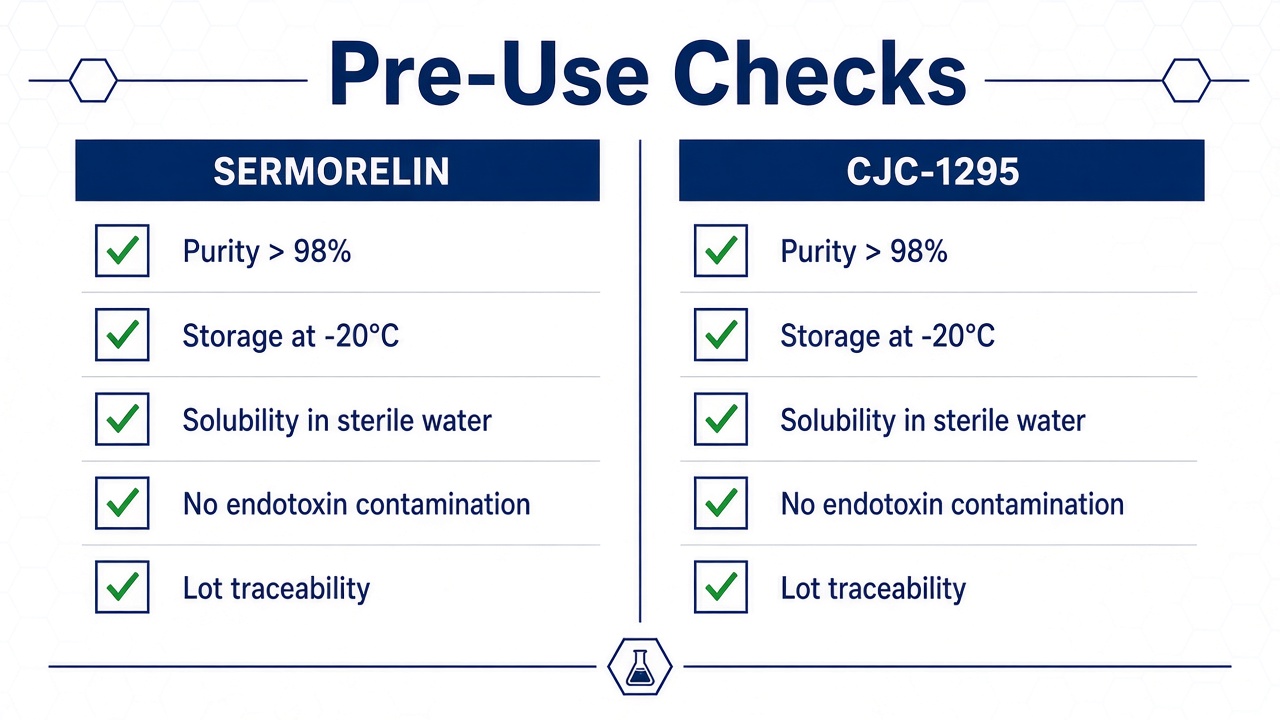
Before starting, laboratories should verify the peptide identity, purity, and Certificate of Analysis (COA). For sermorelin, check the amino acid sequence and confirm it is the 29-amino-acid GHRH(1-29) analog. For CJC-1295, confirm whether the sample is the DAC form or a modified variant, because the Drug Affinity Complex changes pharmacokinetics substantially.
Storage conditions also matter. Lyophilized peptides are typically stored at -20°C or below, protected from light and moisture, and reconstituted solutions should be handled according to the COA to avoid degradation. These handling steps are part of any comparative protocol, and they are especially important when a study spans days, because CJC-1295 experiments may require stability across longer observation windows.
What are the most common interpretation errors in these research differences today?
The most common error is false equivalence: comparing pediatric growth outcomes from sermorelin studies with adult hormone curves from CJC-1295 studies and treating them as if they answered the same question. These research differences today make that comparison invalid.
Another error is assuming that a longer half-life means a better peptide. Longer exposure is not inherently superior; it creates a different experimental condition with different confounders, such as receptor desensitization, feedback loops, and sample timing artifacts.
A third error is ignoring regulatory status. Sermorelin has a documented historical approval for a specific pediatric indication, while CJC-1295 does not. That fact should shape how claims are framed, not be hidden behind vague language like “both are GHRH analogs.”
How do the molecular structures differ?
Sermorelin is a synthetic 29-amino-acid analog of growth hormone-releasing hormone, corresponding to the GHRH(1-29) fragment. It is a relatively short peptide with a structure close to the native GHRH sequence, which contributes to its shorter activity profile.
CJC-1295 is a modified GHRH analog designed for longer action. The key structural difference is the addition of a Drug Affinity Complex, or DAC, which binds reversibly to serum albumin. That binding slows clearance and extends the half-life to the published range of 5.8 to 8.1 days in humans. These structural research differences today explain the half-life gap.
Researchers must confirm which form—DAC or non-DAC—they are using, because the two are not structurally identical and may behave differently in assays.
💡 Key Takeaway: How do the molecular structures differ?
What does the 2006 CJC-1295 human trial actually show?
The 2006 PubMed trial is the most frequently cited human dataset for CJC-1295. Healthy adults received a single subcutaneous dose, and the study reported dose-dependent GH increases of 2- to 10-fold lasting 6 days or more, with IGF-I increases of 1.5- to 3-fold lasting 9 to 11 days. The estimated half-life was 5.8 to 8.1 days. You can access the abstract at PubMed.
That trial was not a long-term efficacy or safety study. It was a pharmacokinetic and pharmacodynamic evaluation in a small healthy adult cohort. The data support the concept of prolonged GHRH analog activity, but they do not establish any therapeutic indication for CJC-1295. This trial anchors many research differences today between CJC-1295 and sermorelin.
What does the sermorelin pediatric literature show?
The sermorelin literature is centered on children with short stature or pediatric growth hormone deficiency. Historical studies measured growth velocity over months, using repeated subcutaneous injections—often once or twice daily. Sermorelin acetate, marketed as Geref, received a 1997 orphan-drug designation for idiopathic or organic growth hormone deficiency in children with growth failure.
That literature is very different from the CJC-1295 adult pharmacokinetic dataset. The endpoint is long-term growth, not acute hormone elevation, and the population is pediatric, not healthy adults. That contrast is one of the clearest research differences today.
How can researchers avoid false equivalence?
Researchers can avoid false equivalence by stating the population, endpoint, exposure pattern, and regulatory context in every comparison. A valid comparison requires that at least the biological question be the same. Comparing growth velocity in children to GH curves in adults is not a valid comparison, even if both involve GHRH analogs.
One practical step is to build a comparison table like the one above and force every claim to reference a specific row. If a claim cannot be mapped to regulatory history, half-life, exposure window, population, dosing pattern, endpoint type, or interpretation risk, it is probably an unsupported generalization. Applying this rule eliminates most false equivalences in research differences today. For more guidance on peptide categories and study design, see the Peptide Library Price and Quality Comparison for Research Labs.
💡 Key Takeaway: How can researchers avoid false equivalence?
What role does the Drug Affinity Complex play?
The Drug Affinity Complex (DAC) is the key structural feature that distinguishes CJC-1295 from simpler GHRH analogs like sermorelin. DAC binds reversibly to albumin, protecting the peptide from rapid clearance and extending its circulating half-life. That mechanism explains the published 5.8 to 8.1 day half-life and the prolonged GH and IGF-I elevations after a single dose.
In laboratory work, the DAC form must be explicitly identified on the COA. A non-DAC CJC-1295 variant would not have the same albumin-binding behavior, and results would not be comparable to the 2006 PubMed dataset. This is one of the research differences today that is easy to miss if you only read the peptide name.
Are there any approved adult indications for these peptides?
No. FDA states that there are no growth hormone secretagogues approved for treatment of adult-onset or childhood-onset growth hormone deficiency in adults. That includes sermorelin and CJC-1295. Sermorelin’s historical approval was for pediatric growth hormone deficiency, not adult use. That regulatory boundary is a key part of research differences today.
This regulatory fact is often misrepresented in online discussions. The existence of approved drug products for adults with GHD does not mean these specific peptides are approved for adults. Approved options are separate pharmaceutical products, and researchers should verify indications through the FDA Orphan Drug Product Designation Database.
What should a researcher document before starting a comparative study?
Before starting, document the following: peptide identity and sequence, form (DAC vs non-DAC for CJC-1295), purity percentage from the COA, storage temperature, reconstitution solvent, sampling times, endpoint assays, and the specific literature source for any half-life or hormone elevation claim.
Documentation should also state the research-use-only scope. The study is in vitro or cell-based laboratory research, not a clinical or human-use protocol. This protects the researcher from misrepresentation and makes the comparison reproducible. Documenting these research differences today prevents mislabeled claims. If you need help sourcing research peptides, check Most Trusted Websites for Cell-Penetrating Peptides (2026) or the Complete Guide to Research Peptides: 2025 Lab Reference.
💡 Key Takeaway: What should a researcher document before starting a comparative study?
How do storage and handling differ in practice?
Both sermorelin and CJC-1295 are typically supplied as lyophilized powders and should be stored at -20°C or below in a dry, light-protected environment. Reconstituted solutions require more care: they should be aliquoted, kept cold, and used within the stability window stated on the COA.
The practical difference is experiment duration. CJC-1295 studies often run for days, so researchers need to plan for longer stability testing and repeated sampling. Sermorelin studies may use shorter repeated exposures, so freeze-thaw cycles and timing of reconstitution can introduce variability. Storage planning is one of the practical research differences today that labs overlook. Always follow the COA rather than assuming one storage protocol fits both peptides.
What are the limits of the existing human data?
The human data for CJC-1295 come from a small 2006 pharmacokinetic/pharmacodynamic study in healthy adults. There is no large long-term safety or efficacy trial in the reviewed sources. The half-life range of 5.8 to 8.1 days is from that single study context, and variability between subjects or formulations should be considered.
Sermorelin has a longer regulatory history but its human literature is mostly pediatric and dates to an earlier era of growth hormone secretagogue research. Endpoints are growth velocity, not detailed receptor signaling or long-term biomarker panels. Neither peptide has robust adult efficacy data, and both remain research-use-only. Understanding these limits is essential for interpreting research differences today.
How should researchers cite the key sources?
Cite the 2006 CJC-1295 trial via its PubMed identifier: https://pubmed.ncbi.nlm.nih.gov/16968713/. Cite FDA regulatory history through the FDA Orphan Drug Product Designation Database. For peptide sourcing and lab reference, use the internal guides linked above.
When writing a paper or lab report, do not paraphrase FDA statements as if they approved CJC-1295 for any indication. Quote the specific regulatory language: no growth hormone secretagogues are approved for adult GHD, and sermorelin’s approval was for a pediatric indication under a specific orphan-drug pathway. Precise citation keeps research differences today anchored in evidence and prevents the false equivalence that plagues this comparison.
💡 Key Takeaway: How should researchers cite the key sources?
FAQ
What are the 7 research differences today between Sermorelin and CJC-1295?
The seven differences are regulatory status, half-life, exposure window, study populations, dosing pattern, endpoint type, and interpretation risk. These research differences today explain why the two peptides cannot be treated as interchangeable in laboratory study design.
Which peptide has a longer half-life?
CJC-1295 has a much longer published half-life of 5.8 to 8.1 days in humans. Sermorelin studies use short-interval repeated dosing without that multi-day persistence.
Is CJC-1295 FDA approved?
No. CJC-1295 lacks FDA approval evidence in the sources reviewed. FDA also states that no growth hormone secretagogues are approved for adult GHD. Sermorelin has a historical pediatric approval, but that is a different regulatory context.
Can these peptides be used for human research?
No. Both peptides are sold strictly for in vitro laboratory research purposes only. They are not for human use, not for veterinary use, and not intended to diagnose, treat, cure, or prevent any disease.
What should I check before buying either peptide for my lab?
Verify the peptide identity, DAC vs non-DAC form for CJC-1295, purity percentage from the Certificate of Analysis, storage temperature, and whether the supplier provides clear research-use-only documentation. Always follow the COA for reconstitution and stability.
Ready to Take the Next Step?
Every product includes lot-specific documentation and third-party purity testing.
Explore Our Research Products →Free shipping on qualifying orders · Batch COA on request