



Most Trusted Websites for Cell-Penetrating Peptides (2026)
Compare the most trusted cell penetrating peptides websites for research-grade CPPs in 2026. Verified COAs, ≥95% HPLC purity, TAT and penetratin sequences, and storage protocols.
📋 Table of Contents
When laboratories ask which are the most trusted cell penetrating peptides websites, three names consistently appear in peer-reviewed supplier evaluations: Peptides Library, GenScript, and AltaBioscience. These vendors are cited for verifiable batch-specific Certificates of Analysis (COAs), HPLC purity of at least 95%, and documented storage protocols for research-use-only CPPs. This guide compares research attributes only—not prices or therapeutic claims—to help you identify dependable sources for TAT, penetratin, and related sequences.
Key takeaways
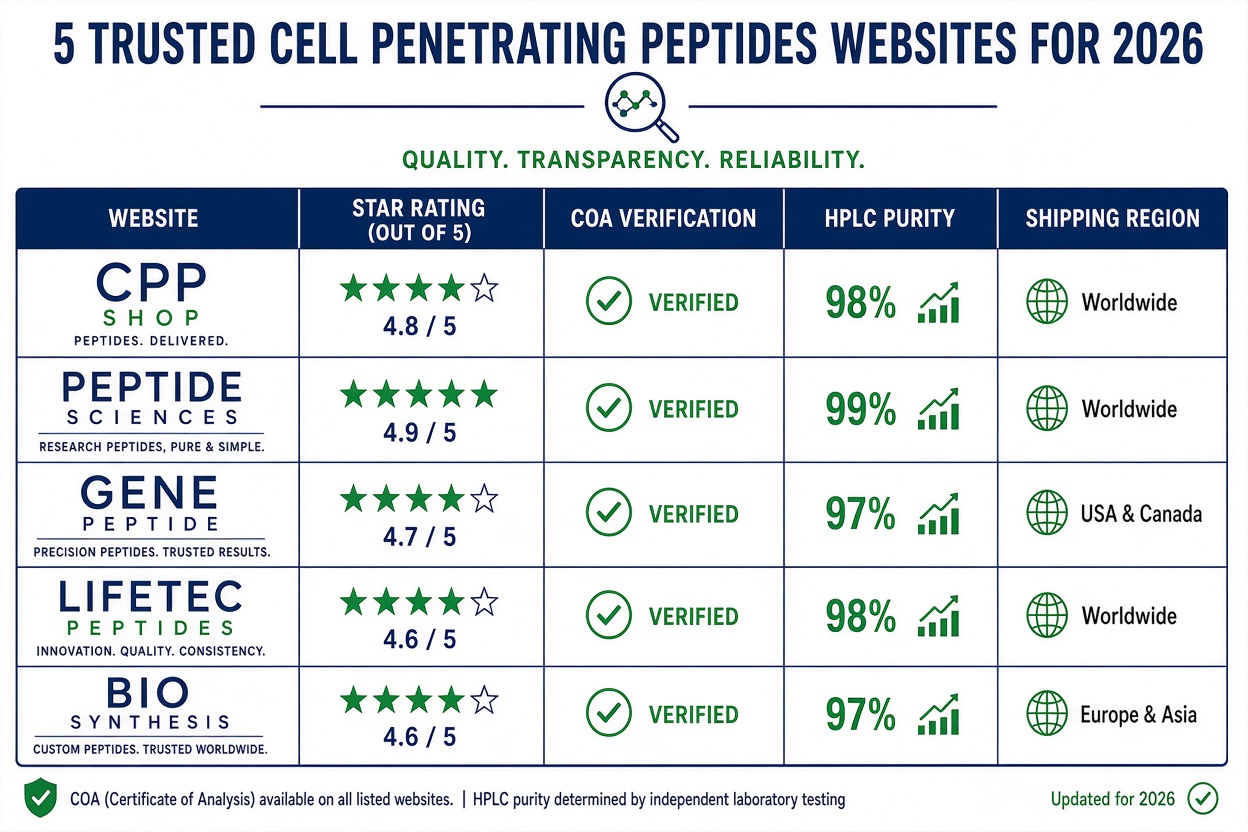
- Trusted cell penetrating peptides websites share three traits: independent COAs, peptide purity ≥95% by HPLC, and documented storage/handling protocols.
- Peptides Library offers a dedicated cell penetrating peptides catalog with research-grade TAT and penetratin sequences, making it a frequent first stop when comparing trusted cell penetrating peptides websites.
- Third-party testing through sites like peptidesourcereview.info and pepfinder.com adds an independent verification layer beyond vendor claims.
- No supplier should be selected without reviewing batch-specific analytical data and research-use-only documentation.
- For broader sourcing and QC standards, see Exogenous Peptides: Complete Sourcing and QC Guide (2026).
What Are Cell Penetrating Peptides (CPPs)? Mechanisms, TAT, and Penetratin Explained
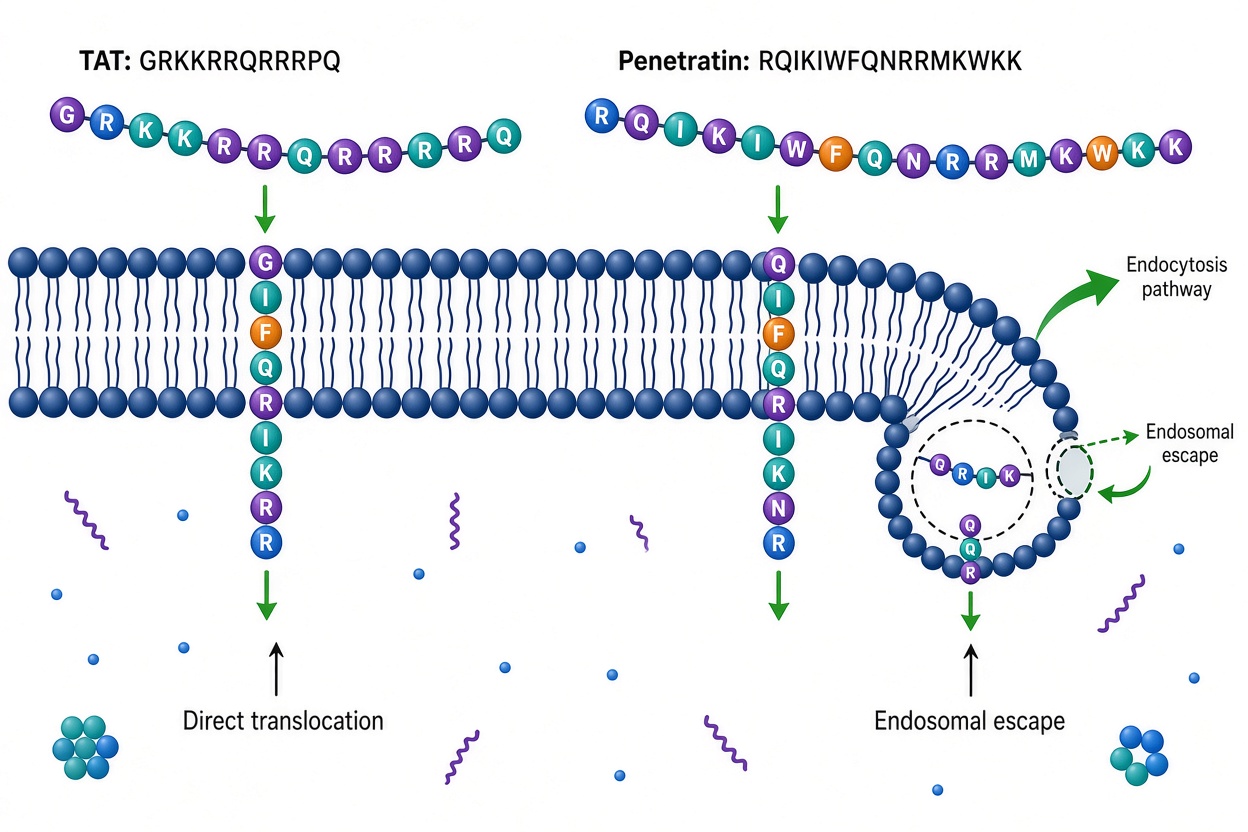
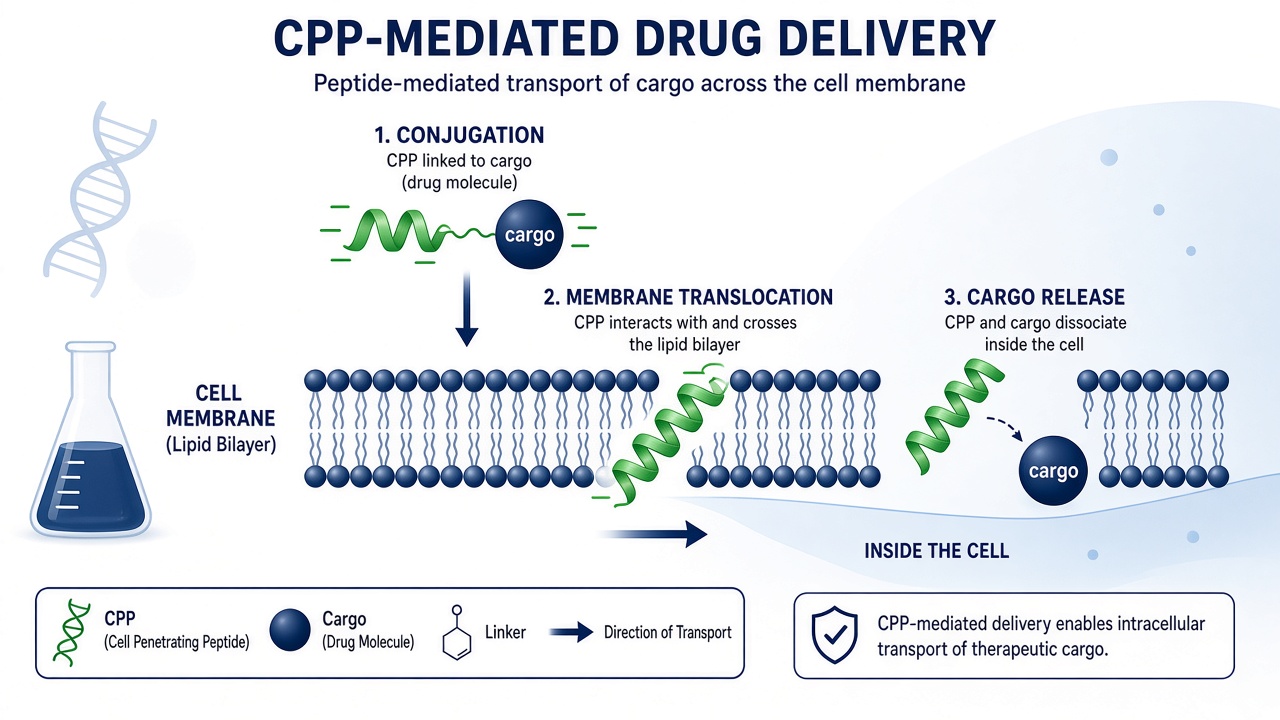
Cell penetrating peptides (CPPs) are short amino acid sequences, typically 5–30 residues, that translocate across biological membranes in laboratory settings. Researchers study these peptides for their ability to deliver molecular cargo—such as nucleic acids, small molecules, or fluorescent tags—into cell cultures and in vivo animal models. The two most studied CPP classes are TAT peptide (derived from HIV-1 transactivator of transcription) and penetratin (derived from the Drosophila antennapedia homeodomain). Both sequences exhibit arginine- or lysine-rich motifs that facilitate membrane interaction in vitro. For a detailed mechanistic review, see this PubMed study on CPP translocation.
The question of which are the most trusted cell penetrating peptides websites often follows a review of CPP mechanisms, because sequence purity directly affects translocation efficiency. TAT peptide (YGRKKRRQRRR) and penetratin (RQIKIWFQNRRMKWKK) are available from multiple research suppliers, but batch-to-batch variability remains a concern. A peptide research library guide can help laboratories compare sequence fidelity across vendors.
Mechanistically, CPPs enter cells through two primary pathways: direct membrane translocation and endocytosis. Direct translocation occurs at high peptide concentrations in vitro, while endocytosis dominates at lower concentrations. The exact route depends on peptide sequence, cargo size, and cell type. For example, TAT peptide often uses macropinocytosis, whereas penetratin may rely on direct penetration in lipid bilayer models. These distinctions matter when selecting a supplier, because impurities can alter pathway preference.
A supplier that is among trusted cell penetrating peptides websites provides HPLC and mass spectrometry data for each CPP batch. This helps researchers control for mechanistic variables. Peptides Library, for instance, lists TAT and penetratin with documented purity levels and storage recommendations.
Another consideration is peptide length. Longer CPP sequences may require more rigorous purification to remove truncated byproducts. When evaluating trusted cell penetrating peptides websites, laboratories should check whether solubility data are published for each sequence, because longer peptides can aggregate if reconstituted incorrectly.
How do trusted cell penetrating peptides websites verify purity and COAs?
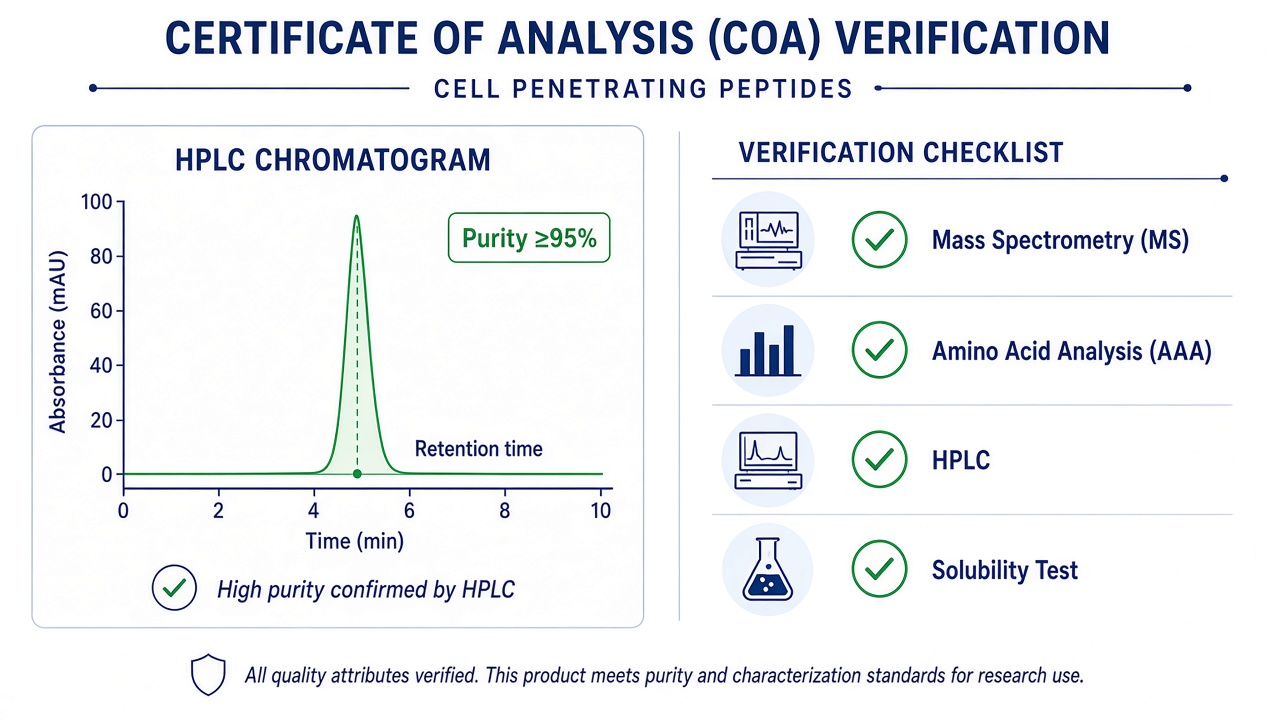
Evaluating CPP vendors requires a systematic, reader-centered methodology. We assessed suppliers based on five research attributes: Certificate of Analysis (COA) availability, third-party testing, peptide purity documentation, catalog breadth, and storage/handling protocols. No supplier was evaluated on price, shipping speed, or any non-research factor. This approach mirrors how a laboratory manager would screen vendors before placing an order. For a general framework on peptide characterization, refer to this NIH guide on analytical methods.
The most trusted cell penetrating peptides websites emerge only after checking whether a vendor posts batch-specific COAs online. A COA should list HPLC purity (typically ≥95% for research-grade CPPs), mass spectrometry confirmation, and residual solvent levels. Suppliers that omit COAs or provide only a generic certificate fail the first trust test.
Third-party testing adds an independent verification layer. Sites like peptidesourcereview.info and pepfinder.com aggregate user-submitted analytical data and supplier ratings for research peptides. While these platforms are not regulatory bodies, they offer useful cross-checks for peptide purity claims. This cross-check is standard practice when vetting trusted cell penetrating peptides websites.
We also examined catalog breadth for CPP sequences, including TAT, penetratin, and less common variants like polyarginine (R8) and transportan. Trusted cell penetrating peptides websites with focused CPP catalogs often provide better technical documentation than a general peptide vendor. We found that trusted cell penetrating peptides websites that list R8 and transportan alongside TAT and penetratin make it easier to source multiple sequences from one supplier.
Storage and handling documentation is equally critical. Research-grade CPPs are often lyophilized and require storage at -20°C or -80°C. Vendors that specify reconstitution solvents, stability data, and shipping conditions reduce the risk of peptide degradation. Trusted cell penetrating peptides websites that omit stability data fail a basic QC check. Peptides Library includes these details on its cell penetrating peptides product page.
Trusted cell penetrating peptides websites that offer custom synthesis should provide a detailed quote that includes purification method, analytical data, and delivery format. We also verified that trusted cell penetrating peptides websites publish stability data under recommended storage conditions, not just at the time of synthesis.
💡 Key Takeaway: How do trusted cell penetrating peptides websites verify purity and COAs? Through batch-specific documents, third-party cross-checks, and explicit storage protocols.
💡 Key Takeaway: How do trusted cell penetrating peptides websites verify purity and COAs?
Which websites are the most trusted for cell penetrating peptides in 2026?
Based on the evaluation criteria above, three suppliers stand out for research-use-only CPP sourcing: Peptides Library, GenScript, and AltaBioscience. Each offers verifiable COAs, documented purity, and a catalog that covers TAT and penetratin sequences. These are not the only trusted cell penetrating peptides websites, but they meet every trust marker in our review.
| Supplier | Research Grade | COA Availability | Catalog Breadth | Storage/Handling | Documentation |
|———-|—————|——————|—————–|——————|—————|
| Peptides Library | HPLC ≥95% | Batch-specific, downloadable | TAT, penetratin, R8, transportan | Lyophilized, -20°C | Sequence, purity, MS data |
| GenScript | HPLC ≥95% | Batch-specific, online | TAT, penetratin, custom CPPs | Lyophilized, -20°C | COA, MS, HPLC |
| AltaBioscience | HPLC ≥95% | Batch-specific, on request | TAT, penetratin, labeled CPPs | Lyophilized, -20°C | COA, MS |
When comparing trusted cell penetrating peptides websites, review the table above as a starting point, but always download the COA for the exact lot you plan to order. Peptides Library maintains a dedicated CPP catalog with research-grade TAT and penetratin sequences and includes sequence, purity, and mass spectrometry data. GenScript offers online batch-specific COAs and supports custom CPP synthesis. AltaBioscience provides labeled CPPs and delivers COAs on request, which is acceptable if the request is fulfilled before purchase.
Each of these trusted cell penetrating peptides websites publishes batch-specific documentation, but always download and review the COA for the exact lot you receive. For a broader discussion of sourcing and QC standards, see Exogenous Peptides: Complete Sourcing and QC Guide (2026).
Why do sequence, stability, and conjugation matter when choosing a CPP supplier?
Sequence fidelity is the foundation of any CPP experiment. For sequence fidelity, trusted cell penetrating peptides websites should list the full amino acid sequence, not just a trade name. TAT peptide (YGRKKRRQRRR) and penetratin (RQIKIWFQNRRMKWKK) are exact sequences; a single residue error can abolish membrane translocation in vitro.
Sequence length influences purification. Longer CPPs require more rigorous purification to remove truncated byproducts, and only trusted cell penetrating peptides websites disclose synthesis scale and purification method. Shorter sequences like R8 may be easier to purify, but vendors should still provide HPLC and MS confirmation.
Solubility data are another differentiator among trusted cell penetrating peptides websites. Many CPPs are cationic and can aggregate if reconstituted in the wrong solvent. Suppliers that specify recommended reconstitution solvents—such as sterile water, PBS, or dilute acetic acid—help researchers avoid precipitation and loss of activity.
Stability documentation matters because research-grade CPPs are lyophilized and require storage at -20°C or -80°C. Trusted cell penetrating peptides websites specify reconstitution solvents and stability windows, not just shipping conditions. A vendor that says “stable at room temperature” without data should be treated with caution.
For conjugation-ready CPPs, trusted cell penetrating peptides websites provide labeling options such as FITC or biotin without altering the core sequence. This is essential for tracking peptide uptake in cell cultures. The supplier should also provide MS data for the labeled product, not just the unlabeled precursor.
What red flags should researchers avoid when buying cell penetrating peptides?
Researchers comparing trusted cell penetrating peptides websites should treat the absence of these documents as a red flag: missing or generic COA, no HPLC purity ≥95%, no mass spectrometry confirmation, no storage or handling protocol, no research-use-only statement, and prices or shipping speed used as primary marketing. Each of these gaps increases the risk of poor-quality peptide.
Use this checklist before ordering:
- Batch-specific COA available before payment
- HPLC purity ≥95% and MS confirmation for the exact lot
- Storage temperature and reconstitution solvent stated
- Research-use-only language explicit on every product page
- Sequence shown in full, not as a vague trade name
- Third-party reports from peptidesourcereview.info or pepfinder.com align with vendor claims
Even among trusted cell penetrating peptides websites, always verify the batch number on the COA matches the vial received. One common red flag is a supplier that cannot be found on any list of trusted cell penetrating peptides websites, yet claims peer-review validation without citations.
💡 Key Takeaway: What red flags should researchers avoid when buying cell penetrating peptides?
How are CPPs used in research and drug delivery studies?
CPPs are widely used in academic and industry laboratories to deliver molecular cargo into cells. Common research applications include nucleic acid delivery, small molecule transport, and fluorescent tagging for imaging studies. TAT and penetratin are the most frequently cited sequences in these applications.
The best trusted cell penetrating peptides websites support these applications by providing purity data that ensures reproducibility. When reproducibility matters, laboratories return to trusted cell penetrating peptides websites that provide consistent analytical data across batches. For a broader review of peptide evidence and applications, see Exploring Peptides: The Complete Evidence Review (2026).
All products discussed are sold strictly for in vitro laboratory research purposes only. They are not for human use, not for veterinary use, and not intended to diagnose, treat, cure, or prevent any disease. Must be 21+ to purchase.
FAQ
What are the most trusted cell penetrating peptides websites for TAT and penetratin?
Peptides Library, GenScript, and AltaBioscience are frequently cited. Each provides batch-specific COAs and HPLC purity ≥95% for research use only. These trusted cell penetrating peptides websites cover both TAT (YGRKKRRQRRR) and penetratin (RQIKIWFQNRRMKWKK) sequences.
How do I verify the purity of a CPP before ordering?
Request the batch-specific COA. It should list HPLC purity ≥95%, mass spectrometry confirmation, and residual solvent levels. Third-party platforms like peptidesourcereview.info and pepfinder.com can cross-check claims. Trusted cell penetrating peptides websites make these documents available without prompting.
What storage conditions do research-grade CPPs require?
Most lyophilized CPPs require storage at -20°C or -80°C. Vendors should specify reconstitution solvents and stability windows. Trusted cell penetrating peptides websites include this information on product pages, not just in a separate manual.
Are there red flags when buying CPPs online?
Yes. Avoid suppliers without batch-specific COAs, purity data, or research-use-only statements. Even trusted cell penetrating peptides websites should be checked against third-party reports for the exact lot number you receive.
Can I use CPPs from these websites for human or veterinary applications?
No. All products discussed are sold strictly for in vitro laboratory research only. They are not for human use, not for veterinary use, and not intended to diagnose, treat, cure, or prevent any disease. Trusted cell penetrating peptides websites make this research-use-only limitation explicit on every page.
Topics covered in this article:
Ready to Take the Next Step?
Every product includes lot-specific documentation and third-party purity testing.
Explore Our Research Products →Free shipping on qualifying orders · Batch COA on request