


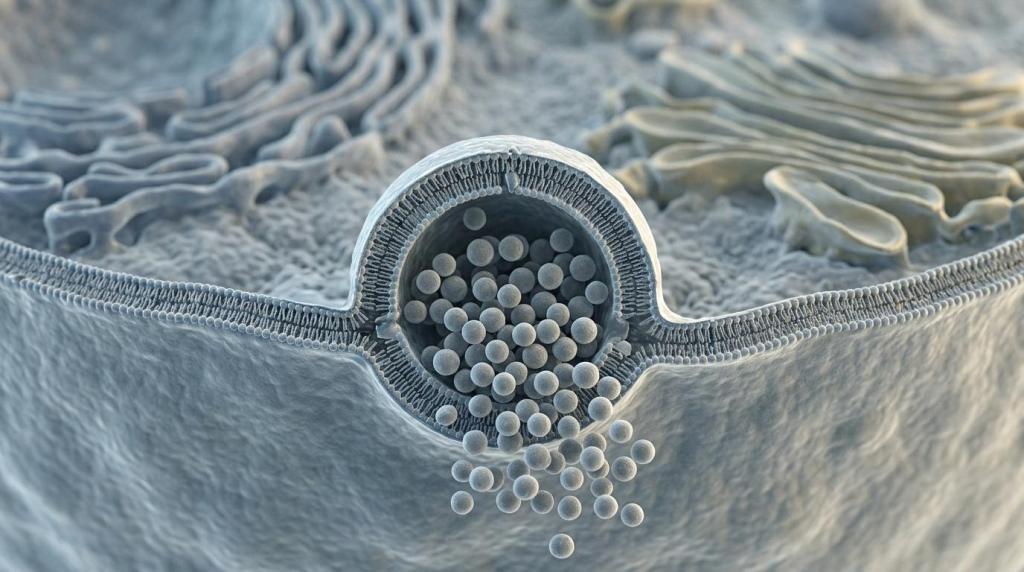
Hormones built from amino acids are often grouped together, yet the labels used for them can be surprisingly slippery. “Peptide hormone” and “protein hormone” sound like sharply separate categories, but in practice they describe a spectrum. Chain length, folding, post-translational processing, and receptor biology all matter, and the border between the two terms is not always fixed.
That said, the distinction is still useful. In most cases, peptide hormones are shorter, water-soluble signaling molecules that act through receptors on the cell surface. Protein hormones are usually larger, more structurally folded molecules with more complex architecture. If the goal is to compare how they are made, how they signal, and why certain clinical agents behave the way they do, the contrast remains highly practical.
Peptide hormones and protein hormones: why the terms overlap
Both peptide hormones and protein hormones are made of amino acids linked by peptide bonds. That shared chemistry is the reason many textbooks discuss them together. Both classes are encoded by genes, translated as larger precursors or polypeptides, and shaped by post-translational processing before reaching their active forms.
The challenge comes from terminology. Some sources describe peptide hormones as generally under 100 amino acids, while others extend the range to roughly 200 amino acids. Protein hormones are often described more by their size and folded complexity than by a strict amino acid cutoff. This means some familiar hormones sit near the boundary rather than neatly on one side.
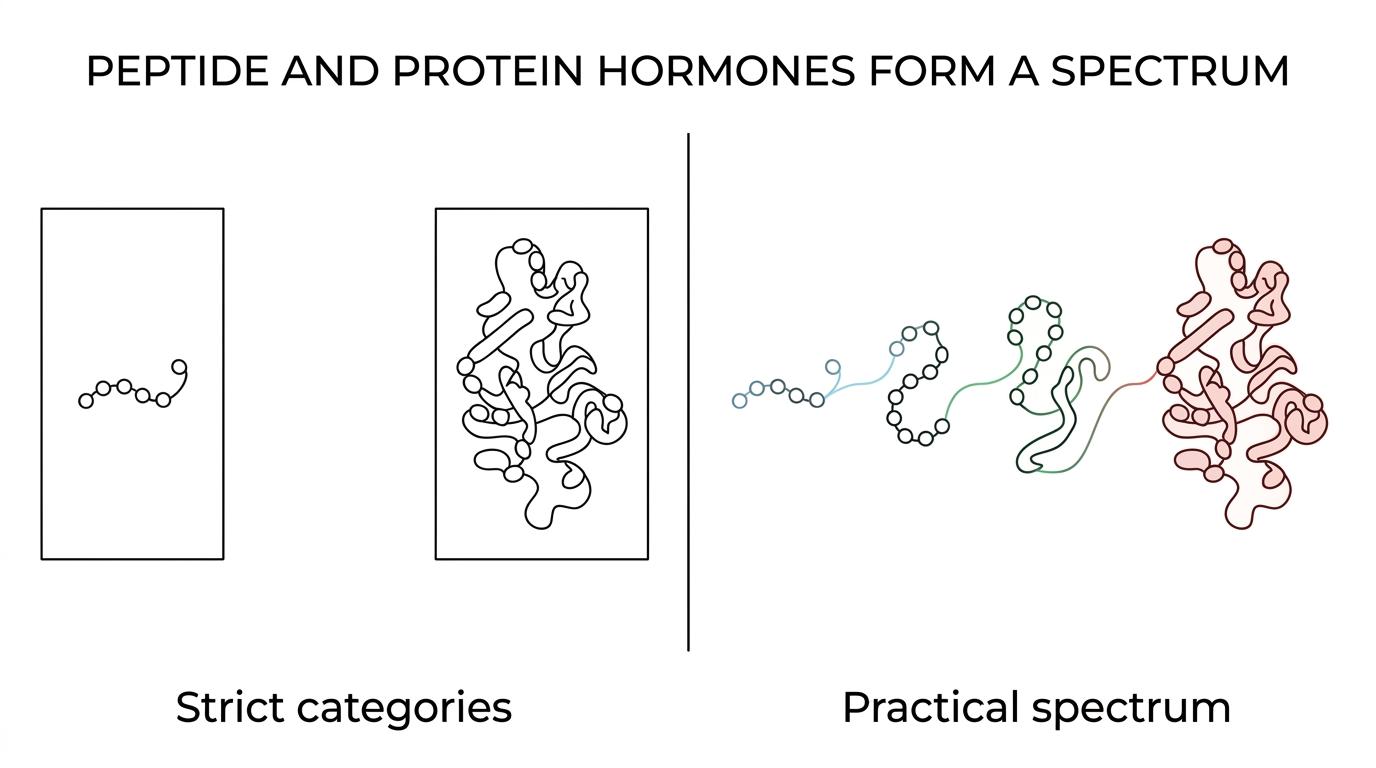
Insulin is a good example. It is widely called a peptide hormone, yet it has two chains linked by disulfide bonds and a highly specific three-dimensional structure. Growth hormone, by contrast, is much larger and is usually described as a protein hormone. The language reflects useful trends, not absolute laws.
Structure and chain length differences between peptide hormones and protein hormones
The most visible difference is size. Peptide hormones are commonly short sequences, while protein hormones are generally larger polypeptides with more extensive folding. That difference influences stability, receptor recognition, storage, and drug design.
A second difference is structural complexity. Many peptide hormones can function with relatively compact architecture, though some still depend on disulfide bonds or chemical modifications for activity. Protein hormones more often rely on stable tertiary structure, multiple domains, or intricate folding patterns that tightly shape their biological behavior.
The table below summarizes the usual pattern.
| Feature | Peptide Hormones | Protein Hormones |
|---|---|---|
| Typical size | Often shorter, commonly under 100 amino acids | Usually larger polypeptides |
| Solubility | Water-soluble | Usually water-soluble as well |
| Structure | Simpler overall, though still biologically precise | More extensive folding and structure-function dependence |
| Receptor location | Commonly cell-surface receptors | Also typically cell-surface receptors |
| Signaling speed | Often rapid through second messenger systems | Often rapid too, but may involve broader structural regulation |
| Processing | Frequently produced from precursor proteins and cleaved | Produced by transcription and translation, with folding and modifications |
| Examples | Glucagon, vasopressin, oxytocin, insulin | Growth hormone, prolactin, parathyroid hormone is often discussed near the peptide side depending on context |
A few quick markers help when reading papers or labels.
- Short chain length
- Water solubility
- Extracellular receptor binding
- Precursor cleavage
- Folding-dependent activity
These markers point in the right direction, but they do not settle every case.
Receptor signaling differences in peptide hormones and protein hormones
Because peptide and protein hormones are water-soluble, they usually do not pass straight through the lipid membrane of target cells. Instead, they bind extracellular receptors and trigger intracellular cascades. This is one of the clearest functional themes shared across both groups.
For many peptide hormones, signaling is rapid and highly modular. Binding at the cell surface can activate G-protein pathways, cyclic AMP signaling, calcium mobilization, or kinase cascades. Other peptide and protein hormones signal through receptor systems tied to JAK/STAT pathways or receptor tyrosine kinase activity. Insulin is a classic case where the receptor’s architecture is central to the hormone’s effect on metabolism.
This membrane-based signaling creates an important practical contrast with steroid hormones and thyroid hormones, which often act through intracellular or nuclear receptors. When a hormone is described as a short amino acid chain acting quickly through a surface receptor, it strongly fits the peptide-hormone pattern.
A useful way to frame the signaling distinction is this:
- Peptide hormones: commonly trigger fast surface-receptor responses with second messengers
- Protein hormones: also use surface receptors, yet larger size and folding often make receptor recognition more structurally dependent
- Shared trait: both are typically unable to diffuse freely across the plasma membrane
- Research implication: receptor biology often matters as much as hormone size
Biosynthesis and post-translational processing of peptide and protein hormones
From a cell biology standpoint, peptide and protein hormones follow a sophisticated production pipeline. The cell transcribes the relevant gene, processes the RNA, translates the message into a precursor polypeptide, and then modifies, folds, sorts, and secretes the final product.
Many peptide hormones begin life as larger precursor proteins. Those precursors are cut by specific enzymes to generate the active hormone. This processing step is not a minor detail. It determines which bioactive fragments appear, how much active hormone is produced, and where it is released.
Protein hormones also depend on this broader biosynthetic machinery, though folding may become even more central. Larger hormones often require precise tertiary structure, disulfide bond formation, and trafficking through the endoplasmic reticulum and Golgi apparatus before secretion.
Post-translational modifications add another layer. Reviews of peptide hormone biology note that O-glycosylation can affect receptor potency and stability, while phosphorylation can alter receptor binding or help protect a hormone from enzymatic breakdown. These chemical edits remind us that “peptide” does not mean “simple.” Even short hormones can carry regulatory features that shape half-life, activity, and tissue selectivity.
Examples that clarify the peptide hormone vs protein hormone distinction
Looking at individual hormones makes the pattern easier to grasp.
Glucagon is commonly treated as a peptide hormone. It is relatively small, acts through a cell-surface receptor, and is used clinically as an injectable polypeptide hormone. Its biology fits the classic image of a fast-acting, water-soluble peptide signal.
Oxytocin and vasopressin also sit comfortably in the peptide category. Their short length, strong receptor specificity, and rapid physiological actions make them standard examples in endocrine education.
Insulin is more interesting. It is usually categorized as a peptide hormone and consists of 51 amino acids arranged in two chains connected by disulfide bonds. Even though it is short by protein standards, its structure is highly organized and inseparable from function. This is exactly why the peptide-versus-protein split works best as a practical guide, not a rigid sorting rule.
Growth hormone tends to fall on the protein hormone side. It is larger, more structurally elaborate, and usually discussed as a protein hormone in endocrinology. The difference is not only size. The larger folded architecture has direct consequences for receptor interaction and biological behavior.
A few examples are worth keeping in view:
- Classic peptide hormones: glucagon, oxytocin, vasopressin
- Boundary case: insulin
- Common protein hormone example: growth hormone
- Terminology caution: some sources group peptide and protein hormones together as one amino acid-based class
Why peptide hormone analogs matter in modern medicine
The biology of peptide hormones has had major therapeutic impact. Many modern endocrine and metabolic drugs are built from natural peptide templates or are designed to mimic peptide hormone signaling with improved stability and pharmacokinetics.
Glucagon-like peptide-1 receptor agonists are a strong example. These agents draw on endogenous incretin biology to influence glucose regulation, appetite, and body weight. Dual agonist strategies have expanded that concept even further by targeting more than one receptor pathway at once.
This clinical progress highlights a central property of peptide hormones: they can be remarkably potent and selective, but native forms may be limited by rapid degradation, short half-life, or delivery constraints. Drug development often focuses on stabilizing the molecule, extending circulation time, or preserving receptor selectivity while reducing unwanted effects.
The same principles matter in research settings. When evaluating a peptide-hormone analog, important questions include:
- Stability: how quickly enzymes degrade the molecule
- Receptor selectivity: whether the analog stays faithful to the intended pathway
- Administration route: whether injection is required or alternative delivery is possible
- Structural modification: whether changes in sequence or glycosylation alter potency
Why the peptide vs protein distinction matters in research and communication
For researchers and clinicians, these labels are more than vocabulary. They shape expectations about assay design, storage conditions, receptor assays, degradation risk, and therapeutic formulation. A small peptide hormone may call for one analytical strategy, while a larger protein hormone may demand closer attention to folding, aggregation, and conformational stability.
The distinction also affects how readers interpret literature. A paper may use “peptide hormone” to emphasize short-chain signaling and precursor cleavage, while another may use “protein hormone” to emphasize macromolecular structure and biosynthesis. Without that context, two articles can seem to disagree when they are actually highlighting different features of the same amino acid-based endocrine family.
For students, one working rule is especially helpful: if a hormone is relatively short, water-soluble, and acts through a membrane receptor with rapid intracellular signaling, it will often be described as a peptide hormone. If it is larger and more structurally folded, protein hormone is often the better term. The biology remains connected, and that connection is what makes endocrine signaling both orderly and richly nuanced.
That context matters outside specialist journals too, because BFAN’s overview of hormone imbalance symptoms that can disrupt sleep at night shows how hormone discussions in public-facing health content often focus on downstream effects rather than the signaling class behind them.