


Quick Answer
What Is Oxytocin Peptide?
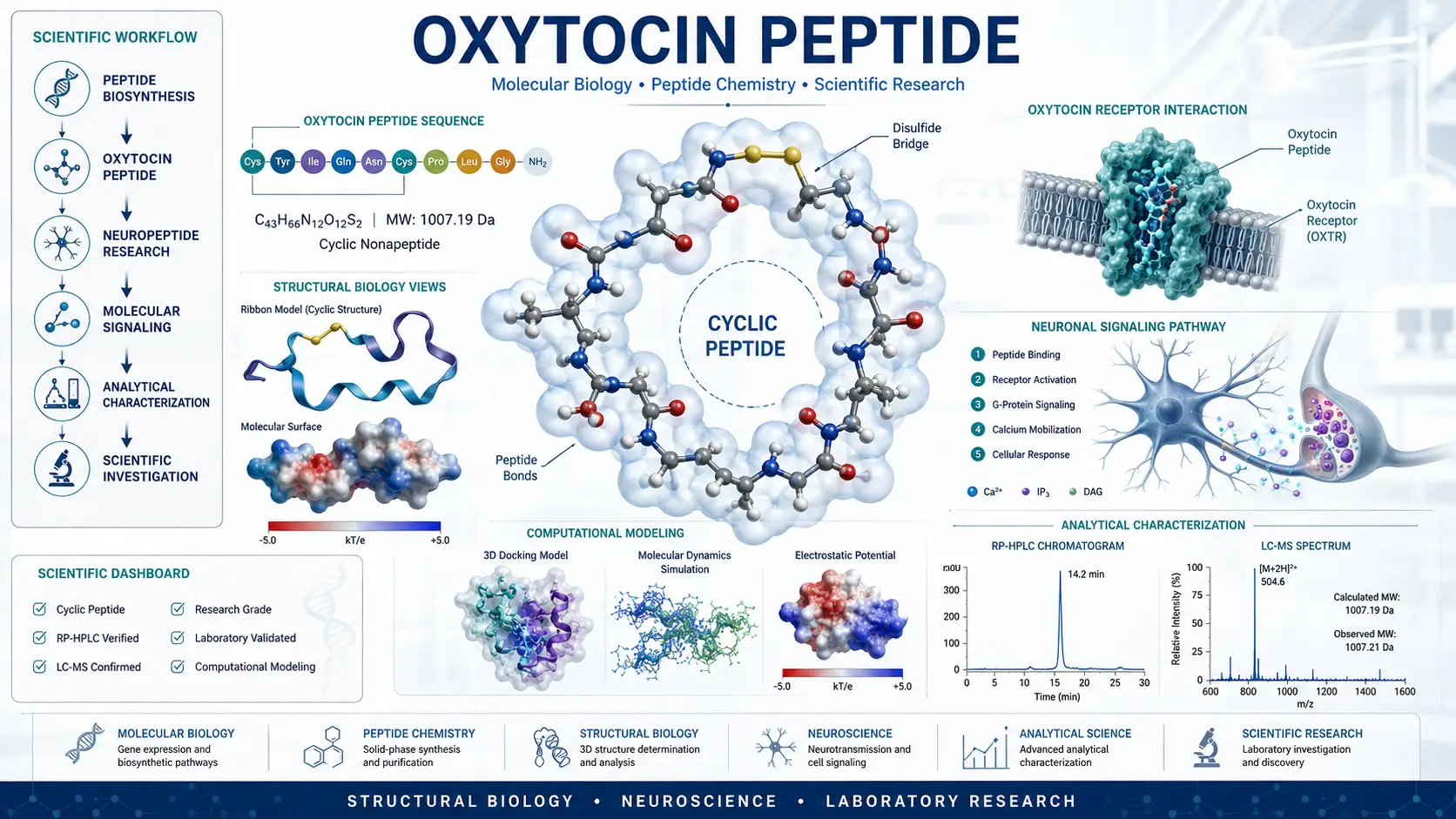
The oxytocin peptide is a naturally occurring cyclic neuropeptide composed of nine amino acids that has become one of the most extensively investigated signaling molecules in molecular biology and neuroscience. Researchers study oxytocin because of its well-characterized molecular structure, receptor interactions, peptide chemistry, and role as an experimental model for investigating neuropeptide signaling pathways. Today, both naturally occurring oxytocin and oxytocin acetate peptide preparations are widely utilized in laboratory research involving peptide biology, analytical chemistry, structural biology, and computational molecular modeling.
Oxytocin Peptide Explained: Molecular Biology, Peptide Chemistry & Scientific Research
Scientific Snapshot
| Scientific Name | Oxytocin |
| Peptide Class | Cyclic Nonapeptide |
| Primary Research Areas | Neuroscience, Molecular Biology, Endocrinology & Peptide Chemistry |
| Research Methods | RP-HPLC, LC-MS, Peptide Sequencing, Molecular Dynamics, Computational Modeling |
| Research Maturity | Extensive Experimental Research with Decades of Scientific Investigation |
| Analytical Characterization | RP-HPLC, LC-MS & Structural Verification |
Quick Facts
| Peptide Type | Naturally Occurring Cyclic Neuropeptide |
| Amino Acid Length | 9 Amino Acids (Nonapeptide) |
| Primary Scientific Focus | Neuropeptide Signaling & Molecular Biology |
| Major Research Fields | Neuroscience, Endocrinology, Structural Biology & Peptide Chemistry |
| Common Research Form | Oxytocin Acetate Peptide |
Key Takeaways
- ✓The oxytocin peptide is a naturally occurring cyclic nonapeptide that serves as one of the most extensively investigated neuropeptides in modern scientific research.
- ✓Researchers investigate oxytocin peptides to better understand molecular signaling, peptide-receptor interactions, structural biology, and peptide chemistry.
- ✓Research-grade oxytocin acetate peptide preparations are routinely characterized using RP-HPLC, LC-MS, peptide sequencing, and stability testing.
- ✓Modern oxytocin research combines structural biology, computational modeling, molecular biology, and advanced analytical chemistry to investigate peptide behavior.
- ✓Scientific discussions involving oxytocin peptide benefits are best interpreted within the context of peer-reviewed laboratory investigations and experimental research.
Table of Contents
Research Timeline
Scientific investigations involving oxytocin began in the early twentieth century, culminating in the determination of its amino acid sequence and pioneering work in peptide synthesis. These discoveries established oxytocin as one of the first peptides to be fully synthesized in the laboratory and laid the foundation for decades of research in peptide chemistry, molecular biology, neuroscience, and structural biology. Today, artificial intelligence, computational molecular modeling, and systems biology continue to expand scientific understanding of oxytocin and related neuropeptides.
| Period | Scientific Milestone |
|---|---|
| 1900–1955 | Discovery, isolation, sequencing, and complete chemical synthesis of oxytocin. |
| 1956–2000 | Expansion of peptide chemistry, receptor biology, and analytical characterization research. |
| 2001–2020 | Growth of molecular biology, structural biology, and computational peptide investigations. |
| 2021–2026 | Integration of AI-assisted molecular modeling, cryo-EM, multi-omics, and advanced peptide analytics. |
Introduction
The oxytocin peptide is among the most thoroughly characterized neuropeptides in modern molecular biology. Its cyclic structure, highly conserved amino acid sequence, and well-defined receptor interactions have made it a cornerstone of peptide chemistry and neuroscience research. Because of its extensive scientific history, oxytocin continues to serve as a benchmark molecule for investigating peptide synthesis, receptor biology, structural biology, and computational molecular modeling.
Interest in oxytocin peptide benefits, oxytocin peptides, and oxytocin acetate peptide has grown as laboratory investigations continue to explore peptide signaling pathways and molecular mechanisms. Throughout this guide, these topics are discussed exclusively from the perspective of peer-reviewed scientific literature and controlled laboratory research, consistent with National Science Labs’ research-only editorial standards.
Researchers interested in experimental peptides may also find our published guides on Retatrutide Peptide Research, Wolverine Stack Peptide Research, and Semax Peptide Research valuable, as each explores different aspects of peptide biology, analytical characterization, and laboratory investigation while contributing to a broader understanding of modern peptide science.
This article examines the molecular structure of oxytocin, peptide chemistry, analytical characterization, laboratory synthesis, current scientific evidence, and future research directions while maintaining a strict focus on experimental science, structural biology, and evidence-based laboratory research.
What Is the Oxytocin Peptide?
The oxytocin peptide is a naturally occurring cyclic nonapeptide composed of nine amino acids and belongs to a highly conserved family of neuropeptides involved in intercellular signaling. First isolated and structurally characterized during the mid-twentieth century, oxytocin became one of the earliest peptides to be successfully synthesized in the laboratory, marking a major milestone in peptide chemistry and molecular biology.
Because of its relatively compact molecular structure and well-characterized receptor interactions, oxytocin has become an important experimental model for studying peptide folding, receptor binding, intracellular signaling, and structure-function relationships. Modern investigations integrate peptide chemistry with structural biology, computational modeling, transcriptomics, and systems neuroscience to better understand the molecular behavior of this peptide.
Today, the scientific literature surrounding oxytocin peptides extends far beyond classical peptide chemistry. Researchers increasingly investigate oxytocin using artificial intelligence, molecular dynamics simulations, cryo-electron microscopy, and advanced analytical chemistry to generate deeper insight into peptide biology under controlled laboratory conditions.
Molecular Structure of Oxytocin
Oxytocin possesses a distinctive cyclic molecular architecture formed through an intramolecular disulfide bond between two cysteine residues. This cyclic configuration contributes to its structural stability and has made oxytocin one of the most thoroughly investigated peptide models in structural biology. Researchers continue examining its three-dimensional conformation using molecular dynamics simulations, X-ray crystallography, nuclear magnetic resonance (NMR), and computational peptide modeling.
The peptide’s compact architecture allows scientists to investigate how conformational flexibility influences receptor recognition, molecular interactions, and peptide stability. These investigations provide valuable information for peptide engineering while supporting broader studies of synthetic and naturally occurring neuropeptides.
| Structural Feature | Description | Scientific Importance |
|---|---|---|
| Peptide Type | Naturally occurring cyclic nonapeptide | Model for peptide biology |
| Disulfide Bond | Intramolecular cysteine linkage | Maintains cyclic conformation |
| Amino Acid Sequence | Nine amino acids | Highly conserved peptide structure |
| Analytical Characterization | RP-HPLC, LC-MS & peptide sequencing | Identity and purity verification |
Research Insight
Oxytocin Was the First Peptide to Be Chemically Synthesized
In 1953, Vincent du Vigneaud and colleagues achieved the complete laboratory synthesis of oxytocin, a landmark accomplishment in peptide chemistry that earned the 1955 Nobel Prize in Chemistry. This breakthrough established the foundation for modern peptide synthesis and continues to influence contemporary peptide engineering and analytical science.
Molecular Signaling Mechanisms Under Investigation
Current research investigates how the oxytocin peptide interacts with its receptor at the molecular level, initiating complex intracellular signaling cascades that are studied using biochemical assays, structural biology, computational modeling, and molecular pharmacology. Researchers continue exploring receptor conformational dynamics, ligand binding mechanisms, intracellular protein interactions, and downstream signaling pathways to better understand peptide-receptor communication.
Modern investigations frequently combine cryo-electron microscopy, molecular dynamics simulations, single-cell transcriptomics, and artificial intelligence-assisted structural prediction to generate increasingly detailed models of oxytocin receptor biology. These computational approaches complement traditional experimental methods by identifying structural hypotheses for subsequent laboratory validation.
| Research Focus | Scientific Objective | Primary Methodology |
|---|---|---|
| Receptor Biology | Characterize ligand-receptor interactions | Structural biology & molecular pharmacology |
| Signal Transduction | Investigate intracellular signaling | Cellular & molecular biology |
| Protein Dynamics | Model receptor conformational changes | Molecular dynamics simulations |
| Computational Biology | Predict structural interactions | AI-assisted molecular modeling |
Understanding Oxytocin Acetate Peptide
The term oxytocin acetate peptide refers to the acetate salt form commonly encountered in laboratory research and analytical characterization. Salt forms are frequently used in peptide science because they can improve handling, consistency, and standardization during manufacturing, purification, storage, and analytical testing without altering the peptide’s primary amino acid sequence.
Researchers routinely characterize oxytocin acetate peptide preparations using RP-HPLC, LC-MS, peptide sequencing, and stability studies to verify molecular identity and analytical quality before incorporating them into controlled laboratory investigations.
Research Classification of Oxytocin Peptides
Within the scientific literature, oxytocin peptides are classified as naturally occurring cyclic neuropeptides investigated across molecular biology, neuroscience, endocrinology, structural biology, and peptide chemistry. Their well-defined molecular architecture and extensive experimental history have made them valuable reference molecules for peptide engineering, receptor biology, and analytical chemistry research.
As computational technologies continue to evolve, oxytocin remains a benchmark peptide for validating structural prediction algorithms, molecular simulations, and next-generation analytical workflows that support modern peptide research.
Did You Know?
Oxytocin Helped Shape Modern Peptide Chemistry
The successful laboratory synthesis of oxytocin represented a turning point in peptide science. It demonstrated that complex biologically active peptides could be chemically synthesized with high precision, paving the way for decades of innovation in peptide engineering, medicinal chemistry, and analytical biotechnology.
Key Takeaway
The oxytocin peptide remains one of the most thoroughly characterized cyclic neuropeptides in scientific research. Its well-defined molecular structure, historical importance in peptide chemistry, and extensive investigation using structural biology, molecular biology, and computational modeling continue to make it a cornerstone of laboratory peptide research and an important reference molecule for advancing peptide science.
Understanding Oxytocin Peptide Benefits in Scientific Research
Search interest surrounding oxytocin peptide benefits has increased alongside the expanding body of literature on neuropeptides, molecular signaling, and peptide-receptor biology. Within scientific publications, however, the term “benefits” refers to the experimental value of oxytocin as a well-characterized research model rather than conclusions regarding clinical outcomes or human applications. Its established molecular structure and extensive analytical characterization have made oxytocin one of the most informative peptides for investigating cellular communication and peptide biology.
Researchers continue to investigate oxytocin across multiple scientific disciplines, including molecular biology, structural biology, neuroscience, endocrinology, computational peptide science, and analytical chemistry. These investigations aim to better understand peptide folding, receptor interactions, intracellular signaling networks, and molecular recognition while improving broader knowledge of neuropeptide biology.
Consequently, references to oxytocin peptide benefits throughout this guide describe the peptide’s scientific value within controlled laboratory investigations and should not be interpreted as therapeutic claims or recommendations for human use.
Neuropeptide Signaling and Molecular Biology Research
Oxytocin has become a benchmark molecule for investigating neuropeptide signaling because of its well-defined receptor biology and highly conserved molecular structure. Laboratory studies examine how peptide-receptor interactions influence intracellular signaling pathways, protein networks, gene expression, and molecular communication within experimental systems.
Current investigations frequently integrate transcriptomics, proteomics, structural biology, computational modeling, and molecular pharmacology to produce comprehensive datasets describing peptide behavior. These multidisciplinary approaches enable researchers to generate experimentally testable hypotheses while improving reproducibility across independent laboratories.
| Research Area | Scientific Objective | Current Research Status |
|---|---|---|
| Neuropeptide Biology | Investigate peptide signaling mechanisms | Extensively researched |
| Receptor Pharmacology | Characterize receptor interactions | Active laboratory investigation |
| Structural Biology | Study molecular conformation | Well established |
| Computational Biology | Predict molecular behavior | Rapidly expanding |
Research Insight
Oxytocin Serves as a Reference Molecule for Modern Neuropeptide Research
Because oxytocin has been investigated extensively for decades, researchers frequently use it as a reference molecule when comparing newly discovered neuropeptides and synthetic peptide analogues. Its well-established analytical profile supports the development of improved computational models, receptor studies, and peptide engineering strategies.
Current Experimental Approaches
Modern oxytocin investigations increasingly combine traditional laboratory experimentation with advanced computational technologies. Artificial intelligence, molecular dynamics simulations, cryo-electron microscopy, transcriptomics, and multi-omics platforms enable researchers to explore peptide behavior with greater structural and molecular resolution than ever before.
Researchers interested in computational peptide engineering may also benefit from our AOD9604 Peptide Research Guide, which discusses how emerging analytical technologies and systems biology are transforming modern peptide research across multiple scientific disciplines.
| Experimental Method | Primary Purpose | Research Application |
|---|---|---|
| Transcriptomics | Gene expression profiling | Neuropeptide biology |
| Proteomics | Protein interaction analysis | Receptor biology |
| Cryo-EM | Structural visualization | Structural biology |
| AI-Assisted Modeling | Predict molecular interactions | Computational peptide science |
Comparative Peptide Research
Oxytocin is frequently examined alongside other peptide classes to better understand similarities and differences in molecular architecture, receptor biology, peptide synthesis, and analytical characterization. Comparative investigations contribute to broader knowledge of peptide evolution while supporting the development of improved computational prediction models and experimental workflows.
Scientific Context for Common Oxytocin Searches
Online searches relating to oxytocin peptide benefits, oxytocin peptides, and oxytocin acetate peptide often reflect growing interest in peptide science and experimental neurobiology. Within National Science Labs, these topics are presented exclusively through the lens of peer-reviewed scientific literature, analytical chemistry, and laboratory investigations.
Scientific Context: Experimental studies involving oxytocin frequently investigate molecular mechanisms, receptor biology, analytical characterization, and peptide chemistry under controlled laboratory conditions. Findings from individual studies should always be interpreted within the scope of their experimental design and should not be generalized beyond the original scientific investigation.
Why Oxytocin Continues to Be a Landmark Research Peptide
Few peptides have contributed as significantly to the advancement of peptide chemistry and molecular biology as oxytocin. From its historic laboratory synthesis to its continued role in structural biology, computational modeling, and receptor research, oxytocin remains a foundational molecule that supports both classical biochemical investigations and next-generation peptide science.
As analytical technologies continue to evolve, oxytocin is expected to remain an important benchmark peptide for validating emerging computational tools, artificial intelligence models, and multidisciplinary experimental approaches.
Did You Know?
Oxytocin Continues to Influence Modern Computational Peptide Science
Because oxytocin is one of the best-characterized peptides in structural biology, it is frequently used to benchmark molecular dynamics simulations, receptor docking algorithms, and artificial intelligence models designed to predict peptide structure and molecular interactions.
Key Takeaway
Within the scientific literature, the primary oxytocin peptide benefits relate to its value as an exceptionally well-characterized research model. Its extensive experimental history, conserved molecular architecture, and compatibility with advanced analytical and computational methodologies continue to make oxytocin one of the most influential peptides in contemporary laboratory research.
Laboratory Synthesis of Oxytocin Peptide
Although oxytocin is naturally produced within mammalian physiology, research-grade oxytocin peptide preparations are manufactured using highly controlled laboratory processes. Modern production relies primarily on solid-phase peptide synthesis (SPPS), enabling scientists to assemble the peptide sequentially with exceptional precision while maintaining strict control over amino acid sequence fidelity and manufacturing consistency.
Following peptide assembly, oxytocin undergoes resin cleavage, deprotection, oxidative folding to establish the characteristic intramolecular disulfide bond, chromatographic purification, and comprehensive analytical verification. These standardized workflows support reproducible peptide production suitable for molecular biology, analytical chemistry, and structural biology investigations.
Because oxytocin represents one of the most extensively studied peptide molecules, modern manufacturing protocols continue to serve as reference methodologies for synthesizing numerous cyclic peptides investigated throughout peptide science.
Research-Grade Manufacturing Workflow
| Manufacturing Stage | Laboratory Process | Scientific Purpose |
|---|---|---|
| Solid-Phase Peptide Synthesis | Sequential amino acid assembly | Generate target peptide sequence |
| Oxidative Folding | Formation of disulfide bridge | Establish cyclic peptide structure |
| Chromatographic Purification | Reverse-phase chromatography | Remove synthesis impurities |
| Analytical Verification | RP-HPLC, LC-MS & peptide sequencing | Verify purity and molecular identity |
| Quality Documentation | Certificate of Analysis | Support reproducible scientific research |
Research Insight
The Disulfide Bond Is Critical to Oxytocin’s Structural Identity
Unlike many linear peptides, oxytocin requires precise oxidative folding to create its characteristic cyclic structure. Researchers routinely monitor this critical manufacturing step using complementary analytical techniques to ensure structural integrity before experimental investigations begin.
RP-HPLC Purity Analysis
Reverse-phase high-performance liquid chromatography (RP-HPLC) remains one of the most important analytical techniques for evaluating research-grade oxytocin preparations. During chromatographic separation, peptide components are resolved according to hydrophobic interactions, enabling researchers to identify synthesis-related impurities, degradation products, truncated sequences, or incomplete oxidative folding.
RP-HPLC data contribute significantly to quality assurance by confirming chromatographic purity prior to molecular biology experiments, receptor investigations, and structural analyses.
LC-MS Identity Confirmation
Liquid chromatography-mass spectrometry (LC-MS) complements chromatographic purity analysis by verifying the molecular identity of oxytocin through precise mass determination. Researchers compare experimentally measured molecular weights with theoretical peptide values to confirm that the synthesized molecule corresponds to the intended amino acid sequence.
Combined interpretation of LC-MS data, peptide sequencing results, and RP-HPLC chromatograms provides a comprehensive analytical profile suitable for structural biology, peptide chemistry, receptor biology, and computational validation studies.
| Analytical Technique | Primary Function | Typical Laboratory Outcome |
|---|---|---|
| RP-HPLC | Chromatographic purity evaluation | Purity profile |
| LC-MS | Molecular identity confirmation | Accurate molecular weight verification |
| Peptide Sequencing | Sequence validation | Primary structure confirmation |
| Certificate of Analysis | Analytical documentation | Quality assurance & reproducibility |
Peptide Stability and Storage Investigations
Laboratory researchers routinely evaluate the stability of oxytocin under carefully controlled experimental conditions. Factors including temperature, pH, oxidation, moisture, and repeated freeze-thaw cycles are examined to better understand peptide integrity during storage and analytical testing. Stability investigations contribute to reproducible laboratory workflows by identifying variables that may influence peptide quality over time.
RP-HPLC and LC-MS are commonly incorporated throughout stability studies to monitor degradation products, verify structural integrity, and assess analytical consistency across multiple experimental time points.
Laboratory Quality Control
Research involving oxytocin acetate peptide depends upon comprehensive quality assurance systems that ensure analytical consistency across laboratories. Standard quality control programs typically include chromatographic purity assessment, molecular identity confirmation, peptide sequencing, impurity profiling, stability testing, and complete analytical documentation before experimental investigations commence.
Researchers increasingly align analytical workflows with internationally recognized validation principles to strengthen reproducibility and facilitate comparison between independent scientific studies.
Current Research Limitations
Despite decades of investigation, researchers continue exploring oxytocin using increasingly sophisticated methodologies. Variability among experimental models, analytical platforms, receptor systems, and computational approaches highlights the ongoing need for standardized laboratory protocols, transparent reporting, and independent validation across peptide research.
Emerging technologies—including artificial intelligence-assisted structural prediction, cryo-electron microscopy, molecular dynamics simulations, single-cell transcriptomics, proteomics, and integrated systems biology—are expected to further refine scientific understanding of oxytocin while generating new avenues for experimental investigation.
Did You Know?
Oxytocin Continues to Be Used as a Benchmark for Analytical Method Development
Because oxytocin is one of the best-characterized peptide molecules, analytical laboratories frequently use it to evaluate chromatographic methods, mass spectrometry workflows, peptide sequencing techniques, and computational prediction tools before applying these methods to newly developed peptide candidates.
Key Takeaway
Research involving the oxytocin peptide relies on standardized synthesis, rigorous analytical verification, and comprehensive quality control. Techniques such as SPPS, oxidative folding, RP-HPLC, LC-MS, peptide sequencing, and stability testing collectively provide the scientific foundation for reproducible investigations in peptide chemistry, structural biology, and molecular neuroscience.
Current Scientific Consensus
The oxytocin peptide remains one of the most extensively investigated neuropeptides in modern science. More than seven decades of biochemical, structural, and molecular research have established oxytocin as a reference molecule for studying peptide-receptor interactions, peptide chemistry, neurobiology, and analytical characterization. Its well-defined molecular architecture and reproducible analytical profile continue to make it a cornerstone of laboratory peptide research.
Current scientific consensus emphasizes that oxytocin research benefits from integrating traditional biochemical investigations with structural biology, computational modeling, artificial intelligence, and multi-omics technologies. These multidisciplinary approaches provide increasingly detailed insight into peptide structure-function relationships while improving experimental reproducibility and analytical precision.
Emerging Directions in Oxytocin Research
Technological advances are transforming the study of oxytocin and other neuropeptides. Researchers now combine high-resolution structural biology, cryo-electron microscopy, artificial intelligence, molecular dynamics simulations, single-cell transcriptomics, proteomics, and computational peptide engineering to investigate peptide behavior at unprecedented molecular resolution.
Rather than replacing traditional laboratory experimentation, these computational approaches complement experimental validation by helping researchers prioritize structural hypotheses, predict receptor interactions, and design increasingly sophisticated research strategies for peptide biology.
| Emerging Technology | Contribution to Oxytocin Research |
|---|---|
| Artificial Intelligence | Predict peptide structures and receptor interactions |
| Cryo-Electron Microscopy | Visualize receptor-peptide complexes |
| Molecular Dynamics Simulation | Model peptide flexibility and molecular motion |
| Single-Cell Transcriptomics | Characterize gene expression patterns |
| Integrated Multi-Omics | Correlate genomic, proteomic, and metabolomic data |
Research Insight
Oxytocin Continues to Drive Innovation in Peptide Engineering
Because oxytocin is one of the best-characterized cyclic peptides, researchers frequently use it as a reference molecule when validating new peptide synthesis strategies, receptor modeling algorithms, analytical methods, and computational prediction platforms. Its extensive scientific history makes it an ideal benchmark for evaluating emerging technologies in peptide research.
Research Best Practices
High-quality investigations involving oxytocin require standardized experimental design, validated analytical methodologies, and transparent scientific reporting. Researchers typically combine complementary analytical techniques to strengthen confidence in experimental observations and improve reproducibility across independent laboratories.
- ✓Verify molecular identity using LC-MS before conducting laboratory investigations.
- ✓Confirm chromatographic purity using validated RP-HPLC methods.
- ✓Monitor peptide stability throughout storage and analytical evaluation.
- ✓Integrate computational predictions with laboratory validation whenever possible.
- ✓Interpret experimental findings within the context of peer-reviewed evidence while recognizing methodological limitations.
Related Research Articles
Continue Exploring Peptide Research
Expand your understanding of peptide chemistry, neurobiology, and laboratory research through these related guides from National Science Labs.
Did You Know?
Oxytocin Is One of the Most Studied Peptides in Structural Biology
The combination of a compact cyclic structure, well-characterized receptor interactions, and decades of experimental data has made oxytocin one of the most valuable reference peptides for validating computational biology, analytical chemistry, and peptide engineering methodologies.
Section Summary
Current scientific evidence positions the oxytocin peptide as a foundational research molecule that continues to advance peptide chemistry, structural biology, molecular pharmacology, and computational biology. Emerging technologies—including artificial intelligence, multi-omics integration, and high-resolution structural analysis—are expected to further refine experimental investigations while strengthening our understanding of peptide structure-function relationships.
Frequently Asked Questions
1. What is the oxytocin peptide?
The oxytocin peptide is a naturally occurring cyclic nonapeptide consisting of nine amino acids. It is one of the most extensively studied neuropeptides in molecular biology and serves as an important research model for investigating peptide signaling, receptor interactions, structural biology, and peptide chemistry.
2. What are oxytocin peptide benefits in scientific research?
Within peer-reviewed scientific literature, oxytocin peptide benefits refer to its usefulness as a laboratory research model. Scientists investigate oxytocin to better understand neuropeptide signaling, receptor biology, molecular interactions, computational modeling, and analytical chemistry rather than for clinical or therapeutic purposes.
3. What are oxytocin peptides?
The term oxytocin peptides generally refers to naturally occurring oxytocin and research-grade preparations used in laboratory investigations. These peptides are commonly studied to explore molecular signaling pathways, peptide-receptor interactions, and structural biology using standardized analytical methods.
4. What is oxytocin acetate peptide?
Oxytocin acetate peptide is the acetate salt form frequently used in peptide research. The acetate counterion supports standardized manufacturing and analytical characterization while maintaining the peptide’s primary amino acid sequence. Research laboratories typically verify these preparations using RP-HPLC, LC-MS, and peptide sequencing.
5. How is the oxytocin peptide synthesized?
Research-grade oxytocin is commonly produced through solid-phase peptide synthesis (SPPS). Following synthesis, oxidative folding establishes the peptide’s characteristic disulfide bridge before purification and analytical verification are completed using chromatographic and mass spectrometric techniques.
6. Why are RP-HPLC and LC-MS important for oxytocin research?
RP-HPLC evaluates chromatographic purity by separating peptide components, while LC-MS confirms molecular identity through accurate mass determination. Together, these complementary analytical methods help ensure that research-grade oxytocin preparations meet quality standards before laboratory investigations begin.
7. Why is oxytocin important in peptide chemistry?
Oxytocin occupies a unique place in peptide chemistry because it was the first peptide to be completely synthesized in the laboratory. This historic achievement established many of the foundational principles that continue to influence peptide synthesis, analytical characterization, and peptide engineering today.
8. How does artificial intelligence contribute to oxytocin research?
Artificial intelligence supports modern oxytocin research by predicting peptide conformations, modeling receptor interactions, analyzing structural datasets, and assisting researchers in generating hypotheses before laboratory validation through experimental studies.
9. How do researchers verify the quality of oxytocin peptides?
Quality verification typically includes RP-HPLC purity analysis, LC-MS identity confirmation, peptide sequencing, impurity profiling, stability assessment, and comprehensive analytical documentation such as a Certificate of Analysis (CoA). These procedures support reproducible scientific research.
10. What research areas commonly investigate oxytocin?
Oxytocin research spans multiple scientific disciplines, including neuroscience, molecular biology, structural biology, peptide chemistry, receptor pharmacology, endocrinology, computational biology, and analytical chemistry. Its well-characterized molecular structure makes it valuable across diverse laboratory investigations.
11. Why is oxytocin considered a benchmark peptide?
Because oxytocin has been extensively characterized for decades, researchers frequently use it as a benchmark molecule when developing new analytical techniques, computational prediction models, peptide engineering methods, and structural biology workflows. Its well-established scientific profile enables meaningful comparison across experimental studies.
12. What is the future of oxytocin peptide research?
Future investigations are expected to increasingly combine artificial intelligence, molecular dynamics simulations, cryo-electron microscopy, single-cell transcriptomics, proteomics, and integrated multi-omics technologies to deepen scientific understanding of oxytocin structure, signaling, and peptide-receptor interactions.
Scientific Resources & References
The following peer-reviewed publications, landmark discoveries, and official scientific guidance documents provide authoritative information on oxytocin peptide chemistry, structural biology, analytical characterization, neurobiology, and laboratory best practices.
Landmark Research & Scientific Reviews
-
du Vigneaud V, et al. The Synthesis of Oxytocin.
DOI: 10.1021/ja01619a019 -
du Vigneaud V. Nobel Prize in Chemistry 1955 – Work on Biochemically Important Sulfur Compounds, Especially the First Synthesis of a Polypeptide Hormone.
https://www.nobelprize.org/prizes/chemistry/1955/summary/ -
Gimpl G, Fahrenholz F. The Oxytocin Receptor System: Structure, Function and Regulation.
DOI: 10.1152/physrev.2001.81.2.629 -
Kim Y, et al. Structure of the Human Oxytocin Receptor Bound to Oxytocin.
DOI: 10.1038/s41586-023-06999-0 -
Merrifield RB. Solid Phase Peptide Synthesis.
DOI: 10.1021/ja00897a025 -
Fields GB, Noble RL. Solid-Phase Peptide Synthesis Utilizing Fmoc Chemistry.
DOI: 10.1111/j.1399-3011.1990.tb01039.x -
Jumper J, et al. Highly Accurate Protein Structure Prediction with AlphaFold.
DOI: 10.1038/s41586-021-03819-2 -
Aebersold R, Mann M. Mass Spectrometry-Based Proteomics.
DOI: 10.1038/nature19949 -
National Center for Biotechnology Information (NCBI). PubMed Database.
https://pubmed.ncbi.nlm.nih.gov/
Official Scientific & Analytical Guidance
- ICH Q2(R2). Validation of Analytical Procedures.
- FDA. Analytical Procedures and Methods Validation for Drugs and Biologics.
- United States Pharmacopeia (USP). General Chapters – Chromatography.
- European Medicines Agency (EMA). Quality Guidelines for Biological Products.
Final Takeaway
Oxytocin Remains a Cornerstone of Modern Peptide Science
The oxytocin peptide continues to serve as one of the most influential molecules in peptide research. Its historic role in peptide synthesis, well-defined cyclic structure, extensive analytical characterization, and decades of peer-reviewed investigation have established oxytocin as a foundational model for studying molecular signaling, receptor biology, structural biology, and peptide chemistry.
Looking ahead, advances in artificial intelligence, computational peptide modeling, cryo-electron microscopy, molecular dynamics simulations, and integrated multi-omics technologies are expected to further expand scientific understanding of oxytocin. These innovations will continue improving peptide characterization, analytical methodologies, and evidence-based laboratory research while supporting the discovery and evaluation of future peptide candidates.
Research Disclaimer
All content published on Peptides Library is intended exclusively for educational and scientific research purposes. References to oxytocin peptide, oxytocin peptide benefits, oxytocin peptides, and oxytocin acetate peptide are presented solely within the context of peer-reviewed scientific literature and laboratory investigations. This article does not provide medical advice, therapeutic recommendations, dosage guidance, purchasing advice, or instructions for human use. Readers should interpret all information in accordance with Good Laboratory Practices (GLP), accepted scientific methodologies, and applicable regulatory guidance.