


Quick Answer
What Is Wolverine Stack Peptide?
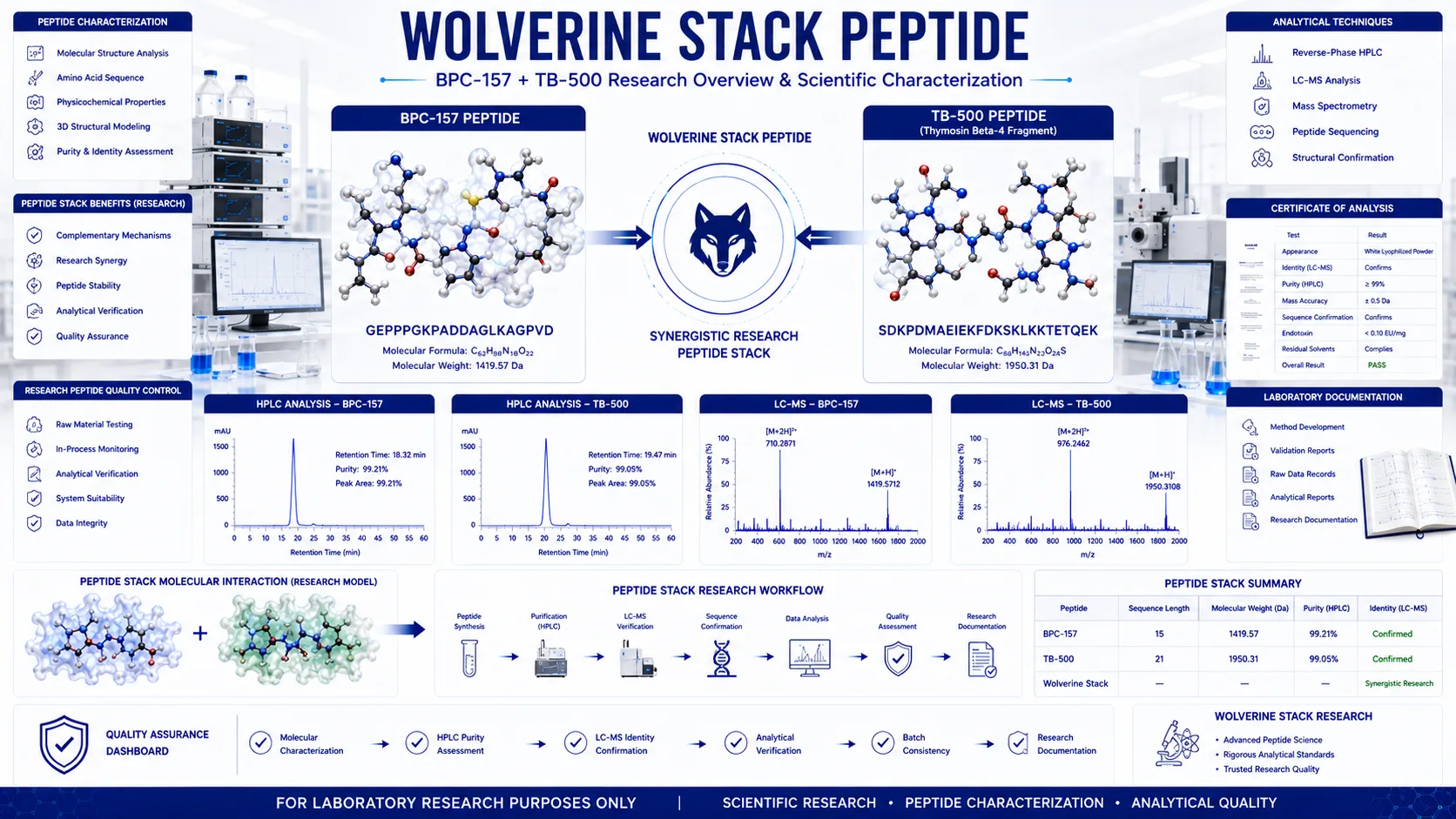
Wolverine Stack Peptide is a research term commonly used to describe the combined laboratory investigation of BPC-157 and TB-500. Researchers frequently study this peptide pairing because each peptide possesses unique molecular characteristics, distinct scientific backgrounds, and complementary areas of investigation. Modern Wolverine Stack Peptide research focuses on peptide characterization, molecular signaling pathways, laboratory models, and analytical verification through HPLC and LC-MS methodologies.
Wolverine Stack Peptide: Complete Research Guide to BPC-157 and TB-500 Peptide Characterization
Scientific Snapshot
| Research Topic | Wolverine Stack Peptide |
| Primary Components | BPC-157 + TB-500 |
| Research Category | Peptide Combination Research |
| Analytical Focus | Identity, Purity & Characterization |
| Common Analytical Methods | RP-HPLC, LC-MS, COA Review |
| Research Status | Preclinical & Laboratory Research |
Key Takeaways
- ✓ Wolverine Stack Peptide refers to combined research involving BPC-157 and TB-500.
- ✓ Both peptides originate from different scientific discovery pathways and possess unique molecular characteristics.
- ✓ Modern laboratories use HPLC and LC-MS to verify peptide identity, purity, and analytical quality.
- ✓ Research interest focuses on molecular biology, signaling pathways, and peptide characterization.
- ✓ This guide reviews current scientific literature, analytical standards, and research considerations surrounding Wolverine Stack Peptides.
Table of Contents
Scientific History & Research Timeline
The emergence of the Wolverine Peptide Stack reflects the broader evolution of peptide science over the past several decades. As research involving BPC-157 and Thymosin Beta-4 expanded independently, scientific interest gradually grew around examining both peptides within the same research framework. This ultimately led to the popularization of the term “Wolverine Stack Peptide” among peptide research communities.
| Period | Scientific Development |
|---|---|
| 1980s | Growing interest in peptide biology and regulatory proteins. |
| 1990s | Expansion of research involving BPC-157 and Thymosin Beta-4 derivatives. |
| 2000s | Increased laboratory characterization using HPLC and LC-MS technologies. |
| 2010s | Growing discussion of peptide combinations within research communities. |
| 2020–2026 | Continued emphasis on peptide characterization, analytical verification, and reproducible laboratory methodologies. |
Introduction
The Wolverine Stack Peptide has become one of the most recognized peptide combinations discussed within research communities. Although the term itself is informal, it generally refers to the combined study of BPC-157 and TB-500, two peptides that have been investigated extensively within laboratory environments for their unique molecular characteristics and biological activities.
Researchers often examine Wolverine Stack Peptides because the two components originate from distinct scientific backgrounds. BPC-157 is a synthetic peptide derived from a protective protein sequence identified in gastric tissue, whereas TB-500 is a synthetic peptide fragment based on Thymosin Beta-4, a naturally occurring protein involved in cellular processes. Their differing molecular origins make them particularly interesting subjects for comparative and combination-based laboratory research.
As peptide science continues to advance, increasing attention has been directed toward understanding how peptide combinations can be characterized, verified, and studied using modern analytical methodologies. This guide explores the current scientific understanding of Wolverine Stack Peptide research while emphasizing peptide characterization, quality control, and laboratory-focused investigation.
Understanding Wolverine Stack Peptide
The term Wolverine Stack Peptide is commonly used within peptide research communities to describe the combined investigation of BPC-157 and TB-500. Unlike a single peptide molecule, the Wolverine Peptide Stack represents a research framework involving two distinct synthetic peptides that are often studied together due to their different molecular origins, biological characteristics, and experimental applications.
Although the phrase has gained popularity within scientific discussions and online research communities, it is important to recognize that Wolverine Stack Peptides are not a separate peptide entity. Rather, the term serves as a convenient way to reference the combined evaluation of BPC-157 and TB-500 within laboratory environments. Each peptide retains its own molecular structure, analytical profile, and scientific literature.
As peptide science continues to expand, researchers increasingly examine how different peptides may be studied side-by-side to better understand molecular pathways, biological signaling mechanisms, and experimental outcomes. This growing interest has contributed to the widespread recognition of the Wolverine Stack Peptide as a notable topic within peptide research literature.
Research Insight
The Wolverine Stack Is a Research Concept, Not a Single Molecule
One of the most common misconceptions surrounding Wolverine Stack Peptides is the belief that they represent a unique peptide compound. In reality, the Wolverine Peptide Stack refers to the combined study of two independently characterized peptides: BPC-157 and TB-500. Each peptide maintains distinct molecular properties, analytical specifications, and scientific literature.
The Two Components of Wolverine Stack Peptides
To understand Wolverine Stack Peptide research, it is essential to examine the individual components that make up the combination. While both peptides are frequently discussed together, their scientific backgrounds differ substantially.
| Characteristic | BPC-157 | TB-500 |
|---|---|---|
| Origin | Synthetic peptide derived from a gastric protein sequence | Synthetic fragment derived from Thymosin Beta-4 |
| Research Category | Peptide biology and molecular signaling research | Cellular and protein interaction research |
| Analytical Verification | HPLC, LC-MS, COA review | HPLC, LC-MS, COA review |
| Scientific Literature | Extensive preclinical research | Extensive preclinical research |
| Role in Wolverine Stack | Research component | Research component |
Why Researchers Study Peptide Combinations
Combination-based peptide research has become increasingly common because biological systems are inherently complex and involve numerous interconnected molecular pathways. Rather than focusing exclusively on a single peptide, researchers may investigate multiple peptides simultaneously to better understand how distinct signaling mechanisms operate within experimental models.
Within the context of Wolverine Stack Peptide research, scientific interest often centers on comparing molecular characteristics, evaluating analytical profiles, and exploring how two independently studied peptides may contribute unique perspectives within laboratory investigations. Importantly, these studies focus on research objectives rather than clinical outcomes, emphasizing scientific observation and molecular analysis.
This approach reflects a broader trend within peptide science toward integrated research strategies that examine multiple biological variables simultaneously while maintaining rigorous analytical verification standards.
Did You Know?
BPC-157 and TB-500 Originated from Different Scientific Discoveries
Although frequently grouped together as Wolverine Stack Peptides, BPC-157 and TB-500 emerged from entirely different scientific research pathways. BPC-157 traces its origins to gastric protein research, while TB-500 is derived from investigations involving Thymosin Beta-4, a naturally occurring protein found throughout the body. Their distinct origins make them valuable subjects for comparative peptide research.
Scientific History of the Wolverine Peptide Stack
The popularity of the Wolverine Stack Peptide emerged gradually as scientific interest in peptide research expanded during the late twentieth and early twenty-first centuries. As independent studies involving BPC-157 and TB-500 accumulated, researchers began discussing both peptides within the same analytical and experimental contexts. Over time, the phrase “Wolverine Stack” became a convenient shorthand used within research communities to reference this combined area of investigation.
Today, Wolverine Stack Peptides remain an active topic of discussion within peptide research, analytical chemistry, and laboratory quality control. Modern investigations increasingly emphasize molecular characterization, analytical verification, and reproducibility through techniques such as RP-HPLC, LC-MS, and Certificate of Analysis review.
As analytical technologies continue to evolve, future Wolverine Stack Peptide research will likely benefit from increasingly sophisticated characterization techniques capable of providing deeper insight into peptide identity, purity, and structural integrity.
Key Takeaway
Wolverine Stack Peptide refers to the combined research investigation of BPC-157 and TB-500 rather than a single peptide compound. Understanding the distinct scientific origins, molecular characteristics, and analytical requirements of each peptide is essential for interpreting Wolverine Stack research accurately and within the context of modern peptide science.
Molecular Characteristics of Wolverine Stack Peptides
Understanding the molecular characteristics of Wolverine Stack Peptides is essential for interpreting laboratory research accurately. Although the Wolverine Stack Peptide combines BPC-157 and TB-500 within a single research framework, each peptide possesses unique structural features, molecular origins, and biological properties. These differences contribute to the growing scientific interest surrounding the Wolverine Peptide Stack and explain why researchers frequently investigate both peptides together while analyzing them independently.
From an analytical perspective, BPC-157 and TB-500 require separate characterization and quality verification processes. Modern peptide laboratories rely on RP-HPLC purity assessment, LC-MS identity confirmation, and Certificate of Analysis review to ensure that each peptide meets established research quality standards before experimental investigations begin.
BPC-157 and TB-500 Overview
Although frequently grouped together as Wolverine Stack Peptides, BPC-157 and TB-500 originate from different scientific discoveries and exhibit distinct molecular profiles. Their complementary research value stems from these differences rather than from structural similarity.
| Characteristic | BPC-157 | TB-500 |
|---|---|---|
| Scientific Origin | Derived from a gastric protein sequence | Derived from Thymosin Beta-4 |
| Research Classification | Synthetic peptide | Synthetic peptide fragment |
| Primary Research Focus | Molecular signaling investigations | Cellular pathway investigations |
| Analytical Verification | HPLC, LC-MS, COA Review | HPLC, LC-MS, COA Review |
| Research Literature | Extensive preclinical studies | Extensive preclinical studies |
Research Insight
The Scientific Value of Wolverine Stack Peptide Research Comes From Molecular Diversity
The Wolverine Stack Peptide attracts scientific interest because BPC-157 and TB-500 represent two distinct peptide systems rather than variations of the same molecule. Researchers often study Wolverine Stack Peptides to compare molecular behaviors, signaling pathways, analytical profiles, and experimental observations across different biological models.
Structural Differences Between BPC-157 and TB-500
One of the defining characteristics of the Wolverine Peptide Stack is the substantial structural distinction between its two components. BPC-157 and TB-500 differ in amino acid composition, sequence length, molecular architecture, and biological origin. These differences influence how researchers approach peptide characterization, analytical testing, and experimental design.
From an analytical chemistry perspective, structural differences can influence chromatographic retention behavior, mass spectrometry profiles, and overall characterization workflows. Consequently, laboratories typically analyze each peptide independently before incorporating them into broader Wolverine Stack research discussions.
| Analytical Consideration | BPC-157 | TB-500 |
|---|---|---|
| Sequence Composition | Unique amino acid arrangement | Distinct amino acid arrangement |
| Mass Spectrometry Profile | Characteristic molecular signature | Distinct molecular signature |
| Chromatographic Behavior | Independently evaluated | Independently evaluated |
| Identity Verification | LC-MS confirmation | LC-MS confirmation |
Did You Know?
Two Peptides Can Share Research Interest Without Sharing Molecular Similarity
Many researchers assume peptides grouped together in a stack must be structurally related. However, Wolverine Stack Peptides demonstrate that scientific interest can arise from complementary research characteristics rather than molecular similarity. BPC-157 and TB-500 originated from entirely different biological discoveries yet continue to be examined together in peptide research literature.
Research Areas Investigated Within Wolverine Stack Peptide Studies
Modern Wolverine Stack Peptide research encompasses a wide range of scientific disciplines including molecular biology, peptide chemistry, analytical science, cellular signaling, and laboratory methodology development. Researchers frequently evaluate how BPC-157 and TB-500 can contribute unique insights within experimental systems while maintaining independent analytical verification standards.
- ✓ Molecular signaling pathway investigations.
- ✓ Peptide characterization and analytical verification.
- ✓ Experimental biological model research.
- ✓ Research peptide quality control methodologies.
- ✓ Comparative peptide research and laboratory investigations.
Key Takeaway
The scientific significance of Wolverine Stack Peptides lies in the combination of two independently researched peptides with distinct molecular origins and analytical characteristics. Understanding these differences provides essential context for interpreting Wolverine Peptide Stack research and appreciating the importance of rigorous peptide characterization and quality verification practices.
Molecular Characteristics of Wolverine Stack Peptides
Understanding the molecular characteristics of Wolverine Stack Peptides is essential for interpreting laboratory research accurately. Although the Wolverine Stack Peptide combines BPC-157 and TB-500 within a single research framework, each peptide possesses unique structural features, molecular origins, and biological properties. These differences contribute to the growing scientific interest surrounding the Wolverine Peptide Stack and explain why researchers frequently investigate both peptides together while analyzing them independently.
From an analytical perspective, BPC-157 and TB-500 require separate characterization and quality verification processes. Modern peptide laboratories rely on RP-HPLC purity assessment, LC-MS identity confirmation, and Certificate of Analysis review to ensure that each peptide meets established research quality standards before experimental investigations begin.
BPC-157 and TB-500 Overview
Although frequently grouped together as Wolverine Stack Peptides, BPC-157 and TB-500 originate from different scientific discoveries and exhibit distinct molecular profiles. Their complementary research value stems from these differences rather than from structural similarity.
| Characteristic | BPC-157 | TB-500 |
|---|---|---|
| Scientific Origin | Derived from a gastric protein sequence | Derived from Thymosin Beta-4 |
| Research Classification | Synthetic peptide | Synthetic peptide fragment |
| Primary Research Focus | Molecular signaling investigations | Cellular pathway investigations |
| Analytical Verification | HPLC, LC-MS, COA Review | HPLC, LC-MS, COA Review |
| Research Literature | Extensive preclinical studies | Extensive preclinical studies |
Research Insight
The Scientific Value of Wolverine Stack Peptide Research Comes From Molecular Diversity
The Wolverine Stack Peptide attracts scientific interest because BPC-157 and TB-500 represent two distinct peptide systems rather than variations of the same molecule. Researchers often study Wolverine Stack Peptides to compare molecular behaviors, signaling pathways, analytical profiles, and experimental observations across different biological models.
Structural Differences Between BPC-157 and TB-500
One of the defining characteristics of the Wolverine Peptide Stack is the substantial structural distinction between its two components. BPC-157 and TB-500 differ in amino acid composition, sequence length, molecular architecture, and biological origin. These differences influence how researchers approach peptide characterization, analytical testing, and experimental design.
From an analytical chemistry perspective, structural differences can influence chromatographic retention behavior, mass spectrometry profiles, and overall characterization workflows. Consequently, laboratories typically analyze each peptide independently before incorporating them into broader Wolverine Stack research discussions.
| Analytical Consideration | BPC-157 | TB-500 |
|---|---|---|
| Sequence Composition | Unique amino acid arrangement | Distinct amino acid arrangement |
| Mass Spectrometry Profile | Characteristic molecular signature | Distinct molecular signature |
| Chromatographic Behavior | Independently evaluated | Independently evaluated |
| Identity Verification | LC-MS confirmation | LC-MS confirmation |
Did You Know?
Two Peptides Can Share Research Interest Without Sharing Molecular Similarity
Many researchers assume peptides grouped together in a stack must be structurally related. However, Wolverine Stack Peptides demonstrate that scientific interest can arise from complementary research characteristics rather than molecular similarity. BPC-157 and TB-500 originated from entirely different biological discoveries yet continue to be examined together in peptide research literature.
Research Areas Investigated Within Wolverine Stack Peptide Studies
Modern Wolverine Stack Peptide research encompasses a wide range of scientific disciplines including molecular biology, peptide chemistry, analytical science, cellular signaling, and laboratory methodology development. Researchers frequently evaluate how BPC-157 and TB-500 can contribute unique insights within experimental systems while maintaining independent analytical verification standards.
- ✓ Molecular signaling pathway investigations.
- ✓ Peptide characterization and analytical verification.
- ✓ Experimental biological model research.
- ✓ Research peptide quality control methodologies.
- ✓ Comparative peptide research and laboratory investigations.
Key Takeaway
The scientific significance of Wolverine Stack Peptides lies in the combination of two independently researched peptides with distinct molecular origins and analytical characteristics. Understanding these differences provides essential context for interpreting Wolverine Peptide Stack research and appreciating the importance of rigorous peptide characterization and quality verification practices.
Analytical Verification & Quality Control for Wolverine Stack Peptides
Regardless of the research objective, analytical verification remains one of the most important aspects of Wolverine Stack Peptide research. Before BPC-157 and TB-500 are incorporated into laboratory investigations, researchers typically evaluate peptide identity, purity, batch consistency, and supporting documentation. These verification procedures help establish confidence in experimental materials and improve the reproducibility of scientific findings.
Modern research peptide quality control relies heavily on orthogonal analytical testing. Rather than depending on a single measurement, laboratories frequently combine chromatographic analysis, mass spectrometry, and documentation review to verify peptide quality. This multi-layered approach has become standard practice across peptide chemistry, biotechnology research, and analytical laboratories worldwide.
For Wolverine Stack Peptides, both BPC-157 and TB-500 should be evaluated independently using validated analytical methods. Because these peptides possess distinct molecular structures, separate analytical verification helps ensure accurate characterization before any comparative or combination-based investigations are performed.
RP-HPLC Purity Assessment
Reverse-phase high-performance liquid chromatography (RP-HPLC) remains one of the most widely used analytical techniques in peptide research. During RP-HPLC analysis, peptide samples are separated according to their physicochemical properties, producing chromatograms that provide insight into purity and impurity profiles.
Researchers examining Wolverine Peptide Stack materials often review chromatographic data to assess peak quality, retention behavior, impurity signals, and overall batch consistency. While HPLC is highly valuable for purity assessment, it does not independently confirm molecular identity, which is why additional analytical techniques are commonly employed.
| HPLC Parameter | Purpose |
|---|---|
| Chromatographic Purity | Evaluates relative purity of the peptide sample. |
| Peak Profile | Provides insight into sample composition. |
| Retention Time | Supports batch comparison and analytical consistency. |
| Impurity Detection | Helps identify additional chromatographic components. |
Research Insight
A High Purity Percentage Does Not Automatically Confirm Peptide Identity
One of the most common misconceptions in peptide research is assuming that a high HPLC purity value independently verifies a peptide’s identity. In reality, chromatographic purity and molecular identity represent different analytical measurements. This is why Wolverine Stack Peptide research often incorporates both HPLC and LC-MS verification as part of a comprehensive quality control workflow.
LC-MS Identity Confirmation
Liquid chromatography-mass spectrometry (LC-MS) provides a complementary analytical perspective by evaluating molecular mass and supporting peptide identity confirmation. Through precise measurement of mass-to-charge ratios, LC-MS helps researchers determine whether the observed molecular profile aligns with the expected peptide structure.
Within Wolverine Stack Peptide research, LC-MS characterization is frequently used to verify BPC-157 and TB-500 independently. This process provides additional confidence beyond chromatographic purity and strengthens overall research peptide quality control practices.
| LC-MS Measurement | Analytical Value |
|---|---|
| Molecular Weight Verification | Supports peptide identity confirmation. |
| Mass Spectrum Analysis | Provides molecular characterization data. |
| Identity Assessment | Verifies expected molecular profile. |
| Quality Verification | Complements chromatographic analysis. |
Did You Know?
Most Research Laboratories Use More Than One Analytical Method
Modern peptide characterization rarely depends on a single analytical result. Researchers commonly combine HPLC, LC-MS, Certificate of Analysis review, and additional verification methods to improve confidence in peptide identity, purity, and overall analytical quality.
Certificate of Analysis (COA) Review
A Certificate of Analysis serves as a critical quality document accompanying many research peptides. For Wolverine Stack Peptides, researchers often review batch-specific COAs to examine purity data, analytical methods, identity verification results, storage recommendations, and manufacturing documentation.
Importantly, a COA should be interpreted as a complete analytical package rather than a single purity figure. Researchers benefit from reviewing chromatograms, LC-MS data, batch identifiers, and testing methodologies collectively when evaluating peptide quality.
- ✓ Batch identification information
- ✓ HPLC chromatographic purity data
- ✓ LC-MS identity confirmation
- ✓ Testing methodology information
- ✓ Storage and handling recommendations
Analytical Comparison: BPC-157 vs TB-500
| Analytical Category | BPC-157 | TB-500 |
|---|---|---|
| HPLC Testing | Required | Required |
| LC-MS Verification | Recommended | Recommended |
| COA Documentation | Important | Important |
| Research Quality Control | Independent Evaluation | Independent Evaluation |
Key Takeaway
Analytical verification forms the foundation of reliable Wolverine Stack Peptide research. By combining RP-HPLC purity assessment, LC-MS identity confirmation, and comprehensive COA review, researchers can establish greater confidence in peptide quality, reproducibility, and scientific integrity before conducting laboratory investigations.
Scientific Consensus Surrounding Wolverine Stack Peptide Research
As interest in Wolverine Stack Peptide research has grown, so too has the body of scientific literature surrounding its individual components. While BPC-157 and TB-500 are frequently discussed together within research communities, the scientific consensus remains focused on evaluating each peptide independently through controlled laboratory investigations, analytical characterization, and preclinical experimentation.
Modern peptide science emphasizes rigorous methodology, reproducibility, and analytical verification. Consequently, researchers examining Wolverine Stack Peptides typically rely on peer-reviewed literature, validated analytical techniques, and carefully designed experimental models when interpreting findings. This approach helps distinguish evidence-based scientific investigation from anecdotal discussion.
Importantly, the scientific community generally views Wolverine Peptide Stack research as an evolving area of study rather than a settled field. Continued investigation is necessary to better understand molecular mechanisms, biological interactions, and analytical characteristics associated with both peptides.
Current State of BPC-157 Research
BPC-157 has been the subject of extensive preclinical research for several decades. Scientific investigations have explored its molecular properties, signaling pathways, cellular interactions, and behavior within experimental systems. As a result, BPC-157 possesses one of the larger bodies of literature among research peptides.
Researchers studying Wolverine Stack Peptide often reference BPC-157 literature because it provides substantial insight into peptide characterization, laboratory methodologies, and molecular biology investigations. However, scientific interpretation continues to depend on controlled experimental evidence rather than assumptions based on isolated findings.
Key Research Areas Investigated for BPC-157
- ✓ Molecular signaling pathways
- ✓ Cellular communication mechanisms
- ✓ Experimental biological models
- ✓ Peptide characterization and analytical studies
Current State of TB-500 Research
TB-500 research originates from scientific investigations involving Thymosin Beta-4, a naturally occurring protein that has attracted substantial attention within molecular and cellular biology. As a synthetic fragment derived from this larger protein, TB-500 has become an important subject of laboratory-based peptide research.
Researchers evaluating Wolverine Stack Peptides often incorporate TB-500 literature because it offers a complementary perspective to BPC-157 research. The peptide’s distinct biological origin and molecular profile contribute to its continued relevance within analytical and experimental investigations.
Like BPC-157, TB-500 continues to be studied primarily through preclinical and laboratory-based research methodologies. Scientific understanding continues to evolve as additional studies are published and analytical technologies improve.
Research Insight
Most Wolverine Stack Literature Is Derived From Independent Peptide Research
A significant portion of the scientific discussion surrounding Wolverine Stack Peptides originates from studies that examined BPC-157 and TB-500 independently rather than as a formal combination. As a result, researchers frequently analyze findings from separate literature sources while maintaining appropriate scientific caution when drawing broader conclusions.
Research Limitations and Scientific Considerations
One of the defining characteristics of responsible peptide research is acknowledging the limitations of available evidence. While substantial scientific literature exists for both BPC-157 and TB-500, researchers recognize that experimental findings often depend on study design, analytical methodologies, model selection, and laboratory conditions.
For Wolverine Stack Peptide research specifically, an additional consideration is the relative scarcity of studies evaluating both peptides together within standardized experimental frameworks. This highlights the importance of careful interpretation and continued scientific investigation.
| Scientific Consideration | Why It Matters |
|---|---|
| Experimental Design | Influences interpretation of research findings. |
| Analytical Verification | Ensures peptide identity and quality. |
| Model Selection | Impacts relevance and reproducibility. |
| Literature Scope | Determines strength of available evidence. |
| Independent Replication | Supports scientific reliability. |
Did You Know?
Peer Review Is Only One Part of Scientific Validation
While peer-reviewed publication is an important component of scientific research, reproducibility remains equally critical. Findings become stronger when independent researchers can replicate results using validated methodologies, analytical verification, and transparent reporting standards.
Future Directions for Wolverine Stack Peptide Research
As peptide science continues to advance, future Wolverine Stack Peptide investigations will likely benefit from improvements in analytical chemistry, peptide sequencing technologies, computational biology, and experimental methodology. These advances may provide researchers with deeper insight into molecular behavior, peptide characterization, and laboratory reproducibility.
Emerging technologies such as high-resolution mass spectrometry, advanced peptide sequencing platforms, artificial intelligence-assisted data analysis, and enhanced quality control frameworks are already transforming peptide research. Their continued adoption may contribute to a more comprehensive understanding of Wolverine Stack Peptides and related areas of scientific investigation.
Ultimately, the future of Wolverine Peptide Stack research will depend upon rigorous experimentation, analytical transparency, and continued collaboration across multiple scientific disciplines.
Key Takeaway
Current scientific consensus views Wolverine Stack Peptide research as an evolving field supported primarily by independent investigations of BPC-157 and TB-500. Continued progress will depend upon rigorous analytical verification, reproducible methodologies, and ongoing peer-reviewed research that expands scientific understanding of these peptides and their molecular characteristics.
Why Researchers Discuss BPC-157 and TB-500 Together
One of the most frequently asked questions surrounding Wolverine Stack Peptide research is why BPC-157 and TB-500 are so often discussed within the same scientific conversations despite originating from different biological systems. The answer lies largely in the complementary nature of peptide research itself. Scientists frequently examine multiple peptides together to compare molecular characteristics, analytical profiles, experimental behaviors, and potential areas of overlap within laboratory investigations.
Importantly, Wolverine Stack Peptides should not be viewed as a single molecular entity. Rather, they represent a research framework in which two independently studied peptides are evaluated within the broader context of peptide science. This distinction helps explain why analytical verification, literature review, and quality control remain essential components of Wolverine Peptide Stack investigations.
As peptide research continues to evolve, the practice of comparing and contrasting peptide systems has become increasingly valuable for understanding molecular biology, laboratory methodology, and experimental reproducibility.
BPC-157 vs TB-500: Scientific Comparison
| Research Category | BPC-157 | TB-500 |
|---|---|---|
| Scientific Origin | Derived from a gastric protein sequence | Derived from Thymosin Beta-4 |
| Research Classification | Synthetic peptide | Synthetic peptide fragment |
| Primary Literature Base | Extensive preclinical studies | Extensive preclinical studies |
| Analytical Verification | HPLC, LC-MS, COA Review | HPLC, LC-MS, COA Review |
| Research Role | Independent peptide investigation | Independent peptide investigation |
| Position Within Wolverine Stack Peptide Research | Core component | Core component |
Research Insight
The Wolverine Stack Is Best Viewed as a Comparative Research Framework
Rather than representing a new peptide compound, Wolverine Stack Peptide research provides scientists with a framework for evaluating two well-known peptides side by side. This comparative approach allows researchers to examine analytical characteristics, literature trends, molecular properties, and laboratory methodologies within a broader scientific context.
Research Decision Matrix
Researchers approaching Wolverine Stack Peptides frequently evaluate several factors before beginning laboratory investigations. The following matrix summarizes common scientific considerations when reviewing peptide literature and analytical documentation.
| Research Objective | Recommended Focus | Analytical Priority |
|---|---|---|
| Evaluate peptide quality | Individual peptide characterization | HPLC & LC-MS verification |
| Review scientific literature | Independent peptide studies | Peer-reviewed sources |
| Compare molecular properties | BPC-157 vs TB-500 analysis | Analytical characterization |
| Assess research quality | Documentation review | COA verification |
| Interpret Wolverine Stack literature | Combined scientific context | Evidence-based evaluation |
Did You Know?
Many Popular Peptide “Stacks” Are Informal Research Terms
Terms such as Wolverine Stack Peptide are generally community-driven research labels rather than formal scientific classifications. Researchers therefore rely on the underlying peptide literature, analytical data, and peer-reviewed publications rather than the informal terminology itself when evaluating scientific evidence.
The Role of Analytical Verification in Wolverine Stack Research
A recurring theme throughout Wolverine Stack Peptide research is the importance of analytical verification. Regardless of how peptides are grouped or discussed, scientific reliability ultimately depends upon accurate characterization, identity confirmation, purity assessment, and documentation review.
For this reason, experienced laboratories evaluate BPC-157 and TB-500 independently through established quality control procedures. RP-HPLC analysis, LC-MS characterization, and Certificate of Analysis review remain among the most important tools used to verify peptide quality and support reproducible research outcomes.
This emphasis on analytical rigor aligns with broader trends throughout peptide science, where reproducibility, transparency, and evidence-based methodology continue to drive scientific progress.
Final Scientific Synthesis
The Wolverine Stack Peptide represents a unique intersection of two extensively studied research peptides: BPC-157 and TB-500. Although they originate from different scientific discoveries and possess distinct molecular characteristics, their combined discussion has created an important area of interest within peptide research communities.
Current evidence suggests that the most reliable approach to interpreting Wolverine Peptide Stack research involves evaluating each peptide independently, verifying analytical quality through modern characterization techniques, and grounding conclusions in peer-reviewed scientific literature. This framework helps ensure that discussions remain scientifically rigorous while supporting ongoing exploration within peptide biology and analytical chemistry.
Section Summary
Wolverine Stack Peptides are best understood as a research framework built around the scientific investigation of BPC-157 and TB-500. Through analytical verification, literature review, and evidence-based methodology, researchers can evaluate these peptides within a structured and reproducible scientific context while maintaining high standards of research quality.
Frequently Asked Questions
1. What is Wolverine Stack Peptide?
Wolverine Stack Peptide is a research term commonly used to describe the combined scientific investigation of BPC-157 and TB-500. It is not a unique peptide molecule but rather a research framework involving two independently studied peptides.
2. What peptides are included in the Wolverine Peptide Stack?
The Wolverine Peptide Stack typically refers to BPC-157 and TB-500, both of which have been extensively investigated in laboratory and preclinical research settings.
3. Are Wolverine Stack Peptides a single compound?
No. Wolverine Stack Peptides consist of two separate peptides that are frequently discussed together within research communities due to their distinct scientific backgrounds and areas of investigation.
4. Why do researchers study BPC-157 and TB-500 together?
Researchers often examine BPC-157 and TB-500 together to compare molecular characteristics, analytical profiles, and experimental findings while evaluating each peptide independently through established scientific methodologies.
5. How is Wolverine Stack Peptide quality verified?
Quality verification typically involves RP-HPLC purity assessment, LC-MS identity confirmation, and review of batch-specific Certificates of Analysis (COAs).
6. What is RP-HPLC testing?
RP-HPLC is an analytical technique used to evaluate chromatographic purity and identify potential impurities within peptide samples.
7. Why is LC-MS important in peptide research?
LC-MS provides molecular characterization and identity confirmation by measuring the mass-to-charge ratio of peptide molecules and comparing observed results with expected molecular profiles.
8. What is a Certificate of Analysis (COA)?
A COA is a quality control document that typically contains analytical results, purity data, identity verification information, batch details, and testing methodologies associated with a peptide sample.
9. Is Wolverine Stack Peptide research primarily preclinical?
Yes. Most scientific literature involving BPC-157, TB-500, and Wolverine Stack research originates from laboratory and preclinical investigations.
10. What analytical methods are commonly used for Wolverine Stack Peptides?
Researchers commonly use RP-HPLC, LC-MS, peptide sequencing when required, and Certificate of Analysis review to evaluate peptide quality and identity.
11. What makes Wolverine Stack Peptides scientifically interesting?
Their scientific interest stems from the fact that BPC-157 and TB-500 originate from different biological pathways and molecular systems while remaining active areas of peptide research.
12. What is the most important consideration when evaluating Wolverine Stack research?
Researchers should prioritize analytical verification, peer-reviewed evidence, reproducibility, and careful interpretation of independent scientific studies when evaluating Wolverine Stack Peptide literature.
Scientific Resources & References
The following peer-reviewed publications provide additional insight into BPC-157, Thymosin Beta-4, TB-500-related research, peptide characterization, and analytical quality control.
- BPC 157 and Its Role in Experimental Research Models (PubMed)
- Stable Gastric Pentadecapeptide BPC 157: Review of Experimental Evidence (PubMed)
- Thymosin Beta 4: Biology and Molecular Function (PubMed)
- Thymosin Beta 4 and Cellular Biology Research (PubMed)
- Liquid Chromatography–Mass Spectrometry in Proteomics and Peptide Analysis (PubMed)
- Mass Spectrometry for Protein and Peptide Characterization (PubMed)
- High-Performance Liquid Chromatography in Peptide Analysis (PubMed)
- FDA Guidance for Industry: Analytical Procedures and Methods Validation
- ICH Q2(R2): Validation of Analytical Procedures
- United States Pharmacopeia (USP) Analytical Standards
Final Takeaway
Understanding Wolverine Stack Peptide Through Scientific Evidence
The Wolverine Stack Peptide represents a research framework centered on the scientific investigation of BPC-157 and TB-500. While both peptides have generated significant interest within laboratory research, responsible scientific evaluation depends upon analytical verification, peer-reviewed literature, and evidence-based interpretation. By combining HPLC purity assessment, LC-MS identity confirmation, and comprehensive literature review, researchers can better understand Wolverine Stack Peptides within the broader context of modern peptide science.
Research Disclaimer
All content published on Peptides Library is intended exclusively for educational and scientific research purposes. The peptides discussed in this article are not approved for human consumption, therapeutic use, medical treatment, or clinical application. Information presented is based on publicly available scientific literature and laboratory research and should not be interpreted as medical advice. Researchers should consult applicable regulations, institutional guidelines, and ethical requirements before conducting any laboratory investigations involving research peptides.