


Quick Answer
What Is the AOD9604 Peptide?
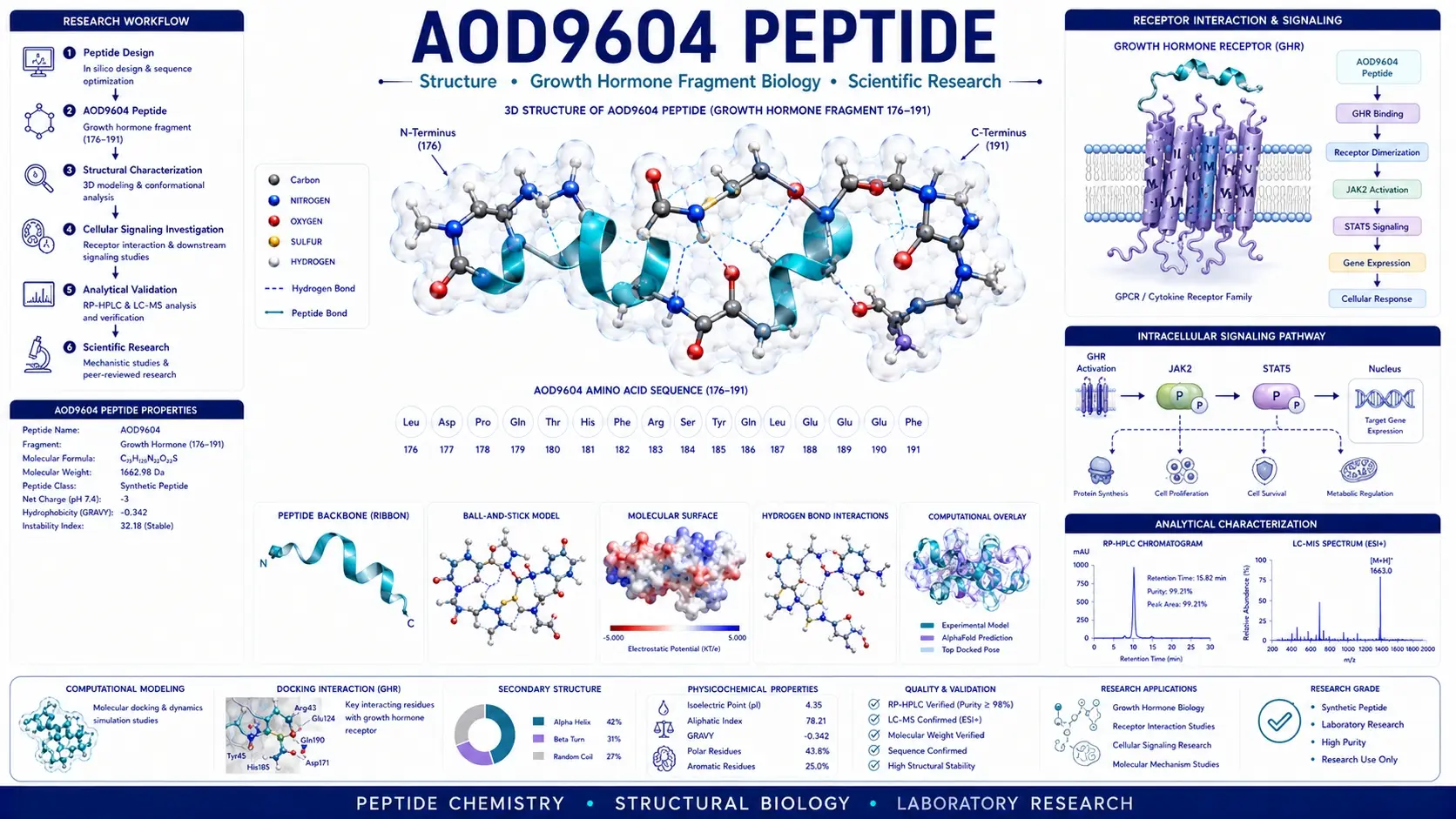
The AOD9604 peptide is a synthetic peptide corresponding to amino acids 176–191 of the human growth hormone (hGH) molecule. Researchers investigate this peptide because it represents a well-defined fragment of growth hormone that enables laboratory studies exploring peptide chemistry, molecular signaling, structural biology, and growth hormone fragment biology. Current scientific interest focuses on understanding its molecular properties, receptor interactions, analytical characterization, and experimental mechanisms rather than providing recommendations for human use.
AOD9604 Peptide Explained: Structure, Growth Hormone Fragment Biology & Current Scientific Research
Scientific Snapshot
| Scientific Name | AOD9604 |
| Peptide Class | Synthetic Growth Hormone Fragment Peptide |
| Parent Molecule | Human Growth Hormone Fragment (176–191) |
| Primary Research Areas | Peptide Chemistry, Molecular Biology, Growth Hormone Fragment Research & Structural Biology |
| Analytical Characterization | RP-HPLC, LC-MS & Peptide Sequencing |
| Research Status | Well-Characterized Experimental Peptide |
Quick Facts
| Peptide Type | Synthetic Peptide |
| Origin | Fragment of Human Growth Hormone (Residues 176–191) |
| Scientific Focus | Growth Hormone Fragment Biology |
| Primary Laboratory Techniques | SPPS, RP-HPLC, LC-MS |
| Research Importance | Model Peptide for Growth Hormone Fragment Research |
Key Takeaways
- ✓The AOD9604 peptide is a synthetic fragment corresponding to amino acids 176–191 of human growth hormone.
- ✓Researchers investigate peptide AOD9604 to better understand peptide chemistry, molecular signaling, and growth hormone fragment biology.
- ✓Current investigations combine structural biology, computational modeling, peptide engineering, and analytical chemistry to characterize AOD9604 peptides.
- ✓Analytical validation using RP-HPLC and LC-MS is fundamental for confirming peptide identity, purity, and stability before laboratory investigations.
- ✓Scientific discussions regarding AOD9604 are most appropriately interpreted within the context of peer-reviewed research and experimental laboratory investigations.
Table of Contents
Research Timeline
AOD9604 emerged from research investigating biologically active regions within the human growth hormone molecule. Scientists identified the C-terminal amino acid sequence spanning residues 176–191 as an important experimental fragment for studying peptide biology. Over time, advances in peptide synthesis, structural biology, computational modeling, and analytical chemistry have enabled increasingly detailed investigations into the molecular characteristics and experimental behavior of this synthetic peptide.
| Period | Scientific Milestone |
|---|---|
| 1990s | Identification of biologically active regions within human growth hormone. |
| 2000–2010 | Development and characterization of the AOD9604 peptide for laboratory investigation. |
| 2011–2020 | Expansion of peptide chemistry, analytical validation, and molecular biology studies. |
| 2021–2026 | Integration of AI-assisted molecular modeling, structural biology, and next-generation analytical techniques. |
Introduction
The AOD9604 peptide is among the most extensively investigated synthetic growth hormone fragments in peptide research. Derived from amino acids 176–191 of the human growth hormone molecule, it has attracted scientific attention because of its defined molecular structure and suitability for experimental investigations involving peptide chemistry, molecular biology, structural biology, and analytical science. Its relatively small size and well-characterized sequence make it an excellent model for studying peptide structure-function relationships and laboratory analytical methodologies.
Interest in aod9604 peptide, peptide aod9604, and aod9604 peptides has continued to increase as additional scientific literature has become available. Likewise, searches such as aod9604 peptide benefits, aod9604 peptide dosage, and aod9604 peptide side effects are frequently encountered online. Within this guide, these topics are discussed exclusively through the lens of peer-reviewed scientific literature and laboratory research, consistent with the research-focused editorial standards of Peptides Library.
This article examines the molecular structure of AOD9604, growth hormone fragment biology, current laboratory investigations, analytical characterization, peptide synthesis, and emerging scientific evidence while emphasizing rigorous experimental methodology, reproducibility, and evidence-based interpretation.
What Is the AOD9604 Peptide?
The AOD9604 peptide is a synthetic peptide corresponding to amino acid residues 176–191 of the human growth hormone (hGH) molecule. Rather than representing the complete growth hormone protein, AOD9604 consists of a carefully selected fragment that researchers investigate to better understand peptide structure, molecular signaling, and fragment-specific biological mechanisms. Its relatively short sequence makes it an excellent experimental model for peptide chemistry and structural biology.
Unlike full-length human growth hormone, peptide AOD9604 is investigated independently as a research peptide with distinct physicochemical characteristics. Scientists employ molecular biology, computational chemistry, peptide engineering, and analytical techniques to evaluate how this synthetic fragment behaves under controlled laboratory conditions.
Today, AOD9604 continues to support multidisciplinary investigations involving peptide synthesis, molecular pharmacology, structural biology, analytical chemistry, and computational modeling while contributing to broader scientific understanding of peptide fragment biology.
Molecular Structure of AOD9604
AOD9604 is classified as a synthetic linear peptide derived from the C-terminal region of human growth hormone. Its amino acid sequence encompasses residues 176–191, a region that has been extensively investigated because of its distinct molecular characteristics and suitability for experimental peptide research.
Researchers analyze the three-dimensional conformation of AOD9604 using molecular dynamics simulations, computational chemistry, nuclear magnetic resonance (NMR), and other structural biology techniques to better understand peptide flexibility, intermolecular interactions, and solution-phase behavior.
| Structural Feature | Description | Scientific Importance |
|---|---|---|
| Peptide Type | Synthetic linear peptide | Supports fragment-specific research |
| Parent Molecule | Human Growth Hormone | Growth hormone fragment investigations |
| Sequence Region | Residues 176–191 | Structure-function analysis |
| Research Classification | Experimental research peptide | Peptide chemistry and molecular biology |
Research Insight
AOD9604 Represents a Targeted Growth Hormone Fragment
Rather than synthesizing the complete growth hormone protein, researchers investigate AOD9604 because its smaller peptide sequence allows more focused studies of fragment-specific molecular behavior, structural characteristics, and peptide chemistry while simplifying analytical characterization.
Growth Hormone Fragment Biology
Growth hormone is a complex protein consisting of multiple functional regions that contribute to its biological activity. Researchers investigate individual peptide fragments to better understand how specific amino acid sequences influence molecular interactions, receptor recognition, and cellular signaling pathways. AOD9604 has become one of the most extensively characterized fragments within this research area.
Laboratory investigations focus on understanding how peptide fragments behave independently from the full-length hormone while evaluating structural stability, molecular interactions, and biochemical properties using reproducible experimental methodologies.
| Research Component | Scientific Focus | Experimental Application |
|---|---|---|
| Growth Hormone Fragment | Fragment biology | Mechanistic investigations |
| Peptide Structure | Conformational analysis | Structural biology |
| Cellular Signaling | Signal transduction research | Molecular biology |
| Analytical Chemistry | Purity and identity assessment | Quality validation |
Cellular Signaling Investigations
Modern research seeks to characterize how AOD9604 participates in molecular signaling networks using transcriptomics, proteomics, computational biology, peptide engineering, and systems biology. Scientists investigate peptide-cell interactions under carefully controlled laboratory conditions while integrating biochemical assays with computational prediction models.
Advanced analytical technologies allow researchers to correlate structural observations with molecular signaling data, providing increasingly detailed insight into peptide behavior while emphasizing reproducibility and rigorous experimental design.
Research Classification of AOD9604 Peptides
AOD9604 peptides are generally classified as synthetic research peptides used for experimental investigations involving peptide chemistry, molecular biology, structural biology, and analytical science. Their relatively simple structure, well-defined amino acid sequence, and compatibility with modern analytical techniques make them valuable tools for laboratory-based peptide research.
Researchers continue applying computational modeling, artificial intelligence, peptide engineering, and high-resolution analytical chemistry to expand scientific understanding of growth hormone fragments and peptide structure-function relationships.
Did You Know?
Small Peptide Fragments Often Reveal Important Biological Insights
Researchers frequently investigate specific regions of larger proteins because isolated peptide fragments can provide valuable information about molecular interactions, structural stability, and biochemical mechanisms that may be difficult to study within the complete protein.
Key Takeaway
The AOD9604 peptide is a well-characterized synthetic fragment of human growth hormone that continues to support laboratory investigations into peptide chemistry, molecular signaling, structural biology, and growth hormone fragment research. Its defined sequence and compatibility with modern analytical technologies make it an important model for multidisciplinary peptide science.
Understanding AOD9604 Peptide Benefits in Scientific Research
Online interest in aod9604 peptide benefits has increased alongside the growing body of scientific literature investigating synthetic growth hormone fragments. Within peer-reviewed publications, these “benefits” primarily describe the scientific value of AOD9604 as a research model for exploring peptide chemistry, molecular signaling, growth hormone fragment biology, and structure-function relationships rather than establishing generalized conclusions regarding biological outcomes.
Researchers continue investigating the AOD9604 peptide because its well-defined amino acid sequence provides an excellent experimental system for evaluating peptide stability, molecular interactions, computational modeling, analytical chemistry, and biochemical mechanisms under standardized laboratory conditions.
Consequently, references to aod9604 peptide benefits should be interpreted within the context of controlled laboratory investigations and evidence-based scientific research rather than recommendations for human use.
Growth Hormone Fragment Research
Growth hormone fragment research seeks to determine how individual peptide sequences contribute to the structural and functional properties of the complete growth hormone molecule. Because AOD9604 corresponds specifically to amino acid residues 176–191, researchers investigate this fragment independently to better understand fragment-specific molecular characteristics and peptide behavior.
Modern investigations combine peptide engineering, computational chemistry, transcriptomics, proteomics, molecular dynamics simulations, and structural biology to evaluate how synthetic peptide fragments interact with cellular systems and biochemical pathways.
| Research Area | Scientific Objective | Current Status |
|---|---|---|
| Fragment Biology | Investigate peptide sequence function | Active laboratory research |
| Structural Biology | Characterize peptide conformation | Rapidly advancing |
| Computational Modeling | Predict molecular interactions | Expanding research field |
| Analytical Chemistry | Evaluate peptide identity and purity | Standard laboratory practice |
Research Insight
AOD9604 Serves as a Valuable Model for Peptide Fragment Biology
Studying individual fragments of larger proteins allows researchers to isolate specific molecular characteristics that may be difficult to evaluate within the complete protein. AOD9604 provides an experimentally reproducible model for investigating peptide conformation, fragment stability, and molecular interactions.
Current Cellular and Molecular Research
Current investigations utilize transcriptomics, proteomics, metabolomics, computational biology, and advanced imaging techniques to characterize molecular responses associated with synthetic peptide fragments. Researchers combine experimental observations with computational simulations to improve mechanistic understanding while minimizing analytical uncertainty.
Artificial intelligence-assisted peptide modeling is increasingly incorporated into these investigations, enabling researchers to predict peptide conformations, estimate molecular stability, and prioritize experimental hypotheses before laboratory validation.
| Experimental Method | Primary Purpose | Research Application |
|---|---|---|
| Transcriptomics | Gene expression profiling | Cellular response studies |
| Proteomics | Protein interaction analysis | Molecular biology |
| Computational Modeling | Structural prediction | Peptide engineering |
| Mass Spectrometry | Peptide characterization | Analytical validation |
Addressing Common AOD9604 Research Questions
Searches for aod9604 peptide dosage and aod9604 peptide side effects are commonly associated with published experimental and clinical research involving this synthetic growth hormone fragment. Their presence in search results reflects interest in the scientific literature rather than recommendations for laboratory practice or human use.
Within Peptides Library, these topics are discussed exclusively from an educational and scientific perspective. This article does not provide dosage recommendations, preparation instructions, administration guidance, or medical advice. Instead, the emphasis remains on peptide chemistry, laboratory methodologies, analytical characterization, and peer-reviewed evidence.
Research Note: Scientific publications discussing dosage or safety observations should be interpreted within the design and objectives of individual research studies. Findings from experimental investigations should not be generalized beyond their original research context.
Why AOD9604 Continues to Attract Scientific Interest
AOD9604 remains an important experimental peptide because it combines a well-defined amino acid sequence with extensive scientific characterization. Researchers continue applying structural biology, computational chemistry, artificial intelligence, and analytical science to better understand peptide fragment behavior, molecular stability, and structure-function relationships.
As peptide engineering technologies continue to advance, AOD9604 is expected to remain an important reference molecule for investigating synthetic peptide fragments and improving experimental methodologies across peptide research laboratories.
Did You Know?
Protein Fragments Can Exhibit Distinct Molecular Properties
Many modern peptide discovery programs investigate individual protein fragments because specific amino acid regions may possess structural and biochemical characteristics that differ from those of the complete parent protein. This approach has become an important strategy in peptide engineering and molecular biology research.
Key Takeaway
Current investigations involving the AOD9604 peptide focus on growth hormone fragment biology, peptide chemistry, structural biology, and analytical science. Searches relating to aod9604 peptide benefits, aod9604 peptide dosage, and aod9604 peptide side effects are most appropriately interpreted within the context of peer-reviewed scientific literature and controlled laboratory investigations rather than instructional or therapeutic guidance.
Laboratory Synthesis of AOD9604 Peptide
The AOD9604 peptide is produced using solid-phase peptide synthesis (SPPS), the internationally recognized standard for manufacturing research peptides. This methodology enables sequential assembly of amino acids with precise control over peptide sequence, coupling efficiency, and final product quality. Because AOD9604 is a relatively short synthetic peptide, SPPS provides excellent reproducibility while minimizing sequence-related synthesis errors.
Following peptide assembly, the synthesized material undergoes cleavage from the solid support, deprotection, chromatographic purification, and comprehensive analytical characterization before being released for laboratory research. Automated peptide synthesizers, validated synthesis protocols, and standardized quality management systems help ensure consistent production across research laboratories.
The defined amino acid sequence of AOD9604 allows researchers to investigate peptide structure, molecular stability, and biochemical properties using reproducible analytical workflows and high-resolution instrumentation.
Typical Manufacturing Workflow
| Manufacturing Stage | Laboratory Process | Scientific Purpose |
|---|---|---|
| Solid-Phase Peptide Synthesis | Sequential amino acid coupling | Assemble peptide sequence |
| Resin Cleavage | Release peptide from solid support | Recover synthesized peptide |
| Chromatographic Purification | Reverse-phase chromatography | Remove synthesis impurities |
| Analytical Characterization | RP-HPLC, LC-MS & peptide sequencing | Verify identity and purity |
| Quality Documentation | Certificate of Analysis | Support research reproducibility |
Research Insight
Short Synthetic Peptides Enable Highly Reproducible Research
Because AOD9604 consists of only sixteen amino acids, researchers can synthesize, purify, and analytically characterize the peptide with exceptional precision. This reproducibility makes it a valuable reference molecule for peptide chemistry, analytical science, and growth hormone fragment research.
RP-HPLC Purity Analysis
Reverse-phase high-performance liquid chromatography (RP-HPLC) is routinely used to evaluate the chromatographic purity of AOD9604 following synthesis and purification. The technique separates peptide molecules according to hydrophobic interactions, enabling researchers to detect synthesis-related impurities, incomplete peptide fragments, oxidation products, or degradation species.
Chromatographic purity assessment is particularly important because even low levels of impurities may influence biochemical assays, molecular interaction studies, and structural investigations. Consequently, RP-HPLC remains one of the principal quality assurance techniques used throughout peptide research.
LC-MS Identity Confirmation
Liquid chromatography-mass spectrometry (LC-MS) provides molecular identity confirmation by measuring the mass-to-charge ratio of peptide ions. Whereas RP-HPLC evaluates chromatographic purity, LC-MS confirms that the synthesized peptide possesses the expected molecular weight and molecular composition.
Researchers frequently combine LC-MS with peptide sequencing and chromatographic analysis to establish comprehensive analytical profiles before initiating experimental studies involving AOD9604.
| Analytical Technique | Primary Function | Typical Laboratory Outcome |
|---|---|---|
| RP-HPLC | Chromatographic purity analysis | Purity profile |
| LC-MS | Molecular weight verification | Identity confirmation |
| Peptide Sequencing | Sequence verification | Structural validation |
| Certificate of Analysis | Analytical documentation | Quality assurance |
Peptide Stability Testing
Peptide stability testing determines how environmental conditions influence the molecular integrity of AOD9604 during storage and laboratory handling. Researchers evaluate variables including temperature, humidity, pH, light exposure, oxidation, and repeated freeze-thaw cycles while monitoring peptide integrity using validated analytical techniques.
Repeated chromatographic and mass spectrometric analyses help identify potential degradation products, ensuring that experimental observations accurately reflect the intended peptide rather than chemically altered forms.
Laboratory Quality Control
Reliable AOD9604 research depends upon comprehensive laboratory quality control procedures that minimize analytical variability and improve experimental reproducibility. Standard quality assurance programs typically include chromatographic purity testing, molecular identity verification, stability assessment, analytical documentation, and traceable quality records before research materials are introduced into laboratory workflows.
These standardized practices support reproducible peptide research while ensuring consistency across independent laboratories investigating growth hormone fragment biology and peptide chemistry.
Current Research Limitations
Although AOD9604 has been investigated for many years, researchers continue exploring its precise molecular interactions, fragment-specific mechanisms, and structural behavior using increasingly advanced laboratory technologies. Differences in experimental models, analytical methodologies, and study designs highlight the importance of standardized protocols and independent validation.
Emerging techniques including artificial intelligence-assisted peptide modeling, high-resolution structural biology, molecular dynamics simulations, and integrated multi-omics analyses are expected to further improve scientific understanding of AOD9604 and related growth hormone fragments.
Did You Know?
Analytical Verification Is Essential for Every Research Peptide
Regardless of peptide length or complexity, researchers routinely verify purity, molecular identity, sequence integrity, and stability before conducting experimental studies. These analytical procedures help ensure reproducibility and improve confidence in laboratory findings.
Key Takeaway
High-quality AOD9604 peptide research depends on standardized synthesis, comprehensive analytical characterization, and rigorous laboratory quality control. Solid-phase peptide synthesis, RP-HPLC, LC-MS, peptide sequencing, and stability testing collectively provide the analytical foundation required for reproducible investigations involving synthetic growth hormone fragments.
Current Scientific Consensus
The AOD9604 peptide is among the most extensively investigated synthetic growth hormone fragments in peptide research. Scientific evidence accumulated over more than two decades has established AOD9604 as a well-characterized research peptide whose molecular structure, physicochemical properties, and analytical profile are thoroughly documented. Contemporary research continues to investigate its biochemical mechanisms, peptide stability, molecular interactions, and fragment-specific biological behavior using increasingly sophisticated experimental methodologies.
Although substantial laboratory and translational research has been published, investigators continue examining unanswered questions surrounding receptor interactions, intracellular signaling pathways, peptide conformational dynamics, and structure-function relationships. Modern peptide science increasingly combines experimental validation with computational prediction to improve mechanistic understanding while strengthening reproducibility.
Emerging Research Directions
Advances in structural biology, computational chemistry, artificial intelligence, and multi-omics technologies are transforming the study of synthetic peptides such as AOD9604. High-resolution analytical tools now enable researchers to visualize peptide conformations, simulate molecular interactions, predict structural stability, and investigate peptide behavior with unprecedented precision.
Researchers increasingly integrate computational modeling with laboratory experimentation, allowing theoretical predictions to be evaluated through biochemical assays, chromatographic analysis, and molecular characterization. This multidisciplinary approach is helping refine scientific understanding of growth hormone fragments while improving the reproducibility of peptide research.
| Emerging Technology | Scientific Contribution |
|---|---|
| Artificial Intelligence | Predict peptide conformation and molecular interactions |
| Molecular Dynamics Simulation | Evaluate structural flexibility and stability |
| Cryo-Electron Microscopy | Support high-resolution structural investigations |
| Multi-Omics Analysis | Integrate genomic, proteomic, and metabolomic datasets |
| Computational Peptide Engineering | Guide rational peptide design and optimization |
Research Insight
Artificial Intelligence Is Transforming Peptide Discovery
Machine learning models are increasingly used to predict peptide folding, estimate molecular stability, identify structurally significant amino acid residues, and simulate peptide-protein interactions before laboratory validation. These computational approaches accelerate hypothesis generation while complementing traditional experimental methodologies.
Research Best Practices
Reliable peptide investigations require standardized laboratory procedures, validated analytical methodologies, and transparent scientific reporting. Researchers working with AOD9604 typically combine complementary analytical techniques to minimize experimental variability and improve reproducibility across independent laboratories.
- ✓Confirm peptide identity through LC-MS before initiating molecular or biochemical investigations.
- ✓Evaluate chromatographic purity using validated RP-HPLC analytical methods.
- ✓Monitor peptide stability throughout storage and experimental workflows using standardized protocols.
- ✓Integrate computational predictions with experimental validation to strengthen mechanistic conclusions.
- ✓Interpret findings within the context of peer-reviewed evidence while acknowledging methodological limitations and opportunities for future research.
Related Research Articles
Continue Exploring Peptide Science
Expand your understanding of peptide chemistry, analytical science, and growth hormone fragment biology through these related research guides from Peptides Library.
- → The Science Behind Research Peptides: A Mechanism Breakdown
- → AI Is Predicting Peptides That Don’t Exist Yet — A 2026 Research Overview
- → Research Peptide Stability Testing Explained
- → RP-HPLC vs LC-MS for Peptide Characterization
- → Computational Peptide Discovery and Machine Learning
- → Growth Hormone Fragments in Modern Peptide Research
- → Peptide Synthesis Protocols Explained
Did You Know?
Short Peptides Are Frequently Used as Structural Biology Models
Short synthetic peptides such as AOD9604 provide highly reproducible experimental systems for investigating peptide folding, conformational flexibility, molecular interactions, and analytical methodologies. Their defined sequences simplify computational modeling and laboratory validation compared with larger protein molecules.
Section Summary
Current scientific evidence supports the AOD9604 peptide as a thoroughly characterized synthetic growth hormone fragment that continues to advance peptide chemistry, structural biology, analytical science, and computational peptide research. Emerging technologies—including artificial intelligence, molecular dynamics simulations, cryo-electron microscopy, and integrated multi-omics—are expected to further improve understanding of peptide structure-function relationships while reinforcing the importance of rigorous analytical validation and reproducible laboratory methodologies.
Frequently Asked Questions
1. What is the AOD9604 peptide?
The AOD9604 peptide is a synthetic peptide corresponding to amino acid residues 176–191 of the human growth hormone (hGH) molecule. Researchers investigate this peptide to better understand growth hormone fragment biology, peptide chemistry, molecular signaling, and structure-function relationships under controlled laboratory conditions.
2. Is AOD9604 a complete growth hormone molecule?
No. AOD9604 represents only a small synthetic fragment of human growth hormone. It contains the amino acid sequence corresponding to residues 176–191 and is investigated independently as a research peptide.
3. What are AOD9604 peptide benefits in scientific research?
Searches for aod9604 peptide benefits generally refer to its value as a research model. Scientists study AOD9604 to investigate peptide chemistry, growth hormone fragment biology, structural biology, molecular interactions, and analytical methodologies. These discussions should be interpreted within the context of scientific research rather than generalized biological conclusions.
4. What makes peptide AOD9604 important for laboratory research?
Peptide AOD9604 possesses a well-defined amino acid sequence, reproducible synthetic chemistry, and excellent analytical characterization. These properties make it valuable for peptide engineering, molecular biology, structural investigations, and computational peptide research.
5. How is AOD9604 synthesized?
Research-grade AOD9604 is commonly produced using solid-phase peptide synthesis (SPPS). Following synthesis, purification, RP-HPLC analysis, LC-MS confirmation, peptide sequencing, and quality verification are performed before laboratory investigations begin.
6. How is the quality of AOD9604 verified?
Researchers evaluate peptide quality using reverse-phase high-performance liquid chromatography (RP-HPLC) to assess purity and liquid chromatography-mass spectrometry (LC-MS) to verify molecular identity. Additional analytical procedures may include peptide sequencing and stability testing.
7. Why is peptide stability testing important?
Peptide stability studies evaluate how environmental conditions influence molecular integrity over time. Researchers monitor potential degradation using chromatographic and mass spectrometric analyses to ensure experimental reproducibility and analytical reliability.
8. What does “AOD9604 peptide dosage” mean in scientific literature?
The phrase aod9604 peptide dosage frequently appears because AOD9604 has been investigated in published experimental and clinical research. Within Peptides Library, this topic is referenced solely to provide scientific context. This article does not provide dosage recommendations, preparation instructions, or guidance for human use.
9. Why do researchers discuss AOD9604 peptide side effects?
References to aod9604 peptide side effects originate from published scientific investigations and safety assessments. In this article, these discussions are presented only to explain the scope of peer-reviewed research and should not be interpreted as medical guidance or clinical recommendations.
10. How does artificial intelligence contribute to AOD9604 research?
Artificial intelligence supports peptide research by predicting three-dimensional structures, evaluating molecular stability, modeling peptide-protein interactions, and assisting researchers in prioritizing experimental hypotheses before laboratory validation.
11. Why are RP-HPLC and LC-MS routinely used for AOD9604?
RP-HPLC measures chromatographic purity, while LC-MS confirms molecular identity and molecular weight. Together, these complementary analytical techniques provide confidence that research materials meet laboratory quality standards before experimental studies begin.
12. What is the future of AOD9604 peptide research?
Future investigations are expected to integrate artificial intelligence, computational peptide engineering, molecular dynamics simulations, cryo-electron microscopy, and multi-omics technologies to further investigate growth hormone fragment biology and peptide structure-function relationships.
Scientific Resources & References
The following peer-reviewed publications and official scientific guidance documents provide authoritative information on AOD9604, growth hormone fragment biology, peptide chemistry, analytical characterization, and laboratory best practices.
Primary Research & Scientific Reviews
-
Ng FM, et al. Human Growth Hormone Fragment 176–191 and Its Biological Activity.
PubMed Search -
Heffernan M, et al. Development of AOD9604 as a Growth Hormone Fragment Peptide.
PubMed Search -
Merrifield RB. Solid Phase Peptide Synthesis. Journal of the American Chemical Society.
https://doi.org/10.1021/ja00897a025 -
Fields GB, Noble RL. Solid-Phase Peptide Synthesis Utilizing Fmoc Chemistry.
https://doi.org/10.1111/j.1399-3011.1990.tb01039.x -
Aebersold R, Mann M. Mass Spectrometry-Based Proteomics. Nature.
https://doi.org/10.1038/nature19949 -
Dominy BN, Brooks CL III. Development of Force Fields for Protein Simulations.
PubMed Search -
Jumper J, et al. Highly Accurate Protein Structure Prediction with AlphaFold. Nature.
https://doi.org/10.1038/s41586-021-03819-2 -
Senior AW, et al. Improved Protein Structure Prediction Using Potentials from Deep Learning. Nature.
https://doi.org/10.1038/s41586-019-1923-7 -
Callaway E. ‘It will change everything’: DeepMind’s AI makes gigantic leap in solving protein structures. Nature.
Nature Article
Official Scientific & Analytical Guidance
-
ICH Q2(R2). Validation of Analytical Procedures.
Official ICH Guideline -
FDA Guidance for Industry. Analytical Procedures and Methods Validation for Drugs and Biologics.
Official FDA Guidance -
United States Pharmacopeia (USP). General Chapters on Chromatography and Analytical Procedures.
https://www.usp.org/ -
European Medicines Agency (EMA). Guidelines for Quality of Biological Products.
https://www.ema.europa.eu/
Final Takeaway
AOD9604 Continues to Advance Growth Hormone Fragment Research
The AOD9604 peptide remains an important model for investigating growth hormone fragment biology, peptide chemistry, structural biology, and analytical science. Its well-defined amino acid sequence, extensive analytical characterization, and compatibility with modern computational approaches continue to support high-quality laboratory investigations. As artificial intelligence, molecular simulations, and advanced structural biology evolve, AOD9604 is expected to remain a valuable reference peptide for understanding fragment-specific molecular mechanisms and improving peptide engineering strategies.
Research Disclaimer
All content on Peptides Library is intended strictly for educational and scientific research purposes. References to aod9604 peptide, peptide aod9604, aod9604 peptide benefits, aod9604 peptide dosage, aod9604 peptide side effects, and aod9604 peptides are presented solely within the context of peer-reviewed scientific literature and laboratory research. This article does not provide medical advice, therapeutic recommendations, dosage instructions, or guidance for human consumption. Research findings should be interpreted in accordance with established scientific methodology, applicable regulatory guidance, and Good Laboratory Practices (GLP).