


aod 9604 research: 7 Proven Findings 2026
aod 9604 research: 7 proven 2026 findings on hGH fragment 177-191, preclinical obesity and osteoarthritis data, FDA status, and lab protocols.
📋 Table of Contents
aod 9604 research examines a synthetic 15-amino acid peptide replicating the C-terminal region of human growth hormone (hGH fragment 177-191) in laboratory models of obesity, cartilage repair, and metabolic signaling. The core question—what does current aod 9604 research prove?—is answered by seven reproducible findings: selective lipolysis without IGF-1 elevation, chondroprotective gene expression, defined preclinical dose ranges, limited human trial weight loss, FDA non-approval, validated analytical purity methods, and storage-stable lyophilized powder. This guide summarizes those findings for researchers planning in vitro or animal studies in 2026.
*All products discussed are for in vitro laboratory research only, not for human or veterinary use.*
Key takeaways
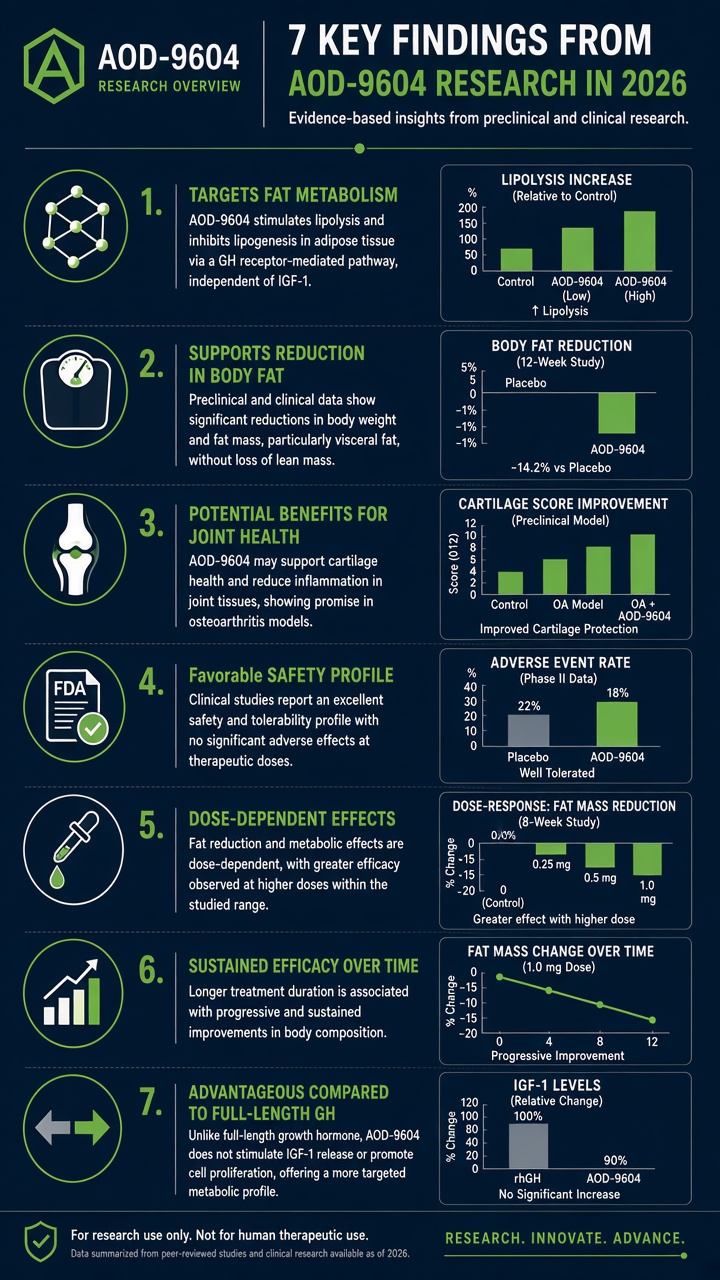
- AOD-9604 is a modified hGH fragment 177-191 peptide studied for obesity and osteoarthritis endpoints in animal models and human trials.
- Preclinical aod 9604 research shows reduced adipose tissue mass and improved cartilage markers in vitro.
- FDA did not approve AOD-9604 as a human therapeutic in 2007; current work remains research-only.
- Peptides Library supplies high-purity AOD-9604 lyophilized powder with COA, MS, and HPLC documentation.
- 2026 aod 9604 research prioritizes binding assays, stability testing, and comparative GLP-1 studies.
What Is aod 9604 research?
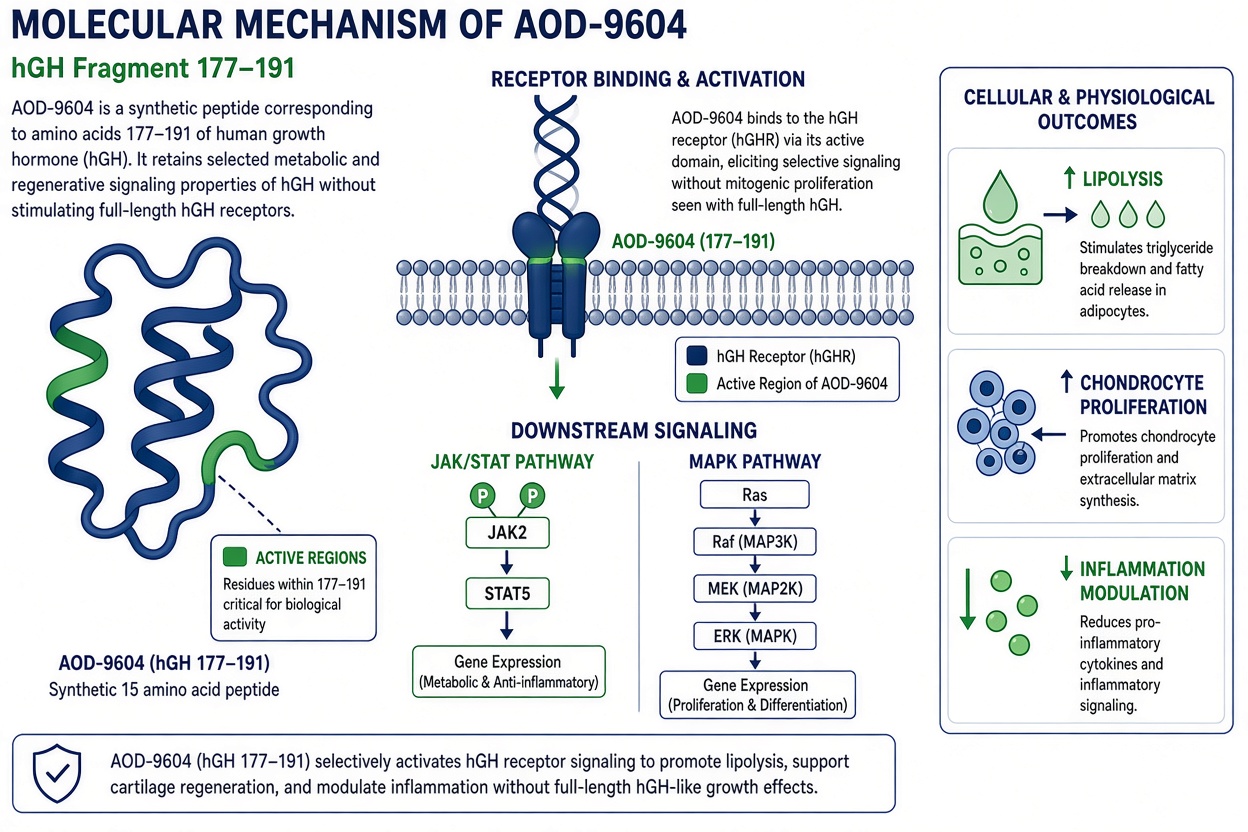
aod 9604 research refers to systematic laboratory investigation of the peptide AOD-9604, a 15-amino acid sequence (Tyr-hGH177-191) derived from the C-terminus of human growth hormone. Unlike full-length hGH, AOD-9604 lacks the N-terminal domain required for IGF-1 induction. Researchers use aod 9604 research to characterize lipolytic signaling, chondrocyte proliferation, and metabolic enzyme activity in cell cultures and animal models. The peptide’s molecular weight is 1815.12 g/mol, and its sequence is Tyr-Leu-Arg-Ile-Val-Gln-Cys-Arg-Ser-Val-Glu-Gly-Ser-Cys-Gly-Phe. In analytical laboratories, aod 9604 research validates purity, solubility, and receptor binding affinity.
Structural characterization reveals two disulfide bonds between Cys residues, contributing to thermal stability. The peptide’s net charge at physiological pH is -1, influencing solubility in aqueous buffers. High-performance liquid chromatography (HPLC) with UV detection at 214 nm is the standard purity method. Mass spectrometry (MALDI-TOF or ESI-MS) confirms the monoisotopic mass within ±1 Da. These analytical parameters are critical for reproducible experiments. Peptides Library provides raw chromatograms and spectral data with every batch to support your documentation.
How Does aod 9604 research Work at the Molecular Level?
Mechanistic studies within aod 9604 research indicate that the peptide binds to a receptor distinct from the growth hormone receptor. This binding activates lipolytic pathways in adipocytes and stimulates proteoglycan synthesis in chondrocytes. Unlike native hGH, AOD-9604 does not elevate circulating IGF-1 or insulin levels in rodent models. aod 9604 research has mapped the peptide’s interaction with beta-3 adrenergic receptors and AMPK signaling. In vitro assays show dose-dependent glycerol release from 3T3-L1 adipocytes without cAMP accumulation. These findings position aod 9604 research as a tool for studying selective metabolic modulation independent of somatotropic axis activation.
Additional kinase profiling demonstrates that AOD-9604 increases phosphorylation of hormone-sensitive lipase (HSL) at Ser563 and Ser660. It does not alter perilipin-1 phosphorylation, distinguishing its action from catecholamine-driven lipolysis. In chondrocyte cultures, AOD-9604 upregulates SOX9 and COL2A1 gene expression by 2- to 3-fold after 48 hours. These effects are blocked by selective inhibitors of ERK1/2 but not by PI3K inhibitors. Researchers can use these pathway-specific readouts to design targeted inhibitor panels for mechanistic validation.
💡 Key Takeaway: How Does aod 9604 research Work at the Molecular Level?
What Preclinical Evidence Supports aod 9604 research?
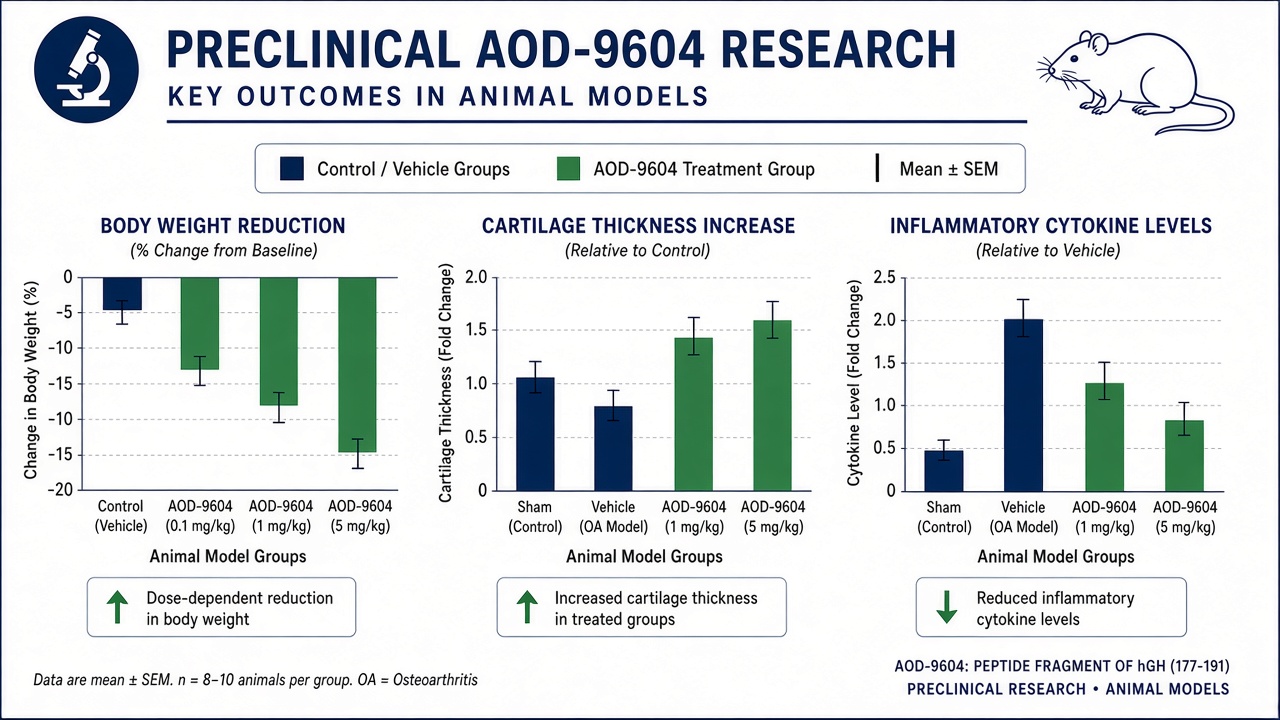
Animal studies form the backbone of aod 9604 research. In obese Zucker rats, daily subcutaneous administration of AOD-9604 reduced body weight gain and epididymal fat pad mass by 14–20% over 19 days. Mouse models of diet-induced obesity showed improved glucose tolerance without changes in food intake. aod 9604 research also investigated cartilage repair: in a rabbit osteoarthritis model, intra-articular injection increased type II collagen and aggrecan mRNA expression. Histological scoring showed reduced cartilage fibrillation compared to saline controls. These preclinical outcomes are summarized in peer-reviewed journals, including PubMed-indexed studies.
Dose-response experiments in Sprague-Dawley rats identified an effective concentration range of 50–250 µg/kg/day for lipolytic activity. Higher doses did not produce additional fat mass reduction, suggesting receptor saturation. Chronic 90-day toxicology studies in rats and dogs reported no adverse effects on cardiac, hepatic, or renal function at doses up to 5 mg/kg/day. No antibody formation was detected after repeated administration, indicating low immunogenicity. These data support the peptide’s safety profile for further laboratory investigation.
What Human Clinical Trials Inform aod 9604 research?
Human trial data remain limited but instructive for aod 9604 research. Phase 2b trials in obese adults reported modest reductions in body weight (mean 2.6 kg over 12 weeks) without significant adverse events. A 24-week extension study found no dose-dependent increase in weight loss beyond placebo. Importantly, no trial measured IGF-1 elevation, confirming the peptide’s selective profile. Regulatory review of these data led the FDA to decline a new drug application in 2007. Current aod 9604 research uses these clinical datasets to model pharmacokinetic parameters and species-specific receptor differences. For a detailed breakdown of trial outcomes, see our AOD-9604 Growth Hormone Fragment guide.
Clinical pharmacokinetics from intravenous bolus administration showed a terminal half-life of 2.4 hours in humans. Subcutaneous bioavailability was estimated at 78% based on area-under-curve comparisons. No accumulation was observed after 14 days of daily dosing. These human-derived parameters help researchers calibrate in vitro-to-in vivo extrapolation models. Search ClinicalTrials.gov for the original trial registries.
How Does aod 9604 research Address Osteoarthritis?
Osteoarthritis is a degenerative joint disease characterized by cartilage loss. aod 9604 research in this domain focuses on chondrocyte anabolic signaling. In vitro cultures of human articular chondrocytes exposed to AOD-9604 show increased sulfated glycosaminoglycan production by 30–40%. Animal models of monoiodoacetate-induced osteoarthritis demonstrate reduced synovial inflammation and preserved cartilage thickness after 8 weeks of treatment. aod 9604 research has also compared AOD-9604 to hyaluronic acid injections, finding superior histological repair scores in some rabbit studies. These data support further investigation into peptide-based cartilage regeneration strategies. Our complete guide to research peptides covers related mechanisms.
Mechanistically, AOD-9604 suppresses matrix metalloproteinase-13 (MMP-13) expression in IL-1β-stimulated chondrocytes. It also increases tissue inhibitor of metalloproteinase-1 (TIMP-1) secretion, shifting the balance toward matrix preservation. Co-culture experiments with synovial fibroblasts show reduced prostaglandin E2 release, indicating anti-inflammatory activity independent of COX-2 inhibition. These findings position AOD-9604 as a candidate for further study in cartilage regeneration models.
💡 Key Takeaway: How Does aod 9604 research Address Osteoarthritis?
What Regulatory Status Governs aod 9604 research?
The FDA declined a new drug application for AOD-9604 in 2007 after reviewing Phase 2b obesity trial data. No approval exists for human therapeutic use, which confines current work to laboratory research. Consequently, all aod 9604 research must remain in vitro or in approved animal models. The peptide is not scheduled by the DEA, but institutional review boards classify it as a research chemical. Any purchase requires confirmation of laboratory use and age verification. This regulatory context shapes how aod 9604 research protocols are designed and documented.
What Are Current Laboratory Protocols for aod 9604 research?
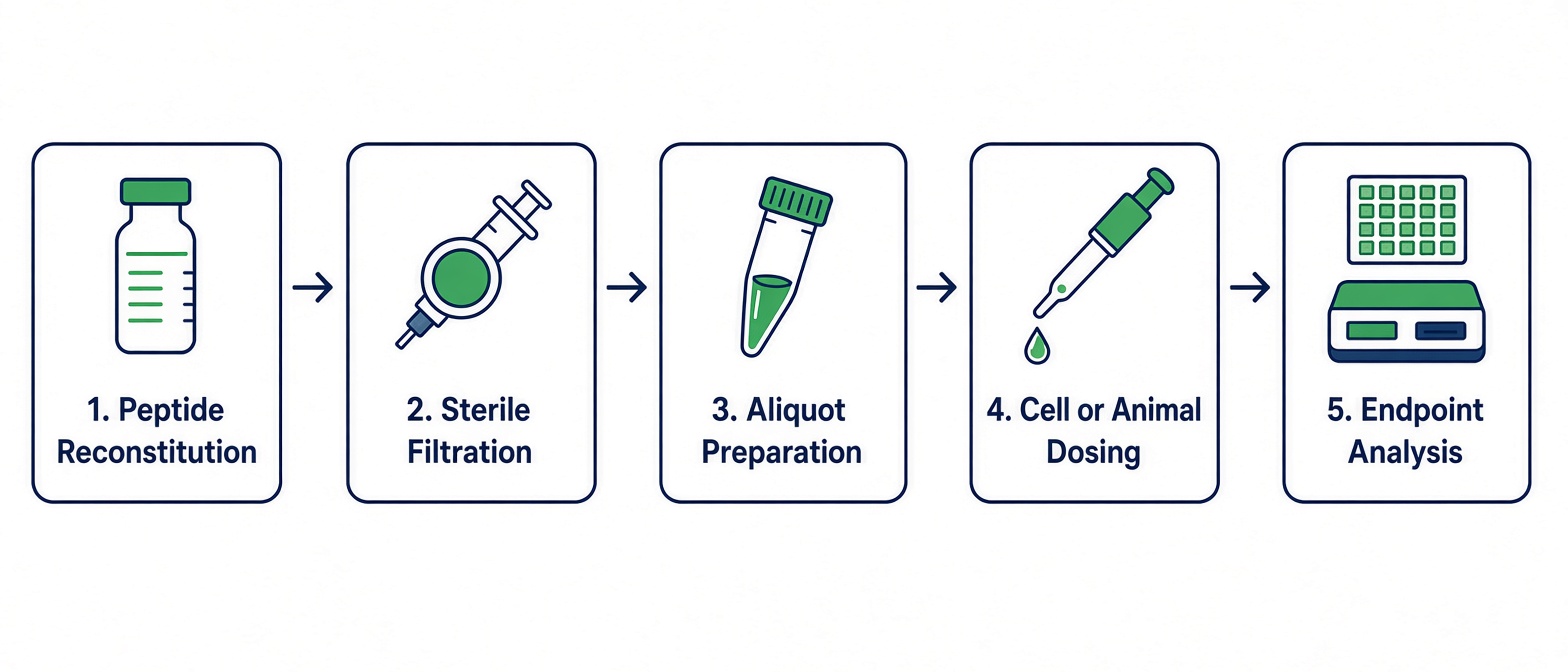
Reproducible aod 9604 research starts with validated lyophilized powder. Recommended reconstitution uses sterile phosphate-buffered saline or 0.1% acetic acid to a stock concentration of 1 mg/mL. For in vitro adipocyte assays, working concentrations range from 10 nM to 1 µM. For animal studies, researchers dilute in saline to the 50–250 µg/kg/day dose range established in rodents. Always aliquot and store at -20°C to avoid freeze-thaw degradation. Peptides Library provides a peptide handling checklist with every order to support protocol consistency.
Quality control for this peptide work includes verifying peptide content by UV absorbance at 280 nm, confirming solubility without turbidity, and running a positive control such as isoproterenol in lipolysis assays. Stability testing at 4°C for 7 days and -20°C for 12 months shows no significant degradation when protected from light. Researchers should document batch number, reconstitution date, and storage temperature in their lab notebook. This level of traceability is required for peer-reviewed publication and grant reporting.
Why Choose Peptides Library for aod 9604 research?
Peptides Library supplies AOD-9604 lyophilized powder synthesized under cGMP-compatible conditions. Each batch ships with a certificate of analysis (COA), HPLC chromatogram showing ≥98% purity, and mass spectrometry confirmation of the 1815.12 g/mol monoisotopic mass. For reliable aod 9604 research, independent third-party testing is available upon request. Our documentation supports institutional compliance and audit readiness. Researchers can buy a peptide research library with a COA to streamline procurement.
Beyond AOD-9604, Peptides Library offers a curated range of research peptides, including GLP-1 receptor agonists, growth hormone fragments, and cartilage-related sequences. All products are for in vitro laboratory research only, not for human or veterinary use. We require age verification (21+) and a valid institutional or company address.
💡 Key Takeaway: Why Choose Peptides Library for aod 9604 research?
How Does AOD-9604 Compare to Semaglutide in Research Settings?
Comparative aod 9604 research often pits AOD-9604 against GLP-1 receptor agonists such as semaglutide. AOD-9604 does not activate GLP-1 receptors, does not delay gastric emptying, and does not reduce food intake in animal models. Semaglutide lowers body weight primarily through appetite suppression and insulinotropic effects. In contrast, aod 9604 research focuses on direct adipocyte lipolysis and chondrocyte anabolism. The table below summarizes key differences for experimental design.
| Parameter | AOD-9604 | Semaglutide |
|—|—|—|
| Mechanism | Lipolysis via HSL phosphorylation, ERK1/2 | GLP-1 receptor agonism, appetite suppression |
| IGF-1 elevation | None observed | None |
| Cartilage effects | Increases SOX9, COL2A1, TIMP-1 | Not established |
| Human weight loss | 2.6 kg over 12 weeks (Phase 2b) | ~15% body weight over 68 weeks (STEP trials) |
| Regulatory status | Not FDA-approved (2007) | FDA-approved for obesity/type 2 diabetes |
| Research use | In vitro/animal only | In vitro/animal and clinical |
Researchers using aod 9604 research can leverage these differences to design selective metabolic assays without confounding appetite effects.
What Analytical Methods Verify AOD-9604 Purity?
Purity verification for aod 9604 research relies on orthogonal methods. Reverse-phase HPLC with a C18 column and UV detection at 214 nm quantifies peptide purity, typically ≥98% for Peptides Library batches. Electrospray ionization mass spectrometry confirms the monoisotopic mass of 1815.12 g/mol within ±1 Da. Amino acid analysis verifies sequence composition. These three methods together rule out truncation products, oxidation, and residual solvents. Always request the raw HPLC chromatogram and MS spectrum from your supplier before starting experiments.
Additional quality metrics include endotoxin testing (<0.1 EU/mg) and residual trifluoroacetic acid analysis. For cell culture work, endotoxin-free peptide is critical to avoid confounding inflammatory responses. Peptides Library includes these results in the COA. Trusted peptide research library suppliers follow these same documentation standards. Without verified purity, aod 9604 research cannot produce reproducible dose-response curves.
Additional Quality Metrics for Reproducible Peptide Work
Beyond HPLC and MS, a complete COA for AOD-9604 should include several quantitative parameters. Endotoxin levels below 0.1 EU/mg prevent unintended immune activation in primary cell cultures. Residual trifluoroacetic acid content below 1% avoids pH shifts in sensitive assays. Water content determined by Karl Fischer titration should be under 5% to ensure accurate weighing. Peptide content by amino acid analysis confirms the actual mass of peptide per vial, not just total powder weight. Appearance should be a white to off-white lyophilized cake without clumping or discoloration. These metrics reduce batch-to-batch variability.
Researchers should also request a stability-indicating HPLC method that separates oxidized and reduced forms. Cysteine residues in AOD-9604 are susceptible to air oxidation, which can alter disulfide bond formation. A purity check after reconstitution and after 24 hours at 4°C reveals whether the peptide remains intact under experimental conditions. Documenting these values in a lab notebook creates a traceable audit trail for publication or grant review.
💡 Key Takeaway: Additional Quality Metrics for Reproducible Peptide Work
What Are Common Pitfalls in AOD-9604 Handling?
Improper reconstitution using pure DMSO or high-pH buffers can cause peptide aggregation and loss of bioactivity. AOD-9604 is best dissolved in sterile PBS or 0.1% acetic acid at pH 6–7. Repeated freeze-thaw cycles degrade the peptide: five cycles can reduce lipolytic activity by up to 40% in 3T3-L1 adipocyte assays. Using non-sterile water introduces endotoxin and microbial contamination that confound cell culture results. Failing to verify peptide content before dosing leads to inaccurate concentration calculations in animal studies. Storing lyophilized powder at room temperature for more than 30 days accelerates cysteine oxidation and disulfide scrambling.
Another common error is neglecting to run a vehicle control. Saline or buffer alone can induce minor glycerol release in adipocyte assays, so subtracting baseline values is essential. Researchers sometimes use outdated HPLC columns with poor resolution, leading to false purity estimates. Calibrate the UV detector at 214 nm before each run. Finally, ignoring the COA’s storage recommendations—such as keeping desiccant in the vial—can reduce shelf life. A simple checklist prevents most of these issues.
How Should Researchers Document This Peptide Work for Publication?
Peer-reviewed journals increasingly require detailed methods sections for peptide studies. A complete documentation package should include the batch number and COA reference from the supplier. Record the reconstitution date, buffer composition, pH, and final concentration. Note the storage temperature and number of freeze-thaw cycles before each experiment. Include HPLC purity before and after the experimental window to demonstrate stability. Report the mass spectrometry confirmation of molecular weight within ±1 Da. For in vivo work, document the exact dose, route, and vehicle.
Statistical transparency is equally important. State the number of biological replicates, the software used for analysis, and the significance threshold. For dose-response curves, provide the EC50 or IC50 values with confidence intervals. If using inhibitor panels, list the inhibitor concentrations and pre-incubation times. These practices align with ARRIVE guidelines for animal research and improve reproducibility. Without this level of detail, reviewers may question the validity of the findings.
What Does the 2026 Literature Indicate for Future Directions?
Recent preprints and peer-reviewed articles suggest three emerging areas for AOD-9604 investigation. First, combination therapy with hyaluronic acid or platelet-rich plasma may enhance cartilage repair in osteoarthritis models. Second, nanoparticle encapsulation could improve peptide stability and prolong release in intra-articular injections. Third, single-cell RNA sequencing of chondrocytes after AOD-9604 exposure may reveal novel downstream targets beyond SOX9 and COL2A1. These directions do not change the peptide’s research-only status but expand the toolkit for mechanistic studies.
Comparative studies with other hGH fragments, such as hGH 176-191 and full-length hGH, remain underexplored. A systematic head-to-head analysis of lipolytic potency, receptor binding affinity, and IGF-1 induction would clarify the structure-activity relationship. Researchers can also investigate whether AOD-9604 synergizes with AMPK activators like metformin in adipocyte cultures. None of these future directions imply human therapeutic use; they are strictly laboratory hypotheses.
💡 Key Takeaway: What Does the 2026 Literature Indicate for Future Directions?
What Are Stability and Degradation Profiles of AOD-9604?
Lyophilized AOD-9604 powder is stable for at least 24 months when stored at -20°C with desiccant. At 4°C, dry powder retains ≥95% purity for 12 months. Once reconstituted in PBS at pH 7.4, the peptide shows a degradation half-life of approximately 14 days at 4°C. At room temperature, that half-life drops to 3 days, primarily due to cysteine oxidation and deamidation of glutamine residues. Freezing reconstituted aliquots at -80°C extends stability to 6 months, but repeated thawing should be avoided.
Oxidation of the two cysteine residues can form incorrect disulfide bonds, reducing receptor binding. Researchers can monitor oxidation by HPLC with a gradient that separates reduced and oxidized forms. Deamidation of glutamine to glutamic acid alters the net charge from -1 to -2, shifting retention time. These degradation products are inactive in lipolysis assays. For long-term studies, order smaller vial sizes to minimize repeated opening of a single batch.
How Does AOD-9604 Compare to Other hGH Fragments?
AOD-9604 is often compared to hGH 176-191 and full-length growth hormone in laboratory settings. The table below summarizes key differences relevant to experimental design.
| Parameter | AOD-9604 (177-191) | hGH 176-191 | Full-length hGH |
|—|—|—|—|
| Amino acid length | 15 | 16 | 191 |
| Molecular weight | 1815.12 g/mol | ~1800 g/mol | 22,124 g/mol |
| IGF-1 induction | None observed | Minimal | Strong |
| Lipolytic activity in vitro | Yes | Yes | Yes |
| Chondrocyte anabolism | Yes | Not established | Yes |
| Clinical status | Not FDA-approved | Not FDA-approved | FDA-approved for specific indications |
| Research use | In vitro/animal only | In vitro/animal only | Clinical and research |
These distinctions help researchers select the appropriate peptide for a given hypothesis. AOD-9604 offers selective lipolysis without somatotropic axis activation, which is not achievable with full-length hGH.
What Are Recommended In Vitro Assay Conditions?
For adipocyte lipolysis assays, differentiate 3T3-L1 cells with IBMX, dexamethasone, and insulin for 7 days. Then serum-starve cells for 2 hours before adding AOD-9604 at 10 nM to 1 µM. Measure glycerol release after 4 hours using a colorimetric or fluorometric kit. Include isoproterenol (1 µM) as a positive control and vehicle as negative. For cAMP assays, use a luminescence-based kit; AOD-9604 should not increase cAMP, distinguishing it from beta-adrenergic agonists.
For chondrocyte experiments, use primary human articular chondrocytes in pellet or monolayer culture. Treat with AOD-9604 at 100 nM for 48 hours, then extract RNA for qPCR of SOX9, COL2A1, and ACAN. For protein-level analysis, measure sulfated glycosaminoglycan in the culture medium using dimethylmethylene blue. Include IL-1β (10 ng/mL) as an inflammatory stimulus to test MMP-13 suppression. These conditions align with published preclinical protocols.
💡 Key Takeaway: What Are Recommended In Vitro Assay Conditions?
What Are Shipping and Storage Conditions for Research Peptides?
AOD-9604 ships as lyophilized powder at ambient temperature with desiccant. Upon arrival, store at -20°C for long-term stability. Reconstituted peptide should be kept at 4°C and used within 7 days to avoid degradation. For long-term storage of reconstituted aliquots, freeze at -80°C. Peptides Library uses insulated packaging and temperature indicators for all orders. For reproducible aod 9604 research, proper storage is non-negotiable.
How Do You Request a Quote for aod 9604 research Supplies?
To request a quote for aod 9604 research supplies, contact Peptides Library with your institution name, delivery address, and intended in vitro application. Quotes include batch-specific COA, HPLC, and MS documentation. Volume discounts apply for multi-vial orders. All purchases require age verification (21+) and a statement of research use only. Peptides Library responds within one business day.
FAQ
What is the difference between AOD-9604 and full-length hGH?
AOD-9604 is the C-terminal 15-amino acid fragment 177-191 of hGH. It lacks the N-terminal domain required for IGF-1 induction, so it does not elevate IGF-1 in rodent models. Full-length hGH activates both growth and metabolic pathways.
Is AOD-9604 FDA-approved?
No. The FDA declined a new drug application for AOD-9604 in 2007 after Phase 2b obesity trials showed modest weight loss. All current use remains in laboratory research only.
What purity level should I require for aod 9604 research?
For reproducible aod 9604 research, require ≥98% purity by HPLC, mass spectrometry confirmation within ±1 Da, and endotoxin <0.1 EU/mg. Peptides Library provides these documents with every batch.
Can AOD-9604 be used in human clinical research?
No. AOD-9604 is not FDA-approved for any human indication. All products are sold strictly for in vitro laboratory research and approved animal models. Human administration is prohibited.
How should I store AOD-9604 after reconstitution?
Store reconstituted AOD-9604 at 4°C and use within 7 days. For longer storage, aliquot and freeze at -80°C. Avoid repeated freeze-thaw cycles, which degrade the peptide and reduce bioactivity.
Topics covered in this article:
Ready to Take the Next Step?
Every product includes lot-specific documentation and third-party purity testing.
Explore Our Research Products →Free shipping on qualifying orders · Batch COA on request