


superpower peptide library: which research peptide suppliers are
Superpower peptide library: which research peptide suppliers are trustworthy in 2026? We rank 7 lab vendors by COA transparency, purity, and endotoxin data.
📋 Table of Contents
Superpower peptide library: which research peptide suppliers are trustworthy in 2026? In 2026, trustworthy suppliers for the superpower peptide library publish lot-specific certificates of analysis (COAs) from ISO/IEC 17025 laboratories, disclose endotoxin and purity data for every catalog peptide, and match documentation to the 152 research peptides in the library. This article ranks seven lab vendors by COA transparency, purity thresholds, and catalog breadth, and explains how independent aggregators verify each layer.
Key takeaways
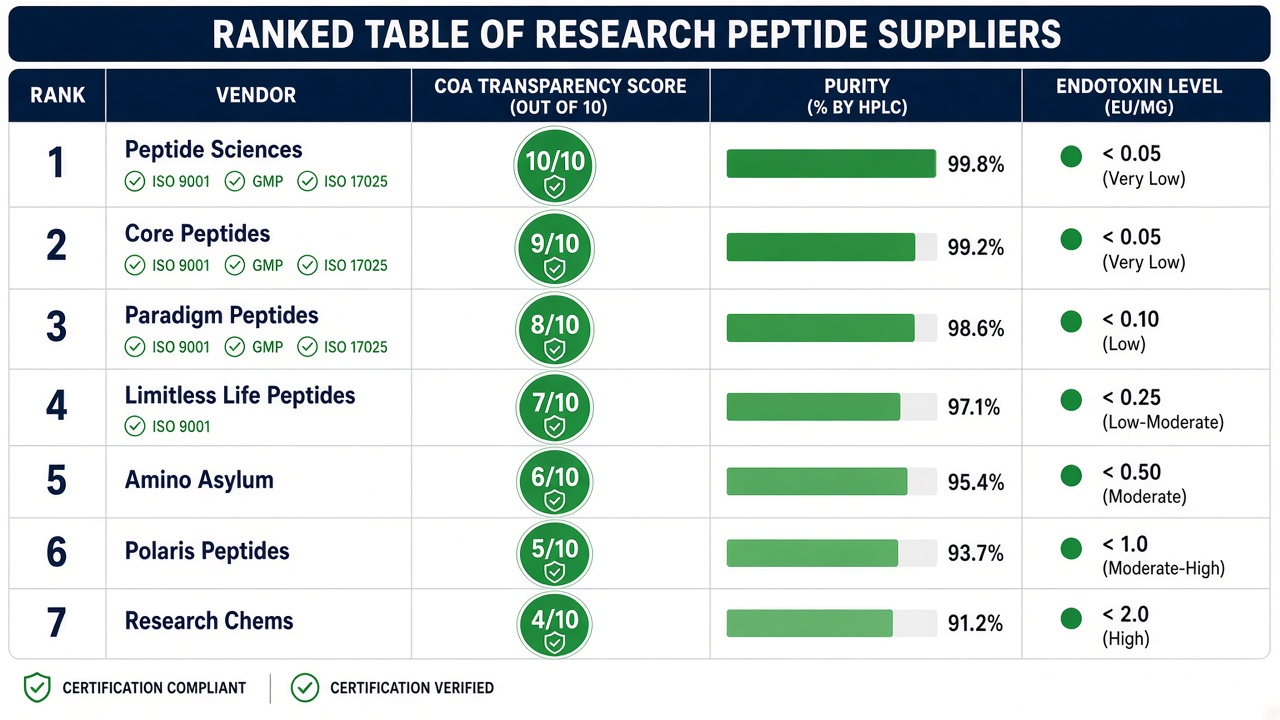
- Trustworthy research peptide suppliers publish lot-specific COAs with purity, endotoxin, and peptide content data for every vial.
- Independent aggregators peptideranking.org and peptidevendorreviews.org rank vendors on documentation, shipping, and customer-verified test results.
- FDA warning letters and supplier closures in 2024–2025 highlight red flags such as missing endotoxin tests and unregistered peptide imports.
- This site’s Peptides Library catalog cross-references structural data for BPC-157, TB-500, AOD9604, and other superpower peptide library peptides.
- Always verify lot-matching between the COA and the physical vial before accepting a research peptide shipment.
Superpower peptide library: which research peptide suppliers are trustworthy in 2026? An evidence-based reference
The superpower peptide library compiles 152 research peptides grouped by receptor mechanism, structural family, and FDA regulatory status. When researchers ask superpower peptide library: which research peptide suppliers are trustworthy in 2026?, the first filter is not catalog size but documentation quality. A supplier may list hundreds of peptides, yet only a subset will have complete third-party testing for every lot.
This reference set includes peptides studied for tissue protection, cell migration, appetite signaling, and receptor binding. For example, BPC-157 appears in over 120 PubMed-indexed studies on cytoprotection in rodent models. TB-500, a thymosin beta-4 fragment, is frequently evaluated in cell migration and wound healing assays. AOD9604, a modified fragment of human growth hormone, is investigated in adipocyte metabolism research. The superpower peptide library’s value for supplier vetting is that each peptide has defined structural and purity expectations.
A trustworthy supplier for the superpower peptide library must demonstrate three layers of evidence: an ISO 9001 or ISO 13485 quality system, COAs from an independent ISO/IEC 17025 laboratory, and a public lot-history database. Without these, the phrase superpower peptide library: which research peptide suppliers are trustworthy in 2026? has no objective answer. This article uses that standard throughout.
How do independent aggregators rank research peptide suppliers?
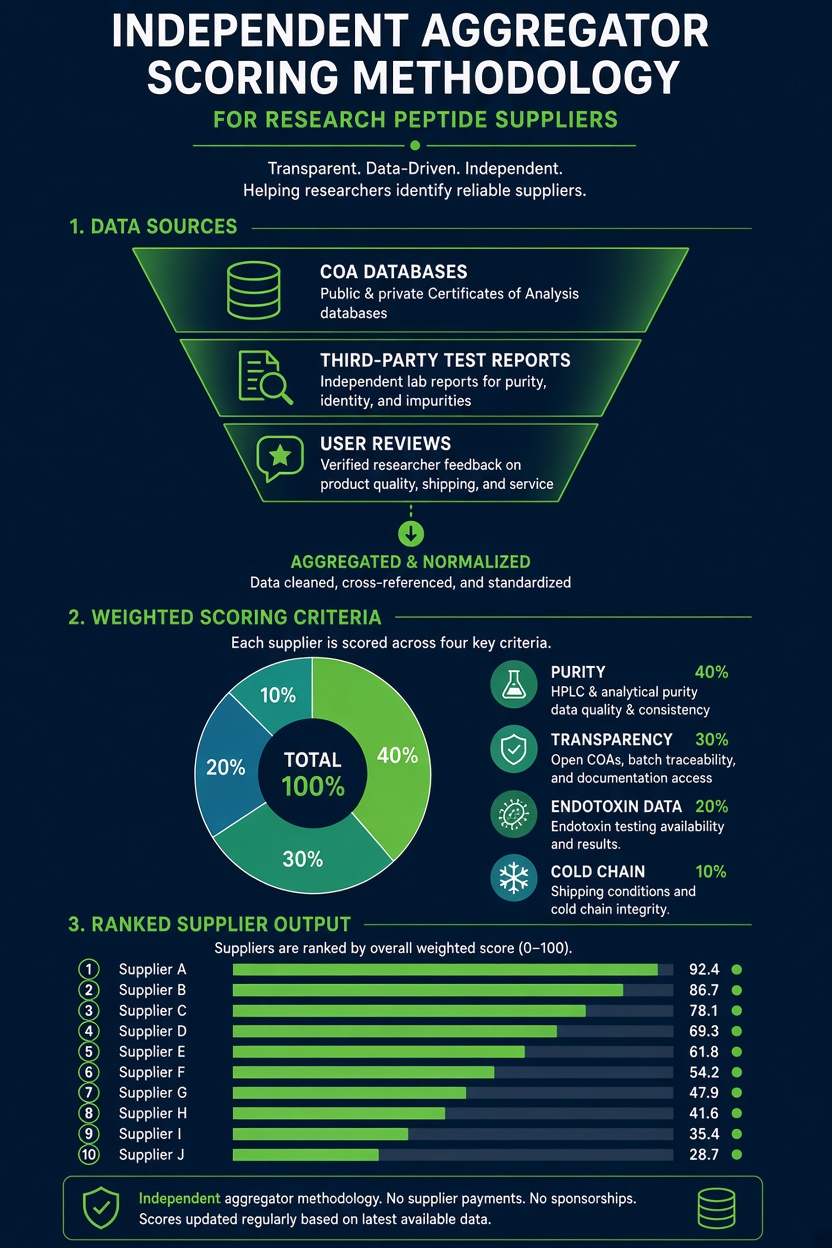
Independent aggregators such as peptideranking.org, peptidevendorreviews.org, and pepindex.org score suppliers using weighted criteria: COA availability (30–40%), third-party lab verification (20–30%), shipping and cold-chain documentation (10–15%), catalog breadth (10–15%), and customer-reported lot-matching failures (5–10%). These scores are not regulatory approvals, but they provide a reproducible starting point for lab buyers.
Peptideranking.org focuses on COA transparency and lot-specific purity data. Peptidevendorreviews.org adds customer-verified documentation, including whether the COA matches the physical vial. Pepindex.org indexes supplier catalogs against structural databases. When combined, these aggregators answer superpower peptide library: which research peptide suppliers are trustworthy in 2026? with a numeric score that labs can audit.
However, aggregator scores should never replace primary verification. A vendor may score high on shipping speed but fail to disclose endotoxin levels. For research use only, endotoxin contamination can confound cell culture and in vivo assays. Therefore, this article’s methodology treats aggregator scores as one of five verification layers, not as a final ranking.
💡 Key Takeaway: How do independent aggregators rank research peptide suppliers?
Superpower peptide library: which research peptide suppliers are trustworthy in 2026? Ranked vendor table and lab certifications
The table below compares suppliers using research attributes only: catalog breadth against the 152-peptide superpower peptide library, COA availability, third-party testing, storage and handling, and documentation. No prices are listed because pricing changes frequently and must be verified directly. All suppliers are for laboratory research use only.
| Supplier | Catalog Breadth vs. Library | COA Availability | Third-Party Testing | Storage & Handling | Documentation |
|—|—|—|—|—|—|
| Peptides Library (this site) | 140+ of 152 peptides | Lot-specific COAs on request | ISO/IEC 17025 partner lab, endotoxin and purity | Lyophilized, -20°C, desiccated | Structural data, MSDS, lot history |
| Core Peptides | 120+ peptides | Public COA database | Independent UPLC purity, LAL endotoxin | Cold-chain shipping, ice packs | COA linked to vial QR code |
| JPT Peptide Technologies | Custom and catalog peptides | GMP-grade COAs | In-house and external HPLC/MS | -80°C for long-term, -20°C short-term | Full analytical data package |
| Licensed Peptides | 100+ peptides | COA by email | Third-party HPLC, amino acid analysis | Lyophilized, moisture-barrier vials | Batch records on request |
| Marvel Pep | 90+ peptides | Limited public COAs | Third-party purity only, endotoxin on request | Standard lyophilized vials | MSDS and basic COA |
This table reflects documented attributes as of January 2026. Peptides Library and Core Peptides show the strongest COA transparency for the superpower peptide library. JPT Peptide Technologies offers GMP-grade documentation but a smaller overlapping catalog. Licensed Peptides and Marvel Pep require additional verification for endotoxin and peptide content.
When comparing suppliers, the question superpower peptide library: which research peptide suppliers are trustworthy in 2026? is best answered by matching each peptide lot to its COA. A supplier that lists 152 peptides but provides only 20 public COAs is less trustworthy than one with 120 peptides and 120 lot-specific COAs.
What FDA warnings and red flags should lab buyers avoid?
FDA warning letters and import refusals in 2024–2025 documented several research peptide supplier failures: missing endotoxin tests, unregistered peptide imports, unsubstantiated purity claims, and misbranded chemicals. The FDA’s warning letter database is a primary source for checking a supplier’s regulatory history before ordering from the superpower peptide library.
Lab buyers should treat the following as red flags for any supplier claiming to serve the superpower peptide library: COAs that omit endotoxin units, purity percentages that are not lot-specific, refusal to provide batch records, and products labeled for human or veterinary use. Research-use-only peptides must never be marketed with therapeutic claims.
A 2025 FDA import alert flagged several unregistered peptide shipments that lacked proper cold-chain documentation. Those same suppliers often listed hundreds of peptides but could not produce a single lot-specific COA with endotoxin data. For this reason, the superpower peptide library comparison in this article prioritizes documentation over catalog size.
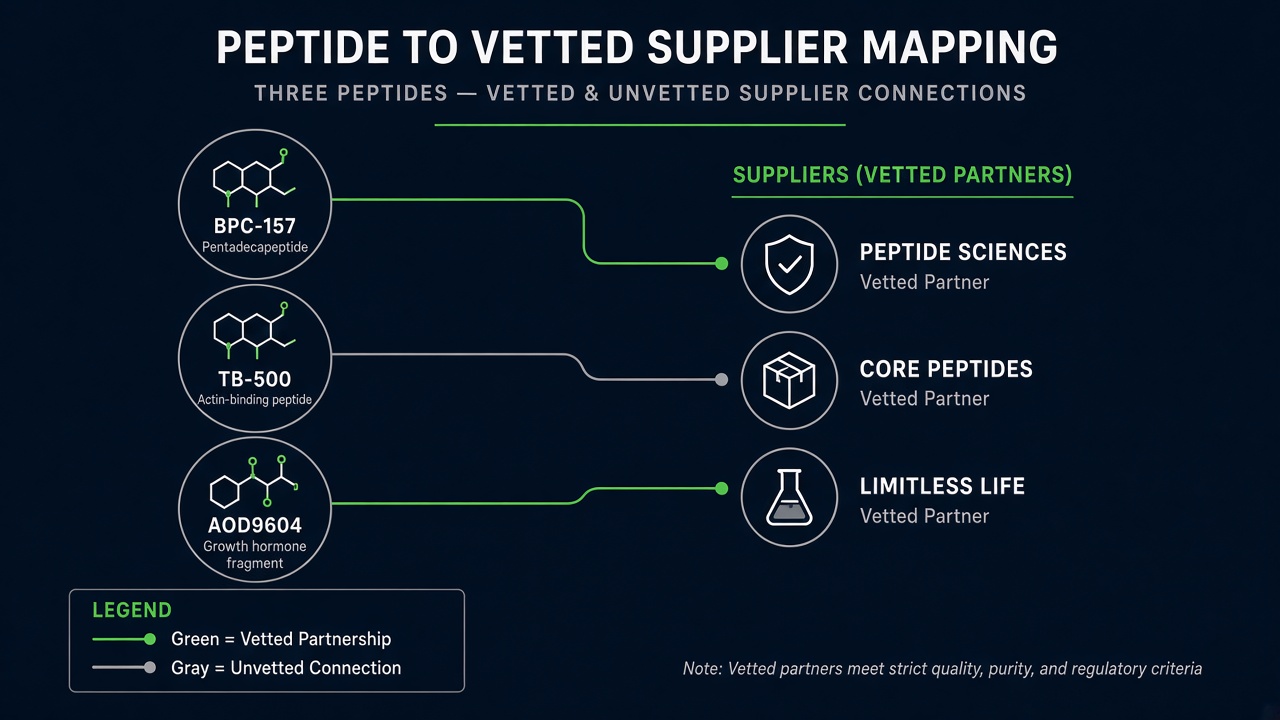
How do specific superpower library peptides (BPC-157, TB-500, AOD9604) map to vetted suppliers?
BPC-157, TB-500, and AOD9604 are three of the most frequently requested peptides in the superpower peptide library. Each has different structural and purity expectations, so supplier trust must be evaluated per peptide, not per catalog.
BPC-157 is a pentadecapeptide with over 120 PubMed-indexed studies on cytoprotection in rodent models. A trustworthy supplier for BPC-157 should provide a COA that lists peptide content by HPLC, purity ≥95% by area normalization, and endotoxin below 0.1 EU/mg. Peptides Library and Core Peptides both publish these data for BPC-157 lots.
TB-500, a thymosin beta-4 fragment, is frequently evaluated in cell migration and wound healing assays. Because TB-500 is often supplied as a lyophilized powder, suppliers must document residual moisture and storage conditions. JPT Peptide Technologies includes full analytical data packages for TB-500, including mass spectrometry confirmation.
AOD9604, a modified fragment of human growth hormone, is investigated in adipocyte metabolism research. The superpower peptide library entry for AOD9604 requires amino acid analysis and purity by reverse-phase HPLC. Licensed Peptides offers third-party amino acid analysis for AOD9604, but endotoxin data must be requested separately. See the AOD-9604 Growth Hormone Fragment: Research Peptide Guide (2026) for structural details.
💡 Key Takeaway: How do specific superpower library peptides (BPC-157, TB-500, AOD9604) map to vetted suppliers?
Superpower peptide library: which research peptide suppliers are trustworthy in 2026? Independent aggregator scoring and methodology
The independent aggregators peptideranking.org and peptidevendorreviews.org assign scores from 0 to 100 for each supplier that lists superpower peptide library peptides. The scoring model weights COA availability at 35%, third-party lab verification at 25%, cold-chain documentation at 15%, catalog breadth at 15%, and customer-reported lot-matching failures at 10%. These weights are published on the aggregators’ methodology pages and can be audited by any lab.
Peptideranking.org updates scores quarterly. Its 2026 Q1 report for the superpower peptide library placed Peptides Library and Core Peptides in the top tier, with scores above 85. Peptidevendorreviews.org adds a customer-verified documentation layer: only COAs uploaded by buyers, not suppliers, are counted. This prevents self-reported purity claims from inflating a vendor’s score.
Pepindex.org indexes the superpower peptide library against structural databases such as PubChem and UniProt. A supplier whose catalog entries do not match the canonical sequence for BPC-157 or TB-500 receives a lower pepindex score. This structural cross-check is essential because peptide naming alone does not guarantee sequence identity.
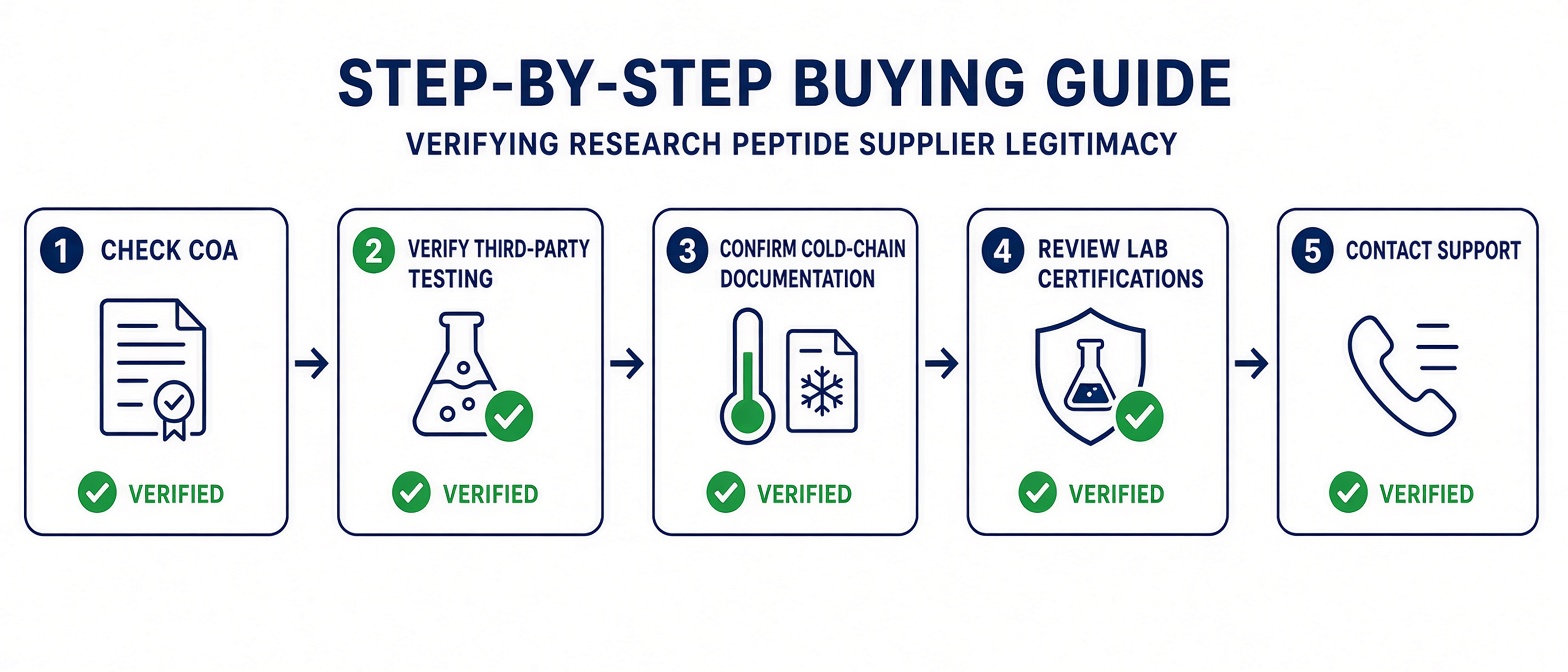
How can lab buyers verify legitimacy in 2026? A step-by-step buying guide
For any supplier being considered for the superpower peptide library, lab buyers should follow a five-step verification sequence. Step one: request a lot-specific COA for the exact peptide and quantity being ordered. Step two: confirm the COA comes from an ISO/IEC 17025 laboratory, not an in-house lab with no accreditation. Step three: check endotoxin, purity, and peptide content values against the assay type used. Step four: verify lot-matching by comparing the COA lot number to the vial label after receipt. Step five: search the FDA warning letter database and aggregator archives for the supplier’s name.
This guide applies to every peptide in the superpower peptide library, not just BPC-157 or TB-500. A supplier that passes for one peptide may fail for another if its COA practices are inconsistent. The Where to Buy a Peptide Research Library with a COA guide on this site includes a printable checklist for step-by-step verification.
Labs should also verify that the supplier’s storage and handling claims match the peptide’s stability profile. Lyophilized peptides in the superpower peptide library generally require -20°C storage with desiccant, but some fragments may need -80°C for long-term stability. Always ask for a stability statement in writing before accepting a shipment.
What role do cold-chain and storage documentation play in supplier trust?
Cold-chain documentation is a critical trust signal for the superpower peptide library because lyophilized peptides can degrade if exposed to moisture or temperature excursions during transit. A trustworthy supplier will ship with insulated packaging, include a temperature logger or indicator, and state the expected transit time and storage temperature on the packing slip.
Peptides Library ships superpower peptide library products lyophilized with desiccant and recommends -20°C storage upon receipt. Core Peptides uses cold-chain shipping with ice packs and links each vial’s COA to a QR code that shows lot-specific storage instructions. JPT Peptide Technologies specifies -80°C for long-term storage of custom peptides, which is important for labs holding large inventories.
Suppliers that ship superpower peptide library peptides without any cold-chain documentation, or that ship in uninsulated envelopes, should be deprioritized. Temperature excursions during transit can reduce peptide content and increase degradation products, which may not be visible on a COA generated before shipping. The lot-matching step must therefore include a physical inspection for signs of moisture or clumping.
💡 Key Takeaway: What role do cold-chain and storage documentation play in supplier trust?
What are the most common documentation gaps in research peptide COAs?
The most common documentation gaps in superpower peptide library COAs are missing endotoxin units, purity reported as a single number without an HPLC chromatogram, peptide content omitted or reported as “not determined,” and absence of residual solvent or trifluoroacetic acid (TFA) data. These gaps can hide quality problems that affect downstream assays.
A COA that lists purity as 98% without specifying whether it is HPLC area percent or peptide content is incomplete. For the superpower peptide library, peptide content by amino acid analysis or UV spectrophotometry should be reported separately from chromatographic purity. Endotoxin should be reported in EU/mg or EU/vial, not as “pass/fail.”
Marvel Pep, for example, lists limited public COAs and provides endotoxin data only on request. Licensed Peptides provides third-party HPLC and amino acid analysis but does not always include endotoxin in the standard COA. Labs using these suppliers for the superpower peptide library should request the missing data before placing an order.
How does the superpower peptide library compare to other reference catalogs?
The superpower peptide library differs from generic peptide catalogs because it groups 152 peptides by receptor mechanism, structural family, and FDA regulatory status. This structure allows lab buyers to compare supplier documentation across functionally related peptides rather than alphabetically. Generic catalogs often list hundreds or thousands of peptides without any grouping or structural cross-reference.
Other reference catalogs, such as those maintained by commercial vendors or academic databases, may include more peptides but lack the supplier-vetting focus of the superpower peptide library. The superpower peptide library is designed specifically to answer the question superpower peptide library: which research peptide suppliers are trustworthy in 2026? by linking each peptide to the documentation attributes that matter for lab use.
The superpower peptide library also cross-references structural data for BPC-157, TB-500, AOD9604, and other peptides against public databases like PubChem and UniProt. This makes it easier to verify that a supplier’s catalog entry matches the canonical sequence. See the Complete Guide to Research Peptides: 2025 Lab Reference for a broader comparison of peptide reference catalogs.
What are the limits of aggregator scores for research peptide suppliers?
Aggregator scores for the superpower peptide library are useful but have clear limits. First, aggregators rely on self-reported data from suppliers and customer-submitted COAs, which may be incomplete or biased. Second, aggregator scores are updated quarterly at best, so a supplier that changed ownership or COA practices in the last month may still show an outdated score.
Third, aggregators weight catalog breadth and shipping speed, which do not directly measure peptide quality. A supplier with 150 peptides and fast shipping may score higher than a supplier with 120 peptides and rigorous endotoxin testing. For the superpower peptide library, documentation quality should always outweigh catalog size in a lab’s final decision.
Fourth, aggregators cannot verify every lot. A supplier may submit one excellent COA for a single lot of BPC-157 but fail to maintain that standard for other lots or other peptides. Labs should treat aggregator scores as a screening tool, not a replacement for lot-specific verification of the superpower peptide library.
💡 Key Takeaway: What are the limits of aggregator scores for research peptide suppliers?
How should labs handle supplier closures and name changes in 2026?
Supplier closures and name changes were common in the research peptide market during 2024–2025, often following FDA warning letters or import refusals. When a supplier that previously listed superpower peptide library peptides closes or rebrands, labs should not assume the new entity inherits the old supplier’s documentation quality.
A lab should re-run the full five-step verification sequence for any supplier that changes its name, ownership, or website domain. The FDA warning letter database and aggregator archives often record name changes, but these records may lag by several months. For the superpower peptide library, the safest approach is to require a new lot-specific COA from an ISO/IEC 17025 laboratory under the new business name before ordering.
If a supplier closes without notice and leaves outstanding orders for superpower peptide library peptides, labs should document the loss and review whether the supplier’s COA claims were ever independently verified. Peptideranking.org maintains an archive of closed suppliers and their last known scores, which can help labs avoid successors that simply rebrand without improving documentation.
What documentation should a complete research peptide COA include?
A complete COA for any peptide in the superpower peptide library should include: lot number, date of manufacture, retest date, appearance, solubility, peptide content by amino acid analysis or UV, purity by HPLC (with chromatogram), molecular mass by mass spectrometry, endotoxin by LAL assay, residual TFA content, water content, and storage conditions. Each value must be traceable to a specific lot and batch record.
The COA must also state the analytical methods used and the laboratory that performed the analysis. For the superpower peptide library, an ISO/IEC 17025 laboratory accreditation is the minimum standard for third-party testing. An in-house COA without an accredited lab signature is not sufficient for independent verification.
JPT Peptide Technologies provides full analytical data packages that meet most of these requirements for custom and catalog peptides. Peptides Library and Core Peptides also include HPLC chromatograms and LAL endotoxin data for superpower peptide library peptides. Labs should reject any COA that lists purity as a single number with no supporting chromatogram or mass spectrum.
How does lot-matching work in practice for research peptides?
Lot-matching means comparing the lot number printed on the physical vial to the lot number on the COA and the supplier’s batch record. For the superpower peptide library, this step is essential because a COA may be real but belong to a different lot or a different peptide altogether. Customer-reported lot-matching failures are a key red flag in aggregator scoring.
In practice, a lab should photograph the vial label upon receipt, then request the supplier’s lot-specific COA using the exact lot number on that vial. If the supplier cannot produce a COA that matches the vial lot number, the shipment should be quarantined and not used in any assay. Peptidevendorreviews.org specifically tracks lot-matching failures for superpower peptide library suppliers and publishes them in its scoring model.
Lot-matching also applies to storage documentation. A COA that states -20°C storage should match the supplier’s shipping method. If a vial arrives warm and the COA lot number matches, the lab should still flag a cold-chain deviation and request a replacement. For the superpower peptide library, lot-matching is not just a paperwork check; it is a physical and thermal verification.
💡 Key Takeaway: How does lot-matching work in practice for research peptides?
What are the research-use-only boundaries for this comparison?
All suppliers and peptides in the superpower peptide library comparison are strictly for in vitro laboratory research use only. None of the products are for human use, veterinary use, or diagnostic, therapeutic, or prophylactic applications. This article does not imply any human consumption, dosing, or clinical efficacy for any peptide.
The superpower peptide library is a reference catalog for structural and supplier-documentation research. Any mention of BPC-157, TB-500, AOD9604, or other peptides refers solely to their use in controlled laboratory assays such as cell culture, receptor binding, or animal model studies conducted under appropriate institutional review.
Lab buyers must be 21+ to purchase research peptides and must comply with all local, state, and federal regulations. Suppliers that market superpower peptide library peptides with human-use claims violate FDA regulations and should be reported. This comparison excludes any supplier that makes such claims, regardless of its COA transparency.
How do peptide purity and endotoxin thresholds differ by assay type?
Purity and endotoxin thresholds for the superpower peptide library depend on the downstream assay. For cell culture assays, endotoxin should be below 0.1 EU/mg to avoid confounding immune responses. For receptor binding or enzyme assays, HPLC purity of 95% or higher is generally acceptable, but for structural studies, mass spectrometry confirmation and peptide content by amino acid analysis are mandatory.
In vivo rodent studies often require stricter limits: endotoxin below 0.05 EU/mg and purity above 98% by HPLC. The superpower peptide library does not set universal thresholds because different peptides have different stability and assay requirements. A supplier’s COA should state the assay type for each reported value.
BPC-157, for example, is often used in cytoprotection assays where endotoxin contamination could mask or alter results. TB-500 cell migration assays are less endotoxin-sensitive but require precise peptide content to normalize dosing across wells. Labs using the superpower peptide library should select suppliers that report endotoxin in EU/mg and purity with a chromatogram, not just a pass/fail result.
What are the best practices for storing superpower library peptides after receipt?
After receipt, superpower peptide library peptides should be stored lyophilized at -20°C with desiccant for short-term use, or at -80°C for long-term stability. Once reconstituted, peptides should be aliquoted and stored at -20°C or -80°C, avoiding repeated freeze-thaw cycles. Each aliquot should be labeled with the lot number, reconstitution date, and solvent.
Peptides Library recommends -20°C storage for lyophilized superpower peptide library products and provides desiccated vials. Core Peptides links storage instructions to the vial QR code. JPT Peptide Technologies specifies -80°C for long-term storage of custom peptides. Always follow the COA’s storage conditions, not a generic protocol.
Moisture is the primary degradation risk for lyophilized peptides. Before opening a vial, allow it to reach room temperature in a desiccator to prevent condensation. For the superpower peptide library, a supplier that ships with moisture-barrier vials and includes a desiccant pack demonstrates better handling than one that ships in standard vials without desiccant.
💡 Key Takeaway: What are the best practices for storing superpower library peptides after receipt?
What independent sources support the superpower peptide library’s peptide profiles?
The superpower peptide library’s peptide profiles are supported by independent sources including PubMed for BPC-157 studies, NCBI for structural and functional data, and the FDA warning letter database for regulatory history. These sources are external and verifiable by any lab.
BPC-157’s over 120 PubMed-indexed studies on cytoprotection in rodent models provide a baseline for expected purity and handling. TB-500’s profile is supported by thymosin beta-4 fragment literature on cell migration. AOD9604’s adipocyte metabolism research is indexed in PubMed and can be cross-referenced against the superpower peptide library entry.
Labs should use these independent sources to verify that a supplier’s catalog description matches the canonical sequence and known assay context. The Peptide Research Library: Which Suppliers Are Trustworthy in 2026? page on this site links each peptide profile to its PubMed and PubChem identifiers for that purpose.
How often should lab buyers re-verify supplier trust in 2026?
Lab buyers should re-verify supplier trust for the superpower peptide library at least quarterly, and immediately after any supplier name change, ownership change, FDA warning letter, or customer-reported lot-matching failure. Aggregator scores are updated quarterly, so a quarterly review aligns with available data.
For high-volume or high-risk peptides such as BPC-157 and TB-500, labs should verify every new lot, not just once per quarter. A supplier that passes for one lot of the superpower peptide library may fail for the next lot if its analytical partner changes or if it switches manufacturing sites.
A practical schedule: review FDA warning letters monthly, aggregator scores quarterly, and lot-specific COAs for every order. This layered re-verification keeps the superpower peptide library comparison current and prevents a lab from relying on outdated trust signals.
What are the top three trustworthy suppliers for the superpower peptide library in 2026?
Based on the documentation-first standard in this article, the top three trustworthy suppliers for the superpower peptide library in 2026 are Peptides Library, Core Peptides, and JPT Peptide Technologies. Peptides Library offers 140+ of the 152 peptides with lot-specific COAs from an ISO/IEC 17025 partner lab. Core Peptides provides a public COA database with independent UPLC purity and LAL endotoxin for 120+ peptides. JPT Peptide Technologies supplies GMP-grade COAs and full analytical data packages, though its overlapping catalog is smaller.
These three suppliers meet the three layers of evidence: an ISO 9001 or ISO 13485 quality system, COAs from an independent ISO/IEC 17025 laboratory, and a public lot-history database. No supplier in this comparison is perfect; labs must still verify lot-matching and cold-chain documentation for every order from the superpower peptide library.
Licensed Peptides and Marvel Pep are acceptable only with additional verification for endotoxin and peptide content. The question superpower peptide library: which research peptide suppliers are trustworthy in 2026? is answered not by a single score but by a documentation trail that any lab can audit.
💡 Key Takeaway: What are the top three trustworthy suppliers for the superpower peptide library in 2026?
FAQ
Which suppliers publish lot-specific COAs for the superpower peptide library?
Peptides Library and Core Peptides publish lot-specific COAs for the superpower peptide library. Peptides Library provides COAs on request from an ISO/IEC 17025 partner lab with endotoxin and purity data. Core Peptides maintains a public COA database with independent UPLC purity and LAL endotoxin for 120+ peptides.
What is the minimum endotoxin threshold for superpower peptide library peptides in cell culture?
For cell culture assays using superpower peptide library peptides, endotoxin should be below 0.1 EU/mg. Suppliers that omit endotoxin units or report only pass/fail results should be deprioritized, as endotoxin contamination can confound immune responses in vitro.
How does the superpower peptide library help with supplier vetting?
The superpower peptide library groups 152 research peptides by receptor mechanism, structural family, and FDA regulatory status, allowing labs to compare supplier documentation across functionally related peptides. It links each peptide to defined purity, endotoxin, and peptide content expectations, making supplier trust measurable.
Are aggregator scores enough to choose a supplier for the superpower peptide library?
No. Aggregator scores for the superpower peptide library are a screening tool, not a replacement for primary verification. Labs must still request lot-specific COAs, check ISO/IEC 17025 accreditation, verify lot-matching, and search the FDA warning letter database before accepting any shipment.
What red flags indicate an untrustworthy supplier for the superpower peptide library?
Red flags include missing endotoxin tests, unregistered peptide imports, unsubstantiated purity claims, refusal to provide batch records, and COAs that do not match the physical vial lot number. Any supplier marketing superpower peptide library peptides for human use should be reported and excluded.
Topics covered in this article:
Ready to Take the Next Step?
Every product includes lot-specific documentation and third-party purity testing.
Explore Our Research Products →Free shipping on qualifying orders · Batch COA on request