


Quick Answer
Can Artificial Intelligence Discover Peptides That Have Never Existed?
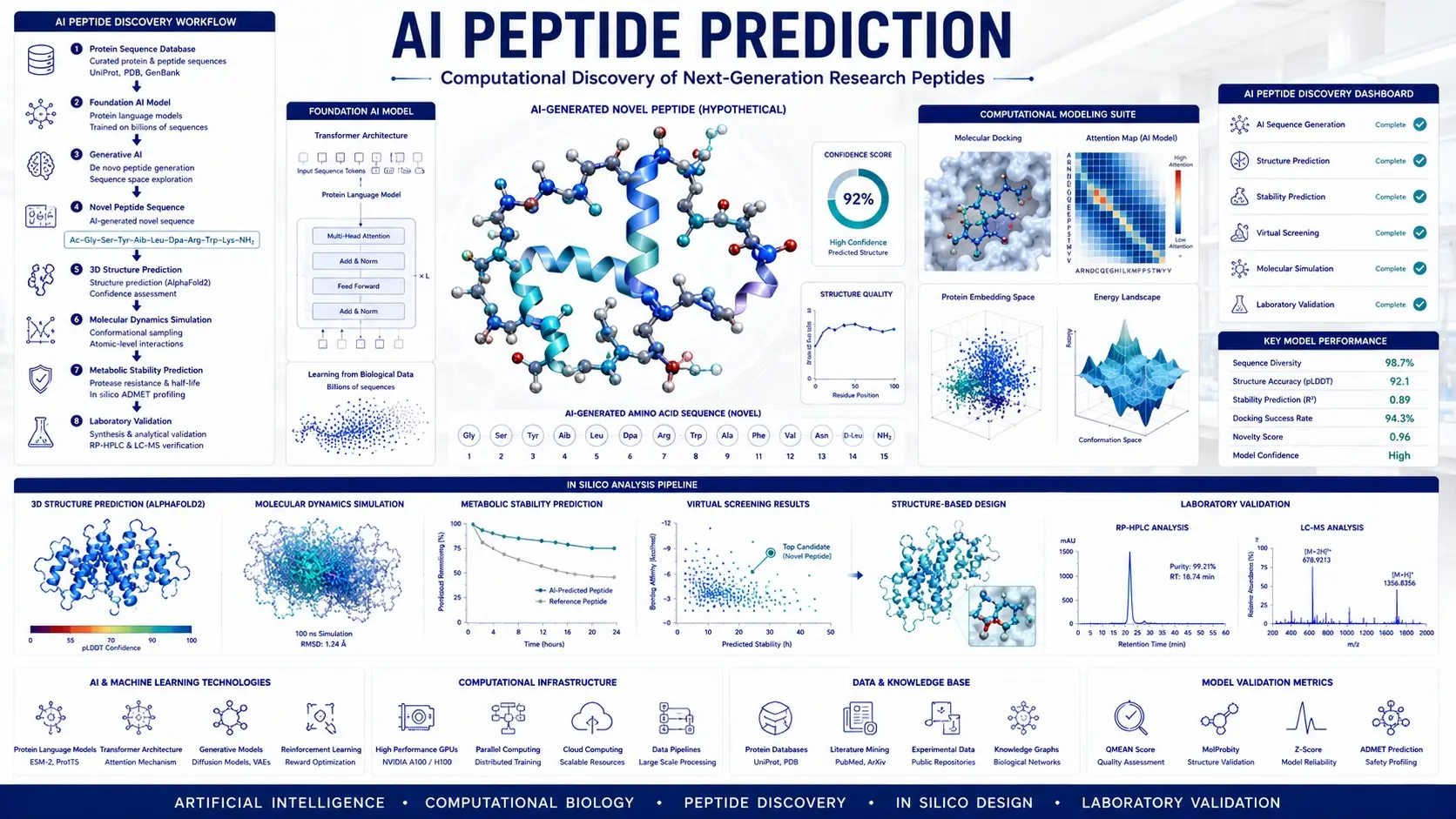
Yes. Modern artificial intelligence systems are increasingly capable of designing entirely novel peptide sequences that have never been identified in nature or synthesized in a laboratory. Using computational peptide discovery, large biological datasets, protein language models, generative AI, molecular simulations, and structure prediction algorithms, researchers can generate candidate peptides with predicted structural and biochemical properties before laboratory validation. These AI-generated molecules must still undergo rigorous experimental verification using analytical methods such as RP-HPLC, LC-MS, and functional laboratory studies before their biological characteristics can be confirmed.
AI Is Predicting Peptides That Don’t Exist Yet: How Artificial Intelligence Is Transforming Computational Peptide Discovery in 2026
Scientific Snapshot
| Research Field | Computational Peptide Discovery |
| Core Technologies | Artificial Intelligence, Machine Learning & Protein Language Models |
| Primary Objective | Design Novel Peptide Sequences Prior to Laboratory Synthesis |
| Key Validation Methods | Structure Prediction, Molecular Dynamics, RP-HPLC & LC-MS |
| Research Status | Rapidly Expanding Scientific Discipline |
Quick Facts
| Primary Technology | Generative Artificial Intelligence |
| Scientific Goal | Predict Novel Functional Peptides |
| Supporting Technologies | Machine Learning, Deep Learning & Molecular Simulation |
| Research Applications | Drug Discovery, Biomaterials, Synthetic Biology & Computational Biology |
| Experimental Validation | Required Before Scientific Conclusions |
Key Takeaways
- ✓Artificial intelligence peptide research is enabling scientists to generate entirely new peptide sequences before laboratory synthesis.
- ✓Computational peptide discovery combines machine learning, structural biology, protein language models, and molecular simulation to accelerate peptide design.
- ✓Generative AI peptide sequences are evaluated using computational predictions before undergoing laboratory validation.
- ✓AI peptide structure prediction and AI peptide metabolic stability prediction are reducing the time required to identify promising research candidates.
- ✓Despite rapid advances, every AI-designed peptide must still be experimentally verified using established analytical and laboratory methods before scientific conclusions can be drawn.
Table of Contents
Research Timeline
The convergence of artificial intelligence and peptide science has accelerated dramatically over the past decade. Improvements in deep learning, transformer architectures, protein language models, and structural prediction algorithms have transformed computational peptide discovery from a theoretical concept into one of the fastest-growing areas of biotechnology research.
| Period | Research Milestone |
|---|---|
| 2016–2019 | Deep learning begins accelerating computational biology and peptide prediction. |
| 2020–2022 | Protein language models and AlphaFold revolutionize structural prediction. |
| 2023–2025 | Generative AI expands into protein and peptide sequence design. |
| 2026 | Integrated AI workflows combine sequence generation, structure prediction, molecular simulation, and laboratory validation. |
Introduction
For decades, discovering new peptides depended on experimental screening, biological observation, and iterative laboratory synthesis. Today, artificial intelligence is fundamentally changing that workflow. Instead of waiting for researchers to identify naturally occurring molecules, modern AI systems can propose entirely new peptide sequences with predicted structural and functional characteristics before a single molecule is synthesized.
This emerging field—known as computational peptide discovery—brings together artificial intelligence, machine learning, structural biology, molecular dynamics, and peptide chemistry into a unified research pipeline. By analyzing millions of protein and peptide sequences, AI models learn biological patterns that allow them to generate previously unknown molecular candidates and estimate characteristics such as folding behavior, receptor interactions, and metabolic stability.
This article explores how AI peptide prediction works, the technologies driving generative peptide design, the role of protein language models, and why computational predictions must always be confirmed through rigorous laboratory validation before becoming accepted scientific knowledge.
What Is Computational Peptide Discovery?
Computational peptide discovery is an interdisciplinary scientific field that combines artificial intelligence, machine learning, computational biology, structural bioinformatics, molecular modeling, and peptide chemistry to identify or design novel peptide molecules before laboratory synthesis. Instead of relying solely on traditional experimental screening, researchers now use AI-driven algorithms to predict peptide sequences with desirable structural and biochemical characteristics based on patterns learned from millions of naturally occurring proteins and peptides.
Modern computational platforms evaluate far more than amino acid sequences alone. They simultaneously estimate three-dimensional structure, receptor binding potential, molecular flexibility, evolutionary conservation, physicochemical properties, and predicted stability. This integrated workflow enables researchers to prioritize the most promising candidates before investing time and resources in laboratory validation.
As computational power and biological datasets continue to expand, computational peptide discovery is becoming an essential component of peptide engineering, synthetic biology, biotechnology, and early-stage therapeutic research.
How AI Peptide Prediction Works
AI peptide prediction begins with training deep learning models on enormous collections of experimentally characterized protein and peptide sequences. These datasets allow neural networks to recognize complex biological relationships that would be extremely difficult to identify using conventional statistical approaches. Rather than memorizing existing peptides, modern AI systems learn the underlying “language” of proteins, enabling them to generate entirely new sequences with predicted structural and functional properties.
Following sequence generation, computational workflows evaluate multiple molecular characteristics including structural folding, physicochemical behavior, receptor compatibility, aggregation potential, and predicted metabolic stability. Only the highest-ranked candidates typically progress to laboratory synthesis and experimental validation.
| AI Workflow Stage | Primary Objective | Scientific Output |
|---|---|---|
| Biological Data Training | Learn sequence relationships | Foundation AI model |
| Sequence Generation | Create novel peptide candidates | AI-generated peptide sequences |
| Structural Prediction | Estimate three-dimensional folding | Predicted molecular structures |
| Computational Screening | Evaluate molecular properties | Ranked candidate peptides |
| Laboratory Validation | Experimental verification | Scientifically validated peptides |
Research Insight
Modern AI Models Learn Biological Patterns Rather Than Memorizing Sequences
The most advanced AI peptide prediction systems do not simply search existing peptide databases. Instead, they learn statistical relationships between amino acids, protein folding, and biological function, enabling them to generate entirely novel peptide candidates that have never previously existed.
Protein Language Models: Teaching AI the Language of Biology
One of the most important advances in artificial intelligence peptide research has been the development of protein language models. Inspired by large language models used for natural language processing, these systems are trained on hundreds of millions of protein sequences and learn how amino acids relate to one another within biological systems.
Rather than interpreting words and sentences, protein language models analyze amino acid sequences as biological “text.” During training, they learn evolutionary relationships, structural constraints, sequence motifs, and functional patterns that enable them to predict missing amino acids, estimate protein folding, and generate completely new peptide sequences with realistic biological characteristics.
| Model Type | Primary Capability | Research Application |
|---|---|---|
| Protein Language Models | Sequence understanding | Biological pattern recognition |
| Transformer Networks | Context learning | Long-range sequence relationships |
| Foundation Models | General biological knowledge | Multi-task prediction |
| Generative Models | Novel sequence generation | Computational peptide discovery |
Generative AI Peptide Sequences: Designing Molecules That Never Existed
Generative AI represents one of the most transformative developments in computational biology. Instead of selecting peptides from existing databases, generative models construct entirely new amino acid sequences predicted to satisfy specific structural or biochemical objectives. Researchers can define desired characteristics such as molecular size, charge distribution, secondary structure, receptor affinity, or predicted stability, allowing AI systems to generate candidate molecules optimized for those parameters.
This capability has dramatically expanded the searchable peptide design space. While naturally occurring peptides represent only a tiny fraction of all possible amino acid combinations, generative AI enables researchers to explore vast regions of sequence space that would be practically impossible to investigate through conventional laboratory screening alone.
Why Machine Learning Is Transforming Peptide Research
Machine learning peptide research has shifted scientific workflows from predominantly experimental discovery toward computational hypothesis generation. Instead of synthesizing thousands of candidate peptides and evaluating each individually, researchers can first perform virtual screening, identify the highest-priority molecules, and then validate only the most promising candidates experimentally.
This approach reduces development timelines, improves research efficiency, and enables scientists to investigate biological questions that were previously beyond practical laboratory capabilities. Rather than replacing experimental science, machine learning complements traditional methodologies by improving decision-making throughout the peptide discovery process.
Did You Know?
The Number of Possible Peptide Sequences Is Astronomically Large
Even a peptide containing only 20 amino acids can theoretically exist in more than 10²⁶ different sequence combinations. Artificial intelligence helps researchers navigate this enormous search space by prioritizing molecules with the highest predicted scientific potential before laboratory testing begins.
Key Takeaway
Computational peptide discovery is transforming modern biotechnology by combining artificial intelligence, machine learning, protein language models, and generative design into an integrated research workflow. Rather than replacing laboratory experimentation, these technologies help scientists generate stronger hypotheses and identify the most promising peptide candidates for experimental validation.
AI Peptide Structure Prediction: From Sequence to Three-Dimensional Biology
Amino acid sequence alone does not fully explain how a peptide behaves within a biological system. Its three-dimensional structure determines how it folds, interacts with receptors, binds to proteins, and performs biological functions. One of the most significant breakthroughs in artificial intelligence peptide research has therefore been the development of AI systems capable of predicting peptide structures directly from amino acid sequences.
Recent advances in deep learning have dramatically improved structural prediction accuracy. Rather than relying exclusively on traditional molecular modeling or experimentally determined crystal structures, AI algorithms learn structural relationships from millions of biological sequences and experimentally solved protein structures. This allows researchers to estimate peptide conformations within minutes instead of months.
Although computational predictions continue to improve rapidly, predicted structures remain scientific hypotheses that require experimental confirmation through laboratory techniques such as NMR spectroscopy, X-ray crystallography, cryogenic electron microscopy where appropriate, and complementary analytical validation.
How AI Predicts Peptide Structure
Modern structure prediction systems combine transformer neural networks, attention mechanisms, evolutionary information, geometric constraints, and statistical learning to estimate how peptide chains fold into stable three-dimensional conformations. Rather than calculating every molecular interaction individually, these models infer structural relationships learned from extensive biological training datasets.
| Prediction Stage | AI Objective | Scientific Output |
|---|---|---|
| Sequence Encoding | Learn amino acid relationships | Biological feature representations |
| Structural Inference | Predict molecular folding | Three-dimensional coordinates |
| Confidence Estimation | Evaluate prediction reliability | Confidence metrics |
| Structural Refinement | Improve molecular geometry | Optimized structural models |
| Experimental Verification | Validate computational predictions | Confirmed structural information |
Research Insight
Structure Prediction Is Reducing One of Biology’s Greatest Bottlenecks
Determining molecular structure has historically required extensive laboratory experimentation. Artificial intelligence now allows researchers to prioritize the most promising peptide candidates computationally, dramatically accelerating early-stage scientific discovery while reducing experimental workload.
AI Peptide Metabolic Stability Prediction
Another rapidly developing area of computational peptide discovery is AI peptide metabolic stability prediction. Beyond predicting molecular structure, researchers increasingly use artificial intelligence to estimate how peptide sequences may behave under simulated biological conditions. These computational assessments evaluate characteristics such as enzymatic susceptibility, degradation patterns, physicochemical stability, aggregation potential, and predicted half-life before laboratory experimentation begins.
By identifying potentially unstable peptide candidates early in the discovery process, researchers can refine molecular designs before synthesis. This iterative optimization workflow improves research efficiency while allowing laboratories to focus experimental resources on candidates with stronger predicted characteristics.
| Predicted Property | Why It Matters | AI Evaluation |
|---|---|---|
| Metabolic Stability | Estimate degradation susceptibility | Machine learning prediction |
| Protease Resistance | Evaluate enzymatic cleavage | Sequence-based modeling |
| Aggregation Potential | Assess molecular behavior | Computational simulation |
| Physicochemical Stability | Predict molecular robustness | Integrated AI analysis |
| Optimization Potential | Guide sequence refinement | Iterative model improvement |
Virtual Screening and Digital Peptide Optimization
Traditional peptide discovery often required researchers to synthesize and experimentally evaluate large numbers of candidate molecules. Artificial intelligence has fundamentally changed this workflow through virtual screening, allowing millions of hypothetical peptide sequences to be evaluated computationally before laboratory resources are committed.
Machine learning models rank candidate peptides according to predicted structural quality, receptor compatibility, molecular stability, and other computational metrics. Researchers can then prioritize a much smaller group of promising molecules for synthesis and experimental investigation, substantially improving research efficiency.
Machine Learning Continues to Improve AI Peptide Design
One of the greatest strengths of machine learning peptide research is its ability to improve continuously as additional experimental data become available. Newly characterized peptide sequences, structural information, biochemical assays, and laboratory validation studies can all contribute to retraining future models, gradually increasing prediction accuracy over time.
This creates a feedback loop in which computational predictions guide laboratory experiments, while experimental findings strengthen future AI systems. The combination of artificial intelligence and experimental science therefore represents a collaborative research strategy rather than a replacement for traditional laboratory investigation.
Did You Know?
AI Can Evaluate Millions of Candidate Peptides Before a Single Experiment Begins
High-performance computing allows artificial intelligence platforms to screen enormous virtual peptide libraries in a fraction of the time required for traditional laboratory experimentation. Researchers can therefore concentrate experimental resources on only the highest-priority candidates predicted by computational analysis.
Key Takeaway
Artificial intelligence is transforming peptide discovery by extending beyond sequence generation to include structural prediction, metabolic stability estimation, and virtual screening. Although these computational capabilities substantially accelerate research, experimental validation remains the essential step that confirms whether AI-generated hypotheses accurately reflect biological reality.
From AI Prediction to Laboratory Validation
Artificial intelligence can rapidly generate peptide sequences, predict molecular structures, and estimate numerous biochemical properties. However, computational predictions represent scientific hypotheses rather than experimentally verified facts. Every AI-designed peptide must therefore progress through rigorous laboratory validation before researchers can evaluate its biological characteristics with confidence.
The modern peptide discovery pipeline combines computational modeling with experimental science. Artificial intelligence dramatically reduces the number of candidate molecules requiring laboratory investigation, while analytical chemistry and molecular biology provide the evidence needed to confirm or refine computational predictions.
Foundation Models Powering AI Peptide Design
Several landmark AI systems have accelerated computational biology by solving different components of the peptide discovery workflow. Some models specialize in sequence generation, others predict molecular structure, while additional platforms optimize protein engineering or estimate biological properties. Together, these foundation models are transforming how researchers approach peptide discovery.
| AI Platform | Primary Capability | Research Application |
|---|---|---|
| AlphaFold | Protein structure prediction | Three-dimensional molecular modeling |
| ESM & ESMFold | Protein language modeling | Sequence understanding and structure prediction |
| ProteinMPNN | Protein sequence design | Computational protein engineering |
| RFdiffusion | De novo protein generation | Novel molecular scaffold design |
| ProGen | Generative protein language modeling | AI-generated biological sequences |
Although many of these platforms were originally developed for proteins, their underlying architectures have strongly influenced modern AI peptide design workflows. Researchers frequently combine multiple foundation models within the same computational pipeline to improve sequence generation, structural prediction, and candidate prioritization.
Research Insight
No Single AI Model Performs Every Step of Peptide Discovery
Modern computational peptide discovery relies on integrated AI workflows rather than individual algorithms. Sequence generation, structural prediction, molecular simulation, and analytical validation each require specialized computational tools working together throughout the research pipeline.
Molecular Dynamics Simulations After AI Prediction
Once artificial intelligence predicts a promising peptide structure, researchers often perform molecular dynamics simulations to investigate how that molecule behaves over time. These simulations model atomic movement under defined environmental conditions, providing insights into structural flexibility, conformational stability, solvent interactions, and potential receptor binding behavior.
Rather than replacing laboratory experimentation, molecular dynamics serves as an additional computational filter that helps researchers identify which AI-generated candidates warrant further experimental investigation.
Analytical Verification Using RP-HPLC and LC-MS
After computational design and peptide synthesis, analytical chemistry confirms whether the manufactured molecule matches its predicted sequence and quality requirements. Reverse-phase high-performance liquid chromatography (RP-HPLC) evaluates peptide purity, while liquid chromatography-mass spectrometry (LC-MS) verifies molecular identity and expected molecular mass.
| Validation Method | Purpose | Scientific Outcome |
|---|---|---|
| RP-HPLC | Assess peptide purity | Identify impurities and verify chromatographic quality |
| LC-MS | Confirm molecular identity | Verify expected molecular mass |
| Peptide Sequencing | Confirm amino acid order | Validate AI-generated sequence |
| Certificate of Analysis | Document analytical results | Support reproducibility and quality assurance |
Current Limitations of AI Peptide Prediction
Despite remarkable advances, artificial intelligence remains dependent on the quality and diversity of the data used during model training. Computational predictions may not fully capture complex biological environments, post-translational modifications, cellular interactions, immune responses, or unexpected biochemical behavior. Consequently, computational models should be viewed as tools for hypothesis generation rather than definitive evidence.
Researchers continue improving prediction accuracy by integrating larger biological datasets, higher-resolution structural information, enhanced molecular simulations, and experimental feedback into successive generations of AI models. This iterative process steadily strengthens the reliability of computational peptide discovery.
Did You Know?
AI Accelerates Discovery—But Experimental Science Confirms It
Even the most advanced artificial intelligence systems cannot replace laboratory validation. Every computational prediction must ultimately be confirmed through peptide synthesis, analytical characterization, and experimental testing before becoming accepted scientific evidence.
Key Takeaway
Artificial intelligence has become an indispensable component of modern peptide discovery, but its greatest strength lies in complementing—not replacing—experimental research. By combining foundation AI models, molecular simulations, analytical chemistry, and laboratory validation, researchers are building a faster, more efficient, and increasingly reliable peptide discovery ecosystem.
The Future of AI-Designed Peptides
Artificial intelligence is rapidly evolving from a computational support tool into an integral component of peptide discovery. Modern research no longer views AI simply as software that predicts peptide sequences. Instead, it has become part of an interconnected scientific ecosystem that combines computational biology, structural prediction, molecular simulation, automated laboratory technologies, and experimental validation.
Future computational peptide discovery platforms are expected to integrate increasingly sophisticated biological datasets, multimodal AI models, robotic experimentation, and real-time laboratory feedback. Rather than designing individual peptide candidates, next-generation systems may optimize entire discovery pipelines, continuously improving predictions as new experimental evidence becomes available.
Artificial Intelligence and Autonomous Laboratories
One of the most exciting developments in biotechnology is the emergence of autonomous research laboratories. These facilities combine artificial intelligence, robotic automation, laboratory instrumentation, and cloud-based data analysis into highly integrated research environments capable of accelerating scientific discovery.
Within these workflows, AI systems may recommend peptide candidates, robotic platforms can synthesize and prepare experimental samples, analytical instruments evaluate peptide quality, and machine learning models analyze the resulting data before proposing the next round of computational optimization. Each experimental cycle contributes additional knowledge that improves subsequent predictions.
| Integrated Technology | Primary Function | Scientific Contribution |
|---|---|---|
| Artificial Intelligence | Generate research hypotheses | Computational peptide discovery |
| Robotic Automation | Laboratory execution | Improved experimental throughput |
| Analytical Chemistry | Peptide verification | Quality assurance |
| Machine Learning | Continuous model refinement | Improved prediction accuracy |
| Scientific Databases | Knowledge integration | Evidence-driven optimization |
Research Insight
The Most Powerful Discovery Systems Combine AI With Experimental Science
The greatest advances in peptide research are emerging from workflows that integrate computational prediction with laboratory validation. Artificial intelligence identifies promising candidates, while experimental science verifies molecular behavior and generates new knowledge that further improves future AI models.
Current Scientific Consensus
The scientific community increasingly recognizes artificial intelligence as a transformative technology for computational peptide discovery. AI-driven approaches have demonstrated remarkable capability in sequence generation, structural prediction, molecular optimization, and virtual screening, significantly reducing the time required to identify promising research candidates.
However, peer-reviewed research consistently emphasizes that computational predictions must be interpreted within the context of experimental validation. Structural predictions, metabolic stability estimates, and functional hypotheses generated by AI require confirmation through laboratory synthesis, analytical characterization, and reproducible biological experimentation before becoming accepted scientific evidence.
Research Best Practices for AI-Assisted Peptide Discovery
As artificial intelligence becomes more deeply integrated into biotechnology research, maintaining rigorous scientific methodology remains essential. Reliable peptide discovery depends on combining advanced computational models with standardized laboratory procedures and transparent scientific reporting.
- ✓Treat AI-generated peptide sequences as research hypotheses that require independent experimental validation.
- ✓Verify peptide identity and purity using validated analytical methods including RP-HPLC and LC-MS.
- ✓Document computational workflows, datasets, model versions, and analytical procedures to improve reproducibility.
- ✓Interpret computational predictions alongside peer-reviewed literature, structural biology, and experimental evidence.
- ✓Continuously refine AI models using experimentally validated data to improve future computational peptide discovery.
Related Research Articles
Continue Exploring Computational Biology
Expand your understanding of peptide science, computational biology, and analytical methodologies with these related research guides.
- → The Science Behind Research Peptides: A Mechanism Breakdown
- → RP-HPLC vs LC-MS: Understanding Peptide Quality Testing
- → Peptide Stability Testing Explained
- → Computational Biology in Modern Drug Discovery
- → How Molecular Dynamics Simulations Work
- → Fundamentals of Peptide Synthesis and Characterization
Did You Know?
The Next Breakthrough May Be Discovered by Humans and AI Working Together
Rather than replacing scientists, artificial intelligence is increasingly functioning as a collaborative research partner. By combining computational prediction with human expertise and laboratory experimentation, researchers can explore biological questions at a scale that was previously impossible.
Section Summary
Artificial intelligence is reshaping computational peptide discovery by integrating sequence generation, structural prediction, molecular simulation, and laboratory validation into a unified scientific workflow. While AI dramatically accelerates early-stage research, experimental verification remains the foundation upon which reliable peptide science is built.
Frequently Asked Questions
1. What is AI peptide prediction?
AI peptide prediction is the use of artificial intelligence models to analyze biological sequence data and generate predictions about peptide structure, stability, function, or entirely new peptide sequences before laboratory validation. These computational predictions accelerate research but do not replace experimental confirmation.
2. What is computational peptide discovery?
Computational peptide discovery combines artificial intelligence, machine learning, structural biology, molecular simulations, and bioinformatics to identify or design novel peptide candidates. The approach helps researchers prioritize promising molecules for laboratory investigation while reducing the need for large-scale experimental screening.
3. How does machine learning contribute to peptide research?
Machine learning identifies complex biological patterns within large protein and peptide datasets. These models can predict structural features, estimate molecular properties, rank candidate peptides, and support hypothesis generation for subsequent laboratory validation.
4. What are generative AI peptide sequences?
Generative AI peptide sequences are newly designed amino acid sequences created by artificial intelligence models rather than copied from existing biological databases. These computationally generated molecules are evaluated through structural prediction, molecular simulations, and laboratory testing before their biological properties can be verified.
5. How does AI peptide structure prediction work?
AI structure prediction models learn relationships between amino acid sequences and experimentally determined molecular structures. They estimate how peptides fold into three-dimensional conformations, allowing researchers to evaluate structural characteristics before experimental studies begin.
6. What is AI peptide metabolic stability prediction?
AI peptide metabolic stability prediction uses machine learning algorithms to estimate how peptide sequences may respond to enzymatic degradation, physicochemical conditions, and other biological environments. These predictions assist researchers in selecting promising candidates for further laboratory investigation.
7. Can AI replace laboratory peptide research?
No. Artificial intelligence accelerates computational analysis and hypothesis generation, but every predicted peptide must undergo laboratory synthesis, analytical characterization, and experimental validation before scientific conclusions can be established.
8. Which AI technologies are commonly used in peptide discovery?
Researchers use protein language models, transformer neural networks, deep learning algorithms, molecular dynamics simulations, AlphaFold-inspired structure prediction systems, and generative AI models to support peptide discovery and computational biology research.
9. Why are RP-HPLC and LC-MS important after AI peptide design?
Following peptide synthesis, RP-HPLC verifies analytical purity while LC-MS confirms molecular identity and expected molecular mass. These complementary analytical techniques help determine whether synthesized peptides match computational design specifications.
10. Which scientific fields benefit from AI-assisted peptide discovery?
Computational peptide discovery supports research across computational biology, structural biology, peptide chemistry, molecular pharmacology, biotechnology, synthetic biology, bioinformatics, and analytical chemistry.
11. Why is experimental validation still essential?
Computational predictions estimate molecular behavior but cannot fully capture the complexity of biological systems. Experimental validation confirms peptide identity, structural integrity, biochemical properties, and reproducibility under controlled laboratory conditions.
12. What does the future of AI peptide research look like?
Future research is expected to integrate foundation AI models, robotics, autonomous laboratories, molecular simulations, and continuously updated biological datasets into unified discovery platforms that accelerate peptide research while maintaining rigorous experimental validation standards.
Scientific Resources & References
The following peer-reviewed publications and official scientific guidance documents provide foundational information on computational peptide discovery, AI peptide prediction, protein language models, structural biology, and analytical validation. These references were selected specifically for the topics discussed in this article.
Primary Research Articles
-
Jumper J, Evans R, Pritzel A, et al. Highly Accurate Protein Structure Prediction with AlphaFold. Nature. 2021.
https://doi.org/10.1038/s41586-021-03819-2 -
Lin Z, Akin H, Rao R, et al. Evolutionary-scale Prediction of Atomic-Level Protein Structure with a Language Model. Science. 2023.
https://doi.org/10.1126/science.ade2574 -
Dauparas J, Anishchenko I, Bennett N, et al. Robust Deep Learning–Based Protein Sequence Design Using ProteinMPNN. Science. 2022.
https://doi.org/10.1126/science.add2187 -
Watson JL, Juergens D, Bennett N, et al. De Novo Design of Proteins Using RFdiffusion. Nature. 2023.
https://doi.org/10.1038/s41586-023-06415-8 -
Madani A, McCann B, Naik N, et al. ProGen: Language Modeling for Protein Generation. Nature Biotechnology.
Nature Biotechnology
Review Articles
- Nature Reviews Drug Discovery. Artificial Intelligence in Drug Discovery (Review Collection).
- Nature Machine Intelligence. Reviews on AI for Molecular Design and Computational Biology.
- Cell. Reviews covering foundation models and biological machine learning.
- Annual Review of Biomedical Data Science. Machine Learning Applications in Molecular Biology.
Laboratory & Analytical Standards
-
ICH Q2(R2): Validation of Analytical Procedures.
Official Guideline -
FDA Guidance for Industry: Analytical Procedures and Methods Validation for Drugs and Biologics.
Official FDA Guidance -
United States Pharmacopeia (USP). General Chapters for Chromatographic Analysis and Peptide Characterization.
USP Standards
Final Takeaway
Artificial Intelligence Is Expanding the Frontiers of Peptide Discovery
Artificial intelligence is fundamentally reshaping how researchers discover and design peptides. By integrating computational peptide discovery, protein language models, generative AI, structure prediction, molecular simulation, and analytical chemistry, scientists can explore vast regions of peptide sequence space that were previously inaccessible. While AI dramatically accelerates hypothesis generation and candidate prioritization, experimental validation remains the cornerstone of scientific discovery. The future of peptide research will increasingly depend on the collaboration between advanced computational systems and rigorous laboratory science, enabling faster, more informed, and more reproducible innovation.
Research Disclaimer
This article is intended exclusively for educational and scientific research purposes. Discussions of artificial intelligence, computational peptide discovery, peptide design, and related technologies are presented solely within the context of computational biology and laboratory research. The information provided does not constitute medical advice, therapeutic recommendations, or guidance for human use. All computational predictions discussed require experimental verification using validated analytical methods and accepted Good Laboratory Practices (GLP) before scientific conclusions can be established.