


Quick Answer
HPLC vs LC-MS vs Peptide Sequencing: What’s the Difference?
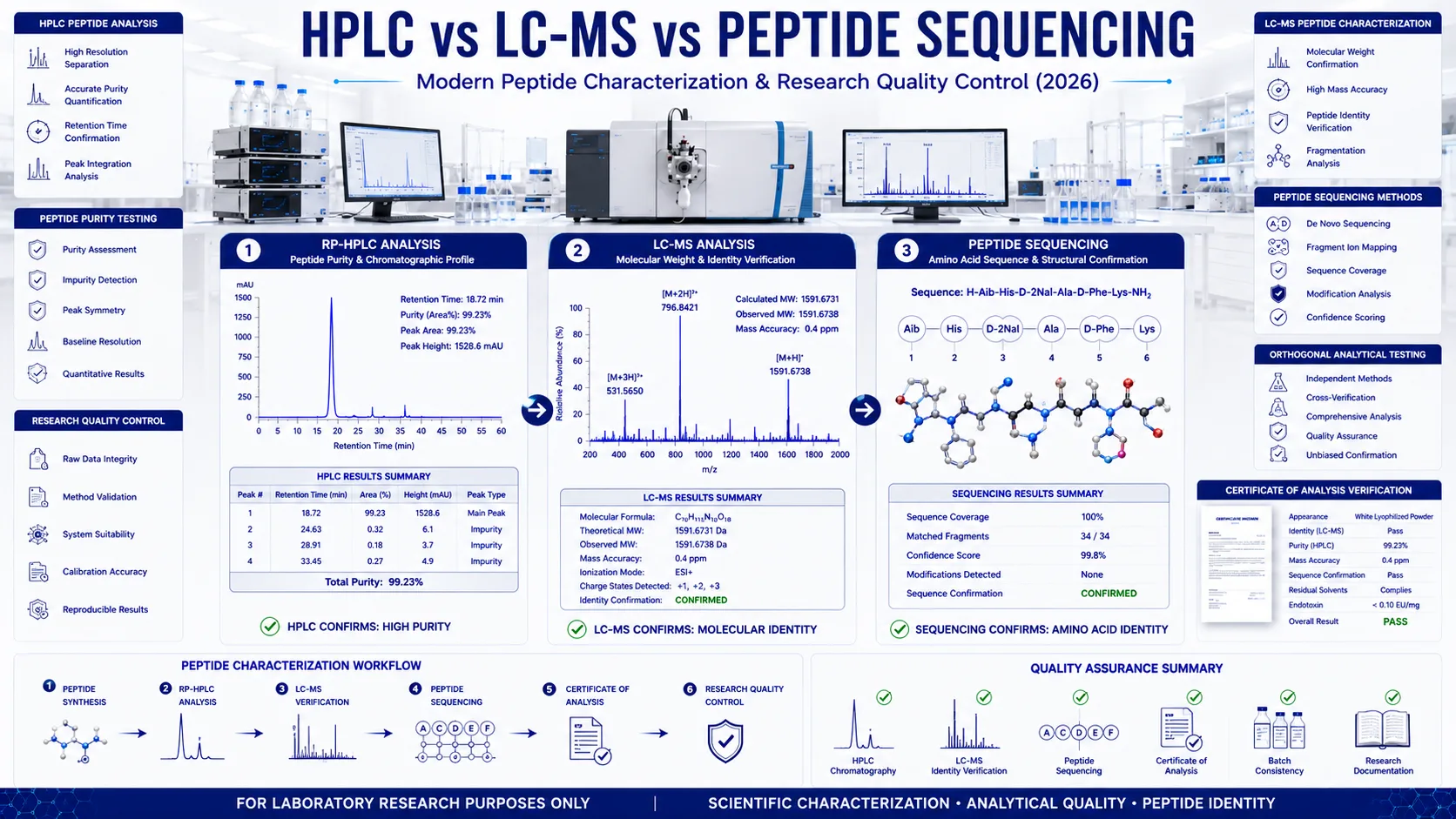
HPLC peptide analysis measures chromatographic purity, LC-MS peptide characterization confirms molecular identity and molecular weight, while peptide sequencing methods verify the amino acid sequence of a peptide. Modern research peptide quality control combines all three peptide analytical methods because no single technique can independently establish purity, identity, and sequence with complete confidence. Together, these complementary analytical approaches form the foundation of laboratory-grade peptide characterization.
Quick Facts
Analytical Methods Snapshot
| Parameter | RP-HPLC | LC-MS | Sequencing |
|---|---|---|---|
| Measures Purity | ✓ | Partial | Partial |
| Confirms Identity | ✕ | ✓ | ✓ |
| Determines Sequence | ✕ | Partial | ✓ |
| Routine QC | ✓ | ✓ | Specialized |
| Primary Purpose | Purity | Identity | Sequence |
Table of Contents
- Why Peptide Characterization Matters
- Evolution of Peptide Analytical Methods
- Understanding RP-HPLC Peptide Analysis
- Understanding LC-MS Peptide Characterization
- Understanding Peptide Sequencing Methods
- RP-HPLC vs LC-MS vs Peptide Sequencing
- Research Workflow for Peptide Quality Control
- Researcher’s Checklist
- Current Scientific Consensus
- Frequently Asked Questions
- Scientific Resources & References
As peptide science continues to advance, analytical characterization has become one of the most critical aspects of laboratory research. Whether investigating synthetic peptides for molecular biology, analytical chemistry, biotechnology, or pharmaceutical development, researchers rely on multiple complementary techniques to evaluate peptide quality before experimental studies begin. Among the most widely adopted peptide analytical methods are HPLC peptide analysis, LC-MS peptide characterization, and peptide sequencing methods, each providing distinct yet interconnected information about a peptide sample.
Although these techniques are often discussed together, they answer fundamentally different scientific questions. RP-HPLC peptide purity focuses on chromatographic separation and impurity detection, LC-MS peptide characterization confirms molecular identity and molecular weight, while peptide sequencing methods establish the precise amino acid sequence of a peptide. Collectively, these approaches enable comprehensive peptide purity testing, peptide identity confirmation, and research peptide quality control through orthogonal analytical verification.
This guide explores the principles, strengths, limitations, and complementary roles of each analytical technology while explaining why modern laboratories increasingly combine multiple peptide characterization techniques rather than relying on a single analytical result. Throughout the article, readers will gain a deeper understanding of how RP-HPLC peptide purity, LC-MS peptide characterization, and peptide sequencing contribute to reproducible, high-quality peptide research in 2026 and beyond.
The Evolution of Peptide Analytical Methods
Modern peptide research relies on analytical confidence rather than assumptions. While peptide synthesis technologies have advanced significantly over the past several decades, the ability to accurately verify peptide purity, identity, and sequence has evolved alongside them. Today’s laboratories rarely depend on a single analytical technique because each method reveals a different aspect of peptide quality. Instead, research peptide quality control is built upon complementary analytical workflows that combine HPLC peptide analysis, LC-MS peptide characterization, peptide sequencing methods, and supporting quality documentation.
This multi-layered approach is often described as orthogonal analytical testing, where independent analytical methods validate one another. Rather than asking a single instrument to answer every question, researchers use several peptide characterization techniques to build a complete scientific picture of a peptide sample. This strategy improves confidence in analytical results while reducing the likelihood of misidentification, contamination, or inaccurate purity interpretation.
Understanding how these technologies developed over time provides valuable context for why modern laboratories routinely integrate RP-HPLC peptide purity testing, LC-MS peptide characterization, and peptide identity confirmation into standardized quality control workflows.
Research Timeline: From Chromatography to Comprehensive Peptide Characterization
| Period | Scientific Milestone | Impact on Peptide Research |
|---|---|---|
| 1970s–1980s | Reverse-phase HPLC becomes widely adopted for peptide purification and chromatographic analysis. | Researchers gain a reliable method for evaluating chromatographic purity and impurity profiles. |
| 1990s | Mass spectrometry becomes increasingly integrated with liquid chromatography. | Laboratories begin confirming peptide molecular weight alongside chromatographic purity. |
| Early 2000s | High-resolution LC-MS instruments improve analytical sensitivity and molecular accuracy. | Peptide identity confirmation becomes more reliable for increasingly complex molecules. |
| 2010–2020 | Orthogonal analytical testing becomes standard practice across peptide laboratories. | Multiple analytical methods are routinely combined to improve reproducibility and quality assurance. |
| 2020–2026 | Artificial intelligence, advanced spectral interpretation, and computational peptide characterization continue to enhance analytical workflows. | Modern peptide characterization techniques increasingly integrate chromatography, mass spectrometry, sequencing, and digital data analysis. |
Did You Know?
A High HPLC Purity Percentage Does Not Automatically Confirm Peptide Identity
One of the most common misconceptions in peptide research is that a chromatographic purity value—such as 98% or 99%—guarantees that a peptide has been correctly synthesized. In reality, HPLC peptide analysis evaluates how compounds separate within a chromatographic system but cannot independently verify molecular identity. Two different molecules with similar chromatographic behavior may produce comparable retention times, making additional peptide analytical methods essential for comprehensive characterization.
This is why modern laboratories routinely complement RP-HPLC peptide purity testing with LC-MS peptide characterization and, when necessary, peptide sequencing methods. By combining chromatographic separation, molecular weight confirmation, and amino acid sequence verification, researchers obtain significantly greater confidence in peptide identity confirmation and research peptide quality control.
Why Orthogonal Analytical Testing Became the Gold Standard
No analytical technique provides every answer required to fully characterize a peptide. Reverse-phase chromatography excels at evaluating chromatographic purity, but it does not determine molecular identity. Mass spectrometry accurately measures molecular weight, yet it does not always establish complete amino acid sequence information. Peptide sequencing confirms structural composition but is typically reserved for situations requiring deeper molecular verification. Each technique therefore contributes a different piece of the overall analytical puzzle.
For this reason, contemporary research peptide quality control relies on orthogonal analysis—the practice of validating peptide samples through multiple independent analytical approaches. When RP-HPLC peptide purity, LC-MS peptide characterization, and peptide sequencing methods all produce consistent findings, researchers gain a much higher level of confidence in peptide quality, identity, and reproducibility than any single analytical result could provide.
This philosophy now underpins peptide characterization techniques used throughout academic laboratories, biotechnology organizations, contract research facilities, and analytical chemistry laboratories worldwide. Rather than viewing HPLC, LC-MS, and sequencing as competing technologies, modern peptide science recognizes them as complementary tools that collectively establish analytical reliability.
Why Peptide Characterization Matters
Before a research peptide is used in analytical, biochemical, or molecular biology investigations, researchers must establish confidence in what the material actually contains. This process, known as peptide characterization, extends far beyond determining whether a peptide appears pure. Comprehensive characterization involves verifying chromatographic purity, confirming molecular identity, evaluating sequence integrity, and documenting analytical findings through validated laboratory procedures.
As peptide synthesis technologies have become increasingly sophisticated, so too have the expectations surrounding research peptide quality control. Modern laboratories recognize that peptides with similar chromatographic profiles may differ in molecular composition, while peptides with identical molecular weights may still contain sequence variations or synthesis-related impurities. Consequently, today’s peptide analytical methods are designed to answer multiple scientific questions rather than relying on a single analytical result.
For this reason, laboratories routinely integrate HPLC peptide analysis, LC-MS peptide characterization, and peptide sequencing methods into a unified analytical workflow. Each technique contributes unique information, allowing researchers to build a more complete understanding of peptide identity, purity, structural integrity, and overall analytical quality before experimental studies begin.
Research Insight
Peptide Quality Is Multi-Dimensional
A peptide cannot be fully characterized by a single measurement. Chromatographic purity, molecular identity, amino acid sequence, batch consistency, and analytical documentation each represent independent quality attributes. Modern research peptide quality control therefore relies on complementary peptide characterization techniques rather than isolated analytical results, providing significantly greater confidence in experimental reproducibility.
Purity, Identity, and Sequence: Three Different Questions
One of the most common misconceptions in peptide research is the assumption that purity automatically confirms identity. Although these concepts are closely related, they represent entirely different analytical measurements. RP-HPLC peptide purity evaluates how effectively compounds separate within a chromatographic system, whereas LC-MS peptide characterization confirms whether the observed molecular mass corresponds to the expected peptide. Peptide sequencing methods go one step further by verifying the precise order of amino acids that make up the peptide itself.
Understanding these distinctions is essential when interpreting Certificates of Analysis and analytical reports. A peptide may demonstrate excellent chromatographic purity while still requiring additional molecular confirmation. Likewise, molecular weight confirmation alone does not necessarily verify complete sequence integrity. By integrating multiple peptide analytical methods, researchers can reduce uncertainty and strengthen confidence in analytical conclusions.
| Analytical Question | Primary Technique | Scientific Purpose |
|---|---|---|
| How pure is the sample? | RP-HPLC peptide analysis | Measures chromatographic purity and detects impurity profiles. |
| Is this the correct molecule? | LC-MS peptide characterization | Confirms molecular weight and peptide identity. |
| Is the amino acid sequence correct? | Peptide sequencing methods | Verifies sequence composition and structural integrity. |
| Can the analytical results be trusted? | Orthogonal analytical testing | Combines multiple independent analytical techniques to improve confidence. |
Understanding Certificates of Analysis (COAs)
A Certificate of Analysis (COA) serves as the primary analytical document accompanying many research peptides, summarizing laboratory findings for a specific production batch. While the exact format varies between manufacturers and testing laboratories, a comprehensive COA typically includes chromatographic purity data, molecular weight confirmation, batch identification, analytical methodology, and quality control results. Interpreting these reports correctly is an essential component of research peptide quality control.
Importantly, a COA should be viewed as a collection of complementary analytical evidence rather than a single percentage value. Researchers should evaluate chromatograms, review LC-MS data where available, verify batch-specific information, and confirm that analytical methods align with established laboratory standards. This integrated approach supports more reliable peptide identity confirmation and helps ensure that analytical documentation reflects the material being investigated.
Key Takeaway
Comprehensive peptide characterization is built upon multiple independent analytical methods. HPLC peptide analysis evaluates chromatographic purity, LC-MS peptide characterization confirms molecular identity, and peptide sequencing methods verify amino acid sequence. Together, these complementary techniques establish a far more reliable foundation for research peptide quality control than any single analytical measurement alone.
RP-HPLC Peptide Analysis: The Foundation of Modern Peptide Purity Testing
Among all peptide analytical methods, reverse-phase high-performance liquid chromatography (RP-HPLC) remains one of the most widely adopted techniques for evaluating research peptide quality. Whether performed during peptide synthesis, batch release, or independent quality verification, HPLC peptide analysis provides valuable information about chromatographic purity, impurity profiles, and batch consistency. For this reason, RP-HPLC peptide purity testing has become a routine component of research peptide quality control across academic laboratories, biotechnology companies, and analytical testing facilities.
Despite its widespread use, RP-HPLC is frequently misunderstood. Researchers often focus on the reported purity percentage while overlooking the chromatogram itself, even though the chromatographic profile frequently contains far more information than the final numerical value. Modern peptide characterization therefore emphasizes careful chromatogram interpretation alongside complementary techniques such as LC-MS peptide characterization and peptide identity confirmation.
Understanding what RP-HPLC measures—and equally important, what it does not measure—is essential for interpreting analytical reports accurately and avoiding common misconceptions surrounding peptide purity testing.
How RP-HPLC Peptide Analysis Works
Reverse-phase HPLC separates molecules according to differences in hydrophobic interactions between the peptide sample, a non-polar stationary phase, and a gradually changing mobile phase. As solvent composition changes during the chromatographic run, different molecular species leave the chromatography column at different times, producing distinct chromatographic peaks known as retention times.
Each peak within the chromatogram represents one or more chemical components detected during separation. By integrating the area beneath these peaks, analysts estimate the proportion of the total chromatographic signal attributed to the principal peptide component compared with impurities. This calculation forms the basis of RP-HPLC peptide purity reporting.
Because chromatographic separation depends on physicochemical properties rather than molecular identity, HPLC peptide analysis should be interpreted as a measurement of chromatographic purity—not absolute confirmation that the detected compound is the intended peptide sequence.
Research Insight
Chromatographic Purity and Molecular Identity Are Different Measurements
A chromatogram can demonstrate excellent peak separation while still requiring independent confirmation of molecular identity. RP-HPLC peptide purity measures how compounds separate within a chromatographic system, whereas LC-MS peptide characterization determines whether the principal chromatographic peak corresponds to the expected molecular mass. This distinction explains why orthogonal analytical testing has become standard practice in peptide characterization techniques.
Understanding Chromatograms
A chromatogram is more than a visual representation of a purity test—it is the primary analytical record generated during RP-HPLC peptide analysis. Every peak, baseline fluctuation, and retention time contributes valuable information about the composition of the analyzed sample. Experienced analytical chemists therefore evaluate the complete chromatographic profile rather than relying solely on the reported purity percentage.
Several chromatographic characteristics are commonly reviewed during peptide purity testing:
- ✓ Retention time consistency between analytical runs.
- ✓ Peak symmetry and overall chromatographic peak shape.
- ✓ Presence of secondary peaks that may indicate impurities or synthesis by-products.
- ✓ Baseline stability throughout the chromatographic run.
- ✓ Peak integration accuracy used during purity calculations.
Retention Time vs Chromatographic Purity
Retention time and purity percentage are often discussed together, yet they describe different aspects of chromatographic analysis. Retention time represents when a compound elutes from the chromatography column under specific analytical conditions, while purity reflects the proportion of the total chromatographic signal attributed to the principal peak after integration. Although both values contribute to peptide characterization, neither independently establishes peptide identity confirmation.
| Chromatographic Parameter | What It Indicates | Primary Limitation |
|---|---|---|
| Retention Time | When a compound exits the chromatography column. | Can vary with analytical conditions and does not confirm molecular identity. |
| Peak Area | Relative contribution of each chromatographic component. | Depends on accurate peak integration. |
| Purity Percentage | Estimated proportion of the principal chromatographic peak. | Cannot independently verify peptide identity or amino acid sequence. |
Key Takeaway
RP-HPLC peptide analysis remains the cornerstone of peptide purity testing because it provides reproducible chromatographic separation and impurity assessment. However, chromatographic purity alone cannot establish peptide identity confirmation or amino acid sequence verification. Modern research peptide quality control therefore combines RP-HPLC peptide purity with LC-MS peptide characterization and, when appropriate, peptide sequencing methods to achieve comprehensive analytical confidence.
LC-MS Peptide Characterization: Confirming Molecular Identity Beyond Chromatographic Purity
While RP-HPLC peptide analysis remains the preferred technique for evaluating chromatographic purity, modern peptide laboratories rarely rely on chromatographic data alone. Instead, HPLC results are routinely complemented by LC-MS peptide characterization, an analytical approach that combines liquid chromatography with mass spectrometry to verify peptide molecular weight and support peptide identity confirmation.
Unlike chromatography, which separates compounds according to their physicochemical properties, mass spectrometry measures the mass-to-charge ratio (m/z) of ionized molecules. This allows researchers to determine whether the principal chromatographic peak corresponds to the expected peptide molecule. As a result, LC-MS peptide characterization has become one of the most important peptide characterization techniques used in research peptide quality control.
When combined with RP-HPLC peptide purity testing, LC-MS provides a significantly higher level of analytical confidence than either technique alone. This complementary relationship explains why laboratories increasingly describe HPLC and LC-MS as orthogonal analytical methods rather than competing technologies.
How LC-MS Peptide Characterization Works
During LC-MS peptide characterization, peptides are first separated chromatographically before entering the mass spectrometer through an ionization source—most commonly electrospray ionization (ESI). Rather than measuring the physical size of a molecule, the instrument records the mass-to-charge ratio of ionized peptide species, generating a characteristic mass spectrum for analytical interpretation.
Modern high-resolution mass spectrometers are capable of distinguishing extremely small differences in molecular mass, allowing researchers to compare observed spectra with theoretical molecular weights calculated from the expected peptide sequence. This capability makes LC-MS particularly valuable for peptide identity confirmation, impurity investigation, and quality verification.
Research Insight
Mass Spectrometry Measures Molecular Identity—Not Just Purity
Two peptides may exhibit similar chromatographic retention times while possessing different molecular masses. LC-MS peptide characterization distinguishes these molecules by measuring their mass-to-charge ratios, providing molecular evidence that supports peptide identity confirmation and strengthens research peptide quality control beyond chromatographic purity assessment alone.
What Information Does LC-MS Provide?
Mass spectrometry generates substantially more information than a simple molecular weight value. Modern analytical laboratories evaluate several complementary parameters when interpreting LC-MS data, each contributing to peptide characterization and identity confirmation.
- ✓ Observed molecular weight compared with theoretical peptide mass.
- ✓ Charge state distribution generated during electrospray ionization.
- ✓ Isotopic pattern consistency supporting molecular confirmation.
- ✓ Detection of unexpected molecular species that may not be resolved chromatographically.
- ✓ Support for peptide identity confirmation before downstream laboratory research.
Did You Know?
High-Resolution Mass Spectrometers Can Detect Extremely Small Mass Differences
Modern high-resolution LC-MS systems are capable of distinguishing molecules that differ by only a fraction of a Dalton. This analytical sensitivity enables researchers to detect subtle molecular variations, investigate synthesis-related impurities, and strengthen peptide identity confirmation with far greater precision than chromatographic analysis alone.
RP-HPLC vs LC-MS: Complementary Rather Than Competitive
One of the most common misconceptions surrounding peptide analytical methods is that laboratories must choose between HPLC peptide analysis and LC-MS peptide characterization. In reality, these techniques answer different analytical questions and are therefore routinely performed together. RP-HPLC peptide purity evaluates chromatographic separation, while LC-MS peptide characterization confirms molecular identity. Together they provide a far more comprehensive assessment of research peptide quality than either technique alone.
| Feature | RP-HPLC | LC-MS |
|---|---|---|
| Primary Measurement | Chromatographic purity | Molecular identity |
| Confirms Molecular Weight | No | Yes |
| Supports Peptide Identity Confirmation | Limited | Excellent |
| Detects Chromatographic Impurities | Excellent | Good |
| Role in Research Peptide Quality Control | Purity assessment | Identity verification |
Laboratory Best Practice
- ✓ Review the complete mass spectrum rather than relying only on the reported molecular weight.
- ✓ Compare observed mass with the theoretical molecular mass calculated from the expected peptide sequence.
- ✓ Evaluate isotopic distribution and charge-state consistency where applicable.
- ✓ Interpret LC-MS findings alongside RP-HPLC peptide purity data rather than in isolation.
Key Takeaway
LC-MS peptide characterization has become indispensable for modern peptide identity confirmation because it directly evaluates molecular mass and supports analytical verification beyond chromatographic purity. When integrated with RP-HPLC peptide analysis and, where appropriate, peptide sequencing methods, LC-MS forms part of a robust orthogonal analytical strategy that underpins reliable research peptide quality control.
Peptide Sequencing Methods: The Highest Level of Identity Confirmation
While RP-HPLC peptide analysis evaluates chromatographic purity and LC-MS peptide characterization confirms molecular mass, neither technique independently verifies the exact amino acid sequence of a peptide. That final level of analytical confidence comes from peptide sequencing methods, which determine the precise order of amino acids within a peptide molecule. For researchers performing high-confidence analytical work, peptide sequencing represents one of the most definitive peptide characterization techniques available.
Sequence verification becomes increasingly valuable when researchers are validating newly synthesized peptides, confirming custom peptide production, investigating unexpected analytical results, or establishing reference standards for future quality control. Because even a single amino acid substitution can alter peptide properties without dramatically affecting chromatographic purity, peptide sequencing methods provide an additional level of confidence beyond conventional analytical testing.
Modern peptide laboratories therefore view sequencing as the final layer of peptide identity confirmation within a comprehensive analytical workflow. Although sequencing is not required for every research project, it plays a critical role whenever absolute molecular verification is necessary.
Research Insight
Sequence Confirmation Goes Beyond Molecular Weight
Two peptides may share nearly identical molecular masses while differing in amino acid sequence. Because LC-MS primarily confirms molecular weight rather than residue order, peptide sequencing methods provide an additional level of analytical verification whenever sequence integrity is scientifically important.
Major Peptide Sequencing Methods Used in Research
Several complementary sequencing technologies are available today, each offering distinct analytical advantages depending on peptide size, experimental objectives, and laboratory instrumentation.
| Sequencing Method | Primary Application | Advantages | Considerations |
|---|---|---|---|
| Edman Degradation | Sequential amino acid identification | Highly accurate for shorter peptides | Less suitable for long or modified peptides |
| LC-MS/MS (Tandem MS) | Fragment-based sequence analysis | Fast, highly sensitive, widely adopted | Requires advanced instrumentation and data interpretation |
| Top-Down Mass Spectrometry | Intact peptide characterization | Preserves structural information | Instrument-intensive methodology |
| De Novo Sequencing | Unknown peptide analysis | Does not require reference databases | Computationally demanding |
Edman Degradation vs Tandem Mass Spectrometry
Historically, Edman degradation served as the gold standard for determining amino acid sequences by chemically removing one residue at a time from the peptide’s N-terminus. Although highly accurate, this approach becomes increasingly challenging for longer peptides, modified peptides, and complex mixtures.
Today, tandem mass spectrometry (LC-MS/MS) has become the dominant analytical platform for peptide sequencing. Instead of sequential chemical reactions, LC-MS/MS fragments peptide ions into predictable pieces and reconstructs amino acid sequences using computational algorithms. This approach offers greater speed, higher throughput, and compatibility with modern research peptide quality control workflows.
Both techniques remain scientifically valuable, with selection depending on research objectives, available instrumentation, and the level of sequence verification required.
Did You Know?
Tandem Mass Spectrometry Can Sequence Peptides Through Fragment Analysis
Instead of measuring only the intact peptide, LC-MS/MS deliberately fragments peptide ions into predictable pieces. Specialized software then reconstructs the amino acid sequence from these fragment ions, making tandem mass spectrometry one of the most powerful peptide sequencing methods used in analytical laboratories today.
When Is Peptide Sequencing Recommended?
Routine research projects may rely primarily on RP-HPLC peptide purity and LC-MS peptide characterization, but sequencing becomes particularly valuable in situations where maximum analytical certainty is required.
- ✓ Validation of newly synthesized research peptides.
- ✓ Confirmation of custom peptide manufacturing.
- ✓ Investigation of unexpected chromatographic or LC-MS findings.
- ✓ Reference material development and analytical method validation.
- ✓ Independent peptide identity confirmation during advanced laboratory investigations.
Research Workflow
Comprehensive Peptide Characterization Workflow
Peptide Synthesis
↓
RP-HPLC Peptide Analysis
↓
LC-MS Peptide Characterization
↓
Peptide Sequencing Methods (When Required)
↓
Certificate of Analysis Review
↓
Research Peptide Quality Control Documentation
Key Takeaway
Peptide sequencing methods provide the highest level of analytical verification by confirming the exact amino acid sequence of a peptide. When integrated with RP-HPLC peptide analysis and LC-MS peptide characterization, sequencing completes a comprehensive analytical strategy that supports robust peptide identity confirmation and strengthens research peptide quality control.
HPLC vs LC-MS vs Peptide Sequencing: Which Analytical Method Should Researchers Choose?
After understanding the individual strengths of RP-HPLC peptide analysis, LC-MS peptide characterization, and peptide sequencing methods, the next question becomes straightforward: Which analytical technique is most appropriate for a given research objective? The answer is that no single method replaces the others. Instead, modern research peptide quality control relies on selecting complementary analytical techniques that collectively establish peptide purity, molecular identity, and sequence integrity.
Each analytical platform answers a different scientific question. RP-HPLC peptide purity evaluates chromatographic separation and impurity profiles. LC-MS peptide characterization confirms molecular identity through precise mass determination. Peptide sequencing methods verify the amino acid sequence itself. Together, these methods form a layered analytical strategy that minimizes uncertainty and improves reproducibility across laboratory research.
Research Insight
The Best Analytical Method Is Usually More Than One Method
Rather than asking whether HPLC, LC-MS, or sequencing is “better,” experienced analytical laboratories ask which combination of techniques best answers the research question. Orthogonal analytical testing significantly increases confidence because independent technologies verify different characteristics of the same peptide sample.
Choosing the Appropriate Technique
| Research Objective | Recommended Method | Why It Matters |
|---|---|---|
| Evaluate chromatographic purity | RP-HPLC peptide analysis | Measures purity and detects chromatographic impurities. |
| Confirm molecular identity | LC-MS peptide characterization | Verifies expected molecular weight. |
| Verify amino acid sequence | Peptide sequencing methods | Confirms sequence integrity. |
| Investigate unexpected analytical findings | RP-HPLC + LC-MS | Separates impurities while confirming molecular identity. |
| Highest analytical confidence | HPLC + LC-MS + Sequencing | Provides comprehensive peptide characterization. |
Common Misconceptions About Peptide Quality Testing
As peptide research continues to expand, several misconceptions persist regarding analytical testing. Many arise from interpreting individual analytical measurements without considering the broader context of peptide characterization.
- ✓ A reported purity value does not independently confirm molecular identity.
- ✓ A correct molecular weight does not automatically verify amino acid sequence.
- ✓ Different analytical instruments answer different scientific questions.
- ✓ Certificates of Analysis should always be interpreted as a complete analytical package rather than a single numerical result.
- ✓ Orthogonal analytical testing provides substantially greater confidence than any individual technique alone.
Did You Know?
Orthogonal Analytical Testing Is Considered Best Practice
Many pharmaceutical and biotechnology laboratories intentionally combine multiple independent analytical methods because each technique validates different molecular characteristics. This approach improves confidence, supports reproducibility, and reduces the likelihood of analytical misinterpretation.
Analytical Workflow for Research Peptide Quality Control
An effective research peptide quality control workflow integrates complementary analytical techniques into a structured verification process. Rather than replacing one another, each analytical method contributes unique evidence that supports comprehensive peptide characterization.
Peptide Synthesis
↓
RP-HPLC Peptide Analysis
↓
LC-MS Peptide Characterization
↓
Peptide Sequencing (when required)
↓
Certificate of Analysis Review
↓
Research Documentation & Quality Verification
Section Summary
Comprehensive peptide characterization is achieved by combining RP-HPLC peptide analysis, LC-MS peptide characterization, and peptide sequencing methods. Each analytical technique contributes unique information that supports peptide purity testing, peptide identity confirmation, and research peptide quality control. Together, these complementary methods establish a robust analytical framework for laboratory research while improving scientific confidence and reproducibility.
Frequently Asked Questions
1. What is HPLC peptide analysis?
HPLC peptide analysis is an analytical chromatography technique used to separate peptide components within a sample and estimate chromatographic purity. It is widely used during peptide manufacturing and laboratory quality control but does not independently confirm molecular identity.
2. What is LC-MS peptide characterization?
LC-MS peptide characterization combines liquid chromatography with mass spectrometry to determine molecular mass, confirm peptide identity, and investigate impurities that may not be distinguishable through chromatography alone.
3. What is the difference between HPLC and LC-MS?
RP-HPLC primarily evaluates chromatographic purity, while LC-MS confirms molecular identity through precise mass determination. The two techniques provide complementary analytical information and are commonly performed together.
4. Does 99% HPLC purity guarantee peptide quality?
No. A reported chromatographic purity value reflects the separation observed under specific analytical conditions. Comprehensive peptide characterization typically combines chromatographic purity with molecular identity confirmation and, when appropriate, peptide sequencing.
5. Why are peptide sequencing methods important?
Peptide sequencing methods verify the precise amino acid order within a peptide molecule, providing the highest level of analytical confirmation when sequence integrity is required.
6. What is peptide identity confirmation?
Peptide identity confirmation refers to analytical procedures used to verify that a peptide sample corresponds to the intended molecular structure, typically through LC-MS and, when necessary, peptide sequencing techniques.
7. Why do laboratories use multiple peptide characterization techniques?
Different analytical methods evaluate different molecular characteristics. Combining orthogonal analytical techniques increases confidence in purity, molecular identity, and overall analytical quality.
8. What is RP-HPLC peptide purity?
RP-HPLC peptide purity represents the proportion of the chromatographic signal attributed to the principal peptide peak following chromatographic separation.
9. When is peptide sequencing recommended?
Sequencing is commonly performed for custom peptides, reference standards, analytical investigations, method validation, and situations requiring the highest degree of molecular verification.
10. What is orthogonal analytical testing?
Orthogonal analytical testing combines independent analytical methods such as RP-HPLC, LC-MS, and peptide sequencing to verify different molecular properties and strengthen confidence in analytical findings.
11. How should researchers interpret a Certificate of Analysis?
A Certificate of Analysis should be interpreted as a complete analytical package, including chromatograms, mass spectrometry results, batch information, analytical methods, and quality documentation rather than focusing solely on the reported purity percentage.
12. Which analytical method provides the most comprehensive peptide characterization?
The highest analytical confidence is achieved by combining RP-HPLC peptide analysis, LC-MS peptide characterization, and peptide sequencing methods where appropriate. Together, these complementary techniques provide comprehensive peptide characterization and robust research peptide quality control.
Scientific Resources & References
The following peer-reviewed publications provide additional information on peptide analytical methods, chromatographic purity assessment, mass spectrometry, peptide sequencing, and laboratory quality control.
- A Practical Guide to Mass Spectrometry-Based Proteomics (PubMed)
- Liquid Chromatography–Mass Spectrometry in Proteomics (PubMed)
- Mass Spectrometry for Protein and Peptide Analysis (PubMed)
- High Performance Liquid Chromatography in Peptide Analysis (PubMed)
- Electrospray Ionization Mass Spectrometry: Principles and Applications (PubMed)
- Tandem Mass Spectrometry for Peptide Sequencing (PubMed)
- FDA Guidance for Industry: Analytical Procedures and Methods Validation
- ICH Q2(R2): Validation of Analytical Procedures
- IUPAC Gold Book – Analytical Chemistry Terminology
- United States Pharmacopeia (USP) Analytical Standards
Final Takeaway
Reliable Peptide Characterization Requires Multiple Analytical Techniques
Modern peptide research increasingly relies on complementary analytical technologies rather than individual testing methods. RP-HPLC peptide analysis evaluates chromatographic purity, LC-MS peptide characterization confirms molecular identity, and peptide sequencing methods verify amino acid sequence integrity. Together, these orthogonal analytical techniques establish a robust framework for peptide purity testing, peptide identity confirmation, and research peptide quality control while supporting reproducible laboratory research.
Research Disclaimer
All content on Peptides Library is intended strictly for educational and scientific research purposes. The peptides discussed are not approved for human consumption, therapeutic use, or clinical application. Information is drawn from peer-reviewed preclinical literature and does not constitute medical advice. Researchers should consult applicable regulations before conducting any in vivo or in vitro work.