


Quick Answer
Ipamorelin vs CJC-1295: What Does Current Research Show?
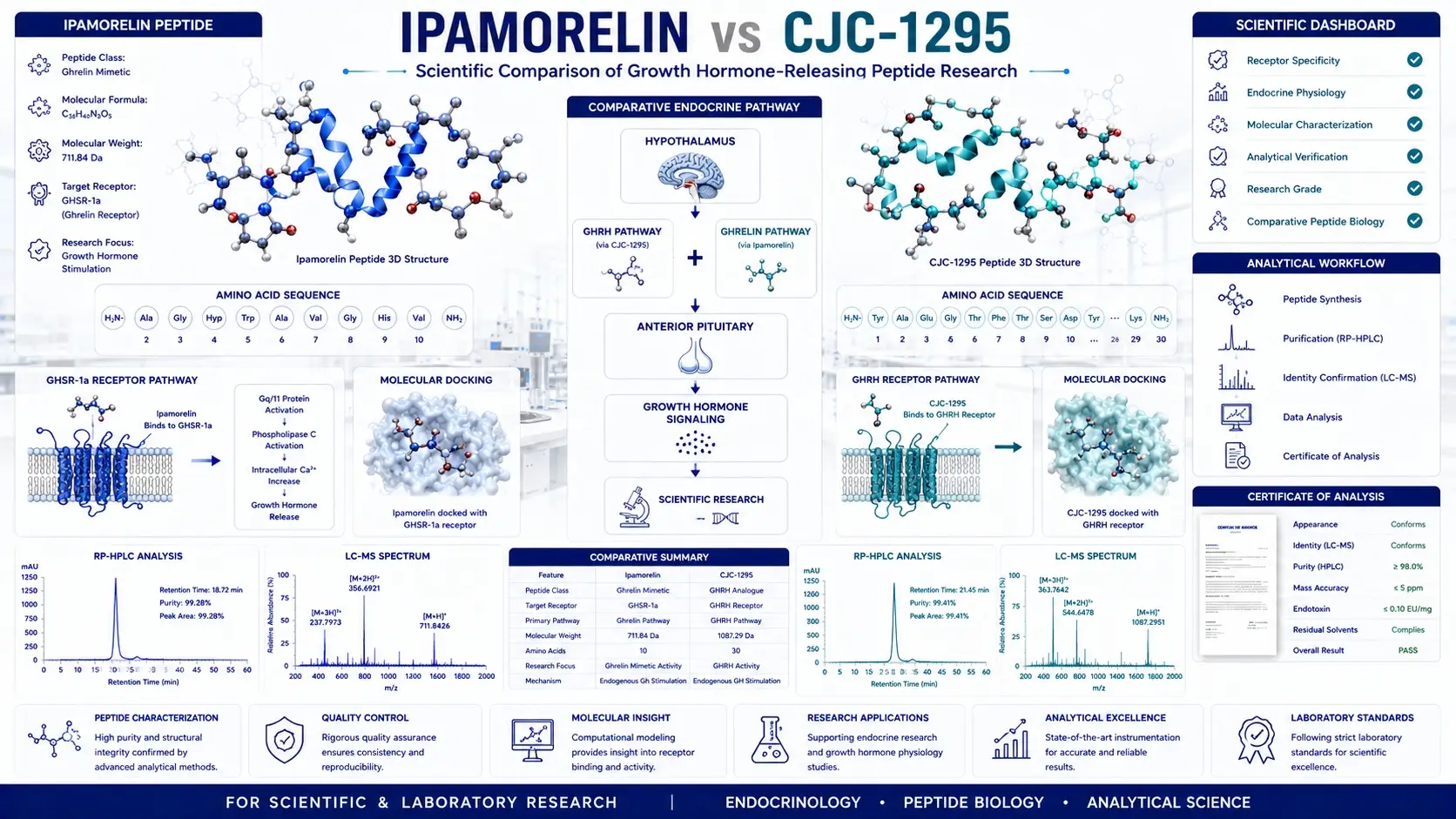
Ipamorelin peptide and CJC-1295 peptide are among the most extensively investigated growth hormone-releasing peptides in endocrine research. Although both influence physiological growth hormone signaling, they act through different biological receptors. Ipamorelin selectively activates the ghrelin receptor (GHSR-1a), while CJC-1295 functions as a growth hormone-releasing hormone (GHRH) analogue targeting the GHRH receptor. Current scientific research investigates both peptides individually and in combination to better understand receptor biology, endocrine communication, and growth hormone regulation under controlled laboratory conditions.
Ipamorelin vs CJC-1295: Stacking or Solo — A Scientific Comparison of Growth Hormone-Releasing Peptide Research
Scientific Snapshot
| Ipamorelin | Selective Growth Hormone Secretagogue |
| CJC-1295 | Synthetic Growth Hormone-Releasing Hormone (GHRH) Analogue |
| Primary Receptors | GHSR-1a (Ipamorelin) & GHRH Receptor (CJC-1295) |
| Scientific Focus | Growth Hormone Physiology, Receptor Biology & Endocrine Signaling |
| Research Status | Well-Characterized Laboratory Research Peptides |
Quick Comparison
| Characteristic | Ipamorelin | CJC-1295 |
|---|---|---|
| Peptide Class | Growth Hormone Secretagogue | GHRH Analogue |
| Primary Target | GHSR-1a Receptor | GHRH Receptor |
| Primary Research Area | Ghrelin Signaling | Growth Hormone Physiology |
| Analytical Verification | RP-HPLC & LC-MS | RP-HPLC & LC-MS |
| Laboratory Use | Solo & Comparative Research | Solo & Comparative Research |
Key Takeaways
- ✓Ipamorelin peptide and CJC-1295 peptide activate different biological receptors involved in growth hormone regulation.
- ✓Current ipamorelin vs CJC-1295 research investigates both peptides individually and together to understand endocrine physiology.
- ✓Researchers compare these peptides with MK-677, GHRP-2, and GHRP-6 to study receptor biology and molecular signaling.
- ✓Both peptides undergo analytical verification using RP-HPLC, LC-MS, peptide sequencing, and Certificates of Analysis before laboratory investigations.
- ✓This guide evaluates peptide stacking research exclusively from a scientific and laboratory perspective without providing recommendations for human use.
Table of Contents
Scientific Research Timeline
Growth hormone secretagogue research has evolved substantially over the past several decades. Scientists initially investigated endogenous growth hormone-releasing hormone before expanding into synthetic GHRH analogues such as CJC-1295 and selective ghrelin receptor agonists like Ipamorelin. Today, comparative laboratory research explores how these peptides influence endocrine signaling individually and in combination while improving understanding of receptor biology and physiological hormone regulation.
| Period | Research Milestone |
|---|---|
| 1980s | Growth hormone-releasing hormone pathways characterized. |
| 1990s | Development of synthetic GHRH analogues and growth hormone secretagogues. |
| 2000s | Comparative endocrine peptide research expands. |
| Present | Integrated investigations evaluate solo and combination peptide signaling using advanced analytical technologies. |
Introduction
Among growth hormone-releasing peptides, few comparisons receive as much scientific attention as Ipamorelin peptide and CJC-1295 peptide. Although both are associated with physiological growth hormone regulation, they activate distinct receptor systems and therefore provide complementary models for investigating endocrine biology. This difference has led researchers to study whether these peptides should be evaluated individually or together in laboratory settings.
Current ipamorelin vs CJC-1295 research also extends beyond these two molecules. Comparative studies frequently include MK-677, GHRP-2, and GHRP-6 to better understand receptor specificity, signaling pathways, and peptide pharmacology. These investigations help scientists characterize how different classes of growth hormone secretagogues interact with the endocrine system under controlled experimental conditions.
This guide examines the available scientific evidence surrounding solo versus stacking research, receptor biology, analytical characterization, peptide quality standards, and current scientific consensus while remaining exclusively focused on laboratory and research applications.
Understanding Ipamorelin vs CJC-1295
Ipamorelin peptide and CJC-1295 peptide are often discussed together because both influence physiological growth hormone regulation, yet they belong to different classes of growth hormone-releasing peptides. Rather than performing identical biological functions, they activate separate receptor systems that converge on the same endocrine pathway. This complementary biology has made them two of the most extensively investigated peptides in growth hormone research.
Ipamorelin functions primarily as a selective ghrelin receptor (GHSR-1a) agonist, whereas CJC-1295 acts as a synthetic analogue of growth hormone-releasing hormone (GHRH). Because these peptides activate different upstream signaling mechanisms, researchers frequently investigate how each influences endocrine communication independently before examining their combined effects in laboratory models.
Current ipamorelin vs CJC-1295 research focuses on receptor biology, hormone pulsatility, intracellular signaling, peptide pharmacology, and endocrine physiology. The objective is to better understand how distinct molecular pathways contribute to growth hormone regulation under controlled experimental conditions.
Comparing Their Mechanisms of Action
Although both peptides ultimately influence endogenous growth hormone secretion, their mechanisms begin with different receptors. Ipamorelin selectively activates the ghrelin receptor, while CJC-1295 binds to the growth hormone-releasing hormone receptor located on somatotroph cells within the anterior pituitary. These distinct initiation points allow researchers to study complementary endocrine signaling pathways within the same physiological system.
| Feature | Ipamorelin Peptide | CJC-1295 Peptide |
|---|---|---|
| Primary Receptor | GHSR-1a (Ghrelin Receptor) | Growth Hormone-Releasing Hormone Receptor |
| Peptide Class | Growth Hormone Secretagogue | GHRH Analogue |
| Primary Scientific Focus | Ghrelin-mediated signaling | Physiological GHRH signaling |
| Growth Hormone Regulation | Indirect physiological stimulation | Physiological receptor activation |
| Research Value | Selective receptor investigation | Endocrine pathway investigation |
Research Insight
Different Receptors, Shared Endocrine Objective
One of the most important findings from comparative peptide research is that Ipamorelin and CJC-1295 activate separate receptor systems while influencing the same physiological growth hormone axis. This complementary biology explains why both peptides continue to be investigated individually and together in endocrine research.
Stacking or Solo: What Current Research Shows
One of the most frequently discussed questions in peptide science is whether Ipamorelin and CJC-1295 should be investigated independently or as part of combination research models. Because the two peptides activate different receptors, scientists have explored whether simultaneous receptor stimulation produces different endocrine signaling characteristics compared with studying each peptide individually.
Current laboratory investigations focus primarily on understanding receptor coordination, hormone pulsatility, intracellular signaling, and physiological regulation rather than determining superiority of one research approach over another. Findings continue to improve scientific understanding of endocrine communication without establishing universal conclusions regarding comparative experimental design.
| Research Model | Scientific Objective | Primary Investigation |
|---|---|---|
| Ipamorelin Alone | Selective ghrelin receptor biology | GHSR-1a signaling |
| CJC-1295 Alone | Growth hormone physiology | GHRH receptor activation |
| Combination Research | Integrated endocrine signaling | Complementary receptor interaction |
Why Researchers Compare These Peptides
Comparative peptide investigations help scientists understand how different receptor systems influence endocrine physiology. By evaluating receptor specificity, signaling efficiency, molecular stability, and downstream biological responses, researchers gain deeper insights into the complex regulatory mechanisms governing endogenous growth hormone secretion.
These comparisons also contribute to peptide engineering, computational modeling, receptor pharmacology, and the development of future experimental peptides designed to investigate endocrine biology with even greater precision.
Did You Know?
Growth Hormone Regulation Depends on Multiple Signaling Systems
Endogenous growth hormone secretion is regulated through coordinated interactions between growth hormone-releasing hormone, ghrelin signaling, somatostatin, and multiple endocrine feedback mechanisms. Comparative peptide research helps scientists investigate how each component contributes to physiological hormone regulation.
Key Takeaway
Current ipamorelin vs CJC-1295 research demonstrates that these peptides are scientifically complementary rather than interchangeable. Their distinct receptor specificity provides researchers with valuable opportunities to investigate multiple components of physiological growth hormone regulation and endocrine signaling.
Ipamorelin Peptide Research Benefits and Scientific Considerations
The phrase “ipamorelin peptide research benefits and risks” commonly appears in scientific literature searches, but within laboratory science these terms have specific meanings. Researchers evaluate the scientific value of Ipamorelin by examining receptor selectivity, endocrine physiology, signaling pathways, molecular pharmacology, and analytical reproducibility. Likewise, scientific considerations primarily relate to experimental design, peptide quality, analytical verification, and interpretation of laboratory findings rather than clinical outcomes.
Because Ipamorelin selectively activates the ghrelin receptor (GHSR-1a), it provides investigators with a valuable experimental model for studying physiological growth hormone regulation while minimizing activation of unrelated endocrine pathways. This receptor specificity continues to make Ipamorelin one of the most frequently investigated growth hormone secretagogues in peptide science.
Scientific Value of Ipamorelin Research
Rather than evaluating therapeutic outcomes, laboratory investigations focus on how Ipamorelin contributes to understanding endocrine regulation and receptor biology. The peptide’s selective mechanism enables researchers to isolate specific physiological processes while generating reproducible experimental data.
| Research Focus | Scientific Contribution | Laboratory Importance |
|---|---|---|
| Receptor Biology | Selective GHSR-1a activation | Improves understanding of ghrelin signaling |
| Endocrine Physiology | Growth hormone regulation | Supports hormone pathway research |
| Peptide Pharmacology | Receptor interaction studies | Advances peptide science |
| Analytical Chemistry | Peptide characterization | Improves experimental reproducibility |
| Comparative Research | Evaluation against other peptides | Expands endocrine knowledge |
Research Insight
Receptor Selectivity Is One of Ipamorelin’s Defining Scientific Characteristics
Among growth hormone secretagogues, Ipamorelin is frequently investigated because of its highly selective interaction with the ghrelin receptor. This specificity enables researchers to study endocrine signaling with reduced interference from unrelated receptor systems, improving experimental precision.
CJC-1295 vs Ipamorelin vs MK-677 Comparison
One of the most common topics in endocrine peptide research is the comparison between CJC-1295, Ipamorelin, and MK-677. Although each compound is investigated in relation to growth hormone physiology, they differ substantially in molecular classification, receptor interactions, and biological mechanisms. These distinctions make comparative studies valuable for understanding endocrine regulation from multiple scientific perspectives.
| Characteristic | Ipamorelin | CJC-1295 | MK-677 |
|---|---|---|---|
| Classification | Growth Hormone Secretagogue | GHRH Analogue | Non-peptide Ghrelin Receptor Agonist |
| Primary Target | GHSR-1a | GHRH Receptor | GHSR-1a |
| Scientific Focus | Selective receptor biology | Endocrine physiology | Ghrelin pathway research |
| Research Category | Peptide | Peptide | Small molecule |
| Analytical Methods | RP-HPLC & LC-MS | RP-HPLC & LC-MS | Chromatographic & spectrometric analysis |
Ipamorelin, CJC-1295 vs GHRP-2 & GHRP-6
Researchers also compare Ipamorelin and CJC-1295 with earlier generations of growth hormone-releasing peptides such as GHRP-2 and GHRP-6. These comparative investigations examine receptor selectivity, signaling characteristics, peptide engineering, and endocrine physiology to better understand how advances in peptide design have influenced laboratory research.
| Peptide | Primary Target | Research Focus |
|---|---|---|
| Ipamorelin | GHSR-1a | Selective ghrelin receptor biology |
| CJC-1295 | GHRH Receptor | Growth hormone physiology |
| GHRP-2 | GHSR-1a | Growth hormone secretagogue research |
| GHRP-6 | GHSR-1a | Early peptide pharmacology research |
Did You Know?
Modern Peptide Engineering Prioritizes Receptor Specificity
One of the major goals of peptide engineering is to improve receptor selectivity while maintaining predictable biological activity. Comparative research involving Ipamorelin, CJC-1295, GHRP-2, and GHRP-6 has contributed significantly to understanding how structural modifications influence receptor interactions and endocrine signaling.
Key Takeaway
Comparative research demonstrates that Ipamorelin, CJC-1295, MK-677, GHRP-2, and GHRP-6 each contribute unique scientific insights into endocrine signaling and growth hormone physiology. Rather than functioning as direct substitutes, these compounds help researchers investigate complementary aspects of receptor biology and peptide pharmacology.
Analytical Characterization of Ipamorelin and CJC-1295
Regardless of whether researchers investigate Ipamorelin peptide, CJC-1295 peptide, or both within comparative laboratory studies, analytical characterization remains an essential prerequisite before experimental work begins. High-quality peptide research depends on verifying molecular identity, purity, sequence integrity, and manufacturing consistency through standardized analytical methodologies.
Modern peptide laboratories routinely combine multiple complementary analytical techniques because no single method can completely characterize a peptide. Together, RP-HPLC, LC-MS, peptide sequencing, and supporting documentation provide researchers with confidence that experimental materials accurately represent their intended molecular structures.
Standard Analytical Methods Used in Comparative Peptide Research
Comparative investigations require both peptides to undergo identical analytical quality assessment before researchers evaluate receptor biology, endocrine signaling, or molecular pharmacology. Consistent quality control minimizes experimental variability while improving reproducibility across independent laboratories.
| Analytical Technique | Primary Purpose | Scientific Value |
|---|---|---|
| RP-HPLC | Purity assessment | Detects impurities and confirms analytical quality |
| LC-MS | Molecular identity verification | Confirms expected molecular mass |
| Peptide Sequencing | Sequence confirmation | Verifies amino acid arrangement |
| Certificate of Analysis | Quality documentation | Provides batch-specific analytical records |
| Stability Testing | Evaluate molecular integrity | Supports reproducible laboratory research |
Research Insight
Reliable Comparative Research Depends on Equal Analytical Standards
When two peptides are compared within the same investigation, analytical consistency is essential. Researchers minimize bias by ensuring that both Ipamorelin and CJC-1295 meet comparable quality standards before evaluating differences in receptor biology or endocrine signaling.
Analytical Considerations for Combination Research
Studies investigating Ipamorelin and CJC-1295 together require careful experimental planning to distinguish individual receptor activity from combined physiological responses. Researchers therefore place significant emphasis on standardized laboratory procedures, validated analytical methods, and consistent peptide characterization before interpreting experimental observations.
From an analytical perspective, combination research introduces additional variables that must be controlled throughout study design. These include peptide stability, storage conditions, batch consistency, analytical verification, and documented laboratory protocols that support reproducibility across independent investigations.
Certificates of Analysis and Laboratory Documentation
Comprehensive Certificates of Analysis (COAs) provide the analytical documentation needed to verify peptide quality before laboratory use. Researchers commonly review batch-specific reports containing purity data, molecular identity, analytical methodology, and manufacturing records to confirm that experimental materials satisfy established quality requirements.
Because reproducibility remains a cornerstone of scientific research, transparent documentation and standardized analytical reporting are essential components of high-quality peptide investigations involving either single peptides or comparative experimental designs.
Why Reproducibility Matters in Peptide Research
Scientific conclusions are only as reliable as the materials and methodologies used to generate them. By combining rigorous analytical verification with standardized laboratory protocols, researchers improve confidence that observed biological responses reflect genuine peptide activity rather than variability in manufacturing, storage, or experimental handling.
These quality assurance principles apply equally to Ipamorelin peptide, CJC-1295 peptide, and all comparative endocrine research involving growth hormone-releasing peptides.
Did You Know?
Multiple Analytical Techniques Are Required to Fully Characterize Research Peptides
RP-HPLC evaluates peptide purity, while LC-MS confirms molecular identity. Peptide sequencing verifies amino acid order, and stability testing assesses molecular integrity over time. Together, these complementary techniques provide researchers with a comprehensive understanding of peptide quality before laboratory experimentation.
Key Takeaway
High-quality comparative peptide research depends on rigorous analytical characterization, standardized quality assurance, and reproducible laboratory methodology. By applying consistent analytical standards to both Ipamorelin and CJC-1295, researchers can generate more reliable insights into endocrine signaling, receptor biology, and growth hormone physiology.
Current Scientific Consensus
Current scientific evidence recognizes both Ipamorelin peptide and CJC-1295 peptide as valuable research tools for investigating physiological growth hormone regulation. Although they activate different receptor systems, both peptides have contributed significantly to expanding scientific understanding of endocrine communication, receptor pharmacology, peptide biology, and molecular signaling.
Researchers generally view these peptides as complementary rather than interchangeable. Because Ipamorelin selectively targets the ghrelin receptor while CJC-1295 activates the growth hormone-releasing hormone receptor, comparative investigations continue to provide important insights into how multiple endocrine pathways coordinate physiological growth hormone secretion.
Future Directions in Comparative Peptide Research
As peptide science advances, researchers are increasingly integrating computational biology, structural bioinformatics, artificial intelligence, and systems endocrinology with traditional laboratory experimentation. These technologies allow scientists to predict peptide-receptor interactions, evaluate molecular stability, and investigate endocrine signaling with greater precision than ever before.
Future comparative studies involving Ipamorelin peptide and CJC-1295 peptide are expected to further explore receptor dynamics, intracellular signaling networks, peptide engineering, molecular modeling, and endocrine physiology. These investigations will continue improving scientific understanding of growth hormone regulation while supporting the development of next-generation research peptides.
| Emerging Research Area | Scientific Objective |
|---|---|
| Artificial Intelligence | Predict peptide-receptor interactions |
| Computational Modeling | Visualize molecular binding dynamics |
| Structural Biology | Characterize receptor activation mechanisms |
| Peptide Engineering | Develop improved research analogues |
| Systems Endocrinology | Investigate integrated hormone signaling networks |
Research Insight
Comparative Research Strengthens Scientific Understanding of Endocrine Biology
Investigating multiple growth hormone-releasing peptides under standardized laboratory conditions allows researchers to distinguish receptor-specific biological responses from broader endocrine regulation. These comparative studies continue to improve scientific understanding of physiological signaling while supporting advances in peptide pharmacology and molecular endocrinology.
Research Best Practices
Reliable comparative peptide investigations require standardized analytical verification, consistent laboratory procedures, and transparent scientific documentation. These quality practices help ensure that differences observed during experimentation reflect genuine biological mechanisms rather than variations in peptide quality or laboratory methodology.
- ✓Verify the identity and purity of every peptide using validated analytical techniques before beginning laboratory investigations.
- ✓Use Certificates of Analysis and batch documentation to maintain analytical consistency throughout comparative studies.
- ✓Maintain standardized storage, handling, and stability procedures for all peptide samples included in an investigation.
- ✓Interpret experimental findings within the context of peer-reviewed scientific literature and validated laboratory methodologies.
- ✓Document all experimental procedures thoroughly to improve reproducibility across independent laboratories and future comparative investigations.
Why Comparative Peptide Studies Continue to Matter
Comparative peptide research extends beyond identifying similarities and differences between individual molecules. By examining receptor specificity, signaling pathways, peptide engineering, and endocrine regulation within the same experimental framework, researchers gain broader insights into the complex biological systems governing hormone physiology.
Studies comparing Ipamorelin peptide, CJC-1295 peptide, MK-677, GHRP-2, and GHRP-6 continue to contribute valuable knowledge that supports peptide chemistry, molecular biology, endocrine science, and future biotechnology innovation.
Related Research Articles
Continue Exploring Peptide Science
Expand your understanding of growth hormone-releasing peptides and endocrine biology with these related scientific guides from Peptides Library.
Did You Know?
Comparative Endocrine Research Continues to Shape Next-Generation Peptide Science
Many advances in peptide engineering originate from comparative laboratory studies. By evaluating how different peptide structures influence receptor activation and endocrine signaling, researchers continue refining molecular design and improving scientific understanding of growth hormone physiology.
Section Summary
Current scientific evidence supports both Ipamorelin peptide and CJC-1295 peptide as complementary research tools for investigating endocrine physiology. Their distinct receptor mechanisms, combined with rigorous analytical characterization and standardized laboratory methodologies, continue to provide valuable insights into growth hormone regulation, receptor biology, and peptide pharmacology.
Frequently Asked Questions
1. What is the difference between Ipamorelin peptide and CJC-1295 peptide?
Ipamorelin peptide selectively activates the ghrelin receptor (GHSR-1a), whereas CJC-1295 peptide is a synthetic growth hormone-releasing hormone (GHRH) analogue that targets the GHRH receptor. Although both influence physiological growth hormone regulation, they initiate signaling through different biological pathways.
2. What does current ipamorelin vs CJC-1295 research focus on?
Current research investigates receptor biology, endocrine signaling, peptide pharmacology, molecular mechanisms, analytical characterization, and physiological growth hormone regulation. Comparative studies help scientists understand how these peptides function independently and within controlled laboratory models.
3. Why are Ipamorelin and CJC-1295 frequently studied together?
Researchers investigate both peptides together because they activate complementary receptor systems involved in growth hormone regulation. Comparative laboratory studies improve understanding of endocrine communication, receptor coordination, and physiological hormone signaling without implying superiority of one peptide over the other.
4. How does MK-677 differ from Ipamorelin and CJC-1295?
MK-677 differs structurally because it is a non-peptide ghrelin receptor agonist, whereas Ipamorelin and CJC-1295 are peptide-based compounds. Comparative research examines how these molecular differences influence receptor interactions and endocrine physiology under laboratory conditions.
5. Why are GHRP-2 and GHRP-6 included in comparative peptide research?
GHRP-2 and GHRP-6 represent earlier generations of growth hormone secretagogues. Researchers compare them with Ipamorelin and CJC-1295 to investigate receptor selectivity, peptide engineering, endocrine signaling, and the evolution of growth hormone-releasing peptide research.
6. What are the primary research benefits of studying Ipamorelin?
Scientific investigations highlight Ipamorelin’s value for studying selective ghrelin receptor activation, endocrine physiology, receptor pharmacology, and molecular signaling. These represent research applications rather than therapeutic or clinical benefits.
7. How are Ipamorelin and CJC-1295 analytically verified?
Laboratories commonly verify both peptides using RP-HPLC purity analysis, LC-MS identity confirmation, peptide sequencing where appropriate, stability testing, and Certificates of Analysis documenting batch-specific quality information.
8. What is the purpose of peptide stacking research?
From a scientific perspective, stacking research investigates how multiple receptor pathways interact under controlled laboratory conditions. Researchers evaluate complementary endocrine signaling, receptor biology, and physiological mechanisms rather than establishing recommendations for use.
9. Why are Certificates of Analysis important for peptide research?
Certificates of Analysis document analytical testing, including purity measurements, molecular identity verification, and batch-specific quality information. These records support reproducibility, transparency, and laboratory quality assurance.
10. Why is reproducibility essential in comparative peptide studies?
Reproducibility ensures that observed experimental findings result from genuine biological mechanisms rather than differences in peptide quality, laboratory procedures, or analytical methods. Standardized protocols strengthen confidence in scientific conclusions.
11. What research disciplines commonly investigate these peptides?
Ipamorelin and CJC-1295 are studied across endocrinology, molecular biology, receptor pharmacology, peptide chemistry, analytical science, structural biology, computational biology, and biotechnology research.
12. Why do these peptides remain important in modern research?
Their distinct receptor specificity, well-characterized molecular mechanisms, and extensive scientific literature continue to make Ipamorelin and CJC-1295 valuable reference molecules for investigating growth hormone physiology, endocrine signaling, and peptide biology.
Scientific Resources & References
The following scientific resources provide additional information on growth hormone physiology, peptide pharmacology, analytical characterization, receptor biology, and laboratory research methodologies.
Final Takeaway
Ipamorelin and CJC-1295 Continue to Advance Endocrine Peptide Research
Current scientific evidence demonstrates that Ipamorelin peptide and CJC-1295 peptide provide complementary approaches for investigating physiological growth hormone regulation. Their distinct receptor mechanisms, combined with rigorous analytical characterization and reproducible laboratory methodologies, continue to support advances in endocrine physiology, receptor biology, peptide pharmacology, and molecular biotechnology. As comparative peptide research evolves, these well-characterized molecules remain valuable reference standards for understanding the complexity of growth hormone signaling pathways.
Research Disclaimer
The information presented in this article is intended exclusively for educational and laboratory research purposes. Ipamorelin peptide, CJC-1295 peptide, and related compounds are discussed solely from a scientific perspective. This content does not constitute medical advice, treatment recommendations, dosing guidance, or instructions for human use. Readers should interpret all findings within the context of peer-reviewed scientific literature, validated laboratory methodologies, applicable regulations, and accepted Good Laboratory Practices (GLP).