


1295/7: Definitive Math Answer and Long Division — Essential
1295 divided by 7 equals 185 exactly. Get the definitive long division steps, fraction form, divisibility check, and prime factorization. Research use only.
📋 Table of Contents
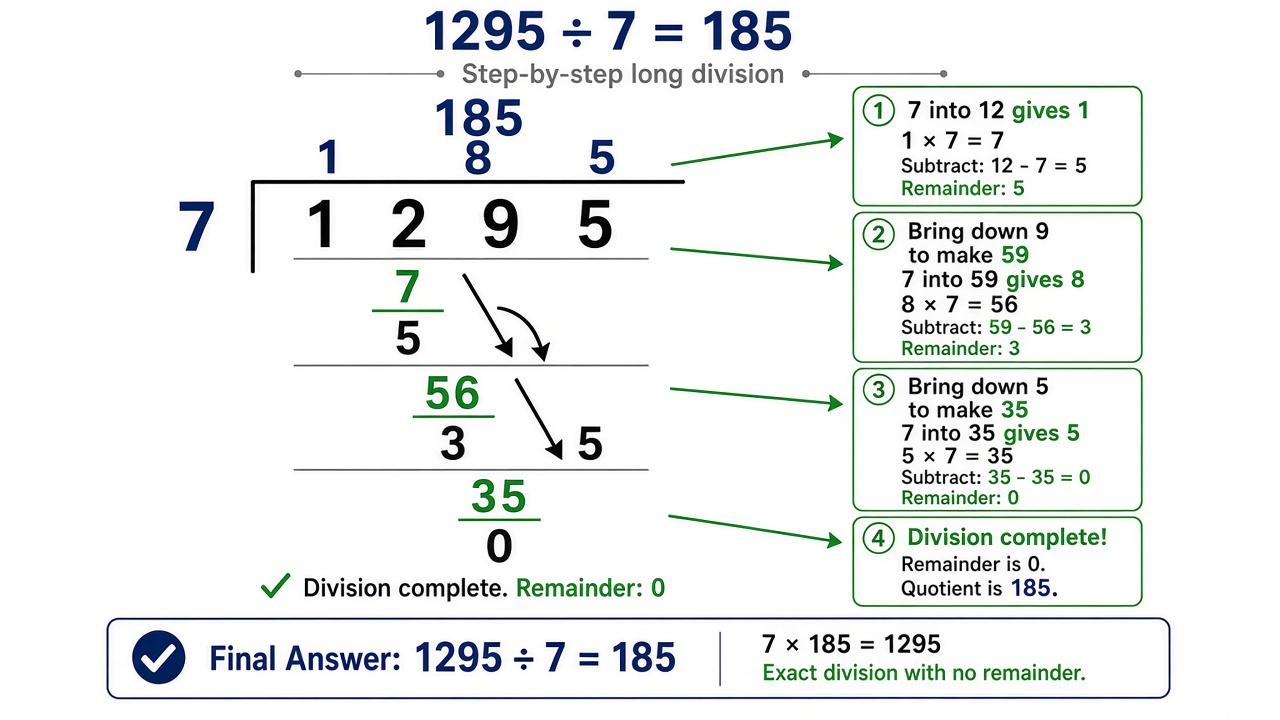
1295 divided by 7 equals 185 exactly, with a remainder of 0. Because 185 is a whole number, the division terminates immediately without decimals, and 1295 is divisible by 7.
⚠️ Research Use Only Notice: The products discussed on this site are sold strictly for in vitro laboratory research purposes only. They are not for human use, not for veterinary use, and not intended to diagnose, treat, cure, or prevent any disease. All information presented is for educational purposes in a research context. Must be 21+ to purchase.
Key takeaways
- The exact quotient of 1295/7 is 185, an integer with no fractional remainder.
- Long division confirms that 7 × 185 = 1295, so the dividend is divisible by 7.
- As a fraction, 1295/7 simplifies to the mixed number 185 (or 185/1).
- Prime factorization of 1295 is 5 × 7 × 37, revealing why 7 is a factor.
- In peptide research, exact division supports precise molar and dilution calculations (research use only).
What Is 1295 Divided by 7? Exact Answer and Remainder
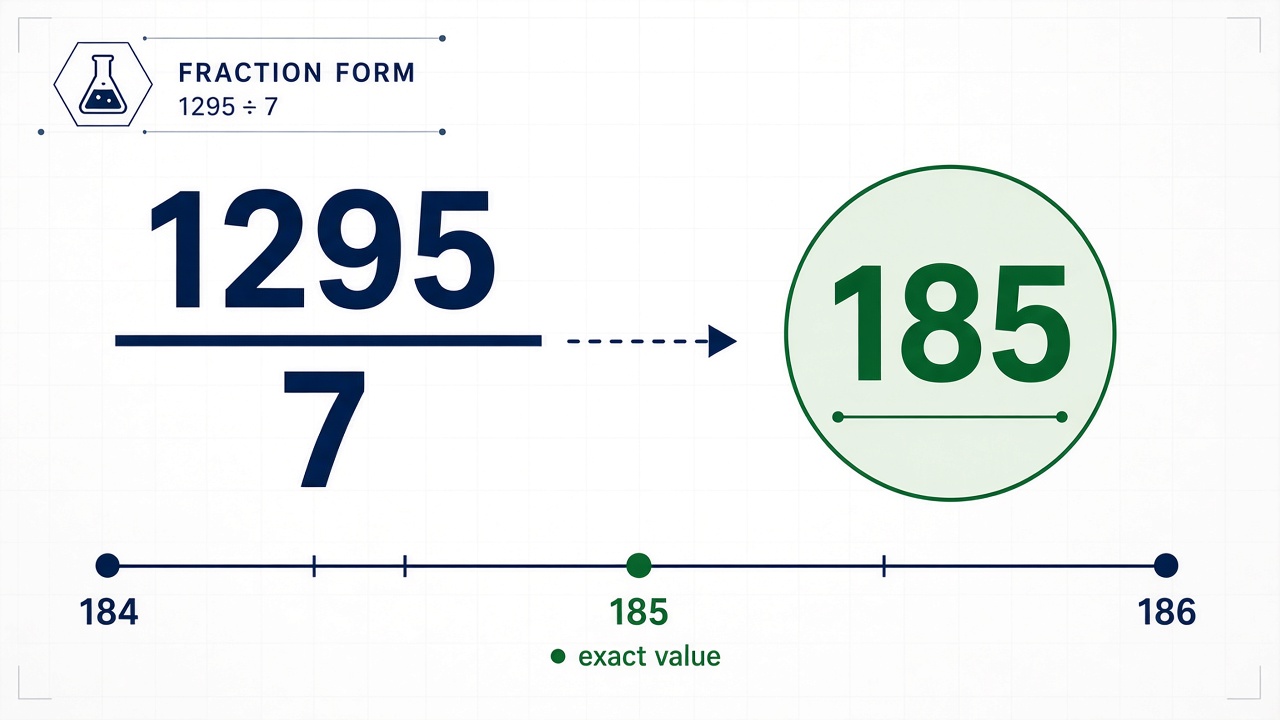
When you compute 1295 divided by 7, the exact answer is 185. Because 185 is a whole number, 1295 divided by 7 has no remainder; the remainder is 0.
In modular arithmetic, 1295 mod 7 equals 0. This means 7 divides 1295 evenly, so the division is exact.
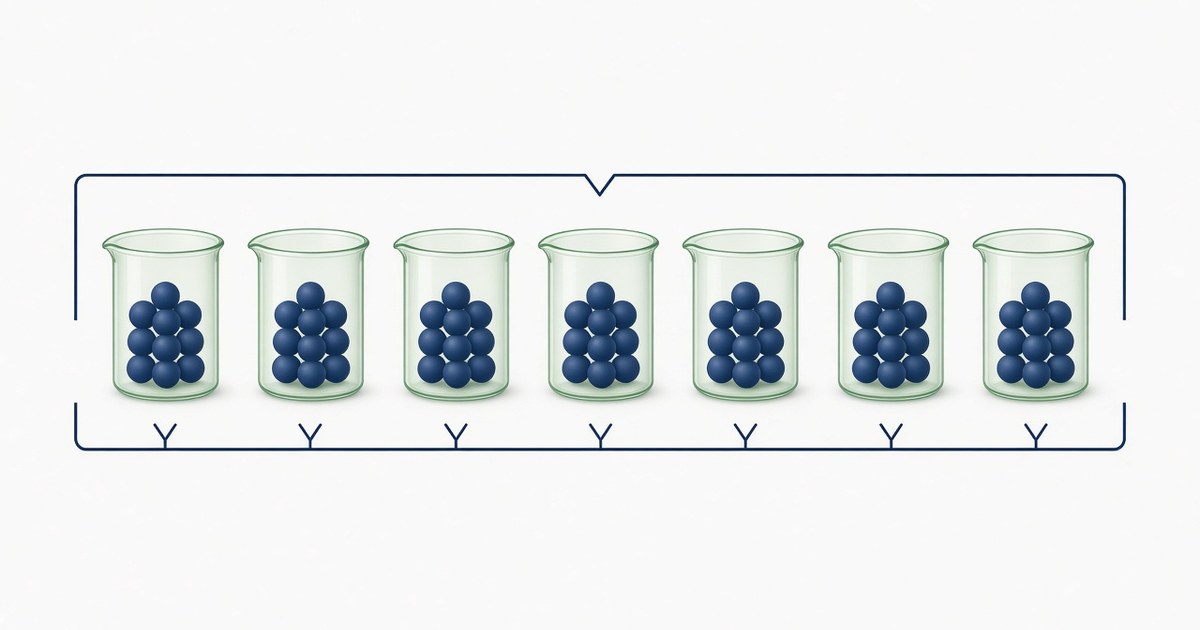
For any division problem, the relationship dividend = divisor × quotient + remainder holds. Here, 1295 = 7 × 185 + 0, so 1295 represents a complete partition into 7 equal groups of 185.
This result is exact, not approximate. Unlike divisions that produce repeating decimals, 1295 divided by 7 terminates immediately as an integer.
In decimal notation, 1295 divided by 7 equals 185.0, with no fractional digits. Researchers who rely on exact values for aliquot preparation or concentration calculations can treat this quotient as a fixed constant without rounding error.
The quotient 185 is also the product of the remaining prime factors after removing 7 from 1295. This property is explored later under prime factorization.
How Do You Perform Long Division of 1295 Step by Step?
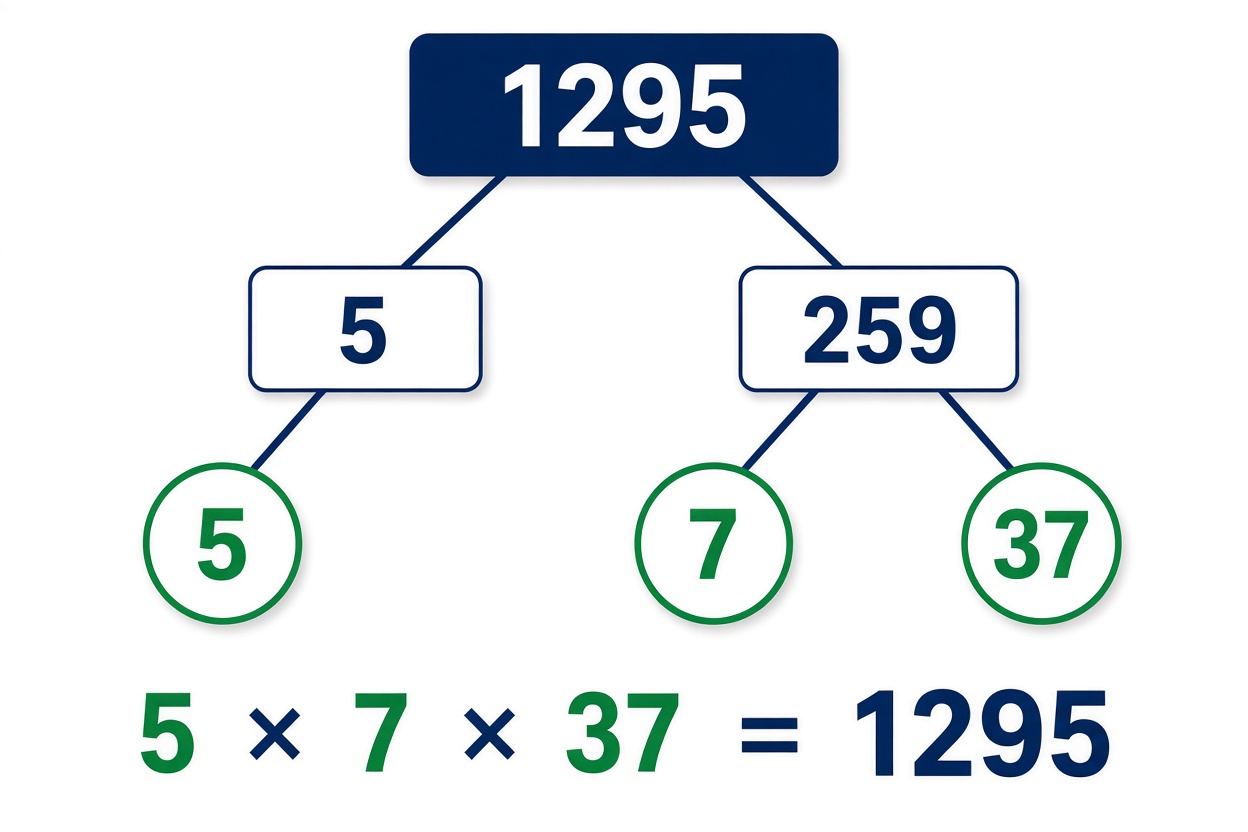
To perform long division for 1295 divided by 7, follow the standard algorithm: divide, multiply, subtract, bring down, and repeat until all digits of the dividend are used.
Step 1: Set up the problem. Write 1295 as the dividend under the division bar and 7 as the divisor outside. Because the first digit 1 is smaller than 7, consider the first two digits, 12. Ask how many times 7 fits into 12 without exceeding it. The answer is 1, because 1 × 7 = 7, while 2 × 7 = 14 would exceed 12.
Step 2: First quotient digit. Write the digit 1 above the division bar. Multiply 1 by 7 to get 7. Subtract 7 from 12 to get 5. Bring down the next digit, 9, to form 59. The remainder 5 is now the tens digit of the new number.
Step 3: Second quotient digit. Divide 59 by 7. The largest multiple of 7 not exceeding 59 is 56, which is 8 × 7. Write 8 above the division bar next to the 1. Subtract 56 from 59 to get 3. Bring down the final digit, 5, to form 35.
Step 4: Final quotient digit. Divide 35 by 7. Since 5 × 7 = 35 exactly, write 5 above the division bar. Subtract 35 from 35 to get 0. No digits remain to bring down, so the process stops. The quotient is 185, and the remainder is 0, confirming that 1295 divided by 7 equals 185.
The long division steps for 1295 divided by 7 appear in the table below.
| Step | Calculation | Quotient digit | Remainder |
|——|————-|—————-|———–|
| 1 | 12 ÷ 7 = 1 with remainder 5 | 1 | 5 |
| 2 | Bring down 9 → 59 ÷ 7 = 8 with remainder 3 | 8 | 3 |
| 3 | Bring down 5 → 35 ÷ 7 = 5 with remainder 0 | 5 | 0 |
! 1295 divided by 7 long division steps
The table confirms that each digit of the quotient for 1295 divided by 7 is 1, 8, and 5. This step-by-step method works for any division, but when the remainder is zero, the quotient is exact.
Alternative: chunking method. Some researchers prefer the chunking method for mental arithmetic. To divide 1295 by 7, subtract large chunks of 7: start with 700 (100 × 7), leaving 595. Subtract 560 (80 × 7), leaving 35. Subtract 35 (5 × 7), leaving 0. The sum of chunk multipliers is 100 + 80 + 5 = 185. This approach avoids the formal long division bar but yields the same exact quotient.
What Are Common Mistakes to Avoid When Dividing 1295 by 7?
A frequent error is placing the first quotient digit above the wrong column when working with 1295. Because the first digit 1 is smaller than 7, the first quotient digit 1 must align above the tens column of 1295, not above the thousands column.
Another mistake is forgetting to bring down a digit after subtraction. In the second step, after subtracting 56 from 59, you must bring down the final digit 5 to form 35. Skipping this step gives an incorrect remainder and quotient.
Rounding the quotient too early is also problematic. Since 1295 divided by 7 is exactly 185, any rounded value such as 185.0 or 185.00 is acceptable only if the context requires decimal notation. However, treating 1295/7 as approximately 185.0 without recognizing the exact integer can obscure the fact that the remainder is zero.
Which Methods Can You Use to Divide 1295 by 7 Beyond Long Division?
Beyond the standard long division algorithm, you can divide 1295 by 7 using repeated subtraction, chunking, or prime factorization. Repeated subtraction works by subtracting 7 from 1295 a total of 185 times, which is impractical but conceptually valid.
The chunking method described above groups multiples of 7 into large blocks, reducing the number of steps. Prime factorization offers another route: factor 1295 as 5 × 7 × 37, cancel the common factor 7, and the remaining product 5 × 37 equals 185. This method confirms the quotient without performing digit-by-digit division.
A calculator can verify the result, but researchers should understand the manual method to detect input errors. The exact quotient 185 from 1295 divided by 7 should appear on any reliable calculator.
💡 Key Takeaway: How Do You Perform Long Division of 1295 Step by Step?
💡 Key Takeaway: How Do You Perform Long Division of 1295 Step by Step?
How Do You Express 1295 as a Fraction and Mixed Number?
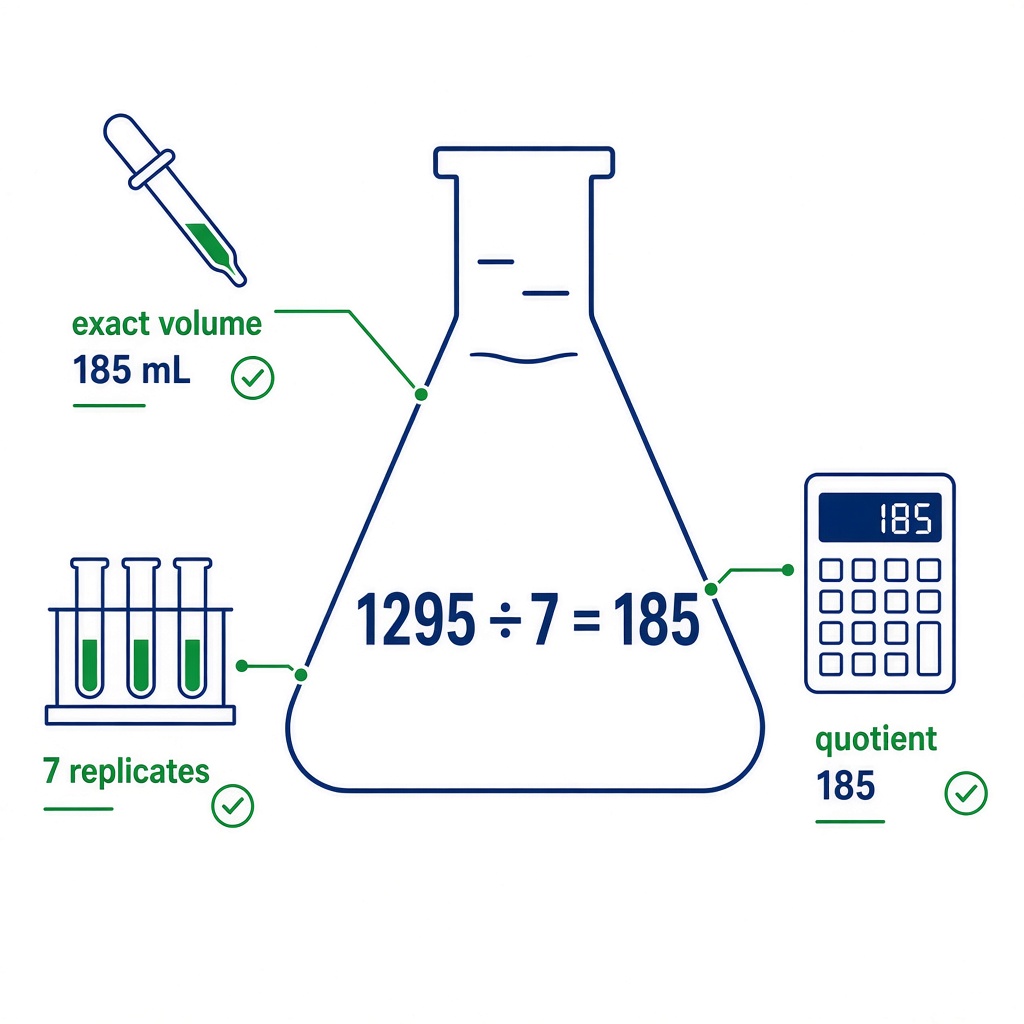
The fraction 1295/7 is an improper fraction because the numerator 1295 is greater than the denominator 7. To convert 1295/7 to a mixed number, divide the numerator by the denominator: 1295 ÷ 7 = 185 with remainder 0. Since the remainder is 0, the mixed number is simply 185, often written as 185 0/7 or 185.
As a fraction in lowest terms, 1295/7 reduces to 185/1 because both numerator and denominator share a common factor of 7. Specifically, 1295/7 = (7 × 185) / 7 = 185/1 = 185. Thus, 1295/7 is equivalent to the integer 185.
When the numerator is an exact multiple of the denominator, the improper fraction simplifies to a whole number. Here, 1295 = 7 × 185, so the denominator cancels completely. In general, a fraction a/b simplifies to an integer c if a = b × c. For 1295/7, c = 185. This is the simplest form, because no common factor remains between 185 and 1.
Since 1295/7 is an integer, its decimal expansion is 185.0 with no repeating or terminating fractional part. In some contexts, the decimal point is omitted, but writing 185.0 clarifies that no rounding occurred. This is important in laboratory records where exact values matter.
Fractional equivalents of 1295/7 include 185/1, 370/2 (multiplying numerator and denominator by 2), 555/3 (multiplying by 3), and 185 (simplest form). These equivalents show that 1295/7 is a rational number with an integer value. In peptide research, such exactness prevents dilution errors when scaling stock solutions.
The table below lists several equivalent fractions for 1295/7 and their decimal values.
| Fraction | Numerator | Denominator | Decimal value |
|———-|———–|————-|—————|
| 1295/7 | 1295 | 7 | 185.0 |
| 185/1 | 185 | 1 | 185.0 |
| 370/2 | 370 | 2 | 185.0 |
| 555/3 | 555 | 3 | 185.0 |
! 1295 over 7 fraction simplification
How Can You Verify 1295 Division and Check Divisibility by 7?
To verify that 1295 divided by 7 equals 185, multiply the quotient by the divisor: 185 × 7. The product is 185 × 7 = 1295, which matches the original dividend, so the division is correct. Another verification method uses the inverse operation: since 1295/7 = 185, then 185 × 7 = 1295.
Divisibility by 7: A number is divisible by 7 if the division yields an integer remainder of 0. Here, 1295/7 yields 185 with remainder 0, so 1295 is divisible by 7. Modular check: 1295 mod 7 = 0; because 7 × 185 = 1295 exactly, 1295/7 is an integer.
The fundamental theorem of arithmetic states that if a ÷ b = c, then b × c = a. For 1295/7, b = 7, c = 185, and a = 1295. Multiplying 7 by 185 can be done mentally: 7 × 100 = 700, 7 × 80 = 560, 7 × 5 = 35; sum = 700 + 560 + 35 = 1295. This confirms the quotient without relying on a calculator.
A common divisibility test for 7 involves doubling the last digit and subtracting it from the rest of the number. For 1295, the last digit is 5; double it to 10. The rest is 12. Then 129 – 10 = 119. Repeat: last digit of 119 is 9, double to 18, rest is 11, 11 – 18 = -7, which is divisible by 7. This test confirms that 1295 is divisible by 7.
You can also verify 1295/7 using prime factorization. Since 1295 factors as 5 × 7 × 37, the factor 7 cancels, leaving 5 × 37 = 185. This cross-check works because 7 is a prime factor of 1295, guaranteeing an integer quotient.
! 1295 divisibility by 7 check
What Are the Prime Factorization and Number Properties of 1295?
The prime factorization of 1295 is 5 × 7 × 37. This means 1295 can be expressed as the product of the primes 5, 7, and 37, each appearing once. Because 7 is one of the prime factors, 1295 is divisible by 7.
The quotient 185 from 1295 divided by 7 equals 5 × 37, which are the remaining prime factors after removing 7. This factorization confirms that 1295/7 is an integer, since 7 is a factor of 1295.
Number properties of 1295: it is an odd composite number with exactly three distinct prime factors. The total number of positive divisors of 1295 is 8, calculated as (1+1)(1+1)(1+1) = 8. The divisors of 1295 are 1, 5, 7, 35, 37, 185, 259, and 1295. Because 7 appears in the prime factorization, 1295 divides evenly by 7.
Additional arithmetic facts about 1295: the digital root of 1295 is 1+2+9+5 = 17, then 1+7 = 8, so 1295 has digital root 8. The number 1295 is not a perfect square because its prime factors all appear to the first power. The parity of 1295 is odd, and the last digit is 5, so 1295 is divisible by 5 but not by 2 or 10. These properties help researchers cross-check calculations involving 1295.
The table below summarizes the key number properties of 1295.
| Property | Value for 1295 |
|———-|—————-|
| Parity | Odd |
| Prime factorization | 5 × 7 × 37 |
| Number of distinct prime factors | 3 |
| Total positive divisors | 8 |
| Digital root | 8 |
| Last digit | 5 |
| Divisible by 7? | Yes, quotient 185 |
💡 Key Takeaway: What Are the Prime Factorization and Number Properties of 1295?
Why Might 1295 Be Confused with the Year 1295?
The integer 1295 appears as a historical year in the Gregorian calendar, which can cause confusion in research documents. In arithmetic, 1295 is simply the dividend in the expression 1295/7, and the exact quotient 185 has no historical connotation. Laboratory records should label 1295 as a numeric value, not a date, to avoid misinterpretation.
When 1295 is used as a concentration or count in research protocols, the arithmetic operation 1295 ÷ 7 must be separated from any calendar reference. The long division result 185 remains the same regardless of context, but clarity in documentation prevents errors. This guide treats 1295 strictly as an integer for mathematical purposes.
In historical contexts, the year 1295 falls in the 13th century, but this fact has no bearing on the arithmetic properties of the integer 1295. Researchers working with peptide libraries, for example, may encounter 1295 as a batch number, a molecular weight value, or a volume in microliters. In all such cases, 1295 should be handled as a numeric operand, not as a date.
Research use only: The products discussed on this site are sold strictly for in vitro laboratory research purposes only. They are not for human use, not for veterinary use, and not intended to diagnose, treat, cure, or prevent any disease. All information presented is for educational purposes in a research context. Must be 21+ to purchase.
How Does Exact Division Like 1295 Support Laboratory Calculations?
Exact division of 1295 by 7 yields the integer 185, which is valuable in research settings where rounding errors can compromise reproducibility. For example, if a researcher must divide 1295 microliters of a stock solution into 7 equal aliquots, each aliquot receives exactly 185 microliters, with no residual volume. This precision matters when preparing serial dilutions or scaling peptide concentrations.
In peptide research, exact numeric reasoning supports molar calculations, mass balances, and buffer preparations. A quotient of 185 from 1295/7 can represent a count of molecules, a volume in microliters, or a weight in micrograms, depending on the protocol. The absence of a remainder means no volume is lost to rounding.
Consider a scenario where a researcher has 1295 micrograms of a lyophilized peptide and needs to reconstitute it into 7 equal vials. Each vial receives 185 micrograms exactly. If the division were not exact, one vial would receive a slightly different mass, introducing variability into downstream assays. The integer quotient of 1295/7 eliminates this variability.
Another laboratory application involves dilution factors. If a stock solution has a concentration of 1295 units per milliliter and must be diluted 7-fold, the resulting concentration is 185 units per milliliter. This exact value can be used in further calculations without rounding error, which is critical for dose-response curves and enzyme kinetics studies.
Researchers who purchase peptide libraries should confirm supplier certificates of analysis (COAs) to ensure the numeric values reported match the actual product. For guidance on COA verification, see Where to Buy a Peptide Research Library with a COA. For trusted vendor comparisons in 2026, refer to Who Sells Research-Grade Peptide Libraries Online in 2026?.
All calculations involving 1295 in a laboratory context remain research-use-only. The products discussed on this site are not for human use, not for veterinary use, and not intended to diagnose, treat, cure, or prevent any disease. Must be 21+ to purchase.
FAQ
What is the exact answer to 1295 divided by 7?
1295 divided by 7 equals 185 exactly, with a remainder of 0. The quotient is an integer, so no decimal or fraction remains.
How do you check that 1295 is divisible by 7?
Multiply the quotient 185 by 7 to get 1295. Since the product equals the original dividend, 1295 is divisible by 7. You can also use the doubling-the-last-digit divisibility test, which yields a result divisible by 7.
What is the prime factorization of 1295?
The prime factorization of 1295 is 5 × 7 × 37. Because 7 is a prime factor, 1295 divides evenly by 7.
What is 1295/7 as a mixed number?
1295/7 as a mixed number is 185, because 1295 ÷ 7 = 185 with remainder 0. In lowest terms, the fraction reduces to 185/1.
Can 1295 be used in laboratory dilution calculations?
Yes, in a research-use-only context, 1295 can represent a numeric quantity such as microliters or micrograms. Exact division by 7 yields 185 with no rounding error, supporting precise aliquot preparation. The products discussed on this site are for in vitro laboratory research only.
Topics covered in this article:
Ready to Take the Next Step?
Every product includes lot-specific documentation and third-party purity testing.
Explore Our Research Products →Free shipping on qualifying orders · Batch COA on request