



Tesamorelin vs Ipamorelin: 7 Research Differences Today
Tesamorelin vs Ipamorelin: 7 Research Differences Today shows tesamorelin has FDA approval and phase 3 data, while ipamorelin remains investigational. Read the evidence.
📋 Table of Contents
Tesamorelin vs Ipamorelin: 7 Research Differences Today gives researchers a clear, evidence-first answer: tesamorelin holds FDA approval for reducing excess abdominal fat in HIV-infected adults with lipodystrophy, while ipamorelin remains an investigational selective growth hormone secretagogue without an approved human indication. This direct comparison from Peptides Library separates regulatory strength, clinical trial depth, and safety characterization. All statements below are for research use only.
Key takeaways
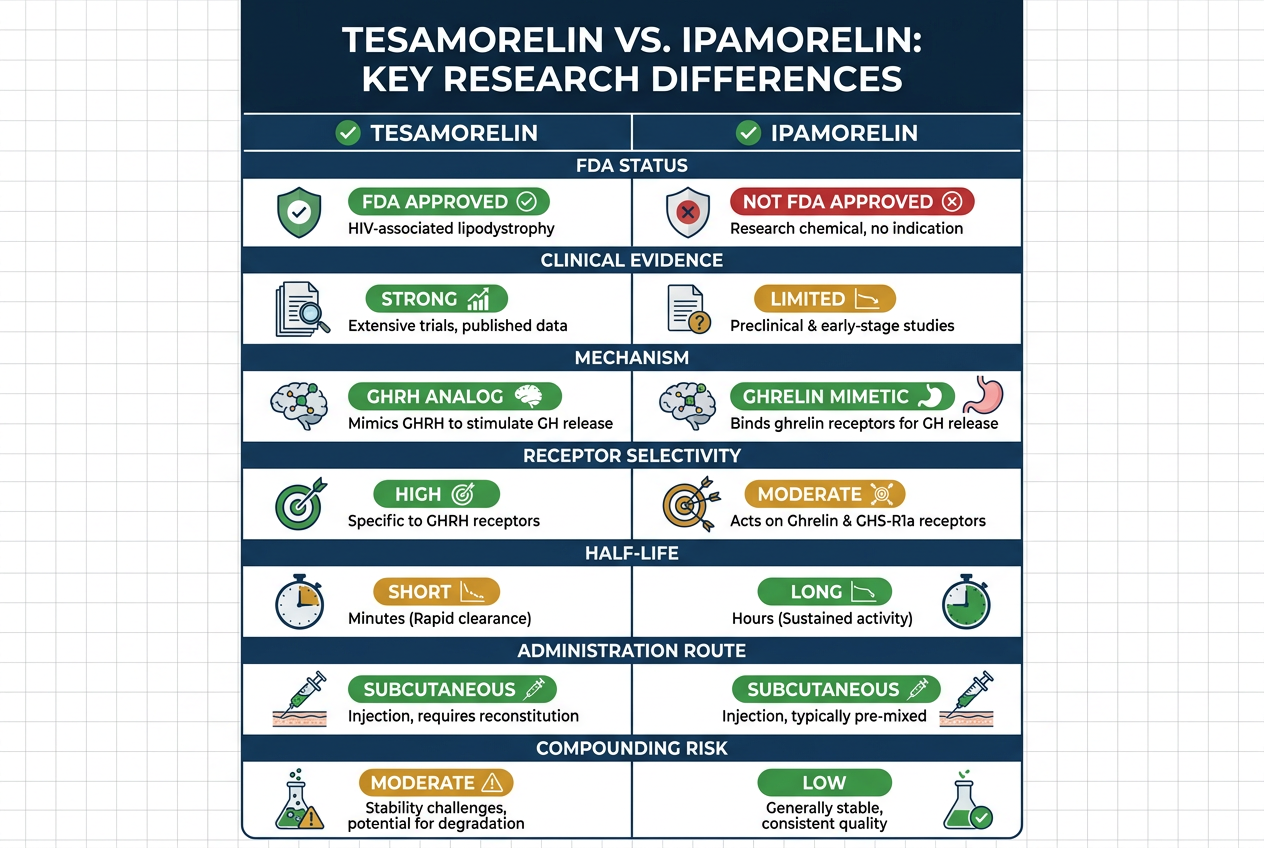
- Tesamorelin has an FDA-approved indication for excess abdominal fat reduction in HIV-infected adults with lipodystrophy; ipamorelin has no FDA-approved human indication.
- A randomized placebo-controlled trial in 404 patients found tesamorelin 2 mg subcutaneously daily reduced visceral fat by about 18%.
- Ipamorelin is described in 1998 literature as the first selective growth hormone secretagogue, but mechanistic promise is not the same as proven human benefit.
- FDA compounding materials flag ipamorelin acetate for immunogenicity risk, peptide-related impurities, and limited human safety data.
- Tesamorelin is not approved for general weight loss, and its label states long-term cardiovascular safety has not been established.
For a broader peptide reference, see Peptide Research Library: A Complete Reference Guide.
!Tesamorelin vs Ipamorelin: 7 Research Differences Today comparison chart
What Is Tesamorelin vs Ipamorelin: 7 Research Differences Today?
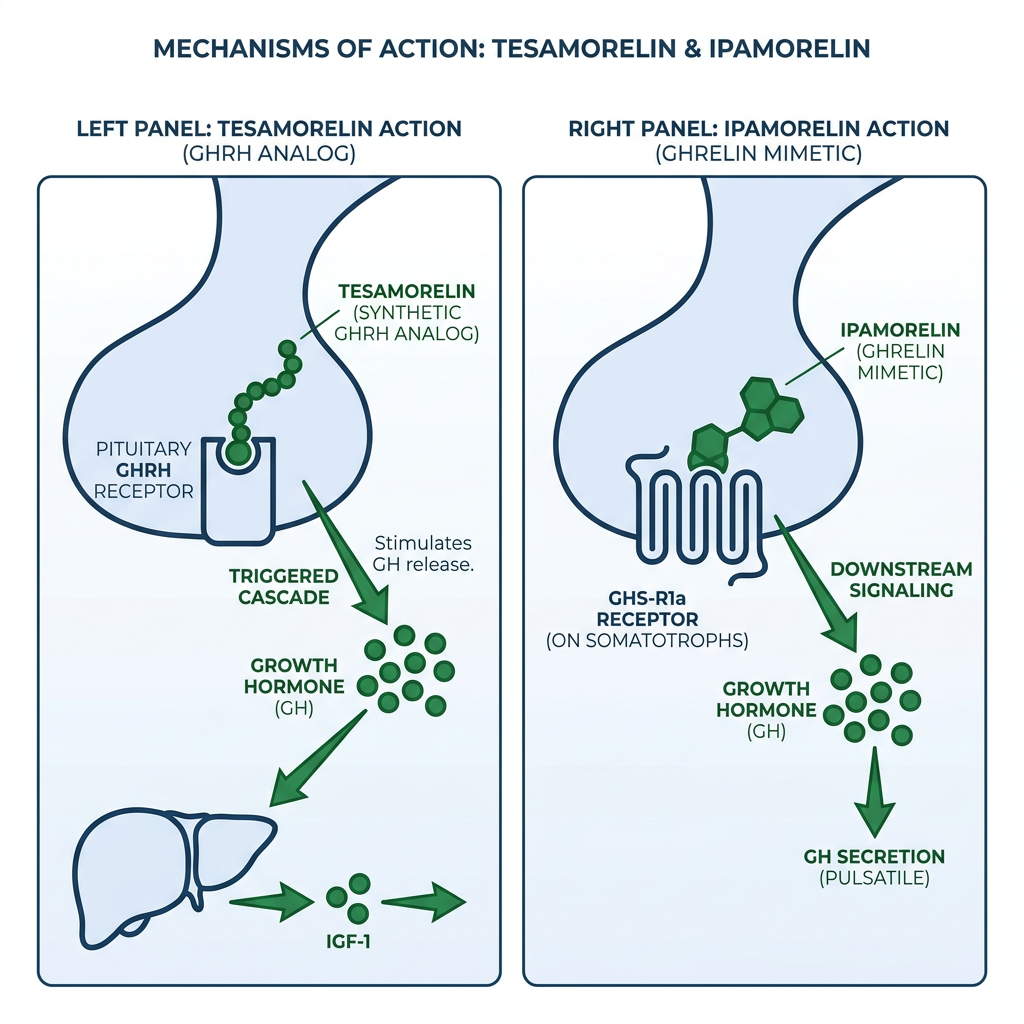
Tesamorelin vs Ipamorelin: 7 Research Differences Today is not a popularity contest between two growth hormone pathway peptides. It is a structured evaluation of regulatory status, clinical evidence quality, target outcomes, safety labeling, compounding risk, and claim reliability. Peptides Library treats this comparison as a question of mechanism versus proof, not just peptide hype.
The short answer on Tesamorelin vs Ipamorelin: 7 Research Differences Today is that tesamorelin is the better-supported peptide for human use. Tesamorelin has FDA approval and phase 3 human data, while ipamorelin remains investigational and more uncertain in FDA-reviewed compounding contexts. The fastest way to separate these peptides is to ask four questions: Is there an FDA-approved indication? Are there controlled human trials tied to that use? Is the benefit specific or broad? Are safety concerns clearly characterized in real patients?
On those questions, tesamorelin leads by a wide margin. The FDA-approved product EGRIFTA WR is indicated for reduction of excess abdominal fat in HIV-infected adults with lipodystrophy. Ipamorelin, by contrast, is known mainly from mechanistic and early research descriptions as a growth hormone secretagogue. Peptides Library separates peptide hype from peptide evidence: tesamorelin has an FDA-approved indication, while ipamorelin does not.
A useful caution is that “stronger evidence” does not mean “universal use.” Tesamorelin is not approved for general weight loss, and its label states that long-term cardiovascular safety has not been established. This distinction matters because many readers are not asking only how these peptides work. They are asking which one has better human data, which one has a defined indication, and which claims should be treated cautiously.
How Do Tesamorelin and Ipamorelin Work Differently?
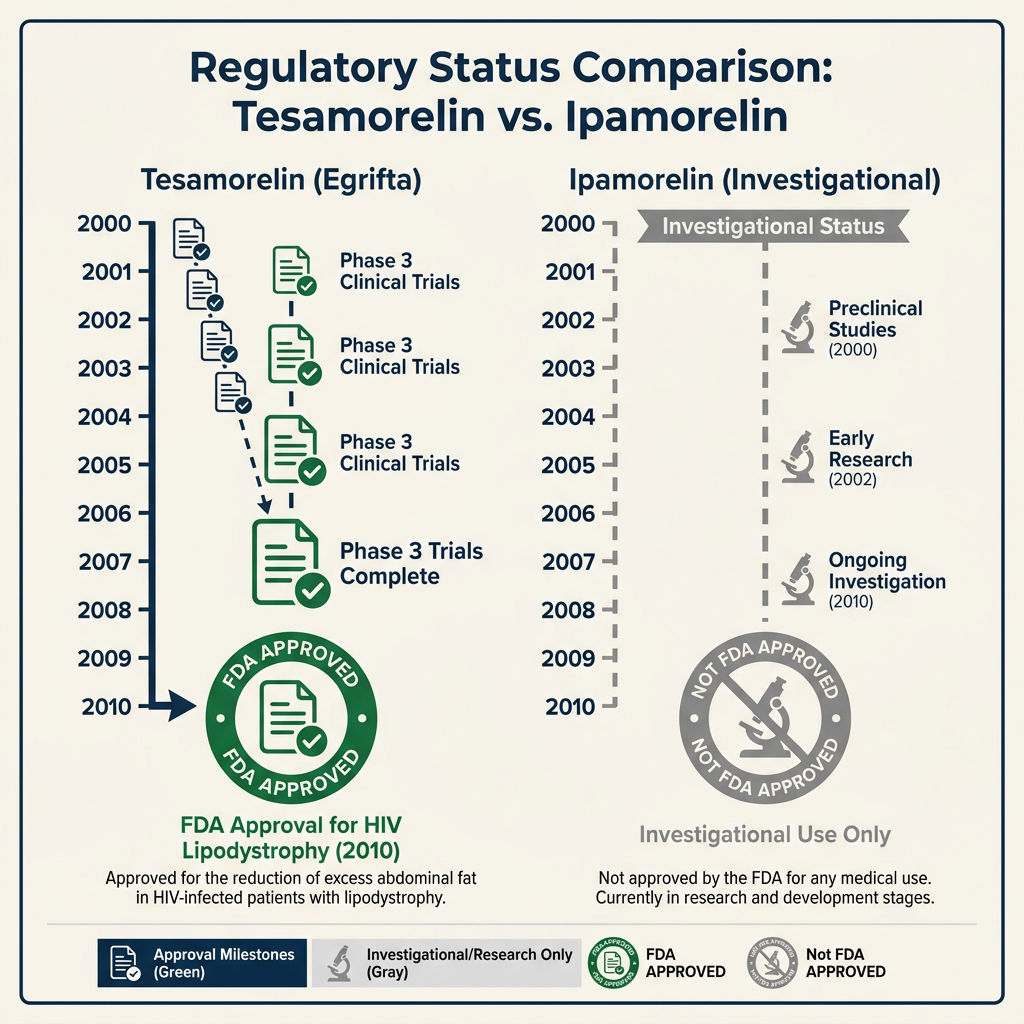
Tesamorelin and ipamorelin both affect growth hormone pathways, but they do so through different entry points. Tesamorelin is a GHRH analog, while ipamorelin is described in the literature as a selective growth hormone secretagogue. This mechanistic split is central to Tesamorelin vs Ipamorelin: 7 Research Differences Today because clinical outcomes cannot be assumed from receptor activity alone.
Tesamorelin is structurally designed to mimic growth hormone-releasing hormone signaling. That means it works upstream at the pituitary level in a way that resembles endogenous GHRH activity. In clinical use, that mechanism has been studied in HIV-associated lipodystrophy, where visceral adipose tissue is the key target rather than simple scale weight. Ipamorelin is typically characterized as a selective secretagogue, meaning it stimulates growth hormone release through a different pharmacologic route than a GHRH analog.
A common mistake is to treat “growth hormone release” as one uniform endpoint. It is not. If two peptides reach overlapping endocrine effects through different receptors or signaling patterns, their clinical outcomes can still be very different. That is why mechanism should be treated as context, not proof. A selective secretagogue profile may sound attractive on paper, but mechanism alone does not replace phase 3 outcome data in humans.
Researchers exploring related secretagogue profiles can review Peptides Library Hexarelin Side Effects Research Hub.
💡 Key Takeaway: How Do Tesamorelin and Ipamorelin Work Differently?
What Are the 7 Research Differences That Matter Most in Tesamorelin vs Ipamorelin: 7 Research Differences Today?
The seven biggest differences in Tesamorelin vs Ipamorelin: 7 Research Differences Today are regulatory status, approved use, quality of human evidence, target outcome, safety characterization, compounding risk, and claim reliability. Once those categories are clear, the comparison becomes much less confusing.
Here are the seven differences for Tesamorelin vs Ipamorelin: 7 Research Differences Today:
- FDA status: Tesamorelin has an FDA-approved human drug product; ipamorelin does not have an FDA-approved indication.
- Clinical endpoint: Tesamorelin has published data tied to visceral fat reduction in HIV-associated lipodystrophy; ipamorelin does not have equivalent approved-use outcome data.
- Evidence depth: Tesamorelin has randomized placebo-controlled and pooled phase 3 trial evidence; ipamorelin is far more limited in human clinical support.
- Mechanistic class: Tesamorelin is a GHRH analog; ipamorelin is a selective growth hormone secretagogue.
- Label clarity: Tesamorelin’s prescribing information states it is not indicated for weight loss management; ipamorelin often appears in less standardized claim environments.
- Safety context: Tesamorelin has an FDA label with defined warnings and limitations; FDA has flagged compounded ipamorelin acetate for potential immunogenicity risk and peptide-related impurities.
- Decision confidence: Tesamorelin supports narrower but clearer evidence-based decisions; ipamorelin supports more tentative, investigational interpretations.
These seven differences define Tesamorelin vs Ipamorelin: 7 Research Differences Today as a practical decision framework for researchers, not a theoretical peptide comparison. Each point rests on published trial data, FDA labeling, or FDA compounding alerts.
Which Peptide Has Stronger FDA Status and Approved Human Use?
Tesamorelin has the stronger regulatory position by a large margin. FDA-approved EGRIFTA WR is indicated for excess abdominal fat reduction in HIV-infected adults with lipodystrophy, while ipamorelin has no FDA-approved human indication. This is the single most important difference for clinicians, researchers, and informed consumers in Tesamorelin vs Ipamorelin: 7 Research Differences Today.
Approval does not mean a drug is risk-free, but it does mean the product has passed a formal review for a specific indication, dose framework, manufacturing standard, and safety labeling. Tesamorelin’s approved use is also narrower than many online claims suggest. The label explicitly says it is not indicated for weight loss management. That matters because abdominal fat in HIV-associated lipodystrophy is not the same clinical problem as general obesity or casual body recomposition.
A common misconception is that availability through compounding or peptide vendors signals comparable legitimacy. It does not. If a peptide lacks an approved indication, then any broader benefit claims deserve a much stricter reading. For official regulatory information, see the FDA.
!Tesamorelin vs Ipamorelin: 7 Research Differences Today regulatory status
What Human Clinical Evidence Supports Tesamorelin?
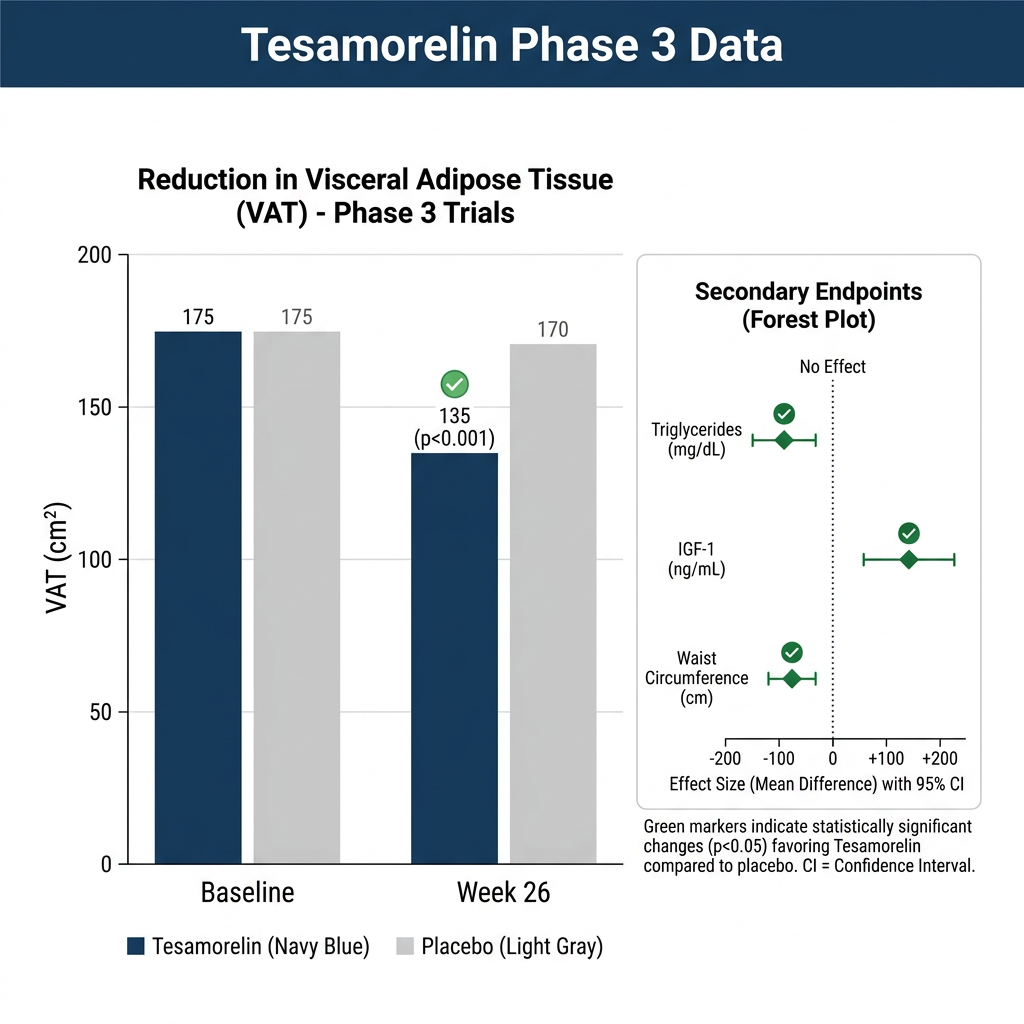
Tesamorelin has meaningful human trial support. PubMed-indexed studies and FDA labeling connect tesamorelin to visceral fat reduction in HIV-treated patients with lipodystrophy, including phase 3 data out to 52 weeks. One randomized placebo-controlled trial enrolled 404 HIV-infected patients with excess abdominal fat and used tesamorelin 2 mg subcutaneously daily during the primary efficacy phase. The study reported an approximately 18% reduction in visceral fat and improvement in body image distress.
A pooled analysis of two phase 3 trials in ART-treated HIV patients found that tesamorelin reduced visceral adipose tissue and maintained that reduction for up to 52 weeks. The same analysis reported improvements in body image and lipids, with no clinically meaningful changes in glucose parameters. That phrase matters: it does not mean glucose is irrelevant, only that the pooled analysis did not show clinically meaningful deterioration in that setting.
Peptides Library gives tesamorelin a stronger evidence rating because phase 3 human trials and FDA labeling define a real clinical use case. The trade-off is scope. Tesamorelin’s evidence is strong for a specific population and endpoint, not as a blanket solution for all fat-loss goals. For primary literature, search PubMed.
For a complete research library overview, visit Peptide Research Library: A Complete Reference Guide.
💡 Key Takeaway: What Human Clinical Evidence Supports Tesamorelin?
What Human Clinical Evidence Supports Ipamorelin?
Ipamorelin has a much thinner human evidence profile. Foundational literature describes it as a pentapeptide and the first selective growth hormone secretagogue, but that is not the same as having robust clinical outcome data for an approved use. The 1998 literature helped define ipamorelin’s pharmacology and growth hormone-releasing potency in vitro and in vivo. That gives it scientific interest. It does not give it a comparable standing to tesamorelin in human therapeutic evidence.
This is where readers often overread early peptide science. If a peptide has elegant receptor-level behavior but lacks large, indication-specific human trials, then its practical certainty remains limited. Mechanistic promise and clinical proof are related, but they are not interchangeable. In Tesamorelin vs Ipamorelin: 7 Research Differences Today, the evidence gap is stark: tesamorelin has phase 3 data tied to a defined endpoint, while ipamorelin has foundational pharmacology without equivalent human outcome trials.
!Tesamorelin vs Ipamorelin: 7 Research Differences Today clinical evidence
Why Do Compounding Risks Differ in Tesamorelin vs Ipamorelin: 7 Research Differences Today?
Compounding risk is a major differentiator in Tesamorelin vs Ipamorelin: 7 Research Differences Today because FDA has issued specific warnings for compounded ipamorelin acetate. FDA materials identify safety concerns with compounded ipamorelin acetate, including immunogenicity risk, peptide-related impurities, and limited human safety data in relevant use contexts. Tesamorelin, as an FDA-approved product, has a defined manufacturing and quality framework under its approved labeling.
Immunogenicity risk is not a minor point. Peptide-related impurities can trigger immune responses that are difficult to predict outside controlled studies. When a peptide is compounded without the same quality controls as an approved drug product, the safety profile becomes less certain. This is why Peptides Library emphasizes that “available through a compounding pharmacy” is not equivalent to “FDA-approved.”
Tesamorelin vs Ipamorelin: 7 Research Differences Today should therefore include a hard look at sourcing and regulatory oversight. Researchers must treat compounded ipamorelin acetate with extra caution because FDA has explicitly flagged these concerns. Tesamorelin’s approved product path does not eliminate all risk, but it does provide a clearer safety label and defined warnings.
How Should Researchers Compare Tesamorelin vs Ipamorelin: 7 Research Differences Today?
Researchers comparing Tesamorelin vs Ipamorelin: 7 Research Differences Today should start with the regulatory question, not the mechanism question. Ask first: Is there an FDA-approved indication? If yes, then examine the specific endpoint, trial design, and label limitations. If no, then every downstream claim about human benefit must be treated as investigational.
The next step is evidence quality. Tesamorelin has randomized placebo-controlled and pooled phase 3 data in a defined patient population. Ipamorelin has early pharmacology literature and mechanistic descriptions. These are not equal evidence tiers. A selective secretagogue profile is scientifically interesting, but it does not answer whether a peptide produces reliable, clinically meaningful outcomes in humans.
Safety characterization is the third filter. Tesamorelin has an FDA label with warnings, contraindications, and limitations, including the statement that long-term cardiovascular safety has not been established. Ipamorelin’s safety profile is less defined, and FDA compounding alerts raise immunogenicity and impurity concerns. For research planning, Tesamorelin vs Ipamorelin: 7 Research Differences Today means choosing between a well-characterized approved drug and a less certain investigational peptide.
💡 Key Takeaway: How Should Researchers Compare Tesamorelin vs Ipamorelin: 7 Research Differences Today?
What Safety Labels and Limitations Define Tesamorelin vs Ipamorelin: 7 Research Differences Today?
Safety labels define Tesamorelin vs Ipamorelin: 7 Research Differences Today in concrete ways. Tesamorelin’s prescribing information states it is not indicated for weight loss management. It also states that long-term cardiovascular safety has not been established. These are not minor footnotes; they define the boundaries of approved use and the limits of current evidence.
Ipamorelin has no comparable FDA label because it has no approved indication. Its safety profile comes from early research and FDA compounding alerts, which flag immunogenicity risk and peptide-related impurities. This creates an asymmetry: tesamorelin has known limitations within an approved framework, while ipamorelin has unknown limitations outside any approved framework.
For any research protocol, Tesamorelin vs Ipamorelin: 7 Research Differences Today should include a review of these label and safety differences. Researchers should not assume that a peptide with a selective mechanism has a cleaner safety profile. In fact, the FDA’s specific warnings about compounded ipamorelin acetate suggest the opposite: less regulatory oversight, more uncertainty.
!Tesamorelin vs Ipamorelin: 7 Research Differences Today safety profile
Tesamorelin vs Ipamorelin: 7 Research Differences Today — Comparison Table
| Criterion | Tesamorelin | Ipamorelin |
|———–|————-|————|
| FDA-approved indication | Yes, EGRIFTA WR for excess abdominal fat in HIV-infected adults with lipodystrophy | No FDA-approved human indication |
| Mechanistic class | GHRH analog | Selective growth hormone secretagogue |
| Key human trial | 404-patient randomized placebo-controlled trial, ~18% visceral fat reduction | 1998 foundational pharmacology literature |
| Phase 3 data | Yes, pooled analysis out to 52 weeks | No equivalent phase 3 outcome data |
| Label weight-loss limitation | Not indicated for weight loss management | No standardized label |
| FDA compounding alert | No specific alert for approved product | Yes, immunogenicity risk, peptide-related impurities, limited human safety data |
| Long-term CV safety | Not established per label | Not established; limited data |
This table summarizes the core of Tesamorelin vs Ipamorelin: 7 Research Differences Today in a single view. It is not a claim that one peptide is universally better for all research purposes, but it does show where the evidence and regulatory weight sit.
What Should Researchers Do With Tesamorelin vs Ipamorelin: 7 Research Differences Today?
Researchers should use Tesamorelin vs Ipamorelin: 7 Research Differences Today as a decision filter, not a marketing claim. If the question is proven human use for a specific FDA-approved endpoint, tesamorelin clearly outranks ipamorelin. If the question is early-stage mechanistic research, ipamorelin remains an investigational peptide with scientific interest but lower certainty.
The practical takeaway from Peptides Library is evidence-first: do not let “growth hormone secretagogue” or “selective” language override the absence of human outcome data. Tesamorelin vs Ipamorelin: 7 Research Differences Today shows that regulatory approval, phase 3 trials, and defined safety labeling carry more weight than mechanistic elegance.
For further peptide comparisons, see AOD 9604 vs Retatrutide: 7 Research Differences Today.
💡 Key Takeaway: What Should Researchers Do With Tesamorelin vs Ipamorelin: 7 Research Differences Today?
FAQ
What is the main difference between tesamorelin and ipamorelin?
The main difference in Tesamorelin vs Ipamorelin: 7 Research Differences Today is regulatory status. Tesamorelin has an FDA-approved indication for reducing excess abdominal fat in HIV-infected adults with lipodystrophy, while ipamorelin has no FDA-approved human indication and remains investigational.
Does ipamorelin have any FDA-approved use?
No. Ipamorelin has no FDA-approved human indication. FDA compounding materials have flagged compounded ipamorelin acetate for immunogenicity risk, peptide-related impurities, and limited human safety data. Any human benefit claims for ipamorelin should be treated as investigational.
Why is tesamorelin not used for general weight loss?
Tesamorelin’s prescribing information explicitly states it is not indicated for weight loss management. Its approved use is limited to excess abdominal fat in HIV-infected adults with lipodystrophy. The label also states that long-term cardiovascular safety has not been established.
What human trial evidence supports tesamorelin?
A randomized placebo-controlled trial in 404 HIV-infected patients found tesamorelin 2 mg subcutaneously daily reduced visceral fat by about 18% and improved body image distress. A pooled analysis of two phase 3 trials maintained visceral fat reduction for up to 52 weeks with improvements in body image and lipids, and no clinically meaningful changes in glucose parameters.
Is ipamorelin safer than tesamorelin because it is more selective?
No. In Tesamorelin vs Ipamorelin: 7 Research Differences Today, safety cannot be assumed from mechanism. FDA has specifically flagged compounded ipamorelin acetate for immunogenicity risk and peptide-related impurities, while tesamorelin has a defined FDA label with known warnings and limitations. Less regulatory oversight does not mean greater safety.
Ready to Take the Next Step?
Every product includes lot-specific documentation and third-party purity testing.
Explore Our Research Products →Free shipping on qualifying orders · Batch COA on request