


Peptide Research Library: A Complete Reference Guide
A peptide research library guide: 7 critical facts on purity grades, COA docs, storage, and organization for reproducible in vitro research.
📋 Table of Contents
A peptide research library is a systematically curated collection of peptide compounds, each indexed by amino acid sequence, molecular weight, purity grade, and lot-specific documentation, built for reproducible in vitro laboratory research. Unlike a vendor catalog, it anchors every entry to a complete analytical record so researchers can compare candidates without ambiguity. This guide covers seven critical facts about how a peptide research library is organized, why per-lot purity documentation is non-negotiable, and what separates a true library from a simple product list.
*Research Use Only: All products discussed are for in vitro laboratory research only. They are not for human consumption, veterinary use, or in vivo administration. Must be 21+ to purchase.*
Key takeaways
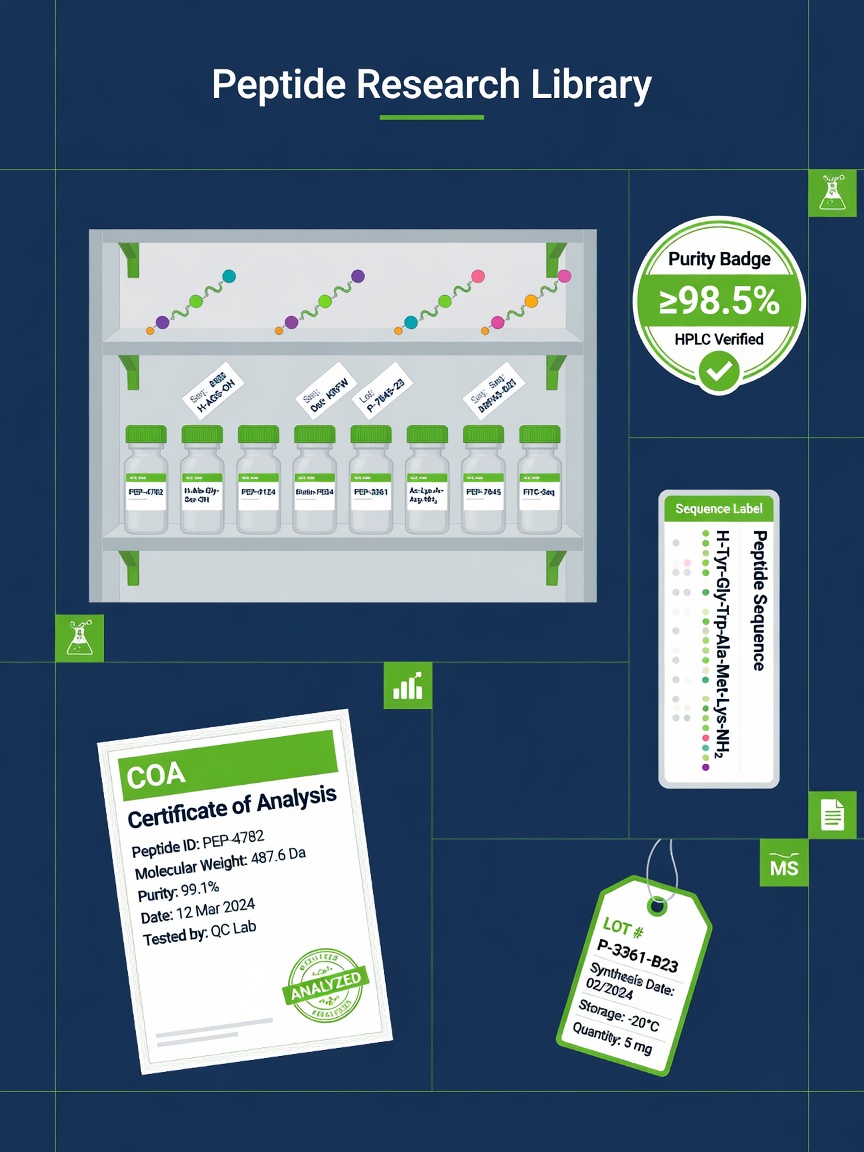
- A peptide research library links every compound to one complete record: primary name, synonyms, sequence, molecular formula, modifications, purity grade, and storage requirements.
- Research-grade purity in a peptide research library is reported as ≥95%, ≥98%, or ≥99% by reverse-phase HPLC, with identity confirmed by ESI-MS or MALDI-TOF.
- Lot-specific COA documentation is the backbone of a peptide research library; without it, reproducibility fails.
- Storage conditions (lyophilized at -20°C, reconstituted at -80°C) are part of the cataloguing standard for any peptide research library.
- A genuine peptide research library is research-use-only and never implies human or veterinary application.
What Is a peptide research library?
A peptide research library is not a collection of books. It is a reference framework in which every peptide compound is catalogued with its amino acid sequence, molecular formula, molecular weight, structural modifications, purity grade, and lot number. This framework allows researchers to select candidates for in vitro assays without guesswork. The term ‘library’ reflects systematic indexing, not physical storage.
Each entry in a peptide research library functions as a data record. The record includes the peptide’s primary name and any synonyms, the one-letter or three-letter amino acid sequence, the net peptide content, and the counterion if present. For example, a lyophilized acetate salt may be listed with its counterion percentage, which affects gravimetric calculations in the lab.
A robust peptide research library also documents the synthesis method—solid-phase or solution-phase—and the final purification step. These details influence residual impurities, such as deletion sequences or truncated peptides. Without this metadata, a researcher cannot accurately interpret a purity report or replicate an experiment.
Researchers use a peptide research library to compare candidates across multiple parameters. Two peptides with the same sequence but different purities or salt forms are distinct entries. This granularity is what separates a true peptide research library from a one-page product list with no analytical backing.
How Is a peptide research library organized?
A peptide research library is typically organized around a relational database structure. Each compound has a unique identifier, often a catalog number plus a lot number. The catalog number points to the molecular entity, while the lot number points to a specific synthesis batch. This two-level indexing is critical because purity can vary between lots.
The primary fields in any peptide research library include sequence, molecular weight, purity grade, storage conditions, and available analytical documents. Secondary fields may include solubility data, stability data, and recommended reconstitution solvents for research use. These secondary fields support reproducible in vitro work.
Sequence is the anchor. A peptide research library may display sequences in one-letter code, three-letter code, or both. Modifications—acetylation, amidation, phosphorylation, PEGylation—are listed as post-translational or synthetic changes. Without clear modification tags, a peptide’s identity is ambiguous.
Molecular weight is calculated from the sequence and modifications, then verified by mass spectrometry. The calculated monoisotopic mass and the observed mass should match within acceptable error. A peptide research library that omits observed mass is incomplete for rigorous research.
Peptide Libraries: 7 Essential Research Formats for 2025 explains how different formats—linear, cyclic, stapled, and peptide nucleic acid libraries—serve different assay needs. A well-organized peptide research library will let you filter by format, length, and modification type.
💡 Key Takeaway: How Is a peptide research library organized?
Why Does Lot Purity Documentation Define a peptide research library?
Lot purity documentation is the single most important differentiator of a peptide research library. A vendor may sell a peptide with a stated purity of 98%, but without a lot-specific certificate of analysis (COA), that number is unverifiable. A genuine peptide research library attaches a COA to every lot.
A COA from a peptide research library typically includes reverse-phase HPLC chromatograms, mass spectrometry spectra, and net peptide content. HPLC purity is reported as area percent at 214 nm or 220 nm. Mass spectrometry confirms identity via ESI-MS or MALDI-TOF. Together, these two methods answer two questions: How pure is it? Is it the right molecule?
The phrase ‘≥98% purity’ in a peptide research library means the main peak area in the HPLC chromatogram represents at least 98% of total integrated area. It does not necessarily mean 98% peptide content by weight. Net peptide content accounts for water, counterions, and residual solvents. A COA that reports both purity and net peptide content is far more useful for quantitative in vitro work.
For reproducible research, lot-to-lot consistency matters. A peptide research library should allow researchers to request historical COAs for previous lots of the same catalog number. This transparency lets a lab compare data across batches and identify any drift in impurity profiles.
Which Purity Grades Are Standard in a peptide research library?
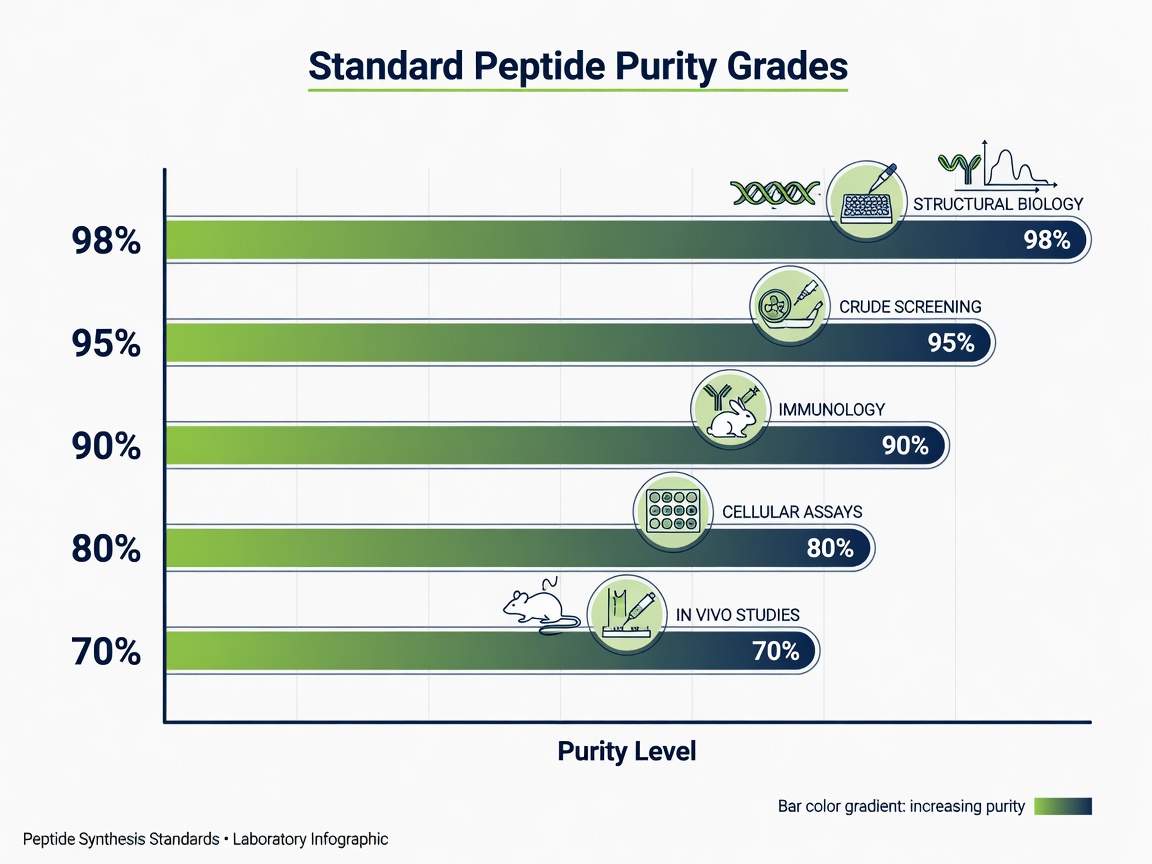
Most research-grade peptides in a peptide research library fall into three purity bands: ≥95%, ≥98%, and ≥99%. Each band serves a different purpose. ≥95% is common for initial screening and binding assays. ≥98% is typical for cell-based assays and enzyme kinetics. ≥99% is reserved for high-sensitivity work such as structural biology or receptor binding with low background.
The purity grade in a peptide research library is determined by reverse-phase HPLC. The method uses a C18 column with a water–acetonitrile gradient containing trifluoroacetic acid. Detection is usually at 214 nm, where the peptide bond absorbs. A single sharp main peak indicates high purity; multiple satellite peaks indicate deletion or truncation impurities.
A peptide research library should always state the analytical method alongside the purity grade. ‘≥98% purity by HPLC’ is a specific claim. ‘98% pure’ without a method is vague. Researchers should also check whether the purity grade refers to the main peak area or to total peptide content, because these can differ by several percentage points.
For any purity grade, mass spectrometry confirmation is non-negotiable in a peptide research library. ESI-MS gives the molecular ion envelope, while MALDI-TOF gives a simpler spectrum. Both should match the calculated monoisotopic mass within 1 Da for peptides under 3000 Da.
| Purity grade | Typical research use | HPLC detection |
|—|—|—|
| ≥95% | Initial screening, binding assays | 214 nm |
| ≥98% | Cell-based assays, enzyme kinetics | 214 nm |
| ≥99% | Structural biology, receptor binding | 214 nm |
How Does a peptide research library support reproducible research?
A peptide research library supports reproducibility by making every compound traceable to a specific lot and analytical file. When a lab reports an assay result, the catalog number and lot number allow another lab to request the same material and review the same COA. This traceability reduces batch-to-batch ambiguity.
Without a peptide research library, researchers often rely on vendor product pages that change over time. A stable library record preserves the sequence, modification tags, and purity data as they were at the time of purchase. This historical record is critical for multi-year studies and cross-lab comparisons.
A research-grade peptide library also standardizes quality thresholds, so a ≥98% claim means the same analytical workflow across every entry. This consistency lets researchers pool data from different peptides without recalibrating their expectations.
💡 Key Takeaway: How Does a peptide research library support reproducible research?
What Is the Difference Between a peptide research library and a product list?
A product list shows what is for sale. A peptide research library shows what each peptide is, how pure it is, and how that purity was measured. The difference is documentation depth and traceability. A product list may say ‘Peptide X, 98%’ while a peptide research library includes the HPLC chromatogram, MS spectrum, and net peptide content for the exact lot.
Many catalogs borrow the word ‘library’ without meeting the standard. A true peptide research library maintains a one-to-one relationship between a catalog entry and a complete analytical record. If a supplier cannot provide a COA before purchase, the collection is a product list, not a peptide research library. For more on research-grade peptides, see Peptide Library: Research-Grade Peptides for Laboratories.
How Can Researchers Evaluate a peptide research library supplier?
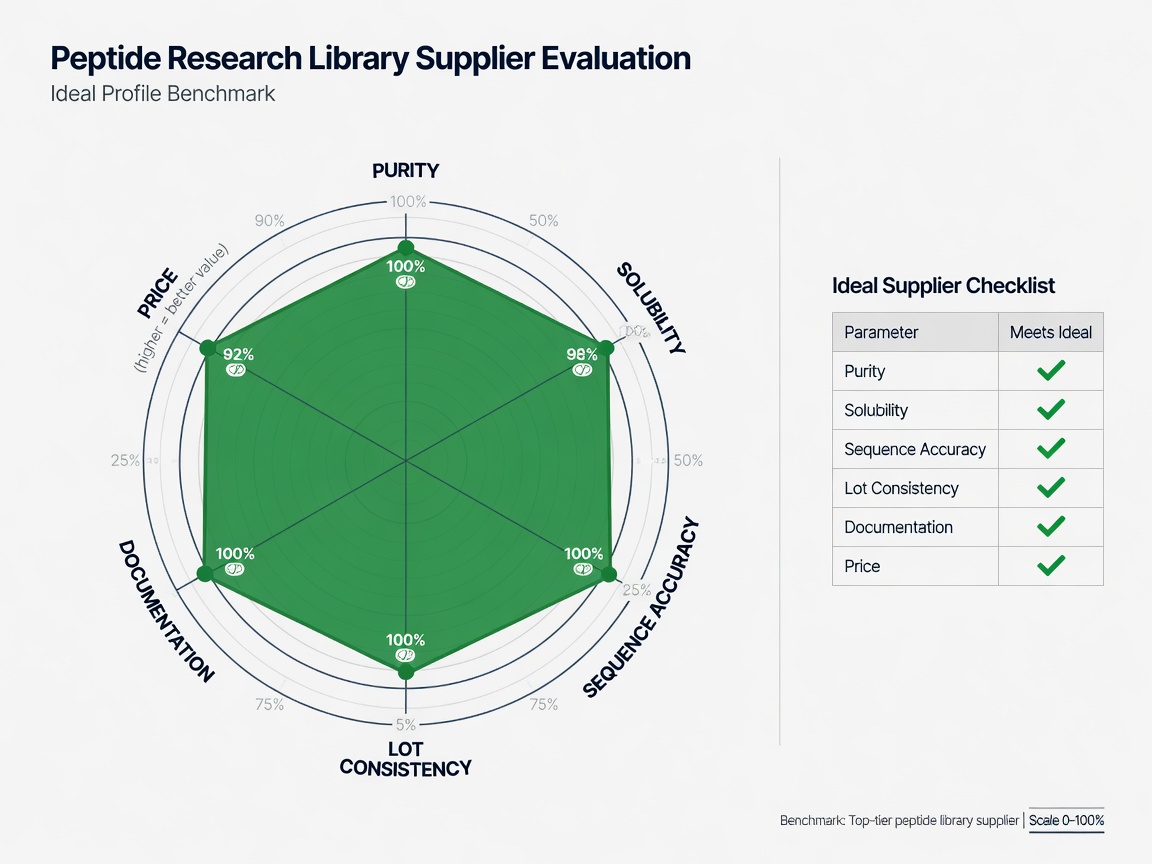
Researchers should ask three questions before selecting a peptide research library supplier. First, are lot-specific COAs available for review before purchase? Second, does the library state the HPLC method, wavelength, and mass spectrometry platform? Third, can the supplier provide historical COAs for previous lots?
A supplier that hesitates to share analytical data is not operating a genuine peptide research library. Look for clear documentation of synthesis method, purification step, and net peptide content. Also check whether the library separates catalog number from lot number and whether each entry lists storage requirements.
For specialized formats, a peptide research library should also include modification-specific data. The Cell Penetrating Peptides for Research | Peptides Library guide explains how CPP sequences require additional characterization for membrane interaction studies.
Use this supplier checklist:
- Lot-specific COA available before purchase
- HPLC method and detection wavelength stated
- ESI-MS or MALDI-TOF identity confirmation
- Net peptide content reported
- Historical COAs accessible
- Storage conditions listed per entry
What Key Parameters Should Researchers Compare Across a Research Library?
Comparing entries in a research library requires a consistent parameter set. Researchers should compare sequence accuracy, modification tags, purity grade, net peptide content, counterion, storage conditions, and available analytical documents. Missing any of these creates ambiguity in quantitative work.
| Parameter | What to verify | Why it matters |
|—|—|—|
| Sequence | One-letter or three-letter code, modifications | Identity |
| Purity grade | HPLC area % at 214 nm | Main peak vs impurities |
| Net peptide content | Percent peptide by weight | Gravimetric calculations |
| Counterion | Acetate, TFA, etc. | Salt mass adjustment |
| Storage | Lyophilized -20°C, reconstituted -80°C | Stability |
A well-documented entry also lists the synthesis method and the final purification step. These details help a lab anticipate residual impurities such as deletion sequences or truncated peptides. Without this metadata, even a high-purity peptide can produce misleading assay results.
💡 Key Takeaway: What Key Parameters Should Researchers Compare Across a Research Library?
How Should Researchers Store and Handle Compounds From a Research Library?
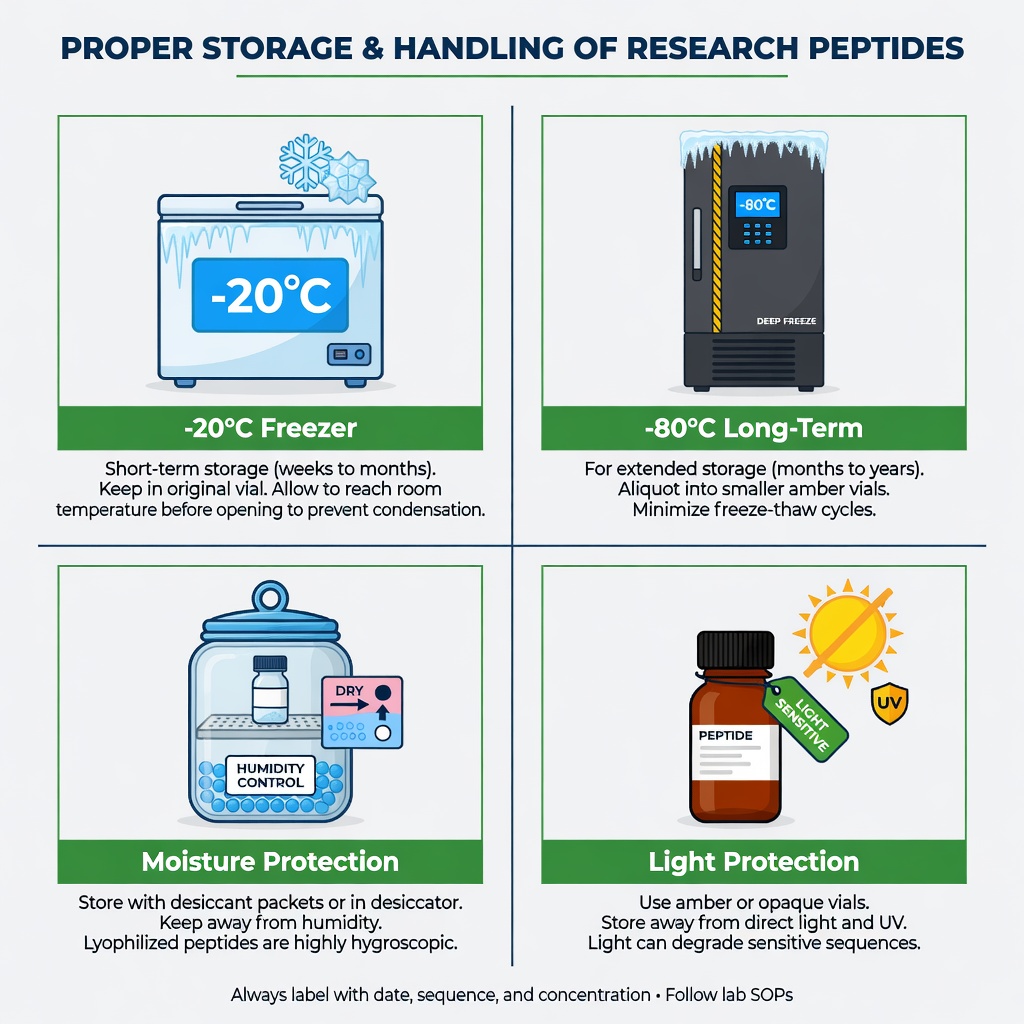
Lyophilized peptides from a research library should be stored at -20°C in a dry, dark environment. The lyophilized form is generally stable for months to years under these conditions, but researchers should always follow the specific storage note on the COA or product record.
After reconstitution for in vitro use, peptide solutions should be aliquoted and stored at -80°C. Avoid repeated freeze-thaw cycles, which can degrade peptide integrity. Use sterile, inert solvents recommended for research use only, and never assume a peptide is stable in aqueous buffer for extended periods.
Always handle lyophilized vials with care. Allow the vial to reach room temperature before opening to prevent condensation. Use desiccant when returning the vial to cold storage. These handling steps are part of the cataloguing standard for any reliable research library.
What Are Common Misconceptions About Research Libraries?
One common misconception is that HPLC purity equals peptide content by weight. In a research library, purity refers to the main peak area at 214 nm, while net peptide content accounts for water, counterions, and residual solvents. The two values can differ by several percentage points.
Another misconception is that all peptides are stable at room temperature. Most lyophilized peptides require -20°C storage, and reconstituted solutions require -80°C. Ignoring storage conditions can invalidate assay results even when the initial COA was perfect.
Some researchers assume a higher purity grade is always better. In fact, ≥95% is often sufficient for initial screening, while ≥99% may be unnecessary for routine binding assays. The right purity band depends on the assay sensitivity and the impurity profile.
Finally, a research library is not a clinical or veterinary resource. All entries are for in vitro laboratory research only. No entry implies human or veterinary application, diagnosis, treatment, or prevention.
How Do You Request COA Documentation From a Research Library?
Requesting a COA should be a standard step before any purchase. First, identify the catalog number and lot number for the peptide of interest. A supplier should provide the COA that corresponds to that exact lot, not a generic example.
Second, ask for the HPLC chromatogram with the detection wavelength stated. The COA should show the main peak area percent and any satellite peaks. Third, request the mass spectrometry spectrum, either ESI-MS or MALDI-TOF, with the observed monoisotopic mass.
Fourth, ask for net peptide content and counterion percentage if applicable. These values are needed for gravimetric calculations in quantitative in vitro work. A supplier that cannot provide these documents before purchase is not operating a true research library.
💡 Key Takeaway: How Do You Request COA Documentation From a Research Library?
What External References Validate a Research Library?
Researchers can cross-check analytical methods against public resources. The National Center for Biotechnology Information (NCBI) maintains peptide and protein sequence databases at https://www.ncbi.nlm.nih.gov/. PubMed indexes peer-reviewed studies on HPLC and mass spectrometry validation for synthetic peptides at https://pubmed.ncbi.nlm.nih.gov/.
These resources help confirm sequence annotations and analytical standards. A research library that aligns its documentation with these public references is easier to validate across independent laboratories.
FAQ
What is the most important document in a research library?
The lot-specific certificate of analysis (COA) is the most important document. It includes HPLC purity at 214 nm or 220 nm, mass spectrometry identity confirmation, and net peptide content. Without a COA, a purity claim is unverifiable.
What is the difference between purity and net peptide content?
Purity is the main peak area percent on an HPLC chromatogram. Net peptide content is the percent peptide by weight after accounting for water, counterions, and residual solvents. Both values are needed for quantitative in vitro work.
How should lyophilized peptides be stored?
Lyophilized peptides should be stored at -20°C in a dry, dark environment. After reconstitution for in vitro use, aliquots should be stored at -80°C and protected from repeated freeze-thaw cycles.
What purity grades are common in a research library?
The three standard purity bands are ≥95%, ≥98%, and ≥99%. ≥95% suits initial screening, ≥98% suits cell-based assays and enzyme kinetics, and ≥99% suits high-sensitivity structural biology or receptor binding work.
Is a research library intended for human or veterinary use?
No. All products in a research library are for in vitro laboratory research only. They are not for human consumption, veterinary use, or in vivo administration, and purchase requires being 21+.
Ready to Take the Next Step?
Every product includes lot-specific documentation and third-party purity testing.
Explore Our Research Products →Free shipping on qualifying orders · Batch COA on request