


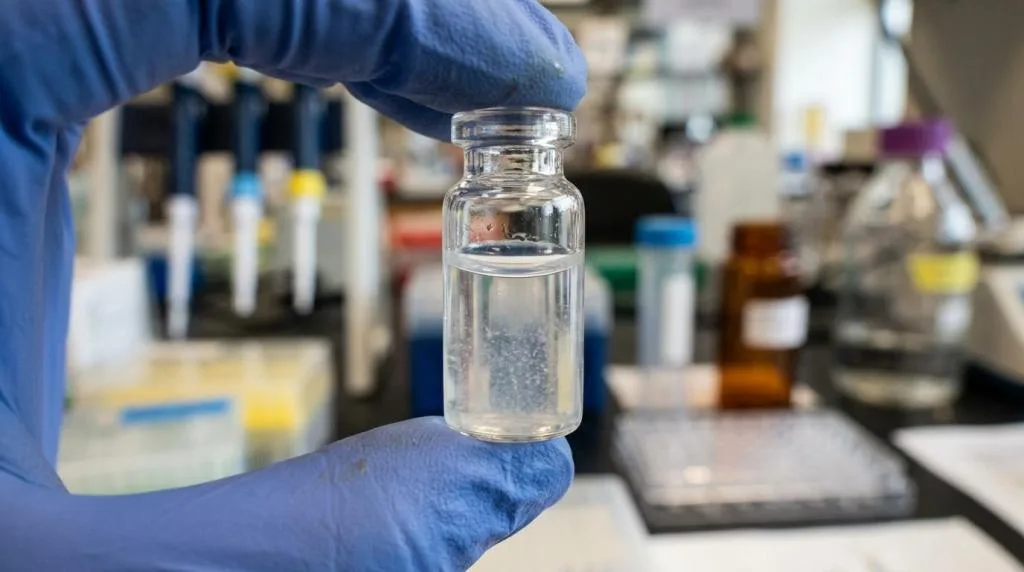
How Peptide Solubility Affects Stability and Delivery
Stability and delivery depend on peptide solubility, pH, aggregation, and formulation choices. Explore proven research insights, delivery systems, and FAQs.
📋 Table of Contents
Peptide solubility directly shapes stability and delivery by determining whether a peptide remains in solution, avoids aggregation, and reaches its intended research target in a usable form. A peptide that dissolves poorly is more likely to self-associate, adsorb to container surfaces, precipitate, and fail delivery requirements. This article explains the connection and the formulation levers that matter most for research-grade peptide handling.
Key takeaways
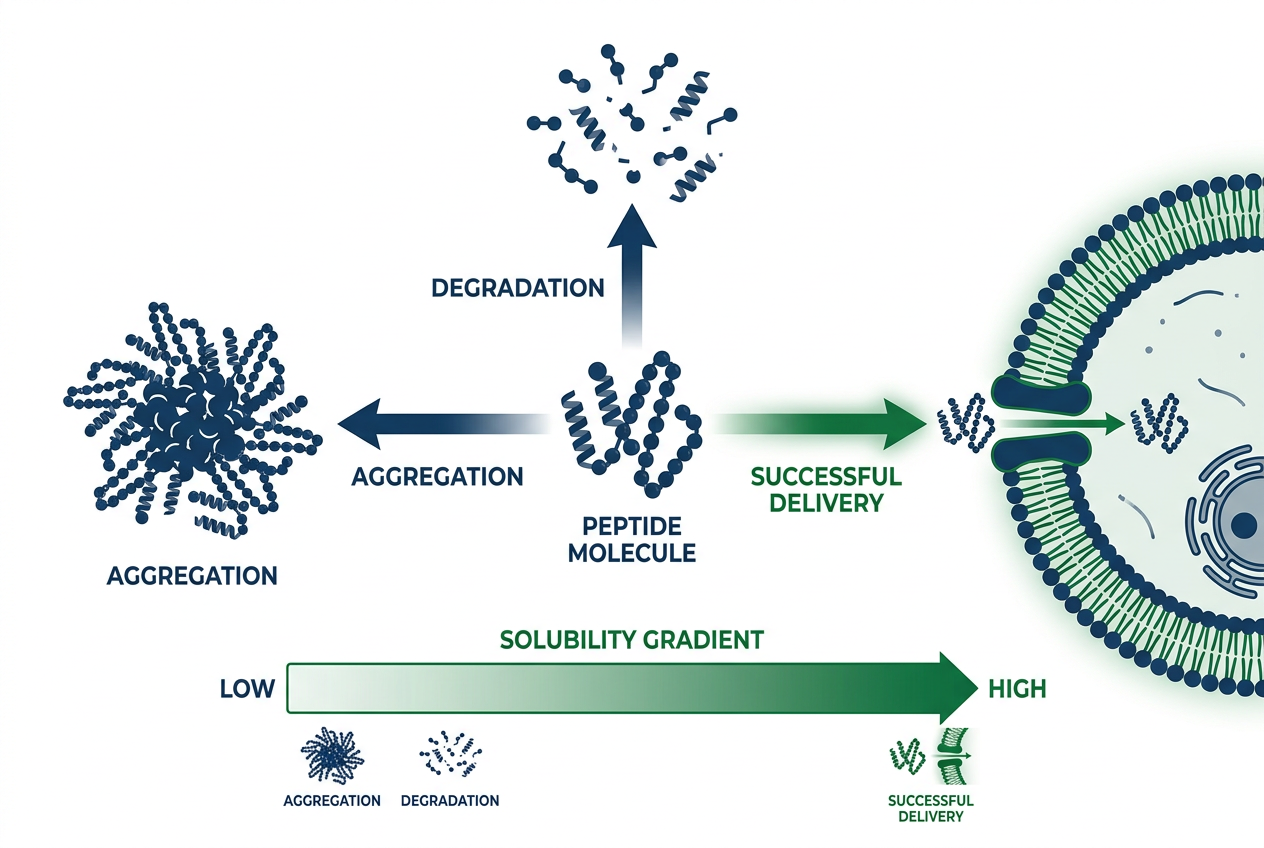
- Solubility and stability are linked; poor solubility often drives aggregation, precipitation, and adsorption losses that weaken stability and delivery.
- pH is the strongest practical lever; formulation near the isoelectric point reduces net charge and raises aggregation risk.
- Concentration, ionic strength, excipients, temperature, agitation, and lyophilization all change peptide solubility and stability.
- Weak solubility can force suspension formulations or advanced delivery systems, shifting development complexity.
- Research-use-only peptide handling should always confirm purity, storage conditions, and certificate of analysis before use.
How does peptide solubility affect stability and delivery?
Peptides sit between small molecules and large biologics. Their solution behavior depends on sequence, net charge, amino acid composition, hydrophobic patches, and amphiphilic character. Even modest environmental shifts can change whether a peptide stays dispersed, self-associates, or crashes out of solution.
A soluble peptide usually has a better chance of remaining physically stable because fewer molecules are forced into close contact. Once local concentration rises, self-association becomes more likely. That can lead to amorphous aggregates, fibrillar species, or visible precipitation. Any of those outcomes can reduce usable concentration, alter potency, and complicate stability and delivery.
A 2024 review in PMC notes that therapeutic peptide developability is often limited by self-association, aggregation, adsorption to surfaces, and a strong dependence of solubility and stability on pH. That pairing is worth emphasizing: solubility and stability are not separate problems. In practice, they frequently rise and fall together, which directly shapes stability and delivery.
Why is pH critical for peptide solubility, aggregation, and stability and delivery?
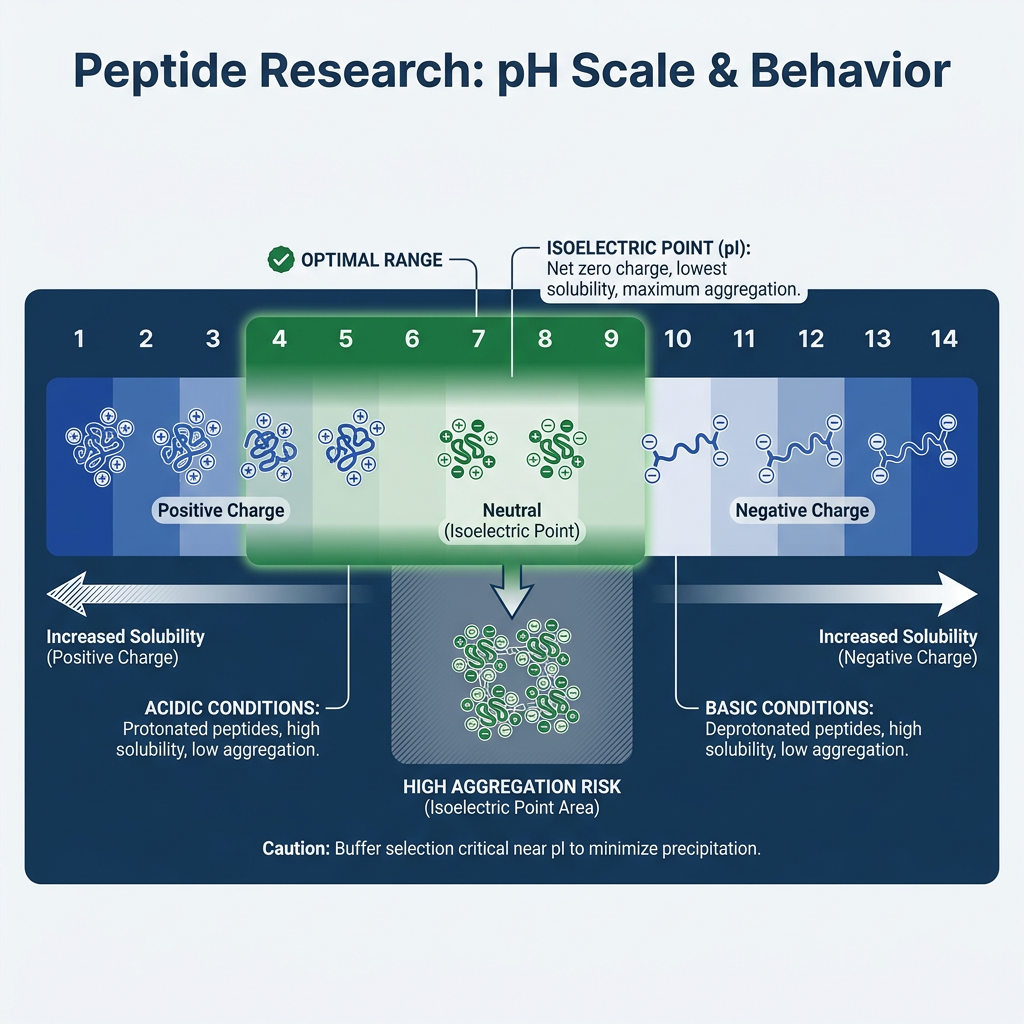
For many peptides, pH is the strongest practical lever during formulation. It changes ionization state, net charge, and intermolecular repulsion. That means it can shift a peptide from poorly soluble to workable, or from stable to aggregation-prone, with a relatively small adjustment.
One central concept is the isoelectric point. When formulation pH approaches a peptide’s isoelectric point, net charge tends to shrink. With less electrostatic repulsion, molecules can come together more easily. That raises the likelihood of aggregation and precipitation. Reviews on peptide and protein therapeutics repeatedly note this pattern.
Moving pH away from the isoelectric region can increase ionization and improve colloidal stability, which is one reason pH screening is often one of the first formulation exercises. This step directly influences stability and delivery for any peptide research formulation.
A few pH-related effects show up again and again:
- Higher or lower ionization
- Changes in net charge
- Shifts in aggregation tendency
- Altered adsorption to container surfaces
- Different rates of acid- or base-catalyzed degradation
The tradeoff is that the best pH for solubility is not always the best pH for chemical integrity. A peptide may dissolve nicely in a region where deamidation, hydrolysis, or another degradation pathway becomes faster. Good formulation work balances both sides of the problem rather than optimizing solubility alone. That balance is essential for reliable stability and delivery.
💡 Key Takeaway: Why is pH critical for peptide solubility, aggregation, and stability and delivery?
Which formulation variables affect stability and delivery?
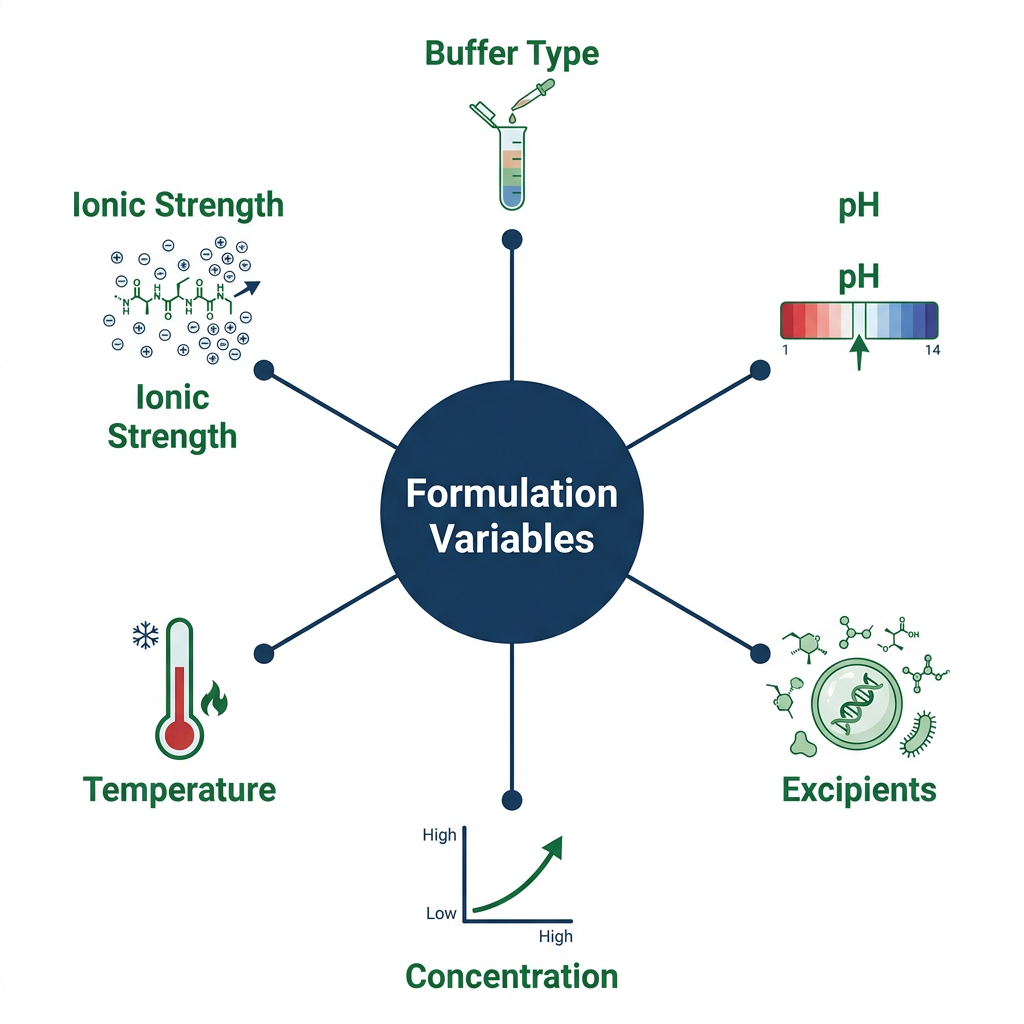
pH gets most of the attention, yet several other variables shape how a peptide behaves in solution. Concentration is one of the clearest examples. A peptide may look stable at a screening concentration and then aggregate when the research protocol demands a much higher load. Ionic strength can also matter because salts screen electrostatic interactions and may either stabilize or destabilize the system depending on the peptide and buffer conditions.
Excipients can help by reducing surface adsorption, limiting aggregation, or supporting reconstitution behavior after drying. Still, excipients can also create new issues if they alter peptide conformation, interact with charged residues, or change water activity in ways that favor instability. These choices feed directly into stability and delivery.
Handling conditions deserve equal attention. Temperature excursions, agitation during transport, repeated freeze-thaw cycling, and lyophilization stress can all shift a peptide away from its preferred state. A formulation that looks fine on paper may perform poorly once real-world handling is introduced. For research-grade peptides, documenting handling conditions is part of ensuring reproducible stability and delivery.
The most common formulation and process stressors include:
- Concentration: higher molecular crowding can increase self-association
- Ionic strength: salt can alter electrostatic shielding and aggregation behavior
- Excipients: stabilizers may reduce adsorption or aggregation, but effects are peptide-specific
- Temperature: heat can accelerate degradation and cold can trigger phase changes or precipitation
- Agitation: shaking and interfacial stress can promote aggregation
- Lyophilization: drying and reconstitution may change structure, solubility, or particle formation
This is one reason regulatory guidance treats formulation as central to peptide product quality and stability. The molecule matters, but so does the environment built around it. For any laboratory working with peptides, a systematic formulation screen is the most direct way to protect stability and delivery.
How does poor peptide solubility affect stability and delivery?
Poor solubility does more than complicate storage. It can reshape the entire delivery strategy. If a peptide cannot reach the target concentration in solution, a fully soluble injectable formulation may not be possible. In those cases, researchers may need to consider suspension formulations or specialized delivery systems.
That shift affects several practical questions at once. Can the full research dose be administered in a reasonable volume? Will the syringe or device handle the viscosity or particle burden? Is dose uniformity reliable across storage and use? Can the formulation release the peptide at a predictable rate? These are all stability and delivery concerns.
For peptides with short plasma half-lives and rapid clearance, these questions become even sharper. Delivery systems are often expected to compensate for metabolic instability, protease susceptibility, and poor oral bioavailability. If solubility is weak from the start, the burden on the delivery platform increases, and overall stability and delivery suffer.
The relationship can be summarized clearly:
| Variable | Effect on Solubility | Stability Implications | Delivery Implications |
|—|—|—|—|
| pH near isoelectric point | Often reduced | More aggregation and precipitation risk | Less reliable dosing, harder formulation |
| High concentration | Can exceed solubility limit | More self-association | Needed dose may not fit a practical volume |
| Surface exposure | May not change bulk solubility directly | Adsorption losses, interfacial aggregation | Reduced delivered dose |
| Lyophilization and reconstitution | Re-dissolution may be incomplete | Particle formation or altered structure | Slower prep, inconsistent administration |
| Encapsulation in carriers | Apparent free solubility may be less relevant | Carrier can protect from degradation | May allow sustained release or local targeting |
When do suspension formulations become necessary for stability and delivery?
A suspension is not automatically a failed formulation. In some cases it is the most realistic path. If a peptide cannot be kept fully dissolved at the required concentration and acceptable pH, a suspension may support research administration where a true solution cannot.
Still, suspensions introduce their own demands. Particle size must be controlled. Sedimentation behavior matters. Redispersibility matters. Physical stability during shipping matters. The route of administration also matters, because not every research delivery route tolerates particulates equally well.
Suspensions can be useful, but they change the development problem from “keep this peptide dissolved” to “control this dispersed solid system precisely.” That is a very different challenge for stability and delivery.
💡 Key Takeaway: When do suspension formulations become necessary for stability and delivery?
How do advanced delivery technologies improve stability and delivery?
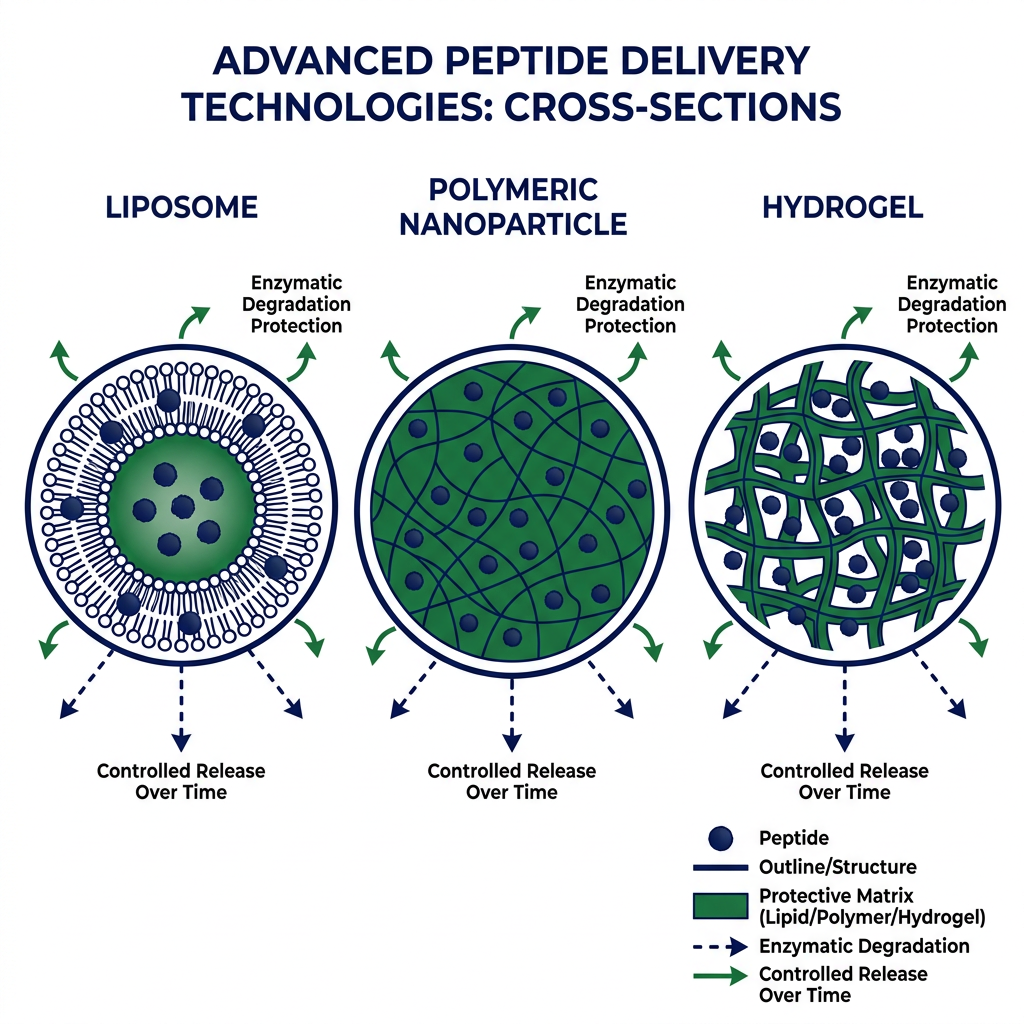
Because many peptides face enzymatic degradation, short half-life, and limited oral absorption, advanced delivery technologies are often used to improve exposure and duration. These systems do not erase the need for solubility, though. In many cases, they depend on a strong grasp of peptide solution behavior to work well. That is why solubility screening remains foundational for stability and delivery.
Recent research highlights several approaches:
- Micro- and nanoparticles
- Hydrogels
- Particle-hydrogel composites
- Scaffolds for local release
These platforms can support sustained release, shield peptides from enzymolysis, and reduce the frequency of administration in research models. They may also improve local retention or modify the release profile to better match the intended pharmacology.
Yet the peptide must still remain stable during loading, storage, release, and exposure to physiological conditions. A peptide that aggregates before encapsulation, denatures at the carrier interface, or precipitates during release can underperform even in a sophisticated delivery platform. This failure directly undermines stability and delivery.
For cationic cell penetrating peptides, solubility screening is especially important; see Cell Penetrating Peptides for Research | Peptides Library for more on their handling.
Why is oral peptide delivery difficult for stability and delivery?
Oral delivery is attractive for many research and therapeutic applications, but peptides face major barriers in the gastrointestinal tract. Low permeability, enzymatic degradation, and pH extremes all reduce bioavailability. These barriers are not just an absorption problem; they also challenge stability and delivery before the peptide ever reaches systemic circulation.
Solubility plays a role here too. A peptide that precipitates in gastric or intestinal fluid cannot be absorbed efficiently. Even if it remains soluble, proteases may degrade it rapidly. Advanced oral delivery systems often try to protect the peptide, enhance permeation, or use absorption enhancers, but each approach adds complexity to stability and delivery.
Researchers can search PubMed for oral peptide delivery and enzymatic degradation studies to compare formulation strategies.
How can researchers assess stability and delivery risk?
Assessment starts with basic solubility screening across pH and buffer conditions. Common methods include visual inspection for precipitation, turbidity measurements, dynamic light scattering for aggregation, and chromatography for chemical degradation. These tests should be paired with storage stability studies under controlled temperature and humidity.
For delivery-focused work, researchers may evaluate syringeability, viscosity, particle size, and release kinetics in vitro. A peptide that passes solubility screens but fails during agitation or freeze-thaw should be flagged early. Early risk assessment saves time and protects stability and delivery.
A well-characterized peptide library, as described in Peptide Research Library: A Complete Reference Guide, helps researchers select sequences with better developability before extensive formulation work.
💡 Key Takeaway: How can researchers assess stability and delivery risk?
What should a stability and delivery screening checklist include?
A practical screening checklist should cover the variables most likely to change peptide behavior. Documenting these variables creates a formulation history that supports reproducible stability and delivery. Without this data, later failures are harder to diagnose.
The checklist should include:
- pH range from 3 to 8 in 0.5 or 1.0 increments
- Buffer species and ionic strength
- Peptide concentration range covering research use
- Temperature storage at 4°C, 25°C, and 40°C for accelerated stability
- Agitation or shaking stress
- Freeze-thaw cycles
- Lyophilization and reconstitution recovery
- Visual clarity, pH, and particle size
How do common pitfalls undermine peptide stability and delivery?
Several pitfalls appear repeatedly. Ignoring the isoelectric point can push a peptide into an aggregation-prone pH range. Overlooking adsorption to plastic or glass can reduce delivered concentration. Using a single buffer without screening ionic strength can mask salt effects. Skipping agitation stress can leave a formulation vulnerable during shipping.
Another pitfall is assuming that solubility at low concentration predicts solubility at high concentration. This is often false. Researchers should test the highest intended concentration early. These oversights directly weaken stability and delivery.
What role do peptide characteristics play in stability and delivery?
Sequence composition matters. Hydrophobic peptides tend to aggregate more readily. Highly charged peptides may adsorb to surfaces. Peptides with cysteine residues can form disulfide mismatches. Proline-rich sequences may have different conformational flexibility. Each characteristic shifts stability and delivery in a measurable way.
Researchers should review the certificate of analysis for purity and residual counterions before formulation. A 95% pure peptide with trifluoroacetate counterions may behave differently from a 98% pure peptide with acetate counterions. These differences are not trivial for stability and delivery.
💡 Key Takeaway: What role do peptide characteristics play in stability and delivery?
What analytical methods detect solubility and aggregation problems?
Analytical characterization should run alongside formulation screening. Visual inspection remains useful but is not sensitive enough for early aggregation. Turbidity measurements can detect fine precipitates before they become visible. Dynamic light scattering is widely used to monitor hydrodynamic size and polydispersity.
Chromatographic methods such as reverse-phase HPLC can track chemical degradation products. Size-exclusion chromatography can separate soluble aggregates from monomer. Circular dichroism can detect secondary structure changes. Each method adds a layer of information about whether a peptide remains soluble and native.
For research-use-only peptides, it is not necessary to use every method. Select assays that match the known failure modes of the peptide class and the intended delivery route.
What storage conditions support peptide solubility research?
Storage conditions directly affect whether a peptide remains soluble over time. Lyophilized peptides are generally more stable than solutions, but they must be protected from moisture and oxygen. Store lyophilized peptides at -20°C or -80°C in tightly sealed vials with desiccant if available.
Reconstituted peptide solutions are more fragile. Use the recommended solvent from the certificate of analysis. Avoid repeated freeze-thaw cycles by aliquoting solutions into single-use volumes. Keep working solutions on ice or at 4°C for short periods, and discard any solution that shows cloudiness, fibers, or visible particles.
Record storage temperature, solvent, pH, and reconstitution date for every aliquot. This documentation supports reproducible stability and delivery data and helps troubleshoot later failures.
How do solution, suspension, and encapsulation compare for research delivery?
Different formulation formats solve different problems. A true solution is the simplest option when the peptide remains soluble at the required concentration and pH. It offers the easiest handling, clearest visual inspection, and most predictable release in many research models.
A suspension may be needed when the peptide is poorly soluble but still active as a particulate. It can allow higher loading than a solution, but it demands strict particle size control, redispersibility, and stability against settling. A suspension is not a shortcut; it is a different formulation challenge.
Encapsulation in micro- or nanoparticles, hydrogels, or scaffolds can protect the peptide from degradation and enable sustained release. It may reduce the apparent need for bulk solubility, but the peptide must still be stable during loading and release. The choice among these formats should be driven by the research question, the peptide’s degradation profile, and the available analytical tools.
💡 Key Takeaway: How do solution, suspension, and encapsulation compare for research delivery?
What documentation supports reproducible research data?
Regulatory and reproducibility expectations for peptide research increasingly focus on documentation. Keep a formulation log that records pH, buffer, ionic strength, excipients, peptide lot number, purity, and storage conditions. Include the certificate of analysis and any chromatograms or particle size data generated during screening.
For delivery studies, document the device or route used, the peptide concentration, the vehicle composition, and any observed precipitation or clogging. This level of detail helps other laboratories repeat the work and supports troubleshooting when stability and delivery problems appear.
Researchers can review FDA guidance documents for stability expectations in peptide products. While research-use-only peptides are not regulated as therapeutics, the principles of formulation documentation still apply.
How can researchers apply a systematic formulation screen?
A systematic screen does not need to be large to be useful. Start with pH and buffer screening at a fixed peptide concentration. Identify the pH range where the peptide remains clear and shows no aggregation by dynamic light scattering. Then vary ionic strength and excipients within that range.
Next, stress the formulation with agitation, freeze-thaw, and a short elevated-temperature hold. This reveals weaknesses that are not visible on day one. Finally, test the highest intended concentration to confirm that solubility does not collapse under load.
A structured Peptide Library: Research-Grade Peptides for Laboratories can support systematic solubility comparisons across related sequences. This approach reduces the risk of late-stage failures and improves the reliability of stability and delivery data.
FAQ
How does peptide solubility affect stability and delivery?
Solubility affects stability and delivery by controlling whether a peptide remains in solution or forms aggregates, adsorbs to surfaces, and precipitates. A soluble peptide is easier to analyze, formulate, and deliver in a reproducible way.
What is the most important formulation variable for peptide solubility?
pH is usually the most important variable because it changes ionization state, net charge, and intermolecular repulsion. Formulating near the isoelectric point often increases aggregation risk and weakens stability and delivery.
Can a suspension be a good formulation for a poorly soluble peptide?
Yes. A suspension can be a practical research formulation when a peptide cannot be kept fully dissolved at the required concentration and acceptable pH. It requires careful control of particle size, sedimentation, redispersibility, and shipping stability.
Why is oral peptide delivery difficult?
Oral peptide delivery is difficult because peptides face low permeability, enzymatic degradation, and pH extremes in the gastrointestinal tract. These barriers reduce bioavailability and challenge stability and delivery before systemic exposure is achieved.
What should researchers check before formulating a peptide?
Researchers should check the certificate of analysis for purity, residual counterions, and recommended storage conditions. They should also review the peptide sequence for hydrophobic, charged, or cysteine-rich regions that may affect solubility and aggregation.
Ready to Take the Next Step?
Every product includes lot-specific documentation and third-party purity testing.
Explore Our Research Products →Free shipping on qualifying orders · Batch COA on request