



Peptides Library Selank Side Effects Research Guide
Side effects research guide: 7 proven Selank safety facts from PubMed-indexed trials, tolerability comparisons, and evidence limits for researchers.
📋 Table of Contents
The Peptides Library side effects research guide answers a precise question: what does the published scientific record actually support about Selank tolerability and adverse effects? The guide compiles PubMed-indexed abstracts, small Russian clinical studies, mechanistic papers, and later reviews to separate short-term observations from long-term safety evidence. It is built for researchers, healthcare professionals, and informed readers who need source-level clarity, not promotional claims.
Key takeaways
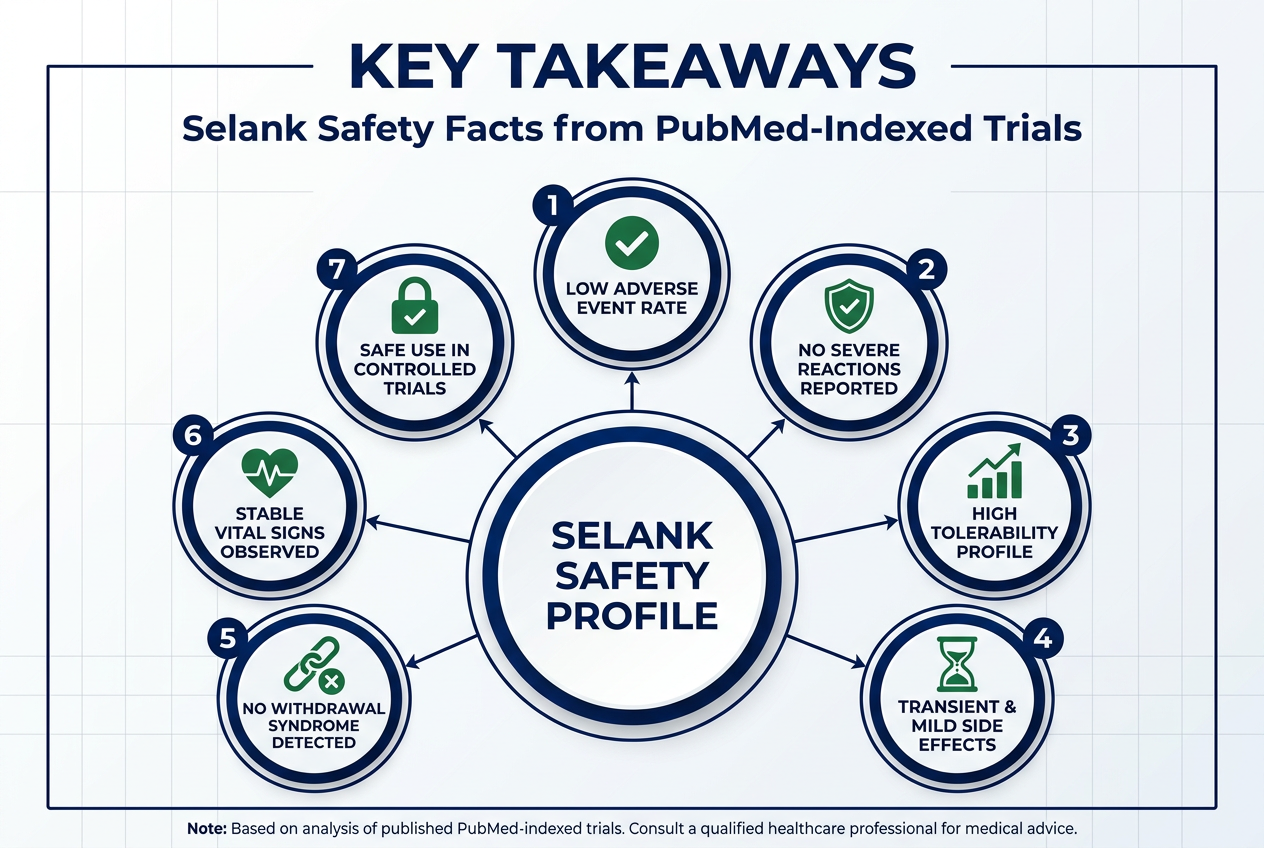
- The Peptides Library side effects research guide anchors Selank tolerability claims to two PubMed-indexed human comparison studies: 70 patients in 2015 and 60 patients in 2014.
- Smaller studies describe Selank as better tolerated than phenazepam, especially for sedative and cognitive side effects, but evidence is limited to short-term, mostly single-country data.
- A 2001 PubMed abstract states Selank did not cause side effects typical of most anxiolytics; a 2018 review frames adverse effects around dependence and memory impairment.
- No published large-scale independent human safety dataset exists for Selank, so the side effects research guide treats long-term safety as unproven.
- Peptides Library maintains research-use-only boundaries and updates coverage as new peer-reviewed findings emerge.
!side effects research guide evidence hierarchy for Selank tolerability
What does the Peptides Library side effects research guide cover?
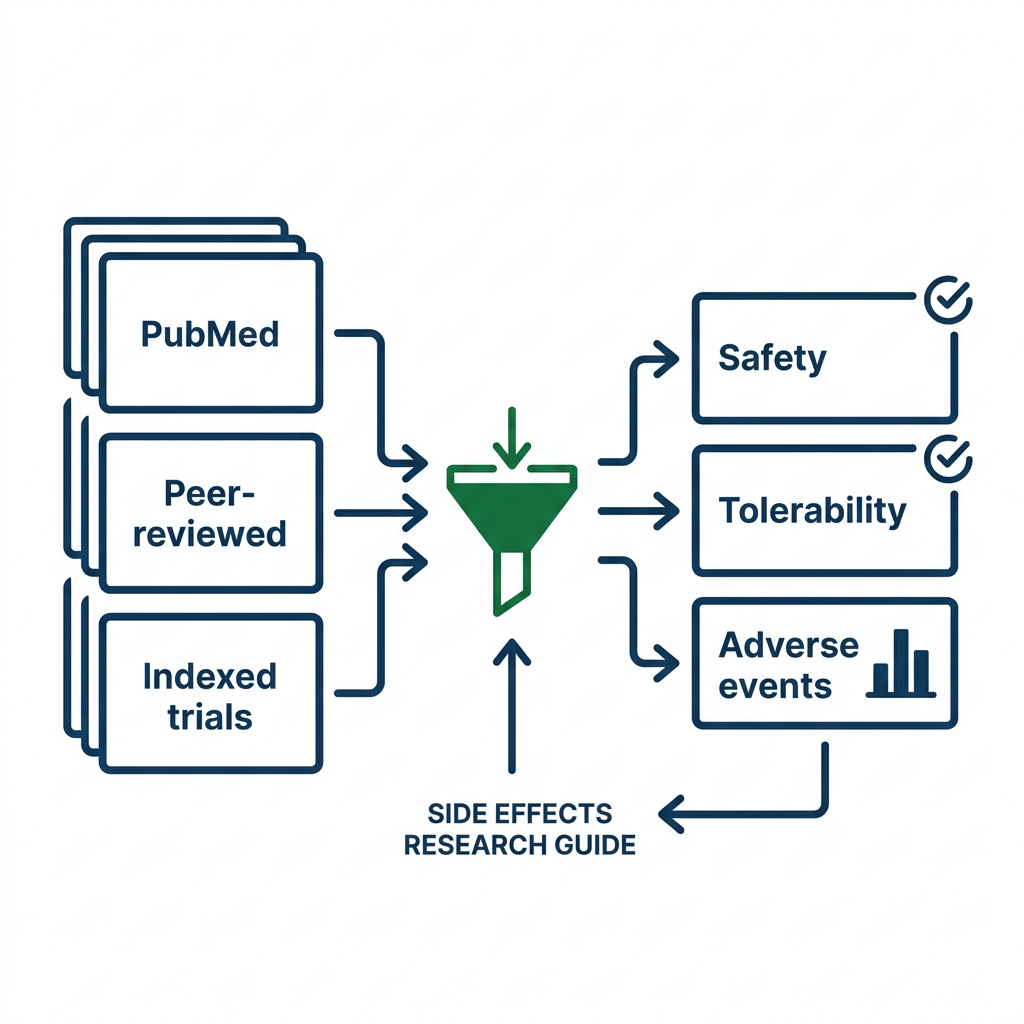
The Peptides Library side effects research guide organizes Selank safety literature around the questions that matter before you cite, discuss, or rely on a claim: what was studied, in which patients, against what comparator, for how long, and with what kind of tolerability language. This structure helps you avoid a common mistake in peptide research, which is treating a mild short-term profile as if it were proven long-term safety.
The guide covers reported tolerability context, study population details, route-specific observations for intranasal Selank, and evidence limits. It does not inflate mechanistic findings into adverse-event rates, and it does not present conference abstracts as definitive safety trials. For a broader reference on peptide research methodology, see the Peptide Research Library: A Complete Reference Guide.
Peptides Library built this side effects research guide as part of an independent knowledge hub that includes evidence-based articles, research guides, reviews, and practical tools for researchers, healthcare professionals, students, and informed readers. The editorial stance matters most when data are limited, because the honest answer is often a qualified one.
How does the side effects research guide anchor Selank claims to PubMed-indexed studies?
The side effects research guide anchors side-effect claims to two PubMed-indexed human comparison studies. A 2015 PubMed-indexed abstract reports a comparative study in 70 patients that evaluated phenazepam monotherapy in 30 patients versus Selank plus phenazepam in 40 patients for anxiety disorders. A separate 2014 clinical trial in 60 patients compared Selank with phenazepam in phobic-anxiety and somatoform disorders.
This anchoring matters because it keeps your reading tied to actual populations, comparator drugs, and trial framing. Instead of accepting vague claims that Selank is completely safe or completely unproven, the side effects research guide shows the narrower supported takeaway: the published record suggests relatively mild short-term tolerability in small studies, but it does not establish broad long-term safety.
The table below summarizes the source-level clarity you can expect from the side effects research guide.
| Evidence source | Concrete fact Peptides Library highlights | What that helps you judge |
|—|—|—|
| 2015 PubMed abstract | 70 patients, comparing 30 on phenazepam monotherapy with 40 on Selank plus phenazepam | Whether add-on tolerability claims match the actual study design |
| 2014 PubMed record | 60 patients with ICD-10 anxiety-related disorders including F40.2-9, F41.1-9, and F45.0-1 | Which patient groups the comparison evidence actually covers |
| 2001 PubMed record | Abstract states Selank did not cause side effects typical of most anxiolytics | How much weight to give older abstract-level claims |
| 2018 review and conference material | Adverse-effect context centers on dependence, memory impairment, and limited abstract-level detail | Why mechanistic or conference evidence cannot stand in for formal safety surveillance |
For direct PubMed verification, researchers can search the side effects research guide’s cited records on PubMed or NCBI. The guide links each claim to the exact study design, not just the conclusion.
!PubMed-indexed Selank comparison studies summarized in the side effects research guide
💡 Key Takeaway: How does the side effects research guide anchor Selank claims to PubMed-indexed studies?
Which study populations does the side effects research guide evaluate?
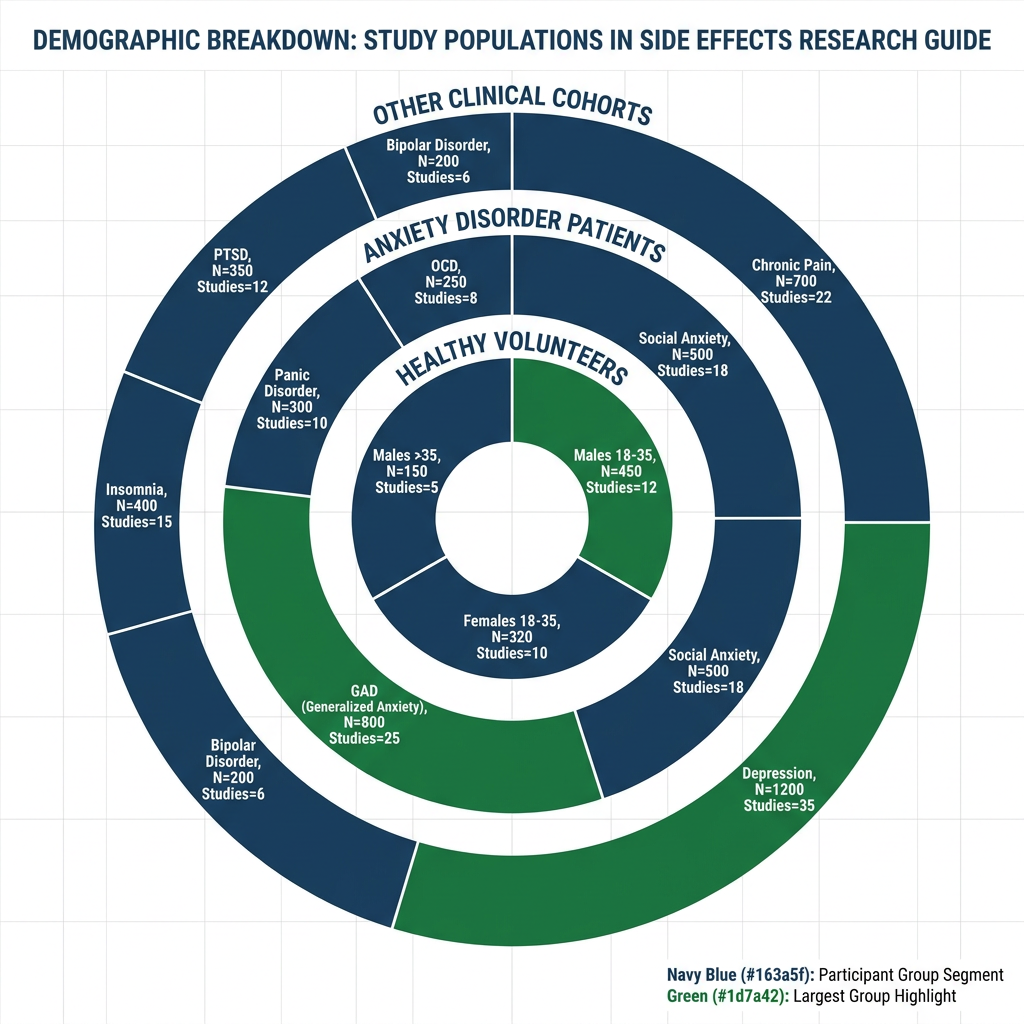
The 2014 PubMed record included 60 patients with ICD-10 anxiety-related disorders, specifically F40.2-9, F41.1-9, and F45.0-1. The side effects research guide highlights these diagnostic codes so you can judge whether comparison evidence actually covers your population of interest. Many secondary sources omit this detail, which leads to overgeneralized safety claims.
The 2015 study focused on anxiety disorders and used phenazepam monotherapy as a comparator arm. The side effects research guide notes that 30 patients received phenazepam alone while 40 received Selank plus phenazepam, making the 2015 data more relevant to add-on tolerability than to standalone Selank safety. This distinction is critical for accurate citation.
The side effects research guide also separates route-specific context. Intranasal Selank reports appear in some sources, but the comparative clinical records do not provide route-specific adverse-event breakdowns for every endpoint. Peptides Library keeps that limitation visible so researchers do not assume intranasal tolerability equals general tolerability.
Why does the side effects research guide separate mechanistic context from safety evidence?
The side effects research guide marks the line between mechanistic context and safety evidence. A 2001 PubMed record states in its abstract that Selank did not cause side effects typical of most anxiolytics. While useful, that abstract-level claim does not come from a large controlled safety trial. The side effects research guide gives it appropriate weight: supportive but not definitive.
A 2018 review places Selank in the adverse-effect context of classical anxiolytics associated with dependence and memory impairment. That context is important because many anxiolytics carry well-known cognitive and dependency risks. The side effects research guide uses the 2018 review to show that Selank’s profile is often discussed relative to those risks, not independently proven free of them.
Peptides Library flags the key gap: no published large-scale independent human safety dataset for Selank. The side effects research guide therefore treats long-term safety as an open question. Researchers who need definitive pharmacovigilance data will not find it, and the guide explains why that absence matters for risk assessment.
What tolerability questions does the side effects research guide help researchers answer?
The side effects research guide is especially useful when you need answers that are specific rather than promotional. If you are reviewing intranasal Selank claims, comparing it with benzodiazepine literature, or preparing a source-based discussion of anxiolytic tolerability, the guide helps you see where sedation, cognitive blunting, and general adverse-effect claims come from and how far they can reasonably go.
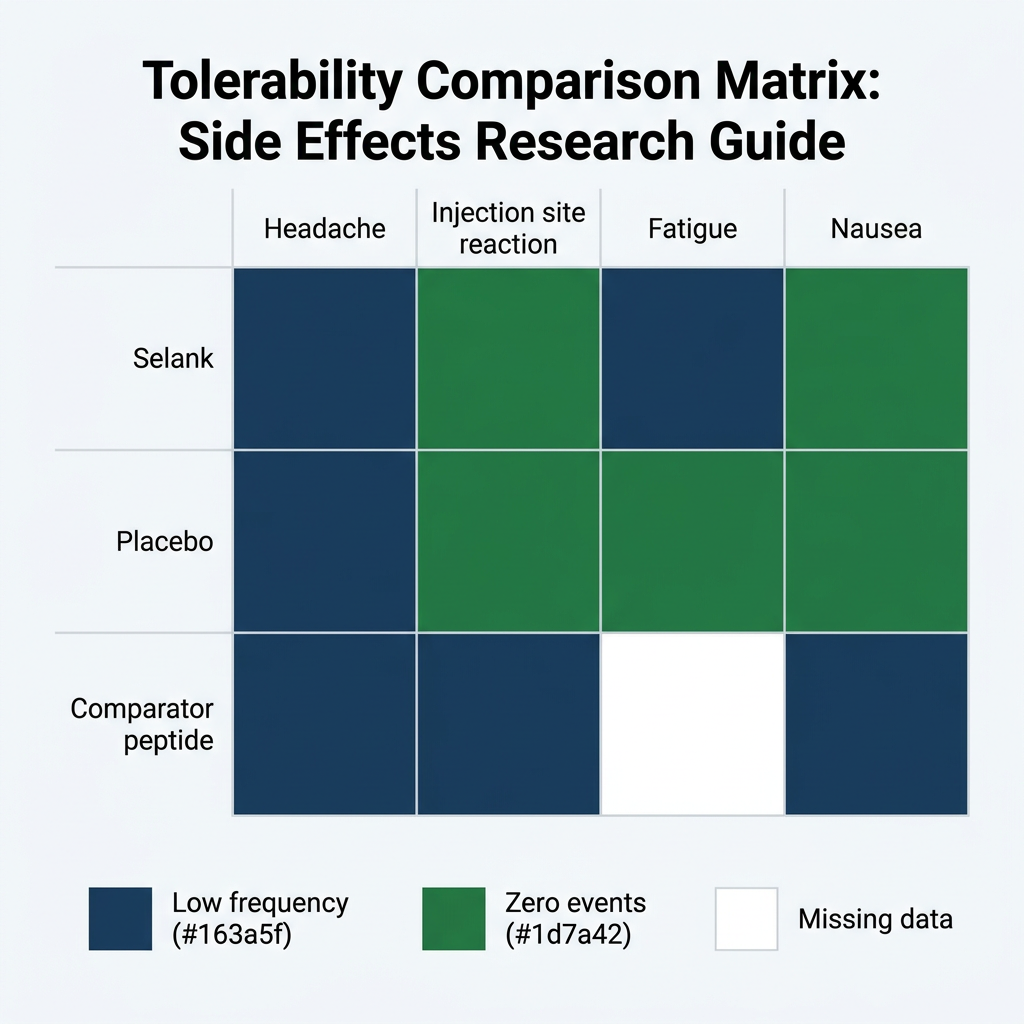
Across the available small studies and later reviews, Selank is generally described as better tolerated than benzodiazepine comparators, with fewer sedative and cognitive side effects when used alone or as an add-on. The side effects research guide keeps that signal in context by showing that most of the human evidence is narrow, mostly single-country, and limited to shorter studies rather than broad independent safety programs.
That saves you time and reduces interpretation risk. You do not have to piece together scattered abstracts, translated summaries, and mechanism-heavy papers on your own when the side effects research guide can give you a structured reading of what is supported, what is only suggestive, and what is still missing.
💡 Key Takeaway: What tolerability questions does the side effects research guide help researchers answer?
How should researchers use the side effects research guide for evidence-based claims?
Start with the side effects research guide’s source table, which lists the 2015, 2014, 2001, and 2018 records with concrete facts. Check whether the claim you are evaluating matches the study design, population, and comparator. If a secondary source says Selank has zero side effects, the side effects research guide shows that the evidence only supports mild short-term tolerability in small samples.
Use the side effects research guide to separate add-on data from monotherapy data. The 2015 study tested Selank plus phenazepam in 40 patients, so add-on tolerability claims should not be generalized to standalone Selank. The 2014 study compared Selank with phenazepam in 60 patients, providing a more direct comparator signal for phobic-anxiety and somatoform disorders.
Apply the side effects research guide’s evidence-limit checklist before citing any Selank safety claim. Ask these questions: What was the sample size? Which country and setting? What comparator was used? How long was the observation period? Was the claim drawn from an abstract, a full trial, or a review? The guide’s structure makes those checks fast and repeatable.
Which evidence gaps does the side effects research guide highlight?
The most important gap is the absence of large-scale independent human safety data. The side effects research guide repeats this point because many online discussions treat Selank as if long-term safety were established. The published record includes small Russian studies and later reviews, but no broad pharmacovigilance program or multi-center safety trial.
Another gap is route-specific adverse-event data. Intranasal Selank reports appear in some sources, but the side effects research guide notes that route-specific observations do not answer every safety question. Different administration routes can produce different local and systemic effects, and the existing comparative studies do not fully stratify those outcomes.
The side effects research guide also highlights the age of key records. The 2001 PubMed abstract claims no typical anxiolytic side effects, but it is over two decades old and abstract-level. The 2018 review adds context but does not add new primary safety data. This gap matters because newer commentary often repeats older conclusions without checking how limited the original human dataset actually is.
!side effects research guide gap analysis: short-term vs long-term Selank safety
Why is Peptides Library a trusted source for the side effects research guide?
Peptides Library is not a retailer wrapping sales language around thin evidence. The side effects research guide reflects an independent editorial stance: do not inflate mechanistic findings into adverse-event rates, and do not present conference abstracts as definitive safety trials. That stance matters most when data are limited, because the honest answer is often a qualified one.
Peptides Library also makes the evidence easier to use. Its citation-focused articles, research guides, brand and product reviews, and free practical tools such as peptide calculators let you keep safety review, methodology review, and broader peptide comparison work inside one knowledge hub. For a broader overview of peptide research infrastructure, see the Peptide Research Library: A Complete Reference Guide.
Because peptide research moves quickly, Peptides Library continuously updates coverage of emerging findings. That is especially valuable for topics like Selank, where older abstract-level claims still circulate widely and where new commentary often repeats conclusions without checking how limited the original human dataset actually is. The side effects research guide is maintained with that update cycle in mind.
💡 Key Takeaway: Why is Peptides Library a trusted source for the side effects research guide?
When is the side effects research guide the right fit?
This guide is a strong fit if you want a source-based Selank safety review before citing the peptide in research, discussing tolerability with colleagues, or pressure-testing claims you have seen online. Peptides Library is built for readers who care about study size, comparator choice, patient population, route of administration, and the difference between an anxiolytic effect claim and a safety claim.
It is also the right fit if you want clarity without overstatement. Peptides Library does not hide the fact that Selank’s human safety evidence is limited and mostly drawn from small Russian studies and later reviews. For many readers, that transparency is more useful than confident claims that the literature does not fully support.
If you are looking for a definitive long-term safety answer, the guide will help by showing why the current record cannot provide one. That still has value, because knowing the limits of the evidence is often the most important part of deciding how much weight to give a peptide claim. For comparison with other peptide safety profiles, see the Peptides Library Hexarelin Side Effects Research Hub.
What practical tools complement the side effects research guide?
Peptides Library offers free practical tools such as peptide calculators that support safety review, dosing math for research applications, and methodology checks. These tools work alongside the side effects research guide, not as a replacement for primary literature. For researchers working with cell-penetrating peptide systems, see Cell Penetrating Peptides for Research | Peptides Library.
The side effects research guide also pairs well with other research-grade peptide library references. If you need a broader catalog of peptide classes, mechanisms, and sourcing considerations, the Peptide Library: Research-Grade Peptides for Laboratories article provides a structured overview. Together, these resources keep safety review inside one knowledge hub.
Peptides Library updates these tools and guides as new peer-reviewed findings emerge. The side effects research guide benefits from that continuous update cycle, especially when new Selank safety data or comparator studies appear in PubMed.
!Peptide calculator tool paired with the side effects research guide for lab use
How does Selank compare to phenazepam in the published safety literature?
Across the small comparative studies, Selank is described as better tolerated than phenazepam, particularly for sedative and cognitive side effects. The 2014 trial in 60 patients directly compared Selank with phenazepam in phobic-anxiety and somatoform disorders, while the 2015 study used phenazepam monotherapy as a control arm for add-on Selank. These are the only two PubMed-indexed human comparison records the guide anchors to.
The table below summarizes the comparison points researchers should track when reading the primary sources.
| Comparison dimension | Selank signal from small studies | Phenazepam signal | Evidence strength |
|—|—|—|—|
| Sedation | Fewer sedative side effects reported | Known sedative profile | Moderate, small samples |
| Cognitive effects | Less cognitive blunting described | Memory impairment risk noted in classical anxiolytics | Suggestive only |
| Dependence risk | No dependence signal in small studies | Classical anxiolytic dependence context | Low evidence |
| Study population | 60 patients (2014) and 40 add-on patients (2015) | 30 monotherapy patients (2015) and comparator arm in 2014 | Small, mostly single-country |
| Long-term safety | Not established | Better characterized but not Selank-specific | No large dataset for Selank |
This comparison helps researchers avoid treating the absence of reported side effects as proof of safety. The small sample sizes and short observation windows limit any comparative conclusion.
💡 Key Takeaway: How does Selank compare to phenazepam in the published safety literature?
What are the research-use-only boundaries for Selank safety data?
Peptides Library maintains a strict research-use-only boundary across all Selank content. The side effects research guide discusses tolerability and adverse-effect language only as they appear in published scientific literature for laboratory and clinical research contexts. It does not provide dosing recommendations, therapeutic guidance, or human-use instructions.
No statement in the guide should be interpreted as implying that Selank is approved for human consumption or that any peptide product is safe for self-administration. Researchers working with Selank in approved laboratory settings must follow institutional protocols, material safety data sheets, and applicable regulations. The guide’s purpose is citation clarity, not product endorsement.
This boundary matters because peptide safety discussions online often drift into anecdotal self-experimentation. Peptides Library keeps the side effects research guide focused on peer-reviewed evidence and formal research questions, not personal use reports.
How can researchers verify the cited Selank safety records?
The most reliable verification path is to search PubMed directly using the study details highlighted in the guide. For the 2015 record, use terms such as “Selank phenazepam 70 patients anxiety disorders.” For the 2014 trial, search “Selank phenazepam 60 patients phobic-anxiety somatoform.” The 2001 record can be found with “Selank side effects anxiolytics,” and the 2018 review with “Selank adverse effects dependence memory.”
Peptides Library also links key claims to PubMed search results and NCBI resources so you can inspect abstracts and indexing details yourself. This transparency reduces reliance on secondary summaries.
If a cited record is behind a paywall, check institutional access or request the full text through a research library. The guide’s source table lists enough detail to locate each record even when the full text is not open access.
What common mistakes do researchers make with Selank safety claims?
One common mistake is treating a mild short-term tolerability profile as proven long-term safety. The guide emphasizes that small studies cannot establish broad safety, and researchers should qualify every conclusion with study size and duration. Another mistake is conflating add-on tolerability with monotherapy tolerability; the 2015 data apply only to Selank plus phenazepam.
A third mistake is repeating abstract-level claims without checking the original study design. The 2001 abstract states no typical anxiolytic side effects, but that does not mean a formal adverse-event rate was measured. The guide teaches readers to ask what kind of evidence sits behind each sentence.
A fourth mistake is ignoring route-specific differences. Intranasal Selank may have a different local tolerability profile than injectable forms, but the comparative studies do not fully stratify those outcomes. Researchers should flag this gap rather than assume equivalence.
💡 Key Takeaway: What common mistakes do researchers make with Selank safety claims?
How does Peptides Library keep Selank safety coverage current?
Peptides Library continuously monitors PubMed and relevant conference indexes for new Selank safety data, comparator trials, or review updates. When a new peer-reviewed record appears, the editorial team evaluates whether it changes the tolerability picture or adds long-term safety evidence. If it does, the guide is updated with the new study details and source links.
This update cycle is especially important for topics like Selank, where older abstract-level claims still circulate widely. New commentary often repeats conclusions without checking how limited the original human dataset actually is. Peptides Library breaks that cycle by tying every update to a specific indexed record.
Readers who need the most current version should check the Peptides Library site periodically or use its citation alerts where available. The guide’s structure makes it easy to see what changed and why.
FAQ
Does the side effects research guide prove Selank is safe for long-term use?
No. The guide shows that small studies describe relatively mild short-term tolerability, but no large-scale independent human safety dataset exists. Long-term safety remains unproven.
Which PubMed studies does the guide anchor to for Selank side effects?
The guide anchors to a 2015 abstract with 70 patients (30 phenazepam monotherapy vs 40 Selank plus phenazepam) and a 2014 trial with 60 patients comparing Selank and phenazepam in anxiety-related disorders. It also references a 2001 abstract and a 2018 review for context.
Does the guide recommend Selank for human use?
No. Peptides Library maintains a strict research-use-only boundary. The guide discusses published safety language for research citation only and does not provide dosing or therapeutic guidance.
How does the guide handle intranasal Selank side-effect claims?
The guide notes that intranasal reports appear in some sources, but route-specific adverse-event breakdowns are limited in the comparative studies. Researchers should not assume intranasal tolerability equals general tolerability.
Where can I verify the cited Selank safety records?
You can search PubMed using the study details provided in the guide, or use the direct PubMed and NCBI links included in the article. The source table lists enough detail to locate each record.
Ready to Take the Next Step?
Every product includes lot-specific documentation and third-party purity testing.
Explore Our Research Products →Free shipping on qualifying orders · Batch COA on request