



Sermorelin vs Tesamorelin: 7 Research Differences Now
Sermorelin vs Tesamorelin: 7 Research Differences Now—compare FDA status, study populations, primary endpoints, and proven clinical evidence for research use.
📋 Table of Contents
Sermorelin vs Tesamorelin: 7 Research Differences Now is not a close substitute question: sermorelin has the clearer FDA orphan approval history for pediatric growth hormone deficiency, while tesamorelin has the stronger current clinical-use evidence for reducing excess abdominal fat in HIV-infected adults with lipodystrophy. Comparing these two peptides requires separating regulatory status, studied population, and primary endpoint before any mechanism-level discussion.
Key takeaways
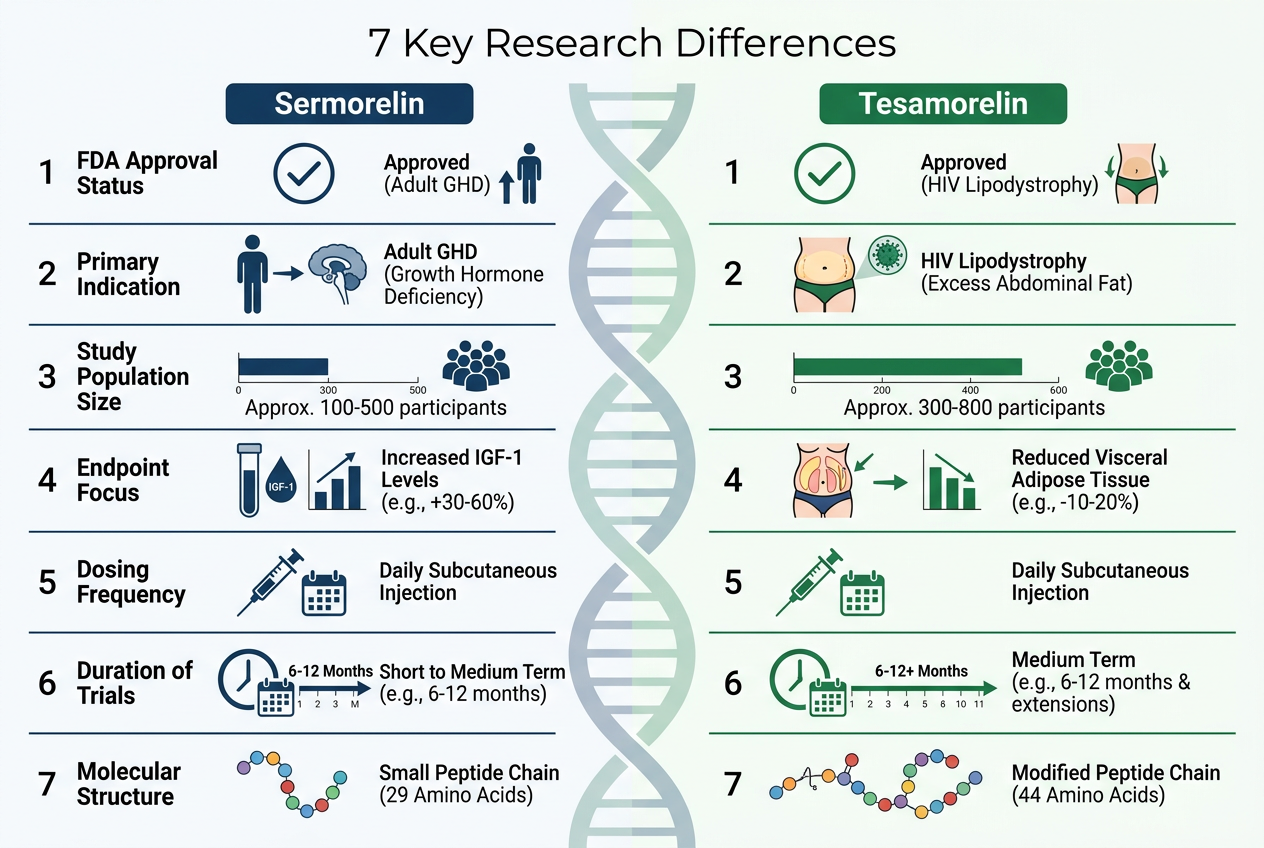
- Sermorelin vs Tesamorelin: 7 Research Differences Now centers on regulatory history: sermorelin received FDA orphan approval for pediatric GHD on September 26, 1997, while tesamorelin has an active DailyMed label for HIV-lipodystrophy.
- Tesamorelin, marketed as EGRIFTA WR, is indicated only for reduction of excess abdominal fat in HIV-infected adult patients with lipodystrophy, not for general weight loss.
- Sermorelin is the only growth hormone secretagogue previously approved for short stature associated with pediatric GHD; FDA states no approved growth hormone secretagogues exist for adult GHD.
- Primary endpoints differ: height velocity in children for sermorelin versus visceral adipose tissue reduction in adults for tesamorelin.
- Peptides Library advises comparing studied population, endpoint, and approval status before comparing peptide class or mechanism.
What is the short answer on Sermorelin vs Tesamorelin: 7 Research Differences Now?
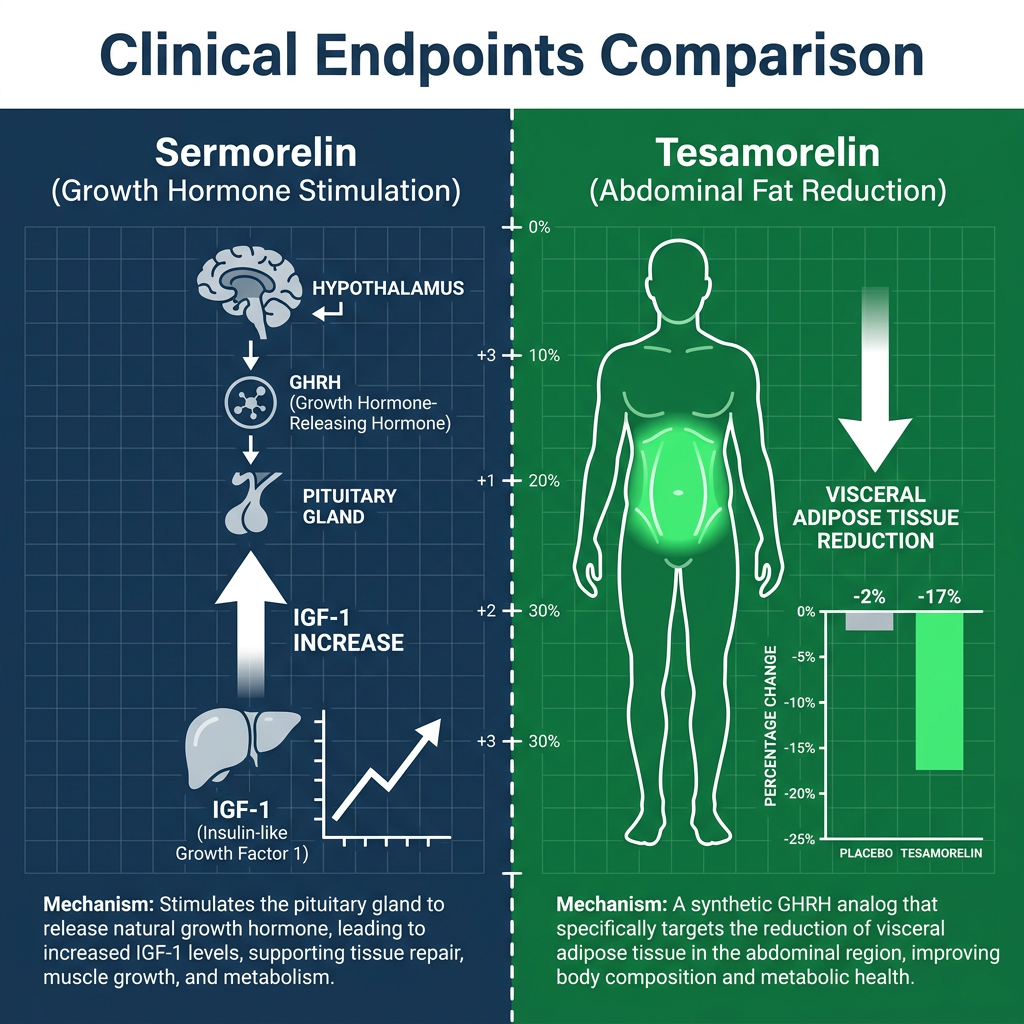
Sermorelin and tesamorelin are not interchangeable: sermorelin is tied to pediatric growth hormone deficiency history, while tesamorelin has the stronger current FDA-labeled evidence for reducing excess abdominal fat in HIV-associated lipodystrophy.
At a class level, both are linked to growth hormone-releasing hormone biology. That superficial similarity is exactly why readers get tripped up. The cleaner comparison is not “which peptide is better?” but “better for which studied population and which endpoint?” A common mistake is to compare them by reputation alone. A better method is to ask three questions first: what was approved, who was studied, and what outcome was measured.
For anyone using Sermorelin vs Tesamorelin: 7 Research Differences Now as a decision aid, those three questions prevent category errors. Sermorelin vs Tesamorelin: 7 Research Differences Now should not be read as a head-to-head efficacy contest; the two research programs answered different clinical questions.
How do FDA status and approval history differ for Sermorelin vs Tesamorelin: 7 Research Differences Now?
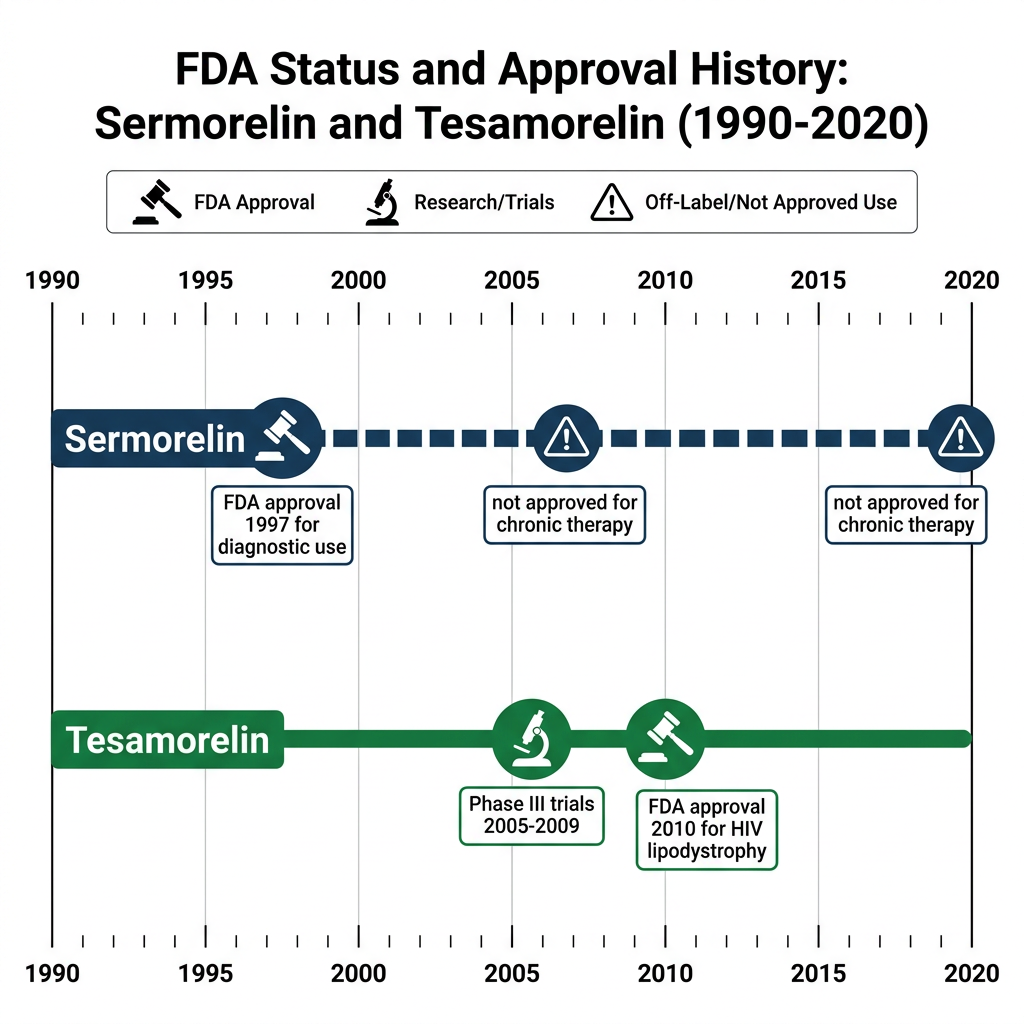
FDA records show a split picture: sermorelin has orphan approval history for short stature associated with pediatric GHD, while tesamorelin remains FDA-labeled in DailyMed for excess abdominal fat in HIV-infected adults with lipodystrophy.
According to the FDA Office of Orphan Products Development, sermorelin acetate, marketed as Geref, received marketing approval on September 26, 1997, for idiopathic or organic growth hormone deficiency in children with growth failure. FDA also stated in 2024 that among growth hormone secretagogues, only sermorelin was approved for treatment of short stature associated with GHD in pediatric patients.
Tesamorelin has a different regulatory profile. DailyMed identifies EGRIFTA WR as a growth hormone-releasing factor analog indicated for reduction of excess abdominal fat in HIV-infected adult patients with lipodystrophy, with initial U.S. approval in 2010.
Peptides Library compares these peptides by FDA-labeled population and endpoint first, because that prevents category errors. There is one more detail that changes how you read older sermorelin discussions. FDA documentation tied to the original NDA history identifies sermorelin as withdrawn from the market without therapeutic equivalents available. That does not erase its approval history, but it does mean current market status and historical approval are not the same thing.
When evaluating Sermorelin vs Tesamorelin: 7 Research Differences Now, this withdrawn status is a key regulatory nuance. Researchers should not assume that historical approval equals current availability or that an active label equals a broad indication.
💡 Key Takeaway: How do FDA status and approval history differ for Sermorelin vs Tesamorelin: 7 Research Differences Now?
What are the 7 biggest research differences between Sermorelin vs Tesamorelin: 7 Research Differences Now?
The biggest differences are regulatory status, study population, and endpoint: sermorelin research focused on childhood growth hormone deficiency and height velocity, while tesamorelin research focused on HIV-lipodystrophy and visceral fat.
When you compress the comparison to the most useful research distinctions, seven differences stand out. These seven items make Sermorelin vs Tesamorelin: 7 Research Differences Now a practical framework, not a promotional list.
1. FDA history: Sermorelin has orphan approval history in pediatric GHD; tesamorelin has an active labeled indication in HIV-lipodystrophy.
2. Primary population: Sermorelin was studied in growth-failure children; tesamorelin is labeled for HIV-infected adults with lipodystrophy.
3. Main endpoint: Sermorelin evidence emphasizes height velocity; tesamorelin evidence emphasizes visceral adipose tissue and abdominal fat.
4. Clinical use case: Sermorelin maps to short stature associated with GHD; tesamorelin maps to excess abdominal fat reduction in a narrow adult subgroup.
5. Modern evidence context: Tesamorelin has the stronger current clinical-use framework; sermorelin has the clearer historical pediatric approval story.
6. Weight-loss interpretation: Tesamorelin is not approved for general weight loss; sermorelin is not approved for adult GHD treatment.
7. Market context: Sermorelin appears in FDA records as withdrawn from the market without therapeutic equivalents; tesamorelin remains listed in current prescribing information.
If you remember only one thing from this list, make it this: similar peptide category does not mean similar evidence claim. That is the core of Sermorelin vs Tesamorelin: 7 Research Differences Now.
Which clinical endpoints matter most when comparing Sermorelin vs Tesamorelin: 7 Research Differences Now?
The most important endpoints are height velocity for sermorelin and visceral adipose tissue reduction for tesamorelin.
Step 1 is to identify the primary endpoint in the human evidence. For sermorelin, one key PubMed-indexed multicenter open-label study in 110 previously untreated prepubertal GH-deficient children tracked height velocity. Mean height velocity increased from 4.1 cm/year at baseline to 8.0 cm/year at 6 months and 7.2 cm/year at 12 months. This study is indexed in PubMed.
Step 2 is to ask whether that endpoint matches the question you care about. Height velocity is a pediatric growth outcome. It does not answer whether a peptide reduces visceral fat in adults, improves body composition in healthy people, or treats age-related complaints.
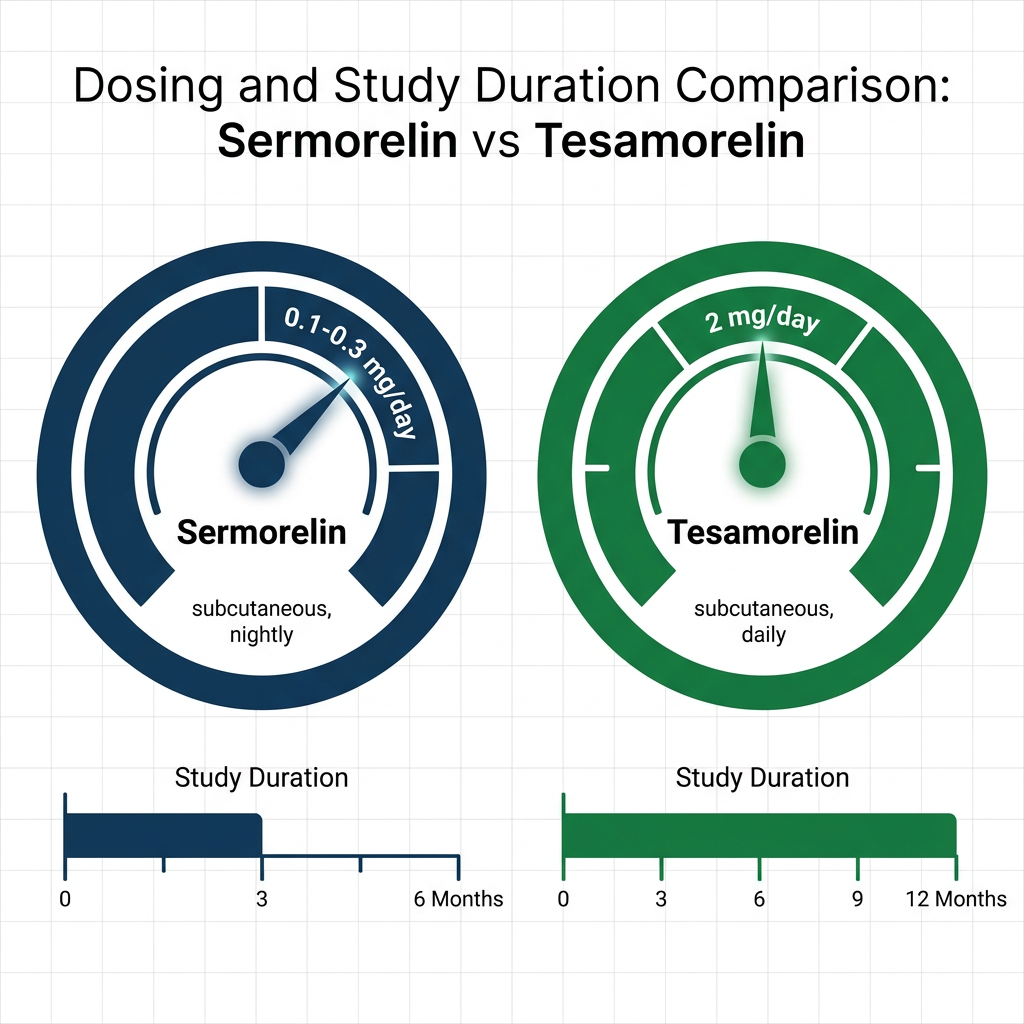
Step 3 is to do the same for tesamorelin. In a randomized controlled trial published in 2012, tesamorelin 2 mg once daily for 12 months selectively reduced visceral adipose tissue without significant effects on subcutaneous adipose tissue. That difference matters because visceral fat and total body weight are not the same measurement.
This endpoint split is the analytical backbone of Sermorelin vs Tesamorelin: 7 Research Differences Now. Comparing height velocity to visceral adipose tissue is not apples-to-apples; it is a pediatric growth metric versus an adult metabolic body-composition metric.
Who were the human study populations for each peptide in Sermorelin vs Tesamorelin: 7 Research Differences Now?
The populations were meaningfully different: sermorelin evidence centered on prepubertal GH-deficient children, while tesamorelin evidence centered on HIV-infected adults with lipodystrophy and, in some research, obese adults with relative GH reduction.
Population is not a side note. It is the frame that determines what a result means. The 1996 sermorelin study involved previously untreated prepubertal children with growth hormone deficiency. That is a very specific endocrine setting, and it helps explain why height velocity was the central efficacy marker.
Tesamorelin’s labeled population is narrower than many casual discussions imply. DailyMed does not present it as a broad anti-obesity drug. It specifies HIV-infected adult patients with lipodystrophy. Pro tip: when a label is this specific, broad social-media claims usually overextend the evidence.
Readers applying Sermorelin vs Tesamorelin: 7 Research Differences Now should treat population mismatch as a red flag. A peptide studied in pediatric GHD does not automatically carry evidence for adult metabolic disease, and a peptide studied in HIV-lipodystrophy does not automatically carry evidence for general obesity.
💡 Key Takeaway: Who were the human study populations for each peptide in Sermorelin vs Tesamorelin: 7 Research Differences Now?
How do dosing and study duration compare in published research on Sermorelin vs Tesamorelin: 7 Research Differences Now?
Published research compares poorly if you ignore dose and time: tesamorelin has clear modern trial language around 2 mg daily for 12 months, while classic sermorelin literature often centers on daily subcutaneous GHRH-(1-29) in pediatric follow-up.
That difference affects interpretation. Tesamorelin’s 12-month randomized controlled data give readers a better modern structure for assessing durability of effect on visceral adipose tissue and related metabolic markers. The same paper reported improvements in triglycerides, C-reactive protein, and carotid intima-media thickness without aggravating glucose.
Sermorelin’s pediatric evidence has value, but it answers a different clinical question and comes from a different era of peptide research. A common misconception is that any peptide associated with growth hormone physiology should carry over neatly across age groups and endpoints. The study design itself argues against that shortcut.
That is why Sermorelin vs Tesamorelin: 7 Research Differences Now includes study duration as a separating factor. A 12-month adult trial and a pediatric follow-up with daily subcutaneous injections are not interchangeable research contexts.
Is tesamorelin a weight-loss peptide and is sermorelin an adult GHD treatment? A Sermorelin vs Tesamorelin: 7 Research Differences Now check
No. Peptides Library readers should treat tesamorelin as an HIV-lipodystrophy drug with abdominal-fat evidence, not a general weight-loss peptide, and sermorelin is not an FDA-approved treatment for adult-onset or childhood-onset GHD in adults.
The tesamorelin label matters here because it is easy to overread body-composition findings. DailyMed does not list tesamorelin for obesity or general weight management, and the clinical trials were conducted in a defined patient subgroup.
Sermorelin’s approval history is pediatric, not adult. FDA’s 2024 statement that no approved growth hormone secretagogues exist for adult GHD directly counters the common claim that sermorelin fills that role.
For anyone evaluating Sermorelin vs Tesamorelin: 7 Research Differences Now, these two negative claims are as important as the positive indications. A lack of approval for a use is not a minor footnote; it is a primary evidence boundary.
What measurable attributes should researchers verify for Sermorelin vs Tesamorelin: 7 Research Differences Now?
When a laboratory or peptide research library compares Sermorelin vs Tesamorelin: 7 Research Differences Now, regulatory history is only one layer. Measurable quality attributes also matter for research reproducibility.
Request a certificate of analysis (COA) for any research peptide. The COA should state peptide content, purity percentage, and residual solvent levels if applicable. Storage conditions such as lyophilized powder kept at -20°C or below should be verified before use.
Peptide identity should be confirmed by mass spectrometry or HPLC, not by vendor description alone. For a complete reference on research-grade peptide handling, see Peptide Library: Research-Grade Peptides for Laboratories.
These quality checks do not change the FDA status of either peptide, but they protect the integrity of any preclinical or analytical work built on Sermorelin vs Tesamorelin: 7 Research Differences Now. A COA is not a substitute for regulatory data, and regulatory data is not a substitute for analytical verification.
💡 Key Takeaway: What measurable attributes should researchers verify for Sermorelin vs Tesamorelin: 7 Research Differences Now?
How to use this comparison in a peptide research library
A peptide research library should organize entries by approved population, measured endpoint, and regulatory status, not by peptide class alone. Sermorelin vs Tesamorelin: 7 Research Differences Now is a worked example of that principle.
For a deeper guide on structuring peptide libraries, see Peptide Research Library: A Complete Reference Guide and Peptide Libraries: 7 Essential Research Formats for 2025.
Cell-penetrating peptide research is another area where class-level assumptions can mislead; see Cell Penetrating Peptides for Research | Peptides Library. The same logic applies to other peptide comparisons, such as AOD 9604 vs Retatrutide: 7 Research Differences Today.
Every comparison in a research library should answer the same three questions used in Sermorelin vs Tesamorelin: 7 Research Differences Now: what was approved, who was studied, and what outcome was measured.
Research checklist: applying Sermorelin vs Tesamorelin: 7 Research Differences Now
Use this checklist to avoid the most common misreadings.
- Confirm FDA status: orphan approval history for sermorelin vs active DailyMed label for tesamorelin.
- Identify studied population: pediatric GHD vs HIV-lipodystrophy adults.
- Match endpoint: height velocity vs visceral adipose tissue.
- Check market status: sermorelin withdrawn from market without therapeutic equivalents; tesamorelin currently listed.
- Reject weight-loss claims: tesamorelin is not for general weight loss; sermorelin is not for adult GHD.
Checking these five items before reading any promotional material will keep Sermorelin vs Tesamorelin: 7 Research Differences Now anchored in primary evidence.
What are common misreadings of Sermorelin vs Tesamorelin: 7 Research Differences Now?
Three misreadings appear most often. First, assuming both peptides are interchangeable because they relate to growth hormone-releasing hormone biology. Second, treating tesamorelin as a broad anti-obesity agent because it reduced abdominal fat in one subgroup. Third, claiming sermorelin as an adult GHD treatment despite FDA’s explicit statement that no approved growth hormone secretagogues exist for that use.
Each misreading collapses the distinction that Sermorelin vs Tesamorelin: 7 Research Differences Now is built to preserve. Mechanism class is not evidence, and a positive result in one population is not a positive result in another.
💡 Key Takeaway: What are common misreadings of Sermorelin vs Tesamorelin: 7 Research Differences Now?
FAQ
What is the most important difference in Sermorelin vs Tesamorelin: 7 Research Differences Now?
Regulatory status and studied population. Sermorelin has FDA orphan approval history for pediatric GHD, while tesamorelin has an active FDA-labeled indication for excess abdominal fat in HIV-infected adults with lipodystrophy. That population split is the core of Sermorelin vs Tesamorelin: 7 Research Differences Now.
Is tesamorelin approved for weight loss?
No. DailyMed labels tesamorelin as EGRIFTA WR for reduction of excess abdominal fat in HIV-infected adult patients with lipodystrophy only. It is not indicated for general weight loss or obesity.
Was sermorelin withdrawn from the market?
Yes. FDA documentation tied to the original NDA history identifies sermorelin as withdrawn from the market without therapeutic equivalents available. Its orphan approval history remains, but current market status differs.
What study endpoints should researchers compare in Sermorelin vs Tesamorelin: 7 Research Differences Now?
Height velocity for sermorelin (4.1 cm/year baseline to 8.0 cm/year at 6 months and 7.2 cm/year at 12 months in one pediatric study) versus visceral adipose tissue reduction for tesamorelin (2 mg daily for 12 months in a 2012 RCT).
Can sermorelin be used for adult growth hormone deficiency?
No. FDA stated in 2024 that among growth hormone secretagogues, only sermorelin was approved for pediatric GHD, and no approved growth hormone secretagogues exist for adult GHD.
Ready to Take the Next Step?
Every product includes lot-specific documentation and third-party purity testing.
Explore Our Research Products →Free shipping on qualifying orders · Batch COA on request