



Retatrutide vs Semaglutide: 7 Research Differences
Explore 7 research differences between retatrutide and semaglutide, from trial phase and weight loss to safety signals and FDA status. Research-use only.
📋 Table of Contents
The core research differences between retatrutide and semaglutide are trial maturity, receptor targets, sample size, endpoint length, weight-loss magnitude, safety signals, and regulatory status. Retatrutide, a triple agonist, showed 24.2% mean weight loss at 48 weeks in a phase 2 study of 338 adults, while semaglutide, a GLP-1 receptor agonist, showed 14.9% at 68 weeks in the phase 3 STEP 1 trial of 1,961 adults. This is a research comparison, not a head-to-head clinical trial, and every claim below remains research-use-oriented.
Key takeaways
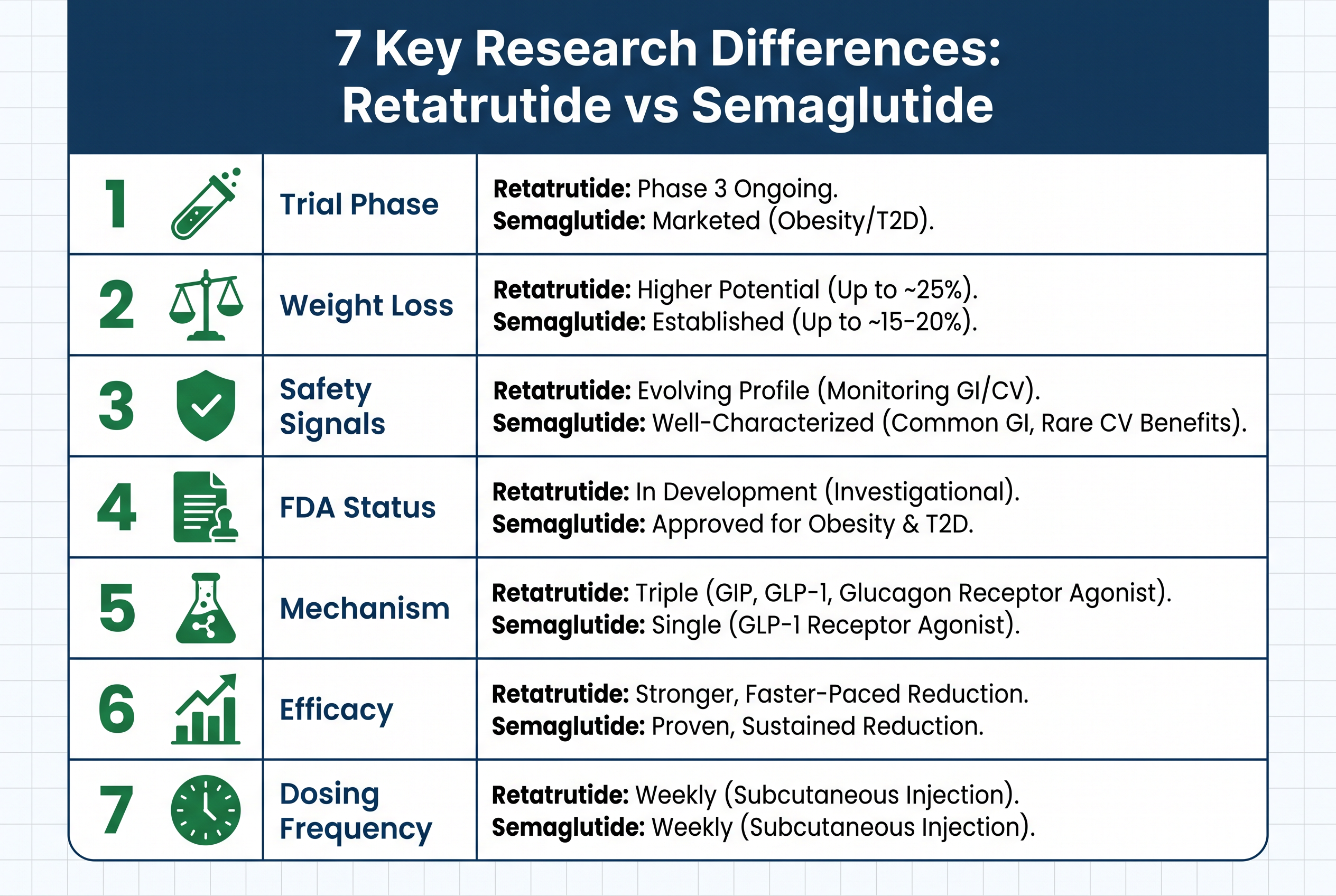
- The seven research differences between retatrutide and semaglutide are receptor targets, trial phase, sample size, endpoint length, weight-loss magnitude, safety signals, and regulatory status.
- Retatrutide 12 mg reached 24.2% mean weight loss at 48 weeks in a phase 2 trial; semaglutide 2.4 mg reached 14.9% at 68 weeks in STEP 1.
- Both compounds showed gastrointestinal tolerability issues, but retatrutide also had dose-dependent heart-rate increases that peaked at 24 weeks.
- Semaglutide has FDA approval as Wegovy for chronic weight management; retatrutide remains investigational.
- Peptides Library treats semaglutide as the current clinical benchmark and retatrutide as a high-potential investigational candidate for laboratory research.
What is the short answer on retatrutide vs semaglutide research differences?
Retatrutide looks stronger on early weight-loss potency, while semaglutide has the stronger real-world decision profile because FDA-approved Wegovy, STEP 1, and longer phase 3 data set a higher evidence bar. Those research differences matter for any laboratory or clinical reader comparing obesity-trial signals.
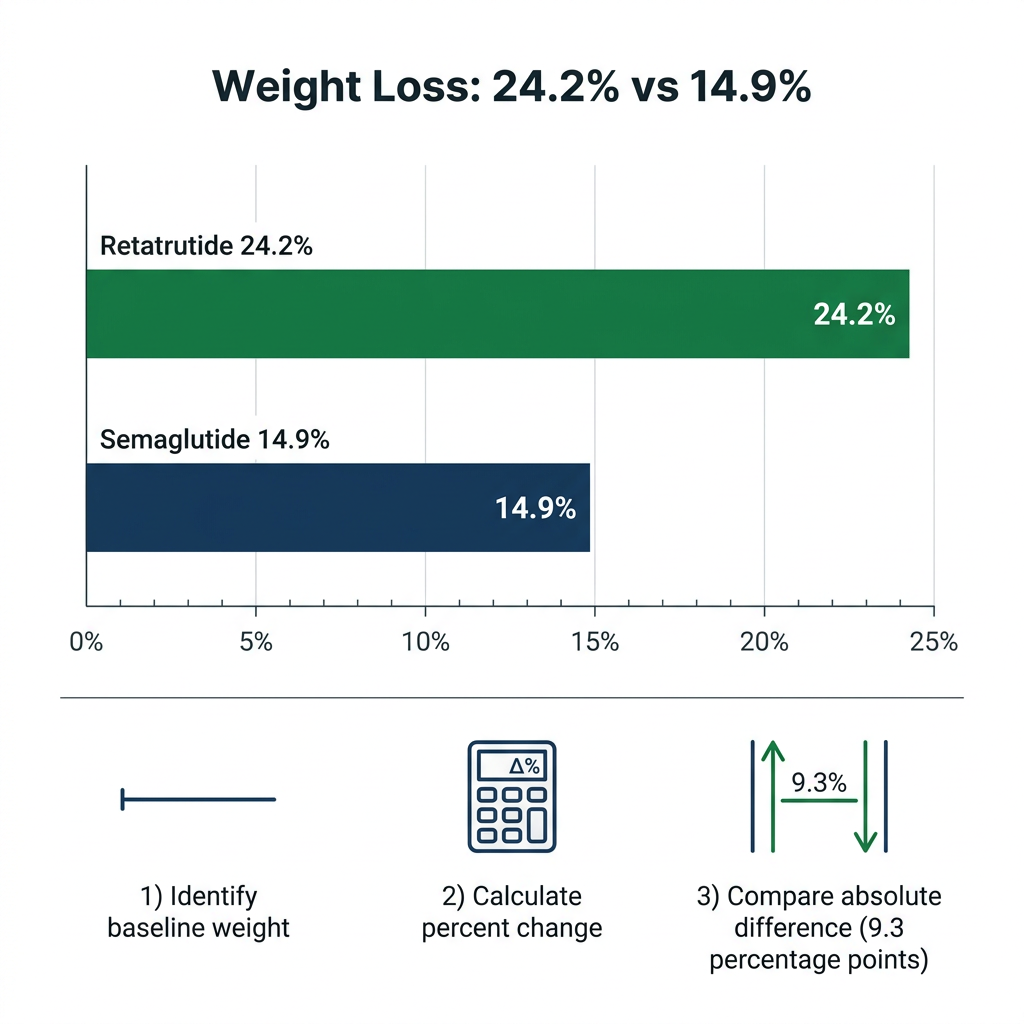
That split appears clearly in the PubMed-indexed phase 2 obesity trial. A total of 338 adults were randomized to weekly retatrutide or placebo for 48 weeks, and the 12 mg arm reached a mean body-weight change of -24.2% versus -2.1% with placebo. In STEP 1, a PubMed-indexed phase 3 trial, 1,961 adults without diabetes received semaglutide 2.4 mg or placebo for 68 weeks plus lifestyle intervention, with mean body-weight change of -14.9% versus -2.4%.
A common mistake is treating those numbers as a clean winner-take-all result. They are impressive, but they come from different studies, different phases, different sample sizes, and different follow-up lengths. The research differences are not just numerical; they are structural.
For researchers using a peptide library approach, this means the comparison belongs in a decision framework, not a leaderboard. You can review the broader Peptide Research Library: A Complete Reference Guide to see how laboratory cataloging separates early signals from decision-ready evidence.
How do retatrutide and semaglutide work differently in research terms?
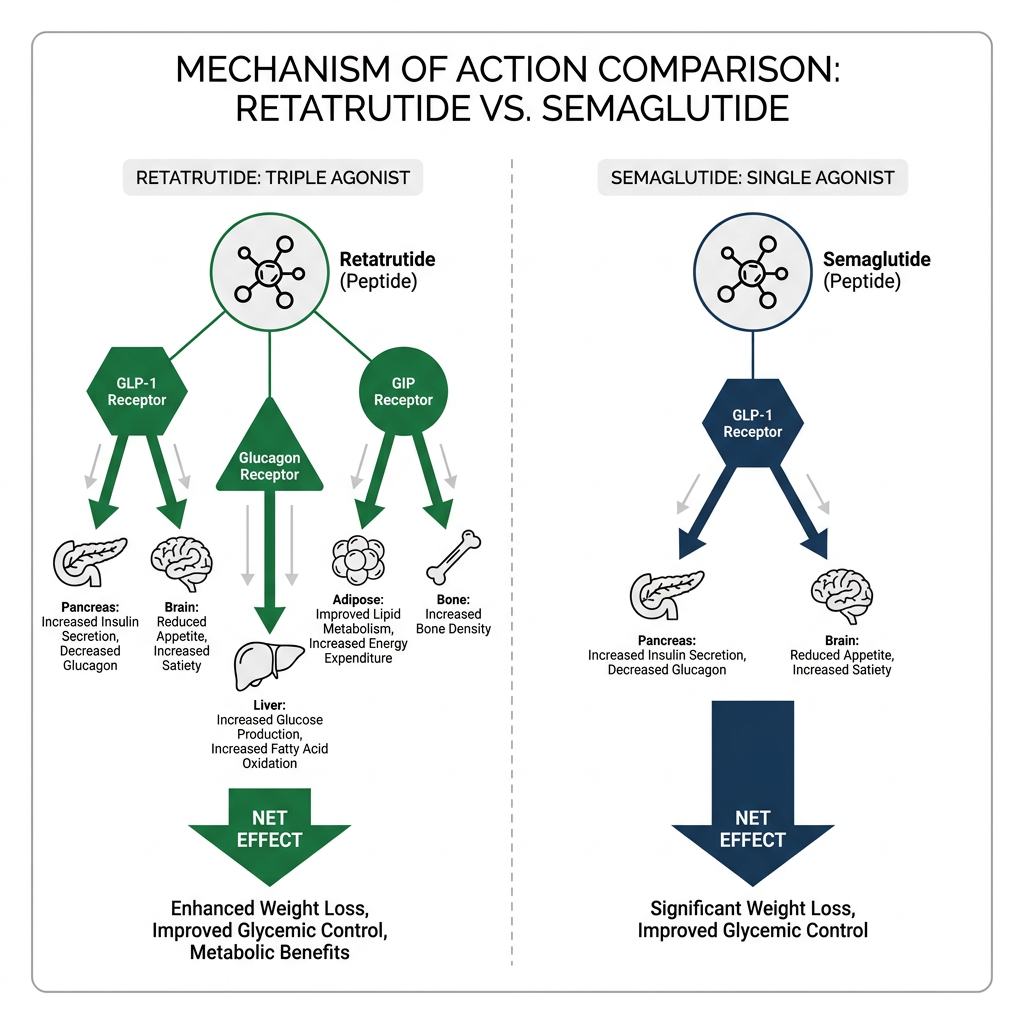
Retatrutide activates the GIP receptor, GLP-1 receptor, and glucagon receptor; semaglutide targets the GLP-1 receptor alone. That makes retatrutide a triple agonist and semaglutide a single-pathway incretin drug. This receptor-level distinction is one of the most fundamental research differences between the two molecules.
Mechanistically, that extra glucagon-receptor activity is a major reason retatrutide attracts attention. In theory, combining GIP, GLP-1, and glucagon signaling could affect appetite, satiety, and energy balance differently from a GLP-1 receptor agonist alone. Semaglutide, by contrast, sits in a more established class with years of clinical use and FDA-reviewed obesity labeling through Wegovy.
Peptides Library compares peptide candidates by receptor profile, trial phase, and endpoint length, not by mechanism alone. Mechanism helps explain why a drug may work. It does not prove long-term benefit, safety balance, or regulatory success. That is where phase 3 trials and post-approval experience start to separate a promising candidate from a treatment standard.
For a wider view of receptor-targeted research peptides, the Cell Penetrating Peptides for Research | Peptides Library page outlines how delivery and target engagement shape laboratory study design. Those considerations influence how researchers interpret these research differences.
💡 Key Takeaway: How do retatrutide and semaglutide work differently in research terms?
What are the 7 key research differences between retatrutide and semaglutide?
Seven research differences matter most: receptor targets, trial phase, sample size, treatment duration, weight-loss magnitude, safety signals, and regulatory status. If you only compare weekly dosing and obesity headlines, you miss the decision-grade details. The strongest side-by-side reading is a research framework, not a scorecard.
The table below summarizes these seven research differences without flattening the evidence tier.
| Research difference | Retatrutide | Semaglutide |
|—|—|—|
| Receptor pharmacology | Triple agonist: GIP, GLP-1, glucagon receptors | GLP-1 receptor agonist only |
| Trial maturity | Phase 2 obesity data | Phase 3 obesity data (STEP 1) |
| Sample size | 338 adults randomized | 1,961 adults randomized |
| Endpoint length | 48 weeks | 68 weeks |
| Mean weight loss | -24.2% at 48 weeks (12 mg) | -14.9% at 68 weeks (2.4 mg) |
| Safety pattern | GI events plus dose-dependent heart-rate increases | GI events, consistent with GLP-1 class |
| Regulatory position | Investigational | FDA-approved obesity labeling as Wegovy |
These research differences do not imply that one compound is universally better. They imply that the questions you can answer today are different. Retatrutide answers questions about early potency and multi-receptor signaling. Semaglutide answers questions about phase 3 confidence, long-term follow-up, and FDA-reviewed labeling.
For a related comparison that uses the same seven-point framework, see AOD 9604 vs Retatrutide: 7 Research Differences Today. That article applies the same research-use lens to another pair of investigational peptides.
How do the obesity trial designs change the comparison of research differences?
Peptides Library treats the design gap as decisive: retatrutide comes from a 48-week phase 2 study in 338 adults, while semaglutide’s STEP 1 enrolled 1,961 adults for 68 weeks. Those research differences in design change how much confidence you should place in each mean weight-loss figure.
Step 1 is comparing trial phase. Phase 2 is built to test signal, dosing, and tolerability. Phase 3 is built to support regulatory and clinical decisions at a much higher confidence level. If two drugs have strong efficacy signals but only one has phase 3 obesity data, the evidence maturity is not equal.
Step 2 is comparing population size and follow-up. A larger trial observed longer gives you a firmer view of average effect and variability. That does not make a smaller phase 2 result unimportant. It means the confidence you attach to it should be different.
Step 3 is checking whether the trials are directly comparable. They are not. STEP 1 explicitly included lifestyle intervention with semaglutide or placebo. When readers compare mean percentage weight loss without first checking design and context, they usually overstate how certain the ranking is.
These research differences are not hidden. They are visible in the original PubMed records, which you can review on PubMed. A careful laboratory reader treats trial design as the first filter before comparing efficacy numbers.
How should researchers compare 24.2% vs 14.9% step by step?
Start with context, not the headline. Retatrutide’s 24.2% came from its 12 mg arm at 48 weeks; semaglutide’s 14.9% came from 2.4 mg in STEP 1 at 68 weeks. The research differences in endpoint length and phase make the two percentages non-equivalent.
Step 1 is keeping the endpoint straight. Both figures are mean percentage changes in body weight, which makes them superficially comparable. That is useful, but only at the first pass.
Step 2 is checking what sits behind the number. Retatrutide’s figure comes from a phase 2 dose arm. Semaglutide’s figure comes from a much larger phase 3 program. If your question is, “Which agent has the bigger upside signal?” retatrutide looks stronger. If your question is, “Which estimate is more decision-ready today?” semaglutide is on firmer ground.
Step 3 is asking what the longer horizon might do to the comparison. Retatrutide reported at 48 weeks and semaglutide at 68 weeks. That means the timeline itself differs. A common misconception is that a larger earlier effect always guarantees the strongest long-term balance of efficacy, tolerability, and adherence. Drug development rarely works that neatly.
For a complete reference on how peptide libraries structure these step-by-step evaluations, the Peptide Library: Research-Grade Peptides for Laboratories page explains how laboratory researchers catalog candidates by phase, endpoint, and safety signal.
💡 Key Takeaway: How should researchers compare 24.2% vs 14.9% step by step?
How do safety signals differ in practice for these research compounds?
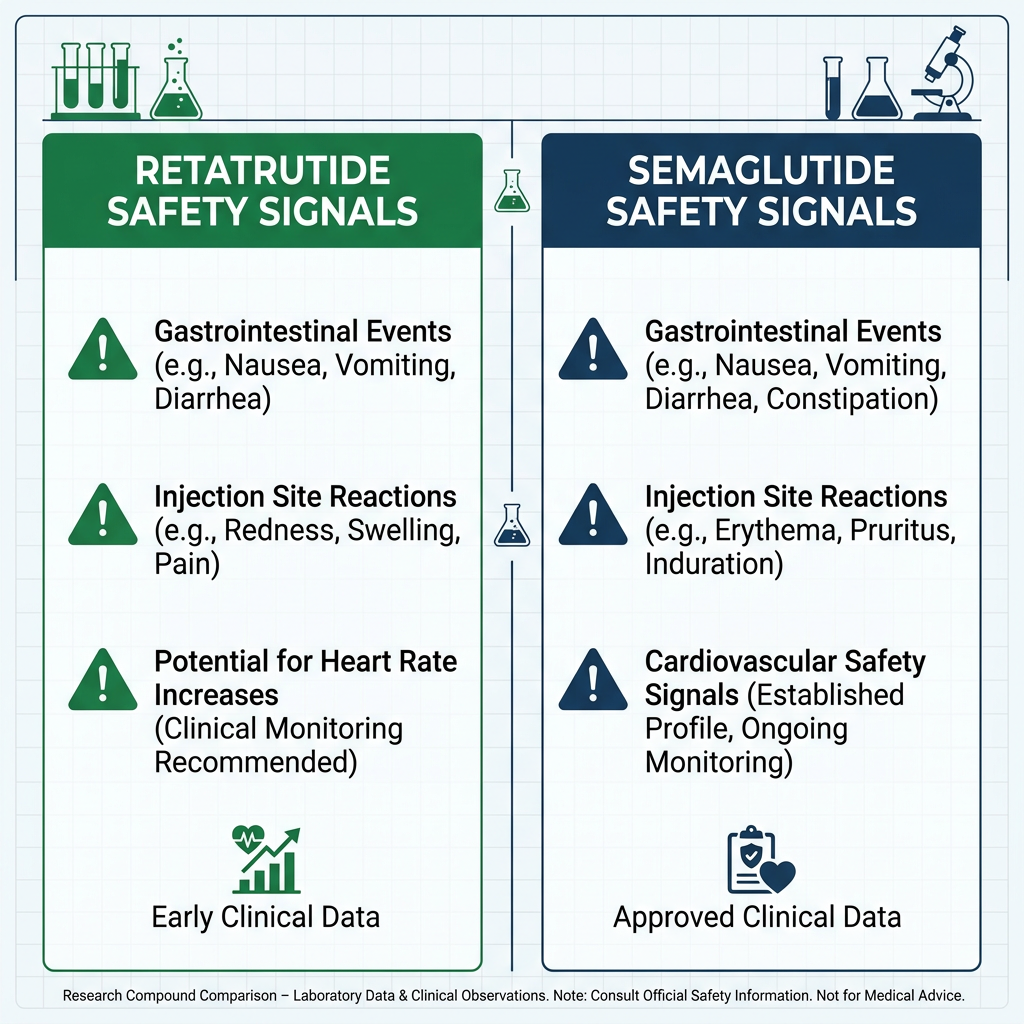
Both agents mainly raise gastrointestinal tolerability questions, but retatrutide adds a notable signal: dose-dependent heart-rate increases that peaked at 24 weeks in phase 2. That is one of the clearest research differences in the safety profile.
The obesity-trial comparison here is fairly crisp. The most common adverse events with retatrutide were dose-related gastrointestinal events, and heart-rate increases were dose-dependent. Semaglutide’s obesity program also commonly involves gastrointestinal adverse events, which fits its GLP-1 receptor agonist class. So the simplest safety contrast is this: both ask readers to watch GI tolerability, while retatrutide adds a cardiovascular monitoring question that deserves attention as development continues.
Peptides Library flags heart-rate change as the clearest early safety separator between retatrutide and semaglutide in obesity-trial reading. A good research habit is separating frequency from importance. Not every adverse event carries the same clinical meaning. Timing, dose response, and whether a signal persists or resolves can change how seriously it shapes a benefit-risk view.
These safety research differences reinforce why phase 3 data matter. A phase 2 signal can identify a monitoring question, but only larger and longer trials can clarify whether that signal is durable or manageable. The National Institutes of Health offers general guidance on how phase 2 safety signals inform later trial design.
Is retatrutide approved, and why does regulatory status matter for research differences?
No. Retatrutide remains investigational, while Wegovy, the semaglutide obesity brand, has FDA approval for chronic weight management. This regulatory gap is one of the most consequential research differences between the two compounds.
FDA status matters because it tells you whether a therapy has crossed the threshold from promising data to reviewed labeling, defined indication, and formal prescribing context. Wegovy was approved by the FDA on June 4, 2021, for chronic weight management as an adjunct to reduced-calorie diet and increased physical activity in adults with obesity, or adults with overweight plus at least one weight-related comorbid condition. FDA labeling also identifies Wegovy as a GLP-1 receptor agonist and states it is not recommended with other semaglutide-containing products or any other GLP-1 receptor agonist.
This is not a technical footnote. If a clinician, health system, or patient needs a therapy now, approval status changes access, monitoring standards, reimbursement discussions, and informed consent language. An investigational agent may still become best in class later, but that future possibility is different from present-day availability. You can verify the approval details on the U.S. Food and Drug Administration website.
For laboratory researchers, these regulatory research differences mean that semaglutide has a reviewed label and defined clinical context, while retatrutide remains a high-potential investigational candidate. Peptides Library maintains that distinction in every comparison.
When is semaglutide the stronger evidence-based choice for research?
For current clinical decisions, Peptides Library frames semaglutide as the stronger evidence-based choice because it has phase 3 STEP 1 data, a larger sample size, longer follow-up, and FDA-approved obesity labeling. Retatrutide is the high-potential investigational candidate. Those research differences make semaglutide the benchmark today.
This does not mean retatrutide is weak. It means the evidence bar is different. A phase 2 study with 338 adults and a 48-week endpoint can generate a strong signal, but it cannot replace the decision-grade confidence of a phase 3 program with 1,961 adults and a 68-week endpoint. The research differences in maturity, sample size, and regulatory status push semaglutide ahead for present-day clinical use.
For laboratory researchers, semaglutide is also the more stable reference point because its FDA label, class profile, and adverse-event pattern are well documented. Retatrutide remains a valuable investigational candidate for studying triple-agonist mechanisms, but it does not yet carry the same decision-ready weight. The distinction is not about which molecule is more interesting; it is about which question you are asking.
If you are building a research peptide library around obesity candidates, semaglutide serves as the current clinical benchmark, while retatrutide serves as the high-potential future pipeline candidate. Both have a place, but their roles in a laboratory reference set are different.
💡 Key Takeaway: When is semaglutide the stronger evidence-based choice for research?
How should peptide researchers use a reference library for these comparisons?
A peptide research library should separate molecules by receptor profile, trial phase, endpoint length, and regulatory status. That is exactly how Peptides Library organizes retatrutide and semaglutide. The seven research differences discussed here map directly onto a reference-library checklist.
Start with receptor pharmacology. Retatrutide is a triple agonist; semaglutide is a single GLP-1 receptor agonist. Next, record trial maturity. Retatrutide has phase 2 obesity data; semaglutide has phase 3 STEP 1 data. Then record sample size, endpoint length, mean weight loss, safety signals, and regulatory position. This creates a reproducible comparison that avoids headline bias.
A good reference library also flags what a molecule cannot yet answer. Retatrutide cannot yet answer long-term cardiovascular safety questions. Semaglutide cannot answer whether adding GIP and glucagon activity would produce a larger effect. Those are open research questions, not weaknesses.
The Peptide Research Library: A Complete Reference Guide provides a fuller framework for building these comparisons in a laboratory setting. It shows how research differences should be documented rather than implied.
What are the most common research mistakes when comparing retatrutide and semaglutide?
The most common mistake is treating 24.2% and 14.9% as a clean head-to-head result. They come from different trials with different phases, sample sizes, and follow-up lengths. Those research differences make direct percentage ranking misleading.
A second mistake is ignoring safety signals. Both compounds have gastrointestinal tolerability issues, but retatrutide also showed dose-dependent heart-rate increases that peaked at 24 weeks. If you compare only efficacy, you miss a key research difference that could shape the benefit-risk view.
A third mistake is assuming a larger early effect guarantees long-term superiority. Retatrutide’s 48-week signal is promising, but semaglutide’s 68-week phase 3 data and FDA approval provide a stronger decision-ready profile. Larger earlier effects do not always translate into the best long-term balance of efficacy, tolerability, and adherence.
A fourth mistake is forgetting regulatory status. Retatrutide is investigational; semaglutide has FDA-approved obesity labeling as Wegovy. This changes access, monitoring, and prescribing context. Laboratory readers should always separate investigational potential from present-day approval.
Avoiding these mistakes means treating the seven research differences as a checklist, not a scoreboard. For a related example of this checklist in action, see AOD 9604 vs Retatrutide: 7 Research Differences Today.
A practical checklist for evaluating retatrutide vs semaglutide research differences
Use this checklist to evaluate any retatrutide vs semaglutide comparison in a research-use context. It turns the seven research differences into a repeatable laboratory workflow.
1. Receptor targets: Is the molecule a triple agonist (GIP, GLP-1, glucagon) or a single GLP-1 receptor agonist?
2. Trial phase: Is the obesity data phase 2 or phase 3?
3. Sample size: Does the trial enroll hundreds or thousands of adults?
4. Endpoint length: Is the outcome reported at 48 weeks, 68 weeks, or another time point?
5. Mean weight loss: Is the percentage change from a dose arm or a broader phase 3 program?
6. Safety signals: Does the profile include only GI events, or also dose-dependent heart-rate increases?
7. Regulatory status: Is the compound investigational or FDA-approved for chronic weight management?
This checklist keeps the comparison anchored to the actual research differences rather than marketing headlines. For laboratory cataloging, the Peptide Library: Research-Grade Peptides for Laboratories page shows how these fields are recorded in a reference set.
All statements in this article are for research and educational purposes only. Retatrutide is an investigational compound not approved for human use. Semaglutide as Wegovy is FDA-approved for chronic weight management, but any comparison here is about evidence structure, not prescribing advice. Always consult original trial records and regulatory labels for decision-grade information.
💡 Key Takeaway: A practical checklist for evaluating retatrutide vs semaglutide research differences
FAQ
What are the main research differences between retatrutide and semaglutide?
The main research differences are receptor targets, trial phase, sample size, endpoint length, weight-loss magnitude, safety signals, and regulatory status. Retatrutide is a triple agonist with phase 2 data; semaglutide is a GLP-1 receptor agonist with phase 3 STEP 1 data and FDA approval as Wegovy.
Is retatrutide stronger than semaglutide for weight loss in research?
Retatrutide showed a larger early mean weight-loss signal at 24.2% over 48 weeks in a phase 2 trial, compared with semaglutide’s 14.9% over 68 weeks in STEP 1. However, these research differences in trial phase, sample size, and endpoint length mean the comparison is not a head-to-head result. Semaglutide has the stronger decision-ready evidence today.
Why does trial phase matter when comparing these two research compounds?
Trial phase changes the confidence you can place in a result. Retatrutide’s obesity data are phase 2, designed to test signal and dosing. Semaglutide’s STEP 1 data are phase 3, designed to support regulatory and clinical decisions. Those research differences mean a phase 3 estimate is more decision-ready than a phase 2 signal.
What safety research differences should researchers watch?
Both compounds commonly cause gastrointestinal adverse events. Retatrutide adds a notable research difference: dose-dependent heart-rate increases that peaked at 24 weeks in phase 2. Semaglutide’s safety profile is consistent with its GLP-1 receptor agonist class, mainly GI tolerability issues.
Is retatrutide FDA approved for any indication?
No. Retatrutide remains investigational. Semaglutide has FDA approval as Wegovy for chronic weight management in adults with obesity or overweight plus at least one weight-related comorbid condition. This regulatory research difference is central to any evidence comparison.
Ready to Take the Next Step?
Every product includes lot-specific documentation and third-party purity testing.
Explore Our Research Products →Free shipping on qualifying orders · Batch COA on request