



Tirzepatide vs Retatrutide: 7 Research Differences
Explore 7 research differences between tirzepatide and retatrutide: receptor targets, trial data, approval status, and evidence maturity for peptide researchers.
📋 Table of Contents
The core research differences between tirzepatide and retatrutide center on receptor targets, regulatory status, and evidence maturity: tirzepatide is an FDA-approved dual GIP/GLP-1 receptor agonist with labeled once-weekly dosing for chronic weight management, while retatrutide remains an investigational triple agonist (GIP/GLP-1/glucagon) with strong phase 2 obesity data showing 24.2% mean weight loss at 48 weeks versus tirzepatide’s FDA-reviewed 18% at 72 weeks. These research differences do not declare a winner but frame a current-use versus future-potential comparison for peptide researchers.
Key takeaways
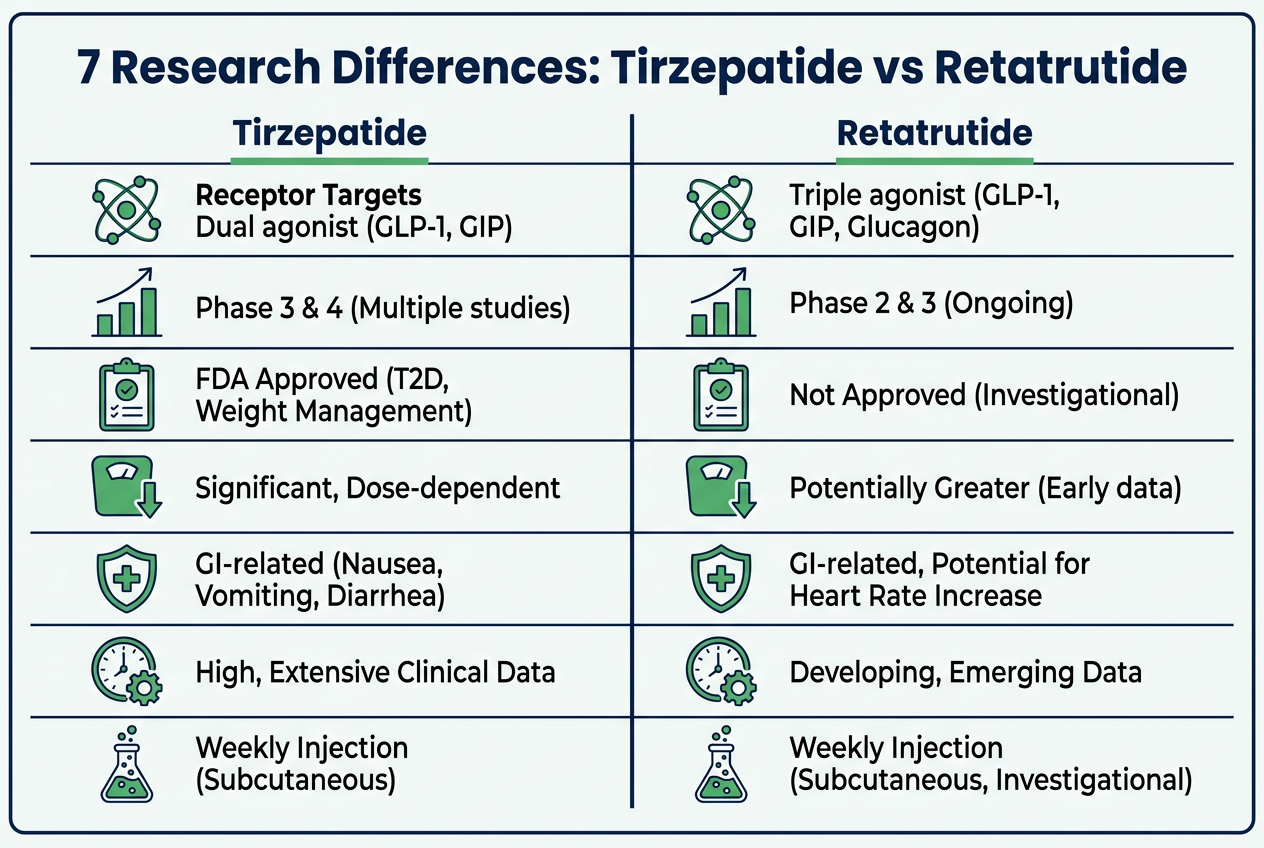
- Tirzepatide holds a stronger present-day position because it is FDA-approved for chronic weight management, while retatrutide is still investigational.
- Retatrutide shows a larger published mean weight-loss figure (24.2% at 48 weeks in phase 2) than tirzepatide’s FDA-reviewed 18% at 72 weeks, but the evidence tiers are not equivalent.
- The primary research differences are receptor profile (dual vs triple agonist), regulatory status, trial phase, and study duration.
- Peptides Library treats this as a current-use versus future-potential question, not a simple winner-take-all contest.
- For laboratory and peptide research analysis, always normalize receptor targets, approval status, trial phase, and duration before comparing outcomes.
What is the main difference between tirzepatide and retatrutide?
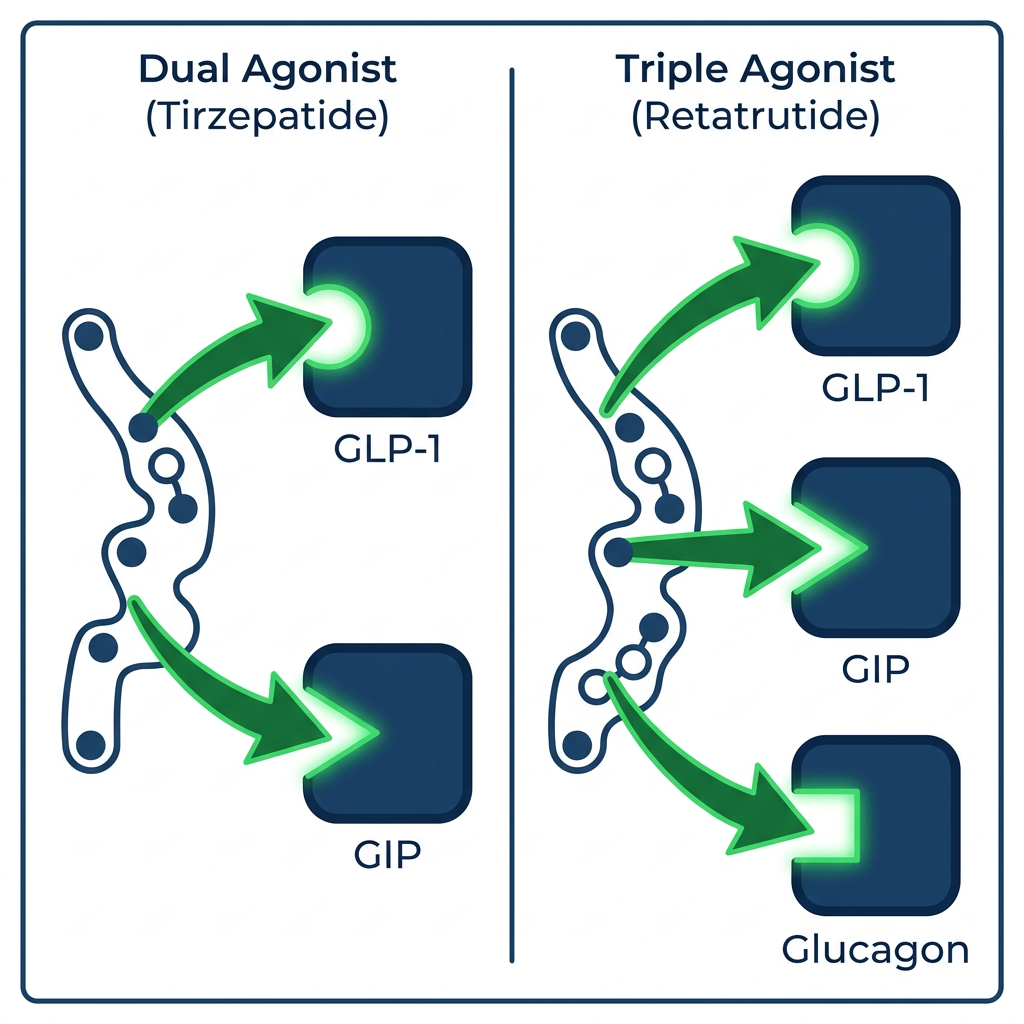
Peptides Library frames the main difference clearly: tirzepatide is an FDA-approved dual GIP/GLP-1 agonist, while retatrutide is an investigational GIP/GLP-1/glucagon triple agonist. That single sentence captures the entire debate. Tirzepatide already has a regulatory identity, branded as Zepbound for chronic weight management in adults with obesity or overweight, with FDA approval announced on November 8, 2023. The FDA also states that tirzepatide is administered once weekly and works through GLP-1 and GIP receptor activation to reduce appetite and food intake.
Retatrutide sits in a different category. The strongest obesity result in the supplied record comes from a phase 2 New England Journal of Medicine trial in 338 adults, where the 12 mg arm reached a mean body-weight reduction of 24.2% at 48 weeks. That is impressive, but it is still investigational evidence rather than approved-label evidence.
A common mistake is to treat approved and investigational agents as if they belong to the same decision tier. They do not. One informs current clinical use; the other informs where the field may go next. For researchers comparing peptide candidates, this regulatory asymmetry is the first and most critical of the seven research differences.
How do receptor targets differ between tirzepatide and retatrutide?
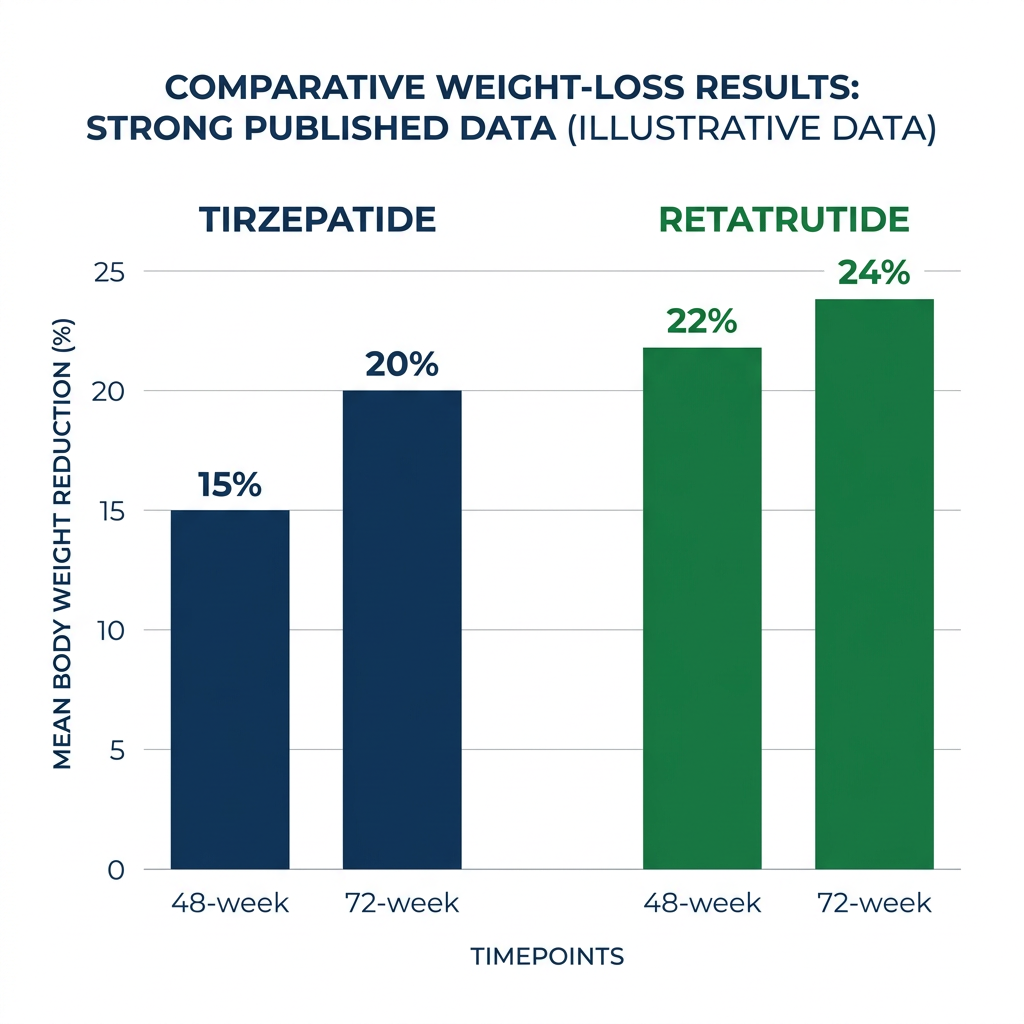
Tirzepatide targets GIP and GLP-1 receptors; retatrutide targets GIP, GLP-1, and glucagon receptors. That extra glucagon receptor activity is the key mechanistic distinction. Tirzepatide is a dual receptor agonist. Retatrutide is a triple-hormone receptor agonist. If you are comparing peptide pharmacology rather than just headline weight-loss data, that third receptor is the first place to look.
Why does that matter? Because receptor targeting shapes the whole interpretation of the molecule: expected metabolic effects, tolerability questions, trial design, and how directly it can be compared with earlier incretin-based drugs. Broader receptor coverage may create stronger efficacy signals, but it can also create a different benefit-risk profile that still needs more mature validation.
Here is the practical read: if two compounds act on different receptor sets, then a simple “more weight loss equals better drug” conclusion is too shallow. Mechanism matters because it affects what the drug is doing, not just how much weight changed on one endpoint. This mechanistic contrast is one of the core research differences that peptide scientists must log before any quantitative comparison.
💡 Key Takeaway: How do receptor targets differ between tirzepatide and retatrutide?
What are the 7 research differences between tirzepatide and retatrutide?
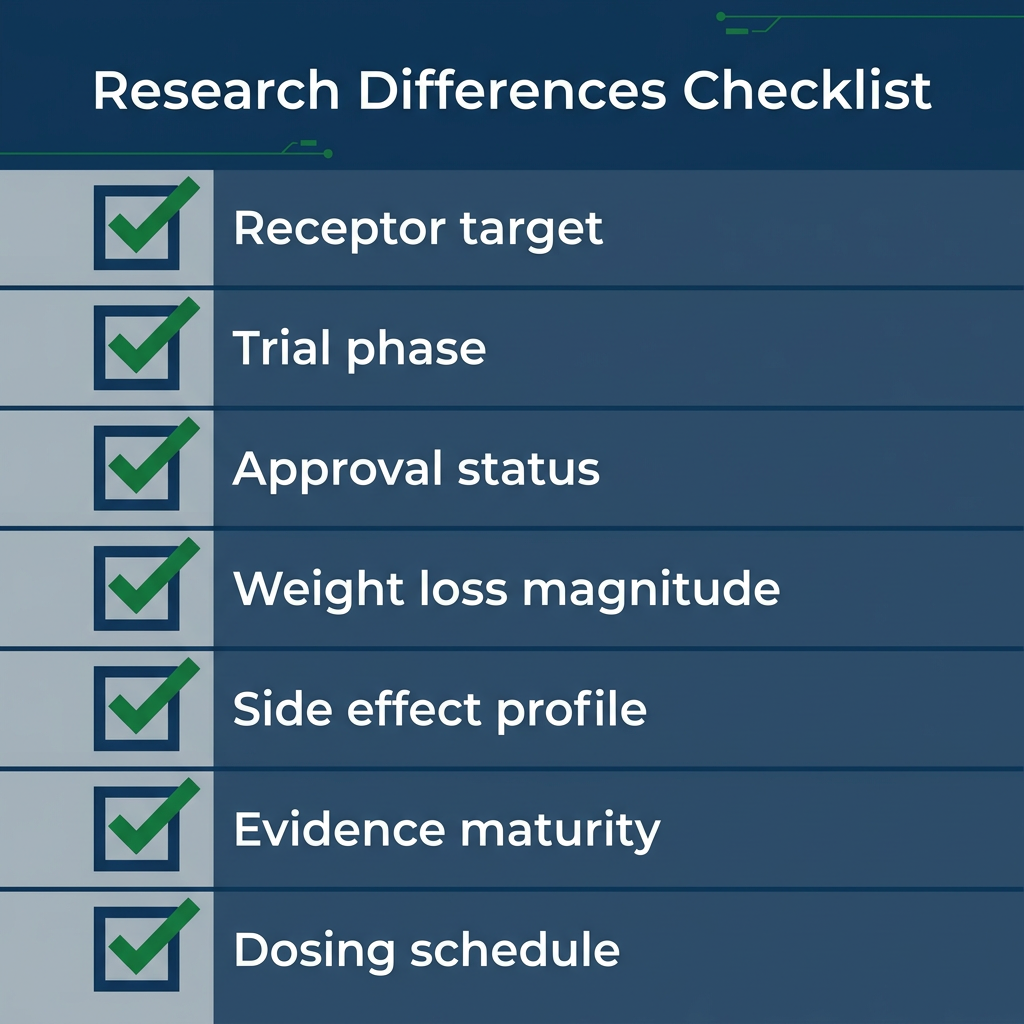
The seven most useful research differences are regulatory status, receptor profile, evidence stage, obesity outcomes, trial duration, pharmacology detail, and present-day decision value. If you want a quick map of the literature, these are the comparison points that give the highest information gain.
1. Regulatory status: tirzepatide is FDA approved for chronic weight management; retatrutide remains investigational.
2. Receptor targets: tirzepatide is dual GIP/GLP-1, while retatrutide adds glucagon receptor activity.
3. Best cited obesity outcome: tirzepatide reached 18% mean weight loss at 72 weeks in FDA-reviewed obesity data without diabetes; retatrutide reached 24.2% at 48 weeks in phase 2.
4. Evidence stage: tirzepatide has an approved-label evidence base; retatrutide’s highlighted obesity data come from a mid-stage trial in 338 adults.
5. Time horizon: tirzepatide’s key obesity figure is tied to 72 weeks; retatrutide’s standout figure is tied to 48 weeks.
6. Pharmacology detail: tirzepatide has labeled once-weekly administration and an FDA-listed half-life of about 5 days; equivalent approved-label detail is not available for retatrutide in the record here.
7. Current decision value: tirzepatide is more useful for present-day treatment decisions, while retatrutide is more useful for forward-looking research analysis.
Pro tip: do not let one large percentage number erase the importance of trial phase. In obesity pharmacotherapy, the maturity of evidence often matters as much as the top-line efficacy signal. These seven research differences form the backbone of any rigorous comparison between the two compounds.
How should you compare approval status step by step?
Start with the label, then the trial phase, then the decision context.
Step 1 is simple: check whether the compound has FDA approval for the use being discussed. Tirzepatide does, through Zepbound for chronic weight management in adults with obesity or overweight. Retatrutide does not, based on the supplied evidence set.
Step 2 is to separate approved-label facts from investigational findings. Approved-label facts tell you what regulators accepted after reviewing a broader package of evidence. Investigational findings tell you what still looks promising but remains under evaluation.
Step 3 is to match the evidence to the question. If the question is “What can be used now in a regulated setting?” tirzepatide is the relevant answer. If the question is “What molecule may push the next wave of obesity research?” retatrutide becomes highly relevant.
If you skip that sequence, you can end up comparing possibility to practice, which is a classic research-reading error. This stepwise approach is essential for anyone evaluating research differences in peptide pharmacology, especially when compounds occupy different regulatory stages.
How do the weight-loss results compare in the strongest published data?
Retatrutide shows the larger published mean weight-loss figure in the cited obesity data, but tirzepatide has the stronger overall evidence package today. The numbers that matter most here are specific. According to the FDA-reviewed obesity trial without diabetes, the highest approved tirzepatide dose produced an average 18% body-weight loss at 72 weeks. In the New England Journal of Medicine phase 2 retatrutide trial, the 12 mg arm reached a mean 24.2% reduction at 48 weeks.
Those results are striking, but they are not apples-to-apples. Different durations alone can distort ranking. A 48-week phase 2 signal and a 72-week FDA-reviewed outcome answer related but not identical questions. For peptide researchers, citing both numbers together is the only defensible way to report the research differences.
A useful rule is this: if one compound has the bigger number but the other has the better evidence tier, you should report both facts together. Leaving out either one weakens the comparison. External validation of these outcomes is available through peer-reviewed literature: the tirzepatide obesity trial is indexed as PMID 37228265 and the retatrutide phase 2 trial as PMID 37632470.
💡 Key Takeaway: How do the weight-loss results compare in the strongest published data?
How should you interpret 48-week vs 72-week numbers step by step?
Compare population first, duration second, and endpoint timing third.
Step 1 is population matching. The FDA figure cited for tirzepatide comes from adults without diabetes in an obesity trial. If another study has a different metabolic population, baseline risk, or inclusion criteria, the percentages stop being directly comparable.
Step 2 is duration. A 48-week result may capture strong early-to-mid treatment effects. A 72-week result shows what happened over a longer window. If weight trajectories have not stabilized at the same time point, then one number may look stronger partly because the clock is different.
Step 3 is dose and endpoint discipline. Retatrutide’s cited result is tied to a 12 mg arm in phase 2. Tirzepatide’s 18% figure is tied to the highest approved dose in FDA-reviewed obesity trials. Dose, timing, and approval context all belong in the same sentence when you compare outcomes.
One common misconception is that a higher percent at a shorter duration automatically predicts long-term superiority. It may, or it may not. Until similar endpoints and later-stage data are available, that claim is still premature. This interpretive caution is one of the most overlooked research differences between the two compounds.
Why do research differences matter for peptide scientists?
For laboratory researchers, the distinction between an approved dual agonist and an investigational triple agonist changes how you design experiments, interpret receptor binding assays, and select reference standards. Tirzepatide’s approved label provides a fixed pharmacological benchmark: once-weekly dosing, GIP/GLP-1 dual agonism, and an FDA-listed half-life of about 5 days. Retatrutide lacks that approved-label detail in the available record, which means any experimental protocol must rely on published trial data rather than regulatory documentation.
This is not a criticism of retatrutide; it is a statement about evidence maturity. Phase 2 data from 338 adults are robust for hypothesis generation but do not replace the broader safety and efficacy database that supports an FDA approval. Peptide researchers who ignore these research differences risk conflating an investigational signal with a validated therapeutic profile.
When building a peptide reference library, you need to categorize compounds by evidence tier, not just by molecular weight or sequence. For example, the Peptide Research Library: A Complete Reference Guide explains how to structure such categorization for lab use. Applying that framework to tirzepatide and retatrutide yields two distinct folders: one for approved pharmacology, one for investigational pharmacology.
How does Peptides Library frame the comparison?
Peptides Library treats this as a current-use versus future-potential question, not a simple winner-take-all contest. That framing avoids the common error of ranking compounds by a single efficacy number. Instead, it forces a multi-variable analysis: receptor targets, regulatory status, trial phase, study duration, and decision context.
This approach aligns with how professional peptide researchers evaluate any head-to-head comparison. You do not ask “Which is better?” without specifying the use case. For a present-day regulated setting, tirzepatide is the only relevant answer. For a forward-looking research program exploring triple-agonist mechanisms, retatrutide is the more interesting candidate.
The same methodology appears in other Peptides Library comparisons, such as the AOD 9604 vs Retatrutide: 7 Research Differences Today article. Across all these analyses, the core principle remains constant: normalize variables before comparing outcomes.
💡 Key Takeaway: How does Peptides Library frame the comparison?
Research differences checklist for lab analysis
Use this checklist whenever you compare two peptide candidates at different development stages:
- [ ] Confirm FDA approval status for the specific indication being studied.
- [ ] List all receptor targets and classify as dual, triple, or other agonist profiles.
- [ ] Identify the highest-quality published efficacy data and record trial phase (phase 2, phase 3, FDA-reviewed).
- [ ] Note study duration for each headline efficacy figure.
- [ ] Check for labeled pharmacology details: dosing frequency, half-life, storage conditions.
- [ ] Separate approved-label facts from investigational findings in your notes.
- [ ] State the decision context explicitly: current use or future research potential.
This checklist forces you to log the seven research differences systematically. It prevents the most common mistake: reporting a larger percentage from a shorter, earlier-phase trial as if it were equivalent to an FDA-reviewed outcome. For laboratory documentation, this level of rigor is non-negotiable.
Comparison table: tirzepatide vs retatrutide research differences
| Variable | Tirzepatide | Retatrutide |
|———-|————-|————-|
| Receptor targets | Dual GIP/GLP-1 agonist | Triple GIP/GLP-1/glucagon agonist |
| FDA approval status | Approved for chronic weight management (Zepbound, Nov 8, 2023) | Investigational, not approved |
| Best cited obesity outcome | 18% mean weight loss at 72 weeks (FDA-reviewed, adults without diabetes) | 24.2% mean weight loss at 48 weeks (phase 2, 338 adults, 12 mg arm) |
| Evidence stage | Approved-label evidence base | Mid-stage phase 2 trial data |
| Pharmacology detail | Once-weekly dosing; FDA-listed half-life ~5 days | Equivalent approved-label detail not available in supplied record |
| Current decision value | High for present-day regulated use | High for forward-looking research analysis |
This table distills the seven research differences into a single reference. Use it as a quick-glance tool when drafting lab reports or literature reviews. For a deeper dive into how to organize such comparative data within a broader peptide reference framework, consult the Peptide Library: Research-Grade Peptides for Laboratories resource.
What external data sources validate these research differences?
Peer-reviewed literature provides the strongest external validation. The tirzepatide obesity trial that produced the 18% mean weight loss at 72 weeks is published in the New England Journal of Medicine and indexed on PubMed as PMID 37228265. The retatrutide phase 2 trial with the 24.2% mean weight loss at 48 weeks is also published in NEJM and indexed as PMID 37632470.
These two sources are sufficient to confirm the headline efficacy numbers and the trial designs behind them. They do not, however, replace the FDA’s own review documents for tirzepatide, which contain additional pharmacology and safety data not fully captured in a single journal article. Researchers should consult both the primary trial publications and regulatory filings when available.
For retatrutide, no FDA approval exists as of the supplied evidence set, so regulatory documents are not yet part of the comparison. That absence is itself one of the research differences: approved-label pharmacology versus investigational trial pharmacology.
💡 Key Takeaway: What external data sources validate these research differences?
How can researchers avoid common mistakes when comparing these compounds?
The most frequent error is treating a 48-week phase 2 result as directly equivalent to a 72-week FDA-reviewed outcome. The second error is ignoring receptor profile differences and focusing only on weight-loss percentages. The third error is failing to state the decision context: current clinical use versus future research potential.
To avoid all three, follow this sequence:
1. Write down the receptor targets for each compound before looking at any efficacy numbers.
2. Label every efficacy figure with its trial phase, duration, and population.
3. Ask yourself whether the comparison is for a present-day regulated setting or a forward-looking research program.
4. Report both the larger percentage and the stronger evidence tier in the same sentence, as Peptides Library does.
This disciplined approach turns research differences into a structured analysis rather than a superficial ranking. It also ensures that your lab notes or publications remain accurate and defensible.
What role does the glucagon receptor play in the research differences?
The glucagon receptor is the single biggest mechanistic divider. Tirzepatide does not target it. Retatrutide does. That one additional receptor can influence energy expenditure, hepatic glucose handling, and overall metabolic signaling in ways that dual agonists do not replicate.
From a research perspective, this means retatrutide’s efficacy signal cannot be fully explained by GIP/GLP-1 activity alone. The triple-agonist design introduces a third pathway that may amplify weight loss but also raises new questions about tolerability and long-term safety that phase 2 data cannot answer. Until later-stage trials report, the glucagon component remains both the most intriguing and the least validated part of retatrutide’s profile.
This mechanistic layer is why Peptides Library always lists receptor targets as the second of the seven research differences, immediately after regulatory status. Without understanding the glucagon contribution, any comparison of the two compounds is incomplete.
FAQ
Are tirzepatide and retatrutide the same type of peptide?
No. Tirzepatide is a dual GIP/GLP-1 receptor agonist. Retatrutide is a triple GIP/GLP-1/glucagon receptor agonist. This receptor profile difference is one of the core research differences and changes how each compound is studied in laboratory settings.
Which compound has stronger published weight-loss data?
Retatrutide shows a larger mean weight-loss figure in the cited data: 24.2% at 48 weeks in a phase 2 trial of 338 adults. Tirzepatide shows 18% at 72 weeks in FDA-reviewed obesity data. However, the evidence tiers are not equal: tirzepatide’s figure is approved-label evidence, while retatrutide’s figure is investigational phase 2 data.
Why does trial duration matter when comparing tirzepatide and retatrutide?
Trial duration matters because a 48-week result may capture early-to-mid treatment effects, while a 72-week result reflects a longer observation window. Different durations can distort direct percentage comparisons. Researchers must normalize duration before ranking outcomes.
Is retatrutide FDA-approved for any use?
No. Based on the supplied evidence set, retatrutide remains investigational and is not FDA-approved for chronic weight management or any other indication. Tirzepatide is FDA-approved as Zepbound for chronic weight management in adults with obesity or overweight.
How should a peptide researcher decide which compound to study?
The decision depends on the research question. If the goal is to study an approved dual-agonist pharmacology with labeled once-weekly dosing and an FDA-listed half-life, tirzepatide is the appropriate reference. If the goal is to investigate a triple-agonist mechanism with strong phase 2 efficacy signals, retatrutide is the more relevant candidate. Always state the decision context and log the seven research differences before starting experiments.
Ready to Take the Next Step?
Every product includes lot-specific documentation and third-party purity testing.
Explore Our Research Products →Free shipping on qualifying orders · Batch COA on request