



Thymosin Alpha 1 vs TB 500: 6 Research Differences
Research differences between thymosin alpha 1 and TB-500: 6 proven facts on molecular identity, human evidence, and regulatory context for research use.
📋 Table of Contents
Thymosin alpha 1 and TB-500 are not close substitutes. The core research differences are: thymosin alpha 1 is a 28-amino-acid immune-modulating peptide with published human clinical and mechanistic literature, while TB-500 is FDA-described as the N-acetylated heptapeptide fragment N-acetyl-LKKTETQ, reviewed mainly in a wound-healing and compounding context with no published human pharmacokinetic studies or clinical treatment literature in the 2026 review context. Researchers should compare these two only after checking sequence identity, evidence depth, and whether the cited paper actually studied the exact peptide or only a related thymosin beta-4 fragment.
Key takeaways
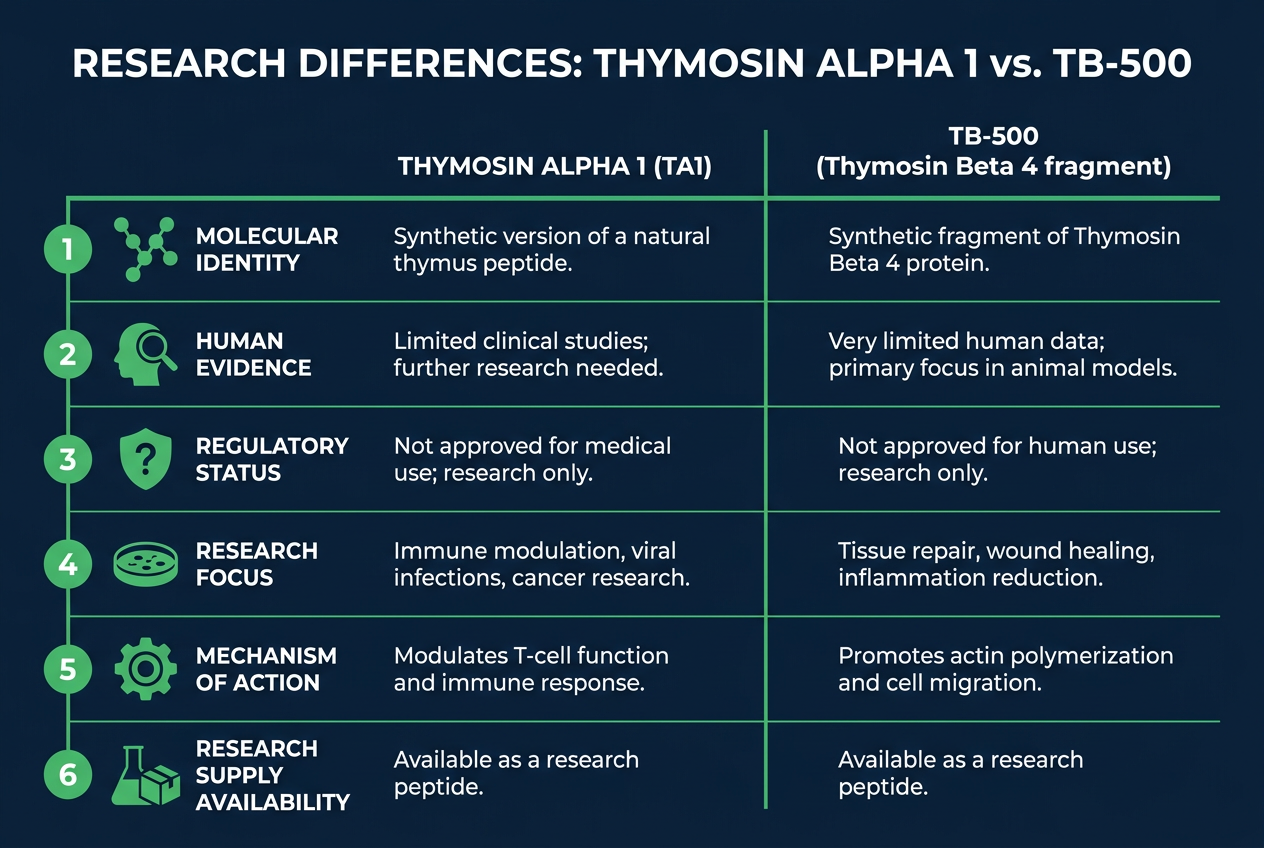
- Thymosin alpha 1 vs TB-500 research differences begin with molecular identity: 28 amino acids versus N-acetyl-LKKTETQ, a seven-amino-acid thymosin beta-4 fragment.
- Human evidence gap: FDA reported no published human pharmacokinetic studies or clinical treatment literature for TB-500 in its 2026 review context, while thymosin alpha 1 has human clinical and mechanistic literature.
- Mechanism lanes: thymosin alpha 1 connects to T cell maturity and TLR3/4/9, IRF3, and NF-κB signaling; TB-500 connects to actin binding and wound-healing rationale.
- Claim transfer risk: many TB-500 claims are borrowed from full-length thymosin beta-4, which is a different evidence object.
- For research-use-only evaluation, always check the exact sequence in the methods section before accepting any peptide-specific claim.
What is the short answer on thymosin alpha 1 vs TB-500?
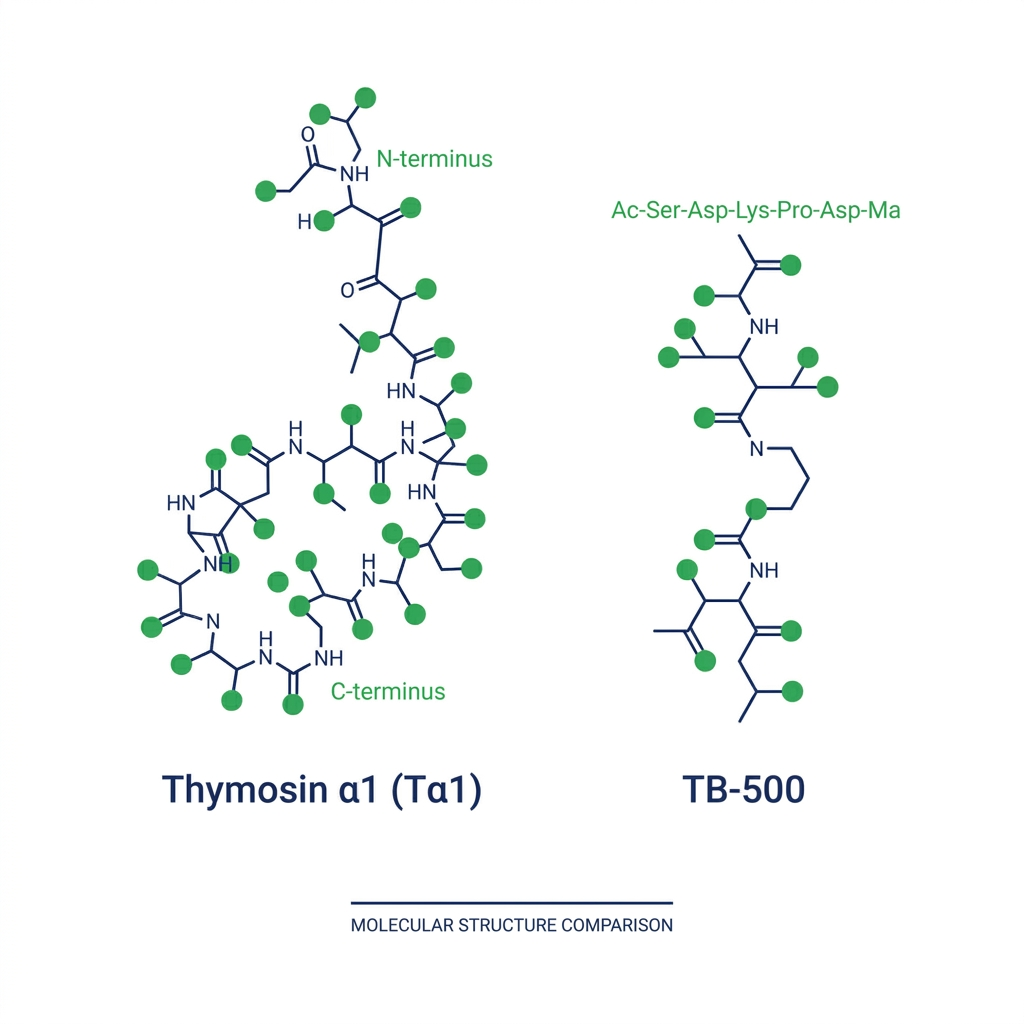
Thymosin alpha 1 and TB-500 are not close substitutes. Thymosin alpha 1 is a 28-amino-acid peptide with immune-focused literature, while TB-500 is FDA-described as the N-acetylated heptapeptide fragment N-acetyl-LKKTETQ, reviewed mainly in a wound-healing and compounding context.
The fastest way to separate them is to ask what kind of question each peptide was built to answer in the literature. Thymosin alpha 1 appears in human and mechanistic discussions about immunomodulation, viral disease support, and immune cell signaling. TB-500 appears in discussions about a thymosin beta-4 fragment associated with actin binding, cell migration, and wound-healing concepts.
That means the comparison is less “which one is better?” and more “better for what research frame, with what level of evidence?” If the frame is human immune literature, thymosin alpha 1 has depth. If the frame is a short thymosin beta-4 fragment and its proposed wound-healing biology, TB-500 is a different and much less clinically developed topic.
Peptides Library separates thymosin alpha 1 from TB-500 at the sequence level: one is a 28-amino-acid immune peptide, the other is N-acetyl-LKKTETQ, a seven-amino-acid thymosin beta-4 fragment. These research differences matter because peptide discussions often drift from molecular identity into broad claims.
How do thymosin alpha 1 and TB-500 differ at the molecule level?
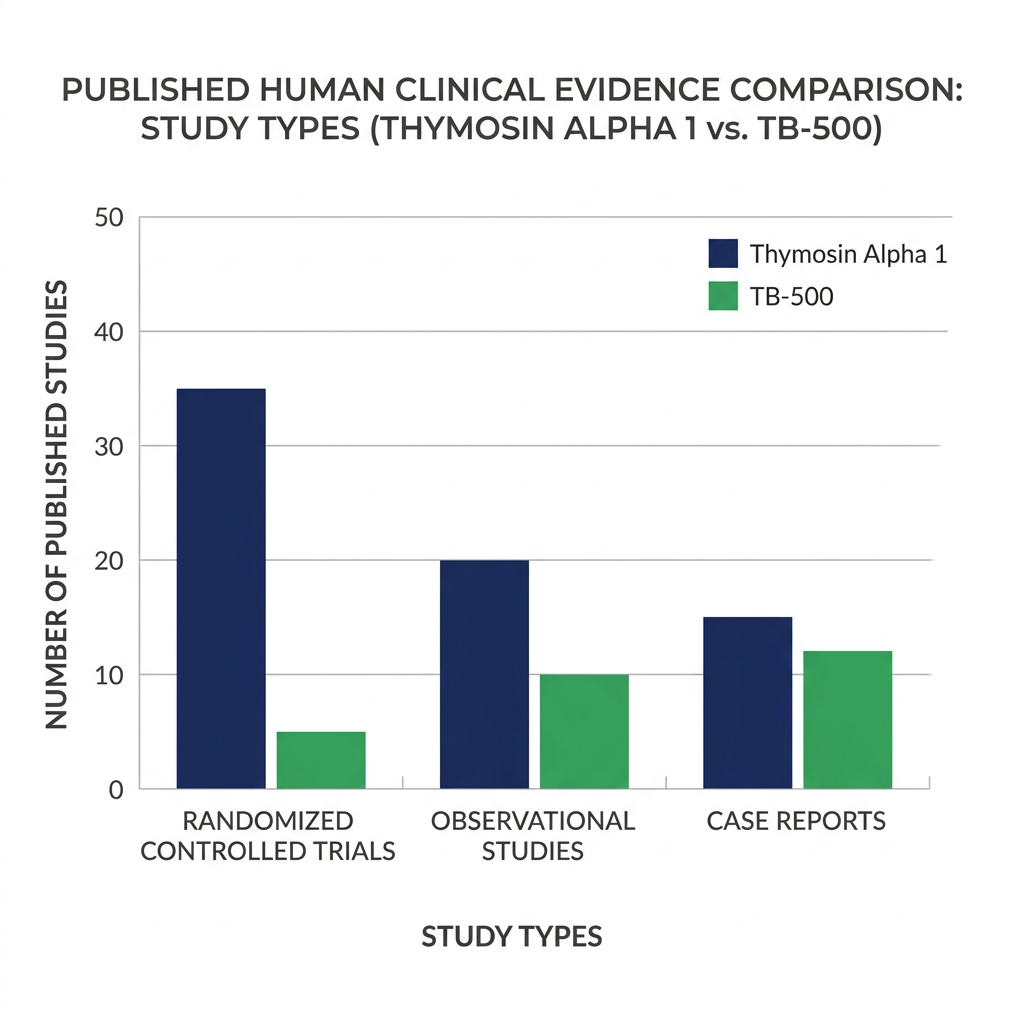
They differ in both length and parent biology. Thymosin alpha 1 is a naturally occurring 28-amino-acid thymic peptide, while TB-500 is described by FDA as an N-acetylated seven-amino-acid fragment derived from thymosin beta-4 amino acids 17 to 23.
This is the first place many readers get tripped up. TB-500 is often discussed as if it were the same thing as full-length thymosin beta-4. FDA’s reviewed description does not support that shortcut. It identifies TB-500 as a fragment, not the whole peptide.
That distinction changes how you read claims. If a paper studies full-length thymosin beta-4, you cannot assume the same pharmacology, tissue distribution, or clinical behavior applies to TB-500. A fragment may preserve part of a functional motif, like an actin-binding region, without reproducing the full biology of the parent molecule. If the sequence is different, then the evidence must be checked at the sequence level too.
The molecular research differences are the foundation for every other comparison. Thymosin alpha 1 has a 28-amino-acid sequence tied to thymic immune biology. TB-500 has a seven-amino-acid sequence tied to a fragment of thymosin beta-4. Those are not interchangeable evidence objects.
💡 Key Takeaway: How do thymosin alpha 1 and TB-500 differ at the molecule level?
What are the 6 main research differences between thymosin alpha 1 and TB-500?
The six biggest research differences are evidence depth, molecular identity, mechanism, clinical exposure, regulatory context, and claim transferability. Those six points explain most of the confusion in this comparison.
Here is the cleanest side-by-side view:
| Research differences | Thymosin alpha 1 | TB-500 |
|—|—|—|
| Core identity | 28-amino-acid peptide | FDA-described N-acetylated heptapeptide N-acetyl-LKKTETQ |
| Primary research frame | Immune regulation | Actin-binding region linked with cell migration and wound-healing properties |
| Human literature | Published human clinical and mechanistic literature | FDA reported no published human pharmacokinetic studies or treatment literature in its 2026 review context |
| Named biology | T cell maturity, TLR3/4/9, IRF3, and NF-κB | Actin binding and fragment-based wound-healing rationale |
| Regulatory framing | Synthetic form thymalfasin described in literature as approved for hepatitis B and vaccine-response support in certain populations | FDA discussed mainly through compounding and 503A bulk substance review documents |
| Evidence transfer risk | Claims can often be checked against peptide-specific literature | Claims frequently borrowed from full-length thymosin beta-4, a different evidence object |
If you remember only one item from this list, make it number six. Many comparison errors start when full-length thymosin beta-4 findings get copied onto TB-500 without peptide-specific proof.
The research differences above are not subtle. One peptide has a defined human immune literature base; the other has a fragment-centered topic with major human evidence gaps. The Peptide Research Library: A Complete Reference Guide reinforces this distinction by organizing peptides according to sequence identity and evidence depth rather than marketing labels.
Why do the research differences matter for peptide selection?
Researchers select peptides for specific questions, not for vague similarity. The research differences between thymosin alpha 1 and TB-500 matter because they change what you can responsibly claim from the literature.
If you need immune-focused evidence, thymosin alpha 1 has the stronger frame. If you need wound-healing biology, TB-500 is a fragment-centered topic with much thinner human support. Choosing between them without acknowledging these research differences leads to category errors.
Another reason is safety and exposure confidence. Human pharmacokinetic data reduce uncertainty about how a peptide behaves in a living system. FDA’s 2026 review context reported no published human pharmacokinetic studies for TB-500. Thymosin alpha 1 has published human clinical and mechanistic literature. That gap is not a minor detail; it is a core decision criterion.
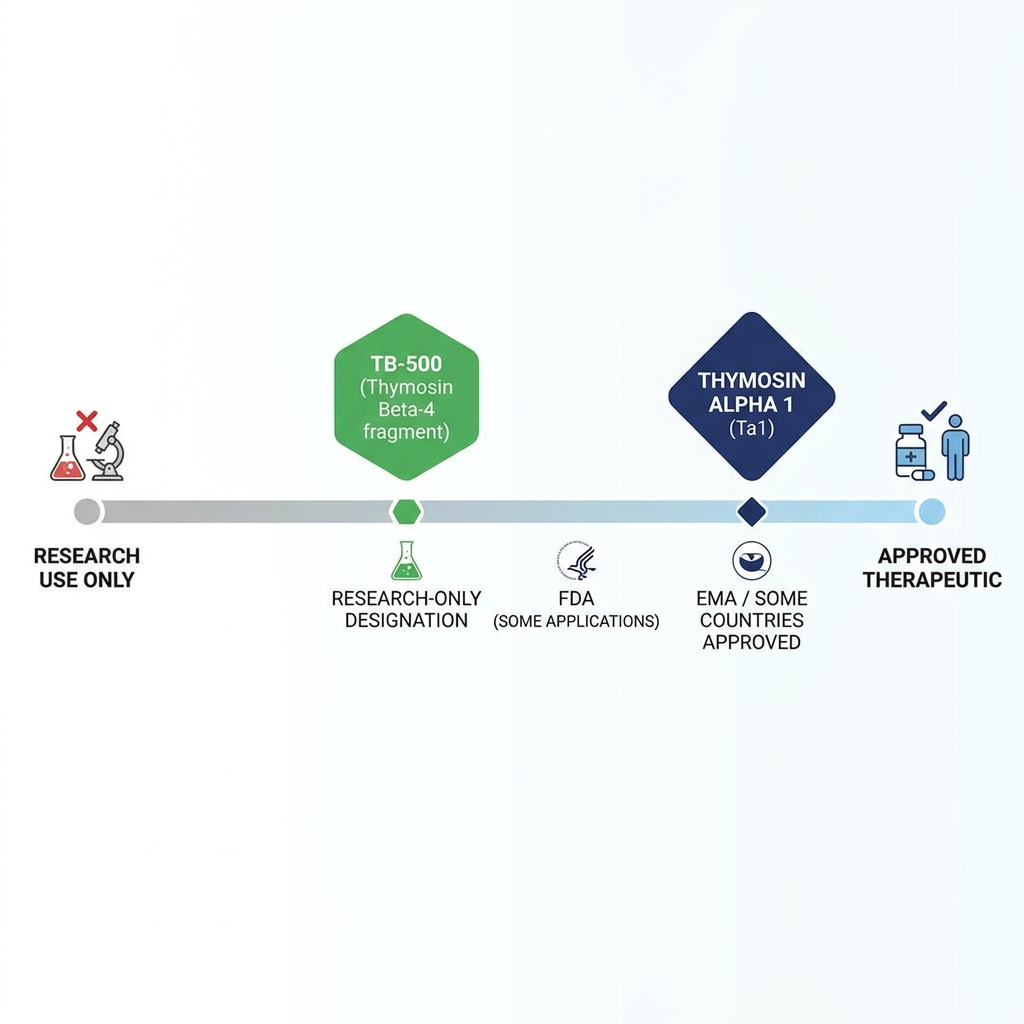
Finally, regulatory context matters. Thymosin alpha 1’s synthetic form, thymalfasin, has been described in the literature as approved by various agencies for hepatitis B and vaccine-response support in certain populations. TB-500 has been discussed mainly through compounding and 503A bulk substance review documents. Those are very different regulatory lanes.
How does the human clinical evidence compare?
Peptides Library would rate thymosin alpha 1 as far stronger on human evidence than TB-500. PubMed-indexed reviews describe thymosin alpha 1 in human disease and immune settings, while FDA reported no published human exposure or clinical treatment literature for TB-500 in the reviewed context.
The gap is not subtle. A 2023 review describes thymosin alpha 1 as a highly conserved peptide involved in T cell maturity and differentiation, and another review places it in immune-enhancer discussions involving hepatitis B, hepatitis C, and AIDS. Those reviews also describe interactions with TLR3, TLR4, and TLR9 and downstream IRF3 and NF-κB signaling.
By contrast, FDA stated that it did not identify published clinical pharmacokinetic studies for TB-500 in humans and did not find published medical literature showing TB-500 had been administered to patients to treat disease or a condition in the reviewed context. That does not prove TB-500 has no biological effect. It does mean confidence should be much lower when someone presents TB-500 claims as if they were supported by human clinical literature.
Peptides Library highlights the central gap: FDA reported no published human pharmacokinetic studies or clinical treatment literature for TB-500 in its 2026 review context. These research differences are not a matter of opinion; they are a matter of available evidence.
💡 Key Takeaway: How does the human clinical evidence compare?
How should you compare mechanism claims step by step?
Start with the dominant mechanism, then test whether the cited evidence matches the exact peptide. TLR signaling and immune cell effects fit thymosin alpha 1; actin-binding and wound-healing logic fit TB-500’s proposed fragment role.
Step 1 is to name the biological lane. If a source talks about T cells, macrophages, natural killer cells, or Toll-like receptors, you are likely in thymosin alpha 1 territory. If a source talks about actin binding, cell migration, and repair signaling, you are likely in thymosin beta-4 or TB-500 territory.
Step 2 is to ask whether the mechanism was shown for the exact sequence. This is where many summaries go off course. A mechanistic pathway attached to full-length thymosin beta-4 is not automatically a TB-500 result.
Step 3 is to weigh mechanism against evidence depth. A plausible mechanism is useful, but if human exposure data are absent, then the mechanism should stay in the hypothesis category rather than the established clinical one.
These three steps expose the most common research differences between thymosin alpha 1 and TB-500. One peptide has mechanism-to-human chains; the other has mechanism-to-fragment chains with missing human links.
How can you check whether TB-500 data actually applies to TB-500?
Check the sequence, the model, and the endpoint before trusting any TB-500 claim. If a paper studies full-length thymosin beta-4, a cell culture model, or a different fragment, it is not direct TB-500 human evidence.
Start with the peptide name in the methods section. You want to see whether the substance is actually TB-500, described by FDA as N-acetyl-LKKTETQ, or whether the article is about thymosin beta-4 more broadly. This single step filters out a lot of overextended claims.
Next, inspect the model. If the evidence comes from in vitro work only, then the result says something about cellular behavior, not human pharmacokinetics, dosing, or safety. If the evidence comes from animal work on a different molecule, then translation is even more limited.
Finish by matching the endpoint. A wound-closure signal, an actin-binding observation, and a patient outcome are not the same thing. Without a peptide-specific human endpoint, the claim should stay in the mechanistic or preclinical category.
The Peptide Library: Research-Grade Peptides for Laboratories page emphasizes the same principle: research-grade peptides require sequence-level verification before any literature claim is accepted.
Which peptide has stronger regulatory context?
Thymosin alpha 1 has the stronger regulatory context. Its synthetic form, thymalfasin, has been described in the literature as approved by various agencies for hepatitis B and vaccine-response support in certain populations. Those approvals are peptide-specific and human-relevant.
TB-500 has a different regulatory frame. FDA discussed TB-500 mainly through compounding and 503A bulk substance review documents. The FDA compounding page shows how bulk drug substances are reviewed for inclusion on the 503A bulks list, which is not the same as clinical approval.
These regulatory research differences matter because they shape how a peptide can be sourced and discussed in research contexts. Thymosin alpha 1 has a clear named synthetic form with literature-described approvals. TB-500 remains in a fragment and compounding review space.
💡 Key Takeaway: Which peptide has stronger regulatory context?
How can researchers use these research differences to avoid claim transfer errors?
Use a three-check rule: check the exact sequence, check the model, check the endpoint. Most claim transfer errors fail at least one of these checks.
First, confirm that the cited evidence used the exact peptide named in the claim. Thymosin alpha 1 means the 28-amino-acid peptide. TB-500 means N-acetyl-LKKTETQ. If the paper studied full-length thymosin beta-4, do not transfer that result to TB-500.
Second, confirm the model matches the claim. In vitro actin binding is not human wound healing. Animal data on a parent peptide are not human data on a fragment.
Third, confirm the endpoint matches the claim. Immune cell maturation is a thymosin alpha 1 endpoint. Actin-mediated cell migration is a TB-500-related endpoint. Crossing those lanes without sequence-specific evidence is a claim transfer error.
For a broader look at how peptide comparisons should be handled, see AOD 9604 vs Retatrutide: 7 Research Differences Today. The same research differences logic applies: evidence depth, molecular identity, and claim transferability decide whether a comparison is meaningful.
FAQ
What are the main research differences between thymosin alpha 1 and TB-500?
The main research differences are molecular identity, evidence depth, mechanism, clinical exposure, regulatory context, and claim transferability. Thymosin alpha 1 is a 28-amino-acid immune peptide with human literature; TB-500 is N-acetyl-LKKTETQ, a seven-amino-acid thymosin beta-4 fragment with no published human pharmacokinetic studies or clinical treatment literature in FDA’s 2026 review context.
Is TB-500 the same as thymosin beta-4?
No. FDA describes TB-500 as N-acetyl-LKKTETQ, a fragment derived from thymosin beta-4 amino acids 17 to 23. It is not full-length thymosin beta-4. Research differences between these entities mean full-length thymosin beta-4 data cannot automatically be transferred to TB-500.
Does thymosin alpha 1 have human clinical evidence?
Yes. PubMed-indexed reviews describe thymosin alpha 1 in human disease and immune settings, including hepatitis B, hepatitis C, and AIDS. Its synthetic form, thymalfasin, has been described in the literature as approved by various agencies for hepatitis B and vaccine-response support in certain populations.
Why does FDA’s 2026 TB-500 review matter?
FDA stated it did not identify published human pharmacokinetic studies or clinical treatment literature for TB-500 in the reviewed context. That means human exposure confidence for TB-500 is much lower than for thymosin alpha 1, which has published human clinical and mechanistic literature.
How can I avoid claim transfer errors between thymosin alpha 1 and TB-500?
Check the exact sequence in the methods section, inspect the model, and match the endpoint to the claimed effect. If the paper studied full-length thymosin beta-4, a cell culture model, or a different fragment, it is not direct TB-500 human evidence. These research differences must be verified at the sequence level every time.
Ready to Take the Next Step?
Every product includes lot-specific documentation and third-party purity testing.
Explore Our Research Products →Free shipping on qualifying orders · Batch COA on request