



Peptides Library Tesamorelin Research Overview Hub
Peptides library tesamorelin research overview with 4 proven outcomes, FDA labeling, visceral fat reductions, and study limits for research use only.
📋 Table of Contents
The peptides library tesamorelin research overview answers one core question: what does tesamorelin actually show in human studies? The evidence anchors to FDA labeling for HIV-associated abdominal fat accumulation in adults with lipodystrophy, with the strongest documented outcomes in visceral adipose tissue and liver fat reductions. Peptides Library built this hub to keep that clinical context intact for research use only.
Key takeaways
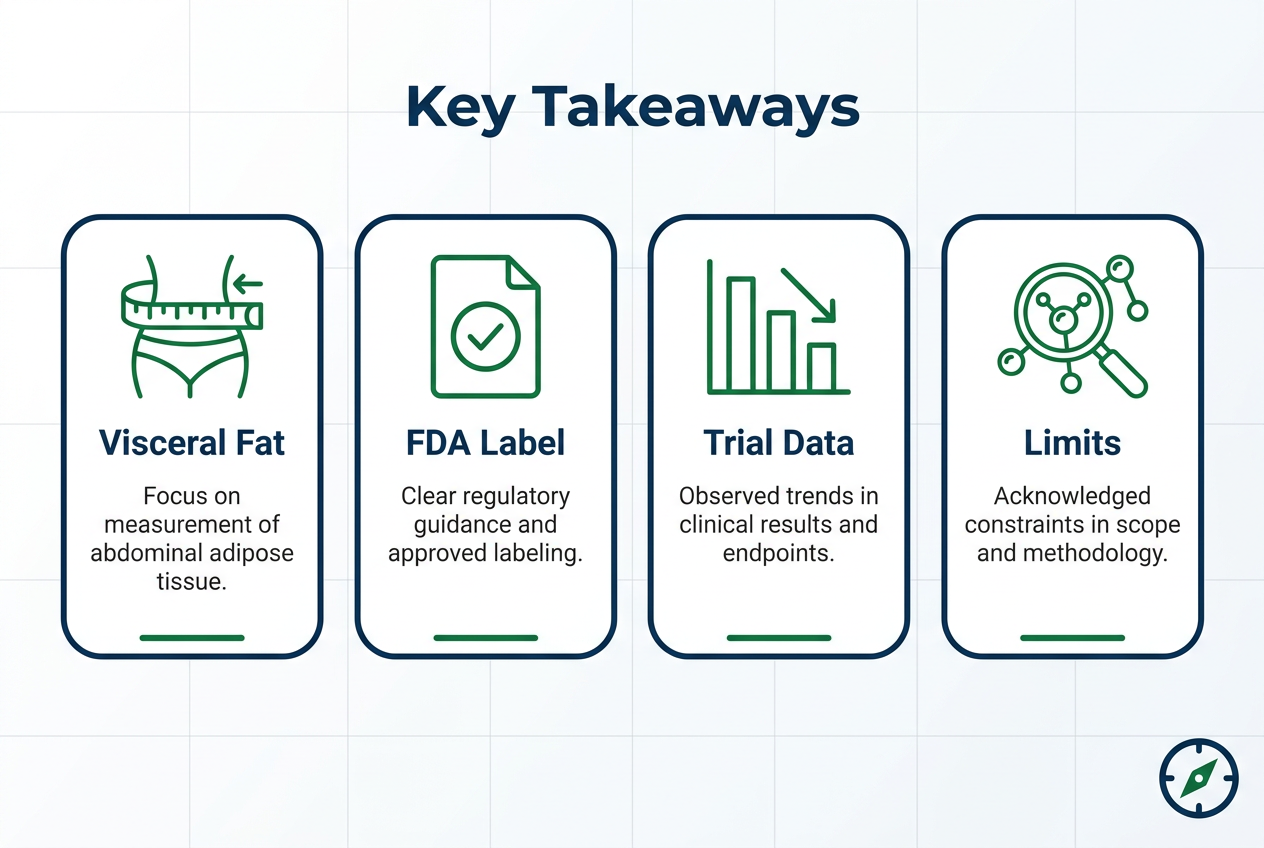
- The peptides library tesamorelin hub centers the FDA-labeled indication: reduction of excess abdominal fat in HIV-infected adults with lipodystrophy, not general weight loss.
- A 2010 randomized placebo-controlled trial reported an approximately 18% reduction in visceral fat, with maintenance described up to 52 weeks in an extension.
- Later trial evidence shows significant liver fat reduction, alongside changes in body image distress, lipids, and glycemic control.
- Peptides Library separates supported outcomes from overextended claims using official documents and PubMed-indexed studies.
- All tesamorelin content on Peptides Library is research-use-only: no human consumption, no dosing guidance, and no retail transaction framing.
What is the peptides library tesamorelin research hub?
The peptides library tesamorelin research hub is an independent editorial resource that organizes tesamorelin evidence around its strongest human data. Peptides Library does not treat tesamorelin as a generic fat-loss peptide. Instead, the hub centers the molecule where the best evidence actually sits: a growth hormone-releasing factor analog studied and labeled for excess abdominal fat in adults with HIV and lipodystrophy.
This focus matters if you need to separate supported outcomes from overextended claims. The peptides library tesamorelin overview keeps the clinical context intact so you can see which findings belong to HIV-associated lipodystrophy and which claims go beyond the evidence. You do not have to jump between retailer pages, forum posts, and scattered abstracts.
Peptides Library anchors tesamorelin to the FDA-labeled indication and the current 2 mg per vial prescribing information for EGRIFTA SV. That formulation detail is part of the research-use-only framework, not a dosing recommendation. The hub then builds every summary around official labeling and peer-reviewed human trials.
Which tesamorelin outcomes does the peptides library tesamorelin overview prioritize?
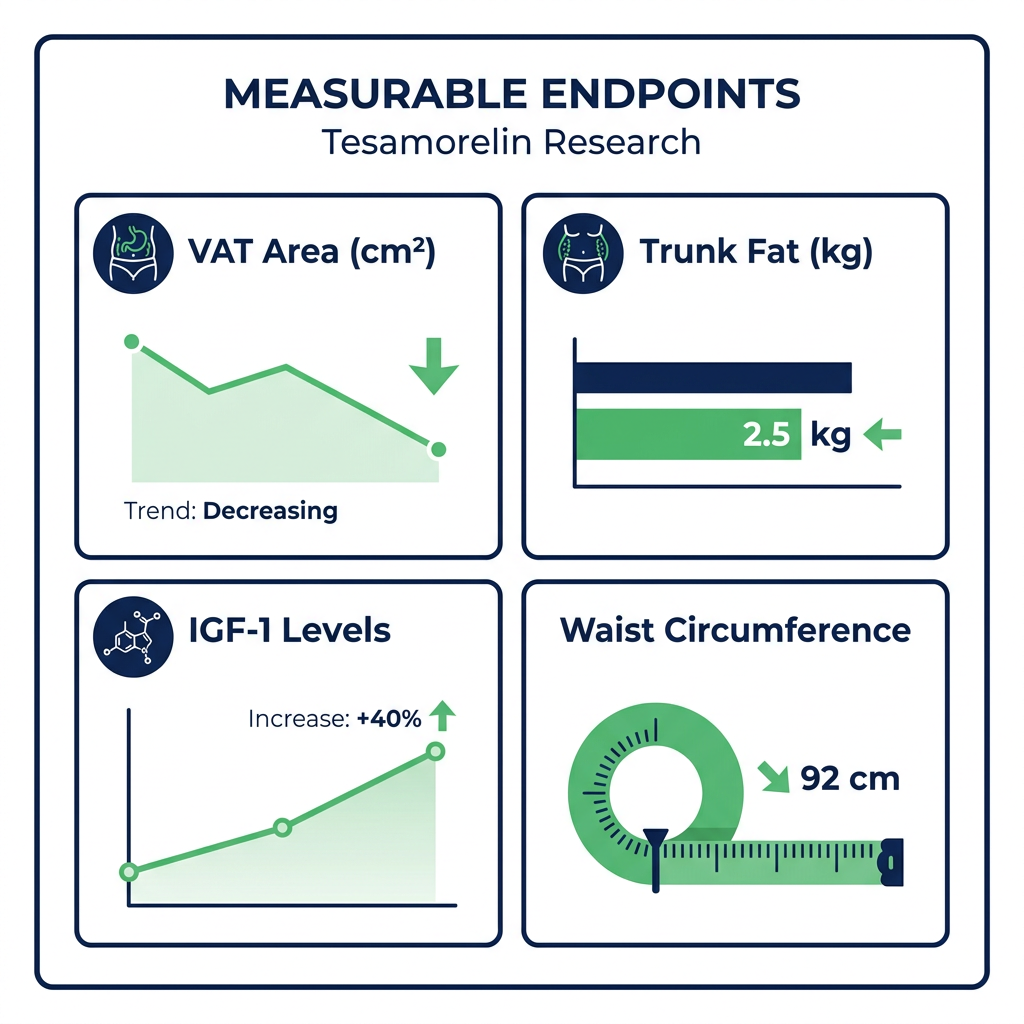
The peptides library tesamorelin overview prioritizes outcomes with the strongest human support: visceral adipose tissue, hepatic fat fraction, body composition, lipids, body image distress, and glycemic control. These endpoints come from randomized placebo-controlled trials, not mechanistic speculation. Peptides Library keeps the evidence boundaries visible so you do not confuse targeted fat-distribution research with broad body-weight claims.
Inside the peptides library tesamorelin coverage, you can expect focused content such as FDA indication context, human outcome summaries, evidence boundaries, and source-first navigation. The hub gives priority to official documents and PubMed-indexed studies so you can assess claims against the underlying literature.
For example, the 6-month randomized trial evidence shows significant reductions in visceral adipose tissue and liver fat versus placebo. Peptides Library highlights that result because it is the clearest, most reproducible human finding. The overview also makes room for details that change decision quality, including imaging-based body composition outcomes over 6 and 12 months.
💡 Key Takeaway: Which tesamorelin outcomes does the peptides library tesamorelin overview prioritize?
How does peptides library tesamorelin use FDA labeling?
Peptides Library uses FDA labeling as the primary anchor for the peptides library tesamorelin research summaries. U.S. labeling and drug-information sources align that tesamorelin is used to reduce excess abdominal fat in adults with HIV and lipodystrophy. This narrow indication is useful because it prevents the molecule from being framed as a catch-all body-fat solution for every population.
The peptides library tesamorelin hub includes the official prescribing information for EGRIFTA SV, specifically the 2 mg per vial formulation. Peptides Library keeps that labeling context visible so you can check whether a claim belongs to the approved use or goes beyond it. The editorial stance stays close to the data, without promotional language or retail pressure.
This labeling-first approach changes the reading experience. You get citation-focused summaries and practical interpretation, not a list of unverified benefits. Peptides Library also updates the tesamorelin content as new official documents or clinical discussions emerge, so the labeling anchor remains current for research use only.
What does the 2010 tesamorelin trial show about visceral adipose tissue?
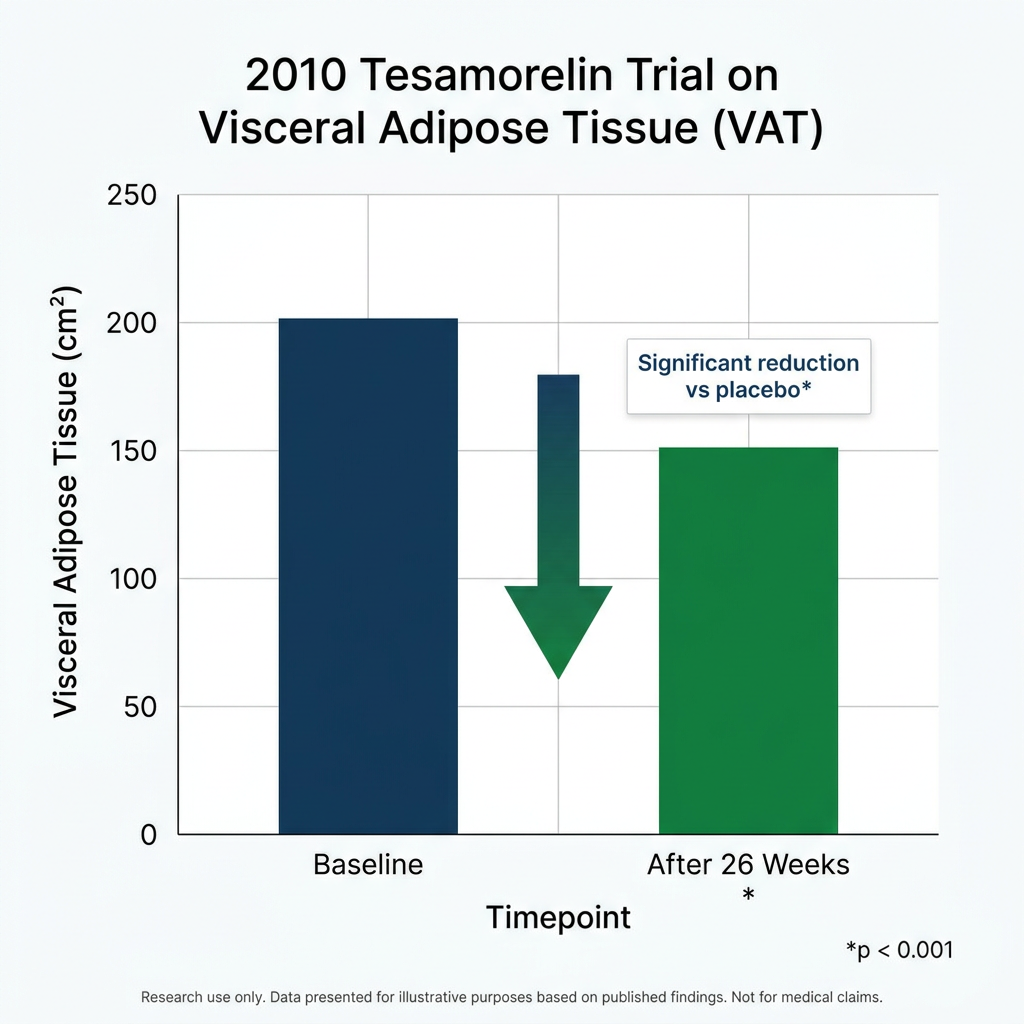
The 2010 randomized placebo-controlled trial is the cornerstone of the peptides library tesamorelin evidence base. In HIV-infected patients with central fat accumulation, the trial reported an approximately 18% reduction in visceral fat. This outcome was measured against placebo, not as an open-label observation, which makes it a high-quality human data point.
Peptides Library also surfaces the maintenance data from that trial. The visceral fat reduction was described up to 52 weeks in an extension phase, meaning the effect was not just a short-term fluctuation. For researchers reviewing the peptides library tesamorelin overview, this timeline matters because it shows durability beyond the initial 6-month randomized period.
The same trial reported improvement in body image distress, a patient-centered outcome often overlooked in peptide summaries. Peptides Library includes that finding because it connects the imaging-based visceral fat change to a measurable quality-of-life endpoint. All of this remains research-use-only context, not a clinical recommendation.
Why does peptides library tesamorelin separate HIV-associated lipodystrophy from general fat loss?
Peptides Library separates HIV-associated lipodystrophy from general fat loss because the strongest tesamorelin research base is specifically about that condition. The peptides library tesamorelin hub does not stretch the molecule into unsupported general fat-loss promises. If you want a page that overstates broad weight-loss evidence, this overview is not written for that purpose.
Abdominal fat accumulation linked to HIV or long-term antiretroviral exposure is a distinct clinical context. Tesamorelin was studied and labeled for that population, not for healthy individuals seeking body-fat reduction. The peptides library tesamorelin content keeps that distinction visible so you can evaluate the molecule in the right evidence lane.
This separation also protects decision quality. When you read a claim about tesamorelin, you can ask whether it belongs to HIV-associated visceral adiposity or to a broader, less-supported use. Peptides Library provides that filter through source-first navigation and plain-language interpretation, all within a research-use-only frame.
!peptides library tesamorelin FDA indication and clinical trial endpoints
💡 Key Takeaway: Why does peptides library tesamorelin separate HIV-associated lipodystrophy from general fat loss?
What are the measurable endpoints in peptides library tesamorelin research?
The peptides library tesamorelin research summaries focus on endpoints that were actually measured in human trials: visceral adipose tissue, hepatic fat fraction, lipids, body image distress, and glycemic control. Visceral adipose tissue is the primary imaging-based outcome, often assessed by CT or MRI over 6 months. Hepatic fat fraction is a secondary but important liver outcome.
Peptides Library surfaces the approximately 18% visceral fat reduction reported in HIV-associated central fat accumulation, with maintenance described up to 52 weeks. That number is the most frequently cited human data point. The overview also includes later trial evidence showing significant liver fat reduction, which matters if you are reading beyond waist-size narratives and into hepatic outcomes.
Lipid changes and glycemic control are safety and metabolic context endpoints. The peptides library tesamorelin hub does not overstate these as independent benefits. Instead, it shows how the molecule behaved in the studied population, so you can assess the full body of evidence for research use only.
How does the peptides library tesamorelin hub handle liver fat and glycemic control?
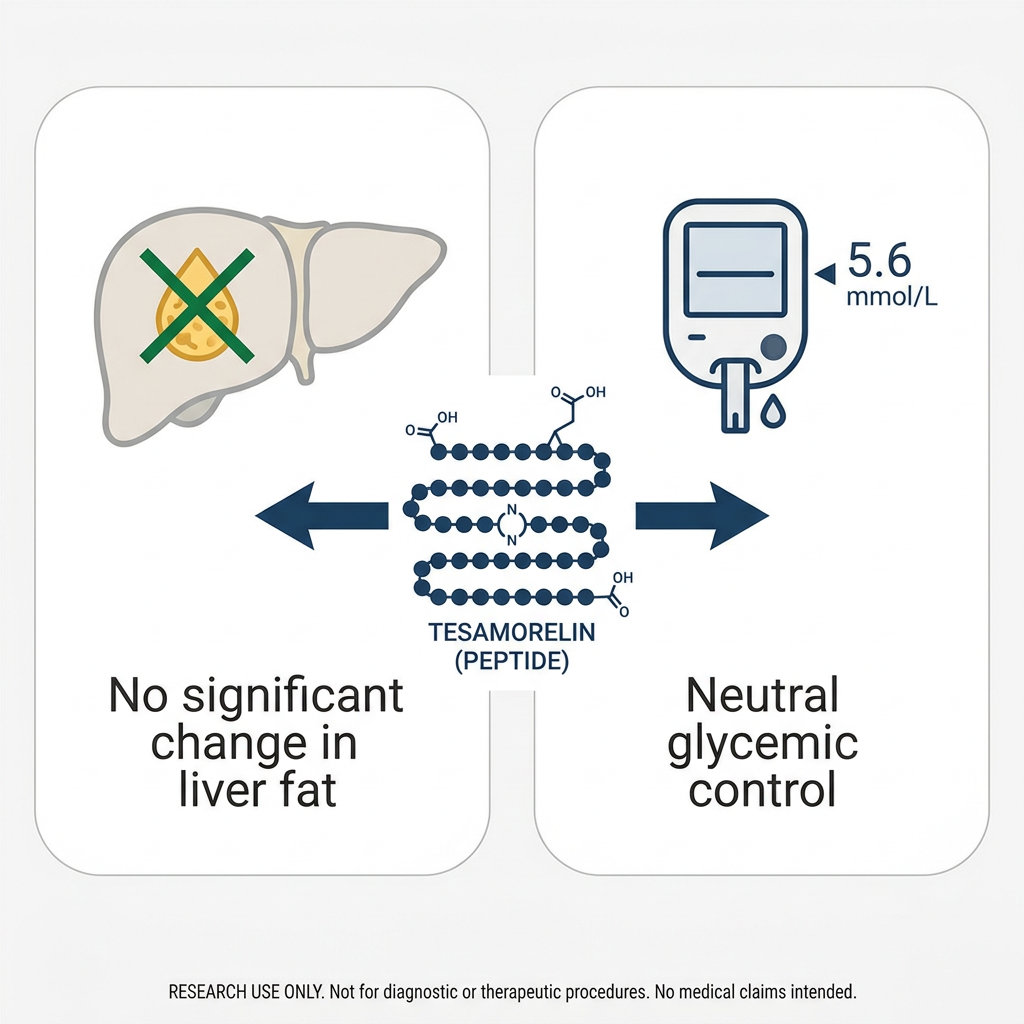
The peptides library tesamorelin hub handles liver fat and glycemic control as secondary endpoints within the HIV-associated lipodystrophy evidence. A later randomized trial reported significant liver fat reduction, which Peptides Library includes alongside the visceral fat data. This dual outcome profile helps you understand tesamorelin beyond a single metric.
Glycemic control is discussed in the peptides library tesamorelin overview as part of the safety context, not as a primary benefit claim. The trials measured glucose-related parameters, and Peptides Library summarizes those findings without implying a metabolic indication. That discipline keeps the research-use-only framing intact.
Hepatic fat fraction is especially relevant if you are comparing tesamorelin to other growth hormone-releasing factor analogs. Peptides Library links this endpoint to the broader peptide research library so you can see how tesamorelin fits within the class. For a complete reference guide, see Peptide Research Library: A Complete Reference Guide.
What are the evidence boundaries in peptides library tesamorelin?
The peptides library tesamorelin evidence boundaries are explicit: the strongest human support is for HIV-associated visceral adiposity, not general weight loss, not healthy bodybuilding, and not aging-related fat gain. Peptides Library writes those boundaries into every summary so you do not overinterpret the data.
One boundary is the population. Tesamorelin was studied in adults with HIV and lipodystrophy, often with long-term antiretroviral exposure. Another boundary is the endpoint. Visceral adipose tissue and liver fat are the documented outcomes; total body weight change is not the primary finding. The peptides library tesamorelin hub keeps these boundaries visible through plain-language explanation.
A third boundary is the timeframe. The 2010 trial measured 6-month randomized outcomes, with extension data up to 52 weeks. Peptides Library does not extrapolate those results to indefinite use. For researchers who need a clean, source-first overview, this boundary-setting is more useful than promotional bullet points.
💡 Key Takeaway: What are the evidence boundaries in peptides library tesamorelin?
Which sources anchor the peptides library tesamorelin summaries?
Peptides Library anchors the peptides library tesamorelin summaries to official and academic materials. The primary sources are the FDA prescribing information and PubMed-indexed trial data. When linking is available, Peptides Library points to those documents so you can verify the underlying basis instead of relying on secondhand paraphrases.
You can explore the human evidence directly through a PubMed search for tesamorelin visceral adipose tissue. For registered clinical trial records, see ClinicalTrials.gov results for tesamorelin. These external sources keep the peptides library tesamorelin content accountable to the literature.
Peptides Library also uses internal cross-references to related peptide research. For example, the hub links to Peptide Library: Research-Grade Peptides for Laboratories and Peptides Library Hexarelin Side Effects Research Hub for comparative context. This source-first navigation reduces the time you spend hunting for primary data.
!peptides library tesamorelin visceral adipose tissue reduction data
Who benefits most from the peptides library tesamorelin overview?
Researchers, clinicians, students, and informed consumers benefit most from the peptides library tesamorelin overview. Researchers can scan the human evidence faster because the hub organizes trial outcomes by endpoint and timeframe. Healthcare professionals can review the clinical focus without digging through promotional language.
Students and informed consumers benefit from plain-language definitions of terms like visceral adipose tissue, hepatic fat fraction, lipodystrophy, and glycemic control. The peptides library tesamorelin content places those terms in the correct scientific setting, so you learn the context rather than just the vocabulary.
Because Peptides Library is an independent, non-retailer editorial resource, the tesamorelin content is built to improve judgment rather than push a transaction. That changes the reading experience: you get citation-focused summaries, practical interpretation, and a clearer sense of what the studies actually measured, all for research use only.
What comparison tables does peptides library tesamorelin provide?
The peptides library tesamorelin overview includes comparison tables to help you see where tesamorelin sits relative to other peptide research topics. For example, you can compare tesamorelin to other growth hormone-releasing factor analogs by endpoint, population, and evidence strength. This format is faster than reading multiple abstracts.
One comparison table in the peptides library tesamorelin hub contrasts visceral adipose tissue reduction with hepatic fat fraction outcomes across the 2010 and later trials. Another table separates FDA-labeled use from off-label discussion, using the 2 mg per vial EGRIFTA SV formulation as the reference point. These tables are editorial tools, not clinical recommendations.
Peptides Library also links comparison tables to broader peptide library resources. For instance, the hub references Peptide Research Library: A Complete Reference Guide when discussing class-level differences. This internal linking keeps the research-use-only context connected across the site.
💡 Key Takeaway: What comparison tables does peptides library tesamorelin provide?
How often should you revisit peptides library tesamorelin research?
You should revisit the tesamorelin research hub whenever new clinical discussions or papers emerge. Tesamorelin is a topic where official indications, mechanistic speculation, and off-label interest often mix. Peptides Library continuously updates its coverage so you can return to the evidence base without losing sight of what is already established.
The hub is also useful before a clinical discussion, research project, literature review, or deeper peptide comparison. You can move from “What does tesamorelin claim to do?” to “What has been shown, in which population, over what timeframe, and with what limits?” much faster.
Because the peptides library tesamorelin content is source-first and citation-focused, you do not need to re-verify every claim from scratch each time. The overview keeps the FDA labeling and key PubMed-indexed trial links current, so your next decision is based on the latest available evidence for research use only.
What should you do before using tesamorelin evidence in a research project?
Before using tesamorelin evidence in a research project, review the FDA indication and the 2010 randomized trial outcomes. Confirm that your question falls within HIV-associated lipodystrophy, not a general fat-loss frame. Peptides Library makes this check easier by keeping the labeling context at the top of the hub.
Then compare the visceral adipose tissue and liver fat data against the specific endpoint you care about. If you need body-weight change, tesamorelin is not the strongest evidence. If you need imaging-based visceral fat reduction in a defined population, the data are clearer. The peptides library tesamorelin overview structures that comparison for you.
Finally, track the source documents. Use the PubMed and ClinicalTrials.gov links from Peptides Library to pull the original abstracts and trial records. This research-use-only workflow prevents you from relying on secondhand paraphrases and keeps your project anchored to the underlying literature.
FAQ
Does the peptides library tesamorelin hub cover general weight loss?
No. The peptides library tesamorelin hub centers HIV-associated abdominal fat accumulation in adults with lipodystrophy. General weight loss is not the documented indication, and Peptides Library does not frame tesamorelin as a broad fat-loss solution.
What is the strongest human finding for tesamorelin?
The strongest finding is an approximately 18% reduction in visceral fat reported in a 2010 randomized placebo-controlled trial of HIV-infected patients with central fat accumulation. Maintenance was described up to 52 weeks in an extension, and later trials showed significant liver fat reduction.
Why does Peptides Library emphasize the 2 mg per vial formulation?
Peptides Library emphasizes the 2 mg per vial formulation because it is the current EGRIFTA SV prescribing information. This detail anchors the research context to the FDA-labeled product, not to retail-grade or research-chemical alternatives.
Are the tesamorelin summaries on Peptides Library for human use?
No. All tesamorelin content on Peptides Library is research-use-only. There is no dosing guidance, no human consumption framing, and no retail transaction language anywhere in the hub.
How does Peptides Library keep tesamorelin evidence current?
Peptides Library continuously updates the tesamorelin overview as new official documents, PubMed-indexed studies, or clinical discussions emerge. The source-first navigation keeps the FDA labeling and key trial links current for research use only.
Ready to Take the Next Step?
Every product includes lot-specific documentation and third-party purity testing.
Explore Our Research Products →Free shipping on qualifying orders · Batch COA on request