


If you are researching sexual health peptides, the hardest part is usually not finding claims. It is finding the line between approved use, early human data, and marketing language. Peptides Library exists to make that line clear with evidence-based articles, citation-focused research guides, practical tools, and independent reviews built around peptide science.
Peptides Library helps researchers, healthcare professionals, students, and informed consumers understand what is actually supported for compounds such as bremelanotide, PT-141, and kisspeptin. Instead of treating every libido-related peptide as if it belongs in the same bucket, we separate labeled indications, study endpoints, dosing limits, adverse effects, and real-world research relevance.
Peptides Library makes sexual health peptide research easier to compare and harder to misread
Sexual health peptide content online often mixes together approved products, speculative hormone discussions, and product promotion. Peptides Library organizes sexual health peptides by indication status, route of administration, dose, study population, and safety profile so you can compare like with like.
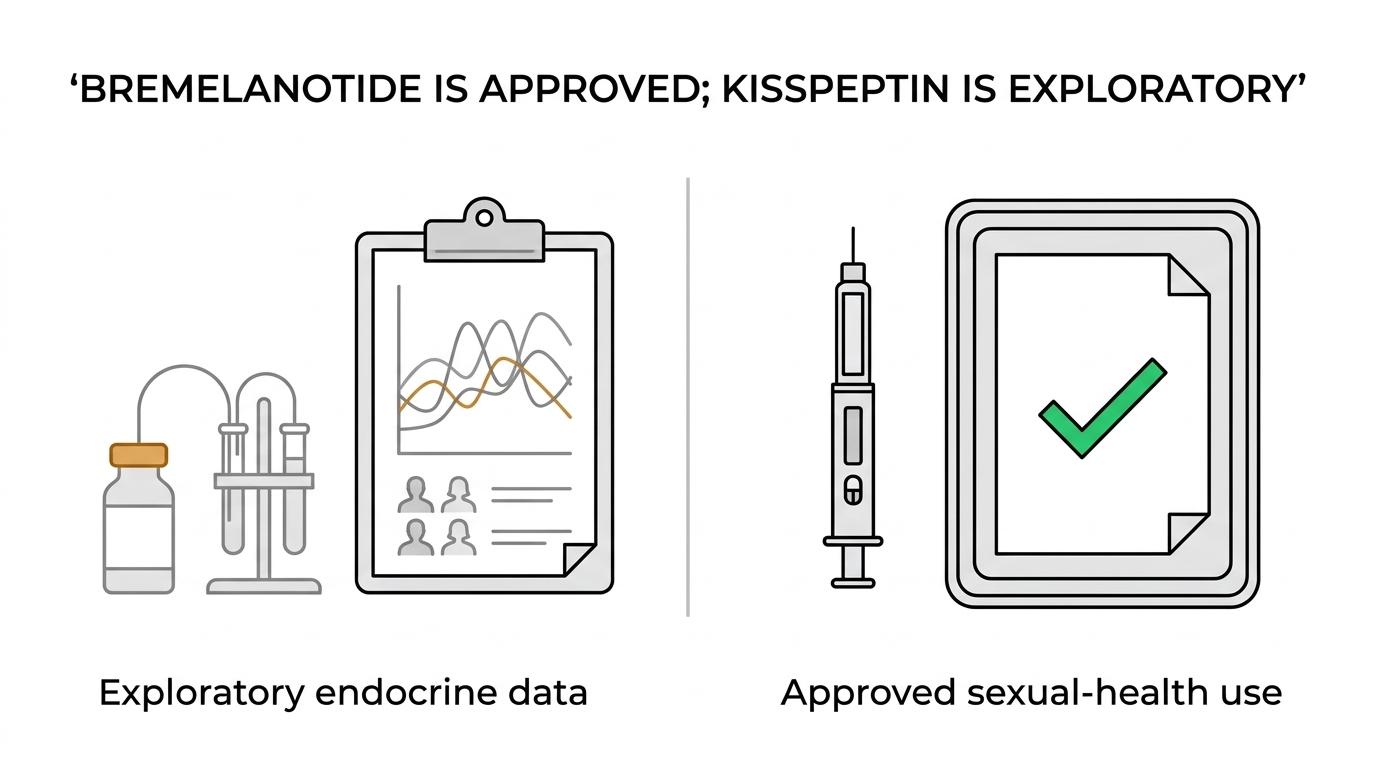
For this topic, the most important distinction is also the one most often skipped: bremelanotide is the only peptide here with an FDA-labeled sexual-health indication, while kisspeptin is supported mainly by small human studies showing endocrine effects rather than an approved sexual-health treatment role.
“Peptides Library separates the FDA-labeled bremelanotide indication from kisspeptin studies centered on LH, FSH, and testosterone.”
That difference matters when you are deciding what deserves closer attention. Peptides Library shows where VYLEESI applies, where it does not apply, and what kisspeptin studies actually measured before you spend time on sources that blur treatment claims with exploratory biology.
| Peptide | Best-supported role in sexual health research | Key human details | Limits you need to know |
|---|---|---|---|
| Bremelanotide / VYLEESI / PT-141 | FDA-labeled use for premenopausal women with acquired, generalized hypoactive sexual desire disorder (HSDD) causing marked distress or interpersonal difficulty | Labeled dose is 1.75 mg subcutaneously at least 45 minutes before anticipated sexual activity | Not indicated for postmenopausal women or men, and not indicated to enhance sexual performance |
| Kisspeptin-54 / Kisspeptin-10 | Human endocrine research on gonadotropin and testosterone response | Studies report LH, FSH, and testosterone stimulation in specific research settings | No approved sexual-health indication in the evidence provided here |
Peptides Library clarifies bremelanotide, VYLEESI, and PT-141 dosing, indication, and risk details
If you are evaluating PT-141 in a serious way, Peptides Library brings the label details to the front. The FDA labeling for VYLEESI states that bremelanotide is indicated for premenopausal women with acquired, generalized HSDD causing marked distress or interpersonal difficulty, and not due to another medical or psychiatric condition, relationship problems, or a medication or substance.
Peptides Library also makes the dosing limits easier to scan than a long label document. The labeled dose is 1.75 mg given subcutaneously at least 45 minutes before anticipated sexual activity, with no more than one dose in 24 hours and no more than 8 doses per month.
“Peptides Library highlights the concrete bremelanotide limits: 1.75 mg subcutaneously, no more than 1 dose in 24 hours, and no more than 8 doses per month.”
That same guide also protects you from common misreadings. VYLEESI is not indicated for postmenopausal women or men, and it is not indicated to enhance sexual performance, which changes how you should interpret many broad online claims.
Peptides Library gives equal weight to safety language because sexual health research is not useful if the risk profile gets buried. The label reports transient blood-pressure increases after each dose, with maximal increases of 6 mmHg systolic and 3 mmHg diastolic, plus heart-rate reductions up to 5 beats per minute; it is contraindicated in uncontrolled hypertension or known cardiovascular disease. In pooled phase 3 trials, nausea occurred in 40.0% of VYLEESI-treated patients versus 1.3% with placebo.
Peptides Library tracks kisspeptin sexual health evidence through actual human endocrine studies
Kisspeptin is where many readers need the most help because the science is interesting, but the commercial interpretation often runs ahead of the evidence. Peptides Library does not present kisspeptin as an approved sexual-health therapy here. We present it as a peptide with human endocrine findings that may be relevant to sexual-health research questions, reproductive physiology, and hypothalamic-pituitary-gonadal signaling.
In one human study, intranasal kisspeptin-54 rapidly stimulated gonadotropin release in healthy men and women and in patients with hypothalamic amenorrhoea. At 12.8 nmol/kg, reported mean maximal luteinizing hormone increases were 4.4 IU/L in healthy men, 1.4 IU/L in healthy women, and 4.4 IU/L in patients with hypothalamic amenorrhoea.
“Peptides Library follows kisspeptin down to study-level details, including 12.8 nmol/kg intranasal kisspeptin-54 and chronic kisspeptin-10 data sustained for 12 days.”
Peptides Library also surfaces the next layer of evidence rather than stopping at one abstract. A later study in healthy men included 15 participants receiving acute and chronic subcutaneous kisspeptin-10 infusions and 12 controls, with acute 8-hour dose-response testing and chronic protocols lasting 5 days or 12 days; the authors concluded that chronic kisspeptin administration sustained gonadotropin and testosterone secretion for 12 days.
Those distinctions make your reading sharper. A source discussing short-term LH, FSH, and testosterone changes is not automatically discussing an approved sexual-health treatment, and Peptides Library keeps that boundary explicit.
Peptides Library serves researchers, clinicians, students, and informed consumers who need source-based answers
This is not a generic overview built for casual scrolling. Peptides Library is for readers who want to move from a peptide name to the useful details: approved indication, route, timing, dose ceiling, study population, contraindications, and endocrine endpoints.
When you use Peptides Library for sexual health peptide research, you get:
- Cited summaries of official labeling and human study findings
- Clear separation between approved use and exploratory endocrine evidence
- Practical context on safety warnings, adverse-event rates, and dosing limits
- Related evidence reviews, how-to guides, calculators, and brand or product reviews that support deeper comparison
That mix is useful whether you are preparing for a research project, checking a claim before a clinical discussion, or trying to understand why two peptides that are mentioned in the same conversation may have very different evidence status.
Why Peptides Library is a stronger fit than retailer-led sexual health peptide content
Peptides Library is an independent, non-retailer editorial resource. That matters because we are not trying to turn every peptide question into a product checkout.
Our editorial stance improves the quality of the decision in front of you. Peptides Library can tell you when the strongest support comes from an FDA label, when the available evidence comes from small PubMed-indexed human studies, and when a peptide is being discussed beyond what the cited data can carry.
Peptides Library also gives you more than one format for working through the topic. We publish research articles, how-to guides, evidence reviews, peptide calculators, and brand or product reviews, so you can start with a high-level comparison and keep drilling down into dosing logic, source quality, and methodology without leaving the same knowledge hub.
When Peptides Library is the right fit for sexual health peptide questions
Peptides Library is a strong fit when you want evidence boundaries before you commit time, money, or attention to a peptide topic. That includes situations such as:
- Comparing bremelanotide or PT-141 against kisspeptin
- Checking whether a sexual-health claim is backed by an FDA indication or only by hormone-study data
- Reviewing dose timing, monthly limits, contraindications, or adverse effects before a clinician conversation or research decision
If you need diagnosis, prescribing, or personal treatment advice, you need a licensed medical professional. If you need a cleaner, citation-backed starting point so those conversations are better informed, Peptides Library is built for that job.
Start with Peptides Library’s sexual health peptide research content to compare bremelanotide, VYLEESI, PT-141, and kisspeptin on evidence instead of noise, then use our guides and tools to keep your next step grounded in the actual data.