


If you are researching fertility peptides, you do not need another generic peptide list. You need a source-driven explanation of which compounds actually matter in reproductive endocrinology, what the evidence supports, and where marketing language overreaches.
Peptides Library gives you that context. As an independent online peptide knowledge hub, we publish evidence-based articles, research guides, evidence reviews, practical tools, and brand or product reviews that help you evaluate fertility-related peptide claims with much more precision. For this topic, our coverage centers on GnRH signaling, gonadorelin, and selected fertility-related endocrine use cases rather than vague promises of “fertility enhancement.”
Peptides Library focuses fertility peptide research on GnRH, gonadorelin, and real reproductive-endocrine evidence
Peptides Library approaches fertility peptides the same way serious readers do: by starting with physiology and then narrowing to supported use cases. In this area, the evidence base is anchored in gonadotropin-releasing hormone, or GnRH, which academic endocrinology sources describe as a decapeptide that stimulates pituitary release of LH and FSH.
That framing matters because it keeps your research tied to reproductive signaling, not broad peptide marketing. Peptides Library makes the connection explicit so you can understand why gonadorelin belongs in a fertility conversation and why many other peptides do not.
“Peptides Library centers fertility peptide research on GnRH, the decapeptide that drives LH and FSH release.”
When you use Peptides Library for fertility peptide research, you get more than definitions. You get source-based interpretation that helps you separate upstream endocrine regulation, downstream hormone effects, condition-specific applications, and the practical limits of current label-supported use.
Peptides Library also keeps the topic grounded in real demand. According to the World Health Organization infertility fact sheet, approximately one in every six people of reproductive age worldwide experience infertility in their lifetime, which is one reason fertility care is a major health-system issue rather than a niche topic.
Peptides Library clarifies what fertility peptides may improve, and where the evidence is narrow
A major reason readers come to Peptides Library is clarity. Fertility peptide discussions are often oversimplified, but the biology is not. GnRH-related therapies depend heavily on signaling pattern, indication, and route. Pulsatile signaling can support reproductive endocrine function, while continuous non-pulsatile exposure suppresses the axis and reduces LH and FSH output.
Peptides Library highlights that distinction because it changes how you interpret the entire category. If you are reviewing gonadorelin, GnRH analogues, or fertility-related protocols, the difference between pulsatile and continuous exposure is not a minor detail. It is central to whether the endocrine effect is supportive or suppressive.
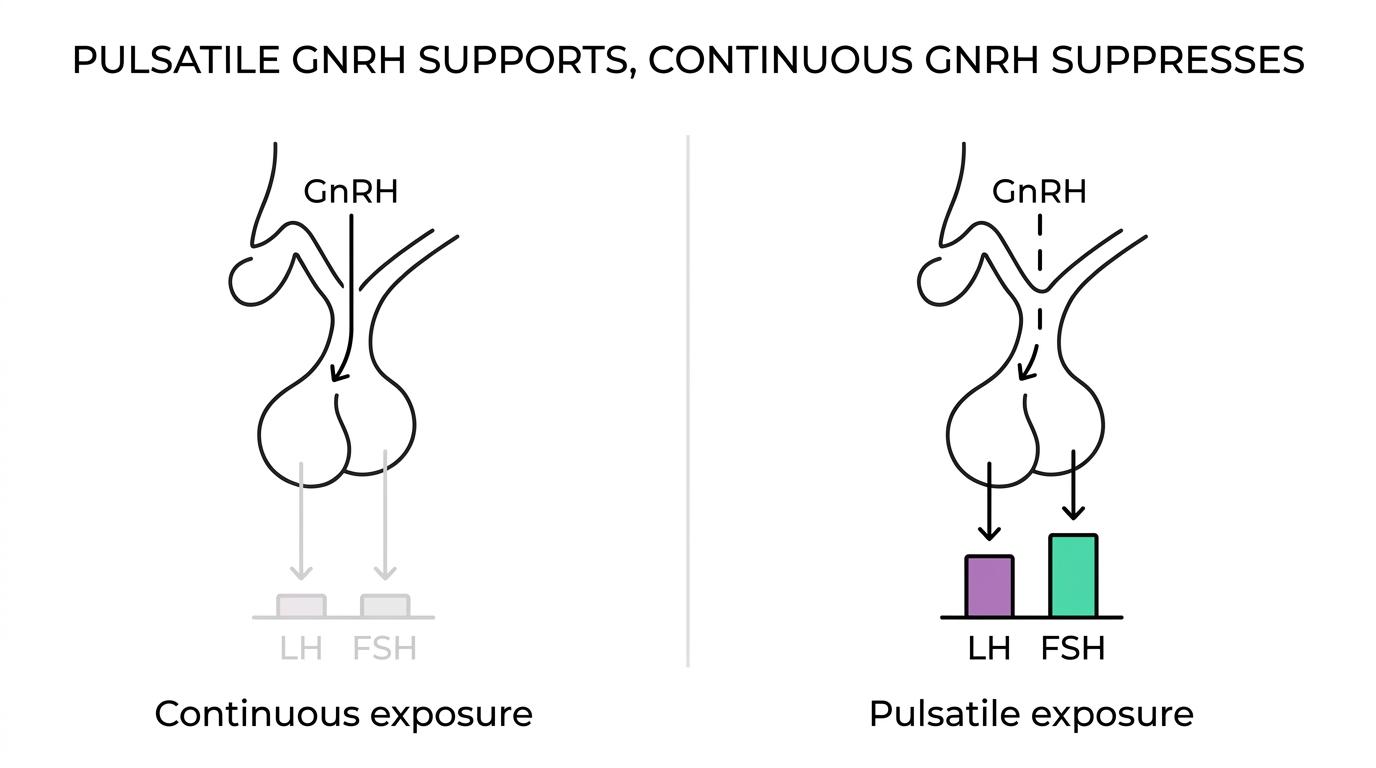
“Peptides Library treats pulsatile versus continuous GnRH exposure as the key distinction in fertility peptide research.”
Peptides Library is especially useful when you need condition-specific evidence rather than broad fertility claims. In isolated GnRH deficiency, for example, academic sources note that gonadotropins or pulsatile GnRH therapy may be required to realize fertility potential, and GeneReviews reports that spermatogenesis can be induced in approximately 90% to 95% of affected men with appropriate therapy. At the same time, the same source notes that in the United States, pulsatile GnRH therapy for male infertility is not currently FDA-approved and is available only at specialized research centers.
That kind of nuance is where Peptides Library adds value. We help you understand both the promise and the constraint, so you can see where the literature is strong, where access is limited, and where “fertility peptides” is too broad to be a useful label.
“Peptides Library tracks evidence in isolated GnRH deficiency, including reports of spermatogenesis in approximately 90% to 95% of affected men with appropriate therapy.”
Peptides Library also flags label context that is easy to miss in online peptide discussions. For example, DailyMed states that FACTREL Injection contains 50 micrograms of synthetic gonadorelin per mL and is labeled for use in animals only, not humans. If you are comparing sources, that distinction protects you from confusing veterinary labeling with human fertility evidence.
What you get from Peptides Library when you research fertility peptides
Peptides Library is built for readers who want to move faster without cutting corners. Our fertility peptide research coverage helps you verify the core facts that shape better decisions, literature reviews, and clinical conversations.
You can use Peptides Library to:
- Identify relevant peptides: We narrow the field to fertility-related signaling compounds such as GnRH and gonadorelin instead of treating all peptides as interchangeable.
- Check indication and context: We show where evidence relates to isolated GnRH deficiency, reproductive-endocrine disorders, animal labeling, or specialized research settings.
- Interpret mechanism correctly: We explain why pulsatile stimulation and continuous exposure produce very different endocrine outcomes.
- Trace claims back to sources: Our citation-focused editorial style helps you verify whether a statement comes from WHO, DailyMed, academic endocrinology texts, or our own synthesized review work.
For researchers and students, that means less time sorting through low-quality summaries. For healthcare professionals, it means quicker access to the distinctions that matter when reviewing endocrine mechanisms, label limitations, and condition-specific literature. For informed consumers, it means a much clearer sense of which fertility peptide claims are evidence-based and which ones are not.
Peptides Library also offers free practical tools, including peptide calculators, but we do not present calculators as a substitute for fertility care or specialist protocols. In fertility-related endocrine topics, pattern of administration, indication, and clinical oversight matter far more than a simplistic dose comparison, and our content reflects that.
Why Peptides Library is a strong fit for fertility peptide due diligence
Peptides Library is not a retailer pushing a fertility product. That independent editorial stance matters when you are reviewing a topic that attracts both genuine medical interest and aggressive marketing.
Because Peptides Library is a citation-focused knowledge hub, our job is to make the evidence easier to interpret. We connect mechanism, indication, route, label status, and research limitations in one place so you can evaluate fertility peptides with fewer blind spots.
That is especially helpful if you are asking questions such as:
- Is gonadorelin being discussed as a direct GnRH signal or as a vague “fertility peptide”?
- Is the source describing a human reproductive-endocrine use case, a veterinary label, or a theoretical mechanism?
- Does the protocol depend on pulsatile GnRH signaling rather than continuous exposure?
- Is the evidence tied to a defined disorder such as isolated GnRH deficiency, or is it being generalized too broadly?
Peptides Library is the right fit when you want to understand the science before you act on the claim. We are also a strong fit when you need a research guide that respects the limits of the evidence, including access barriers, approval status, and the difference between endocrine support and endocrine suppression.
When to use Peptides Library for fertility peptide questions
Use Peptides Library when you need a better starting point for fertility peptide research, a faster way to review source-backed evidence, or a more reliable filter for online claims. Our coverage is designed to help you prepare for deeper literature review, clinical discussion, or academic work with a much stronger factual base.
Peptides Library is not a clinic, and we do not diagnose infertility or recommend treatment. If you are dealing with a personal fertility concern, that boundary is important. WHO defines infertility as failure to achieve a pregnancy after 12 months or more of regular unprotected sexual intercourse, and fertility care often requires specialist evaluation, not just better internet research.
If you want a clearer view of gonadorelin, GnRH analogues, pulsatile signaling, and fertility-related evidence, start with Peptides Library’s fertility peptide coverage and use it to build a more accurate research path from the first source onward.