


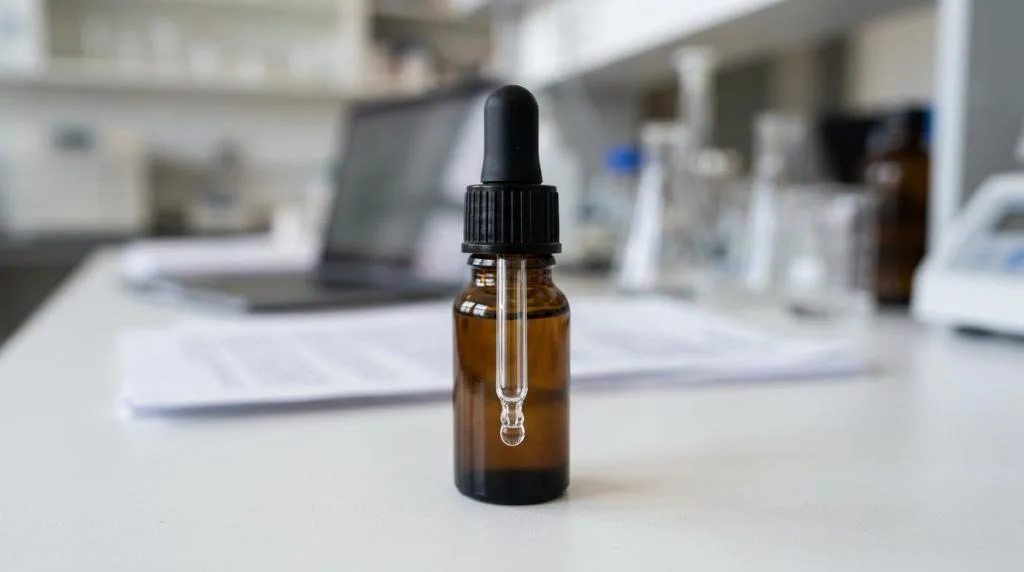
Peptides Library Selank Research Overview Guide Hub
Peptides library selank organizes the 62-patient trial, GABA-A mechanisms, and intranasal context into one independent research hub. Explore the evidence now.
📋 Table of Contents
Peptides library selank is an independent, evidence-based research hub that organizes the published human trial, GABAergic mechanisms, and intranasal product history around the Russian heptapeptide Selank—without retail bias. It anchors Selank review on the 62-patient comparative study, clarifies the two leading mechanistic hypotheses, and separates clinical proof from speculation. This makes peptides library selank a reliable first stop for researchers, clinicians, students, and informed readers who need source-grounded context, not marketing copy.
Key takeaways
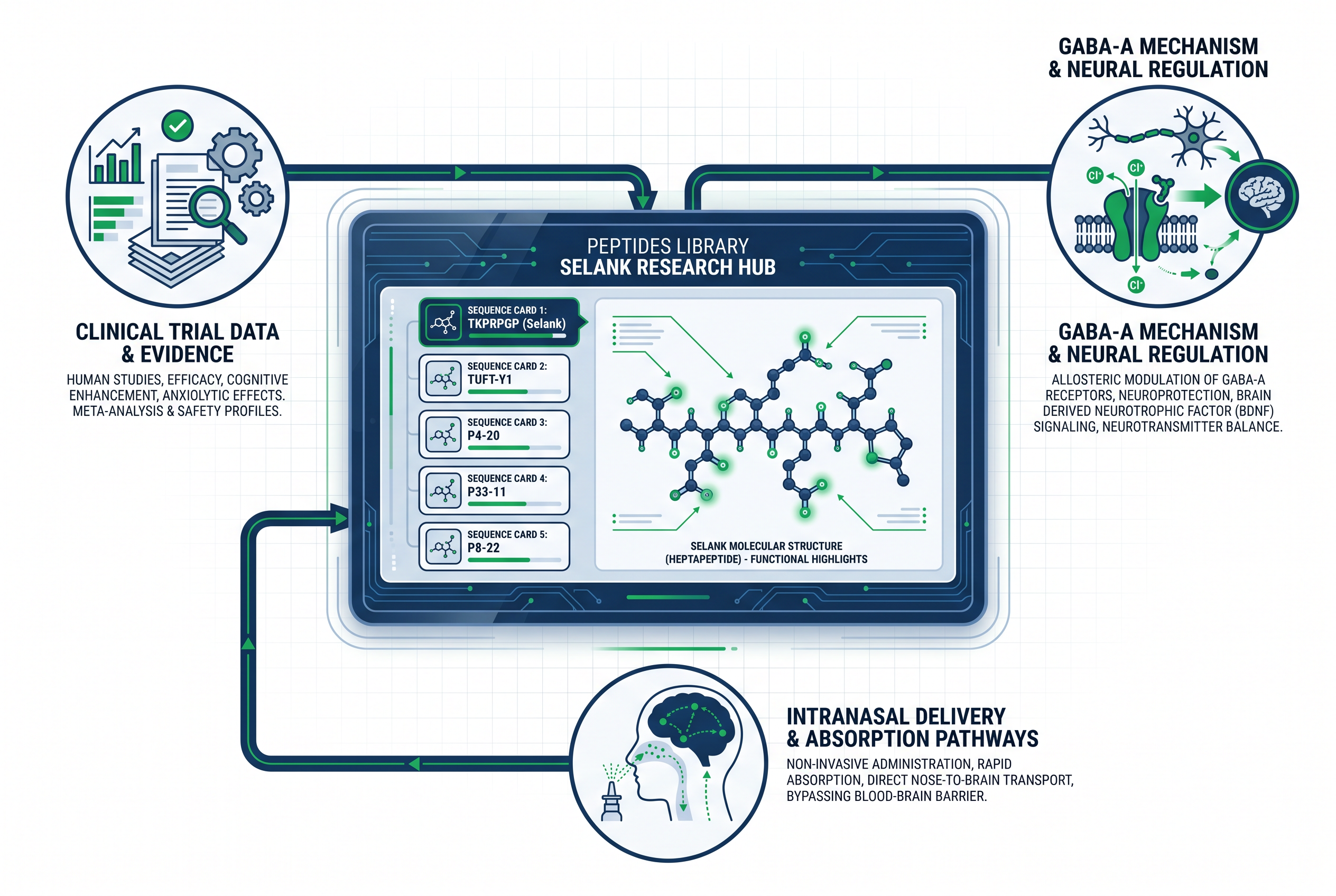
- peptides library selank centers the 62-patient comparative trial (30 Selank vs 32 medazepam) as the strongest human evidence, not broad claims.
- It tracks two published mechanisms: GABA-A positive allosteric modulation (including the 2018 review on [3H]GABA binding) and reduced enkephalin degradation.
- It preserves intranasal context—Russian nasal-drop instructions and a reported 14-day course—without implying universal clinical validation.
- It is built for research use only: no dosing advice, no human consumption guidance, no retailer promotion.
- It saves time by mapping primary literature, including PubMed, so you can verify core claims directly.
What is peptides library selank?
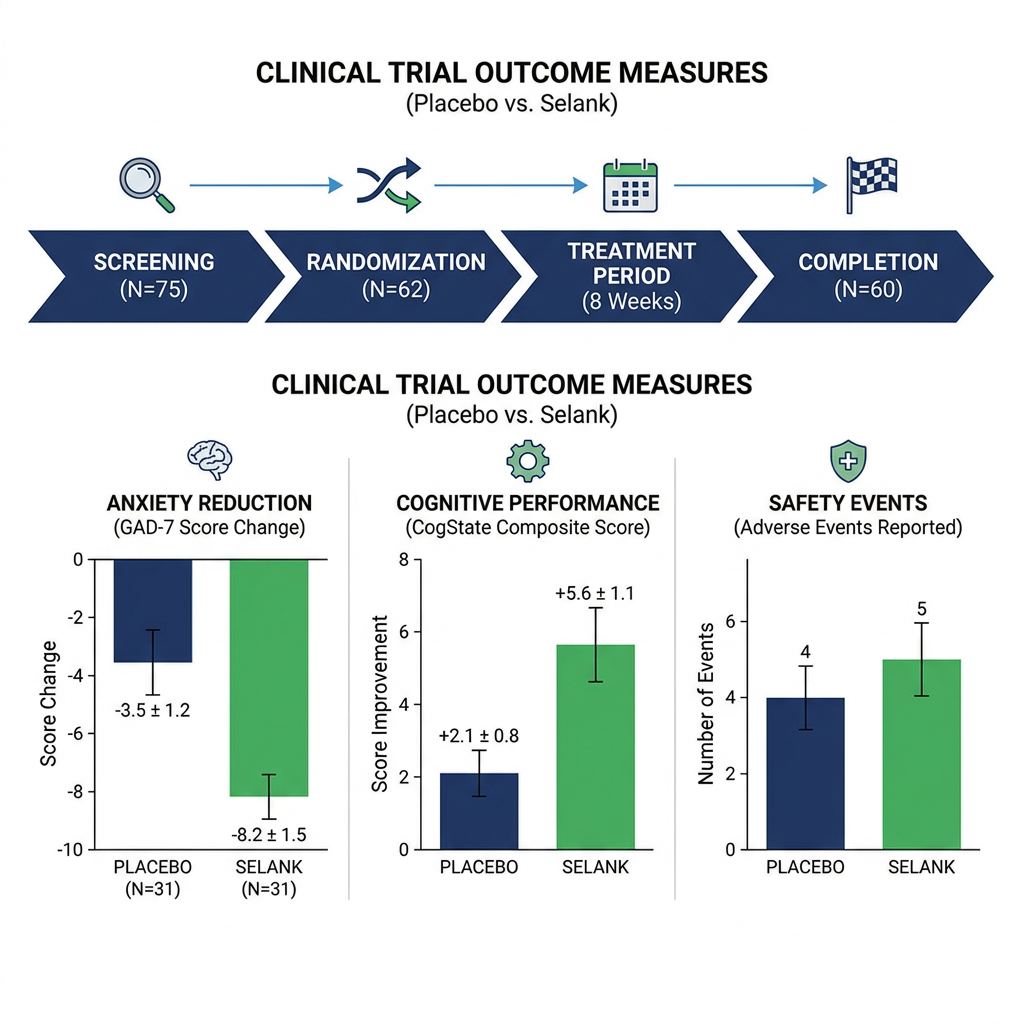
peptides library selank is not a retailer and not a peptide vendor. It is an independent knowledge hub that treats Selank as a research topic with real signals and real limitations. In published sources, Selank is described as a Russian intranasal heptapeptide anxiolytic, but the evidence base remains small enough that source quality and study context matter.
One reason peptides library selank is useful is that it does not flatten the literature into a simple yes or no claim. It highlights that the strongest published human evidence is a relatively small comparative study, much of the literature is Russian-language, and the overall research footprint is narrower than many readers first expect.
The editorial stance is explicit: peptides library selank centers the 62-patient comparative trial, not broad claims pulled from marketing copy. That matters when screening papers for clinical relevance, comparing anxiolytic mechanisms, or deciding whether Selank belongs in a serious peptide research discussion at all.
With peptides library selank, the core evidence is positioned where it belongs: promising, specific, and still limited. This approach extends to mechanism mapping, where the hub pairs the GABA-A receptor hypothesis with papers on enkephalin degradation without overstating either.
How does peptides library selank structure Selank evidence?
peptides library selank structures Selank coverage so you can move from first-pass orientation to deeper source review without rebuilding the topic from scratch. The content is organized around five recurring categories: evidence review, mechanism breakdown, practical research context, citation-focused reading paths, and independent editorial perspective.
Evidence review on peptides library selank distills the main Selank studies, including the 62-patient generalized anxiety disorder and neurasthenia comparison that reported similar anxiolytic effects to medazepam in 30 versus 32 patients. This is the anchor study, and the hub explains what it supports and what it does not.
Mechanism breakdown on peptides library selank summarizes the published GABA-A receptor hypothesis, positive allosteric modulation findings, and the enkephalin hydrolysis theory discussed in older papers. Practical research context covers intranasal administration, how Russian product instructions describe nasal-drop use and a reported 14-day course, and why that context should not be confused with broad international clinical validation.
Citation-focused reading paths on peptides library selank direct readers to primary literature, including official sources such as PubMed, so core claims can be verified instead of relying on recycled summaries. Independent editorial perspective means coverage is written to clarify evidence, not to sell a vial, a protocol, or a miracle outcome.
Evidence review category in detail
The evidence review category breaks the Selank literature into layers. The top layer is the human comparative trial, followed by mechanistic animal and binding studies, then Russian-language product documentation. This layering prevents a rat frontal cortex paper from being treated as clinical proof.
A rat frontal cortex paper reporting mRNA changes across 84 neurotransmission-related genes is worth knowing, but it does not replace human outcomes. The evidence review category makes that distinction explicit so your reading stays rigorous.
Mechanism breakdown category in detail
The mechanism breakdown category labels each mechanistic claim by its source type—binding assay, animal model, or human trial. This lets you weigh a positive allosteric modulation finding from a [3H]GABA binding study differently from a human outcome.
Terms like antiasthenic, psychostimulant, neurasthenia, and benzodiazepine-like mechanism comparisons are explained only when they matter to interpretation, not as filler and not as promotional framing.
Practical research context category in detail
Practical context includes intranasal administration details, Russian nasal-drop instructions, and the reported 14-day course. This category frames those details as historical and regional product context, not as universal clinical guidance.
This distinction matters because international readers sometimes assume the product context implies broad validation. The evidence base does not support that assumption, and the hub states it clearly.
Citation-focused reading paths category in detail
Citation paths link to primary literature on PubMed and other official databases. You can verify the 62-patient trial, the 2018 review on [3H]GABA binding, and enkephalin degradation papers directly.
The hub also connects to broader peptide research workflows. For example, the Peptide Research Library: A Complete Reference Guide helps place Selank inside a wider peptide-research context.
💡 Key Takeaway: How does peptides library selank structure Selank evidence?
Why does the 62-patient trial matter in peptides library selank?
The 62-patient trial is the most frequently cited human evidence for Selank, and peptides library selank treats it as the ceiling of clinical proof, not the floor. In that study, 30 patients received Selank while 32 received medazepam, and the reported anxiolytic effects were similar between groups for generalized anxiety disorder and neurasthenia.
peptides library selank makes the trial’s limits explicit. The sample is small, the comparator is a benzodiazepine-like drug, and much of the supporting literature remains Russian-language. This matters because many secondary sources present the study as definitive when it is actually a promising but narrow signal.
By anchoring the overview on this trial, peptides library selank prevents readers from overinterpreting animal or mechanistic papers as clinical proof. A rat frontal cortex paper reporting mRNA changes across 84 neurotransmission-related genes is worth knowing, but it does not replace human outcomes, and the hub keeps that distinction explicit.
The trial’s design also introduces context around neurasthenia and antiasthenic effects. These terms appear in Russian clinical literature more often than in Western anxiety research, and the hub explains them so readers do not misread the study’s scope.
What the 62-patient trial supports
The trial supports the conclusion that Selank showed similar anxiolytic effects to medazepam in a small sample of patients with generalized anxiety disorder and neurasthenia. It does not support claims of superiority, long-term safety, or broad efficacy across all anxiety disorders.
What the 62-patient trial does not support
The trial does not support dosing recommendations, human consumption guidance, or use outside research settings. It also does not validate the intranasal product instructions as internationally accepted clinical practice.
Which mechanisms does peptides library selank track for Selank?
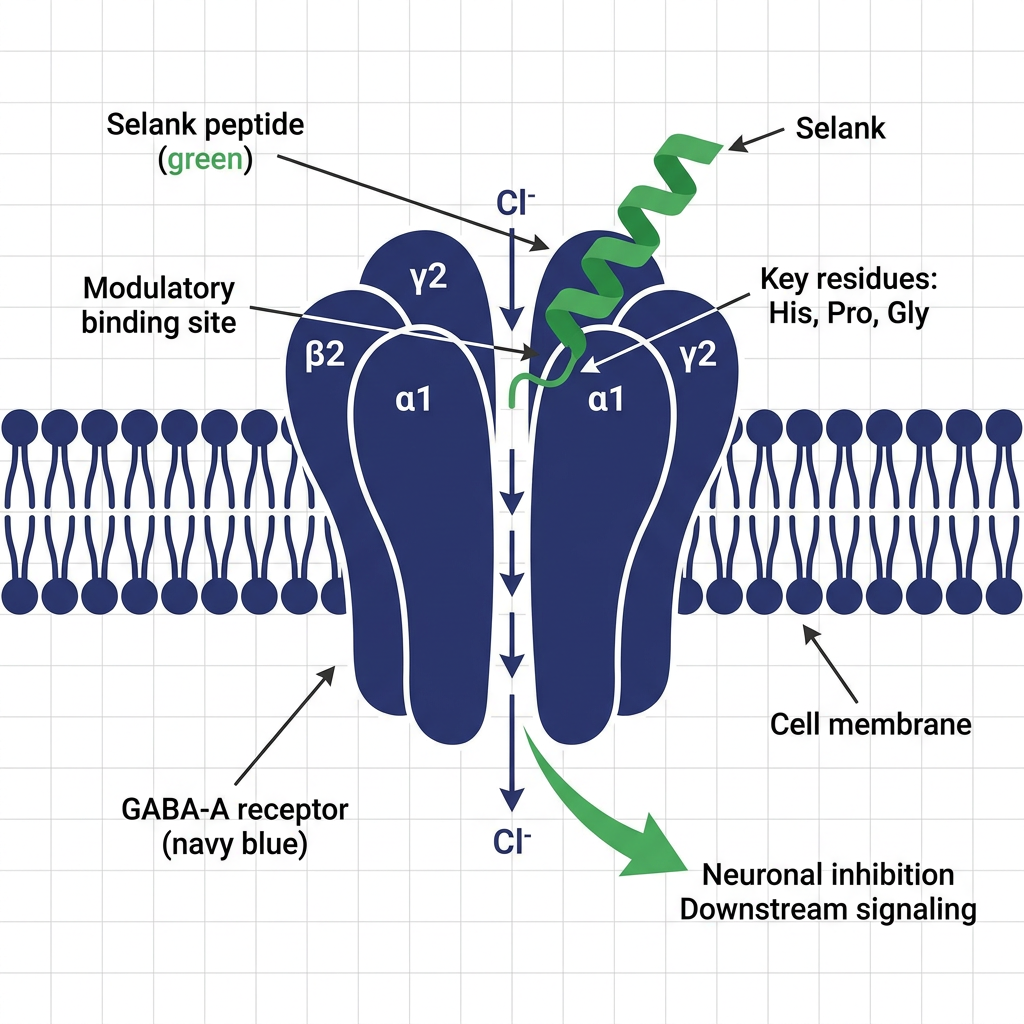
peptides library selank tracks two leading mechanistic hypotheses from the published literature. The first is GABA-A receptor activity, including a 2018 review that described Selank as affecting [3H]GABA binding as a positive allosteric modulator. The second is reduced enkephalin degradation, a plausible but older anxiolytic pathway.
The hub separates mechanistic plausibility from clinical proof. A positive allosteric modulation finding in binding studies does not automatically translate to human anxiolytic efficacy. peptides library selank labels each mechanism with its source type—binding assay, animal model, or human trial—so readers can weigh the evidence correctly.
Terms like antiasthenic, psychostimulant, neurasthenia, and benzodiazepine-like mechanism comparisons are explained when they matter to interpretation. peptides library selank uses these terms as analytical tools, not promotional framing, which keeps the mechanism section rigorous.
GABA-A allosteric modulation pathway
The GABA-A receptor hypothesis comes primarily from binding studies and reviews. The 2018 review described Selank as affecting [3H]GABA binding as a positive allosteric modulator, which suggests a benzodiazepine-like mechanism without being identical to benzodiazepines.
This pathway is often summarized as “GABAergic,” but the hub avoids oversimplification. It notes that allosteric modulation is a specific type of receptor interaction, not a general increase in GABA levels.
Enkephalin degradation pathway
The enkephalin hydrolysis theory appears in older papers and suggests that Selank may reduce the breakdown of enkephalins, endogenous peptides involved in stress and mood regulation. This pathway is plausible but less supported by recent human data than the GABA-A hypothesis.
The hub pairs both mechanisms without ranking one as definitive. This balanced approach lets researchers compare the evidence themselves.
Rat frontal cortex gene expression data
A rat frontal cortex paper reported mRNA changes across 84 neurotransmission-related genes. This is valuable mechanistic data, but it is preclinical and cannot substitute for human outcomes. The hub includes this paper with that caveat explicit.
What practical research context does peptides library selank provide?
Practical context on peptides library selank covers intranasal administration as described in published papers and Russian product instructions. The hub notes that Russian instructions describe nasal-drop use and a reported 14-day course, but it frames this as historical and regional product context, not as universal clinical guidance.
peptides library selank also clarifies that intranasal heptapeptide anxiolytic descriptions come from a narrow set of Russian studies. This is important because international readers sometimes assume the product context implies broad validation, which the evidence base does not support.
The practical section links to broader peptide research workflows, including how-to guides, evidence reviews, peptide calculators, and brand or product review content. This helps place Selank inside a wider peptide-research context rather than treating it as an isolated trend.
For example, researchers interested in delivery mechanisms can review the Cell Penetrating Peptides for Research guide, which explains peptide uptake concepts relevant to intranasal formulations.
Intranasal administration in published papers
Published papers describe Selank as an intranasal heptapeptide anxiolytic. The intranasal route is relevant to bioavailability and onset, but the hub does not extrapolate this into dosing or efficacy claims beyond what the literature states.
Russian product instructions and the 14-day course
Russian product instructions describe nasal-drop use and a reported 14-day course. The hub presents this as product documentation, not as clinical validation. It explicitly warns against treating this regional context as universal clinical guidance.
Why context matters for due diligence
Without this context, readers may mistake a Russian product instruction for an internationally accepted protocol. The hub prevents that error by labeling the source and scope of every practical claim.
💡 Key Takeaway: What practical research context does peptides library selank provide?
How does peptides library selank compare to other Selank resources?
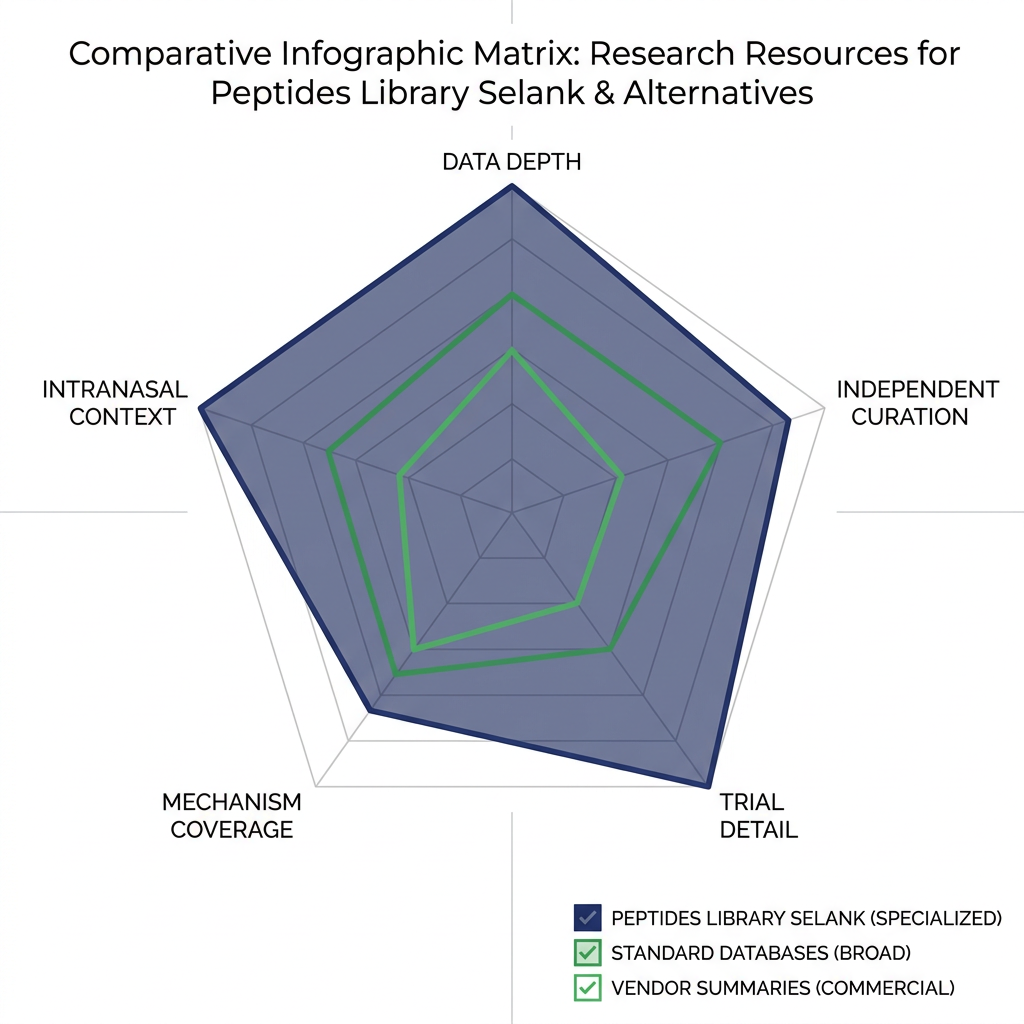
Most Selank content falls into two traps: aggressive marketing or casual dismissal. peptides library selank avoids both by being an independent, non-retailer knowledge hub. It can present Selank as it appears in the literature—a peptide with meaningful anxiolytic research signals, recurring GABAergic and enkephalin-related hypotheses, intranasal product history, and a still-limited body of human evidence.
This editorial stance changes the value of the page. Because peptides library selank is not selling a vial, it can state clearly that the evidence base is narrow and concentrated in a few studies. That is far more useful than pages that either hype the peptide or dismiss it without engaging the primary literature.
| Feature | peptides library selank | Typical retailer page | Dismissive blog |
|—|—|—|—|
| Evidence anchor | 62-patient comparative trial | Marketing claims | Anecdote |
| Mechanism depth | GABA-A allosteric modulation + enkephalin degradation | Vague “calming” | None |
| Research-use framing | Always research-only | Often implies human use | Unclear |
| Source quality | PubMed-linked primary literature | No citations | Selective citations |
| Intranasal context | Russian instructions, 14-day course noted | Product promotion | Ignored |
This comparison shows why peptides library selank is a strong choice for due diligence: it combines the evidence anchor, mechanism depth, and research-use framing that other resources typically miss.
Retailer bias vs independent editorial perspective
Retailer pages often imply human use or describe Selank as a wellness product. The hub never does this. All statements remain research-use-only, and every claim links back to a citable source or is labeled as context.
Dismissive blogs vs evidence-aware review
Dismissive blogs may ignore the 62-patient trial or the 2018 GABA-A review. The hub includes both, then explains their limits. This is more useful than either extreme.
Who should use peptides library selank for due diligence?
Clinicians and healthcare professionals use peptides library selank for fast orientation to a small and uneven evidence base. Researchers and students use it for a clearer map of mechanistic literature and the main human data. Informed consumers use it to understand where published evidence ends and speculation begins.
That mixed audience is why peptides library selank pages focus on fact density. Terms like antiasthenic, psychostimulant, neurasthenia, and benzodiazepine-like mechanism comparisons are explained only when they matter to interpretation, not as filler and not as promotional framing.
For clinicians and healthcare professionals
Clinicians need to know whether Selank belongs in a serious peptide research discussion at all. The hub answers that by positioning the 62-patient trial as promising but limited, and by separating human outcomes from preclinical signals.
For researchers and students
Researchers need a cleaner explanation of GABA-A receptor modulation and enkephalin hydrolysis. The hub maps these mechanisms to specific papers and labels the evidence type for each.
For informed consumers
Informed consumers need to know where published evidence ends and speculation begins. The hub provides that boundary explicitly, without encouraging any use outside research settings.
When is peptides library selank the right fit?
Use peptides library selank when you need a Selank resource that is specific, evidence-aware, and easy to apply to your next step. This hub is especially useful for screening the literature quickly, comparing mechanism claims, checking the strength of the human evidence, reviewing intranasal context carefully, and avoiding retailer bias.
The checklist below helps you decide if this hub matches your current research need. If you answer yes to most items, the hub will save you time and reduce interpretive risk.
- You want the main Selank studies, mechanisms, and caveats in one place before reading full papers.
- You need a cleaner explanation of GABA-A receptor modulation, enkephalin hydrolysis, and how those theories relate to the anxiolytic discussion.
- You want to know what the 62-patient study actually supports and what it does not.
- You need to understand how published papers and Russian instructions describe formulation and use without treating that as universal clinical guidance.
- You want independent Selank coverage shaped by citations and interpretation, not product promotion.
If that is what you need, start with peptides library selank and use it to review the evidence with more clarity, better source control, and a much lower chance of being misled by oversimplified claims.
Additional resources for deeper review
After the Selank overview, you can move to other research guides. The Peptide Library: Research-Grade Peptides for Laboratories explains how research-grade peptides are sourced and handled, which is useful for anyone planning a study.
The Peptide Research Library: A Complete Reference Guide provides a broader index of peptide topics, including delivery methods and assay considerations.
Source verification steps
To verify core Selank claims, follow these steps:
1. Open the PubMed search for Selank and locate the 62-patient comparative trial.
2. Find the 2018 review describing [3H]GABA binding and positive allosteric modulation.
3. Cross-check enkephalin degradation papers cited in the mechanism breakdown.
4. Compare Russian product instruction descriptions with published intranasal administration reports.
5. Note any claims that go beyond the primary literature and flag them as unsupported.
💡 Key Takeaway: When is peptides library selank the right fit?
FAQ
What is the strongest human evidence for Selank?
The strongest published human evidence is a 62-patient comparative trial. It reported similar anxiolytic effects between Selank (30 patients) and medazepam (32 patients) for generalized anxiety disorder and neurasthenia.
Does the Selank overview provide dosing or consumption advice?
No. The overview is research-use-only. It never provides dosing advice, human consumption guidance, or instructions for self-administration. It only describes what published papers and Russian product instructions state as context.
What two mechanisms does the Selank overview track?
The overview tracks GABA-A receptor activity, including a 2018 review describing Selank as a positive allosteric modulator of [3H]GABA binding, and reduced enkephalin degradation as a separate anxiolytic pathway discussed in older papers.
Is the intranasal 14-day course clinically validated?
No. The 14-day course appears in Russian product instructions, not in broad international clinical validation. The overview frames this as historical and regional product context, not as universal clinical guidance.
Where can I verify the primary Selank literature?
You can verify core claims on PubMed and NCBI PMC. The hub’s citation-focused reading paths link to these official databases.
Ready to Take the Next Step?
Every product includes lot-specific documentation and third-party purity testing.
Explore Our Research Products →Free shipping on qualifying orders · Batch COA on request