



Peptides Library Epitalon Benefits Research Guide Hub
Peptides Library Epitalon research hub reviews telomere, melatonin, and retinal evidence across 25 years of preclinical study. Evidence-based, non-retailer.
📋 Table of Contents
What are the documented Epitalon benefits according to the peptides library epitalon research hub? The hub summarizes published evidence on Epitalon (Ala-Glu-Asp-Gly, AEDG), including telomere elongation, telomerase upregulation, melatonin-related neuroendocrine signaling, and retinal protection signals. The peptides library epitalon position is consistent: these are investigational research findings, not established clinical benefits, and all material remains research-use-only.
Key takeaways
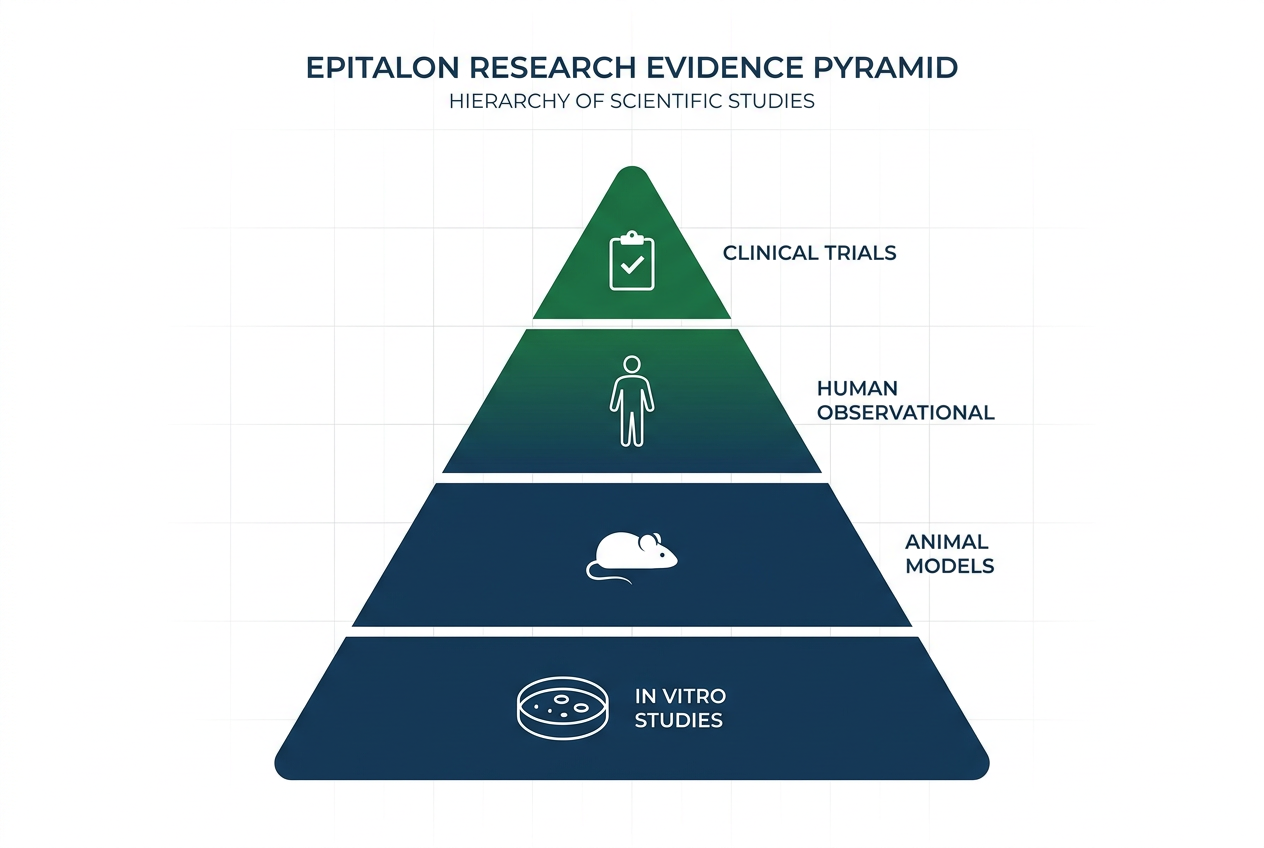
- The peptides library epitalon hub organizes Epitalon claims by evidence strength, separating cell, animal, review, and limited human-related reporting.
- Core published signals include dose-dependent telomere-length extension in normal cells, hTERT/telomerase upregulation, melatonin synthesis, and retinal functional integrity.
- A contradictory mouse study reported no change in food consumption, body weight, or mean lifespan, while still suggesting geroprotective activity and long-term safety.
- The hub provides evidence reviews, research guides, free peptide calculators, and independent brand/product reviews.
- Every Epitalon benefit described remains investigational; the content does not support human consumption, dosing, or clinical application.
What Evidence Strength Does the peptides library epitalon Hub Organize?
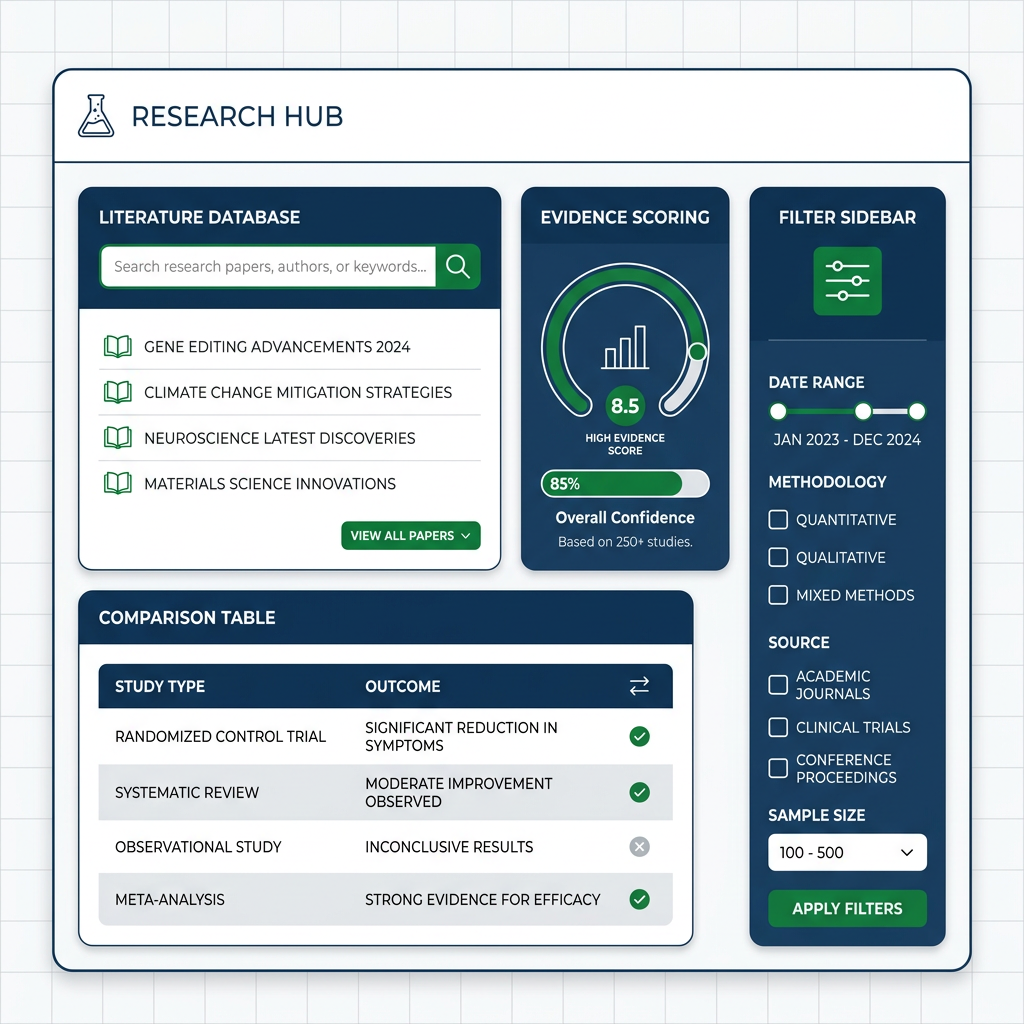
Peptides library epitalon maps benefit claims to the structure of the published literature. For Epitalon, the strongest clusters appear in telomerase and telomere biology, melatonin-related neuroendocrine effects, and retinal protection. The core takeaway remains that benefits are investigational, not clinically established.
This mapping helps you separate cell findings, animal findings, review conclusions, and limited human-related reporting. Instead of relying on headline enthusiasm, you can weight each claim by source quality. That is the central editorial function of the peptides library epitalon research hub.
The hub classifies evidence into four tiers:
- Cell findings: in vitro studies such as the 2025 cell-line telomere work and the 2003 fibroblast study.
- Animal findings: mouse and rat studies, including the Campbell rat retina report and the mouse lifespan study.
- Review conclusions: 2025 and 2002 reviews that synthesize multiple studies.
- Limited human-related reporting: the 2003 lymphocyte study in people aged 76 to 80 and the 2002 patient visual function description.
This tiering is not a hierarchy of truth but a hierarchy of translational distance. A cell finding is valuable for mechanism, but it cannot answer clinical questions. Peptides library epitalon keeps that distance visible in every summary.
What Do You Get Inside the peptides library epitalon Research Hub?
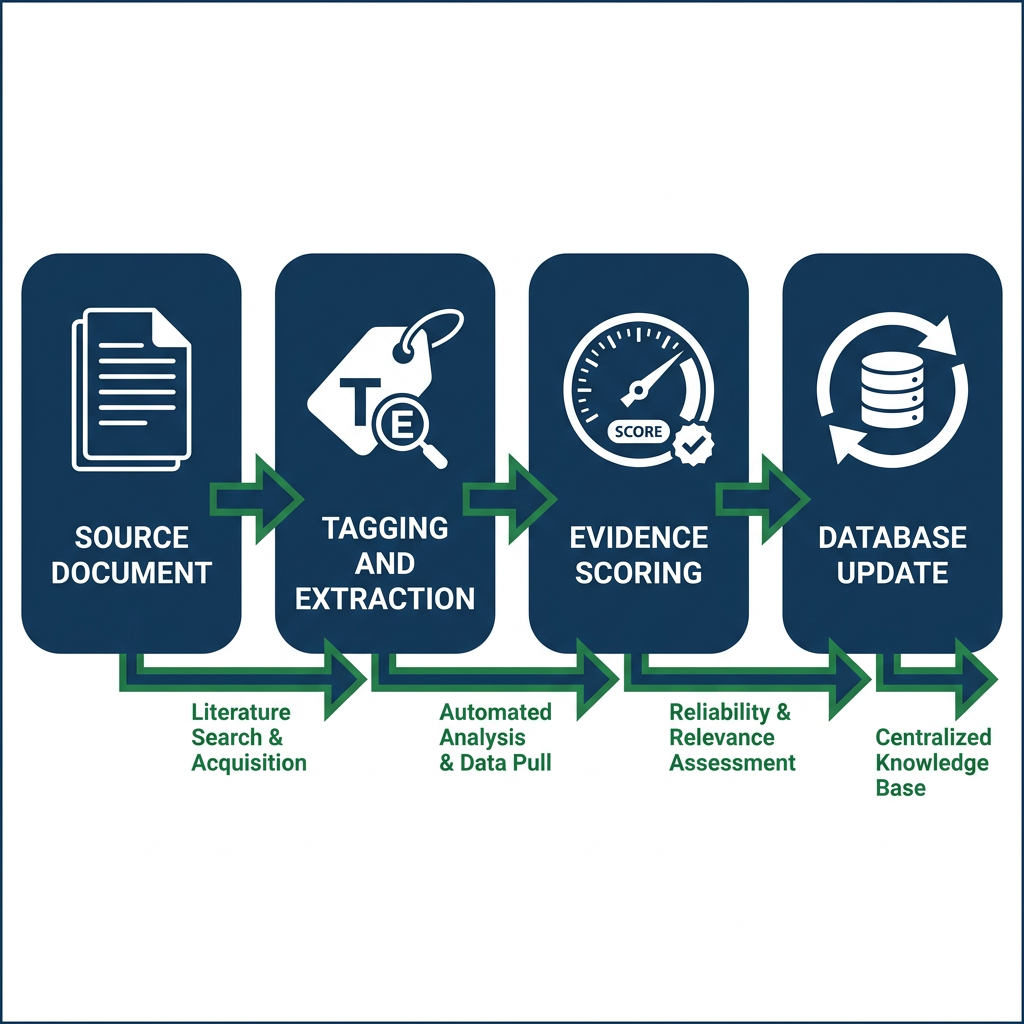
Inside the peptides library epitalon research hub, coverage includes four main resource types: evidence reviews, research guides, practical tools, and independent brand reviews. Each type supports a different step in evaluating Epitalon research.
Evidence reviews connect common Epitalon benefit claims to published studies. Research guides explain terms such as telomerase upregulation, telomere elongation, melatonin synthesis, geroprotective activity, and heterochromatin decondensation. Practical tools include free peptide calculators and methodology comparisons. Brand and product reviews compare market claims against the actual evidence base.
For broader peptide context, the Peptide Research Library: A Complete Reference Guide complements the Epitalon-specific hub. If you need delivery-mechanism background, Cell Penetrating Peptides for Research | Peptides Library explains related concepts. For laboratory sourcing distinctions, see Peptide Library: Research-Grade Peptides for Laboratories.
💡 Key Takeaway: What Do You Get Inside the peptides library epitalon Research Hub?
How Does the peptides library epitalon Hub Track Published Epitalon Benefits Literature?
What Does the 2025 Review Report About Epitalon?
A 2025 review indexed in PubMed describes Epitalon as the tetrapeptide Ala-Glu-Asp-Gly, or AEDG. The review notes roughly 25 years of study across in vitro, in vivo, and in silico methods. Reported geroprotective and neuroendocrine effects are tied to antioxidant, neuro-protective, and antimutagenic activity.
The peptides library epitalon hub highlights this review because it frames the compound’s history and mechanism language in one place. It does not turn the review’s cautious language into a clinical claim.
The 2025 review’s description of Epitalon as Ala-Glu-Asp-Gly, or AEDG, is useful because it anchors the compound’s identity. The review also notes the breadth of methods: in vitro, in vivo, and in silico. Peptides library epitalon uses this review to frame the research history without implying that 25 years of study equals clinical validation.
What Telomere and Telomerase Signals Does the Literature Show?
A 2025 cell-line study reported dose-dependent telomere-length extension in normal cells after Epitalon treatment. That study linked the effect to hTERT and telomerase upregulation in normal cells. A separate 2003 fibroblast study reported telomerase catalytic-subunit expression, telomerase activity, and telomere elongation in telomerase-negative human fetal fibroblast culture.
Peptides library epitalon treats these findings as important but not equivalent to established patient benefit. Telomere and telomerase signals are among the most discussed parts of the Epitalon literature, yet they remain preclinical.
The 2025 cell-line study is important because it reported dose-dependent telomere-length extension in normal cells, not just immortalized lines. That detail matters for interpreting relevance. The 2003 fibroblast study adds an older signal: telomerase catalytic-subunit expression, telomerase activity, and telomere elongation in telomerase-negative human fetal fibroblast culture. Together, they show consistency in telomere-related endpoints across different normal-cell models.
What Non-Telomere Mechanisms Appear in Published Epitalon Research?
Published literature also includes reported effects on melatonin synthesis, interleukin-2 mRNA, murine thymocyte mitogenic activity, and enzymes such as AChE, BuChE, and telomerase. The peptides library epitalon hub separates these into mechanism observations rather than therapeutic promises.
This distinction matters because many summaries blur mechanism and outcome. A mechanism is a plausible pathway; an outcome is a measured endpoint in a defined model. The hub keeps that boundary visible.
Melatonin synthesis and interleukin-2 mRNA are neuroendocrine and immune-related signals. Murine thymocyte mitogenic activity and enzymes such as AChE, BuChE, and telomerase broaden the mechanistic map. The peptides library epitalon hub presents these as observations from specific studies, not as a unified therapeutic profile.
What Retinal and Aging-Related Signals Are Reported?
A 2002 review reported prolonged functional integrity of the retina in Campbell rats with hereditary retinitis pigmentosa. The same review described improved visual functions in patients with pigmental retinal degeneration. A 2003 study in lymphocytes from people aged 76 to 80 reported activation of ribosomal genes and age-related chromatin changes after Epitalon exposure.
These findings, searchable through NCBI PMC, add retinal and chromatin-related dimensions to the Epitalon picture. Peptides library epitalon includes them without overstating their clinical weight.
The 2002 review’s Campbell rat finding is often cited for retinal protection. The same review’s description of improved visual functions in patients with pigmental retinal degeneration is limited human-related reporting, not a controlled clinical trial. The 2003 lymphocyte study in people aged 76 to 80 reported activation of ribosomal genes and age-related chromatin changes, which adds an epigenetic angle.
What Contradictory or Limiting Data Does the Hub Include?
One mouse study reported no change in food consumption, body weight, or mean lifespan. That same study still suggested geroprotective activity and long-term safety in mice. The peptides library epitalon editorial standard includes such contradictory details because full records support better decisions.
Including a mouse study with no change in food consumption, body weight, or mean lifespan is essential. That study still suggested geroprotective activity and long-term safety in mice, but the absence of lifespan extension is a key limiting detail. Peptides library epitalon keeps this contradiction visible because selective citation would mislead.
Evidence Comparison Table
| Evidence Type | Reported Signal | Model / Source | Key Limitation |
|—————|—————–|—————-|—————-|
| 2025 review | Tetrapeptide Ala-Glu-Asp-Gly; 25 years of study; geroprotective and neuroendocrine effects tied to antioxidant, neuro-protective, antimutagenic activity | In vitro, in vivo, in silico | Review conclusion, not clinical proof |
| 2025 cell-line study | Dose-dependent telomere-length extension; hTERT and telomerase upregulation | Normal cells | Cell-line data, not human trial |
| 2003 fibroblast study | Telomerase catalytic-subunit expression, telomerase activity, telomere elongation | Telomerase-negative human fetal fibroblast culture | In vitro, limited translational scope |
| 2002 review | Prolonged functional integrity of retina in Campbell rats; improved visual functions in patients with pigmental retinal degeneration | Rat model; patient reporting | Review and limited human-related reporting |
| 2003 lymphocyte study | Activation of ribosomal genes; age-related chromatin changes | Lymphocytes from people aged 76 to 80 | Small sample, ex vivo |
| Mouse study | No change in food consumption, body weight, or mean lifespan; suggested geroprotective activity and long-term safety | Mice | Contradictory primary endpoint |
Who Benefits Most from the peptides library epitalon Research Hub?
Researchers use the hub to identify mechanisms, endpoints, and study types quickly. Healthcare professionals use it to gauge where the literature is suggestive, thin, or in need of caution. Students and informed consumers use it to understand what a study actually reported before deciding relevance.
This hub is especially useful if you need to compare claim strength, understand mechanism language, or avoid retailer bias. The peptides library epitalon approach turns dense source material into structured reading paths.
Why Is the peptides library epitalon Hub a Strong Fit for Benefit Research?
Peptides library epitalon is built on editorial independence and citation-focused coverage. It does not push a product. That matters because Epitalon attracts large claims from small datasets.
The hub keeps source type, mechanism, and practical interpretation connected. Free tools, research guides, and evidence reviews reduce friction between finding a paper and understanding what it means for research planning, clinical curiosity, academic study, or careful self-education.
The hub also reduces time cost. Instead of searching multiple databases and retailer pages, you can use the peptides library epitalon hub to see claim, source type, and limitation side by side. This is especially valuable when you need to prepare a research summary or explain a finding to a colleague.
💡 Key Takeaway: Why Is the peptides library epitalon Hub a Strong Fit for Benefit Research?
When Should You Start with the peptides library epitalon Hub?
Start here when you want a grounded view of Epitalon benefits instead of a sales-first narrative. The hub is appropriate for reviewing telomere-related findings, scanning melatonin and neuroendocrine literature, checking retinal signals, or comparing brand claims against published evidence.
The peptides library epitalon hub also fits when you need speed without losing nuance. It brings key studies, terminology, limitations, and tools into one research environment.
If you are new to Epitalon, start with the research guides before the evidence reviews. The guides define terms such as telomerase upregulation and heterochromatin decondensation. Then move to the evidence reviews to see which studies support which claims. Finally, use the free calculators only for laboratory methodology questions.
How Can You Use the peptides library epitalon Hub to Evaluate a Specific Epitalon Claim?
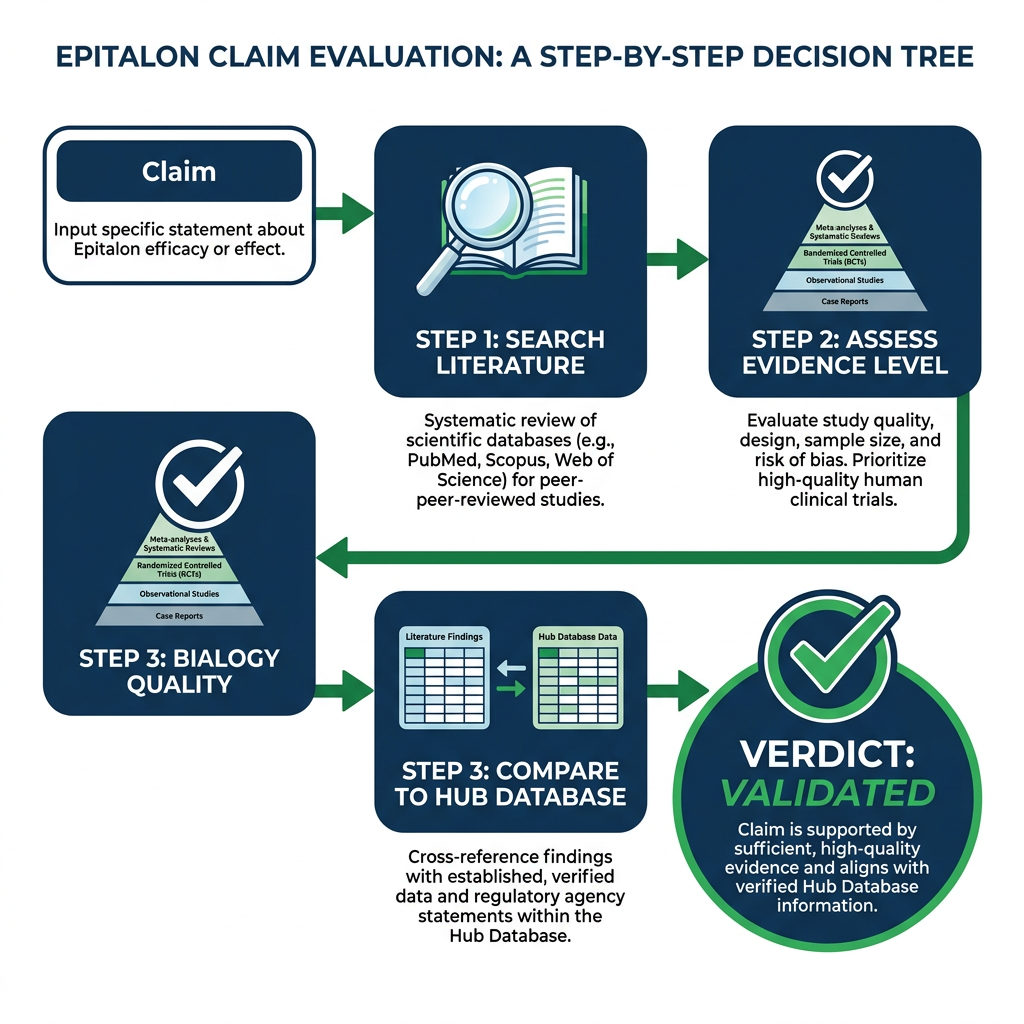
A practical workflow can help you assess any Epitalon benefit claim.
Checklist:
1. Identify the exact claim: telomere elongation, melatonin upregulation, retinal protection, or another endpoint.
2. Find the matching evidence review in the peptides library epitalon hub.
3. Note the study type: cell, animal, review, or limited human-related reporting.
4. Check the model and endpoint: normal cells, fibroblast culture, rats, mice, or human lymphocytes.
5. Look for contradictory or limiting data, such as the mouse lifespan study.
6. Decide whether the claim is presented as mechanism, preclinical observation, or broader promise.
7. Keep the research-use-only framing: no human consumption, no dosing, no clinical application.
This checklist turns a dense literature into a repeatable evaluation process.
What Limitations Should You Expect from Epitalon Research?
Epitalon research has real boundaries. The most important limitation is that most benefit signals come from preclinical and review literature, not from controlled human trials. The limited human-related reporting, such as the 2003 lymphocyte study and the 2002 patient visual function description, does not establish clinical benefit.
Another limitation is heterogeneity. Different studies use different models, endpoints, and durations. For example, a 2025 cell-line study reports telomere-length extension, while a mouse study reports no lifespan change. Peptides library epitalon does not flatten these differences.
The absence of human clinical trials is not a reason to dismiss all research, but it is a reason to avoid clinical language. Peptides library epitalon maintains that boundary by labeling every benefit as investigational and research-use-only.
💡 Key Takeaway: What Limitations Should You Expect from Epitalon Research?
How Does the peptides library epitalon Hub Compare to Retailer Information?
Retailer copy often emphasizes telomere or anti-aging language and omits contradictory data. The peptides library epitalon hub includes both supportive and limiting findings. It also avoids sales language and does not sell products.
This difference is not cosmetic. When you evaluate Epitalon for research planning or academic study, the presence of contradictory data changes your confidence level. The hub’s non-retailer stance keeps that confidence honest.
Brand reviews in the hub compare market claims against the actual state of evidence. For example, a retailer may describe Epitalon as a proven telomere lengthener. The hub will note that telomere-length extension was reported in cell-line and fibroblast studies, not in a human trial. That comparison helps you avoid retailer bias.
FAQ
What are the main Epitalon benefits covered by the peptides library epitalon hub?
The main covered signals are telomere-length extension, hTERT and telomerase upregulation, melatonin-related neuroendocrine effects, and retinal functional integrity. All remain investigational and are presented as research findings only.
Does the peptides library epitalon hub claim Epitalon is clinically proven?
No. The hub consistently states that Epitalon benefits are not clinically established. The evidence base is led by preclinical and review literature, with limited human-related reporting.
Which published studies does the peptides library epitalon hub highlight for telomere effects?
It highlights a 2025 cell-line study reporting dose-dependent telomere-length extension and hTERT/telomerase upregulation in normal cells, and a 2003 fibroblast study reporting telomerase catalytic-subunit expression, telomerase activity, and telomere elongation.
Does Epitalon research show any contradictory findings?
Yes. One mouse study reported no change in food consumption, body weight, or mean lifespan, while still suggesting geroprotective activity and long-term safety in mice. The peptides library epitalon hub includes this limiting detail.
Is the peptides library epitalon hub a retailer or product seller?
No. The hub is an independent, non-retailer editorial resource. It provides evidence reviews, research guides, practical tools, and brand comparisons to support research-use-only evaluation.
Ready to Take the Next Step?
Every product includes lot-specific documentation and third-party purity testing.
Explore Our Research Products →Free shipping on qualifying orders · Batch COA on request