


Peptides Library PT 141 Benefits Research Guide Hub
Peptides Library is the research hub for PT-141 benefits: phase 3 data, FDA limits, and 2025 evidence, all for research use only.
📋 Table of Contents
PT-141, also known as bremelanotide, has its strongest human evidence for improving sexual desire and reducing distress related to low sexual desire in premenopausal women with acquired, generalized hypoactive sexual desire disorder (HSDD). Peptides Library organizes that evidence into clear, citation-focused guides, making it easier to separate supported outcomes from speculation. All content is for research and educational use only, not for human consumption.
Key takeaways
- PT-141 benefits are best supported for sexual desire and distress outcomes in premenopausal women with acquired, generalized HSDD.
- FDA labeling limits bremelanotide to that specific population and excludes postmenopausal women, men, and sexual performance enhancement.
- Phase 3 data showed statistically significant improvements: sexual desire change score +0.35 and distress change score -0.33 versus placebo.
- A 2025 meta-analysis screened 8,994 abstracts and included 36 studies, finding improved desire and arousal without pain conditions.
- The library keeps the labeled 1.75 mg subcutaneous regimen visible: at least 45 minutes before activity, max 1 dose per 24 hours, max 8 doses per month.
What are PT-141 benefits according to the strongest human evidence?
The strongest supported takeaway on PT-141 benefits is specific, not broad. Peptides Library centers its PT-141 research coverage on the evidence for sexual desire-related outcomes in premenopausal women with acquired, generalized hypoactive sexual desire disorder. That is where the best human data and FDA labeling align.
If you are evaluating PT-141 benefits, the hard part is not finding claims. It is finding the claims that actually match human evidence, FDA labeling, and the populations studied. Peptides Library was built for exactly that job, with evidence-based peptide articles, research guides, reviews, and practical tools.
Peptides Library gives researchers, healthcare professionals, students, and informed consumers a focused way to study PT-141 without having to piece together trial data from scattered abstracts and sales pages. Our PT-141 coverage is designed to make the evidence clearer, the limitations more visible, and the practical research questions easier to answer.
This matters if you want a source that helps you assess applicability, not just possibility. On Peptides Library, PT-141 benefit discussions are framed around the actual studied use case, the trial endpoints, and the official indication boundaries rather than vague “sexual enhancement” language.
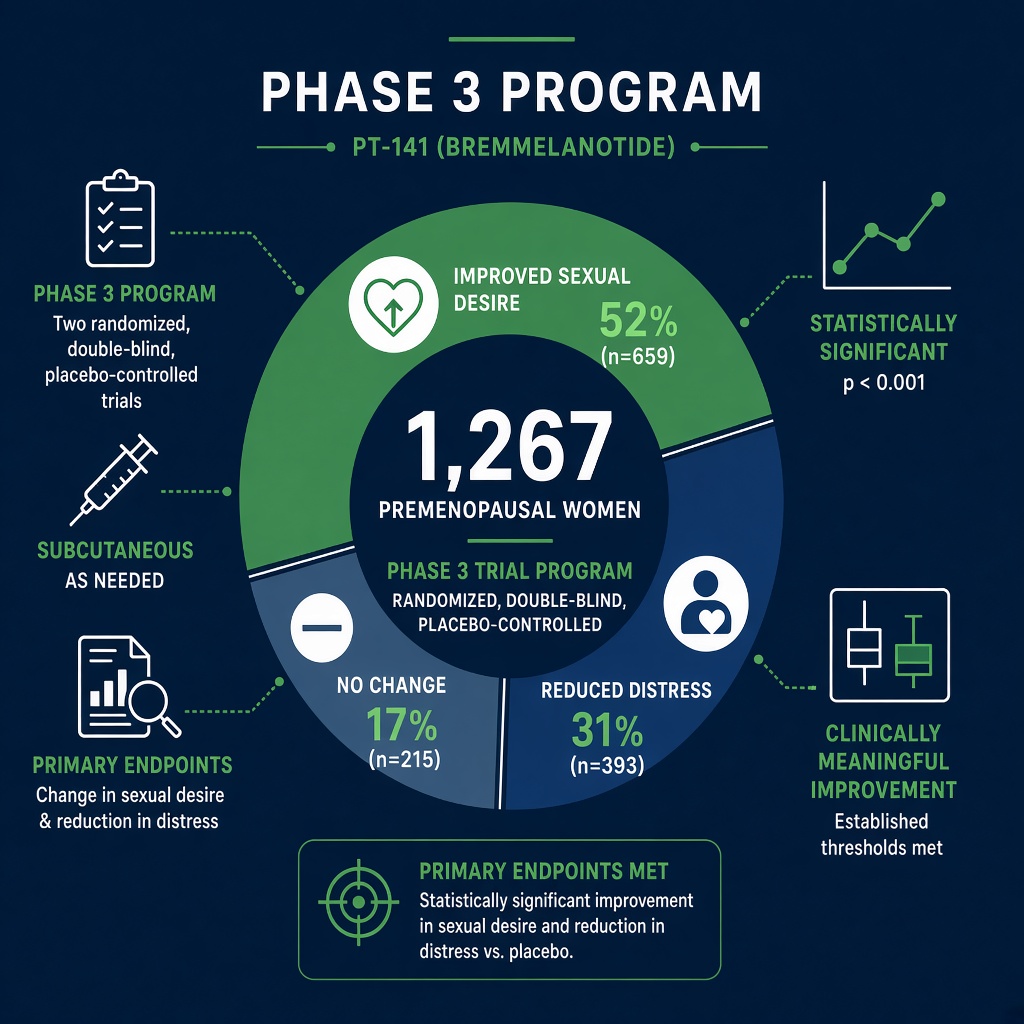
Peptides Library focuses PT-141 analysis on the 1,267-woman phase 3 clinical program, where the strongest human efficacy data were established. That program is not a generic peptide claim; it is a defined clinical evidence base with measurable endpoints.
Why does Peptides Library focus PT-141 analysis on the 1,267-woman phase 3 program?
The best-known phase 3 evidence showed statistically significant improvements versus placebo in sexual desire and in distress related to low sexual desire. In the integrated analysis reported in a phase 3 publication on PubMed, change scores favored bremelanotide for sexual desire by 0.35 and for distress by -0.33, with individual study results also significant.
Peptides Library highlights that PT-141 benefit claims are strongest for desire and distress outcomes, not for general sexual performance claims. That distinction matters because many public discussions blur the endpoint.
The 1,267-woman phase 3 program provides the largest and most controlled human dataset for bremelanotide. The library uses that dataset as the anchor for its PT-141 benefit summaries, rather than relying on anecdotal reports or animal models.
This approach helps you avoid overgeneralization. When you read about PT-141 benefits outside the studied population, the library helps you see where the evidence becomes thinner or non-indicated instead of blurring those distinctions.
For a broader evidence-checking workflow, the article Are There Studies on It? 7 Essential Ways to Check (2026) explains how to evaluate any peptide claim against published data.
💡 Key Takeaway: Why does Peptides Library focus PT-141 analysis on the 1,267-woman phase 3 program?
How does the FDA label define PT-141 benefits and population limits?
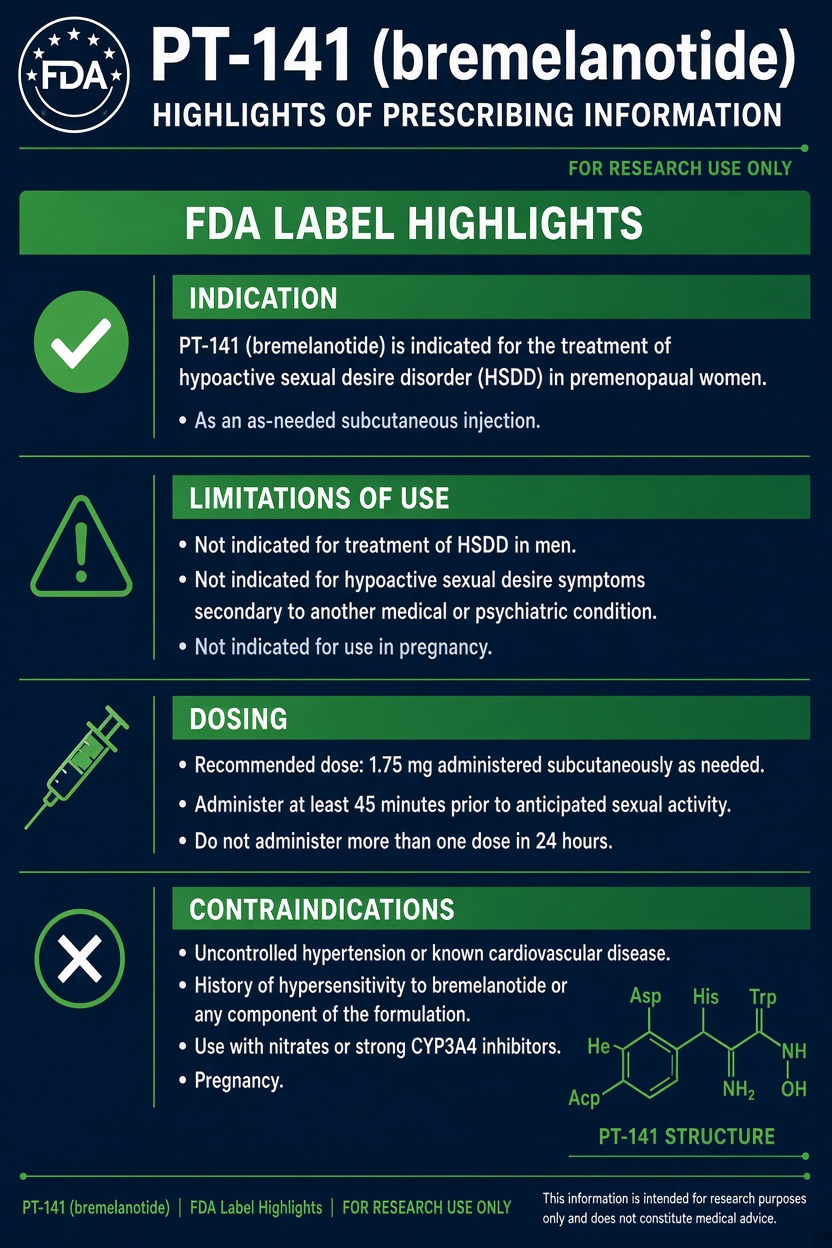
Peptides Library makes the FDA boundary clear because it changes how the evidence should be interpreted. FDA labeling for bremelanotide limits the approved use to premenopausal women with acquired, generalized HSDD that causes marked distress or interpersonal difficulty and is not due to another medical, psychiatric, relationship, or medication cause.
Just as important, the same labeling states it is not indicated for postmenopausal women, men, or sexual performance enhancement. If you are trying to understand PT-141 benefits outside that population, Peptides Library helps you see where the evidence becomes thinner or non-indicated instead of blurring those distinctions.
This labeling boundary is not a minor detail. It defines the exact population in which the benefit claims have regulatory support. Peptides Library keeps that boundary visible in every PT-141 discussion, so you do not accidentally apply premenopausal HSDD data to unrelated uses.
The FDA label also includes administration facts. Peptides Library includes those facts because timing and frequency limits affect how the benefits data should be read, especially when readers encounter off-label or exaggerated dosing discussions elsewhere.
What outcome measures does Peptides Library explain for PT-141 benefit claims?
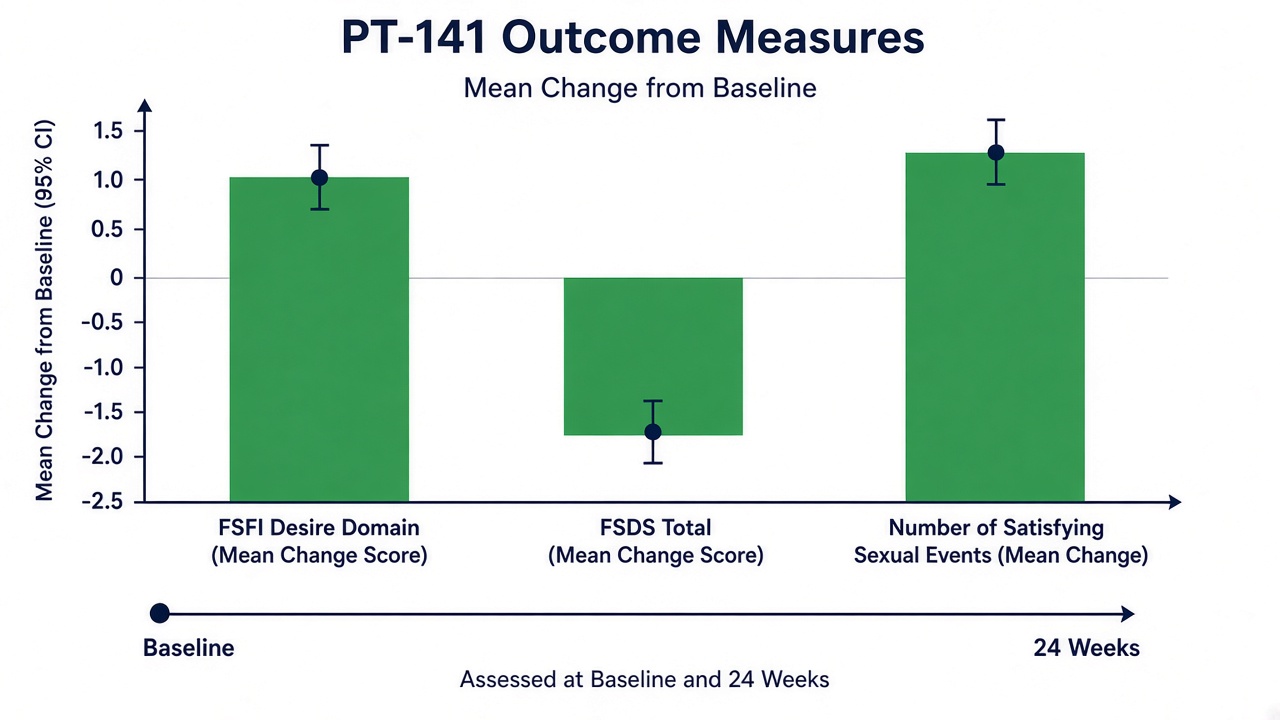
A common problem with PT-141 content online is that outcome measures are named but not explained. Peptides Library breaks down terms like FSFI-desire domain, FSDS-DAO, satisfying sexual events, and distress related to low sexual desire so you can interpret benefit claims in the same language used by the studies.
That saves time for advanced readers and reduces misreading for newer ones. Instead of forcing you to jump between trial tables, labeling documents, and discussion threads, Peptides Library organizes the evidence into usable summaries that connect the endpoint, the patient group, and the practical meaning of the result.
Peptides Library also covers the earlier dose-finding clinical data because many readers want to know how trial endpoints behaved beyond a single headline result. In that study, pooled 1.25 mg and 1.75 mg bremelanotide improved satisfying sexual events per month from +0.2 with placebo to +0.7, improved total FSFI change from +1.9 to +3.6, and improved FSDS-DAO total score change from -6.8 to -11.1.
To make these numbers easier to compare, Peptides Library provides the following outcome measure table:
| Outcome measure | What it captures | Key PT-141 result in studied population |
|—|—|—|
| FSFI desire domain | Sexual desire score on the Female Sexual Function Index | Improved in phase 3 trials; total FSFI change +1.9 to +3.6 in dose-finding |
| FSDS-DAO | Distress related to low sexual desire | Total score change -6.8 to -11.1 in dose-finding; phase 3 distress change -0.33 vs placebo |
| Satisfying sexual events | Count of satisfying sexual events per month | Improved from +0.2 placebo to +0.7 pooled bremelanotide |
| Distress related to low sexual desire | Distress severity linked to low desire | Statistically significant reduction versus placebo |
This table is part of the citation-focused method Peptides Library uses across peptide topics. If you need sourcing and QC context for research materials, the guide Exogenous Peptides: Complete Sourcing and QC Guide (2026) covers purity, COA, and storage questions that an editorial hub like Peptides Library intentionally does not provide because it is not a vendor.
Which PT-141 dose context does Peptides Library keep visible?
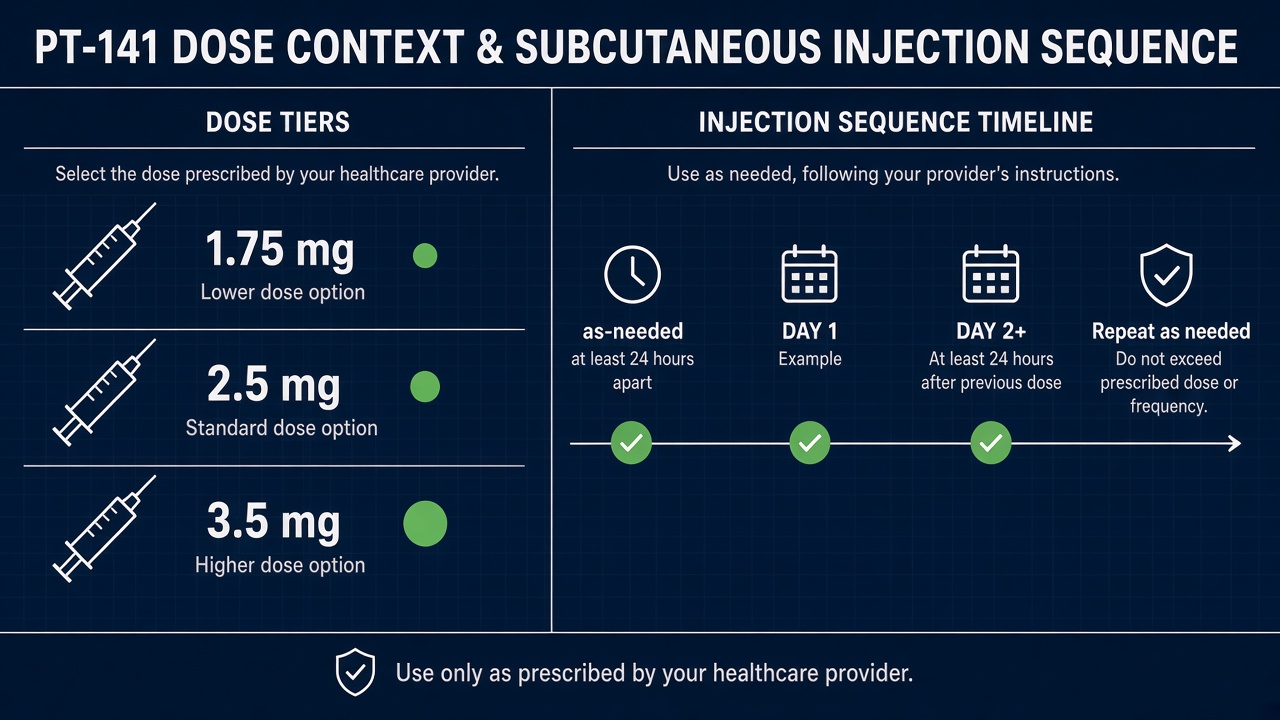
Peptides Library keeps the FDA labeled PT-141 regimen visible: 1.75 mg subcutaneously, at least 45 minutes before activity, no more than 1 dose in 24 hours and no more than 8 doses per month. This is factual labeling information, not a recommendation for any human use.
Dose context is another place where precision matters. Many online discussions ignore the monthly dose cap or the timing requirement, which can distort how benefit data should be interpreted. The library includes these facts because they define the studied administration context.
The labeled regimen also helps explain why some benefit claims are population-specific. The phase 3 trials used this regimen in premenopausal women with HSDD, so applying the same benefit expectation to other groups requires evidence that may not exist.
For researchers who need to compare peptide vendors or product claims, the library offers independent tools. One example is the Bibtides: The Complete Research Peptide Library Guide (2026), which shows how Peptides Library structures vendor-neutral comparisons.
💡 Key Takeaway: Which PT-141 dose context does Peptides Library keep visible?
Why do researchers, clinicians, students, and informed consumers use Peptides Library for PT-141 research?
Peptides Library is a good fit when you want an independent editorial stance. We are not a peptide retailer, so our PT-141 content is built to clarify evidence, safety boundaries, and methodology rather than push a purchase.
That independence is especially valuable with PT-141 because public interest often outruns the data. Peptides Library keeps attention on the studied population, the clinical endpoints, and the supported takeaway that the best evidence concerns desire-related outcomes in premenopausal women with HSDD.
We also keep emerging evidence in view. A 2025 systematic review and meta-analysis concluded that bremelanotide improves desire and arousal and reduces distress across female sexual dysfunction studies without pain conditions, after screening 8,994 abstracts and abstracting data from 36 studies, including 24 medication trials.
Peptides Library tracks emerging PT-141 evidence, including that 2025 review on PubMed. This matters because a single phase 3 program is not the final word; the evidence base continues to expand, and the library updates its summaries accordingly.
Because our content is citation-focused, you can use Peptides Library differently depending on your role. A clinician may want fast confirmation of labeled population limits, a student may need help understanding FSDS-DAO or satisfying sexual events, and an informed consumer may want to know whether a popular claim matches the actual trial evidence.
When is Peptides Library the right fit for your PT-141 questions?
Peptides Library is the right place to start when your question is practical and evidence-sensitive. That includes situations like these:
You want supported PT-141 benefits: you need to know what human trials actually found for sexual desire, distress, arousal, or satisfying sexual events.
You need population-specific clarity: you want to know whether evidence applies to premenopausal women with acquired generalized HSDD, or whether a claim extends beyond the studied use.
You want an independent read: you prefer a citation-based knowledge hub over sales-first content.
Peptides Library may be less useful if you want hype, broad enhancement promises, or a retailer pitch. Our value is in making the research easier to use, easier to verify, and easier to compare against real-world claims.
For example, if you are comparing vendors for research peptides, you may want the independent vendor analysis in Aavant Research Retatrutide: Complete Vendor Analysis (2026), which applies the same citation-first method to a different peptide.
How can you use Peptides Library to evaluate PT-141 benefits with more confidence?
When you use Peptides Library for PT-141 research, you get a clearer picture of what the peptide has been shown to do, for whom, under what dosing limits, and with what evidence strength. That makes it easier to study the topic responsibly, communicate it accurately, and avoid relying on claims that stretch past the data.
Start with the library when you want PT-141 benefits explained through clinical evidence, FDA-defined use boundaries, and citation-focused analysis that respects the difference between supported outcomes and speculation.
A practical checklist for using Peptides Library on PT-141 includes:
1. Check the population: Is the claim about premenopausal women with acquired, generalized HSDD?
2. Check the endpoint: Does the claim match sexual desire, distress, arousal, or satisfying sexual events?
3. Check the dose context: Does the discussion include the labeled 1.75 mg subcutaneous, 45-minute timing, 24-hour cap, and 8-dose monthly cap?
4. Check the evidence date: Does the claim account for the 2025 meta-analysis screening 8,994 abstracts?
5. Check the source independence: Is the content from a retailer or from an editorial knowledge hub like Peptides Library?
This checklist reflects how Peptides Library turns scattered trial data into usable research guidance.
💡 Key Takeaway: How can you use Peptides Library to evaluate PT-141 benefits with more confidence?
FAQ
What is PT-141, and why does Peptides Library focus on it?
PT-141 is the peptide name for bremelanotide, a melanocortin receptor agonist studied primarily for hypoactive sexual desire disorder. Peptides Library focuses on PT-141 because the public discussion often ignores the FDA-defined population limits, and the library exists to make evidence boundaries clearer.
Does Peptides Library claim PT-141 works for men or for sexual performance enhancement?
No. Peptides Library keeps the FDA label visible: bremelanotide is not indicated for men, postmenopausal women, or sexual performance enhancement. Any benefit discussion outside premenopausal women with acquired, generalized HSDD is treated as off-label and not supported by the same human evidence.
What phase 3 data does Peptides Library cite for PT-141 benefits?
Peptides Library cites the 1,267-woman phase 3 program, where change scores favored bremelanotide for sexual desire by 0.35 and for distress by -0.33 versus placebo. The library also includes dose-finding data showing satisfying sexual events improved from +0.2 placebo to +0.7 pooled bremelanotide.
How does Peptides Library handle the 2025 meta-analysis on bremelanotide?
Peptides Library includes the 2025 systematic review and meta-analysis that screened 8,994 abstracts and included 36 studies. The review concluded that bremelanotide improves desire and arousal and reduces distress across female sexual dysfunction studies without pain conditions, including 24 medication trials.
Is Peptides Library a peptide retailer or vendor?
No. The library is an independent editorial knowledge hub. It does not sell peptides, does not list prices, and does not provide purity percentages or certificates of analysis. For sourcing and QC questions, readers can use the library’s separate guides, such as Exogenous Peptides: Complete Sourcing and QC Guide (2026).
Ready to Take the Next Step?
Every product includes lot-specific documentation and third-party purity testing.
Explore Our Research Products →Free shipping on qualifying orders · Batch COA on request