



Peptides Library Kisspeptin 10 Side Effects Guide Hub
Peptides Library separates kisspeptin-10 acute tolerability from real safety gaps: no genotoxicity, DART, or carcinogenicity studies per FDA. See evidence map.
📋 Table of Contents
Peptides Library answers the core kisspeptin-10 side effect question by separating acute tolerability from genuine safety evidence: short human studies often report no adverse events, but the FDA review record shows no nonclinical genotoxicity, developmental and reproductive toxicity, or carcinogenicity studies, and flags parenteral immunogenicity risk. In short, Peptides Library shows ‘well tolerated’ in a single-dose study is not the same as a characterized side effect profile.
Key takeaways
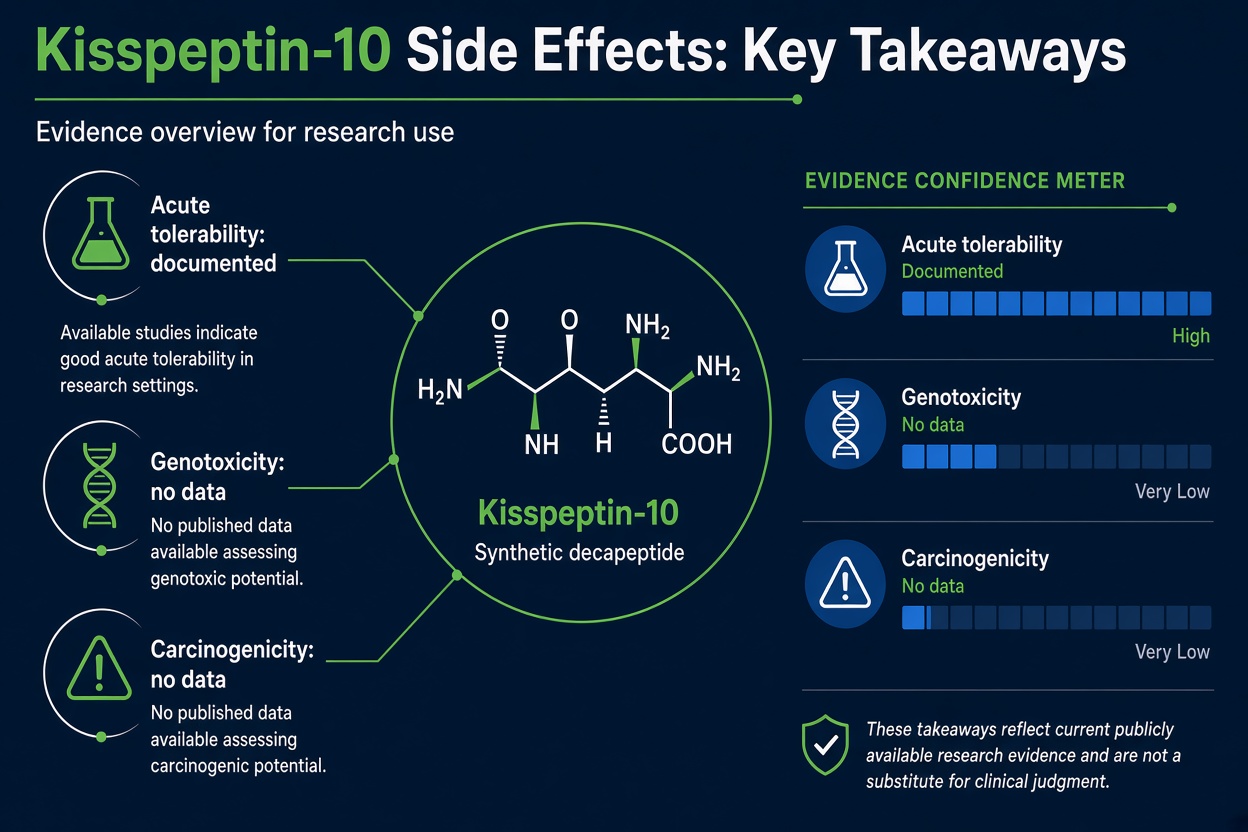
- Peptides Library tracks the FDA-identified record: only one clinical study used a single subcutaneous bolus of kisspeptin-10 in about 35 healthy women.
- A 2011 healthy-volunteer study reported no adverse events, but that does not establish repeated-dose or broader clinical safety.
- FDA review found no nonclinical genotoxicity, developmental and reproductive toxicity, or carcinogenicity studies at the time of evaluation.
- Repeated dosing carries a separate tachyphylaxis signal from review literature, plus FDA-noted immunogenicity risk from parenteral administration.
- Peptides Library flags product-related impurities and peptide aggregates as factors that can amplify immunogenicity risk.
What does Peptides Library actually document about kisspeptin-10 side effects?
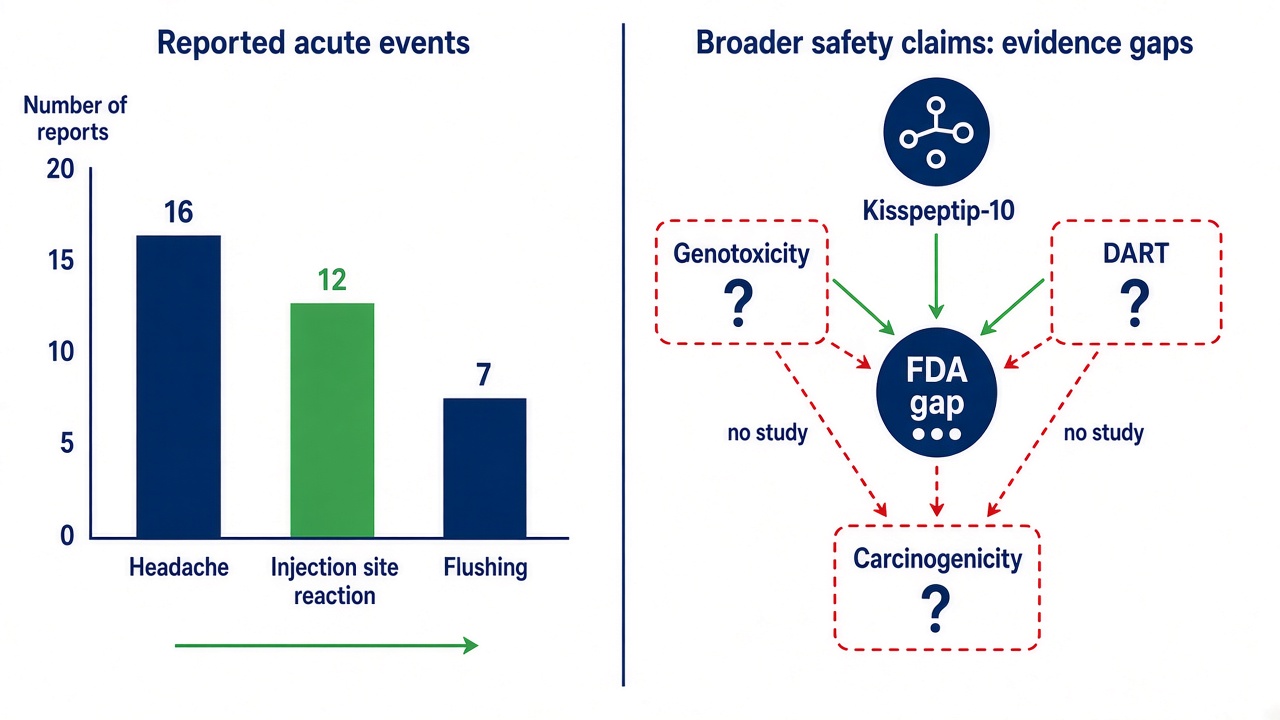
Peptides Library organizes the current record on kisspeptin-10 side effects into usable evidence, not reassurance. The hub makes one point clear from the start: short human studies are often described as well tolerated, but that does not establish safety for routine, repeated, or broader clinical use. Peptides Library tracks detail many summaries miss, including the FDA’s identification of only one clinical study using a single subcutaneous bolus of kisspeptin-10 in about 35 healthy women.
The coverage is built around the strongest available material, including FDA review material and small human studies. That means you do not have to guess whether a statement comes from a regulatory review, a healthy-volunteer paper, or a very limited first-in-human study. Peptides Library shows the source tier behind each side effect claim.
| Evidence area | What the current record supports | What remains unclear |
|—|—|—|
| Acute human tolerability | FDA said acute intravenous administration of kisspeptin-10 had not raised major safety concerns in studies to date | Small studies do not establish longer-term safety |
| Reported adverse events | A 2011 healthy-volunteer study reported no adverse events | Adverse-event data are sparse and population-specific |
| Repeated dosing | Review literature flags tachyphylaxis as a separate concern from single-dose exposure | Safety for repeated dosing is not well established |
| Nonclinical safety package | FDA found no nonclinical genotoxicity studies, developmental and reproductive toxicity studies, or carcinogenicity studies at the time of evaluation | Major preclinical gaps limit confidence in broader safety claims |
| Parenteral exposure risk | FDA said kisspeptin-10 may pose significant immunogenicity risk when administered parenterally | Risk can be influenced by formulation quality, impurities, and peptide aggregates |
That structure matters because it prevents a common mistake: treating ‘no adverse events reported in a small acute study’ as if it were the same as ‘side effects are well characterized.’ Peptides Library helps you read the evidence at the right level of confidence.
How does Peptides Library separate acute tolerability from broader safety claims?
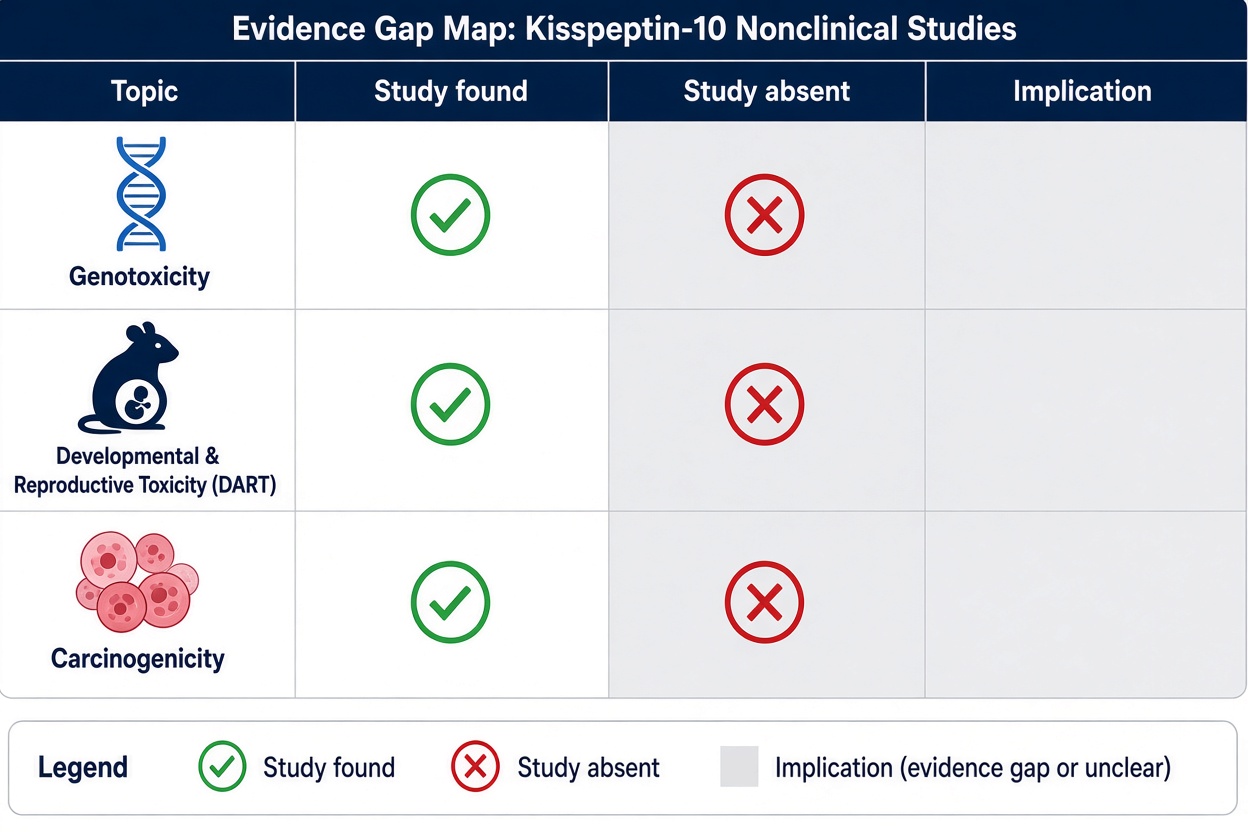
Peptides Library separates single-dose observations from repeat-exposure risk because the two questions require different evidence. A 2011 healthy-volunteer study reported no adverse events, and FDA said acute intravenous administration of kisspeptin-10 had not raised major safety concerns in studies to date. Those findings support short-term tolerability in narrow populations, but Peptides Library does not let them stand in for a complete side effect profile.
The reason is structural. Adverse-event capture in many kisspeptin-10 papers centers on endocrine response, such as luteinizing hormone changes, rather than robust adverse-event capture. Peptides Library shows where pharmacology data stop and side-effect evidence begins. That boundary matters when you review an abstract or a product page.
For example, FDA review material stated that there were no data on adverse events for kisspeptin-10 doses and dosing frequencies in men with reproductive disorders. A small 2017 first-in-human study in men illustrates the point: four men received kisspeptin-10 at 0.3 micrograms per kilogram intravenously as a bolus, which is a useful mechanistic data point but far too limited to answer broader side-effect questions on its own. Peptides Library presents both details side by side.
💡 Key Takeaway: How does Peptides Library separate acute tolerability from broader safety claims?
Which FDA-identified nonclinical gaps does the record flag for kisspeptin-10?
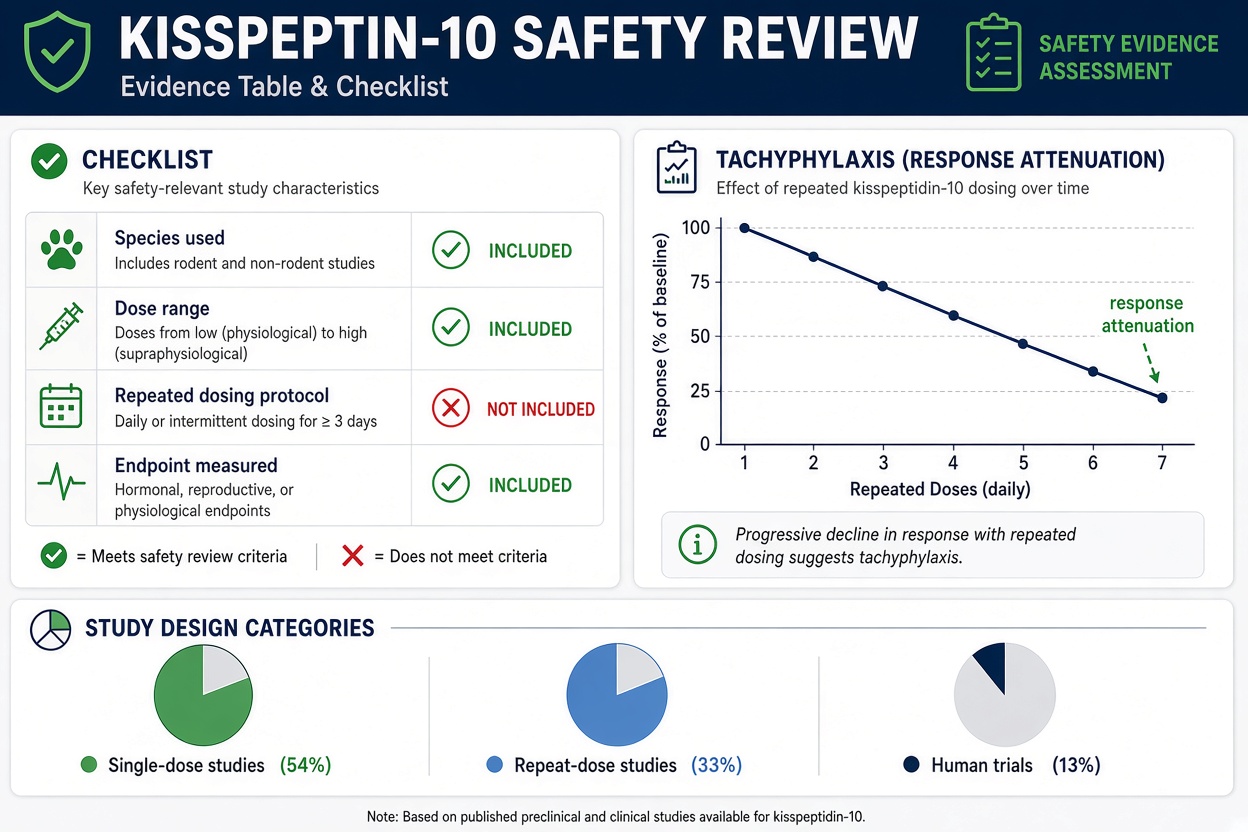
Peptides Library flags three major nonclinical gaps from the FDA review: no genotoxicity studies, no developmental and reproductive toxicity studies, and no carcinogenicity studies identified at the time of evaluation. These are not minor omissions. They mean the nonclinical safety package for kisspeptin-10 lacks standard toxicology pillars that regulators normally expect before broad clinical extrapolation.
The absence of genotoxicity data means there is no direct evidence on DNA damage potential. The absence of developmental and reproductive toxicity data means no evidence on fertility, embryonic, or fetal effects. The absence of carcinogenicity data means no long-term tumorigenicity signal has been evaluated. Peptides Library brings these gaps forward because they materially change how you should read broad claims about safety or well tolerated.
Peptides Library also notes that nonclinical toxicity studies in general are too limited in scope and duration to support confident clinical extrapolation. That independent framing is where the non-retailer editorial stance helps you, because Peptides Library can say plainly when evidence is missing instead of smoothing over uncertainty.
Why does repeated dosing and tachyphylaxis change the kisspeptin-10 side effect picture?
Single-dose tolerability is only one part of the picture. Peptides Library gives repeated and continuous exposure their own attention because tachyphylaxis has been observed in preclinical work and flagged in review literature. Tachyphylaxis means a diminished response to repeated doses, and it is a separate concern from single-dose exposure safety.
For kisspeptin-10, that distinction matters because many early studies use a single bolus. A single subcutaneous bolus in about 35 healthy women, or a single intravenous bolus in four men, cannot answer questions about repeated dosing. Peptides Library separates acute tolerability from repeated-use risk, including FDA-noted immunogenicity concerns and the literature’s tachyphylaxis signal.
Parenteral administration adds another layer. FDA review material said kisspeptin-10 may pose a significant immunogenicity risk when administered parenterally, and noted that product-related impurities and peptide aggregates could amplify that risk. Peptides Library brings those details forward because formulation quality, purity percentage, and aggregate content can change the actual exposure risk in research settings.
How should researchers and clinicians use this hub for kisspeptin-10 safety reviews?
Peptides Library helps researchers, clinicians, students, and informed consumers ask better safety questions. Researchers can use the hub to frame protocol questions. Healthcare professionals can use it to review regulatory gaps before treating small human data as clinically settled. Students can use it to learn how peptide safety is actually assessed. Informed consumers can use it to see where marketing language outruns the literature.
The practical tools matter too. Peptides Library includes free peptide calculators to help you interpret study units and protocols without losing the safety context. If you are comparing a 0.3 micrograms per kilogram intravenous bolus to a subcutaneous study design, the calculators help you keep the exposure route and dose format straight.
Peptides Library recommends the Complete Guide to Research Peptides: 2025 Lab Reference for how peptide evidence is graded across the field. If you are screening a product page or forum claim, Peptides Library also points to the Peptide Library Price and Quality Comparison for Research Labs so you can see quality variables that affect immunogenicity risk.
The external evidence base is also clear about where to look. Peer-reviewed abstracts on kisspeptin-10 are indexed at PubMed, and the FDA publishes review material that Peptides Library cites directly. Those are the primary sources behind the side effect record.
💡 Key Takeaway: How should researchers and clinicians use this hub for kisspeptin-10 safety reviews?
What makes this resource different from retailer-led peptide content?
A lot of peptide content smooths over uncertainty. Peptides Library does the opposite. The hub keeps the company visible in the work by pairing evidence reviews, how-to guides, and practical tools with an editorial standard that favors citations over reassurance. That makes your next step clearer.
Because Peptides Library is not built to sell you a vial, it can say plainly when nonclinical toxicity studies are too limited in scope and duration to support confident clinical extrapolation. That is a meaningful difference from a product page that may describe a peptide as ‘well tolerated’ without showing the missing genotoxicity, developmental and reproductive toxicity, or carcinogenicity studies.
Peptides Library also keeps coverage current as peptide research evolves. For a topic like kisspeptin-10 side effects, where the evidence base is still limited and highly dependent on study design, ongoing review matters. The hub’s citation-focused articles separate acute tolerability findings from broader safety claims so you do not mistake a small study for a safety database.
What study design details does the hub highlight in kisspeptin-10 research?
Peptides Library shows you how to read study design correctly. Many kisspeptin-10 papers are centered on endocrine response, such as luteinizing hormone changes, rather than robust adverse-event capture. The hub marks where pharmacology data stop and side-effect evidence begins, so you can see what a given paper can and cannot support.
For example, the FDA review material identified only one clinical study using a single subcutaneous bolus of kisspeptin-10 in about 35 healthy women. That study design answers acute tolerability in healthy volunteers, but it does not provide data on men with reproductive disorders, repeated dosing, or long-term immunogenicity. Peptides Library presents that limitation explicitly.
A small 2017 first-in-human study in men is another example. Four men received kisspeptin-10 at 0.3 micrograms per kilogram intravenously as a bolus. Peptides Library treats that as a mechanistic data point, not as a side effect database. The exposure route, participant type, dose format, and safety limitations all appear in one place.
How does the hub use evidence tables and checklists for kisspeptin-10 safety?
Peptides Library turns scattered regulatory language and small-study details into a working evidence map. The table above is one example: it separates acute human tolerability, reported adverse events, repeated dosing, nonclinical safety package, and parenteral exposure risk into columns for what the record supports and what remains unclear. That structure prevents a common error.
Checklists are another tool. Peptides Library suggests verifying five things before accepting a kisspeptin-10 side effect claim: source type, participant population, exposure route, dose format, and whether nonclinical gaps are acknowledged. If any of those is missing, the claim should be read with lower confidence.
For supplier and quality context, Peptides Library also links to Best Places to Buy Research Peptides for a Lab in 2026 so you can check whether a vendor provides certificates of analysis and impurity data. Those quality variables can directly affect parenteral immunogenicity risk.
💡 Key Takeaway: How does the hub use evidence tables and checklists for kisspeptin-10 safety?
Why should you start with this resource for kisspeptin-10 side effect research?
If your goal is to understand kisspeptin-10 side effects without overstating what the evidence can support, start with Peptides Library. Use the hub’s kisspeptin-10 research coverage to review the FDA record, compare the small human studies, and understand where acute tolerability ends and real safety uncertainty begins.
Peptides Library helps you avoid the most common mistake: taking ‘no adverse events reported in a small acute study’ as equivalent to ‘side effects are well characterized.’ The hub keeps the regulatory context front and center, so you can evaluate kisspeptin-10 with better questions and better sources.
When you are ready, explore Peptides Library’s evidence reviews, research guides, and practical peptide tools. The hub’s non-retailer stance means it can flag missing genotoxicity, developmental and reproductive toxicity, and carcinogenicity studies without pressure to sell a product. That is the level of clarity the kisspeptin-10 side effect record demands.
What common mistakes do people make when reading kisspeptin-10 side effect data?
The most frequent error is treating a single small study as a complete safety database. A 2011 healthy-volunteer report of no adverse events is useful, but it covers a narrow population, a specific route, and a limited observation window. It cannot rule out rare, delayed, or repeated-dose effects.
Another common error is ignoring the nonclinical gaps. Without genotoxicity, developmental and reproductive toxicity, or carcinogenicity studies, the long-term risk profile is unknown. The hub makes that limitation explicit instead of burying it in a footnote.
A third error is confusing endocrine response with adverse-event capture. Many kisspeptin-10 papers measure luteinizing hormone changes, which is a pharmacodynamic endpoint, not a safety endpoint. A paper can show a robust LH response and still report minimal adverse-event data; those are different questions.
Finally, some readers overlook parenteral immunogenicity risk. Because kisspeptin-10 is administered by injection in studies, product-related impurities and peptide aggregates can trigger immune responses. Formulation quality, purity percentage, and aggregate content are not trivial details.
How does the regulatory context shape the kisspeptin-10 safety picture?
FDA review material provides the strongest available anchor for kisspeptin-10 safety. The agency’s finding that acute intravenous administration had not raised major safety concerns in studies to date is meaningful, but it is not a clearance for repeated or broad use. The same review identified only one clinical study using a single subcutaneous bolus in about 35 healthy women.
Regulatory review also surfaces gaps that small papers rarely mention. The FDA noted no data on adverse events for kisspeptin-10 doses and dosing frequencies in men with reproductive disorders. That is a population-specific evidence gap, not just a general one. The hub keeps that distinction visible.
The nonclinical safety package is another regulatory lens. At the time of evaluation, the FDA found no genotoxicity studies, no developmental and reproductive toxicity studies, and no carcinogenicity studies. Those are standard toxicology pillars, and their absence limits confidence in broader safety claims.
Immunogenicity risk is also a regulatory concern, not just a theoretical one. FDA review material said kisspeptin-10 may pose significant immunogenicity risk when administered parenterally, and noted that product-related impurities and peptide aggregates could amplify that risk. The hub presents that language without dilution.
💡 Key Takeaway: How does the regulatory context shape the kisspeptin-10 safety picture?
What practical tools and checklists support kisspeptin-10 side effect evaluation?
The hub provides free peptide calculators to help interpret study units and protocols. For kisspeptin-10, this matters because study doses appear in different formats, such as 0.3 micrograms per kilogram intravenous bolus or a single subcutaneous bolus. A calculator helps keep exposure route and dose format straight without losing the safety context.
A five-point checklist can also improve side effect claim evaluation. Before accepting a kisspeptin-10 safety statement, verify the source type, participant population, exposure route, dose format, and whether nonclinical gaps are acknowledged. If any item is missing, lower your confidence.
For supplier-related risk, certificates of analysis matter. A vendor that provides purity percentage, impurity profile, and aggregate data helps you assess parenteral immunogenicity risk more accurately. The hub links to quality comparison resources so you can check those variables before relying on a product claim.
FAQ
What does Peptides Library say about the 2011 healthy-volunteer study?
Peptides Library documents that the 2011 healthy-volunteer study reported no adverse events, but the hub pairs that finding with the FDA review context: small studies do not establish longer-term safety, and missing nonclinical data limit broader claims.
Which nonclinical studies are missing from the kisspeptin-10 record according to Peptides Library?
Peptides Library flags three FDA-identified gaps: no genotoxicity studies, no developmental and reproductive toxicity studies, and no carcinogenicity studies at the time of evaluation.
How does Peptides Library handle the immunogenicity concern for parenteral kisspeptin-10?
Peptides Library explains that FDA review material said kisspeptin-10 may pose significant immunogenicity risk when administered parenterally, and that product-related impurities and peptide aggregates could amplify that risk. The hub ties that concern to formulation quality and purity percentage.
Does the hub provide dosing guidance for kisspeptin-10?
No. This resource is a research-use-only knowledge hub. It reports study design details, such as the 0.3 micrograms per kilogram intravenous bolus in a 2017 first-in-human study, but it never provides dosing instructions or implies human consumption.
Why does the hub emphasize tachyphylaxis for kisspeptin-10?
The hub separates single-dose tolerability from repeated-use risk because tachyphylaxis has been observed in preclinical work and flagged in review literature. Repeated dosing questions cannot be answered by single-bolus studies, and the resource makes that distinction explicit.
Ready to Take the Next Step?
Every product includes lot-specific documentation and third-party purity testing.
Explore Our Research Products →Free shipping on qualifying orders · Batch COA on request