


Peptides Explained: How Sequence Drives Function in Cells
Peptides explained how sequence determines structure, binding, stability, and cellular activity in research peptides. Explore 2025 sequence-function rules.
📋 Table of Contents
Peptides explained how sequence drives function in cells: a peptide’s amino-acid order—not just its chemical composition—determines the shapes it can adopt, the targets it can bind, and the cellular responses it can trigger. In research, short chains of up to about 50 residues act as hormone signals, receptor ligands, antimicrobial agents, or trafficking cues because sequence dictates structure, and structure dictates interaction. All peptides referenced here are sold strictly for in vitro laboratory research only, not for human or veterinary use.
Key takeaways
- Peptides explained how sequence is a research framework: sequence → structure → binding → biological response.
- A single residue change can shift charge, remove a hydrogen bond, break a helix, or alter receptor affinity by orders of magnitude.
- Sequence features such as charge distribution, hydrophobic placement, glycine/proline frequency, and cysteine positions control folding and degradation.
- Peptide drug design balances binding, stability, selectivity, exposure, and manufacturability through sequence edits and chemical modifications.
- Screening methods such as phage display and alanine scanning reveal which residues drive activity.
What Do Peptides Do in Cells?
Cells use peptides as information-rich molecules. Some serve as signals released into the extracellular space. Others act locally at membranes, inside vesicles, or in the cytosol. Many work by binding receptors, enzymes, transporters, or nucleic acids with enough selectivity to trigger a defined response. This is why peptides matter far beyond a basic biochemistry lesson.
A short sequence can tell a receptor to switch on, help a molecule cross or associate with a membrane, or mark a protein region for interaction. The FDA has also noted that peptide drug candidates often show features of both small molecules and biologics, which reflects how broad their behavior can be.
Peptides sit in a sweet spot between small molecules and full-length proteins. They are usually short chains of amino acids, often up to about 50 residues, yet they can act with striking precision inside cells. Hormone signaling, receptor activation, antimicrobial defense, trafficking cues, and molecular recognition can all depend on peptides whose activity comes down to the order of a few residues.
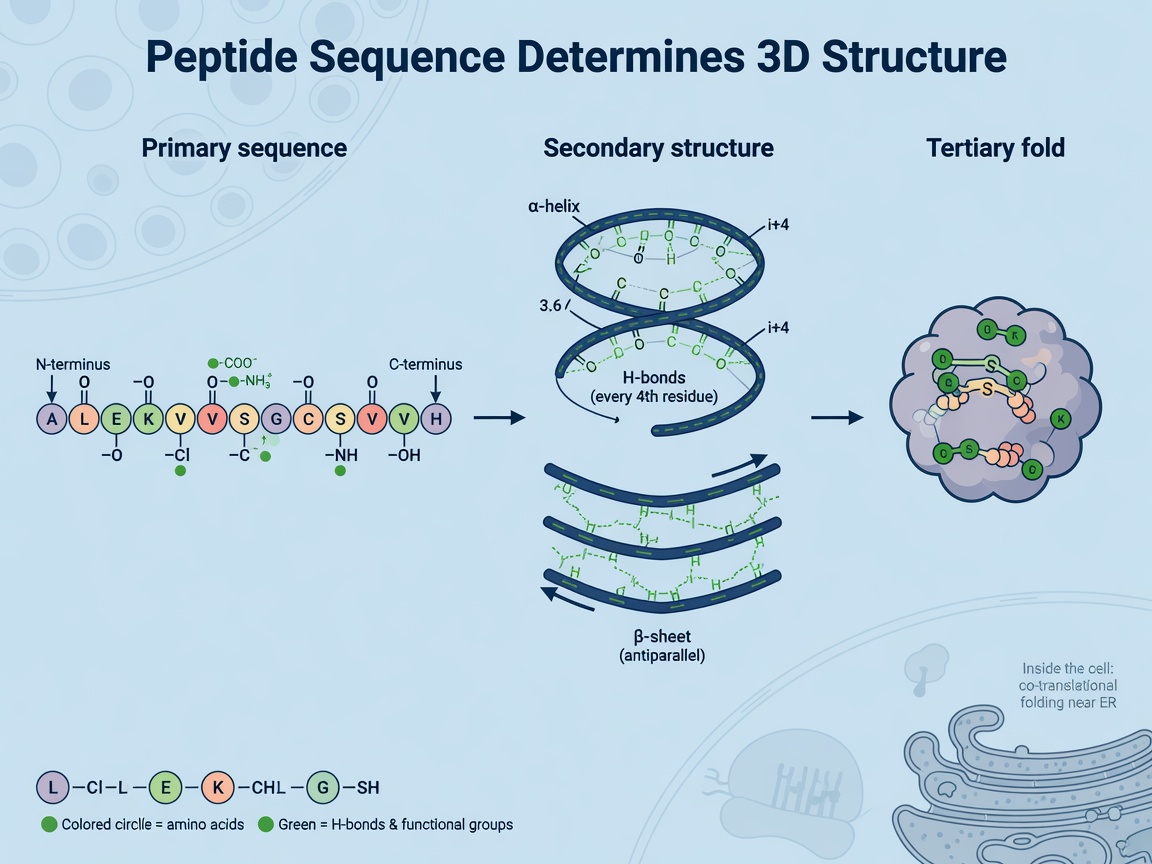
That central idea is simple and powerful: sequence drives function. A peptide’s amino-acid sequence limits the shapes it can adopt, those shapes affect what it can bind, and binding patterns shape the biological response. Current cell biology, structural biology, and drug-development work all point back to that sequence-to-structure-to-function link. This is the essence of peptides explained how sequence as a research principle.
Why Is Peptides Explained: How Sequence Drives Function in Cells a Core Research Framework?
The sequence is often called the primary structure, and that phrase is more than bookkeeping. Each residue brings size, charge, polarity, hydrogen-bonding potential, and conformational preferences. Put those residues in one order and a peptide may fold into a stable helix. Rearrange them slightly and the same chemical parts may become flexible, exposed to solvent, or unable to bind the same target.
A 2024 review in *Nature Reviews Molecular Cell Biology* emphasized that design methods have improved because researchers now have better rules linking sequence, structure, and function. That matters for natural peptides and engineered ones alike. It also helps explain why sequence comparisons can suggest function long before a peptide is tested in a cell.
Several sequence features tend to matter early when scientists evaluate peptide behavior. Charge distribution, hydrophobic residue placement, glycine and proline frequency, aromatic side-chain patterning, cysteine positions, net length, and terminal chemistry all contribute. No single feature gives the whole answer. Cells respond to the combination. Peptides explained how sequence therefore requires a systems view, not a one-residue explanation.
Researchers working with peptide libraries often use these features to rank candidates before functional assays. For example, Peptide Libraries: 7 Essential Research Formats for 2025 shows how sequence diversity is structured to probe these variables efficiently.
💡 Key Takeaway: Why Is Peptides Explained: How Sequence Drives Function in Cells a Core Research Framework?
How Does Peptide Sequence Shape Structure Inside Cells?
A peptide does not float through the cell as a simple string. Its backbone twists, side chains pack, hydrogen bonds form or fail to form, and hydrophobic segments may collapse inward or toward a membrane surface. Even when a peptide is dynamic rather than rigid, its sequence still sets the boundaries of that motion. This is where structural motifs become useful.
Some sequences favor alpha-helical segments. Others promote turns, beta-rich assemblies, or highly disordered ensembles. NCBI’s cell biology references have long pointed out that amino-acid sequence can predict structural elements, including membrane-spanning alpha helices in larger proteins. The same logic applies to peptide segments: sequence biases structure, and structure biases interaction.
The table below captures common sequence features and the kinds of effects they can create in cells.
| Sequence feature | Structural tendency | Likely cellular effect |
|—|—|—|
| Clustered hydrophobic residues | Burial, self-association, membrane affinity | Stronger membrane interaction, altered uptake, aggregation risk |
| Alternating polar and nonpolar residues | Amphipathic surfaces | Receptor contact or membrane binding with directional selectivity |
| Proline in a helical region | Helix disruption, kink formation | Reduced receptor fit or changed conformational switching |
| Glycine-rich segments | Higher flexibility | Broader conformational sampling, weaker binding in some cases |
| Cysteine pairing potential | Disulfide formation | Greater rigidity and protease resistance in suitable environments |
| Positive charge enrichment | Electrostatic attraction to anionic membranes or nucleic acids | Increased cellular uptake or nucleic acid binding |
How Does Peptide Binding Depend on Sequence and Shape?
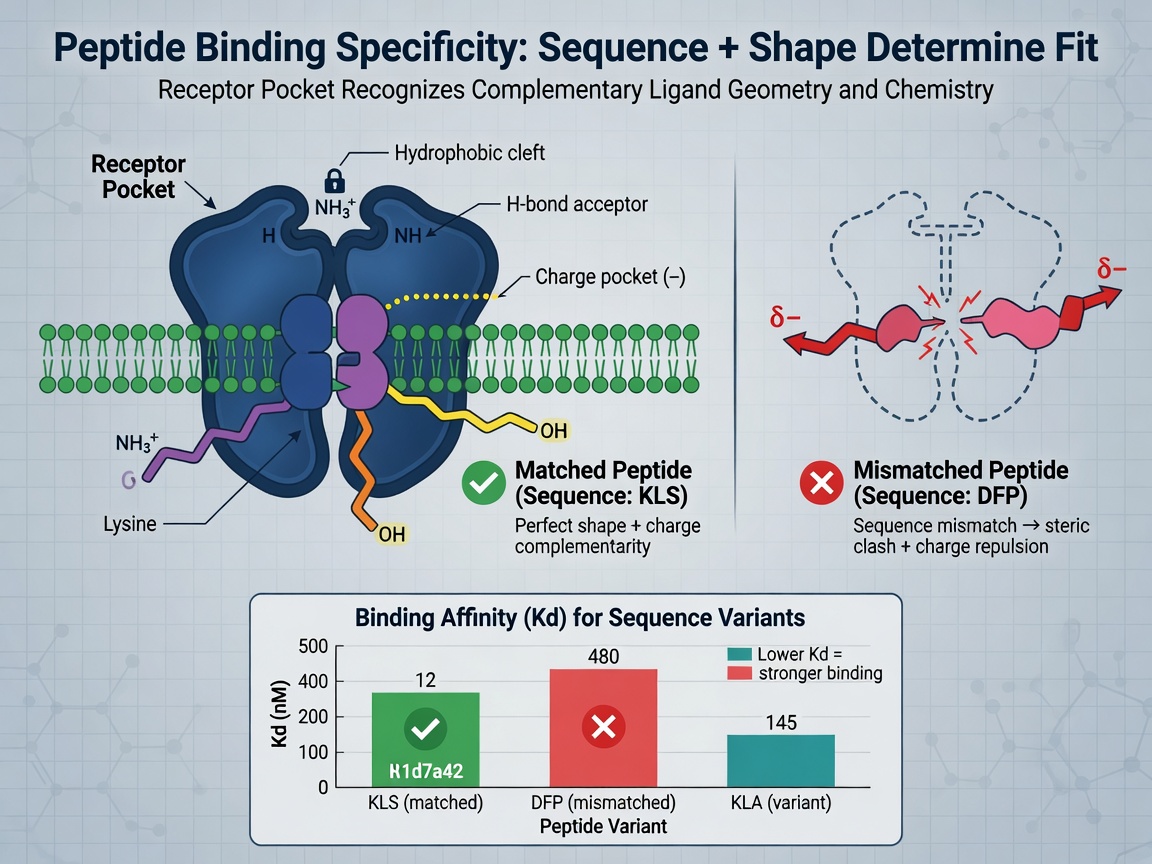
Binding is not a simple on/off event. It depends on shape complementarity, hydrogen bonds, salt bridges, hydrophobic contacts, and conformational entropy. The sequence determines which of those interactions are possible. A peptide that folds into a stable helix presents side chains on one face, while a flexible peptide may expose them randomly.
When a peptide binds a receptor, the sequence often dictates which residues contact the binding pocket. Changing one residue can remove a key hydrogen bond or introduce steric clash. This is why peptides explained how sequence remains the foundation for rational peptide design. Researchers cannot ignore shape when optimizing affinity.
Even peptides that are mostly disordered in solution can adopt a defined conformation upon binding. The sequence encodes the potential for that induced fit. Aromatic residues, charged residues, and helix-promoting residues all contribute to the final bound state. Sequence comparisons between active and inactive peptides often reveal conserved positions that drive binding.
Why Can a Single Amino-Acid Change Alter Biological Activity?
A single amino-acid change can alter biological activity because residues differ in size, charge, hydrophobicity, and hydrogen-bonding capacity. Replacing a glutamate with an alanine removes a negative charge. Replacing a tryptophan with a glycine removes a large aromatic side chain. These changes can reduce affinity by orders of magnitude or abolish activity entirely.
The effect is not always linear. A single change can also shift folding, expose a protease cleavage site, or create a new aggregation interface. Peptides explained how sequence highlights why even conserved positions deserve careful attention. Alanine scanning experiments routinely show that some residues are critical while others tolerate substitution.
For research peptides, a single residue change can be the difference between a useful tool compound and an inactive control. This sensitivity is both a challenge and an advantage. It allows researchers to map interaction surfaces precisely, but it also demands strict quality control during synthesis and purification.
💡 Key Takeaway: Why Can a Single Amino-Acid Change Alter Biological Activity?
How Does Sequence Affect Stability and ADME in Peptide Drug Design?
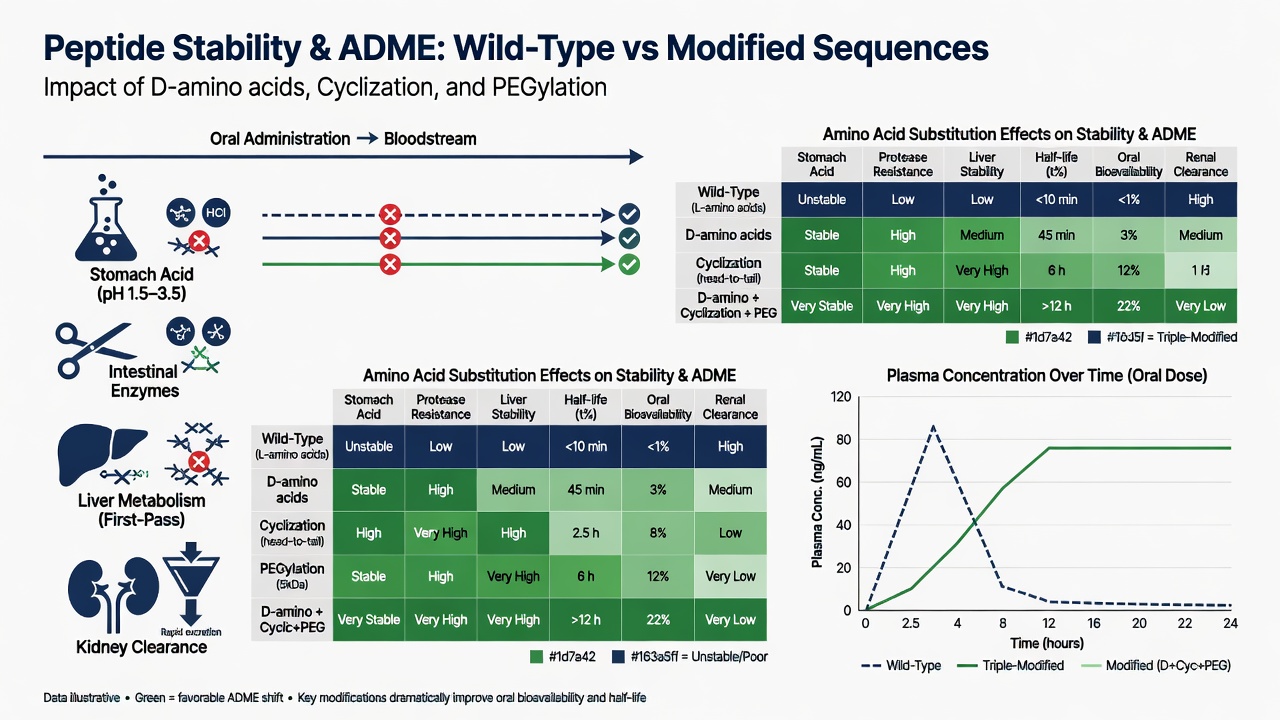
Stability and ADME properties—absorption, distribution, metabolism, excretion—depend heavily on sequence. Proteases recognize specific cleavage motifs, so changing a residue can extend half-life. Oxidation of methionine or deamidation of asparagine can also reduce shelf life. The sequence determines which degradation pathways are available.
In peptide drug design, researchers balance stability against activity. A helix-stabilizing substitution may improve binding but reduce solubility. A D-amino acid or N-methylation can block proteolysis but may alter target affinity. Peptides explained how sequence provides the framework for making those trade-offs rationally.
Sequence also affects plasma protein binding, renal clearance, and membrane permeability. Hydrophobic peptides may bind albumin more tightly, while charged peptides may clear faster through the kidney. These are not separate from function; they are part of the sequence-function relationship that researchers must manage.
How Do Researchers Test Sequence-Function Relationships in Peptides?
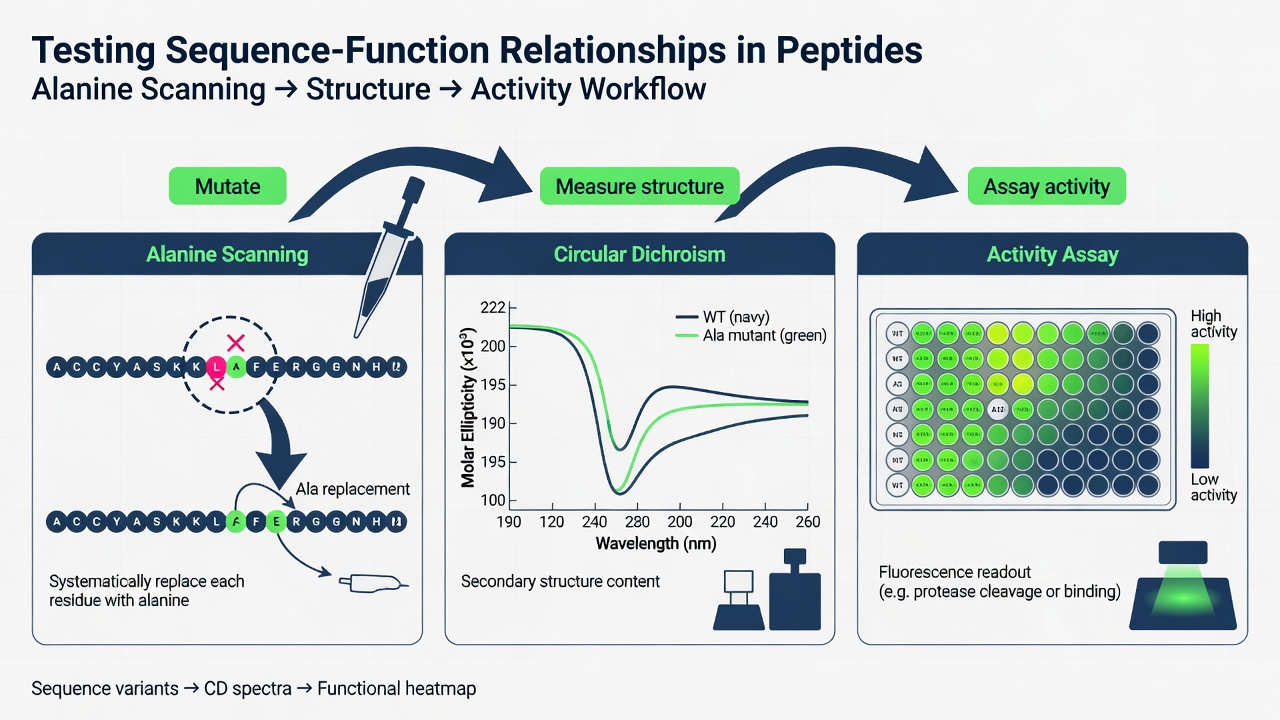
Researchers use several methods to test sequence-function relationships. Alanine scanning replaces each residue with alanine to identify positions critical for activity. Truncation studies remove residues from the N- or C-terminus to map minimal active sequences. Substitution with similar or dissimilar residues probes the chemical requirements at each position.
PubMed’s peptide sequence function search returns thousands of studies using these approaches. Phage display and yeast display allow high-throughput screening of large sequence libraries. Peptide arrays on chips or membranes test binding to immobilized targets. Each method reveals a different slice of the sequence-function landscape.
Peptides explained how sequence also guides the use of structural methods. Circular dichroism, NMR, and X-ray crystallography show how sequence changes alter conformation. Molecular dynamics simulations predict flexibility and binding modes. Together, these tools convert sequence information into mechanistic understanding.
What Does Peptides Explained: How Sequence Drives Function in Cells Mean for Modern Screening?
Modern screening relies on sequence diversity to find active peptides. Instead of testing one peptide at a time, researchers build libraries containing thousands or millions of variants. The sequence of each variant encodes a potential function. High-throughput assays then select for the desired activity.
Peptides explained how sequence means that library design is not random. Researchers bias libraries toward sequences with favorable charge, hydrophobicity, or structural propensity. They also include positive and negative controls to benchmark assay performance. This focused diversity increases the probability of finding hits.
Sequence-function data from screening feeds back into design. Machine learning models trained on peptide activity can predict new sequences likely to perform well. The 2024 *Nature Reviews Molecular Cell Biology* review noted that these design methods have improved because sequence-structure-function rules are now better quantified.
💡 Key Takeaway: What Does Peptides Explained: How Sequence Drives Function in Cells Mean for Modern Screening?
Why Does Peptides Explained: How Sequence Drives Function in Cells Matter for Peptide Stability?
Stability is not a separate property; it is encoded in the sequence. A peptide with a high proportion of beta-branched residues may resist proteolysis better than one rich in flexible glycine. A peptide with a disulfide bond is more rigid and less accessible to proteases. The sequence determines both intrinsic stability and susceptibility to modification.
For research peptides, stability affects assay reproducibility. A peptide that degrades during incubation will produce inconsistent results. Peptides explained how sequence helps researchers choose sequences that remain intact long enough to observe biological effects. Storage conditions also matter, but sequence is the starting point.
Chemical modifications can improve stability, but they must be compatible with the sequence. PEGylation, lipidation, or cyclization can extend half-life without destroying activity if placed correctly. The sequence provides the scaffold for these modifications.
How Does Sequence Influence Membrane Interaction and Cellular Uptake?
Membrane interaction depends on the balance of hydrophobic and charged residues. Peptides with clustered positive charges can interact with negatively charged phospholipid head groups. Peptides with amphipathic helices can insert into the membrane. The sequence determines whether a peptide remains in solution, associates with the membrane, or translocates into the cell.
Peptides explained how sequence is especially relevant for cell-penetrating peptides. Arginine-rich sequences such as TAT and penetratin use positive charge to cross membranes. The exact spacing of arginines, not just their number, influences uptake efficiency. Even a single substitution can reduce cytosolic delivery.
Membrane interaction is not always desirable. A peptide that binds too tightly to membranes may aggregate or fail to reach its intracellular target. Sequence tuning allows researchers to balance uptake against specificity.
How Do Sequence Comparisons Predict Peptide Function Before Testing?
Sequence comparisons can predict function because evolution conserves residues that matter. Homologous peptides from different species often share key positions. If a new peptide aligns with a known antimicrobial peptide, researchers can infer activity before running a single assay. This is not proof, but it narrows the candidate pool.
Peptides explained how sequence also underpins motif-based prediction. Short sequence patterns—such as RGD for integrin binding or KDEL for ER retention—predict specific functions. Bioinformatics tools scan peptide sequences for these motifs and score the likelihood of activity. Predictions are probabilistic, not deterministic.
Machine learning models trained on large peptide activity datasets can predict function from sequence alone. These models learn the nonlinear relationships between residue order and biological outcome. They do not replace experiments, but they reduce the number of experiments needed.
💡 Key Takeaway: How Do Sequence Comparisons Predict Peptide Function Before Testing?
What Are the Most Common Sequence Motifs in Functional Peptides?
Several sequence motifs recur across functional peptides. The RGD motif mediates integrin binding. The KDEL motif directs ER retention. The NLS motif targets nuclear import. The NES motif triggers nuclear export. These short sequences are information tags that cells read.
Peptides explained how sequence shows that motifs are context-dependent. An RGD sequence in a flexible loop may bind integrins, but the same sequence in a rigid helix may not. Flanking residues and conformation control whether a motif is accessible. This is why motif prediction alone is insufficient.
Antimicrobial peptides often have cationic and amphipathic motifs. Cell-penetrating peptides often have arginine-rich or lysine-rich stretches. Signal peptides have hydrophobic cores and cleavage sites. Each motif encodes a specific interaction or processing event.
Why Is Cyclization a Key Sequence-Driven Strategy in Peptide Research?
Cyclization locks a peptide into a constrained conformation. This can improve binding affinity, protease resistance, and membrane permeability. The sequence determines where cyclization can occur. Cysteine residues form disulfide bonds. Lactam bridges link side chains. Head-to-tail cyclization joins the N- and C-termini.
Peptides explained how sequence because cyclization is not a universal fix. A cyclic peptide may lose the flexibility needed for induced fit binding. The ring size, linker chemistry, and stereochemistry all depend on the original sequence. Researchers must test cyclic and linear versions to compare activity.
Cyclic peptides are attractive for drug development because they can target flat protein-protein interaction surfaces. Many natural cyclic peptides, such as cyclosporine and vancomycin, are approved drugs. Sequence-driven cyclization expands the chemical space available to peptide researchers.
How Does Sequence Affect Aggregation and Solubility in Research Peptides?
Aggregation and solubility are sequence-dependent. Peptides with long stretches of hydrophobic residues tend to aggregate in aqueous buffers. Peptides with high net charge tend to be more soluble. The balance between hydrophobic and hydrophilic residues determines whether a peptide remains monomeric.
Peptides explained how sequence helps researchers avoid aggregation during synthesis and assay. Adding a charged residue at the terminus, inserting a helix-breaking proline, or reducing aromatic content can improve solubility. These changes must be tested because they may also reduce activity.
Aggregation is a common cause of assay failure. Aggregated peptides may give false negatives or nonspecific signals. Light scattering and size-exclusion chromatography can detect aggregates. Sequence optimization is often the first step to solve the problem.
💡 Key Takeaway: How Does Sequence Affect Aggregation and Solubility in Research Peptides?
What Role Does Sequence Play in Peptide Selectivity?
Selectivity means a peptide binds its intended target but not closely related targets. Sequence determines selectivity by controlling the shape and chemistry of the binding interface. A peptide that binds receptor A may also bind receptor B if the binding pockets are similar. Subtle sequence changes can improve discrimination.
Peptides explained how sequence is critical for designing selective tools. Researchers compare sequence alignments of target and off-target proteins to identify residues that differ. Then they design peptides that interact with the unique residues. This is easier when structural data are available.
Selectivity also applies to cell types. A peptide may bind one cell line but not another because of differences in membrane composition or receptor expression. Sequence tuning can improve targeting while reducing off-target effects.
How Do Researchers Use Sequence-Function Data to Design Better Peptides?
Researchers use sequence-function data iteratively. They start with a natural peptide or a library hit. They measure activity, stability, and selectivity. Then they make rational substitutions based on the sequence-function relationship. Each round of design and testing improves the peptide.
Peptides explained how sequence provides the rules for this optimization. If binding is weak, add a residue that forms a hydrogen bond. If stability is poor, replace a protease-sensitive residue. If solubility is low, add a charged residue. These edits are not random; they follow from sequence-function knowledge.
Design also uses computational tools. Molecular docking predicts how sequence changes affect binding. Molecular dynamics simulates conformational changes. Machine learning models rank candidate sequences. The best designs combine computational prediction with experimental validation.
Why Is Sequence Context More Important Than Individual Residues?
Sequence context matters because residues do not act in isolation. A glutamate at position 5 may form a salt bridge only if a lysine is nearby. A proline may break a helix only if the surrounding residues are helix-promoting. The same residue can have different effects in different sequences.
Peptides explained how sequence emphasizes the whole chain, not a list of residues. Two peptides with the same amino acid composition but different order can have completely different structures and activities. This is why sequence, not composition, is the primary determinant of function.
Context also includes post-translational modifications. Phosphorylation, acetylation, or glycosylation can change the chemical properties of a residue. The sequence determines where these modifications occur and how they affect folding and binding.
💡 Key Takeaway: Why Is Sequence Context More Important Than Individual Residues?
How Does Sequence Influence Peptide Trafficking and Localization?
Peptide trafficking and localization are encoded in the sequence. A nuclear localization signal directs a peptide to the nucleus. A mitochondrial targeting sequence directs import into mitochondria. A secretory signal directs export from the cell. These sequences are read by cellular machinery.
Peptides explained how sequence for subcellular targeting is a growing research area. By adding a localization sequence to a functional peptide, researchers can deliver it to a specific organelle. This allows spatial control of peptide activity inside cells.
Trafficking is not always direct. Some peptides enter endosomes and require a pH-sensitive sequence to escape. Others are degraded in lysosomes unless protected by sequence modifications. Understanding sequence-trafficking relationships improves intracellular peptide delivery.
What Are the Limitations of Sequence-Based Prediction?
Sequence-based prediction has limitations. It cannot fully account for conformational dynamics, post-translational modifications, or cellular context. A peptide that folds correctly in buffer may misfold in the crowded cytoplasm. A motif that predicts binding may be buried in the folded structure.
Peptides explained how sequence must be paired with experimental validation. Predictions are useful for ranking candidates, but they are not proof of function. False positives and false negatives are common. Researchers should treat predictions as hypotheses to test.
Machine learning models are only as good as their training data. If the training set is biased toward certain peptide classes, predictions may fail for novel sequences. Transparency about model limitations is essential for responsible use in research.
How Does Peptides Explained: How Sequence Drives Function in Cells Apply to Antimicrobial Peptides?
Antimicrobial peptides (AMPs) are a natural test case for peptides explained how sequence. Most AMPs are cationic and amphipathic, with sequences that disrupt bacterial membranes. The exact sequence determines potency, spectrum, and toxicity to mammalian cells.
Small changes in AMP sequence can shift selectivity. Adding a hydrophobic residue may increase membrane disruption but also hemolysis. Reducing positive charge may reduce antimicrobial activity. Researchers use sequence-function data to design AMPs with improved therapeutic windows.
AMPs also illustrate the importance of sequence context. A peptide that is active as a monomer may be inactive as a dimer. The sequence controls oligomerization state, which in turn controls membrane activity. This is a direct sequence-to-function relationship.
💡 Key Takeaway: How Does Peptides Explained: How Sequence Drives Function in Cells Apply to Antimicrobial Peptides?
What Are the Key Sequence Features for Cell-Penetrating Peptides?
Cell-penetrating peptides (CPPs) share sequence features that promote membrane translocation. Arginine-rich sequences are common because guanidinium groups interact with cell-surface proteoglycans. TAT, penetratin, and polyarginine all rely on positive charge density.
Peptides explained how sequence for CPPs includes the spacing of arginines, the presence of hydrophobic residues, and the overall amphipathicity. Not all arginine-rich peptides are equally efficient. The sequence around the arginines affects uptake mechanism and endosomal escape.
For a detailed guide on CPP research tools, see Cell Penetrating Peptides for Research | Peptides Library. This resource covers sequence design, assay methods, and common pitfalls in CPP studies.
Why Does Sequence Affect Receptor Signaling Bias?
Receptor signaling bias occurs when a ligand activates one downstream pathway but not another. The sequence of a peptide ligand determines which receptor conformations it stabilizes. Different conformations couple to different intracellular effectors.
Peptides explained how sequence because even closely related peptides can show different signaling profiles. A single residue change may reduce G protein coupling while preserving arrestin recruitment. This biased agonism is therapeutically relevant for drug development.
Researchers use sequence-function studies to map the residues that control signaling bias. These data guide the design of peptides that selectively activate beneficial pathways while avoiding harmful ones. The same principles apply to peptide hormones and synthetic ligands.
How Does Sequence Influence Peptide Immunogenicity?
Immunogenicity—the ability to trigger an immune response—depends on sequence. Peptides containing T-cell epitopes can activate adaptive immunity. Hydrophobic patches may promote aggregation, which enhances immunogenicity. Terminal modifications can reduce immune recognition.
Peptides explained how sequence helps researchers predict and control immunogenicity. Tools such as MHC-binding prediction identify sequences likely to be presented on immune cells. Removing or modifying these sequences can reduce unwanted immune responses in research models.
For therapeutic peptides, immunogenicity is a safety concern. For vaccine peptides, immunogenicity is the goal. In both cases, sequence is the primary variable that researchers manipulate. This is another example of sequence driving function in a cellular context.
💡 Key Takeaway: How Does Sequence Influence Peptide Immunogenicity?
What Is the Role of Terminal Modifications in Sequence Function?
Terminal modifications change the chemical environment at the N- or C-terminus without altering the core sequence. Acetylation of the N-terminus removes a positive charge and can mimic natural processing. Amidation of the C-terminus removes a negative charge and can improve stability.
Peptides explained how sequence includes terminal chemistry because it affects folding, binding, and degradation. A free N-terminus may be susceptible to aminopeptidases. A free C-terminus may be susceptible to carboxypeptidases. Blocking these termini extends half-life.
Terminal modifications can also alter activity. Some receptors require a free terminus for binding. Others prefer an amidated terminus. Researchers must test both forms to determine which sequence-modification combination gives the desired function.
How Does Sequence Affect Peptide Conformation Dynamics?
Conformation dynamics refer to the range of structures a peptide samples over time. Some peptides are rigid, with a single dominant conformation. Others are highly flexible, sampling many conformations. The sequence determines this dynamic behavior.
Peptides explained how sequence because dynamics affect function. A rigid peptide may bind with high affinity but slow kinetics. A flexible peptide may bind multiple targets with lower selectivity. Researchers can tune dynamics by adding helix-promoting residues, disulfide bonds, or turn-inducing sequences.
Nuclear magnetic resonance and molecular dynamics simulations reveal how sequence changes alter conformational ensembles. These data help researchers design peptides with the right balance of rigidity and flexibility for their intended cellular function.
What Are the Advantages of Sequence-Focused Peptide Libraries?
Sequence-focused peptide libraries are designed around sequence-function hypotheses. Instead of random diversity, they encode specific patterns: charge clusters, hydrophobic faces, helix-promoting residues, or known motifs. This focused approach increases hit rates and reduces screening costs.
Peptides explained how sequence is the logic behind these libraries. By controlling sequence space, researchers can systematically probe which features drive activity. The results are more interpretable than random screens. For more on library design, see Peptide Research Library: A Complete Reference Guide.
Sequence-focused libraries are also useful for structure-activity relationship studies. A library that varies one position at a time maps the contribution of each residue. This is more efficient than synthesizing individual peptides one by one.
💡 Key Takeaway: What Are the Advantages of Sequence-Focused Peptide Libraries?
How Does Sequence Drive Function in Peptide-Protein Interactions?
Peptide-protein interactions are central to cell signaling, regulation, and disease. The sequence of a peptide determines which protein surfaces it can recognize. Short linear motifs—such as SH2, SH3, and PDZ binding sequences—mediate many of these interactions.
Peptides explained how sequence because a few residues can encode high specificity. For example, an SH2 domain binds a phosphotyrosine followed by specific flanking residues. Changing the flanking sequence redirects the peptide to a different SH2 domain. This is sequence-driven functional selectivity.
Researchers use peptide-protein interaction data to design inhibitors, probes, and tool compounds. The sequence is the blueprint. Structural biology and biophysical assays reveal how sequence changes alter binding thermodynamics and kinetics.
Why Is Peptides Explained: How Sequence Drives Function in Cells Relevant to Peptide Drug Development?
Peptide drug development depends on the sequence-function relationship. Every property—potency, selectivity, stability, solubility, immunogenicity, and manufacturability—can be traced back to sequence. Optimizing a peptide drug is an exercise in sequence engineering.
Peptides explained how sequence also matters for regulatory and quality control. A peptide with a single deletion or epimerization can fail specification. Sequence identity must be confirmed by mass spectrometry and amino acid analysis. The sequence is the molecular identity of the drug candidate.
The FDA has noted that peptide drug candidates often show features of both small molecules and biologics. This hybrid nature means sequence-driven design must consider both chemical and biological properties. Researchers who master the sequence-function framework are better equipped to advance peptide candidates.
FAQ
Why does peptide sequence matter more than amino acid composition?
Peptide sequence matters more because the order of residues determines folding, binding surfaces, and interaction patterns. Two peptides with identical composition but different order can have completely different structures and cellular activities. Peptides explained how sequence is the central principle for this distinction.
What is the maximum length of a peptide for sequence-function studies?
Most research peptides range from 2 to about 50 residues. Above 50 residues, molecules are typically classified as proteins, though the boundary is not strict. The sequence-function framework applies across this range, but shorter peptides are easier to synthesize and characterize.
How can a single amino acid change destroy peptide activity?
A single change can remove a critical hydrogen bond, introduce steric clash, disrupt a helix, alter charge, or create a protease cleavage site. Because binding and folding depend on precise chemical complementarity, even a small change can reduce affinity by orders of magnitude.
Are sequence-based predictions reliable for peptide function?
Sequence-based predictions are useful for ranking candidates but are not proof of function. They must be validated experimentally. Limitations include conformational dynamics, post-translational modifications, and cellular context. Predictions are hypotheses, not conclusions.
Where can researchers find sequence-focused peptide libraries?
Researchers can find sequence-focused libraries through specialized suppliers and resources such as Peptide Library: Research-Grade Peptides for Laboratories. These libraries encode systematic sequence variations to probe structure-activity relationships efficiently.
Ready to Take the Next Step?
Every product includes lot-specific documentation and third-party purity testing.
Explore Our Research Products →Free shipping on qualifying orders · Batch COA on request