



Hexarelin vs Ipamorelin: 7 Main Research Differences
Explore the main research differences between hexarelin and ipamorelin, covering GH selectivity, ACTH, cortisol, prolactin, half-life, and study design in 2025.
📋 Table of Contents
The main research differences between hexarelin and ipamorelin center on endocrine selectivity and off-target hormone release. Hexarelin appears broader and less selective, while ipamorelin was developed and reported as a more GH-selective option. Both act through the ghrelin receptor, but their ACTH, cortisol, prolactin, and half-life profiles differ.
Key takeaways
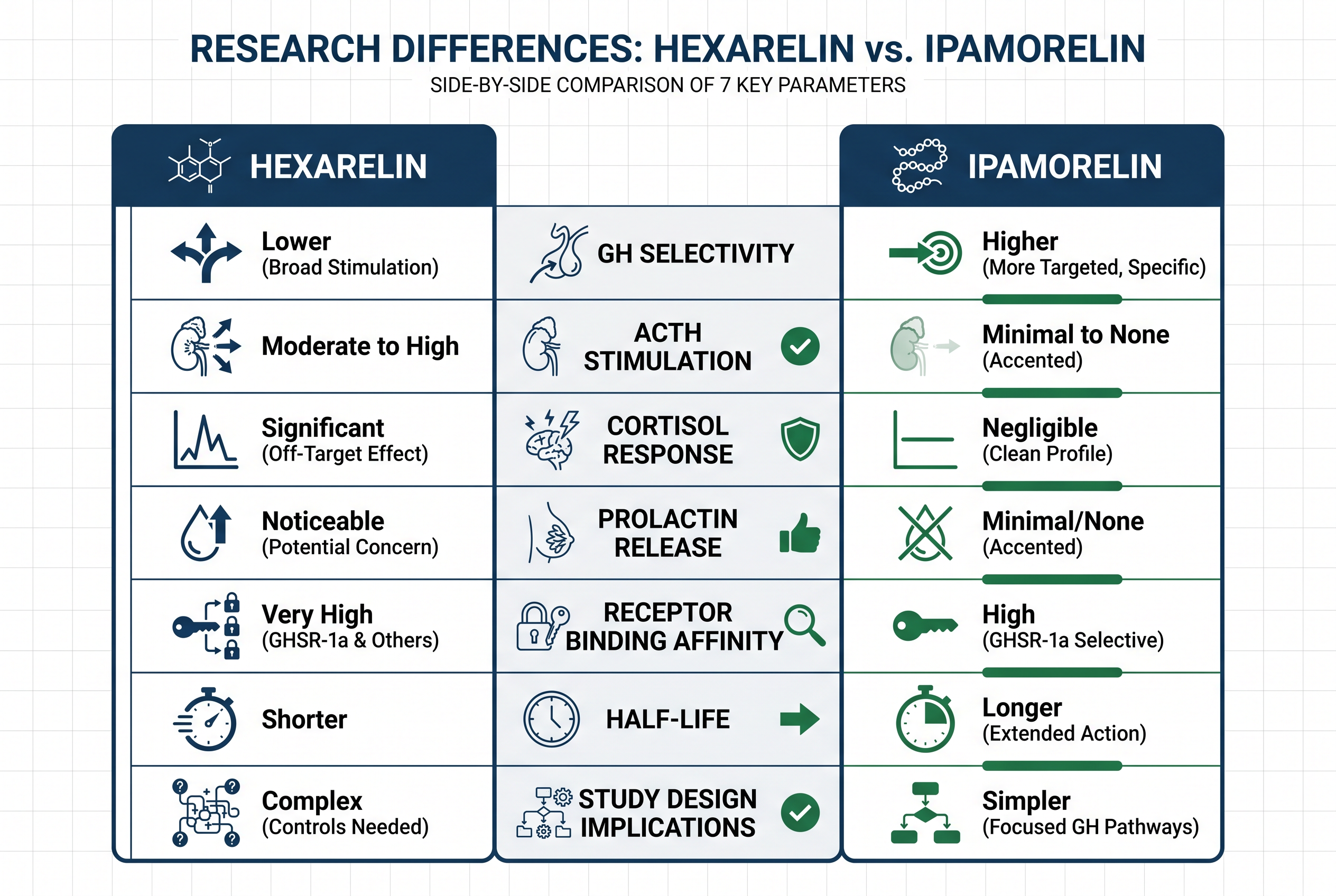
- Hexarelin is the broader, less selective growth hormone secretagogue; ipamorelin is the more GH-selective peptide described in a 1998 PubMed-indexed study.
- Both peptides act through GHS-R, not the GHRH receptor; the key distinction is downstream endocrine profile, not receptor class.
- Hexarelin significantly stimulates prolactin, ACTH, and cortisol in human comparison work; ipamorelin does not release ACTH or cortisol significantly differently from GHRH stimulation.
- A recent review lists hexarelin half-life at about 55 minutes and ipamorelin at about 2 hours—both short-acting.
- For a cleaner GH signal, ipamorelin is usually the better fit; for broader endocrine stimulation or older GHRP literature comparison, hexarelin may be more informative.
What are hexarelin and ipamorelin?
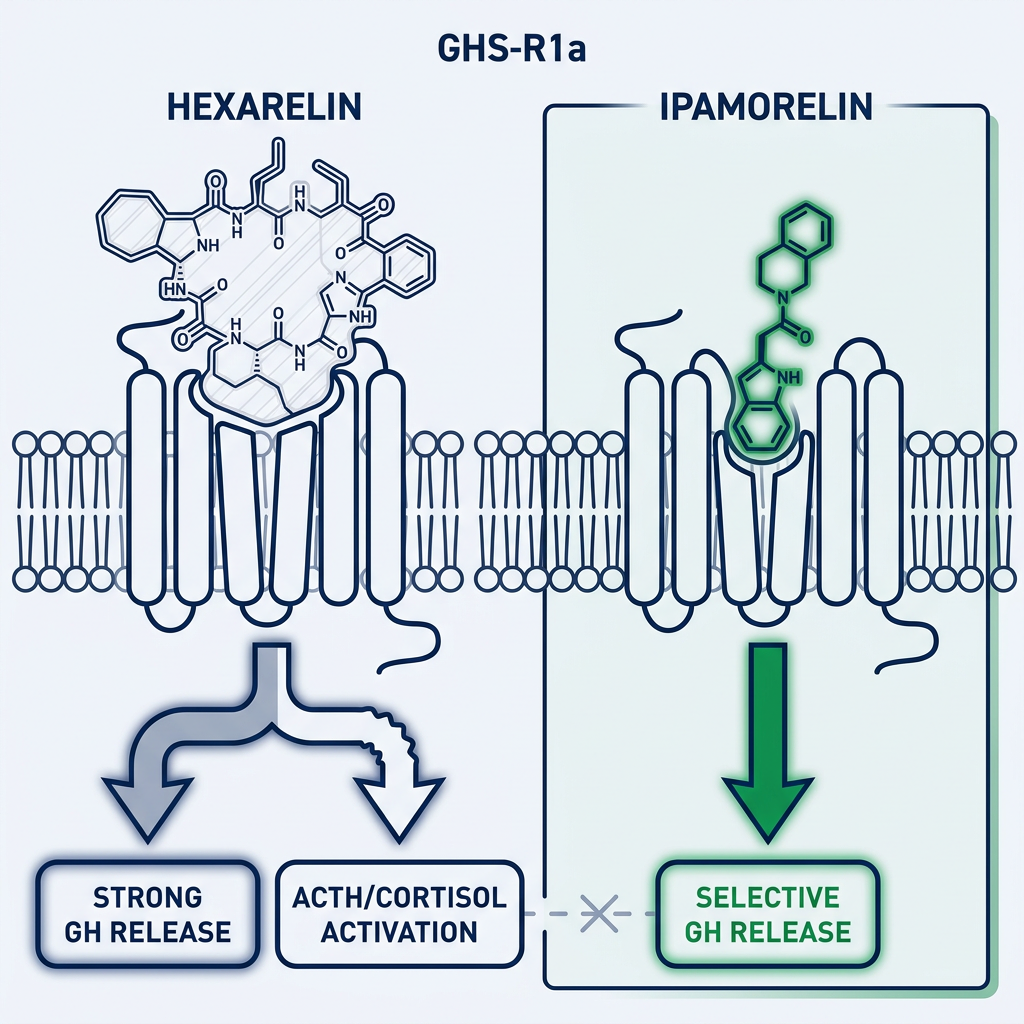
Hexarelin and ipamorelin are both growth hormone secretagogues that act through GHS-R, not the GHRH receptor. Hexarelin is the older, less selective peptide, while ipamorelin was developed as a more GH-selective secretagogue. In practice, both compounds sit in the GHRP and ghrelin-receptor research family. They stimulate GH release, but the surrounding endocrine picture differs. That is why studies often discuss not only GH output, but also ACTH, cortisol, and prolactin. A useful framing point is that “growth hormone secretagogue” is a category, not a verdict of equivalence. Two compounds can share a receptor system and still produce different hormone panels, different apparent tolerability, and different usefulness in experimental design.
For a broader overview of research peptide categories, see the Peptide Research Library: A Complete Reference Guide.
How do hexarelin and ipamorelin differ in receptor targeting and signaling?
Hexarelin and ipamorelin both signal through GHS-R, also called the ghrelin receptor. The key research difference is downstream endocrine selectivity, not a totally different primary receptor. A 2004 American Physiological Society review placed growth hormone secretagogues, ghrelin, and GHS-R in the same receptor system and noted intracellular calcium signaling through an IP3 pathway. That shared mechanism helps explain why both peptides can raise GH. It also explains why people sometimes overstate their similarity.
A common misconception is that ipamorelin’s GH selectivity means it works through the GHRH receptor. It does not. The better interpretation is that ipamorelin appears more selective within the GHS framework, while hexarelin shows broader endocrine activation in human data. If two peptides share GHS-R but one raises GH with less ACTH and cortisol, then the meaningful difference is signaling profile and endocrine specificity, not receptor category.
💡 Key Takeaway: How do hexarelin and ipamorelin differ in receptor targeting and signaling?
What are the 7 main research differences between hexarelin and ipamorelin?
Hexarelin and ipamorelin separate across seven practical dimensions: selectivity, off-axis hormones, duration, literature framing, and study use. Those are the differences that matter most when reading human endocrine data.
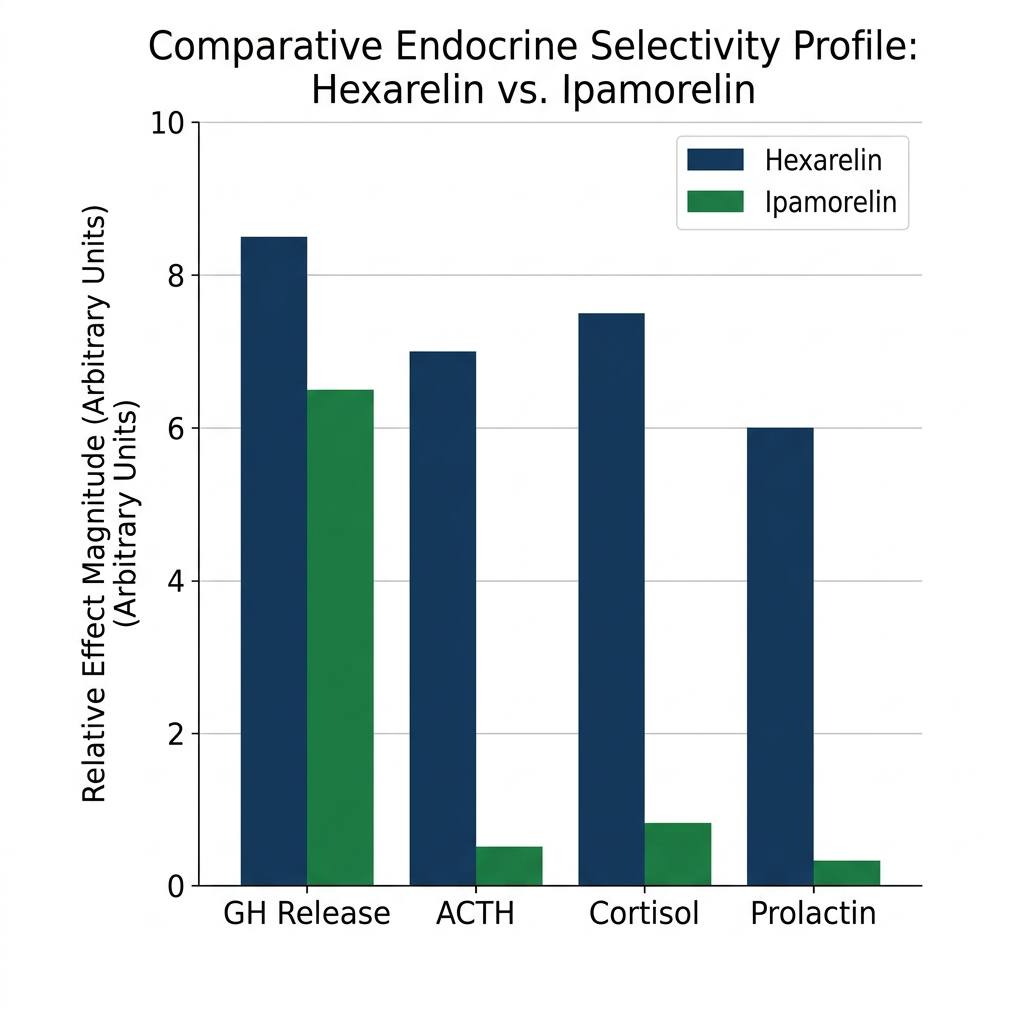
1. GH selectivity: Ipamorelin was described in a 1998 human study as the first selective growth hormone secretagogue, with GH-release selectivity similar to GHRH. Hexarelin is a strong GH secretagogue too, but not with the same “GH-only” reputation.
2. ACTH and cortisol response: Early human data reported that ipamorelin did not release ACTH or cortisol at levels significantly different from GHRH stimulation. Hexarelin, by contrast, significantly stimulated ACTH and cortisol in human comparison work.
3. Prolactin response: Hexarelin has documented prolactin-releasing activity in human studies and reviews. Ipamorelin is mainly remembered for minimizing this broader pituitary spillover.
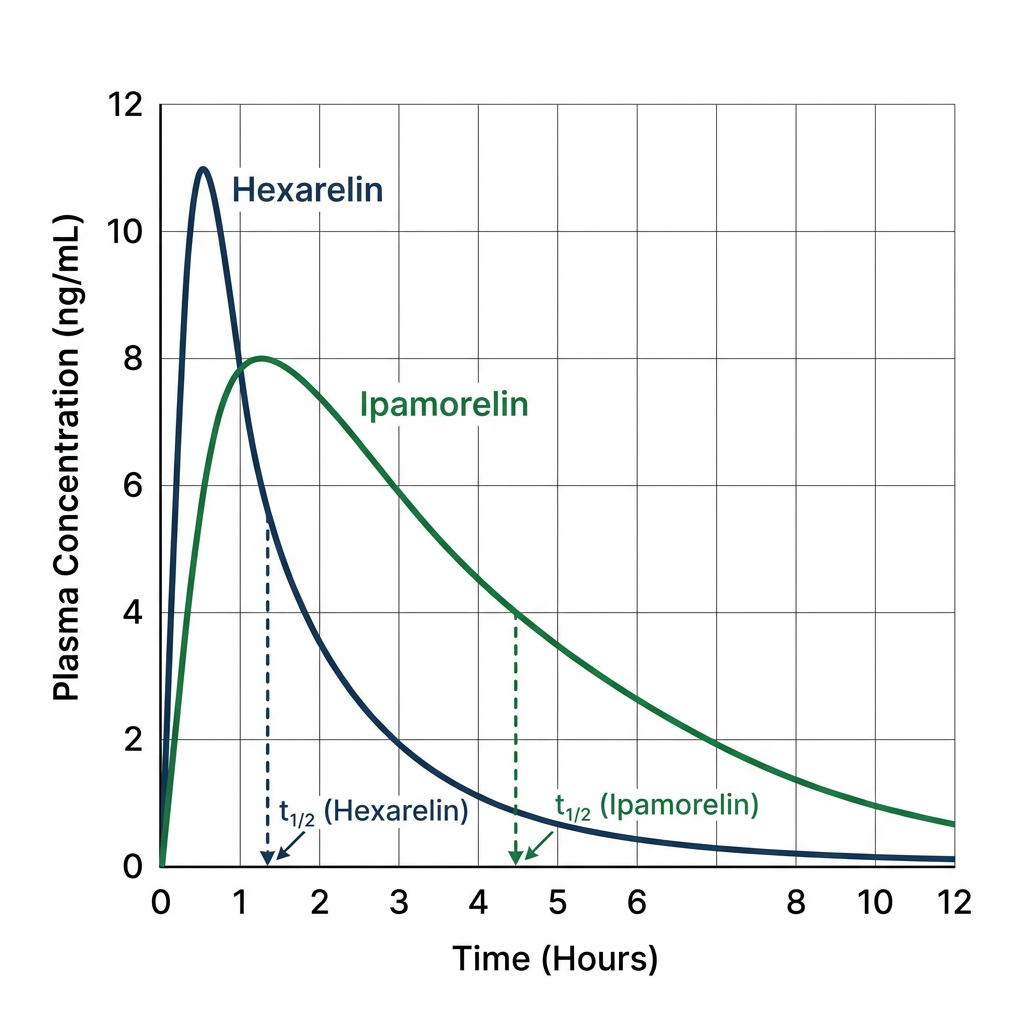
4. Reported half-life: A recent review lists hexarelin as short-acting with an estimated half-life of about 55 minutes. The same review lists ipamorelin as short-acting with an estimated half-life of about 2 hours.
5. Research positioning: Hexarelin has often been used as a benchmark nonnatural peptidyl GHS in older endocrine literature. Ipamorelin was positioned as a next-step selective GHS designed to preserve GH release while reducing non-GH effects.
6. Physiologic breadth: Hexarelin has been described as acting on specific receptors at both pituitary and hypothalamic levels. That broader framing fits its wider endocrine profile.
7. Study fit: Ipamorelin usually fits cleaner GH-axis experiments better. Hexarelin can be more useful when a study intentionally examines broader neuroendocrine activation or compares older GHRP literature against ghrelin biology.
These seven differences are not independent. A peptide with a shorter half-life and broader endocrine footprint will produce different sampling requirements and different data interpretation than a more selective, somewhat longer-acting peptide. That is why the main research differences should be treated as a system, not a checklist.
For another side-by-side comparison, see AOD 9604 vs Retatrutide: 7 Research Differences Today.
How do GH selectivity and non-GH endocrine effects compare?
Ipamorelin is the cleaner GH-selective option, while hexarelin has stronger evidence for non-GH hormonal stimulation. The clearest contrast is ACTH, cortisol, and prolactin. The 1998 PubMed-indexed ipamorelin study concluded that ipamorelin had GH-release selectivity similar to GHRH and did not release ACTH or cortisol at levels significantly different from GHRH stimulation. See the PubMed search for ipamorelin selective growth hormone secretagogue.
A 2001 human comparison study described hexarelin as a strong GH releaser that also significantly stimulated prolactin, ACTH, and cortisol. Put simply, the literature frames ipamorelin as narrower and hexarelin as broader. That does not automatically make ipamorelin “better.” Selectivity is an advantage only if your research question values a cleaner GH signal. If the protocol is meant to probe integrated pituitary and adrenal responses, hexarelin’s broader endocrine footprint may be useful rather than undesirable.
Another common mistake is to equate less off-target hormone release with greater GH potency. Those are separate questions. A peptide can be more selective without being the strongest possible stimulus in every setting. Understanding this distinction is central to interpreting the main research differences correctly.
For research-grade peptide selection guidance, see Peptide Library: Research-Grade Peptides for Laboratories.
How do you read a hexarelin vs ipamorelin endocrine study step by step?
The best reading method is to check population, comparator, and hormone panel in that order. Hexarelin and ipamorelin can look more similar or more different depending on those three variables.
Step 1 is population. Age, baseline endocrine status, and study setting matter because GH responsiveness and counter-regulatory hormones are not constant across groups. A PubMed-indexed hexarelin study even noted age-related variation in endocrine effects. If the population changes, the apparent peptide profile can shift. See the PubMed search for hexarelin prolactin ACTH cortisol.
Step 2 is comparator. Ipamorelin looks especially selective when it is compared with GHRH or older GHRPs. Hexarelin looks broader when it is compared with ghrelin or GHRH in human challenge studies. If a paper uses a weak comparator, the selectivity claim may sound stronger than it really is.
Step 3 is hormone panel and timing. A GH-only chart can hide meaningful differences. If ACTH, cortisol, and prolactin are not measured, you cannot judge endocrine selectivity well. Pro tip: always check whether sampling captured the early pulse window, because short-acting peptides can be misread if the timing is sparse.
This stepwise approach helps researchers avoid the most common errors in peptide comparison. It also makes the main research differences easier to isolate and reproduce across laboratories.
💡 Key Takeaway: How do you read a hexarelin vs ipamorelin endocrine study step by step?
How do half-life and duration compare in human pharmacology?
Hexarelin appears shorter-acting than ipamorelin in current review literature. A recent Frontiers in Endocrinology review lists hexarelin at about 55 minutes and ipamorelin at about 2 hours. That difference is meaningful, but it should be handled carefully. Both are still short-acting compounds. Neither fits the profile of a long-duration sustained agonist in the way many casual summaries imply.
A half-life difference can change study design in several ways. Hexarelin may suit acute provocation experiments where a shorter exposure window is helpful. Ipamorelin may offer a slightly wider observation window, but it is still not a long-acting peptide. Researchers should adjust sampling frequency and total observation time accordingly. This is one of the main research differences that directly affects study logistics.
Which peptide fits which research design?
If a study needs a clean GH readout with minimal ACTH and cortisol noise, ipamorelin is the more appropriate choice in early human research. If a study is revisiting older GHRP literature or probing integrated pituitary-adrenal responses, hexarelin may provide a more informative comparator. The choice should follow from the research question, not from a blanket claim that one peptide is universally better. In many endocrine studies, hexarelin’s broader profile can be an asset. In others, ipamorelin’s selectivity reduces confounding variables. This is one of the main research differences that practical labs weigh most heavily.
For further background on hexarelin’s broader endocrine footprint, see the Peptides Library Hexarelin Side Effects Research Hub.
What does the 1998 ipamorelin study actually report?
The 1998 PubMed-indexed ipamorelin study described ipamorelin as the first selective growth hormone secretagogue. Its GH-release selectivity was similar to GHRH. The study also reported that ipamorelin did not release ACTH or cortisol at levels significantly different from GHRH stimulation. This finding anchored ipamorelin’s reputation as a more GH-selective research peptide. It does not mean ipamorelin has zero non-GH activity in every possible setting. It means the early human evidence framed it as selective relative to GHRH and older GHRPs. That nuance is essential when comparing the main research differences between these two compounds.
💡 Key Takeaway: What does the 1998 ipamorelin study actually report?
What does the 2001 hexarelin comparison study report?
A 2001 human comparison study described hexarelin as a strong GH releaser that also significantly stimulated prolactin, ACTH, and cortisol. That broader endocrine footprint is one of the clearest contrasts with ipamorelin. Hexarelin’s ability to raise multiple pituitary and adrenal hormones makes it less selective outside the GH axis. In research terms, that can be either a limitation or a feature, depending on the protocol. When reading older hexarelin data, it is important to check whether the hormone panel included ACTH, cortisol, and prolactin. If it did not, the full endocrine picture may be incomplete.
How do the main research differences affect literature interpretation?
Many review articles group hexarelin and ipamorelin together because they share GHS-R. That grouping can hide the endocrine selectivity differences that matter for experimental design. When a review summarizes GH release only, it may show both peptides as similar. When the full hormone panel is included, the contrast becomes clearer. Researchers should read the methods section before accepting any comparative claim. A study that only measured GH cannot support a conclusion about ACTH or cortisol selectivity. A study that used a weak comparator may overstate ipamorelin’s uniqueness. A study that sampled too late may underreport hexarelin’s acute effects. These are all ways the main research differences can be obscured or exaggerated in secondary sources.
| Dimension | Hexarelin | Ipamorelin |
|———–|———–|————|
| Receptor | GHS-R | GHS-R |
| GH release | Strong | Strong |
| ACTH/cortisol | Significant stimulation in human comparison | Not significantly different from GHRH |
| Prolactin | Documented release | Minimal broader pituitary spillover |
| Reported half-life | ~55 minutes | ~2 hours |
| Selectivity | Broader endocrine activation | More GH-selective |
| Typical research use | Older GHRP benchmark, broader neuroendocrine studies | Cleaner GH-axis experiments |
Why does the ghrelin receptor matter for these comparisons?
The ghrelin receptor, also called GHS-R, is the shared target for both hexarelin and ipamorelin. Understanding this shared receptor helps explain why both peptides release GH. It also explains why researchers sometimes assume the two compounds are interchangeable. That assumption is incorrect. Shared receptor activation does not guarantee identical intracellular signaling or identical downstream hormone release. Different ligands can bias signaling through the same receptor, leading to different endocrine outputs. Hexarelin’s broader ACTH, cortisol, and prolactin responses suggest that it engages a wider set of downstream pathways or secondary binding interactions. Ipamorelin’s selectivity suggests a more constrained signaling profile. These mechanistic possibilities are consistent with the human data, even if the exact molecular details are still being studied.
💡 Key Takeaway: Why does the ghrelin receptor matter for these comparisons?
How do short half-lives affect research protocols?
Because both peptides are short-acting, sampling frequency must be high enough to capture the GH pulse and any accompanying hormone changes. Hexarelin’s approximate 55-minute half-life may require earlier and more frequent sampling in acute challenge studies. Ipamorelin’s approximate 2-hour half-life allows a slightly longer observation window. However, both are far shorter than many long-acting research agonists. A protocol designed for a long-duration compound will not fit either peptide well. Researchers should plan sampling times based on the specific peptide, not on a generic secretagogue template. This is one of the main research differences that directly affects study logistics and data quality.
Are there any common misconceptions about hexarelin and ipamorelin?
Yes. One common misconception is that ipamorelin works through the GHRH receptor. It does not; it acts through GHS-R. Another misconception is that ipamorelin’s GH selectivity means it is a stronger GH releaser than hexarelin. The literature does not support a simple potency ranking. Selectivity and potency are separate variables. A third misconception is that both peptides have identical safety and tolerability profiles because they share a receptor. Human studies report different endocrine spillover, which may affect apparent tolerability, but safety conclusions require dedicated studies. A fourth misconception is that half-life alone determines which peptide is “better.” Research fit depends on selectivity, comparator, and sampling design, not just duration. These misconceptions can distort the main research differences if they are not corrected early.
How should researchers document the main research differences in a lab notebook?
Laboratories that compare hexarelin and ipamorelin should document the hormone panel, sampling times, and peptide source in every experiment. Because both peptides are short-acting, timing errors can distort apparent selectivity. A GH-only assay cannot distinguish a selective secretagogue from a broader one. Researchers should also note whether the peptide was handled under appropriate research storage conditions and whether a certificate of analysis was reviewed, as is standard for research-grade peptides. This is not a claim about either peptide’s stability; it is a general research documentation practice. Keeping these variables clear makes the main research differences reproducible across studies and laboratories.
💡 Key Takeaway: How should researchers document the main research differences in a lab notebook?
FAQ
What are the main research differences between hexarelin and ipamorelin?
The main research differences are endocrine selectivity and off-target hormone release. Hexarelin is broader and less selective, significantly stimulating prolactin, ACTH, and cortisol in human comparison work. Ipamorelin is more GH-selective, with ACTH and cortisol responses not significantly different from GHRH stimulation in a 1998 study.
Do hexarelin and ipamorelin act on the same receptor?
Yes. Both act through GHS-R, also called the ghrelin receptor. The difference is downstream endocrine profile, not receptor class. Ipamorelin does not work through the GHRH receptor.
What are the half-lives of hexarelin and ipamorelin?
A recent review lists hexarelin at about 55 minutes and ipamorelin at about 2 hours. Both are short-acting peptides.
Which peptide is more selective?
Ipamorelin is more GH-selective based on early human research. Hexarelin shows broader endocrine activation, including prolactin, ACTH, and cortisol stimulation.
Are these peptides for human consumption?
No. This content is for research-use only. Hexarelin and ipamorelin are research peptides for laboratory and preclinical study, not for human consumption.
Ready to Take the Next Step?
Every product includes lot-specific documentation and third-party purity testing.
Explore Our Research Products →Free shipping on qualifying orders · Batch COA on request