


Hexarelin vs Sermorelin: 7 Research Differences Today
Hexarelin vs Sermorelin: 7 Research Differences Today compares GHSR agonism vs GHRH analogue selectivity, ED50 data, and 2009 GEREF withdrawal.
📋 Table of Contents
Hexarelin vs Sermorelin: 7 Research Differences Today answers a core question: hexarelin and sermorelin are not interchangeable growth hormone peptides. Hexarelin is a growth hormone secretagogue receptor (GHSR) agonist with broader endocrine effects, while sermorelin is a pituitary-selective GHRH analogue. Both increase GH release, but receptor class, selectivity, potency, and regulatory history differ.
Key takeaways
- In Hexarelin vs Sermorelin: 7 Research Differences Today, sermorelin is the more pituitary-selective GHRH analogue, while hexarelin is the more potent but less selective GHSR agonist.
- Human studies report hexarelin effects on GH plus ACTH, cortisol, and prolactin; sermorelin review data focus on anterior pituitary GH release.
- Hexarelin IV data show GH peaks at about 30 minutes and returns toward baseline by about 240 minutes; route and sampling windows matter.
- FDA records show the U.S. sermorelin comparator product GEREF had approvals withdrawn in 2009; hexarelin has no identified FDA-approved U.S. drug status.
- Always compare route, endpoint, and population before ranking potency claims.
Why does Hexarelin vs Sermorelin: 7 Research Differences Today matter for study design?
Study design errors are common when researchers treat every GH secretagogue as a single class. The Hexarelin vs Sermorelin: 7 Research Differences Today framework prevents that by separating receptor biology, endocrine selectivity, and regulatory history. A better approach is to compare mechanism first, then endocrine selectivity, then the human data that actually exist.
Many online comparisons flatten receptor biology, study design, and regulatory history into a single “which is stronger?” question. That shortcut leads to mismatched potency claims and ignored off-target endpoints. By contrast, a structured Hexarelin vs Sermorelin: 7 Research Differences Today evaluation keeps each variable in its own lane.
Applying Hexarelin vs Sermorelin: 7 Research Differences Today to route selection
Route selection changes absorption, timing, and off-target readouts. For hexarelin, the cited human data come from single intravenous boluses in healthy men. For sermorelin, review data include subcutaneous bedtime dosing in prepubertal children with idiopathic growth hormone deficiency. Any Hexarelin vs Sermorelin: 7 Research Differences Today comparison must state the route before making potency claims.
A practical example: a 0.50 microgram/kg IV hexarelin ED50 cannot be directly compared to a 30 microgram/kg subcutaneous sermorelin bedtime dose. The routes differ, the populations differ, and the endpoints differ. That is why route matching is step one.

How do hexarelin and sermorelin differ at the receptor level?
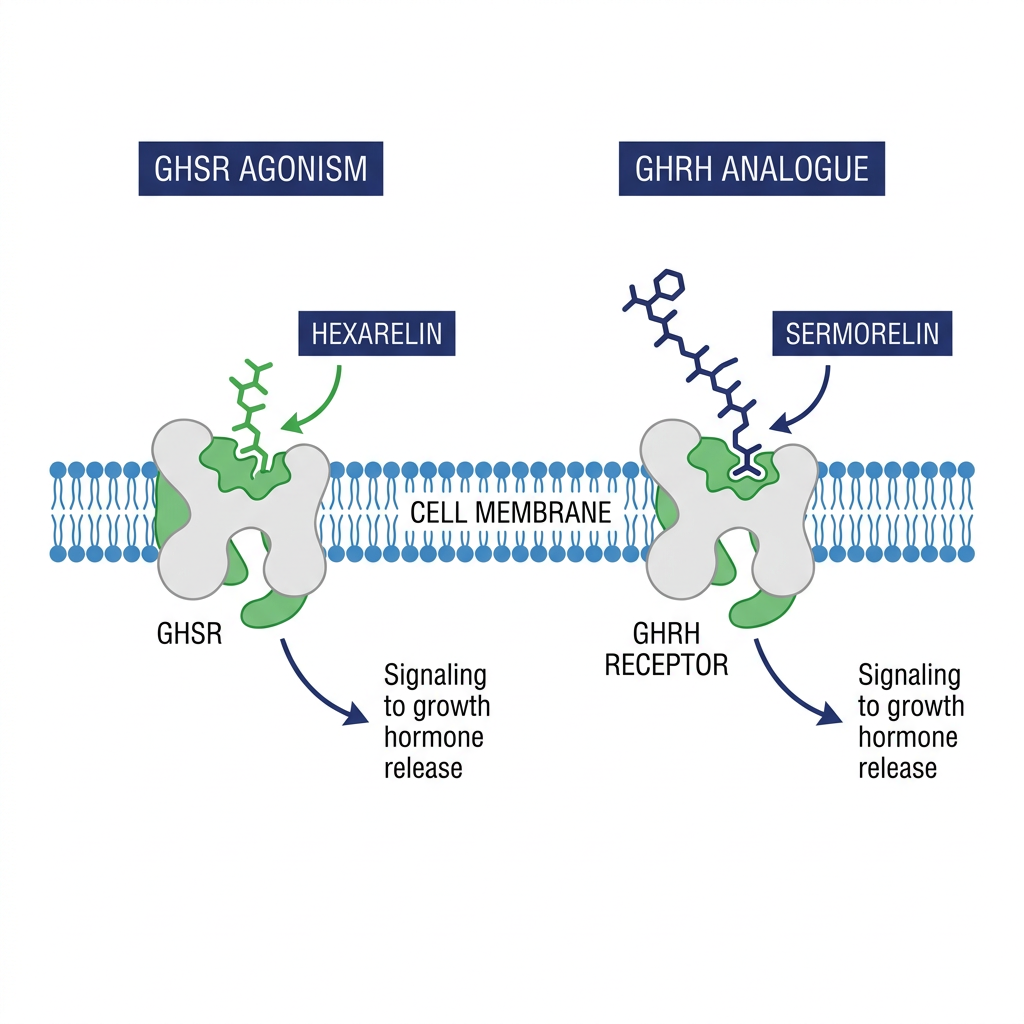
Hexarelin and sermorelin act through different signaling systems: hexarelin is a growth hormone secretagogue receptor agonist, while sermorelin is a GHRH analogue that targets anterior pituitary GH release. Peptides Library treats that receptor split as the starting point for any fair Hexarelin vs Sermorelin: 7 Research Differences Today evaluation.
Sermorelin is a 29-amino-acid analogue of human growth hormone-releasing hormone, described in PubMed review literature as the shortest synthetic peptide with full biological activity of GHRH. Its main action is to stimulate the anterior pituitary to release growth hormone. Mechanistically, that makes it a targeted upstream signal within the GHRH pathway.
This is a key point in any Hexarelin vs Sermorelin: 7 Research Differences Today receptor comparison: sermorelin works through the natural GHRH receptor axis, not the ghrelin pathway. The peptide sequence length and receptor binding profile support that narrower mechanism.
Hexarelin belongs to the GHRP family, not the GHRH family. It acts through the growth hormone secretagogue receptor, commonly discussed alongside ghrelin signaling. That difference is not just naming. If a peptide works through GHSR rather than GHRH receptor biology, then broader endocrine effects become more plausible from the start.
“Peptides Library compares hexarelin and sermorelin by mechanism first: GHSR agonist versus GHRH analogue.”
A common misconception is that every GH secretagogue is simply a stronger or weaker version of the same thing. That is not how these two fit together. They converge on GH release, but they begin from different receptor classes. For deeper background, see Peptide Research Library: A Complete Reference Guide. PubMed-indexed studies on hexarelin and sermorelin support this receptor split.
💡 Key Takeaway: How do hexarelin and sermorelin differ at the receptor level?
Which peptide is more selective for pituitary growth hormone release?
Sermorelin is the more pituitary-selective option, while hexarelin is usually the less selective but stronger secretagogue in human pharmacology studies. PubMed reviews and endocrine challenge data support that distinction.
The clearest research takeaway is selectivity. Sermorelin is described as specifically stimulating growth hormone secretion from the anterior pituitary after intravenous or subcutaneous administration. In contrast, hexarelin has human data showing activity beyond GH.
That does not make hexarelin “worse.” It makes it broader. If a researcher wants a cleaner GHRH-analogue signal, sermorelin is usually the better mechanistic fit. If the aim is to study a more forceful secretagogue profile with possible multi-hormone readouts, hexarelin becomes more relevant.
That contrast is the heart of Hexarelin vs Sermorelin: 7 Research Differences Today selectivity analysis. Many readers assume the stronger acute GH rise answers the entire question. In peptide pharmacology, selectivity often matters just as much as amplitude.

What are the 7 main research differences between hexarelin and sermorelin?
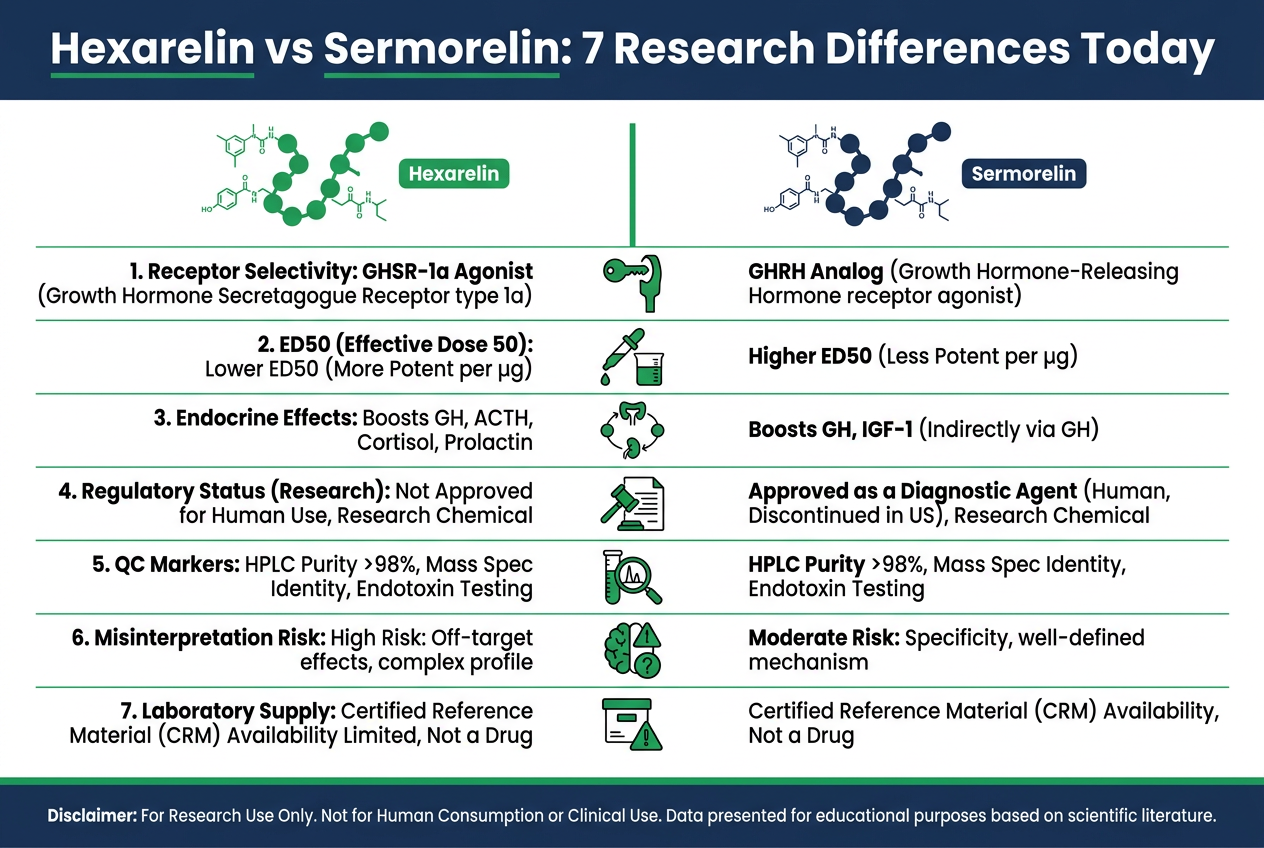
Yes, there are seven practical research differences, and receptor class sits at the top of the list. The rest involve target tissue, endocrine spillover, study endpoints, kinetics, clinical history, and U.S. regulatory context. Here is a working Hexarelin vs Sermorelin: 7 Research Differences Today framework:
1. Receptor class: Hexarelin is a GHSR agonist in the GHRP family; sermorelin is a GHRH analogue.
2. Primary target pathway: Sermorelin more directly stimulates anterior pituitary GH release; hexarelin activates secretagogue signaling with broader downstream effects.
3. Hormone selectivity: Hexarelin human studies report GH plus ACTH, cortisol, and prolactin responses; sermorelin is described more narrowly around GH secretion.
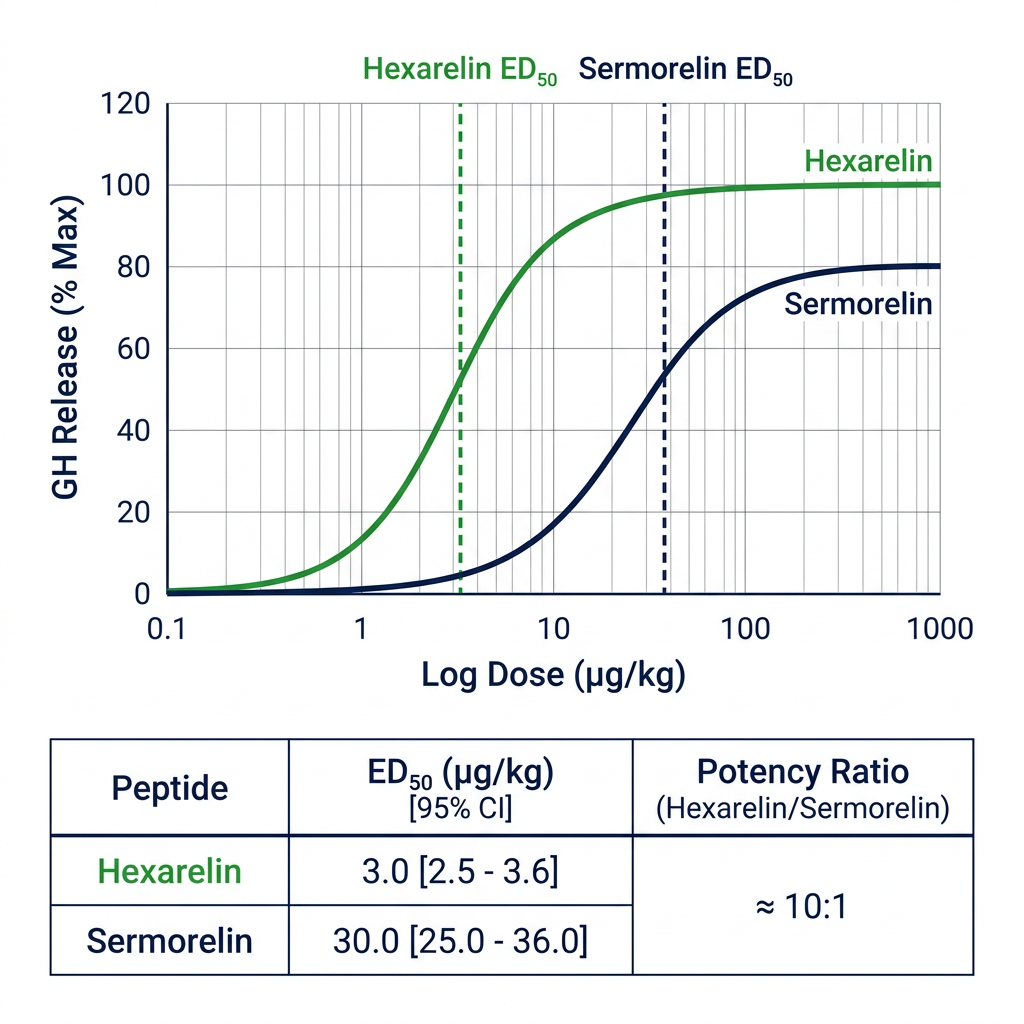
4. Potency readouts: Hexarelin has dose-response data in healthy men, including an ED50 of 0.50 microgram/kg for peak GH response and 0.64 microgram/kg for GH AUC in one IV study.
5. Timing profile: In that hexarelin study, GH peaked at about 30 minutes and returned to baseline by about 240 minutes, which is a very specific acute pharmacology pattern.
6. Human clinical profile: Sermorelin has review data in idiopathic growth hormone deficiency, including once-daily subcutaneous bedtime dosing at 30 microgram/kg in some prepubertal children.
7. U.S. regulatory history: FDA documents identify a sermorelin comparator product, GEREF, with approvals withdrawn in 2009; no FDA-approved U.S. drug status for hexarelin is identified in the provided sources.
This Hexarelin vs Sermorelin: 7 Research Differences Today list helps prevent a common reading error: mixing mechanistic claims, dosing claims, and regulatory claims as if they all measure the same thing. For another side-by-side peptide comparison, see AOD 9604 vs Retatrutide: 7 Research Differences Today.
How do their human endocrine effects compare beyond growth hormone?
Hexarelin affects more than GH in human studies, while sermorelin is described more narrowly around GH release from the anterior pituitary. ACTH, cortisol, and prolactin are the key extra hormones to track.
A 1997 PubMed-indexed study reported that hexarelin significantly increased ACTH and cortisol in normal subjects, with responses described as similar to human CRH in that setting. Another human study from 2002 examined intermittent daily subcutaneous hexarelin and reported stimulation not only of GH, but also prolactin, ACTH, and cortisol.
This finding is frequently overlooked in Hexarelin vs Sermorelin: 7 Research Differences Today summaries. If you are reading a paper on hexarelin, you should not assume GH is the only meaningful endpoint. A study that measures GH alone may miss part of the biological picture.
With sermorelin, the literature summarized in the provided review is more selective. The focus is on growth hormone release from the anterior pituitary rather than a broad endocrine challenge pattern. Common misconception: because both peptides can increase GH, they must have similar off-target hormonal signatures. The available human evidence does not support that shortcut.
💡 Key Takeaway: How do their human endocrine effects compare beyond growth hormone?
How should you compare potency and dose-response data step by step?
Start with matched endpoints, not headline potency claims. Hexarelin ED50 values from intravenous studies and sermorelin bedtime pediatric dosing data answer different questions.
Step 1: Match the route of administration. Hexarelin dose-response data cited here come from single intravenous boluses in healthy men. Sermorelin review data include subcutaneous bedtime dosing in prepubertal children with idiopathic growth hormone deficiency. If the route changes, absorption and timing change with it. For any Hexarelin vs Sermorelin: 7 Research Differences Today potency comparison, route must come first.
Step 2: Match the endpoint. Hexarelin has quantified acute GH response measures, including peak response and AUC. Sermorelin clinical review material speaks more to therapeutic GH stimulation patterns in a defined pediatric population. If one paper measures acute pharmacodynamic intensity and another measures longer clinical response, then a straight potency ranking becomes unreliable.
Step 3: Match the population. Healthy adult men and children with idiopathic GH deficiency are not interchangeable study groups. Baseline endocrine tone, pituitary reserve, and clinical objectives differ. Population matching is another pillar of Hexarelin vs Sermorelin: 7 Research Differences Today evaluation.
“Peptides Library flags a common error: comparing hexarelin IV ED50 data with sermorelin pediatric bedtime dosing as if they were equivalent potency measures.”
A useful rule is simple: if route, endpoint, and population do not match, then potency claims should be treated as context-specific, not universal. That is a foundational principle in any Hexarelin vs Sermorelin: 7 Research Differences Today analysis.

What does the U.S. regulatory history actually show?
At Peptides Library, regulatory checks start with FDA records: sermorelin has a traceable U.S. comparator history, while hexarelin does not show an identified FDA-approved U.S. drug status in the sources provided.
The FDA review materials cited here identify GEREF, a GHRH or sermorelin acetate injection, as the comparator product used in a pivotal trial context. Those same review documents state that production was discontinued and that approvals of the two NDAs containing that comparator product were withdrawn in June 2009.
That concrete event is one of the seven items in Hexarelin vs Sermorelin: 7 Research Differences Today. It is useful, but it needs careful reading. A withdrawn comparator product does not automatically answer every regulatory question, but it does give researchers a concrete U.S. regulatory anchor for sermorelin that hexarelin lacks in the cited records.
Which quality control markers should researchers verify for hexarelin and sermorelin?
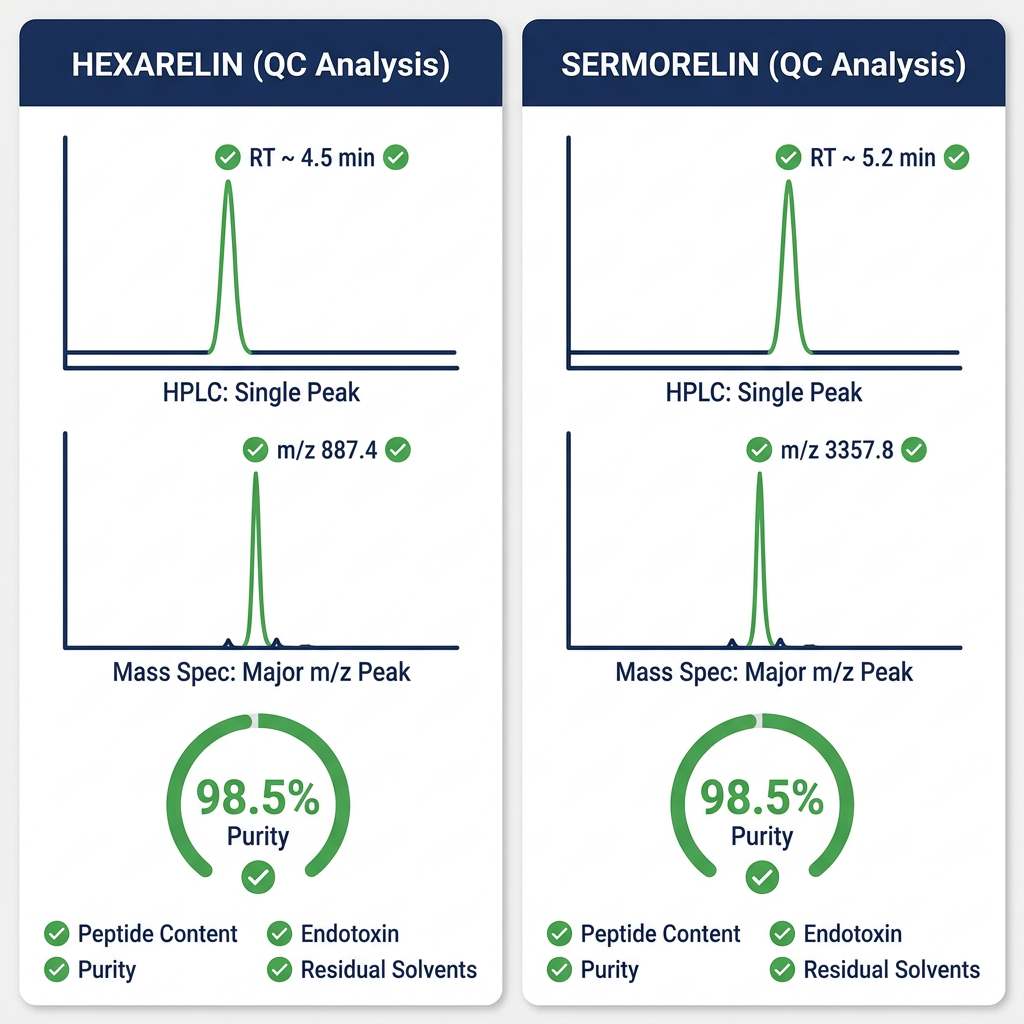
When sourcing either peptide for laboratory studies, request a certificate of analysis (COA) that includes HPLC purity data, mass spectrometry confirmation, and residual solvent or TFA content. Typical research-grade peptides should show purity of at least 95% by HPLC, but always verify the specific batch documentation from your supplier.
Storage conditions are also measurable variables. Lyophilized hexarelin and sermorelin are generally stored at -20°C for long-term stability. After reconstitution, short-term storage at 2-8°C is common for research use, but researchers should follow the exact storage recommendations on the COA and product datasheet.
These quality control markers are not part of the original Hexarelin vs Sermorelin: 7 Research Differences Today endocrine comparison, but they matter for reproducible laboratory results. These practical steps keep a Hexarelin vs Sermorelin: 7 Research Differences Today study reproducible. For a broader overview of research-grade peptide sourcing, see Peptide Library: Research-Grade Peptides for Laboratories.
💡 Key Takeaway: Which quality control markers should researchers verify for hexarelin and sermorelin?
How can researchers avoid common misinterpretations?
The most frequent error in Hexarelin vs Sermorelin: 7 Research Differences Today is conflating “stronger GH response” with “better research tool.” Hexarelin may produce a larger acute GH spike, but that does not make it more selective or more appropriate for every study. Sermorelin’s narrower GHRH analogue profile can be preferable when the goal is to isolate anterior pituitary GH release.
Another misinterpretation is assuming that hexarelin’s multi-hormone effects are automatically adverse. ACTH, cortisol, and prolactin increases are measurable endpoints, not necessarily confounders. Depending on the study question, those extra readouts may be informative.
Finally, do not mix regulatory status with research availability. GEREF’s 2009 withdrawal is a U.S. regulatory event, not a statement about whether sermorelin acetate is available as a research chemical. Always verify the current legal and compliance status for your jurisdiction. This principle applies to every Hexarelin vs Sermorelin: 7 Research Differences Today discussion.

FAQ
What is the primary receptor difference in Hexarelin vs Sermorelin: 7 Research Differences Today?
Hexarelin is a GHSR agonist in the GHRP family, while sermorelin is a GHRH analogue that acts on the anterior pituitary. That receptor split drives selectivity, potency, and endocrine spillover differences.
Which peptide is more pituitary-selective?
Sermorelin is the more pituitary-selective option. Hexarelin has human data showing GH plus ACTH, cortisol, and prolactin responses, making it broader but less selective. That is a core distinction in Hexarelin vs Sermorelin: 7 Research Differences Today.
What are the exact hexarelin dose-response numbers from the cited IV study?
In one IV study, hexarelin had an ED50 of 0.50 microgram/kg for peak GH response and 0.64 microgram/kg for GH AUC. GH peaked at about 30 minutes and returned to baseline by about 240 minutes. Those numbers are often cited in Hexarelin vs Sermorelin: 7 Research Differences Today potency discussions.
How does U.S. regulatory history differ between the two?
FDA records identify GEREF, a sermorelin comparator product, with approvals withdrawn in 2009. No FDA-approved U.S. drug status for hexarelin is identified in the provided sources.
Can I compare hexarelin IV data with sermorelin subcutaneous pediatric data directly?
No. Route, endpoint, and population must match before any potency ranking. Direct comparison is invalid in Hexarelin vs Sermorelin: 7 Research Differences Today without matching these variables.
Ready to Take the Next Step?
Every product includes lot-specific documentation and third-party purity testing.
Explore Our Research Products →Free shipping on qualifying orders · Batch COA on request