



7 TB 500 Side Effects Facts Researchers Should Know
Explore 7 facts researchers should know about TB-500 side effects, FDA safety gaps, immunogenicity risks, and thymosin beta-4 trial data for research use only.
📋 Table of Contents
TB-500 side effects remain uncharacterized in humans because FDA has not identified human exposure data for drug products containing the thymosin beta-4 fragment LKKTETQ. The most defensible facts researchers should know center on that evidence gap, repeated immunogenicity flags, and indirect thymosin beta-4 trial results showing mostly mild to moderate adverse events with no serious adverse events or dose-limiting toxicities in cited intravenous studies. This article separates direct TB-500 data from related full-length thymosin beta-4 findings, keeping the research-use-only framing intact.
Key takeaways
- FDA lacks clinical and nonclinical safety information for TB-500 free base and TB-500 acetate, leaving human harm potential unknown.
- Immunogenicity remains the clearest repeatedly flagged injectable TB-500 risk, tied to aggregation and peptide-related impurities.
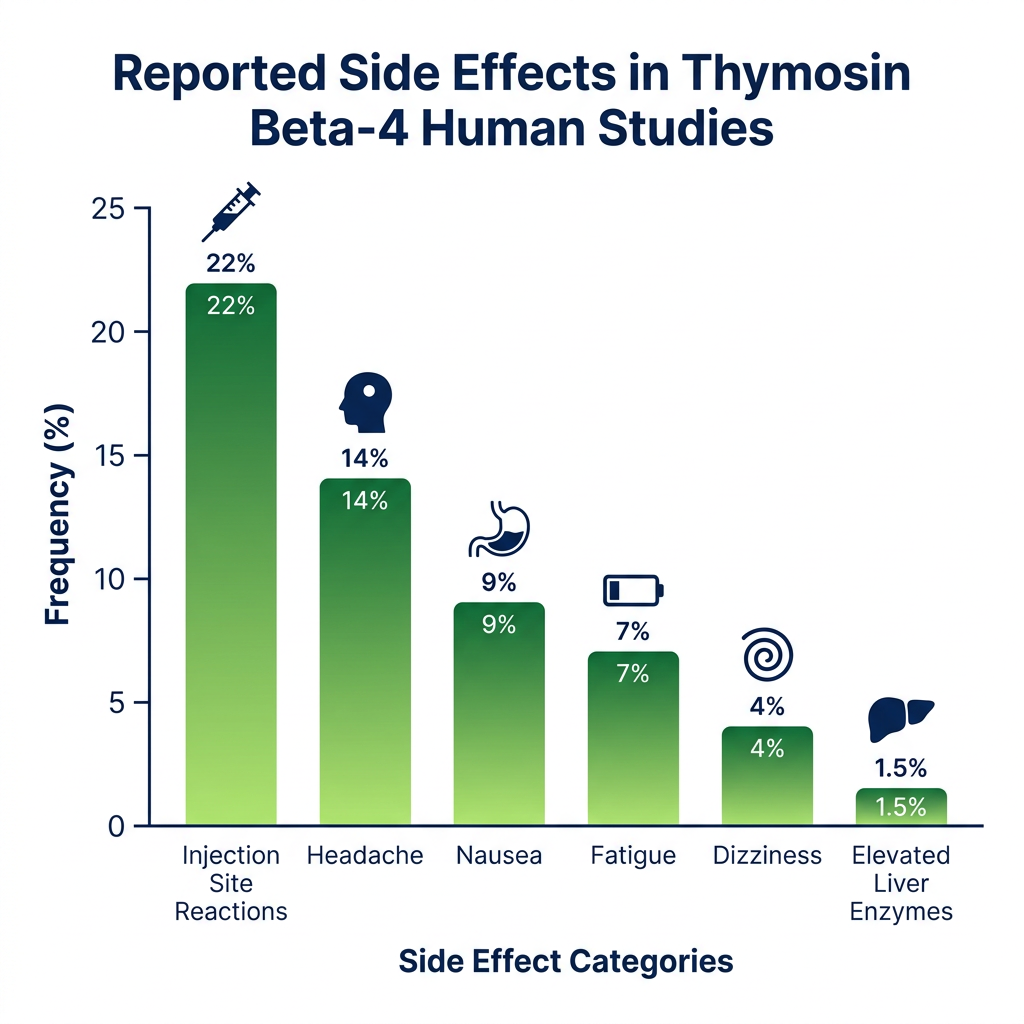
- Related intravenous thymosin beta-4 studies in 40 and 54 healthy volunteers reported mild to moderate adverse events, no serious adverse events, and no dose-limiting toxicities.
- A 72-subject topical 0.1% thymosin beta-4 dry-eye trial reported no adverse events, but topical ocular exposure does not establish injectable TB-500 safety.
- Researchers should treat “no direct human TB-500 data” as the primary safety finding, not a minor caveat.
What does current evidence actually say about TB-500 side effects?
The clearest answer is uncertainty: FDA states that TB-500, the thymosin beta-4 fragment LKKTETQ, lacks adequate clinical and nonclinical safety information, so human harm potential is unknown. Peptides Library treats that evidence gap as the main safety finding, not a minor caveat.
The most important source point comes from FDA reviews in 2025 and 2026. FDA identifies TB-500 as a seven amino acid synthetic fragment of thymosin beta-4 and says it has not identified human exposure data for drug products containing this fragment. That means the standard question, “What side effects have been seen in people taking TB-500?” still has no direct human dataset behind it.
“Peptides Library reads TB-500 cautiously because FDA says no human exposure data have been identified for drug products containing the thymosin beta-4 fragment.”
A common mistake is to treat the absence of documented severe toxicity as if it were evidence of safety. It is not. In safety science, “unknown” is its own category, especially when the compound is injectable and the available information comes from adjacent molecules rather than the exact entity being discussed.
These are not optional caveats but core facts researchers should know before interpreting any TB-500 safety claim. The Peptide Research Library: A Complete Reference Guide explains why molecule-specific evidence matters in peptide research.
Why is TB-500 safety so uncertain in humans?
TB-500 safety is uncertain because the marketed fragment is not backed by the kind of human exposure, dose-ranging, and nonclinical package regulators expect for injectable drugs.
Start with molecule identity. FDA describes TB-500 as the thymosin beta-4 fragment Ac-Leu-Lys-Lys-Thr-Glu-Thr-Gln-OH, also referred to as LKKTETQ. That matters because safety findings are molecule-specific. If the data come from full-length thymosin beta-4 or recombinant human thymosin beta-4, they are related evidence, not direct proof.
Next, check route and formulation. Injectable products carry risks tied to sterility, particulate matter, excipients, concentration, and reconstitution. Even before discussing pharmacology, an injectable peptide can raise product-quality questions that oral or topical materials do not.
Then look for actual human exposure records. FDA’s position is unusually blunt here: it lacks important information about whether TB-500 would cause harm if administered to humans. That is why “limited evidence” is actually a generous phrase. The direct human record for TB-500 itself is missing.
For researchers comparing fragments to full peptides, the Cell Penetrating Peptides for Research | Peptides Library page outlines how structural differences can alter exposure and safety profiles.
💡 Key Takeaway: Why is TB-500 safety so uncertain in humans?
What are the 7 TB-500 side effects facts researchers should know?
Seven facts stand out: there is no direct human TB-500 safety dataset, immunogenicity is the repeated FDA concern, and the closest thymosin beta-4 trials mostly showed mild or moderate adverse events rather than serious toxicity.
After that starting point, the details become more useful than the headlines. The following numbered list captures the facts researchers should know in a review-ready format.
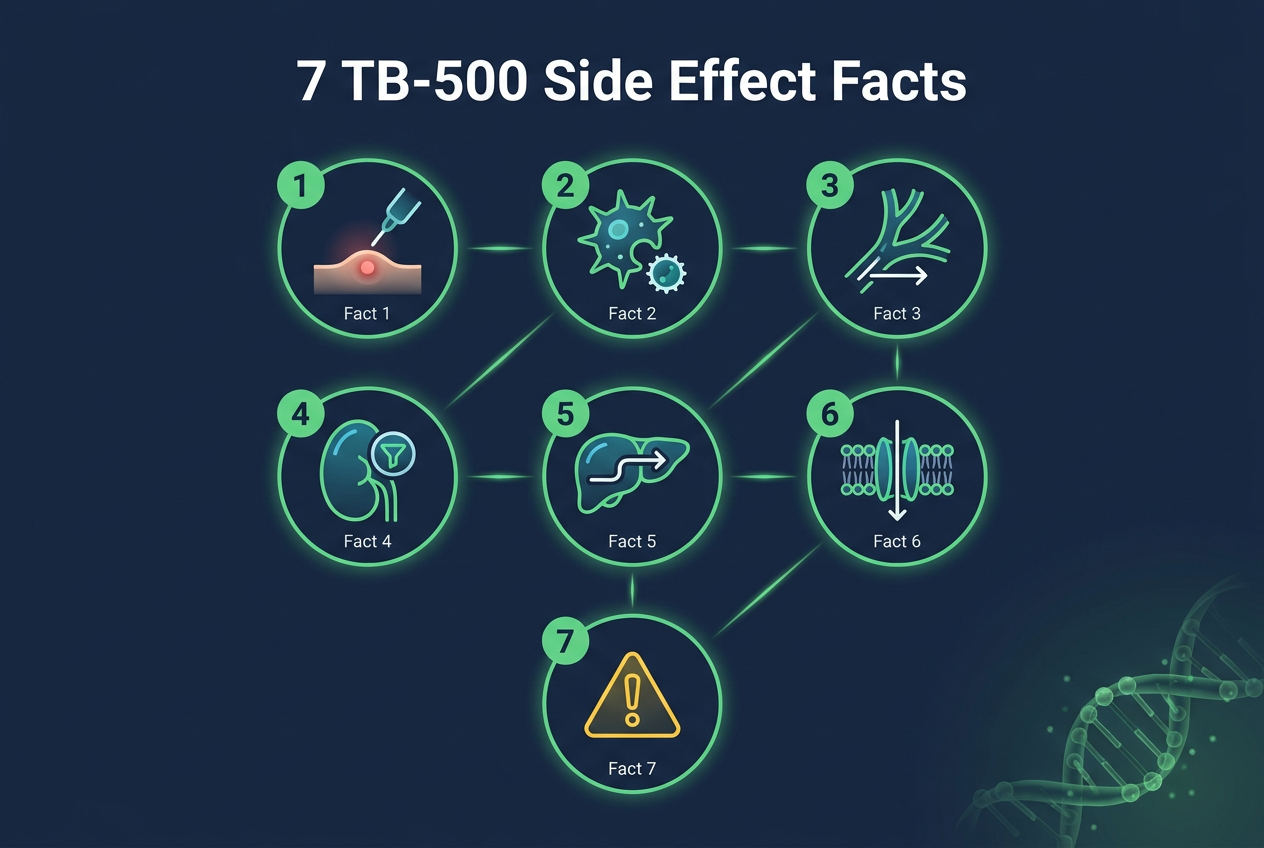
1. No identified human exposure data: FDA says it has not identified human exposure data for drug products containing the thymosin beta-4 fragment known as TB-500.
2. Human harm potential is unknown: FDA also says there is a lack of clinical and nonclinical safety information for both TB-500 free base and TB-500 acetate.
3. Immunogenicity is the clearest flagged risk: FDA repeatedly points to possible immunogenicity, especially with aggregation and peptide-related impurities in injectable products.
4. Injection changes the risk profile: Local reactions, contamination, particulate burden, and formulation quality can create harms that are separate from receptor-level biology.
5. Related intravenous thymosin beta-4 data look mostly mild: In a 2010 randomized placebo-controlled study of 40 healthy volunteers, adverse events were infrequent and mild or moderate across doses from 42 to 1260 mg, with no serious adverse events and no dose-limiting toxicities.
6. A later phase I thymosin beta-4 study was similar: A 2021 first-in-human study in 54 healthy volunteers reported mild to moderate adverse events, with no serious adverse events and no dose-limiting toxicities, and monitored participants for 28 days after single-dose and multiple-dose exposure.
7. Topical safety does not settle injectable safety: A 2015 dry-eye trial randomized 72 subjects to 0.1% thymosin beta-4 or placebo for 28 days and reported no adverse events, but topical ocular exposure is not a substitute for injectable TB-500 data.
The trade-off is clear. Related thymosin beta-4 findings are reassuring enough to prevent automatic worst-case claims, yet they are still too indirect to justify strong safety confidence about TB-500 itself.
How is TB-500 different from thymosin beta-4 in safety discussions?
TB-500 and thymosin beta-4 are related but not interchangeable: FDA describes TB-500 as the seven-amino-acid fragment Ac-Leu-Lys-Lys-Thr-Glu-Thr-Gln-OH, while thymosin beta-4 is the full peptide studied in human trials.
That difference shapes almost every safety interpretation. A fragment may differ from the parent peptide in pharmacokinetics, tissue distribution, receptor interactions, metabolism, and impurity profile. Even if the biological theme overlaps, the safety profile can still shift.
If a paper uses synthetic thymosin beta-4 or recombinant human thymosin beta-4, then it can inform the broader conversation about class behavior and rough tolerability. If the question is “What side effects has TB-500 itself caused in humans?”, then those papers do not answer it directly.
One misconception keeps appearing in peptide discussions: related sequence does not mean interchangeable clinical evidence. That shortcut is tempting, but it lowers the quality of the safety readout. The Peptide Library: Research-Grade Peptides for Laboratories resource reinforces why compound identity cannot be assumed from sequence similarity alone.
What side effects were reported in human thymosin beta-4 studies?
The reported human thymosin beta-4 side effects were mostly mild or moderate treatment-emergent adverse events, with no serious adverse events or dose-limiting toxicities in the cited intravenous studies.
The 2010 PubMed-indexed randomized placebo-controlled trial evaluated intravenous synthetic thymosin beta-4 in 40 healthy volunteers. Across a wide tested dose range of 42 to 1260 mg, adverse events were described as infrequent and mild or moderate in intensity. No dose-limiting toxicities were reported, and no serious adverse events occurred. You can search this study on PubMed.
“Peptides Library separates injectable TB-500 from human thymosin beta-4 findings: mild or moderate adverse events in related studies do not erase FDA’s unknown-harm position for TB-500.”
The 2021 first-in-human phase I study of recombinant human thymosin beta-4 in 54 healthy volunteers reached a similar high-level result. Reported adverse events were mild to moderate, with no serious adverse events and no dose-limiting toxicities. Participants were observed for 28 days after single-dose exposure and again for 28 days after multiple-dose exposure, which gives that study a clearer short-term monitoring frame than informal self-reports ever could.
There is also a 2015 randomized phase II dry-eye trial in 72 subjects using topical 0.1% thymosin beta-4 for 28 days, with no adverse events observed. That sounds highly reassuring, but route matters. Topical ocular exposure does not map cleanly onto injectable systemic exposure.
These indirect human findings are useful but must not be mistaken for direct TB-500 safety data. That is one of the central facts researchers should know when reviewing peptide literature.
💡 Key Takeaway: What side effects were reported in human thymosin beta-4 studies?
How should researchers assess immunogenicity risk step by step?
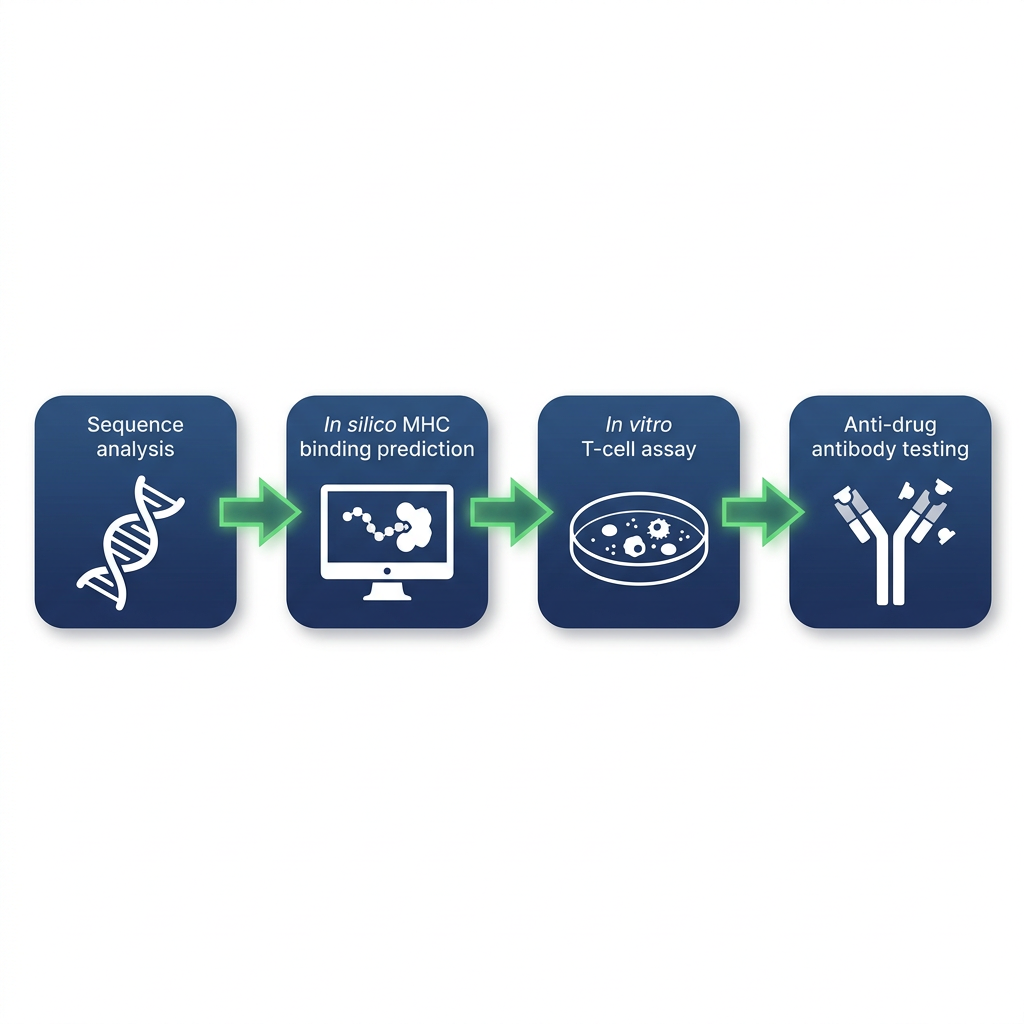
Start with immunogenicity, not general tolerability: FDA repeatedly flags injectable TB-500 for possible immune responses tied to aggregation and peptide-related impurities. A stepwise assessment helps avoid overreading indirect thymosin beta-4 results.
Step one: Check the FDA source language for TB-500. Note that FDA names immunogenicity as a concern area for the injectable fragment and lacks human exposure data for drug products containing LKKTETQ.
Step two: Evaluate aggregation risk. Peptide aggregation can increase immunogenicity by creating repetitive antigenic surfaces. Injectable formulations with poor solubility or improper storage may carry higher theoretical risk.
Step three: Review peptide-related impurities. Impurities can act as adjuvants or novel epitopes, and FDA specifically pairs aggregation with peptide-related impurities when discussing TB-500 immunogenicity.
Step four: Distinguish route of exposure. Injectable administration bypasses mucosal and dermal barriers, so local and systemic immune exposure differ from topical thymosin beta-4 trials.
Step five: Compare with full-length thymosin beta-4 immunogenicity data if available. The cited intravenous studies did not report serious adverse events, but that does not rule out subclinical anti-drug antibody formation or rare immunogenicity signals.
Step six: Request certificate of analysis and purity data for any research material. Without verified purity and aggregation status, immunogenicity risk cannot be properly characterized for a given TB-500 batch.
Step seven: Document the evidence gap. The final step is to state plainly that direct TB-500 immunogenicity data are absent in humans, so any risk estimate remains provisional.
What role do aggregation and peptide-related impurities play in TB-500 risk?
Aggregation and peptide-related impurities are not secondary details; they are the two formulation-related factors FDA repeatedly names alongside possible immunogenicity for injectable TB-500.
Aggregates can trigger immune recognition even when the monomeric peptide is well tolerated. This is a general peptide science principle, not a TB-500-specific finding. For research purposes, aggregation status should be considered part of the safety profile rather than an unrelated quality metric.
Peptide-related impurities may arise from synthesis, degradation, or storage. FDA’s concern is that these impurities could contribute to immune responses when TB-500 is injected. The direct human evidence for this risk is absent, but the regulatory flag is enough to require caution.
Researchers evaluating TB-500 side effects should not rely solely on receptor-level pharmacology. Product quality variables can produce adverse events that have nothing to do with thymosin beta-4 biology.
Which regulatory statements define TB-500 safety status?
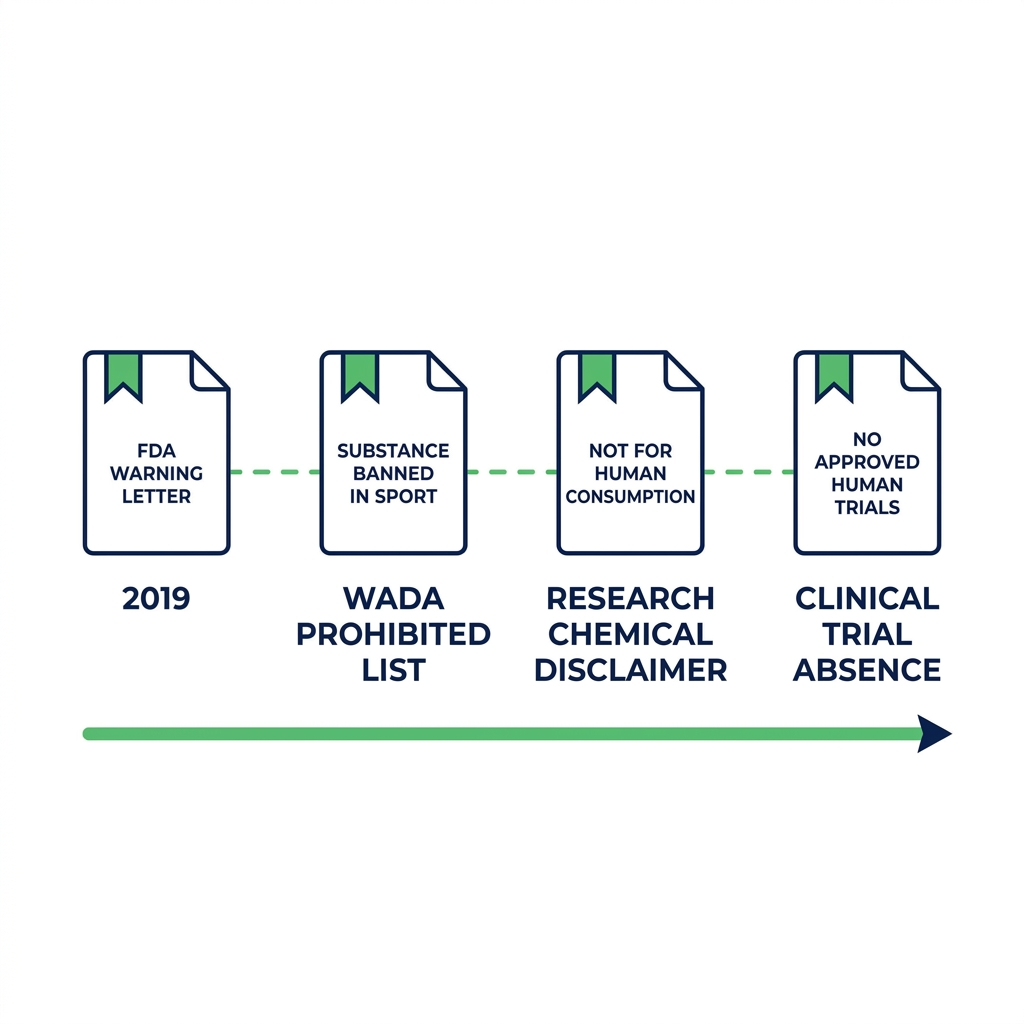
FDA reviews in 2025 and 2026 provide the clearest regulatory anchor for TB-500 safety status. FDA identifies TB-500 as the thymosin beta-4 fragment Ac-Leu-Lys-Lys-Thr-Glu-Thr-Gln-OH and states that it has not identified human exposure data for drug products containing this fragment.
FDA also notes a lack of clinical and nonclinical safety information for both TB-500 free base and TB-500 acetate. This language matters because it covers two common salt forms and still leaves human harm potential unknown.
The regulatory framing does not say TB-500 is proven dangerous. It says the evidence needed to assess harm is missing. That distinction is one of the facts researchers should know before quoting FDA language in a literature review.
You can verify the regulatory context through FDA and related public databases such as NCBI.
💡 Key Takeaway: Which regulatory statements define TB-500 safety status?
How can researchers distinguish direct and indirect safety evidence?
Direct safety evidence would come from human exposure to the exact TB-500 fragment LKKTETQ. Indirect evidence comes from full-length thymosin beta-4, recombinant human thymosin beta-4, or structurally related peptides.
A useful test is to ask three questions. First, is the molecule in the study the same seven-amino-acid fragment? Second, is the route injectable or topical? Third, does the study report actual human exposure or only nonclinical or in vitro data?
If any answer is no, the evidence is indirect. Indirect evidence can still inform a risk discussion, but it cannot establish the human safety profile of TB-500 itself.
This distinction is often skipped in informal peptide commentary. It is one of the most important facts researchers should know when separating signal from assumption.
What should a laboratory safety review include for TB-500?
A laboratory safety review for TB-500 should start with the regulatory evidence gap, then move through product quality, immunogenicity, and indirect clinical data.
First, document that FDA has not identified human exposure data for TB-500 drug products and lacks clinical and nonclinical safety information for both free base and acetate forms.
Second, request certificate of analysis data covering purity, peptide content, residual solvents, and aggregation status for the specific research material.
Third, note the route of intended use in the research protocol. Injectable use carries different product-quality and immunogenicity considerations than topical or in vitro use.
Fourth, summarize the indirect thymosin beta-4 human findings: 40 healthy volunteers in 2010 with doses from 42 to 1260 mg, 54 healthy volunteers in 2021 with 28-day monitoring, and 72 subjects in a 2015 topical 0.1% dry-eye trial.
Fifth, state the conclusion that direct TB-500 side effects remain unknown in humans. This five-part review structure keeps the safety readout accurate and research-use-only compliant.
How do topical thymosin beta-4 findings compare with injectable TB-500?
The 2015 dry-eye trial randomized 72 subjects to topical 0.1% thymosin beta-4 or placebo for 28 days and reported no adverse events. That result is encouraging for topical ocular thymosin beta-4, but it does not transfer to injectable TB-500.
Topical ocular exposure limits systemic absorption and avoids first-pass injection-related risks. Injectable administration introduces sterility, particulate matter, reconstitution, and higher systemic peptide exposure.
The molecule also differs: the trial used thymosin beta-4, not the seven-amino-acid TB-500 fragment. Route, molecule, and formulation all change the risk profile.
For those reasons, the 72-subject topical trial cannot settle injectable TB-500 safety. This is one of the seven facts researchers should know and a common source of overinterpretation.
💡 Key Takeaway: How do topical thymosin beta-4 findings compare with injectable TB-500?
What are the key numbers from the cited thymosin beta-4 trials?
The cited human thymosin beta-4 data include three studies with distinct designs, routes, and participant counts. A summary table helps keep the numbers clear.
| Study year | Design | Participants | Route | Dose or concentration | Duration | Adverse event outcome |
|—|—|—|—|—|—|—|
| 2010 | Randomized placebo-controlled | 40 healthy volunteers | Intravenous | 42 to 1260 mg synthetic thymosin beta-4 | Single dose | Infrequent, mild or moderate; no SAEs; no DLTs |
| 2021 | First-in-human phase I | 54 healthy volunteers | Intravenous | Recombinant human thymosin beta-4 | Single and multiple dose, 28-day monitoring each | Mild to moderate; no SAEs; no DLTs |
| 2015 | Randomized phase II dry-eye | 72 subjects | Topical ocular | 0.1% thymosin beta-4 | 28 days | No adverse events |
These numbers provide a useful context for indirect tolerability, but they do not override FDA’s direct TB-500 evidence gap. Keeping the two layers separate is one of the foundational facts researchers should know.
What is the best-supported conclusion about TB-500 side effects?
The best-supported conclusion is that TB-500 side effects are unknown in humans, while related thymosin beta-4 data look more reassuring than alarming but remain indirect.
No direct human exposure dataset exists for the TB-500 fragment LKKTETQ. FDA’s repeated immunogenicity flags tied to aggregation and peptide-related impurities are the clearest specific risk concerns. Indirect intravenous thymosin beta-4 trials in 40 and 54 healthy volunteers reported mild or moderate adverse events with no serious adverse events and no dose-limiting toxicities, and a 72-subject topical trial reported no adverse events.
Those indirect findings prevent worst-case claims but do not establish safety. Researchers should state that the human safety profile of TB-500 is unknown and that all related thymosin beta-4 evidence is adjacent, not direct.
This balanced position is the most accurate summary of the facts researchers should know, and it avoids both alarmism and false reassurance.
FAQ
What are the most important facts researchers should know about TB-500 side effects?
The most important facts researchers should know are that FDA has not identified human exposure data for TB-500, human harm potential is unknown, immunogenicity is the clearest flagged risk, and related thymosin beta-4 trials showed mostly mild to moderate adverse events with no serious adverse events or dose-limiting toxicities.
Does the absence of serious adverse events in thymosin beta-4 studies prove TB-500 is safe?
No. The cited intravenous thymosin beta-4 studies in 40 and 54 healthy volunteers reported no serious adverse events and no dose-limiting toxicities, but those studies used full-length thymosin beta-4, not the TB-500 fragment. Direct TB-500 human safety data are absent, so safety cannot be proven.
Why does FDA flag immunogenicity for injectable TB-500?
FDA flags immunogenicity because injectable TB-500 may carry aggregation and peptide-related impurities that can trigger immune responses. The direct human immunogenicity data for TB-500 are missing, but the regulatory concern is repeatedly stated and should be treated as a primary risk area.
How should researchers use the 2015 topical thymosin beta-4 trial data?
Researchers should use the 72-subject topical 0.1% thymosin beta-4 trial as indirect evidence only. Topical ocular exposure, the full-length peptide, and the 28-day duration do not establish injectable TB-500 safety, because route, molecule, and formulation all differ.
What is the single clearest safety fact about TB-500?
The single clearest safety fact is that FDA has not identified human exposure data for drug products containing the thymosin beta-4 fragment known as TB-500, so direct human side effects remain unknown. That evidence gap is the starting point for any accurate risk discussion.
Can thymosin beta-4 trial results be applied to TB-500 research use?
Thymosin beta-4 trial results can inform the broader peptide class conversation but cannot be applied directly to TB-500. The seven-amino-acid fragment Ac-Leu-Lys-Lys-Thr-Glu-Thr-Gln-OH may differ in pharmacokinetics, immunogenicity, and impurity profile from full-length thymosin beta-4, so researchers must keep the two molecules separate.
Ready to Take the Next Step?
Every product includes lot-specific documentation and third-party purity testing.
Explore Our Research Products →Free shipping on qualifying orders · Batch COA on request