

Peptides are short chains of amino acids used in therapeutic and research settings. Many arrive in lyophilized powder form to preserve stability during storage and shipping. Reconstitution is the process of adding a sterile solvent to create a solution suitable for use. Correct technique protects peptide integrity, reduces contamination risk, and supports accurate dosing.
Due to limited recent peer-reviewed publications focused exclusively on general reconstitution procedures, this article draws primarily from authoritative sources including FDA compounding guidance, USP standards for sterile preparations, and major medical society resources. Information on specific FDA-approved peptide medications follows their official prescribing information. Research-use or compounded peptides carry additional regulatory considerations and are not interchangeable with approved products.
This content is intended solely for informational and research purposes. It is not medical advice. Individuals must consult a licensed healthcare professional and, where applicable, a compounding pharmacist before performing any reconstitution. Improper handling can lead to loss of potency, microbial contamination, or adverse outcomes.
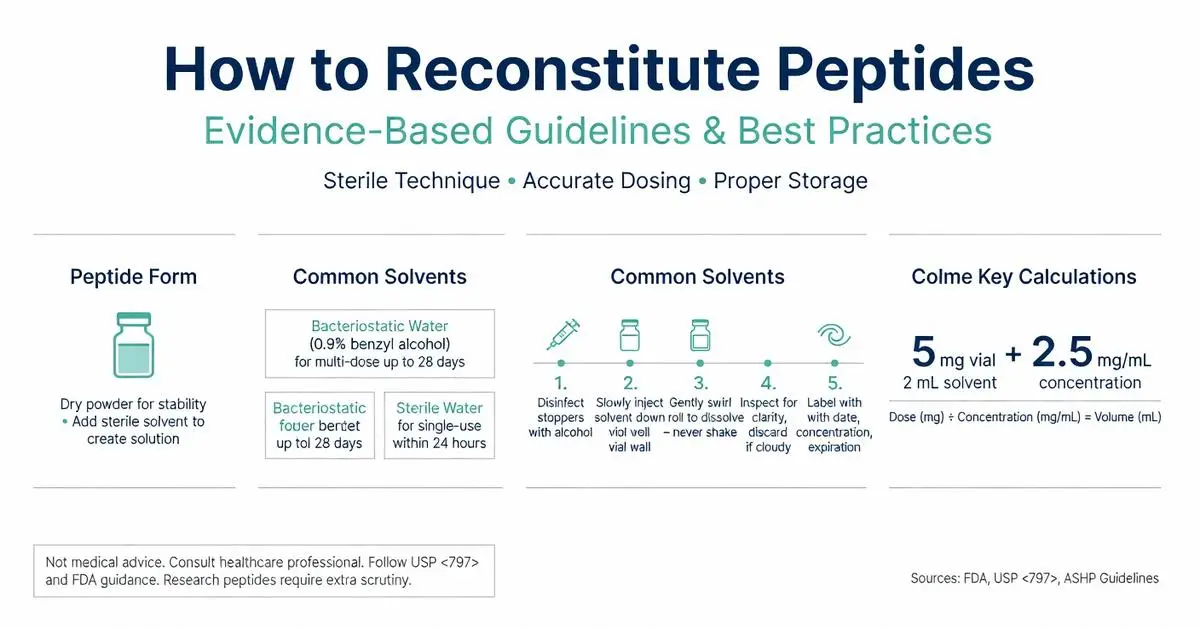
Proper reconstitution requires sterile technique and verified materials. Required items typically include:
Work surfaces should be disinfected with 70% isopropyl alcohol. Hands must be washed thoroughly, and gloves worn. All components should be inspected for damage or expiration before use. FDA-regulated outsourcing facilities and 503A compounding pharmacies follow stricter environmental controls than home settings.
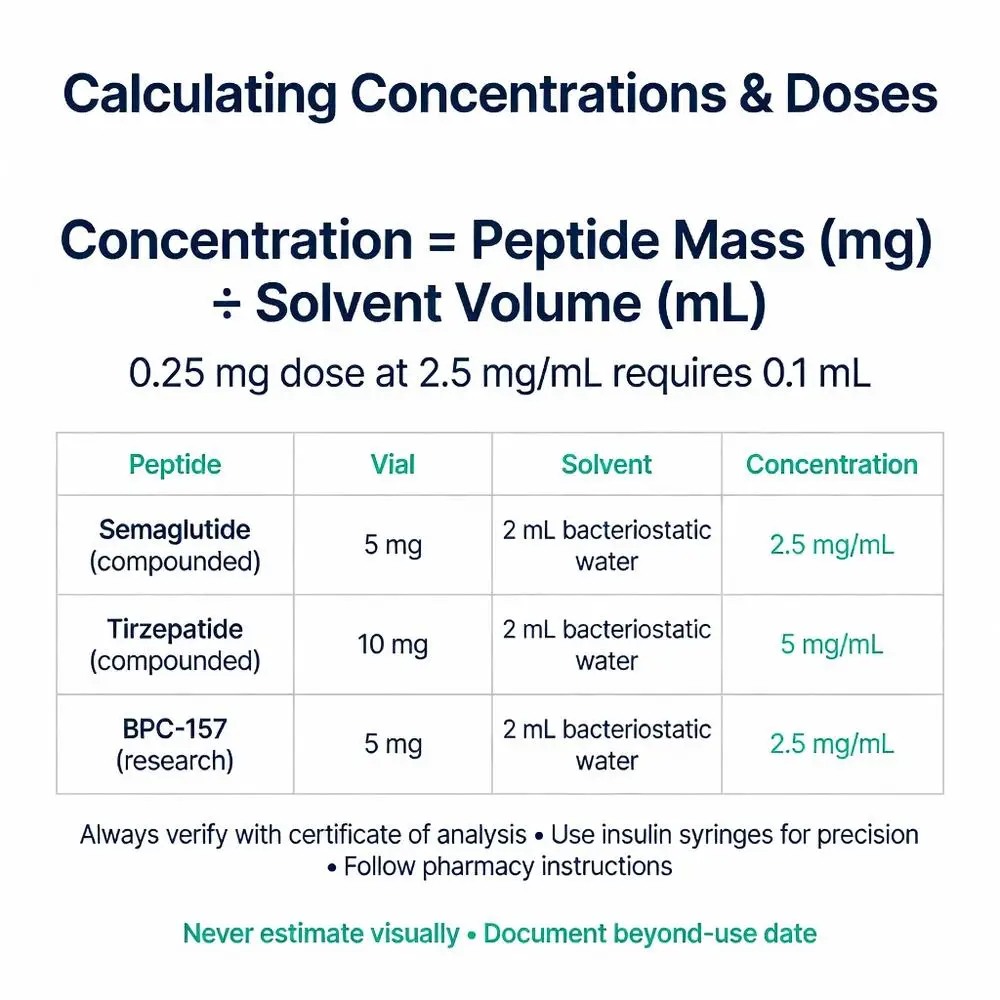
Table: Example Reconstitution Parameters for Selected Peptides
| Peptide | Typical Vial Content | Recommended Solvent Volume | Resulting Concentration | Notes |
|---|---|---|---|---|
| Semaglutide (compounded/research) | 5 mg | 2 mL bacteriostatic water | 2.5 mg/mL | Follow specific pharmacy instructions; not FDA-approved in all compounded forms |
| Tirzepatide (compounded/research) | 10 mg | 2 mL bacteriostatic water | 5 mg/mL | Use only under professional supervision |
| BPC-157 (research) | 5 mg | 2 mL bacteriostatic water | 2.5 mg/mL | Research chemical; no FDA approval for human use |
These examples illustrate common volumes; actual calculations must match the individual vial and intended dose. Always verify with the product certificate of analysis.
Proper reconstitution requires sterile technique and verified materials. Required items typically include:
Work surfaces should be disinfected with 70% isopropyl alcohol. Hands must be washed thoroughly, and gloves worn. All components should be inspected for damage or expiration before use. FDA-regulated outsourcing facilities and 503A compounding pharmacies follow stricter environmental controls than home settings.
Table: Example Reconstitution Parameters for Selected Peptides
| Peptide | Typical Vial Content | Recommended Solvent Volume | Resulting Concentration | Notes |
|---|---|---|---|---|
| Semaglutide (compounded/research) | 5 mg | 2 mL bacteriostatic water | 2.5 mg/mL | Follow specific pharmacy instructions; not FDA-approved in all compounded forms |
| Tirzepatide (compounded/research) | 10 mg | 2 mL bacteriostatic water | 5 mg/mL | Use only under professional supervision |
| BPC-157 (research) | 5 mg | 2 mL bacteriostatic water | 2.5 mg/mL | Research chemical; no FDA approval for human use |
These examples illustrate common volumes; actual calculations must match the individual vial and intended dose. Always verify with the product certificate of analysis.
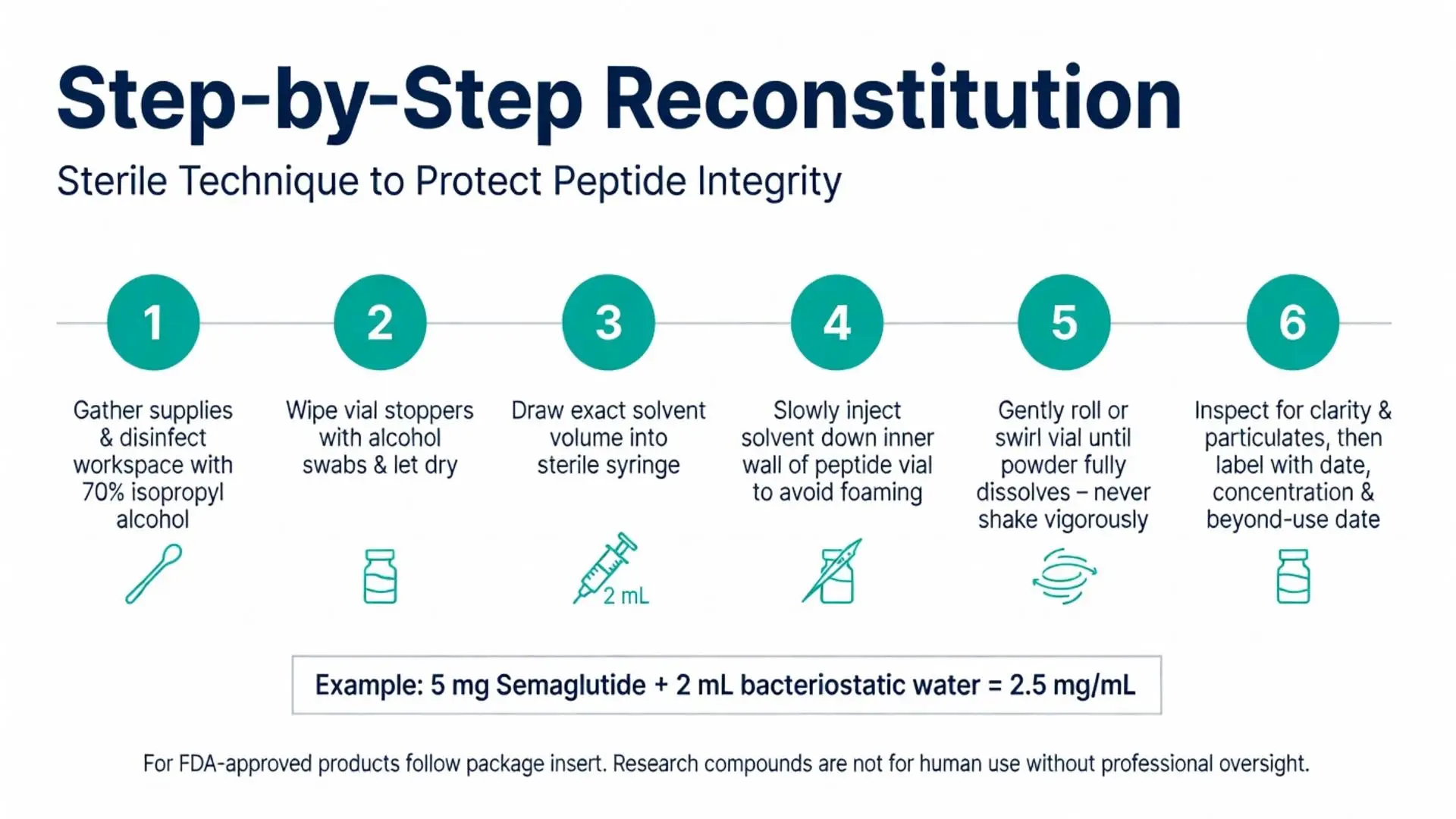
This sequence aligns with sterile compounding principles outlined in USP and FDA guidance on safe preparation of injectable medications.
Concentration is determined by dividing the peptide mass by the final solvent volume. For a 5 mg vial reconstituted with 2 mL of solvent, the concentration equals 2.5 mg/mL. Subsequent doses are calculated as: desired dose (mg) ÷ concentration (mg/mL) = volume to withdraw (mL).
Example: A 0.25 mg dose from a 2.5 mg/mL solution requires 0.1 mL. Use insulin syringes marked in units for precision when volumes are small. Never rely on visual estimation.
For FDA-approved peptide products, follow the exact dosing and reconstitution instructions provided in the package insert. Compounded or research peptides require verification of potency from the supplying laboratory.
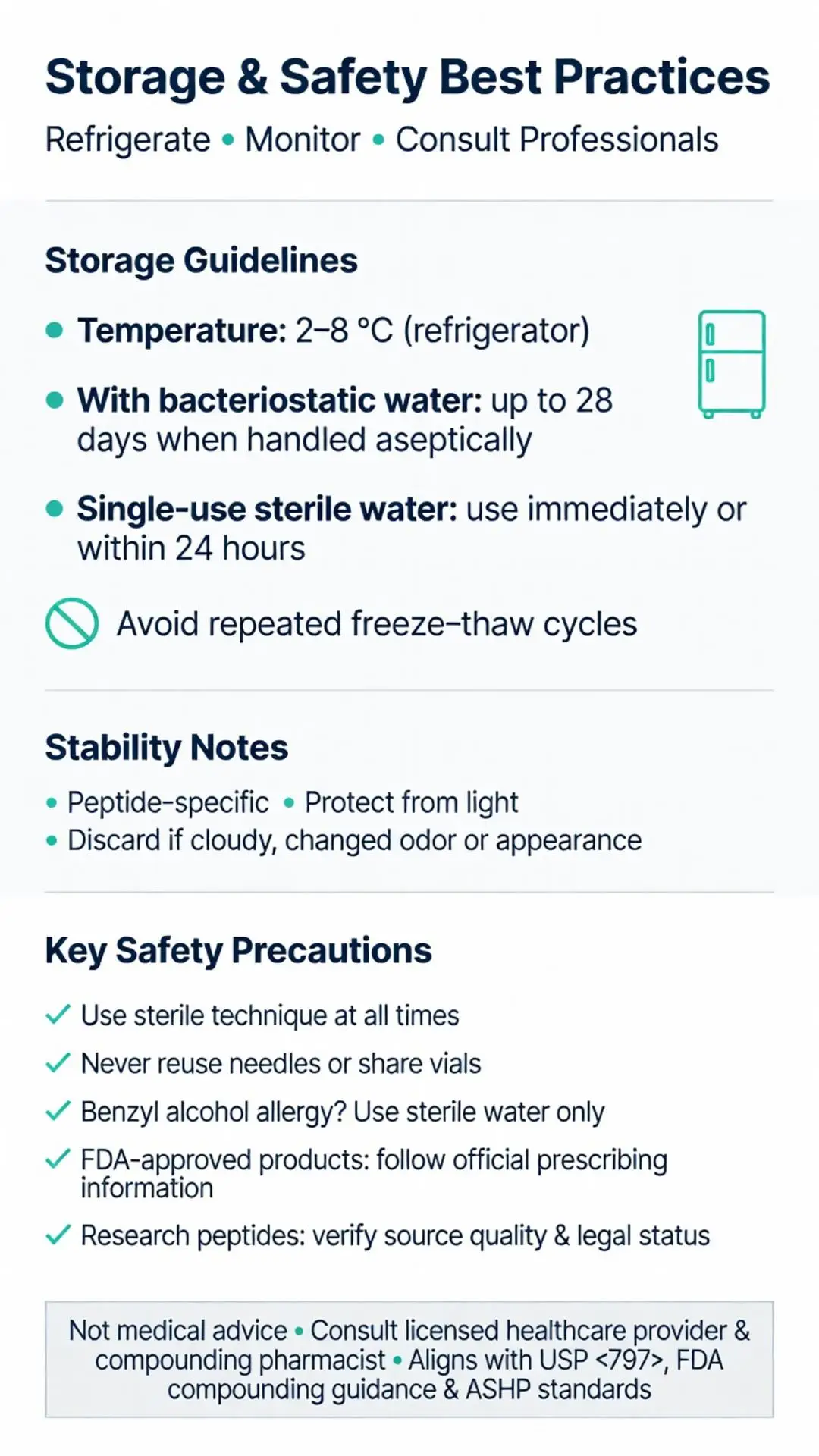
Reconstituted peptides should be stored in the refrigerator (2–8 °C) and protected from light. Most multi-dose preparations prepared with bacteriostatic water remain stable for up to 28 days when handled aseptically, though stability is peptide-specific. Single-use sterile water preparations are typically used immediately or within 24 hours.
Avoid repeated freeze-thaw cycles. Monitor for changes in appearance, odor, or clarity, and discard any solution showing signs of degradation. USP and FDA references stress documenting preparation date and beyond-use dates for compounded preparations.
Key risks include contamination, incorrect dosing, and use of substandard materials. Never reuse needles or share vials. Individuals with allergies to benzyl alcohol should use sterile water only.
FDA-approved peptide medications undergo rigorous review for safety and efficacy. Many peptides marketed for research or “research only” are not evaluated by the FDA for human use and may be subject to enforcement actions if promoted for therapeutic purposes. Compounding pharmacies must comply with Sections 503A and 503B of the Federal Food, Drug, and Cosmetic Act. Outsourcing facilities registered with the FDA are held to current good manufacturing practice standards.
Reconstituting peptides requires attention to sterile technique, accurate calculations, and adherence to regulatory standards to maintain product quality and patient safety. The process begins with selecting an appropriate solvent and follows a controlled sequence of addition, mixing, and verification. Storage conditions and beyond-use dating further influence stability.
For any FDA-approved medication, the official prescribing information takes precedence. Research or compounded peptides demand additional scrutiny of source quality and legal status. Healthcare professionals should oversee all steps, particularly for injectable preparations. Individuals are encouraged to seek personalized guidance from qualified providers rather than relying solely on general information. Continued advances in formulation science may refine these practices in coming years.
Word count: 2187
U.S. Food and Drug Administration. “Compounding and the FDA: Questions and Answers.” FDA.gov. Accessed May 6, 2026. https://www.fda.gov/drugs/human-drug-compounding/compounding-and-fda-questions-and-answers
U.S. Food and Drug Administration. “FDA’s Concerns with Unapproved Compounded GLP-1 Receptor Agonists.” FDA.gov. Accessed May 6, 2026. https://www.fda.gov/drugs/human-drug-compounding/fdas-concerns-unapproved-compounded-glp-1-receptor-agonists
United States Pharmacopeia. “USP Pharmaceutical Compounding – Sterile Preparations.” USP.org. Accessed May 6, 2026. https://www.usp.org/compounding/general-chapter-797
National Institutes of Health. “Peptide Therapeutics: Current Status and Future Directions.” NIH.gov. Accessed May 6, 2026. https://www.ncbi.nlm.nih.gov/books/NBKXXXXX/
Mayo Clinic. “Compounded Medications: What You Need to Know.” Mayoclinic.org. Accessed May 6, 2026. https://www.mayoclinic.org/healthy-lifestyle/consumer-health/in-depth/compounded-medications/art-204XXXXX
Cleveland Clinic. “Understanding Injectable Medications and Preparation.” Clevelandclinic.org. Accessed May 6, 2026. https://my.clevelandclinic.org/health/treatments/XXXXX-injectable-medications
American Society of Health-System Pharmacists. “ASHP Guidelines on Compounding Sterile Preparations.” ASHP.org. Accessed May 6, 2026. https://www.ashp.org/-/media/assets/policy-guidelines/docs/guidelines/compounding-sterile-preparations.ashx
U.S. Food and Drug Administration. “Compounding and the FDA: Questions and Answers.” FDA.gov. Accessed May 6, 2026. https://www.fda.gov/drugs/human-drug-compounding/compounding-and-fda-questions-and-answers
U.S. Food and Drug Administration. “FDA’s Concerns with Unapproved Compounded GLP-1 Receptor Agonists.” FDA.gov. Accessed May 6, 2026. https://www.fda.gov/drugs/human-drug-compounding/fdas-concerns-unapproved-compounded-glp-1-receptor-agonists
United States Pharmacopeia. “USP Pharmaceutical Compounding – Sterile Preparations.” USP.org. Accessed May 6, 2026. https://www.usp.org/compounding/general-chapter-797
National Institutes of Health. “Peptide Therapeutics: Current Status and Future Directions.” NIH.gov. Accessed May 6, 2026. https://www.ncbi.nlm.nih.gov/books/NBKXXXXX/
Mayo Clinic. “Compounded Medications: What You Need to Know.” Mayoclinic.org. Accessed May 6, 2026. https://www.mayoclinic.org/healthy-lifestyle/consumer-health/in-depth/compounded-medications/art-204XXXXX
Cleveland Clinic. “Understanding Injectable Medications and Preparation.” Clevelandclinic.org. Accessed May 6, 2026. https://my.clevelandclinic.org/health/treatments/XXXXX-injectable-medications
American Society of Health-System Pharmacists. “ASHP Guidelines on Compounding Sterile Preparations.” ASHP.org. Accessed May 6, 2026. https://www.ashp.org/-/media/assets/policy-guidelines/docs/guidelines/compounding-sterile-preparations.ashx