



Comparing PT-141 and kisspeptin-10 can look simple on the surface because both appear in conversations about libido, hormones, and sexual physiology. At Peptides Library, the cleaner way to frame the question is by evidence class: PT-141 is an FDA-approved drug product, while kisspeptin-10 remains an investigational peptide discussed mostly in endocrine and regulatory contexts.
TL;DR: Summary
- PT-141 vs kisspeptin-10: PT-141 has stronger regulatory and clinical footing because bremelanotide is an FDA-approved melanocortin receptor agonist product for acquired, generalized hypoactive sexual desire disorder in premenopausal women, while kisspeptin-10 remains investigational.
- Best-supported human outcomes differ: PT-141 is tied to sexual-desire treatment endpoints, while kisspeptin-10 research mainly focuses on LH, FSH, testosterone, and LH pulse frequency.
- Mechanism is not interchangeable: PT-141 works through melanocortin signaling, especially MC1R and MC4R at therapeutic doses, while kisspeptin-10 acts through the reproductive neuroendocrine axis upstream of gonadotropin release.
- Safety context is uneven: FDA materials describe kisspeptin-10 limited nonclinical toxicity information as too limited in scope and duration to inform potential clinical uses.
- Practical takeaway: Use PT-141 when the research question is sexual-function treatment context is labeled sexual-function treatment context; use kisspeptin-10 when the question is reproductive-endocrine mechanism.
That distinction affects almost every serious comparison, from endpoint selection to safety interpretation. If you are asking which peptide has the stronger real-world evidence base today, PT-141 is ahead; if you are asking which peptide is more mechanistically tied to gonadotropin biology, kisspeptin-10 is the narrower fit.
What is the short answer on PT-141 vs kisspeptin-10?
PT-141 and kisspeptin-10 are not close substitutes. As Peptides Library reads the FDA and human data, PT-141 has stronger product-label support for HSDD, while kisspeptin-10 is mainly a reproductive-endocrine research peptide with narrower human evidence.
The fastest way to compare them is to separate three layers: regulatory status, mechanism, and outcome quality. PT-141, also called bremelanotide, has an approved product identity through Vyleesi. Kisspeptin-10 does not have that kind of product-label backing and is discussed more often as an investigational compound within endocrine or compounding-related contexts.
That means the question is not just, “Which peptide is stronger?” The better question is, “Stronger for what?” If the target is a labeled sexual-desire indication, PT-141 clearly has the better footing. If the target is hypothalamic-pituitary-gonadal signaling, kisspeptin-10 becomes more relevant.
How do PT-141 and kisspeptin-10 work differently?
PT-141 acts primarily through melanocortin receptors, especially MC1R and MC4R, while kisspeptin-10 signals through the kisspeptin-GnRH axis. One is framed around central desire biology; the other is framed around gonadotropin release and reproductive endocrine control.
According to DailyMed, bremelanotide is a melanocortin receptor agonist that nonselectively activates several receptor subtypes, with MC1R and MC4R the most relevant at therapeutic doses. That matters because melanocortin signaling is not the same as direct testosterone replacement, direct estrogen modulation, or direct gonadotropin therapy.
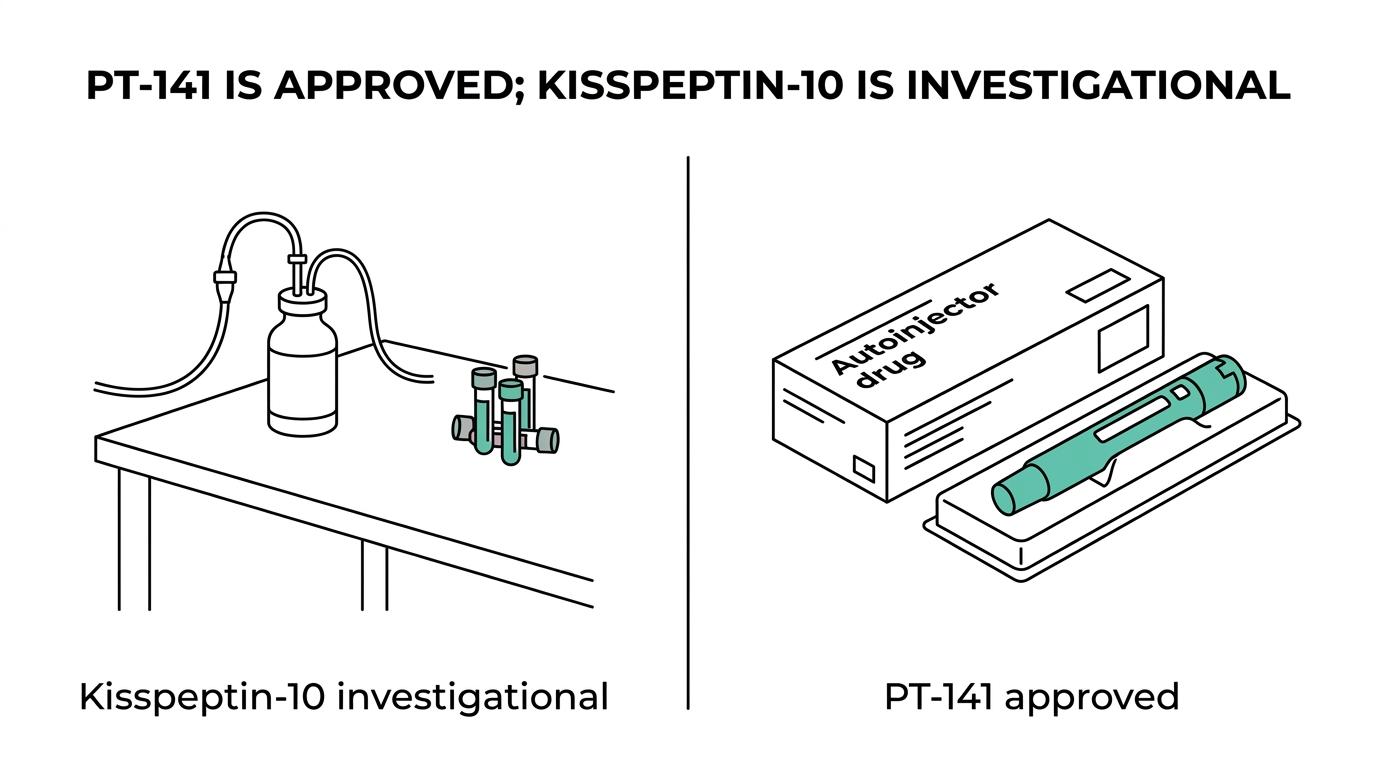
Kisspeptin-10 sits in a different biological lane. Kisspeptin peptides are studied for their role in stimulating GnRH neurons and influencing downstream luteinizing hormone and follicle-stimulating hormone release. In practical terms, kisspeptin-10 is usually discussed as an endocrine signaling tool, not as a labeled libido drug.
“Peptides Library compares PT-141 and kisspeptin-10 as different research categories first: approved melanocortin drug product versus investigational endocrine peptide.”
A common mistake is assuming that anything linked to sexual function must operate through the same hormonal route. That is not how these two peptides map onto physiology. If two compounds affect related symptoms through different systems, then their evidence cannot be merged as if they were the same intervention.
What are the 7 research differences between PT-141 and kisspeptin-10?
The seven biggest differences are regulatory status, receptor target, primary outcomes, approved population, product formulation, safety depth, and evidence maturity. Those seven factors explain why PT-141 usually carries more decision-grade weight in current human-focused comparisons.
When readers mix these compounds together, they usually collapse one or more of those categories. Keeping them separate makes the literature much easier to interpret.
- FDA status: PT-141 is the active ingredient in the FDA-approved product Vyleesi; kisspeptin-10 remains investigational.
- Core mechanism: PT-141 is a melanocortin receptor agonist; kisspeptin-10 primarily acts within the reproductive neuroendocrine pathway.
- Best human endpoints: PT-141 is linked to HSDD treatment outcomes; kisspeptin-10 is linked more to LH, FSH, testosterone, and LH pulse frequency.
- Population fit: PT-141’s labeled indication is limited to premenopausal women with acquired, generalized HSDD. That does not translate automatically to men or postmenopausal women.
- Formulation maturity: PT-141 has a defined drug-device presentation as a subcutaneous autoinjector; kisspeptin-10 research is less standardized at the product level.
- Safety package depth: PT-141 has formal regulatory review as an approved product; FDA materials say kisspeptin-10 has limited nonclinical toxicity information for potential clinical uses.
- Research purpose: PT-141 is closer to a treatment-context peptide; kisspeptin-10 is closer to a mechanistic endocrine probe.
If your question is clinical applicability, differences 1, 3, 4, and 6 matter most. If your question is mechanistic endocrinology, differences 2 and 7 become more important.
Which one has stronger FDA and regulatory status?
PT-141 clearly leads on regulatory status. Vyleesi, the bremelanotide product in DailyMed and FDA records, has an approved NDA and labeled indication; kisspeptin-10 appears in FDA compounding and toxicity materials as an investigational substance, not an approved sexual-dysfunction therapy.
The FDA lists Vyleesi as a new molecular entity approved on June 21, 2019 under NDA 210557. FDA also describes it as a synthetic, cyclic heptapeptide and a complex drug-device combination delivered by subcutaneous autoinjector.
By contrast, kisspeptin-10 appears in a Federal Register notice tied to pharmacy compounding review, where FDA discussed it as a bulk drug substance under evaluation for treatment of secondary hypogonadism in men. That is not the same thing as product approval, labeled efficacy, or standardized clinical use.
One misconception is that “being discussed by FDA” equals “being approved by FDA.” It does not. Regulatory discussion, compounding review, and formal product approval sit in very different categories.
How should you compare the human evidence step by step?
Use a hierarchy of evidence. Peptides Library ranks PT-141 human data above kisspeptin-10 for decision-grade clinical relevance because labeled outcomes, approved population, and delivery details are specified, while kisspeptin-10 evidence is mostly hormonal and mechanistic.
Step 1 is to ask whether the measured endpoint matches the real question. If the question is sexual desire disorder treatment, then patient-centered sexual-function outcomes matter more than endocrine lab shifts. PT-141 has the advantage there because its evidence base connects directly to an approved indication for acquired, generalized HSDD in premenopausal women.
Step 2 is to check population match. PT-141’s label does not extend to postmenopausal women or men, so even PT-141 evidence has boundaries. Kisspeptin-10 discussions often involve endocrine questions, and some related human data in the kisspeptin literature involve different peptide variants, including kisspeptin-54. That is a useful signal, but variant-switching weakens one-to-one inference.
“Peptides Library treats sexual-function endpoints and hormone endpoints differently because they answer different research questions.”
Step 3 is to inspect duration and study design. A 2021 PubMed-indexed review reported that continuous infusion of kisspeptin-10 at receptor-saturating levels increased LH pulse frequency in humans, with no desensitization over 22 hours in the cited human exposure window. That is interesting endocrine evidence, but it is still not the same as an approved sexual-function endpoint.
What outcomes are actually measured in studies of each peptide?
PT-141 and kisspeptin-10 are measured against different kinds of success. PT-141 is anchored to sexual-desire treatment outcomes, while kisspeptin-10 is anchored more often to endocrine biomarkers and reproductive-axis physiology.
This is one of the biggest sources of confusion in online comparisons. A peptide can produce a measurable hormonal effect without proving meaningful benefit for desire, arousal, distress, or relationship-related outcomes. The reverse is also true: a therapy may affect sexual function without acting like a classic gonadal hormone intervention.
A clean comparison looks like this:
- PT-141 primary signal: labeled relevance to hypoactive sexual desire disorder in premenopausal women.
- Kisspeptin-10 primary signal: changes in LH, FSH, testosterone, or LH pulse frequency.
- Interpretation risk: endocrine movement is not the same thing as validated sexual-dysfunction benefit.
- Research consequence: outcome mismatch can make a compound look stronger or weaker than it really is.
A useful rule is simple. If the study’s main readout is hormonal, then it supports endocrine mechanism first. If the study’s main readout is symptom benefit in the labeled population, then it supports treatment relevance first.
How do administration and formulation change interpretation?
Formulation matters more than many comparisons admit. PT-141 is an FDA-classified complex drug-device combination delivered by subcutaneous autoinjector, while kisspeptin-10 literature often centers on research dosing paradigms like infusion or experimental administration.
That difference affects exposure control, real-world use assumptions, and how confidently you can compare papers. A defined commercial formulation reduces some ambiguity around concentration, delivery method, and product identity. With research peptides, those factors are often less uniform across studies or discussions.
This is also where readers can overextend older kisspeptin literature. A 2005 study in the Journal of Clinical Endocrinology & Metabolism reported that systemic kisspeptin-54 significantly increased LH, FSH, and testosterone in male volunteers, with no side effects at any dose in its dose-finding phase. Helpful? Yes. Direct proof for kisspeptin-10? No, because peptide length, pharmacokinetics, and study context can differ.
If you compare compounds without comparing formulation and administration, you risk turning a peptide family discussion into a product-level claim. Those are not the same thing.
How can you evaluate safety and toxicity data step by step?
Start with the missing pieces, not the hoped-for benefit. FDA materials give PT-141 a formal product-label safety frame, while kisspeptin-10 has limited nonclinical toxicity information, including no identified genotoxicity, developmental or reproductive toxicity, or carcinogenicity packages in the cited FDA review.
Step 1 is to separate labeled safety context from sparse preclinical context. PT-141 benefits from the kind of regulatory package that exists for an approved drug product. Kisspeptin-10 does not have that same maturity in the material cited here.
Step 2 is to read limited-data statements carefully. In an FDA review document, the agency said it did not identify nonclinical genotoxicity, developmental and reproductive toxicity, or carcinogenicity studies with kisspeptin-10, and that available nonclinical toxicity studies were too limited in scope and duration to inform safety considerations for potential clinical uses.
A common misconception is that absence of identified studies equals proof of safety. It does not. It means the safety picture is incomplete, which should lower confidence rather than raise it.
Step 3 is to ask whether the safety evidence matches the intended use. If the proposed use is repeated or broad clinical use, then limited nonclinical scope is a much bigger problem than if the question is narrow mechanistic research.
How do you choose the right research lens step by step?
Choose the peptide by question, not by hype. If the question is approved sexual-function treatment context, PT-141 fits better; if the question is hypothalamic-pituitary-gonadal signaling, kisspeptin-10 is usually the cleaner mechanistic model.
Step 1 is to define the endpoint before naming the peptide. Desire disorder, arousal biology, gonadotropin release, testosterone movement, and fertility-related signaling are related topics, but they are not identical research aims.
Step 2 is to rank what kind of evidence you need. If you need regulatory clarity and a labeled product framework, PT-141 wins. If you need mechanistic insight into upstream reproductive endocrine signaling, kisspeptin-10 may be more directly informative even with a thinner clinical package.
Step 3 is to apply if-then logic. If the research question depends on approved indication, product label, and standardized administration, then PT-141 is the better reference point. If the research question depends on LH pulse frequency or GnRH-axis activation, then kisspeptin-10 is more relevant even though it has less mature safety and regulatory support.
What are common misconceptions about PT-141 vs kisspeptin-10?
The biggest mistakes are treating PT-141 and kisspeptin-10 as interchangeable, treating hormone changes as proof of clinical benefit, and treating any kisspeptin study as direct evidence for kisspeptin-10.
First, approved does not mean universal. PT-141’s indication is specific: acquired, generalized HSDD in premenopausal women. DailyMed also states that Vyleesi is not indicated for postmenopausal women or men. So even the better-supported peptide has population limits.
Second, endocrine response does not automatically map to sexual-function success. A rise in LH, FSH, or testosterone can be biologically meaningful without answering whether a patient’s libido, distress, or functional outcome improved.
Third, not all kisspeptin evidence is variant-specific. Kisspeptin-54 findings can inform the broader biology, but they should not be treated as clean substitutes for kisspeptin-10 data. That distinction becomes even more important when people try to compare the peptide directly against a labeled product like PT-141.
The sharpest way to read this topic today is to keep one sentence in mind: PT-141 is better established as a regulated sexual-function product, while kisspeptin-10 is better framed as an investigational endocrine signaling peptide.