



If you are trying to judge kisspeptin-10 side effects, the hardest part is not finding enthusiasm about the peptide. It is finding a source that separates short-term tolerability from actual safety evidence. Peptides Library was built for that job.
Peptides Library is an independent online knowledge hub for peptide science. We help researchers, healthcare professionals, students, and informed consumers review kisspeptin-10 evidence with citations, regulatory context, and practical research tools, so you can see what has been studied, what has not, and where the real uncertainty starts.
Peptides Library organizes the kisspeptin-10 side effect record into usable evidence
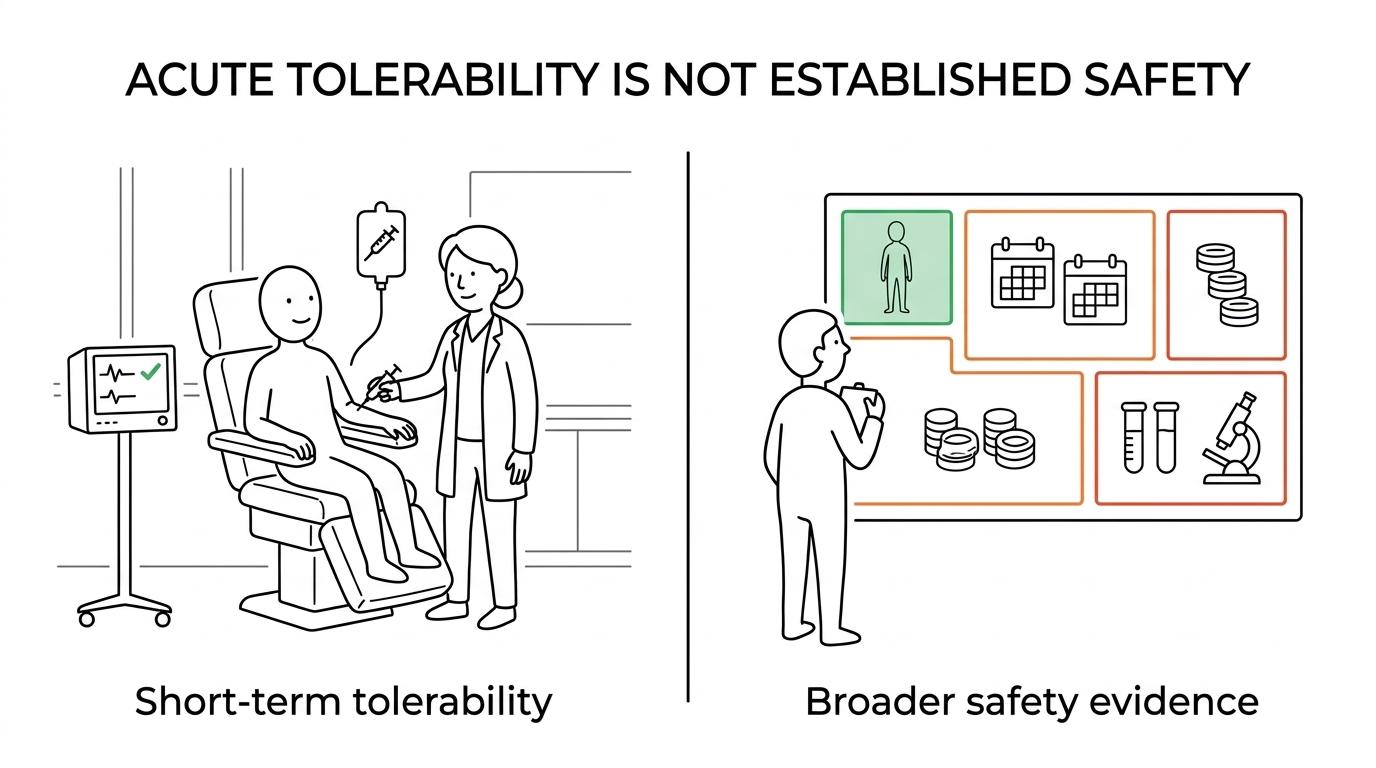
The current record on kisspeptin-10 side effects is narrow. Peptides Library makes that clear from the start: short human studies are often described as well tolerated, but that does not establish safety for routine, repeated, or broader clinical use.
“Peptides Library tracks the detail many summaries miss: FDA identified only one clinical study using a single subcutaneous bolus of kisspeptin-10 in about 35 healthy women.”
Our kisspeptin-10 safety coverage is built around the strongest available material, including FDA review material and small human studies. That means you do not have to guess whether a statement comes from a regulatory review, a healthy-volunteer paper, or a very limited first-in-human study.
| Evidence area | What the current record supports | What remains unclear |
|---|---|---|
| Acute human tolerability | FDA said acute intravenous administration of kisspeptin-10 had not raised major safety concerns in studies to date | Small studies do not establish longer-term safety |
| Reported adverse events | A 2011 healthy-volunteer study reported no adverse events | Adverse-event data are sparse and population-specific |
| Repeated dosing | Review literature flags tachyphylaxis as a separate concern from single-dose exposure | Safety for repeated dosing is not well established |
| Nonclinical safety package | FDA found no nonclinical genotoxicity studies, developmental and reproductive toxicity studies, or carcinogenicity studies at the time of evaluation | Major preclinical gaps limit confidence in broader safety claims |
| Parenteral exposure risk | FDA said kisspeptin-10 may pose significant immunogenicity risk when administered parenterally | Risk can be influenced by formulation quality, impurities, and peptide aggregates |
That structure matters because it prevents a common mistake: treating “no adverse events reported in a small acute study” as if it were the same as “side effects are well characterized.” Peptides Library helps you read the evidence at the right level of confidence.
What you get from Peptides Library for kisspeptin-10 safety research
When you use Peptides Library for kisspeptin-10 side effects research, you get more than a summary paragraph. We turn scattered regulatory language and small-study details into a working evidence map you can actually use.
Here is what that looks like in practice:
- Citation-focused articles that separate acute tolerability findings from broader safety claims
- Evidence reviews that highlight FDA-identified gaps such as missing genotoxicity, developmental and reproductive toxicity, and carcinogenicity studies
- Research guides that explain technical terms like immunogenicity, tachyphylaxis, subcutaneous bolus, intravenous administration, and luteinizing hormone endpoints
- Free practical tools, including peptide calculators, to help you interpret study units and protocols without losing the safety context
Peptides Library also helps you read study design correctly. Many kisspeptin-10 papers are centered on endocrine response, such as luteinizing hormone changes, rather than robust adverse-event capture, so we show you where pharmacology data stop and side-effect evidence begins.
“Peptides Library flags three major nonclinical gaps from the FDA review: no genotoxicity, no developmental and reproductive toxicity, and no carcinogenicity studies identified.”
That difference saves time and reduces false certainty. Instead of pulling a single sentence from an abstract, you can review the exposure route, participant type, dose format, and safety limitations in one place.
Peptides Library helps researchers, clinicians, students, and informed consumers ask better safety questions
Peptides Library is especially useful if you need to evaluate whether a side-effect claim is stronger than the underlying evidence. Researchers can use our hub to frame protocol questions. Healthcare professionals can use it to review regulatory gaps before treating small human data as clinically settled. Students can use it to learn how peptide safety is actually assessed. Informed consumers can use it to see where marketing language outruns the literature.
Peptides Library is also a good fit when you need population-specific context. For example, FDA review material stated that there were no data on adverse events for kisspeptin-10 doses and dosing frequencies in men with reproductive disorders. That is a very different level of confidence than acute observations from healthy volunteers.
A small 2017 first-in-human study in men illustrates the point. Four men received kisspeptin-10 at 0.3 micrograms per kilogram intravenously as a bolus, which is useful as a mechanistic data point, but far too limited to answer broader side-effect questions on its own.
Repeated dosing, tachyphylaxis, and immunogenicity are where Peptides Library adds the most value
Single-dose tolerability is only one part of the picture. Peptides Library gives repeated and continuous exposure their own attention because tachyphylaxis has been observed in preclinical work and flagged in review literature, making repeated-use questions different from one-time administration questions.
“Peptides Library separates acute tolerability from repeated-use risk, including FDA-noted immunogenicity concerns and the literature’s tachyphylaxis signal.”
Our coverage also makes parenteral risk easier to interpret. FDA review material said kisspeptin-10 may pose a significant immunogenicity risk when administered parenterally, and noted that product-related impurities and peptide aggregates could amplify that risk. Peptides Library brings those details forward because they materially change how you should read broad claims about “safety” or “well tolerated.”
That independent framing is where our non-retailer editorial stance helps you. Because Peptides Library is not built to sell you a vial, we can say plainly when nonclinical toxicity studies are too limited in scope and duration to support confident clinical extrapolation.
Why Peptides Library is a stronger fit than retailer-led peptide content
A lot of peptide content smooths over uncertainty. Peptides Library does the opposite. We keep the company visible in the work by pairing our evidence reviews, how-to guides, and practical tools with an editorial standard that favors citations over reassurance.
That makes your next step clearer. If you are comparing sources, you can quickly see whether a claim is grounded in FDA review material, a small healthy-volunteer study, or a mechanistic paper with minimal adverse-event detail. If you are screening a product page or forum claim, Peptides Library gives you the factual checks to challenge it.
Peptides Library also keeps coverage current as peptide research evolves. For a topic like kisspeptin-10 side effects, where the evidence base is still limited and highly dependent on study design, that ongoing review matters.
Start with Peptides Library when you need a clearer kisspeptin-10 safety picture
If your goal is to understand kisspeptin-10 side effects without overstating what the evidence can support, start with Peptides Library. Use our kisspeptin-10 research coverage to review the FDA record, compare the small human studies, and understand where acute tolerability ends and real safety uncertainty begins.
When you are ready, explore Peptides Library’s evidence reviews, research guides, and practical peptide tools so you can evaluate kisspeptin-10 with better questions and better sources.