


Peptide Lead Discovery Library: 7 Proven Strategies for 2025
Peptide lead discovery library strategies for 2025: high-throughput screening, affinity selection, nanoLC-MS/MS, and hit-to-lead optimization.
📋 Table of Contents
A peptide lead discovery library is a curated collection of synthetic or genetically encoded peptide sequences designed for high-throughput screening against biological targets in vitro. Researchers use such a peptide lead discovery library to identify initial hit compounds through affinity selection, phage display, mRNA display, or DNA-encoded library platforms, then advance validated hits through hit-to-lead optimization. This guide details seven proven strategies for 2025 covering construction, screening, and optimization of a peptide lead discovery library for drug discovery research.
Key takeaways
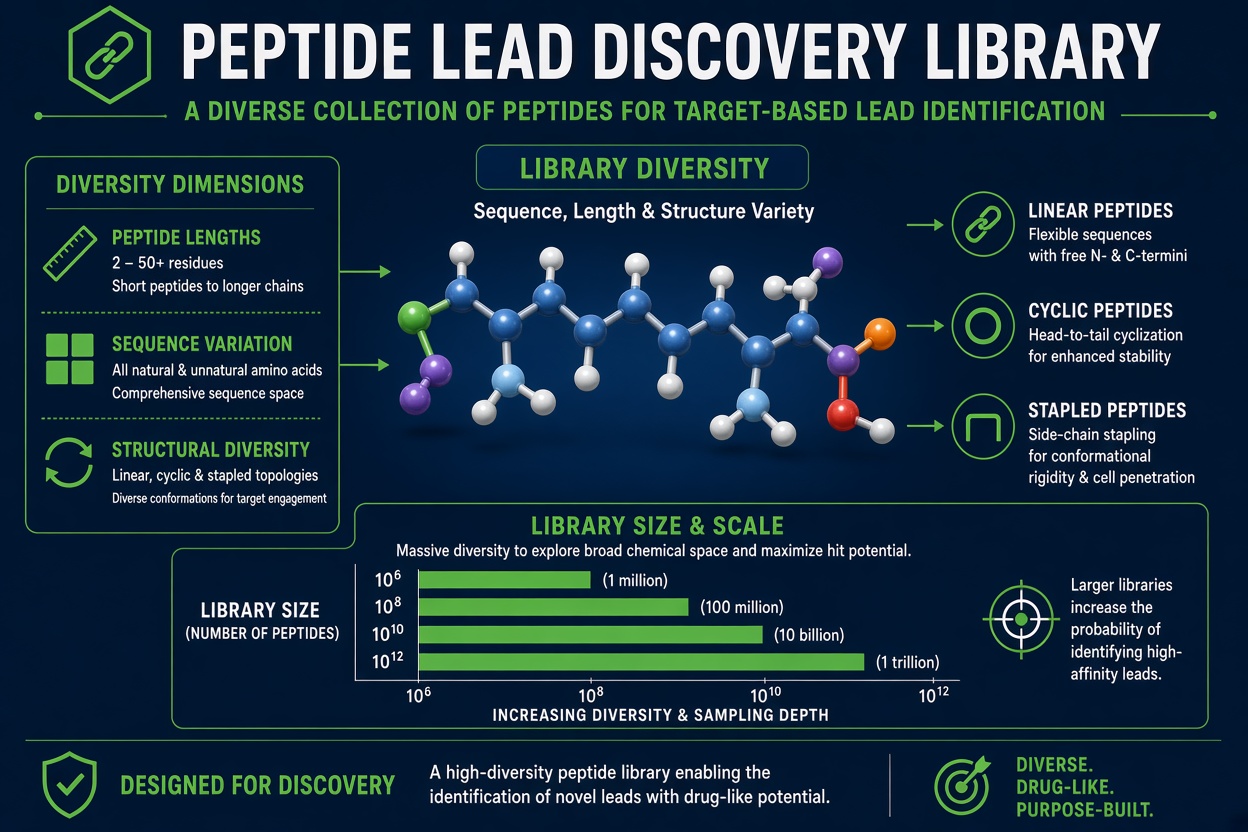
- A peptide lead discovery library accelerates hit identification through massively parallel in vitro screening of 10^6–10^12 unique sequences.
- Affinity selection coupled with nanoLC-MS/MS resolves binding peptides without genetic tags.
- Virtual ultra-large libraries enable in silico screening of billions of peptide analogs before synthesis.
- DNA-encoded and mRNA display platforms link phenotype to genotype for iterative selection.
- Cyclic peptide libraries validate against targets such as MDM2, 14-3-3, AFP, and SARS-CoV-2 RBD.
- Hit-to-lead optimization focuses on ADME/PK tuning, oral bioavailability, and scale-up cost control.
⚠️ Research Use Only Notice: The products discussed on this site are sold strictly for in vitro laboratory research purposes only. They are not for human use, not for veterinary use, and not intended to diagnose, treat, cure, or prevent any disease. All information presented is for educational purposes in a research context. Must be 21+ to purchase.
What is a peptide lead discovery library?
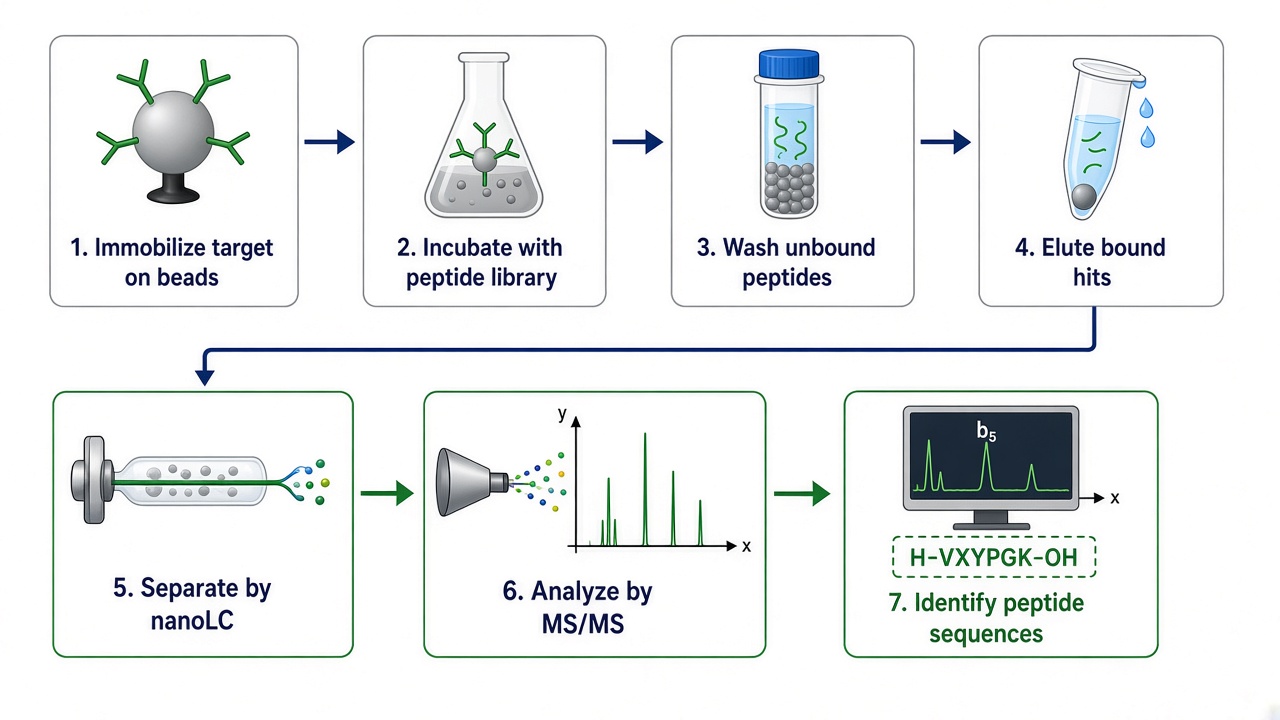
A peptide lead discovery library is a systematically organized collection of peptide sequences used in early-stage drug discovery research. Unlike single-compound screening, a library allows parallel interrogation of thousands to billions of molecular variants against a target of interest.
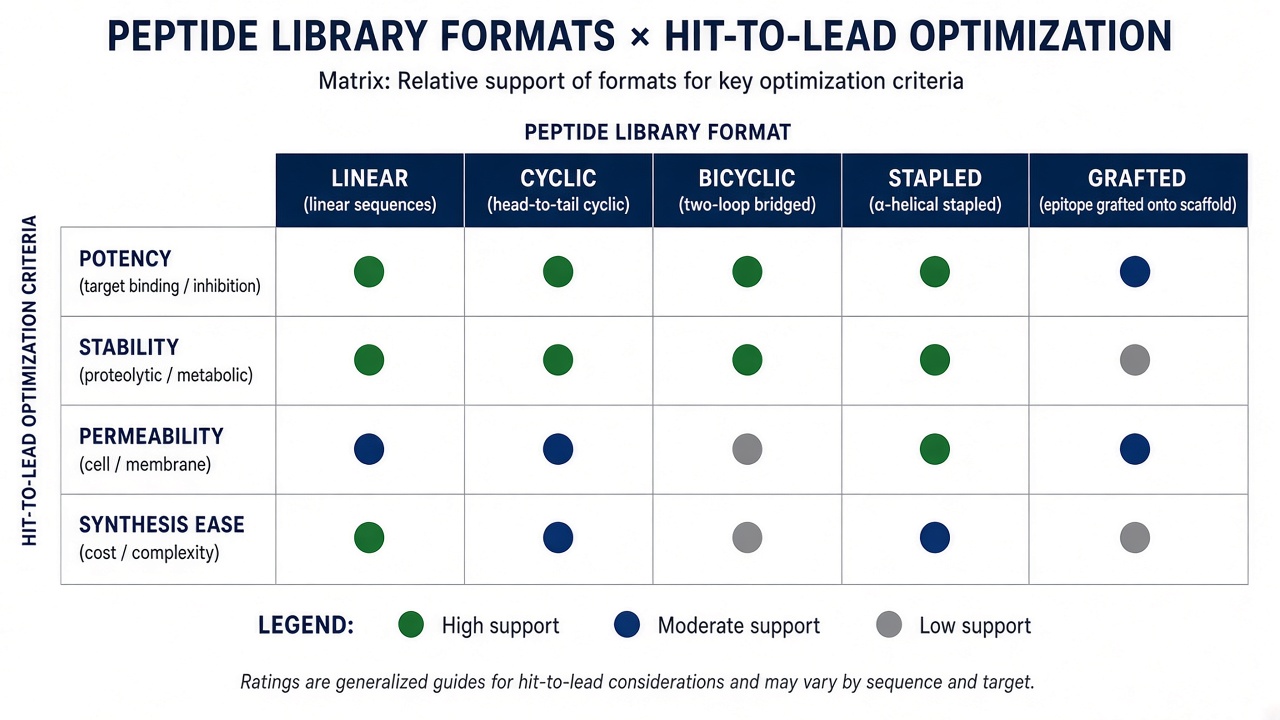
The library may be composed of linear peptides, cyclic peptides, stapled peptides, or peptidomimetics, depending on the desired conformational constraint and metabolic stability. Researchers select a peptide lead discovery library format based on screening throughput, hit validation requirements, and downstream synthetic feasibility.
For a broader overview of available research formats, see amino acid vs peptide hormones — : 7 Key Research — Essential.
A well-constructed peptide lead discovery library balances diversity, purity, and sequence space coverage. The library may be purchased as pre-made screening sets or synthesized on demand with custom constraints. Common library designs include positional scanning, alanine scanning, and random combinatorial libraries. Each design offers different trade-offs between coverage and ease of deconvolution.
Design principles for a peptide lead discovery library
Positional scanning libraries systematically substitute each residue with all 20 canonical amino acids, enabling rapid identification of critical positions for binding. Alanine scanning libraries replace residues with alanine to assess side-chain contributions. Random combinatorial libraries generate diverse sequences without bias, but require deconvolution strategies such as iterative subpooling or encoding tags.
Library diversity is often quantified as the number of unique sequences divided by the total bead count. A well-designed peptide lead discovery library maintains at least 10^4 copies of each sequence on average to ensure statistical representation during screening. Purity thresholds for research-grade libraries typically exceed 90% by HPLC.
| Library Design | Coverage | Deconvolution Ease | Typical Use |
|—|—|—|—|
| Positional scanning | Systematic substitution at each position | High | Epitope mapping, SAR |
| Alanine scanning | Single residue replacement | High | Side-chain contribution analysis |
| Random combinatorial | Full sequence space | Low | De novo hit discovery |
| Focused combinatorial | Reduced sequence space around a hit | Medium | Hit-to-lead optimization |
How does affinity selection with nanoLC-MS/MS work for a peptide lead discovery library?
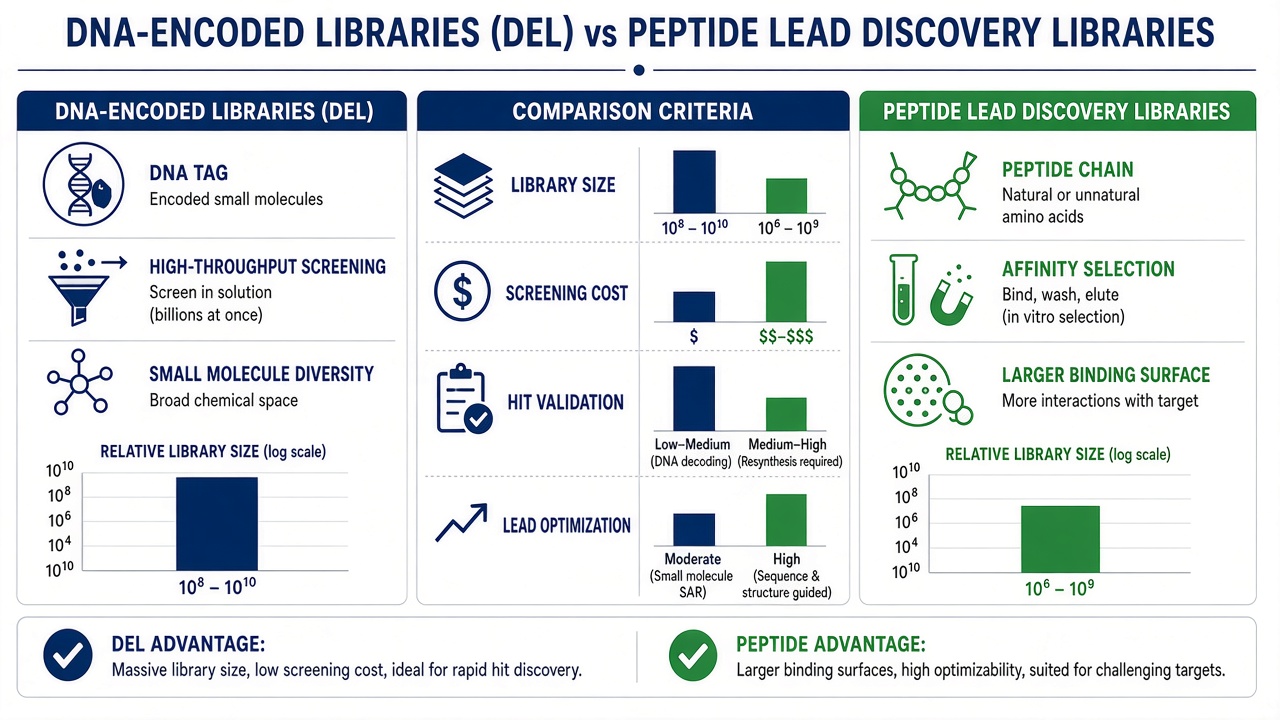
Affinity selection is a core screening method for a peptide lead discovery library. In this workflow, a target protein is immobilized on a solid support, and the library is incubated under controlled buffer conditions. Unbound peptides are washed away, while target-binding peptides are eluted and identified by nanoLC-MS/MS. This label-free approach avoids the need for genetic encoding and directly reports peptide sequence and relative abundance.
Researchers can rank hits by MS signal intensity and validate candidates in secondary binding assays. A detailed protocol for affinity selection and MS deconvolution is available from PubMed. The workflow typically includes target immobilization on beads or plates, library incubation, multiple wash steps with increasing stringency, and elution using low pH or competitive ligand. The eluted fraction is then analyzed by nanoLC-MS/MS, where peptide fragmentation spectra are searched against the library sequence database.

Advantages of nanoLC-MS/MS in peptide lead discovery library screening
One advantage of using nanoLC-MS/MS with a peptide lead discovery library is that no genetic tag or amplification step is required. The method directly reads out peptide masses and fragmentation spectra, enabling de novo sequencing of non-canonical residues. This is particularly useful when screening a synthetic peptide lead discovery library that includes D-amino acids or backbone modifications.
Another advantage is the ability to detect relative binding enrichment across many candidates in a single run. Because nanoLC-MS/MS provides both sequence identification and intensity data, researchers can compare binding levels without synthesizing individual standards. The main limitation is the dynamic range of the mass spectrometer, which may miss very low-abundance binders in a complex mixture.
Troubleshooting affinity selection workflows
Low hit rates often result from insufficient target immobilization or overly stringent wash conditions. Researchers should titrate target density on beads and optimize buffer pH and salt concentration to match physiological binding conditions. Nonspecific binding can be reduced by including a control library of scrambled sequences.
If peptide signals are below the detection limit, pre-fractionation of the eluted pool by high-pH reversed-phase chromatography can improve dynamic range. For synthetic libraries, incorporating an N-terminal biotin tag allows pull-down enrichment before MS analysis, although the tag may alter binding properties.
💡 Key Takeaway: How does affinity selection with nanoLC-MS/MS work for a peptide lead discovery library?
What are ultra-large synthetic peptide libraries for a peptide lead discovery library?
Ultra-large chemical libraries, including peptide lead discovery library formats, extend beyond traditional combinatorial chemistry by using split-and-pool synthesis or one-bead-one-compound (OBOC) methods. A peptide lead discovery library built this way can contain 10^6 to 10^9 distinct sequences on microscopic beads.
Each bead carries multiple copies of a single peptide sequence, enabling direct screening by target binding followed by bead picking and sequencing. The physical size of such libraries is limited by bead handling and encoding capacity, but virtual screening can extend coverage to 10^12 or more analogs.

One-bead-one-compound synthesis for a peptide lead discovery library
OBOC synthesis uses split-and-pool cycles to generate one unique peptide per bead. After each coupling step, beads are split into separate reaction vessels, each receiving a different amino acid. The beads are then pooled and mixed before the next cycle. After n cycles, the library contains 20^n unique sequences, assuming all 20 amino acids are used.
Hit identification from an OBOC peptide lead discovery library typically requires bead picking under a fluorescence microscope, followed by Edman degradation or mass spectrometry sequencing. Researchers often include a coding tag such as a DNA barcode to simplify deconvolution of a synthetic peptide lead discovery library.
How do DNA-encoded libraries (DEL) compare to a peptide lead discovery library?
DNA-encoded libraries use DNA tags to record the synthetic history of each compound, allowing affinity selection and PCR amplification of hits. A peptide lead discovery library, by contrast, may be screened label-free via nanoLC-MS/MS or through display platforms that link peptide to its encoding nucleic acid. Both approaches enable screening of 10^6–10^12 members, but differ in deconvolution speed and chemical diversity.
DEL offers the advantage of massive parallel selection in a single tube, because DNA tags survive affinity capture. However, a peptide lead discovery library built on synthetic beads often includes non-natural amino acids and backbone modifications that cannot be encoded by DNA. Researchers choose between formats based on the target class, desired hit chemistry, and downstream synthesis scale.
Comparison table: DEL vs. peptide lead discovery library
| Feature | DNA-encoded library | Peptide lead discovery library |
|—|—|—|
| Encoding | DNA tag | Optional bead coding or label-free |
| Throughput | Up to 10^12 | Up to 10^9 physical, 10^12 virtual |
| Non-canonical residues | Limited | Supported (D-amino acids, cyclization) |
| Deconvolution | PCR + sequencing | MS/MS or bead picking |
| Chemical diversity | High | High |
Both platforms support hit validation through resynthesis and secondary assays, but a peptide lead discovery library provides direct structure-activity data from MS fragmentation without amplification bias.
How does mRNA display enable iterative peptide lead discovery library screening?
mRNA display covalently links each peptide to its encoding mRNA through a puromycin linker, allowing in vitro selection of 10^12–10^14 variants. This approach supports iterative rounds of affinity selection and PCR amplification, making it a powerful format for a peptide lead discovery library that requires deep sequence exploration.
Each round of selection enriches for target-binding sequences, and error-prone PCR can introduce mutations to explore nearby sequence space. A peptide lead discovery library screened by mRNA display often yields high-affinity binders after three to six rounds. The method is compatible with non-canonical amino acids if the translation system is engineered accordingly.
Compared to phage display, mRNA display avoids bacterial transformation bottlenecks and allows larger library sizes. However, a peptide lead discovery library in mRNA display format requires careful handling of RNA to prevent degradation and ensure covalent linkage fidelity.
💡 Key Takeaway: How does mRNA display enable iterative peptide lead discovery library screening?
Why are cyclic peptide libraries important for a peptide lead discovery library?
Cyclic peptides offer enhanced metabolic stability and conformational rigidity compared to linear peptides. A peptide lead discovery library composed of cyclic peptides can access binding surfaces that are difficult for linear sequences, such as flat protein-protein interaction interfaces. Validated cyclic peptide library hits have been reported against targets including MDM2, 14-3-3, AFP, and SARS-CoV-2 RBD.
Cyclization can be achieved through disulfide bonds, amide bonds, or chemical linkers. A peptide lead discovery library with bicyclic or tricyclic topologies often shows higher target affinity and protease resistance. Researchers should balance ring size and linker flexibility to maintain synthetic feasibility.
For research on related peptide formats, see 1295/7: Essential CJC-1295/7 Research Peptide Guide 2026.

Which peptide lead discovery library formats support hit-to-lead optimization?
Hit-to-lead optimization requires a peptide lead discovery library that allows systematic variation of sequence, length, and chemical modifications. Formats such as positional scanning, alanine scanning, and focused combinatorial libraries are preferred because they provide structure-activity relationship data in parallel.
A peptide lead discovery library designed for optimization often includes N-methylation, PEGylation, or lipidiation sites to tune solubility and half-life. Researchers use the same screening readout as hit identification to rank analog potency, then select leads for scale-up synthesis and ADME profiling.
What are ADME/PK tuning strategies for peptide leads?
ADME/PK tuning for peptide hits focuses on improving oral bioavailability, metabolic stability, and plasma half-life. Common strategies include N-methylation of backbone amides, incorporation of D-amino acids, cyclization, and conjugation to fatty acids or PEG chains. These modifications are introduced during hit-to-lead optimization after initial screening of a peptide library.
Oral bioavailability of peptides is often limited by enzymatic degradation and poor membrane permeability. Researchers use Caco-2 permeability assays and liver microsome stability tests to rank analogs. Structural modifications such as macrocyclization and N-methylation can reduce hydrogen-bond donor count and improve passive diffusion.
- N-methylation: reduces hydrogen bonding, improves permeability.
- Cyclization: constrains conformation, reduces protease cleavage.
- D-amino acid substitution: increases stability against peptidases.
- Lipidiation: increases plasma protein binding and half-life.
- PEGylation: increases hydrodynamic radius, reduces renal clearance.
Scale-up cost control is another factor in ADME/PK tuning. A lead peptide with fewer non-natural amino acids and simpler cyclization chemistry is easier to synthesize at gram scale for in vivo research. Researchers often use convergent synthesis or solid-phase peptide synthesis with optimized coupling reagents.

💡 Key Takeaway: What are ADME/PK tuning strategies for peptide leads?
How to choose the right peptide library for your target?
Choosing a screening library depends on target class, desired hit affinity, and downstream synthesis capabilities. For intracellular protein-protein interactions, cyclic or stapled peptide libraries often perform better. For extracellular targets or proteases, linear libraries with positional scanning can map substrate specificity.
Researchers should consider library size, diversity, and deconvolution method. A one-bead-one-compound library with 10^6 members is practical for bead picking, while an mRNA display library of 10^12 members requires PCR-based selection. Virtual screening can pre-filter a large library before physical synthesis.
Key factors to evaluate:
- Target location (extracellular, membrane, intracellular)
- Binding surface area and topology
- Required metabolic stability
- Available instrumentation (MS, sequencer, flow cytometer)
- Budget and synthesis scale
For sourcing individual research peptides after hit identification, see best places to buy peptides: 7 Proven Vendors for 2026.
What documentation should accompany a peptide library for research use?
A research-grade peptide library should include a certificate of analysis (COA) with purity data, mass spectrometry confirmation, and sequence listing. For synthetic libraries, HPLC purity of each pooled peptide should exceed 90%, and the COA should state residual solvent and TFA content.
For display-based libraries, documentation should include vector maps, round-by-round enrichment data, and sequencing output. Researchers should verify that the library contains no adventitious agents and is suitable for in vitro use only. Storage conditions, typically -20°C lyophilized, should be clearly stated.
Required documentation checklist:
- Certificate of analysis with HPLC purity
- Mass spectrometry data for representative members
- Complete sequence file in FASTA or CSV format
- Storage and stability statement
- Safety data sheet (SDS)
All peptide library products are sold strictly for in vitro laboratory research purposes only, not for human or veterinary use, and not intended to diagnose, treat, cure, or prevent any disease. Must be 21+ to purchase.
How does virtual screening complement a physical peptide library?
Virtual screening of ultra-large peptide libraries uses computational docking or machine learning to rank billions of sequences before synthesis. This approach reduces the cost and time of physical screening by focusing on analogs predicted to bind the target. A virtual library can be built from known hits or from de novo sequence generation.
Machine learning models trained on affinity selection data can predict binding scores for sequences not present in the physical library. Researchers then synthesize a focused sub-library of top-ranked candidates for validation by nanoLC-MS/MS or surface plasmon resonance.
Advantages of virtual pre-screening:
- Reduces synthesis and screening costs by 10- to 100-fold.
- Explores non-natural amino acid space without synthesis constraints.
- Prioritizes analogs with predicted ADME properties.
- Integrates with structure-based docking and pharmacophore models.
Additional resources on computational peptide screening are available from NCBI.
💡 Key Takeaway: How does virtual screening complement a physical peptide library?
FAQ
What is a lead discovery library?
A curated collection of peptide sequences used for high-throughput in vitro screening. It can be synthetic or genetically encoded, with sizes from 10^6 to 10^12 unique members.
How do researchers screen a peptide library?
Common methods include affinity selection coupled with nanoLC-MS/MS, phage display, mRNA display, and DNA-encoded library selection. Each method links phenotype to genotype or directly sequences hits.
What targets are suitable for cyclic peptide libraries?
Cyclic peptide libraries have been validated against protein-protein interaction targets such as MDM2, 14-3-3, AFP, and SARS-CoV-2 RBD, where flat binding surfaces require constrained conformations.
What purity is required for a research peptide library?
Research-grade peptide libraries typically require at least 90% purity by HPLC for each member or pooled fraction, confirmed by COA and mass spectrometry.
Can peptide libraries be used for human or veterinary applications?
No. All peptide library products discussed are for in vitro laboratory research only, not for human or veterinary use, and not intended to diagnose, treat, cure, or prevent any disease.
Topics covered in this article:
Ready to Take the Next Step?
Every product includes lot-specific documentation and third-party purity testing.
Explore Our Research Products →Free shipping on qualifying orders · Batch COA on request